The author is Minamoto no Toshiyori Ason (源俊頼朝臣, 1055 – 1129), “Sir Minamoto no Toshiyori”, who is the son of Tsunenobu (poem 71) and father of Shun’e (poem 85) and was also a leading poet of his era, along with Mototoshi (poem 75). Toshiyori’s talents were not limited to poetry. According to my new book, he excelled at playing an instrument called the hichiriki, enough that he was invited to serve in the Imperial court under Emperor Horikawa. We went on to serve three Emperors in this capacity, and helped compile the unusually eclectic Imperial Anthology the Kinyō Wakashū, as well as many poems of his own in various anthologies.
The poem above was actually composed during a poetry contest held at the residence of Fujiwara no Toshitada, grandfather of Fujiwara no Teika (poem 97) who compiled the Hyakunin Isshu. The topic of the contest was “unfulfilled love so strong that one even prays to the gods”. The poem expresses frustration after having prayed to be able to meet a certain woman, and somehow she became even more resistant. As Professor Mostow explains, Teika valued this poem very highly because of its depth of feeling, excellent word choices, and clever story-telling (see below).
The name “Hatsuse Temple” is another name for a famous Buddhist temple in Nara, Japan called Hasedera. Hasedera is very well-known in Japan, and apparently was a frequent pilgrimage site for lovers and those with romantic interests. If you ever do happen to be in Japan, especially in the Nara area, I’d highly recommend visiting Hasedera temple.
This poem is listed as a “winter” poem, but I was really confused why this is since the topic sounds more like unrequited love. I checked my source, which explains that Toshiyori went up to Hatsuse Temple to pray, and then came back down (yama-oroshi, 山おろし) in the third verse. This symbolism of coming back down the mountain is evidentially considered a powerful symbol of winter. Perhaps this relates to New Year’s prayers and such. This third verse is also a neat dividing technique between the first half, praying at the temple, and the second half, the girl he was fond of despising him even more.
The author, known as Suō no Naishi (周防内侍, dates unknown), the “Suō Handmaid”, was so named because her father was governor Suō Province. As mentioned before, this was a common method used by female authors (cf. poem 65), so unfortunately, their real names are rarely known. This is another poem that speaks to the importance of a woman’s reputation in the ancient Court of Japan, just like poem 65. However, this one is much more playful and shows a lot of wit.
According to the back-story, there was a social gathering at the Nijō-In (二条院), the woman’s quarters at the palace. The woman there were relaxing, and the author of this poem said, “I wish I had a pillow”. At that moment, one Fujiwara no Tada’ie happen to walk by, and hearing this stuck his arm through the bamboo screen (御簾, misu) and said, “Here, takes this as your pillow!”.
In reply, the author composed this poem. As Professor Mostow points out, the word for arm here (kaina) is a pun for pointless (kainaku).
People flirted pretty clever back in those days. 😏
The poem was composed by Sakyō Daibu Michimasa (左京大夫道雅, 993 – 1054) who title means “Master of the Western Capital Michimasa”. He also known by his personal name as Fujiwara no Michimasa.
Michimasa was the son of Fujiwara no Korechika, and Michimasa’s grandmother wrote poem 54. Despite their power and influence, Michimasa’s family was on the losing side of a struggle with a rival clan faction, led by his great-uncle Fujiwara no Michinaga. Michimasa. According to Mostow, Michimasa spent the remainder of his life in “elegant retirement” after their family lost the power struggle.
According to Mostow, the story behind this poem was a famous affair involving Michimasa and the former High Priestess of the Ise Shrine, Masako Naishinnō (当子内親王, “Princess Masako”). My new book explains that Michimasa was 24 at the time and she was 15, and had just returned to the capitol after fulfilling her duties as the high priestess. More on that below.
This affair is described in the Eiga Monogatari, an important historical source at the time, possibly composed by Akazome Emon (poem 55).
In any case, news of the affair angered her father, the Retired Emperor Sanjo (poem 68) and the retired emperor subsequently assigned bodyguards to her to prevent Michimasa from seeing her again. As you can see, Michimasa is lamenting that he can’t even say a proper goodbye to her in person anymore. Princess Masako eventually took tonsure as a Buddhist nun, and soon after died due to illness. They never met again.
But there is a bit more to the story. Michimasa, like his father Korechika, had a bad reputation that dogged him throughout his life, and kept him shut of out any official posts in the government. With the loss of Masako, and no hope of success in society, Michimasa took a dramatic turn for the worse. My new book explains that Michimasa fell headlong into gambling, and violence, so much so that he earned the nicknames such as Arasanmi (荒三位, “Wild third rank”) and Akusanmi (悪三位, “evil third rank”). The “third rank” was his aristocratic rank in the Imperial court.
Worse still, Michimasa was implicated in the murder of Emperor Kazan’s daughter in 1024 in the dread Jotomon-in Incident (上東門院女房殺害事件, jōtōmon-in nyōbō satsugai jiken). The murderer confessed to killing her on Michimasa’s orders. Yikes.
Michimasa was finally demoted and in his final years took tonsure as a Buddhist monk, and faded from history.
Let’s talk about Princess Masako’s role of High Priestess, though.
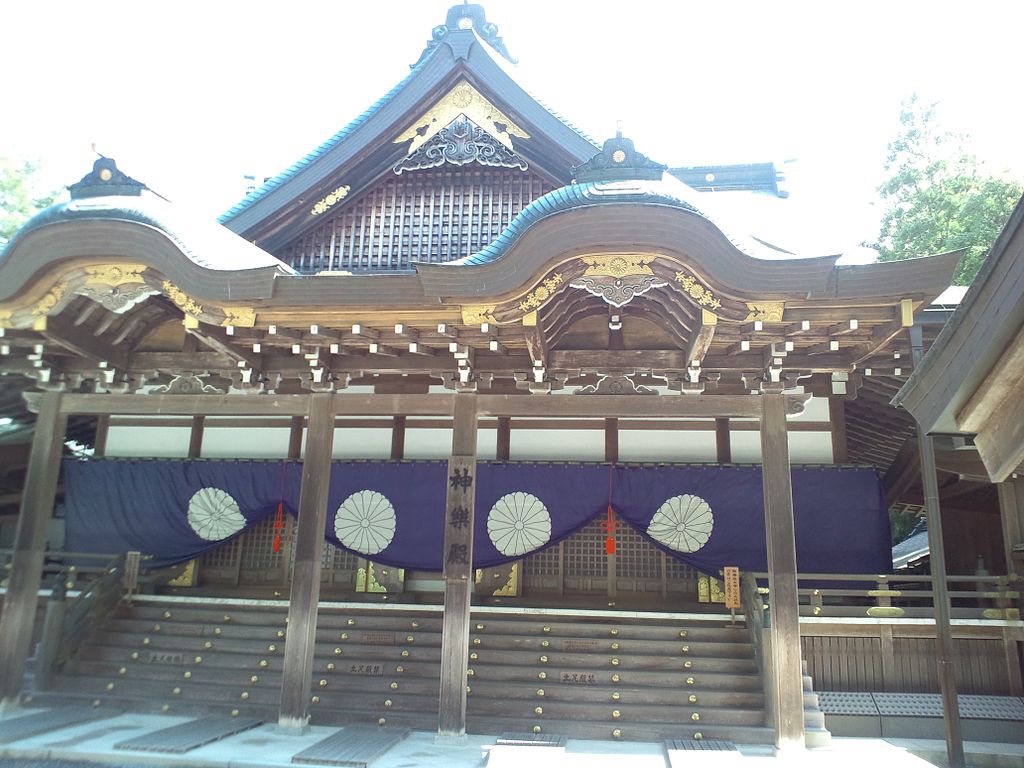
The Ise Grand Shrine is probably one of the most sacred, if not the most sacred, in all of Japanese Shinto religion. The featured photo above shows the inner sanctum (photo by Yanajin33, CC BY-SA 3.0, via Wikimedia Commons).
Due to shrine’s connection with the Imperial Family, who were said to be descended from its primary deity, Amaterasu Omi-no-Kami, the Imperial Family always had one member serving as the High Priestess or saiin (斎院). Usually this was the reigning Emperor’s daughter, and when that Emperor stepped down, she would return to the capitol. This tradition still continues to this day, even with the modern Imperial family. Another example within the Hyakunin Isshu is Shokushi Naishinnō (poem 89).
In those days, the High Priestess was a vestal virgin, similar to the ancient priestesses of Rome, and was supposed to remain so during her tenure. However, as other writings of the time showed, such women still corresponded with men from time to time and kept a social circle of women around them. Lady Murasaki (poem 57) lamented in her diary about the rival social circle around the High Priestess at the time outshining the Court itself.
Nevertheless, the life of High Priestess was very demanding and required strict ritual purity, part of Shinto religion. One could not come into the presence of the gods, particularly at more sacred sites, without it. Thus, Princess Masako’s affair with the dubious Michimasa apparently went too far and Emperor Sanjo’s reaction was quite harsh.
The tragic story of Fujiwara no Michimasa and Princess Masako, encapsulated in this short poem, is a complex and dark tale. Michimasa was in a sense doomed from the start due to his family’s loss of grace and dubious reputation. Princess Masako, being a teen and cloistered in the Imperial family duties probably didn’t know better. Their romance was doomed from the start, but the evil turn by Michimasa only makes the story sadder. What if Michimasa had been able to continue his romance with Masako, or maybe wasn’t shunned by society in his youth? What might the two have become? What if they had simply never met?
The author, Minamoto no Shigeyuki (源重之, ? – 1001) was a well-associated poet who knew Kanemori (poem 40) and Sanekata (poem 51) according to Mostow. He is the last of the Thirty Six Immortals of Poetry featured in the blog (not all 36 are in the Hyakunin Isshu).
The poem, like poem 45 and poem 19, features the popular theme of a cold lover. For some reason, I had a difficult time understanding the analogy of this poem the first time, but Shigeyuki is comparing himself to the waves that crash on the shore. His lover is like the rocks that are unmoved by the waves.
It turns out though that this poem was actually composed for a poetry game involving a hundred-poem sequence “when Retired Emperor Reizei was still called the crown prince” according to Mostow. Such poetry games were popular in the late Heian Period, and influenced people like Fujiwara no Teika and the Hyakunin Isshu anthology.
This poem was composed not by a woman as one would expect, but by a Buddhist priest named Sosei Hōshi (素性法師, dates unknown), or “Dharma Master Sosei”. He was the son of Henjō (poem 12, あまつ) before Henjō took tonsure. In fact, when Henjō did become a monk, Sosei was obligated to do the same.
Nonetheless, Sosei kept busy. He worked in the Imperial Court and was a priest, and a prolific and popular poet. He kept a salon of fellow poets including Ki no Tsurayuki (poem 35, ひさ) and Oshikochi no Mitsune (poem 29, こころあ). Both men were tasked with compiling the imperial anthology, the Kokin Wakashū, and Mostow points out Sosei is heavily represented in there. Coincidence? My new book suggests not. To his credit, Sosei is also one of the Thirty-Six Immortals of Poetry.
As we’ve seen with other poems from this earlier era, it was common to write about poetry themes, and to write from a role outside one’s own. So, for a monastic to be writing from the perspective of a lonely woman wasn’t unusual.
This poem is interesting because it seems to happen in one night, or a long period of time. It is a mystery. Mostow explains the contradiction in this poem between the “one long night” and “months” as being an issue of interpretation. Though most people assumed it was a long Autumn night, Fujiwara no Teika (poem 97, こぬ), the compiler of the Hyakunin Isshu anthology, felt it was more like a long passage of time.
P.S. Photo above is a Japanese calendar we have a home. More on that in a related post in my other blog.
The author, Akazome Emon (赤染衛門, 958? – 1041?), was another court lady in waiting for Empress Shoshi, along with Lady Murasaki (poem 57) and Lady Izumi (poem 56). Although her father is officially Akazome no Tokimochi, it is theorized that her father was actually Taira no Kanemori (poem 40) due to an affair by her mother.
Akazome Emon has an impressive 93 poems in the Shūishū Imperial anthology, and composed at least part of the Eiga Monogatari another classic from the era.
While Lady Murasaki had harsh words for some of her associates, according to Mostow, she describes Akazome Emon as having “great poise” and takes her poetry seriously, without composing verses just for the fun of it. Indeed, Lady Murasaki states she is “most accomplished”.
My new book also mentions that Akazome Emon was liked by the other ladies in waiting, and even by rival cliques including Sei Shonagon (poem 62) whom she corresponded with. It is even said she was happily married to her husband Oe no Masahira (大江匡衡), a rare thing in a world of political marriages.
The poem above itself is a bit of a mystery though. The headnote to the poem is explained as Akazome Emon writing a poem on behalf of her sister who waited all night for her lover, Middle Regent Michitaka, but was stood up. Michitaka was an extremely powerful and charming man in his day and likely had multiple lovers even as he maintained his legitimate marriage to Takashina no Takako (aka Gidōsanshi no Haha, poem 54). Akazome writing this poetic complaint on behalf of her jilted sister was an increasingly common practice at the time.
As explained before, women lived sheltered lives in his era, and men rarely could see them except by secret arranged meetings, and yet sometimes a women might wait all night without her lover ever coming. This is a frequent topic in the Hyakunin Isshu anthology as well, both real and fictional.
However what makes this poem standout is that Akazome Emon complained to Michitaka in a sweet, unaccusing way, when she obviously meant the opposite. “Oh, it’s no big deal I stayed up all night waiting for you, I saw the full moon tonight. No big deal.”
There is some research that suggests that maybe Akazome didn’t author the poem, though it’s unclear who did. Nevertheless, whoever was stood up that night, I hope Michitaka apologised the next day. 😏
The poet Ise (伊勢, c. 875- c. 938), or “Lady Ise” in English, is another celebrated female poet from antiquity. Her sobriquet comes from her father’s position as governor of the prosperous Ise Province, but she earned a name for herself through her extensive poetry both in her private collection, the Ise Shū, and through Imperial anthologies where her poetry is both frequent and prominent.
As Professor Mostow explains, the poem has two possible interpretations: one where she has been spurned by a cold lover, and the other where she cannot reveal her hidden love.
Naniwa Inlet is the bay of what is now the famous city of Osaka, though back then it was a far smaller city, with many waterways, streams and such. Naniwa (Osaka) is often associated with reeds at the time as other poems of the time show, and is mentioned in two other poems in the Hyakunin Isshu (poem 20 and poem 88).




 The Hyakunin Isshu


