I have been quietly doing a number of updates to existing blog content. This includes fixing some inconsistent formatting, and fixing broken or outdated links. Tags and categories were cleaned up and standardized as well. This was long overdue.
In addition, all references to Amazon.com have been removed.
Finally, it’s that time again: cherry blossom season. It is still a bit early where I live, but if you are planning to view cherry blossoms (ohanami, お花見), then feel free use my handy guide.
Thanks everyone and happy spring to readers in the Northern Hemisphere!
This was a particularly nice poem that I found in the Manyoshu heralding early Spring.
Original Manyogana
Japanese
Romanization
Rough Translation
石激
石走る
Iwa bashiru
Are not
垂見之上乃
垂水の上の
Tarumi no ue no
the bracken buds
左和良妣乃
さわらびの
Sawarabi no
sprouting next to a
毛要出春尓
萌え出づる春に
Moe-izuru haru ni
waterfall
成来鴨
なりにけるかも
Narinikeru kamo
the first sign of Spring?
This poem was composed by Shiki no Miko or Prince Shiki (志貴皇子, ? – 716), who was the seventh son of Emperor Tenji (poem 1 in the Hyakunin Isshu). Unlike his siblings who were embroiled in the political strife of the times, Prince Shiki retreated and focused on poetry instead. His talents with poetry earned him a place in the Manyoshu, and Japanese poetic history.
Ironically, despite staying out of succession struggles, Prince Shiki’s own son, Prince Shirakabe later ascended the throne as Emperor Kōnin despite not being the dominant line, and all subsequent emperors in Japan are descended from him. So, in the end, Prince Shiki won afterall.
The poem itself evokes a truly wonderful image of a tiny sprout peeking through the rocks by a riverbank, heralding the first signs of spring.
Note that in the traditional Japanese calendar, based off the Chinese model, Spring started much later than the modern meteorological Spring, namely at the start of the second lunar month. Hence, the holiday of Setsubun relates to the start of Spring, and helps conclude the Lunar New Year. Plum blossoms are also frequently associated with this time of year since they bloom earlier than cherry blossoms, and were highly prized by poets of Manyoshu, as we can see in this poem (also posted here):
Ever since I picked up this book which explores the Pillow Book of Sei Shonagon (poem 62 of the Hyakunin Isshu, よを), it’s been fun to learn many of the hidden meanings and cultural allusions of this famous literary work.
It’s also fun to see how the Pillow Book is viewed by Japanese students in Japan. I talked with my wife and her friends about it, and they confirmed that kids in Japan study the Pillow Book in school, but like all students everywhere, they tend to forget most of it.1 My book jokes that most students in Japan only remember the very first line: haru wa akebono.
I bring this up because with the recent changing of the weather, I’ve been thinking a lot about seasons, especially after writing this post. So, I went back and looked at the first chapter of the Pillow Book.
The opening section begins with Sei Shonagon’s analysis of the four seasons, and what’s great about each one. This website posts the original text in Japanese (tl;dr it’s fairly different than modern Japanese) and even has a nice recording. It’s worth a listen, even if archaic Japanese is not your hobby.
Separately, if you want to hear how it was pronounced at the time you can see this video (00:47 onward):
Anyhow, let’s look at how Sei Shonagon describes each of the four seasons, starting with Spring…
Natsu wa yoru. Tsuki no koro wa sarinari. Yami mo nao, hotaru no ooku tobichigaitaru. Mata, tada hitsotsu futatsu nado, honoka ni uchi hikarite iku mo, okashi. Ame nado furu mo, okashi.
“In summer, the night — moonlight nights, of course, but also as the dark of the moon, it’s beautiful when fireflies are dancing everywhere in a mazy flight. And it’s delightful too to see just one or two fly through the darkness, glowing softly. Rain falling on a summer night is also lovely.”
Aki wa yuugure. Yuuhi no sashite, yama no hai to chikau nari taru ni, karasu no nedokoro e ikutote, mitsu, yotsu, futatsu mitsu nado, tobiisogu sae awarenari. Maite, kari nado no tsuranetaru ga, ito chiisaku miyuru wa, itokashi. Hiirihatete, kaze no oto, mushi no ne nado, hata, iiubeki ni arazu.
“In autumn, the evening — the blazing sun has sunk very close to the mountain rim, and now even the crows, in threes and fours or twos and threes, hurrying to their roost, are a moving sight. Still more enchanting is the sight of a string of wild geese in the distant sky, very tiny. And oh how inexpressible, when the sun has sunk, to hear in the growing darkness the wind, and the song of autumn insects.”
Fuyu wa tsutomete. Yuki no furitaru wa, iubeki ni mo arazu. Shimo no ito shiroki mo. Mata sara demo, itso samuki ni, hi nado isogi okoshite, sumi motewataru mo, ito tsukizuki shi. Hiru ni narite, nurukuyurubi moteikeba, hioke no hi mo, shiroki hai ga chininarite, waroshi.
“In winter, the early morning — if snow is falling, of course, it’s unutterably delightful, but it’s perfect too if there’s a pure white frost, or even just when it’s very cold, and they hasten to build up the fires in the braziers and carry fresh charcoal. But it’s unpleasant, as the day draws on and the air grows warmer, how the brazier fire dies down to white ash.”
As someone who likes to “nerd out” about such things, I try to shorten this to the following for easier memorization:
Spring: haru wa akebono (spring daybreak)
Summer: natsu wa yoru (summer nights)
Fall: aki wa yuugure (fall sunsets)
Winter: huyu wa tsutomete (early winter morning)
… and now you too know some authentic Japanese literature from the Heian Period.
1 Despite being a nerd now, I was actually a pretty lazy student in school. I was assigned to read various English classics like Ivanhoe, Treasure Island, etc, but usually didn’t read them, and faked my way through exams and such. My grades were mostly C’s and even some D’s. In high school, I finally took an interest in reading after picking up J.R.R. Tolkein’s Fellowship of the Ring, and have loved reading since. Looking back, I suppose a chaotic home life, and also just lack of structure and inspiration were to blame.
As fall is approaching, I wanted to share an interesting anecdote provided by my book on the Manyoshu. It seems that throughout Japanese antiquity, poets frequently debated which is better: spring or fall.
The first example comes from Princess Nukata in the 7th century, whom we discussed here and here, she wrote a lengthy poem (a chōka poem, not the usual tanka poem) in the Manyoshu (poem 16). She discusses the pros and cons of spring and of fall:
Original Manyogana1
Japanese
Romanization
Rough Translation2
冬木成 春去來者
冬ごもり 春さり來れば
Fuyu gomori haru sari kureba
When winter passes and spring comes
不喧有之 鳥毛来鳴奴
鳴かざりし鳥も來鳴きぬ
Nakazarishi tori mo nakinu
Birds that didn’t sing before, now come and sing
不開有之 花毛佐家礼抒 山乎茂
咲かざりし 花も咲けれど 山を茂み
Sakazarishi hana mo sakeredo yama wo shigemi
Flowers that didn’t bloom before now bloom, but because the mountains grass is so thick
入而毛不取 草深 執手母不見
入りても取らず 草深み 取り手も見ず
Irite mo torazu kusabukami torite me mizu
One cannot go and pick flowers, let alone see them.
秋山乃 木葉乎見而者
秋山の 木の葉を見ては
Aki yama no ko no ba wo mite wa
When you look at the leaves in the mountains during fall,
黄葉乎婆 取而曾思努布
黄葉をば 取りてそしのふ
Momiji wo ba torite soshi no fu
collecting the yellow leaves is especially prized.
青乎者 置而曾歎久
青きをば 置きてそ歎く
Aoki wo ba okite so nageku
Leaving the green leaves as they are is regrettable.
曾許之恨之 秋山吾者
そこし恨めし 秋山われは
Sokoshi urameshi akiyama ware wa
In spite of that, autumn in the mountains is spectacular…
a – I am heavily indebted to this site for both the original text. Translation is based in part on that site, but also my Manyoshu book, but probably lots of mistakes. Translating a five-line poem in archaic Japanese is hard enough… 😅
Speaking of the Manyoshu, its compiler Otomo no Yakamochi (poem 6 of the Hyakunin Isshu, かさ) left us some very nice poetry about spring:
Original Manyogana1
Japanese
Romanization
Rough Translation2
春苑
春の苑
Haru no sono
Beneath
紅尓保布
紅にほふ
Kurenai ni hofu
the shining crimson
桃花
桃の花
Momo no hana
orchard of
下照道尓
下照る道に
Shita deru michi ni
peach blossoms
出立オ嬬
出で立つ少女
Idetatsu otome
a young maiden lingers.
Poem 4139, book 19
and about fall:
Original Manyogana1
Japanese
Romanization
Rough Translation2
秋去者
秋さらば
Aki saraba
When fall comes
見乍思跡
見つつ思へと
Mitsutsu shinoe to
think fondly of those
妹之殖之
妹が植ゑし
Imo ga ue shi
pink blossoms
屋前乃石竹
やどのなでしこ
Yado no nadeshiko
of days gone by
開家流香聞
咲きにけるかも
Saki ni keru kamo
and remember me.
Poem 464, book 3
Otomo no Yakamochi wrote both of these poems about his beloved wife, but the second was composed shortly after her parting. The word nadeshiko has special meaning in Japan and has a very feminine, demure3 meaning.
Returning to the debate between spring and fall, Ki no Tsurayuki (poem 35 of the Hyakunin Isshu, ひとは) took up the same topic centuries later. This is poem 509 from an imperial anthology, the Shuishu :
Japanese
Romanization
Rough Translation2
春秋に
Haru aki ni
Spring or Fall?
おもひみたれて
Omoi mitarete
My thoughts are a mess,
わきかねつ
Waki kanetsu
and I cannot decide.
時につけつつ
Toki ni tsuketsutsu
The more time passes,
うつるこころは
Utsuru kokoro wa
the more my heart shifts back and forth.
1 This is a rough translation, all mistakes are my own.
The debate was even cited in the famous 12th century novel Tales of Genji written by Lady Murasaki (poem 57 of the Hyakunin Isshu, め):
“Since antiquity, in the debate about spring versus fall, many people lean toward fall, and yet some very noteworthy people who view the Imperial gardens in spring may yet change their mind, as is the way of the world.”
Princess Nukata all the way back in the Manyoshu seemed to imply that autumn was preferable, and it seems that most of the aristocracy shared this view. In fact if we divide up the poems of the Hyakunin Isshu by season, there are more fall poems than spring:
Note: summer only has 4 poems, winter has 9 (same as spring).
But what do you think? Are you Team Spring, or Team Fall?
Edit: added Hyakunin Isshu poetry chart.
1 If you’re wondering why I post Manyogana for some poems, but not others, it depends on the era. The Manyoshu is the oldest anthology by far, and at that time, there was a brief writing system that took Chinese characters, but used them in a phonetic way for Japanese language (a.k.a. Manyogana). By the time of Ki no Tsurayuki and Lady Murasaki, centuries later, this had been replaced with hiragana script. This blog strives to both be accurate and accessible, so I try to balance both needs.
2 These are all rough translations on my part, and likely have mistakes. Any such mistakes are entirely my own.
3 Not to be confused with the “very demure, very mindful” meme. 😛
Waka poetry, including the Hyakunin Isshu has a lot of conventions and symbols used to express certain seasons or sentiments. This is not so unusual. For example, if someone in the US writes a poem about the smell of cinnamon, it definitely brings to mind late autumn or winter.
One common example in the Hyakunin Isshu of poetic symbolism are birds. Birds have distinctive calls, and different species tend to be prominent at different times of year, among other things. For this post, I included a lot of poetry from the Imperial anthology, the Kokin Wakashu, which is much larger than the 100 poems of the Hyakunin Isshu, and thus easier to find examples.
Spring
The most prominent bird in Spring is the uguisu, the Japanese Bush Warbler, also called the Japanese Mountain Thrush:
The uguisu’s distinctive bird call is very emblematic of the season.
The bird call of the uguisu sounds like ho-ho-ke-kyo, which to Japanese people sounds similar to a famous Buddhist text called the Lotus Sutra (hokekyo in Japanese). I’ve written much about the Lotus Sutra in my other blog, so I do not need to repeat here. Needless to say, when Spring comes, people in Japan inevitably hear this lovely sound, even in urban areas.
Oddly, there are no poems in the Hyakunin Isshu about the uguisu, however, I found many poems in the official anthology, the Kokin Wakashu. Here are a few of my favorites thus far. This first one is poem 4 by Fujiwara no Takako (藤原高子; 842–910) later Nijo-kisaki (二条后, “Nijō Consort”):
Apparently, the bird was highly praised during the aristocratic court culture of the Heian Period, and Sei Shonagon (poem 62) mentions an expedition in her Pillow Book:
[94] …it had been overcast and tending to rain since the first day of the [fifth] month. Some of us were sitting about at a loose end, when I came up with the suggestion that it would be fun to go off on an expedition to hear the hototogisu….
[ later ] … and as for the hototogisu, they were indeed calling back and forth, so loudly in fact that they made almost too much of a din for comfort.
Translation by Dr Meredith McKinney
The anecdote is quite long, but Sei Shonagon and the other ladies-in-waiting do encounter the hototogisu, and meant to write poetry about them, but then through a series of interactions forgot the poetry entirely and came back to the Empress empty handed, followed by various witty comments back and forth.
Autumn
Unlike the Spring, where the call of the bird is highly praised in poetry, in the Autumn, theHyakunin Isshu Daijiten lists a few birds that were revered in poetry. For example, migratory birds, such as the Wild Goose (kari):
I had some trouble finding poems for the fall birds listed in either the Hyakunin Isshu or the Kokin Wakashuanthology, but there seems to be a lot in the later Shin-Kokin Wakashu anthology. I don’t have a reliable translation of the Shin-Kokin Wakashu, so I may update later.
I did find this poem under the section “Miscellany 2” in the Kokin Wakashu, poem 497 by an anonymous poet:
The birds associated with winter, were birds whose cries were melancholy and said. First and foremost is the plover, which we saw in poem 78 (あわじ) of the Hyakunin Isshu:
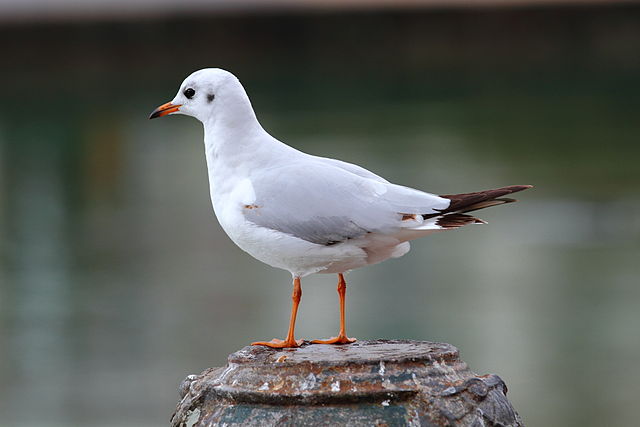
Or the Black-headed Gull (miyako-dori, meaning “bird of the capital”):
The miyakodori in particular stood out due to its unusual name. The Hyakunin Isshu Daijiten lists a poem from the official Kokin Wakashu anthology of note, poem 411 under the section “Travel Poems”:
The headline for this poem explaining the backstory is unusually long, but basically the poet, Ariwara no Narihira (who also wrote poem 17, ちはやふる, in the Hyakunin Isshu) was away in eastern Japan with some companions, and longing for home in the capital, they saw a miyako-dori bird (lit. “capital bird”) and recited this poem.
The Mallard in particular had dual-association with romance and with the melancholy of winter. This poem in the Kokin Wakashu, number 533, by an anonymous author illustrates this:
Certain birds were also used in Japanese poetry for symbolic purposes, but not necessarily for seasonal expression.
We’ve talked about birds associated with seasons thus far, but there’s a couple worth calling out that are an important part of Japanese poetry, but not related to seasons. The first is the Copper Pheasant, called yamadori, which we saw in poem 3 of the Hyakunin Isshu (あしびきの).
In antiquity, it was thought that Copper Pheasants mated for life (true), but slept in separate nests at night. Thus, the poet Kakinomoto no Hitomaro likened himself to a Copper Pheasant sleeping alone at night part from his lover.
And finally we come to the magpie. In poem 6 of the Hyakunin Isshu (かさ), the poet Chūnagon Yakamochi describes frost growing under moonlight on the so-called Magpie Bridge of the Imperial Palace. The magpie (kasasagi) was associated with a Chinese myth that evolved into the Qīxī Festival (七夕), celebrated as Tanabata in Japan.
In this tale, two star-crossed lovers, a celestial princess and a cowherd, were forcibly separated in the heavens by her father the Jade Emperor, but allowed to reunite one night a year. It was said they would reunite by crossing a bridge made of magpie birds who put their outstretched wings together. Thus, the magpie was always associated with this famous tale.
As spring approaches, people eagerly anticipate when cherry blossoms (sakura in Japanese, 桜), but as I have learned recently in my book, the Hyakunin Isshu Daijiten, there are many types of sakura, some of them even referenced in the Hyakunin Isshu. Let’s explore a few and learn how to spot one versus another.
If you’re curious about how to even spot a cherry tree, my alma mater has a nice video introduction from the Pandemic era on spotting various trees in your own neighborhood:
A Brief History Lesson of Cherry Blossoms
Cherry blossoms have been a part of Japanese culture for a very long time, but were not always revered as they are now. In antiquity, the plum blossom, imported from China, were more highly revered as one can see in the Manyoshu, but over the centuries the roles reversed. The tradition of outings to view cherry blossoms is credited to Empress Jitō (poem 2). Nowadays, this tradition continues as ohanami (お花見), and can be a fun outing with friends and family or co-workers. In places like Ueno Park in Tokyo, the grounds are crowded with picnic blankets, visitors, and plenty of food and saké to go around.
The most famous, most iconic poem about cherry blossoms was composed by Ariwara no Narihara (who also wrote poem 17):
Japanese
Romanization
Translation
世の中に
Yo no naka ni
If in all the world
絶えて桜の
Taete sakura no
there were of cherry blossoms
なかりせば
Kanariseba
no trace anywhere
春の心は
Haru no kokoro wa
ah, how truly peaceful then
のどけからまし
Nodokekaramashi
spring would be for everyone!
Translation by Dr Josha Mostow and Dr Royall Tyler from the Ise Stories, the poem is also number 53 in the Kokin Wakashū.
Varieties of Cherry Blossoms
Big thanks to this site for providing additional references. I also relied on some details from the Hyakunin Isshu Daijiten book I’ve used for the blog.
Yoshino Cherry
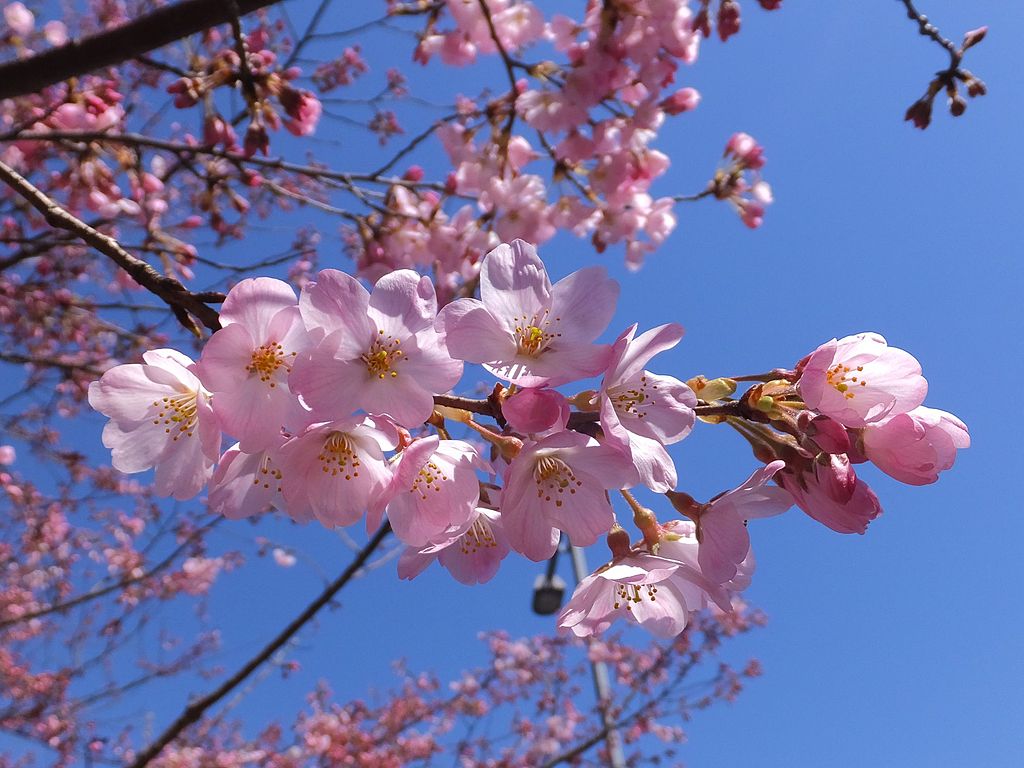
The most common, most well-known type are the Somei Yoshino (ソメイヨシノ) or “Yoshino Cherry” in English:
(Photo by Tak1701d, Public domain, via Wikimedia Commons)
This is a relatively recent variety that was bred for gardening, then gained popularity abroad. It is named after the famous village of Yoshino. For many, this is the classic “cherry blossom” and the one you’re most likely to see outside of Japan.
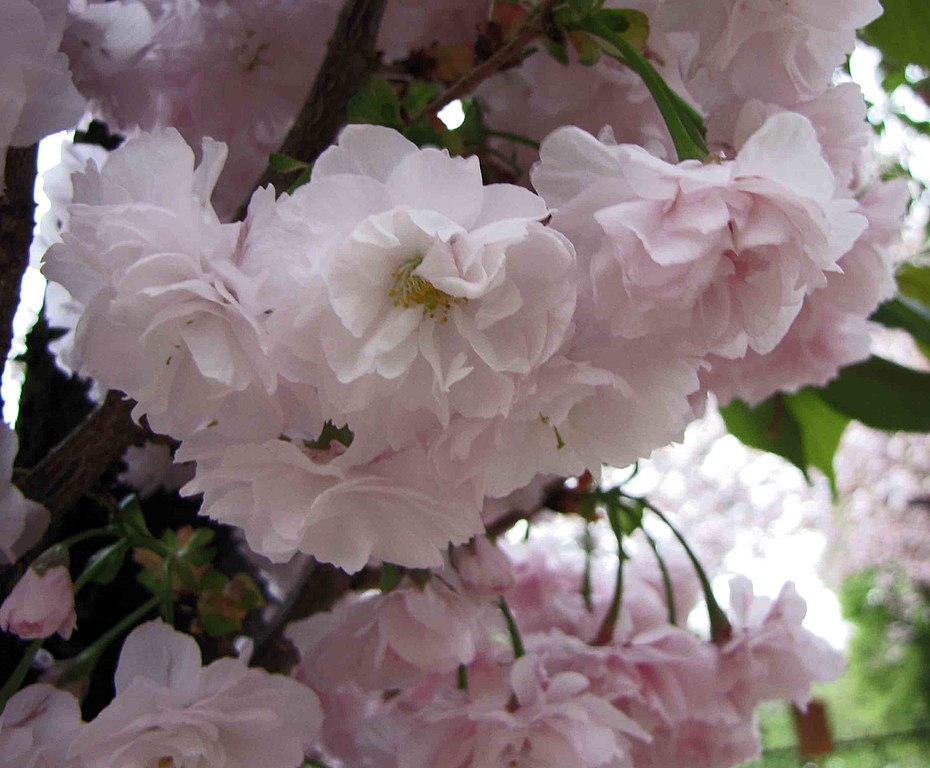
The term yae (八重) means something like “eight layers” or “eight levels”, which helps describe it’s thicker, multi-layered blossoms. It is also the subject of poem 61.
To be honest, yae-zakura are my personal favorite.
Kanzan Cherry
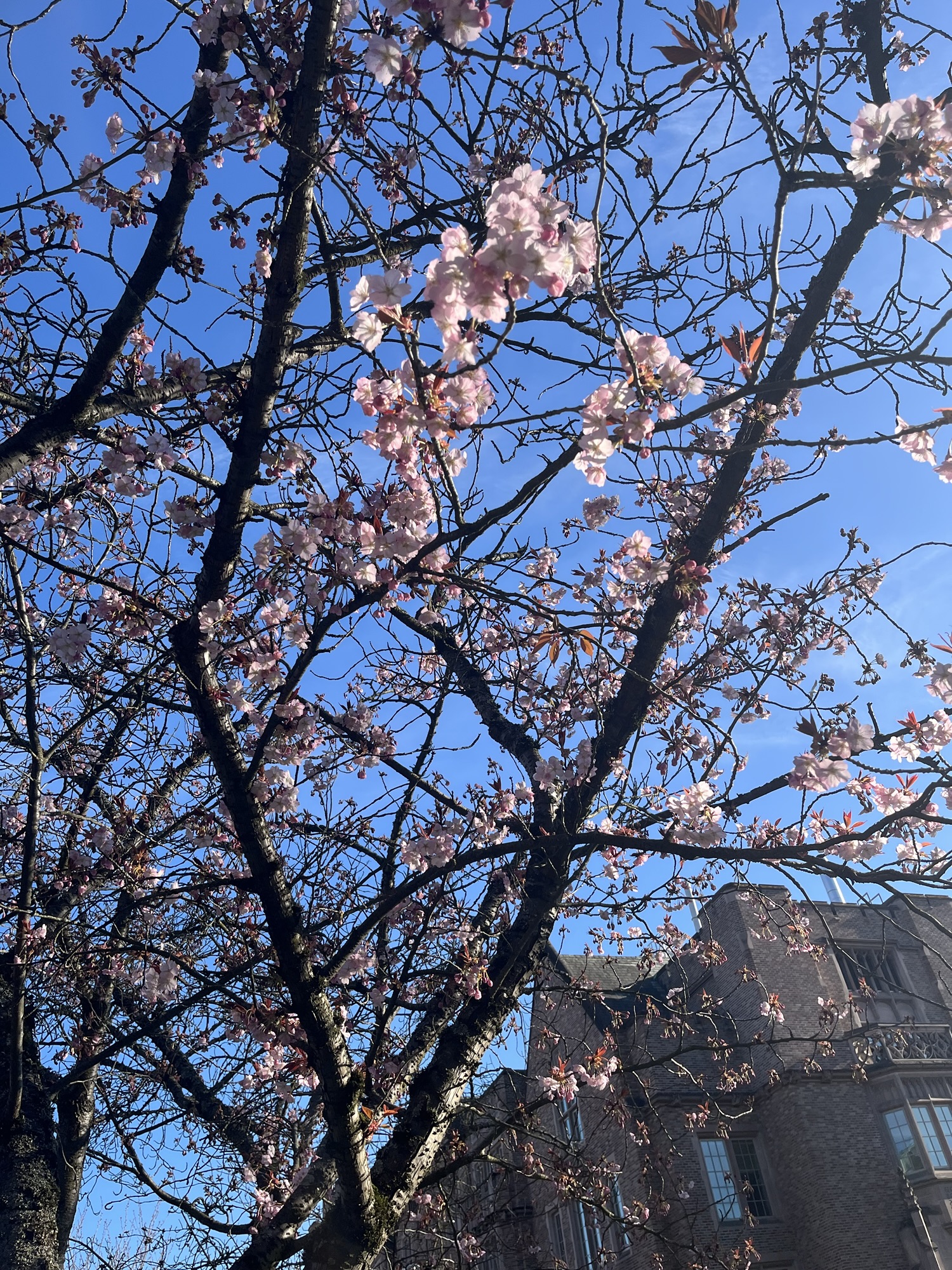
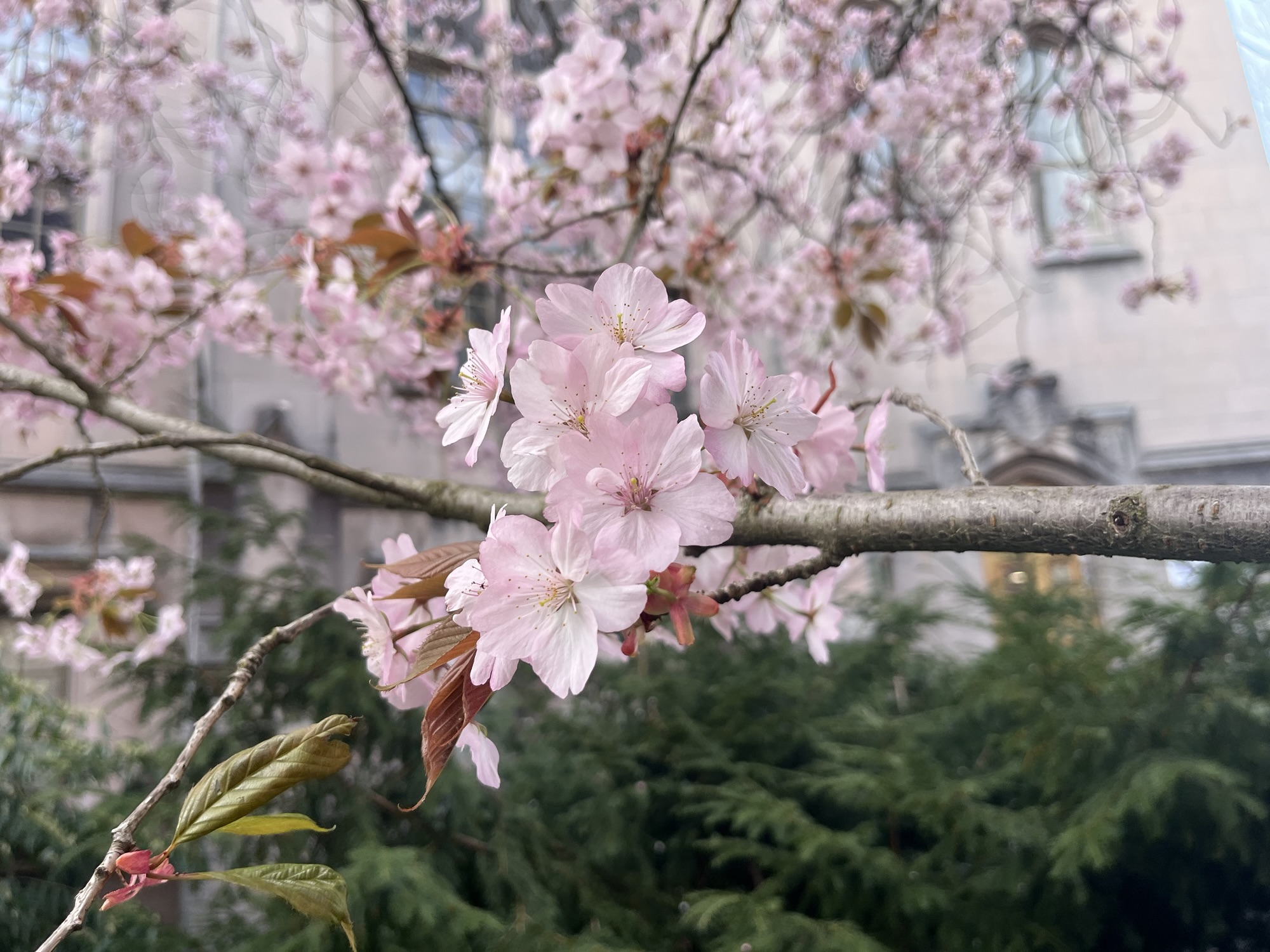
A popular variety that I only learned about recently is a hybrid variety called the kanzan (カンザン, sometimes archaically spelled Kwanzan). I didn’t find this one online at first, but was able to take a photo during a recent visit to the University of Washington.
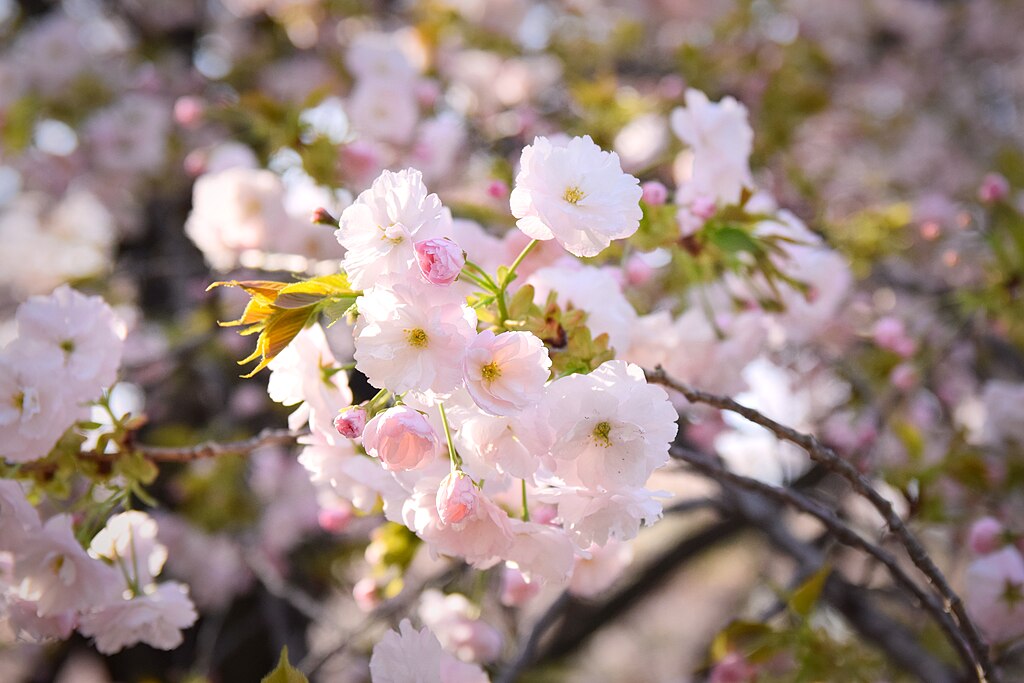
This variety was, similar to the Yoshino, a relatively recent variety, and a result of hybrid breeding with Ōshima cherry. What makes this one interesting is the both the rich pink color, and the multiple layers of blossoms (similar to the Kasumi cherry below).
Fugenzo Cherry
Taken at the University of Washington in 2026
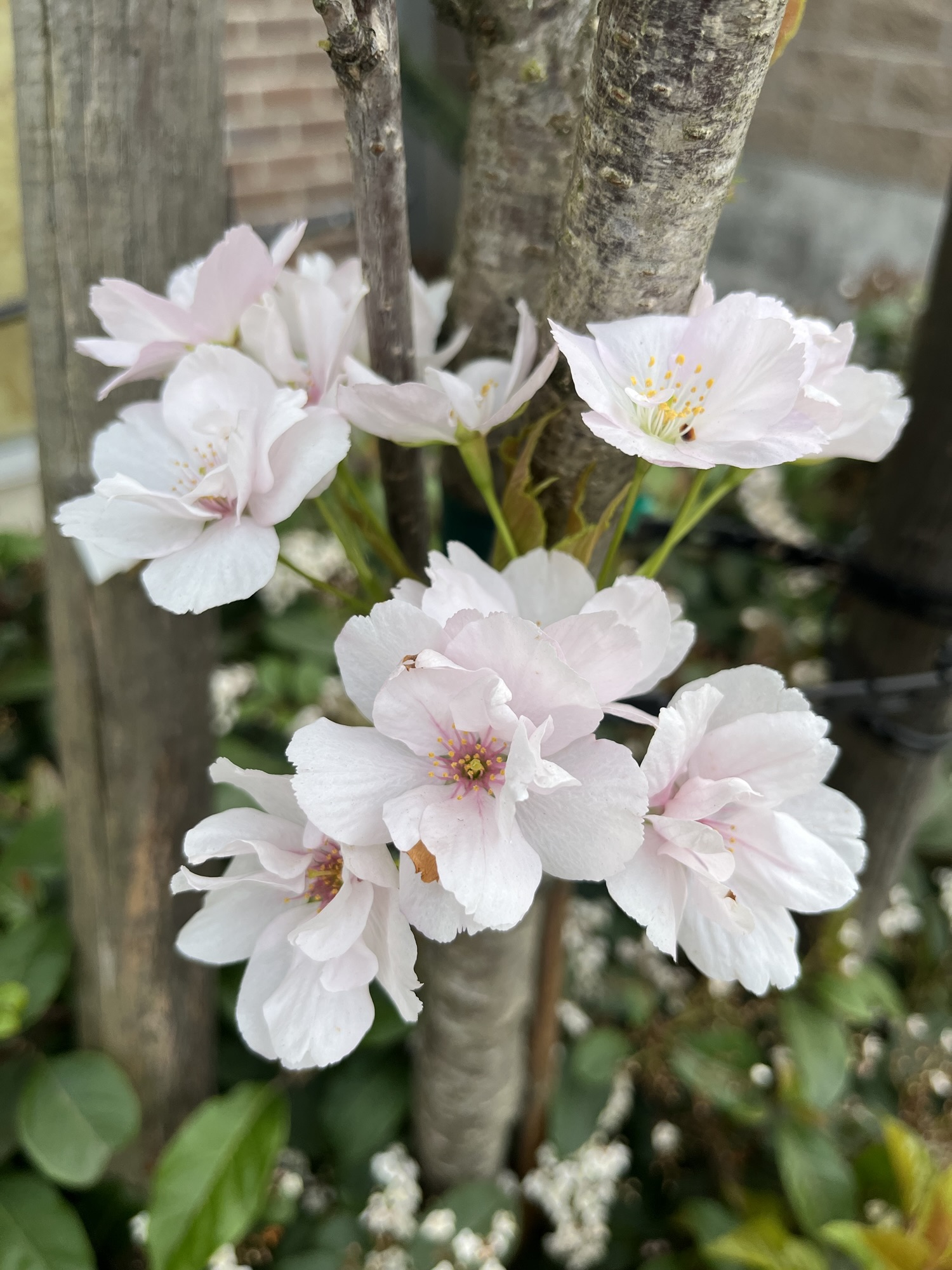
Another variety descended from the Ōshima cherry is called the fugenzo (フゲンゾウ, “Fugen’s elephant”) variety, sometimes called the shirofugen (シロフゲン, “white Fugen”) variety. The name is derived from the pistil of the flower resembling the shape of an elephant’s trunk, and since a revered bodhisattva named Fugen rides a sacred white elephant, that’s how it got its name.
Mountain Cherry
Another example of cherry blossoms, that’s lesser-known in the West are the wild cherry trees, or yama-zakura (ヤマザクラ) also known as the “Mountain Cherry”:
If you compare the Yama-zakura to the classic Yoshino Cherry, you can see the color is a little more faded, kind of whitish in comparison. I think I have also read somewhere that the leaves and blossoms of a mountain cherry sprout at the same time, compared to a Yoshino Cherry where the blossoms comes first.
In antiquity, when the nobility of the capitol would go on a cherry blossom viewing, these are the trees they would most likely go to see. They are the subject of poem 66 as well.
Shidaré-zakura Cherry
Another iconic variety of cherry blossoms are the shidaré-zakura (シダレザクラ), or Hanging Cherry:
You often see these grown in very scenic places, as well as on the grounds of Buddhist temples or Shinto shrines. The way the hanging branches sway in the wind is a sight to behold.
Kasumi-Zakura
One interesting variety that I was unaware of, until researching for this blog was the kasumi-zakura (カスミザクラ):
The word kasumi is a poetic term for haze or mist, especially a spring mist. You can see how the blossoms hang down somewhat, and are particularly large compared to other cherry blossoms varieties. They also seem to have a two-tone quality, where the edges are deeper color than the middle.
Fuyu-Zakura
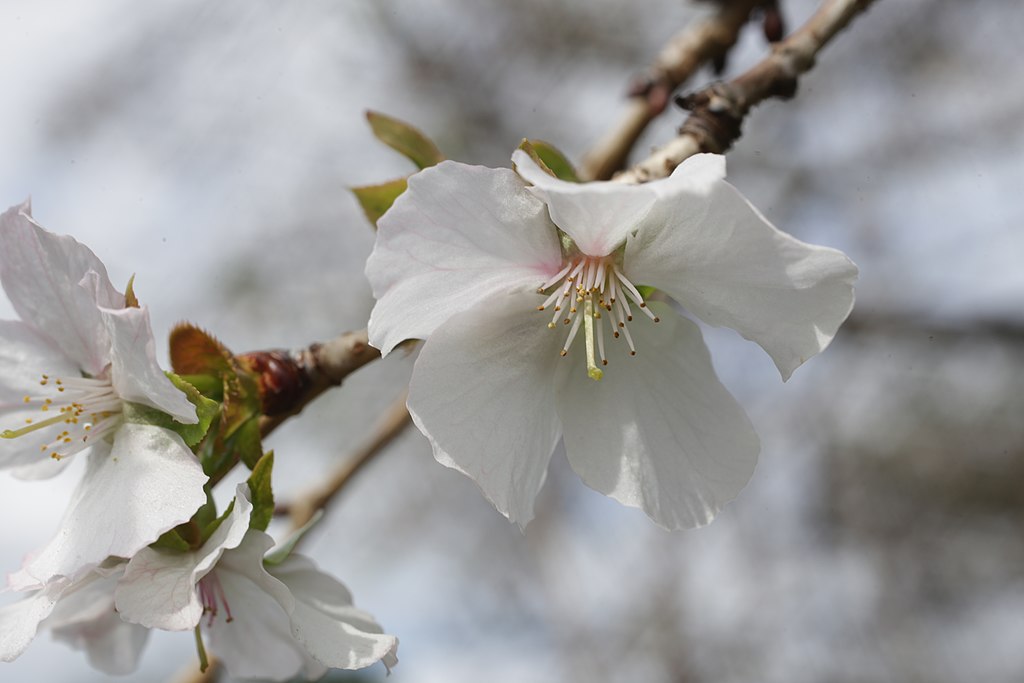
Another example I wanted to share is an unusual variety that blooms in spring, and in winter, called the fuyu-zakura (フユザクラ):
This cherry variety, also known as a gobazakura (コバザクラ) has white blossoms and blooms both in April, and also in December.
Kanhi-zakura
Taken by me at University of Washington in April 2025
While visiting the University of Washington in 2025, I found another variety I hadn’t noticed before. This variety is listed on UW maps as “Hisakura”, but in digging around in Japanese I found that a more common name is Kanhi-zakura (カンヒザクラ), also called Taiwan-zakura (タイワンザクラ) after the island of Taiwan. The name Hizakura (ヒザクラ) is also used. As the name implies (and according to Wikipedia), this variety is found all over East Asia, including Taiwan, and blooms somewhat early. Based on my visit to the UW I can confirm this as an amateur cherry blossom nerd.
Amanogawa Cherry
Taken by me in my neighborhood, April of 2025
Yet another variety I stumbled upon recently in 2025 is the Amanogawa (アマノガワ, “Milky Way”) variety. You can see an extra layer of petals in this one, similar to the Kanzan variety, but a lighter, softer color. I couldn’t find much detail about this variety but it appears to be a form of sato-zakura plants also known as the Ōshima cherry, similar to the Kanzan and Fugenzo varieties.
Conclusion
There are many more varieties of cherry blossoms than listed here, but many are obscure or only known to botanists and experts. Also, it’s important to point out that Korea also has a venerable cherry blossom tradition, though I confess I don’t have much information.
In any case, when spring comes, see if you can identify the different cherry blossoms you see. You may be pleasant surprised.
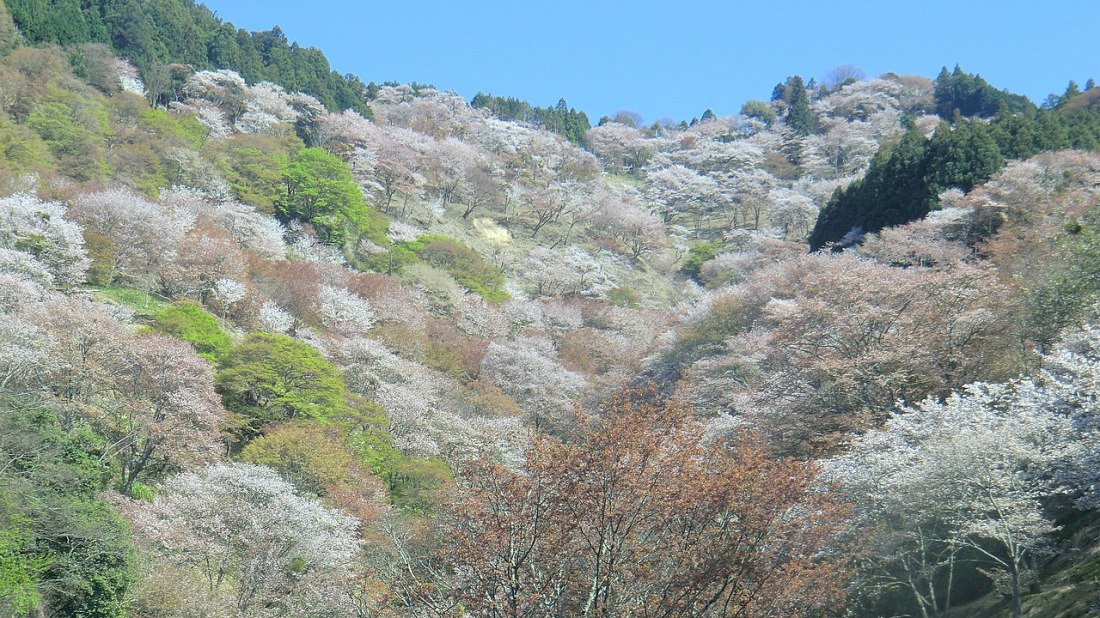
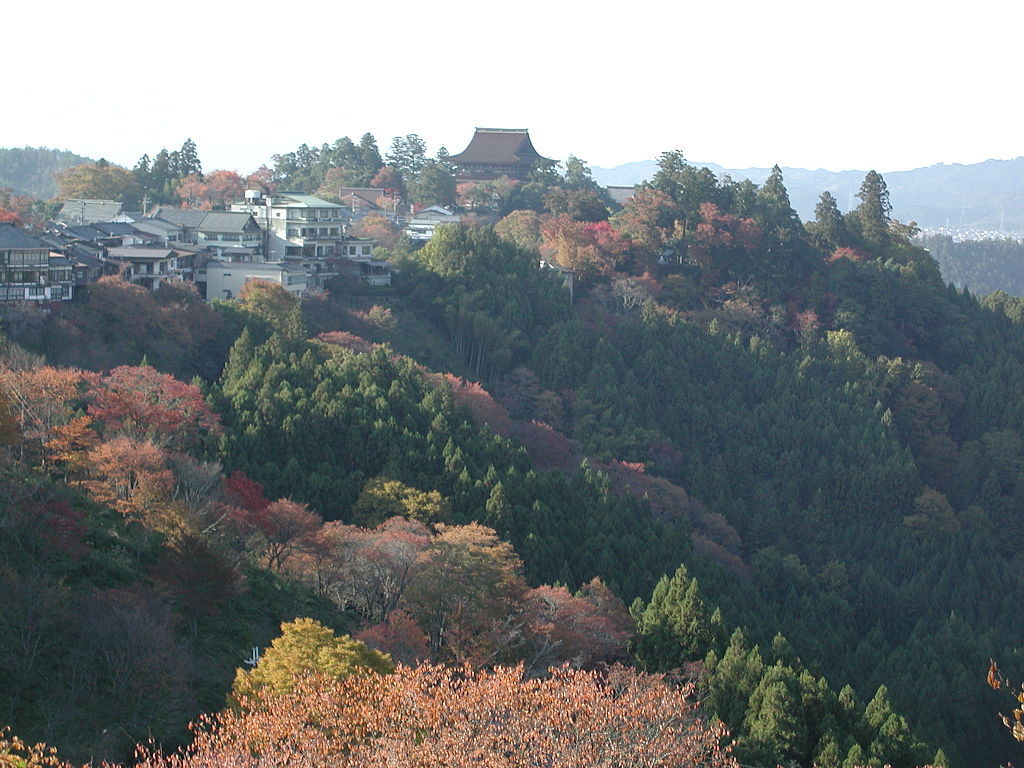
The small town of Yoshino (吉野, official site), near the old capitol of Nara, was a popular spot since ancient times and was often the subject of poetry in the Hyakunin Isshu anthology, for example poem 31 and poem 94. Further, according to the old Japanese historical account, the Nihon Shoki, visits to Yoshino to view the cherry blossoms went as far back as Empress Jitō (poem 2) and became a tradition ever since.
There is also a famous love story that takes place between the celebrated 12th century warrior Minamoto no Yoshitsune, and his mistress Shizuka Gozen. It was said that winter, while fleeing his jealous older brother, on the way to Oshu province in the north, they had to separate for her safety. In the snows of Yoshino, they parted, and Shizuka was sad to watch her beloved disappear in the snow.
Last spring, the Yasaka Taxi company in Japan posted a terrific photo of Yoshino (original link on Twitter):
Even to this day, cherry blossom viewing at Yoshino is a major tourism destination, and from what I hear, it’s pretty amazing.
The author, Nyūdō Saki no Daijōdaijin (入道前太政大臣, 1171 – 1244), or “Buddhist novice and former Chancellor of the Realm”. His personal name was Fujiwara no Kintsune. He was a powerful member of the elite Fujiwara clan and extended his support to the Hyakunin Isshu’s compiler, Fujiwara no Teika (poem 97), after Teika married Kintsune’s older sister. He was also well-liked by members of the old Imperial Court and the new military government at Kamakura.
According to Mostow, Kintsune married a niece of Minamoto no Yoritomo, the first shogun of the new military government. After Yoritomo’s son Sanetomo (poem 93) died a tragic death with no heir, Kintsune pushed to make his grandson Kujō Yoritsune, a distant relation to Sanetomo, the next shogun. My new book states that his reputation worsens in his later years as he kept manipulating the power of shoguns from behind the throne.
It also implies that Kintsune may have helped tip off the new military government about Emperor Gotoba’s (poem 99) plans to wrest back control, helping to contribute to the demise of the Emperor and his son (poem 100).
Ah, times had changed since the earlier generations of the Hyakunin Isshu mostly worried about poetry contests and marriage arrangements.
But I digress.
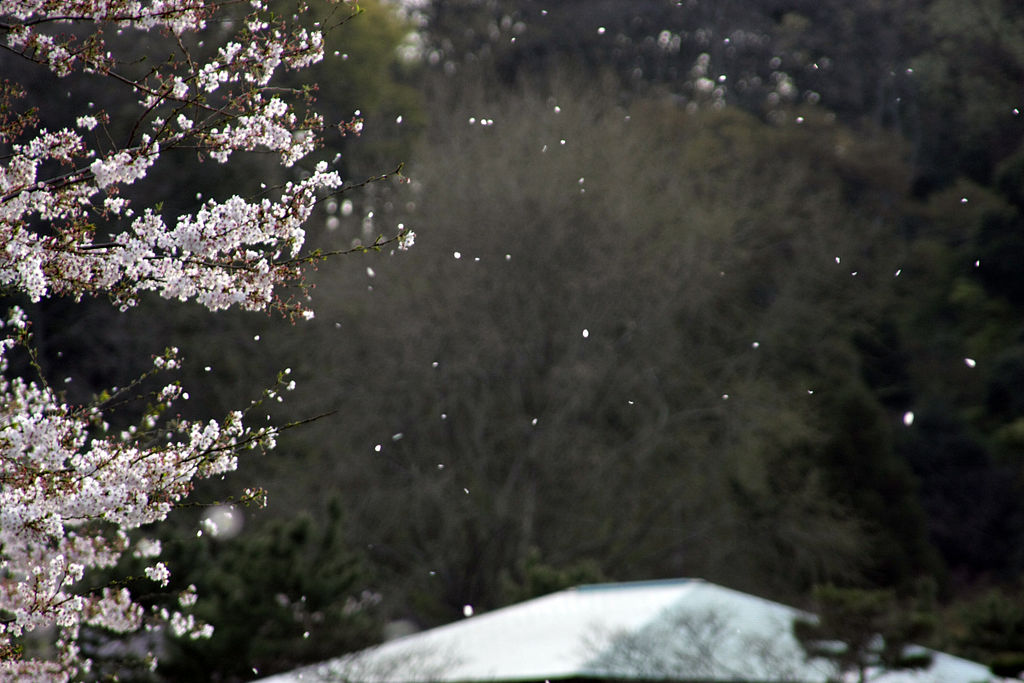
This poem, unlike other poems recently posted which were more clear-cut in meaning, often was the subject of much interpretation. The contrast between the aging man and the scattering of flowers in the wind, called hana fubuki (花吹雪) led to many interpretations by later commentators particularly about the man growing old, according to Professor Mostow. Perhaps he won’t be back next year?
The image of hana fubuki also is noteworthy, because it isn’t a small scattering of flowers. It refers to great scattering of blossoms in the wind, just like a snowfall. Thus Kintsune is witnessing this great scattering even as he contemplates his own decline even after so many years in power.
Pretty awesome poem, really, for a man who lived a noteworthy life.
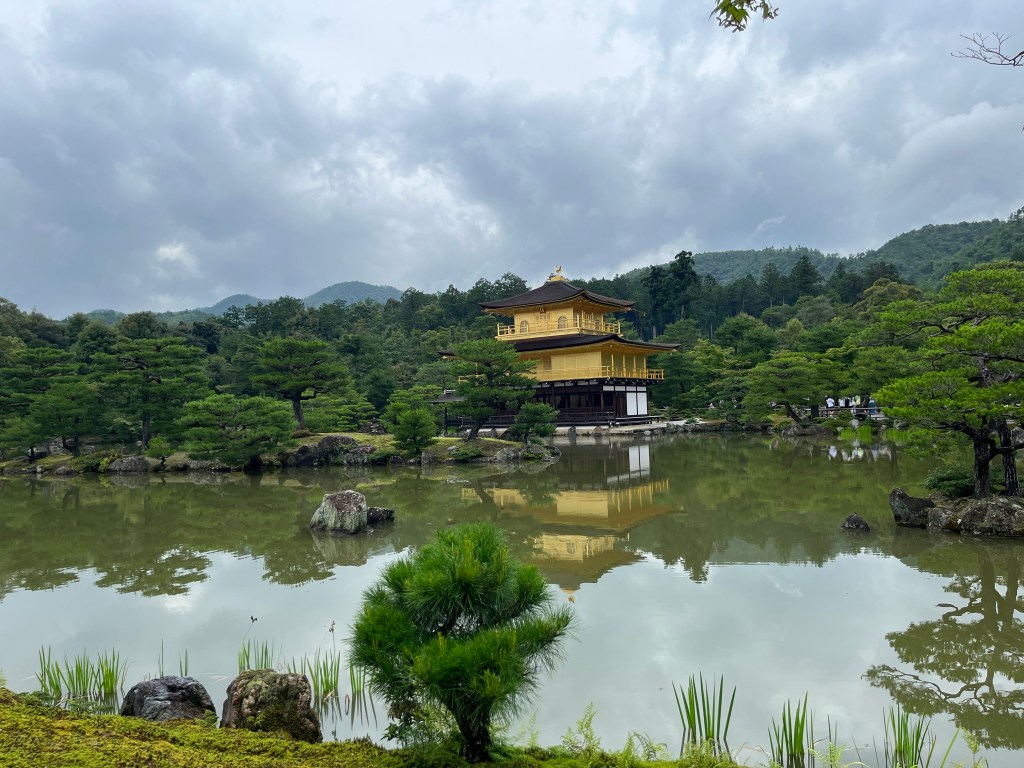
Speaking of scenic views, Kintsune’s residence of Saionji (西園寺), which was also established as his clan’s new name (Saionji), later became the famous Golden Pavilion.
Taken by me in July 2023
Indeed Kintsune’s contribution to Japanese culture and history, dubious as it may be, can be felt even today.
The author, known as Suō no Naishi (周防内侍, dates unknown), the “Suō Handmaid”, was so named because her father was governor Suō Province. As mentioned before, this was a common method used by female authors (cf. poem 65), so unfortunately, their real names are rarely known. This is another poem that speaks to the importance of a woman’s reputation in the ancient Court of Japan, just like poem 65. However, this one is much more playful and shows a lot of wit.
According to the back-story, there was a social gathering at the Nijō-In (二条院), the woman’s quarters at the palace. The woman there were relaxing, and the author of this poem said, “I wish I had a pillow”. At that moment, one Fujiwara no Tada’ie happen to walk by, and hearing this stuck his arm through the bamboo screen (御簾, misu) and said, “Here, takes this as your pillow!”.
In reply, the author composed this poem. As Professor Mostow points out, the word for arm here (kaina) is a pun for pointless (kainaku).
People flirted pretty clever back in those days. 😏
The poem was composed by a young Kōkō Tennō (光孝天皇, 830 – 887), Emperor Kōkō in English, who was traditionally, the 55th Emperor in Japan. He ascended the throne somewhat late (age 55) after Yōzei (poem 13, つく) abruptly retired. Koko’s own reign was similarly short, and power rested in the hands of his minister Fujiwara no Mototsune.
Nonetheless, Koko had a reputation for being a rather bright and easy-going youth. Despite being a Prince of the Blood, he was unlikely to inherit the Throne anytime soon (Yozei was still young, and Koko wasn’t directly related), and thus lived in obscurity. It’s said that he even had to cook his own meals. A poem mourning his passing states that his Imperial chambers still had black soot in them from cooking his own meals even after becoming Emperor.
The poem above is from those younger days, after he picked some wild flowers and herbs and sent them to someone as a New Year’s greeting. The poem was included in the offering. Young greens (wakana, 若菜) were the seven herbs used in the traditional holiday of Nanakusa on January 7th.
Even in the old Lunar Calendar, Nanakusa would fall around late January to early February. This helps to explain why snow was falling on the young prince’s sleeves.
Who was the recipient? It’s not known who received the poem and herbs, but since Nanakusa herbs are meant to bring safety, plus the language used (kimi ga tamé, きみがため), it definitely implies a young woman he cared about. ❤️ One theory suggests it was a beautiful girl named Tachibana no Kachiko (橘嘉智子), who was the consort of Emperor Saga.
This poem doesn’t use a lot of clever wordplays, the meaning is fairly straightforward, and it paints a nice image. It is a remarkably sweet, easy to grasp poem, that even foreign students of the Hyakunin Isshu can easily learn.
















 The Hyakunin Isshu

.JPG)

.jpg)


_W_IMG_0104.jpg)


.jpg)
.jpg)


