A Brief Introduction to Japanese Cherry Blossoms

As spring approaches, people eagerly anticipate when cherry blossoms (sakura in Japanese, 桜), but as I have learned recently in my book, the Hyakunin Isshu Daijiten, there are many types of sakura, some of them even referenced in the Hyakunin Isshu. Let’s explore a few and learn how to spot one versus another.

If you’re curious about how to even spot a cherry tree, my alma mater has a nice video introduction from the Pandemic era on spotting various trees in your own neighborhood:

A Brief History Lesson of Cherry Blossoms

Cherry blossoms have been a part of Japanese culture for a very long time, but were not always revered as they are now. In antiquity, the plum blossom, imported from China, were more highly revered as one can see in the Manyoshu, but over the centuries the roles reversed. The tradition of outings to view cherry blossoms is credited to Empress Jitō (poem 2). Nowadays, this tradition continues as ohanami (お花見), and can be a fun outing with friends and family or co-workers. In places like Ueno Park in Tokyo, the grounds are crowded with picnic blankets, visitors, and plenty of food and saké to go around.

The most famous, most iconic poem about cherry blossoms was composed by Ariwara no Narihara (who also wrote poem 17):

JapaneseRomanizationTranslation
世の中にYo no naka niIf in all the world
絶えて桜のTaete sakura nothere were of cherry blossoms
なかりせばKanarisebano trace anywhere
春の心はHaru no kokoro waah, how truly peaceful then
のどけからましNodokekaramashispring would be for everyone!
Translation by Dr Josha Mostow and Dr Royall Tyler from the Ise Stories, the poem is also number 53 in the Kokin Wakashū.

Varieties of Cherry Blossoms

Big thanks to this site for providing additional references. I also relied on some details from the Hyakunin Isshu Daijiten book I’ve used for the blog.

Yoshino Cherry

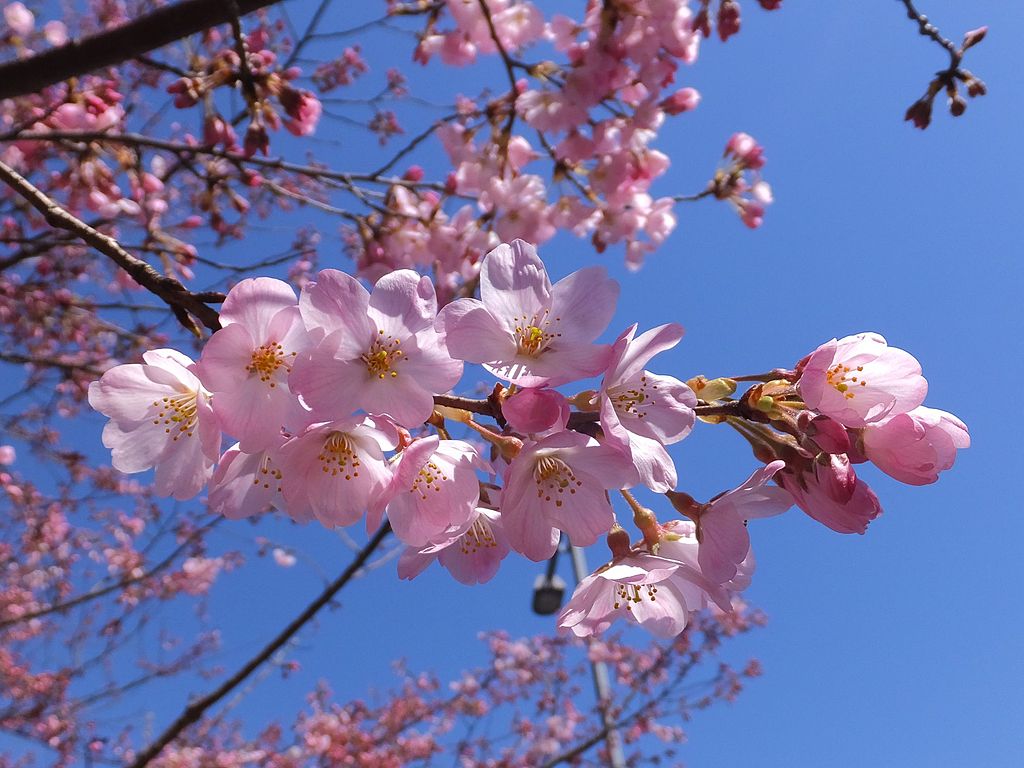
The most common, most well-known type are the Somei Yoshino (ソメイヨシノ) or “Yoshino Cherry” in English:

(Photo by Tak1701d, Public domain, via Wikimedia Commons)

This is a relatively recent variety that was bred for gardening, then gained popularity abroad. It is named after the famous village of Yoshino. For many, this is the classic “cherry blossom” and the one you’re most likely to see outside of Japan.

Yae-Zakura Cherry

Another famous example is the Yae-Zakura (ヤエザクラ):

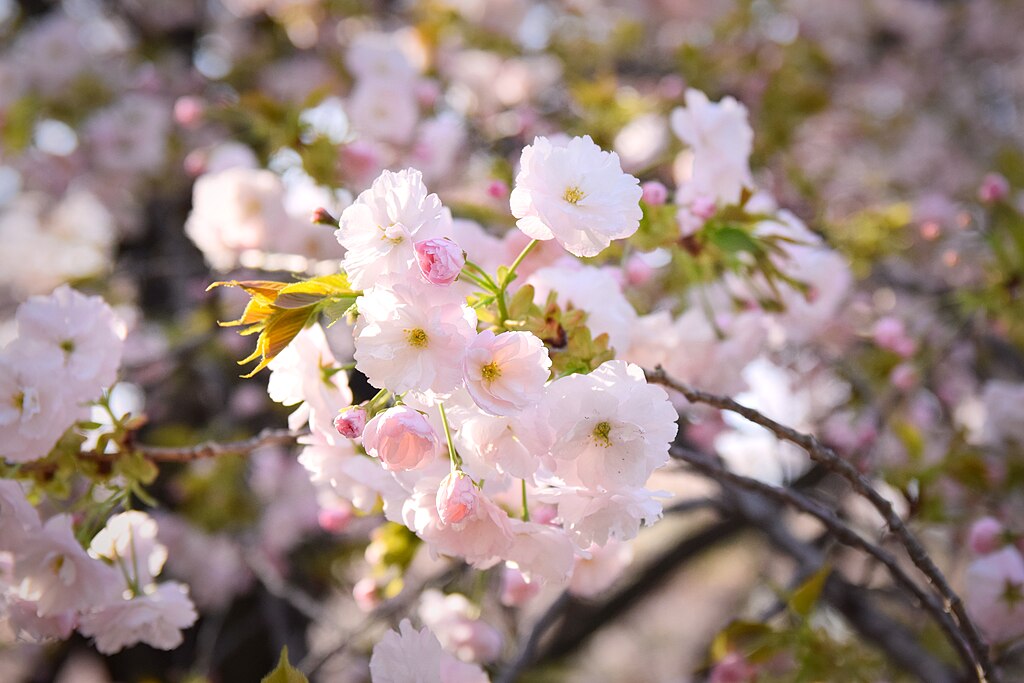
(Photo by Raita Futo from Tokyo, Japan, CC BY 2.0, via Wikimedia Commons)

The term yae (八重) means something like “eight layers” or “eight levels”, which helps describe it’s thicker, multi-layered blossoms. It is also the subject of poem 61.

To be honest, yae-zakura are my personal favorite.

Kanzan Cherry

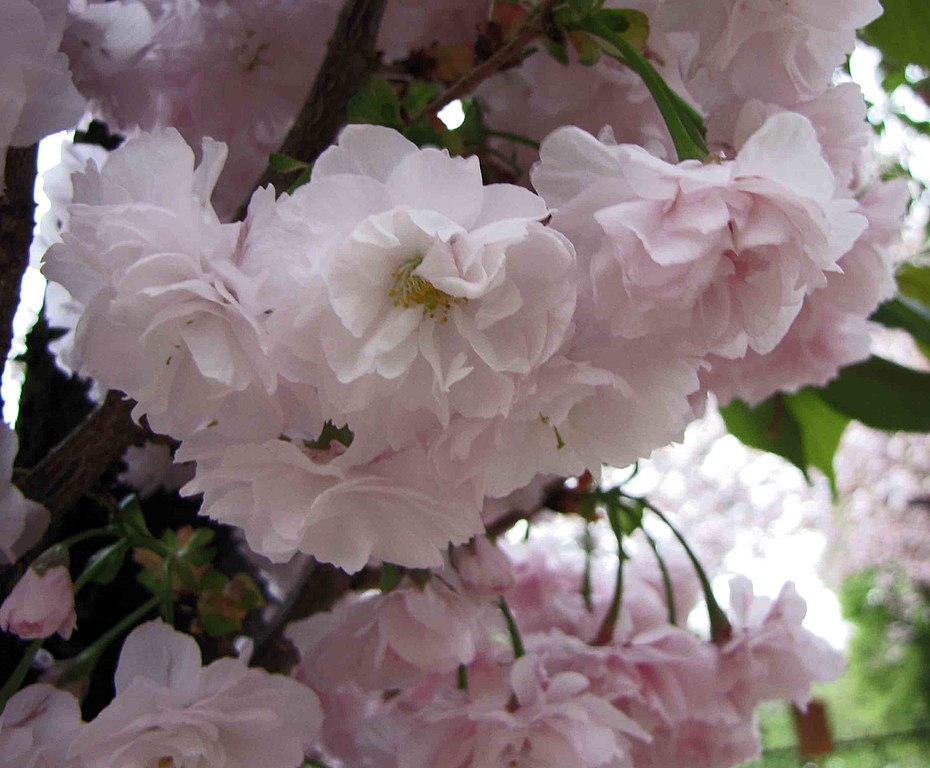
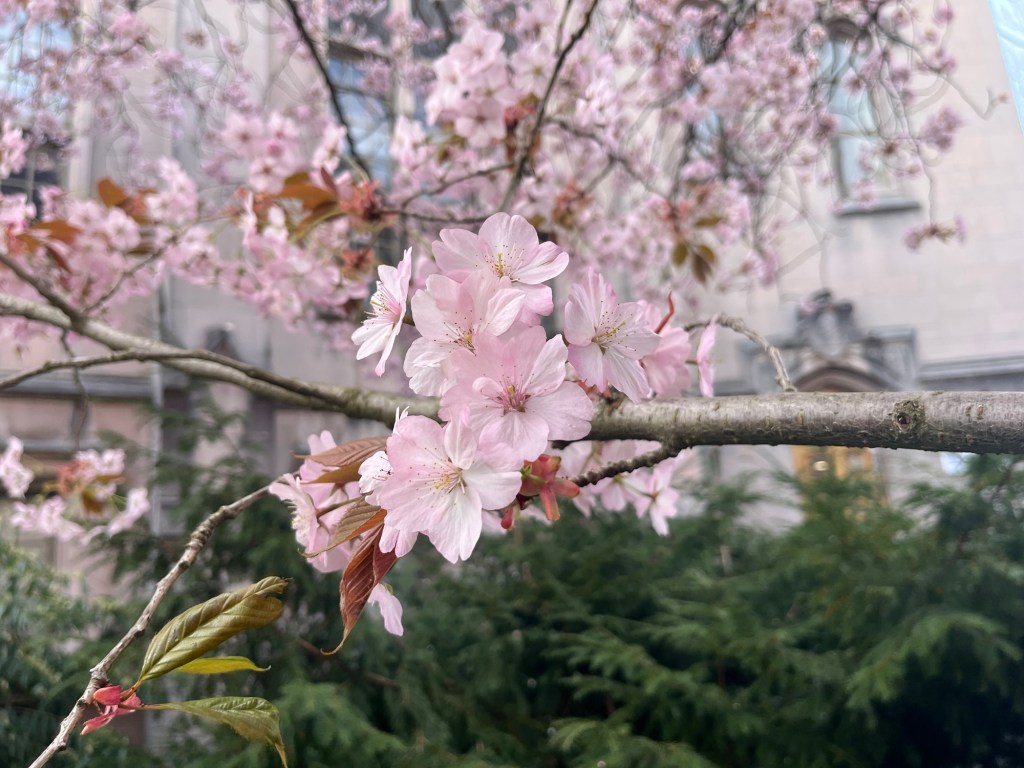
A popular variety that I only learned about recently is a hybrid variety called the kanzan (カンザン, sometimes archaically spelled Kwanzan). I didn’t find this one online at first, but was able to take a photo during a recent visit to the University of Washington.

This variety was, similar to the Yoshino, a relatively recent variety, and a result of hybrid breeding with Ōshima cherry. What makes this one interesting is the both the rich pink color, and the multiple layers of blossoms (similar to the Kasumi cherry below).

Mountain Cherry

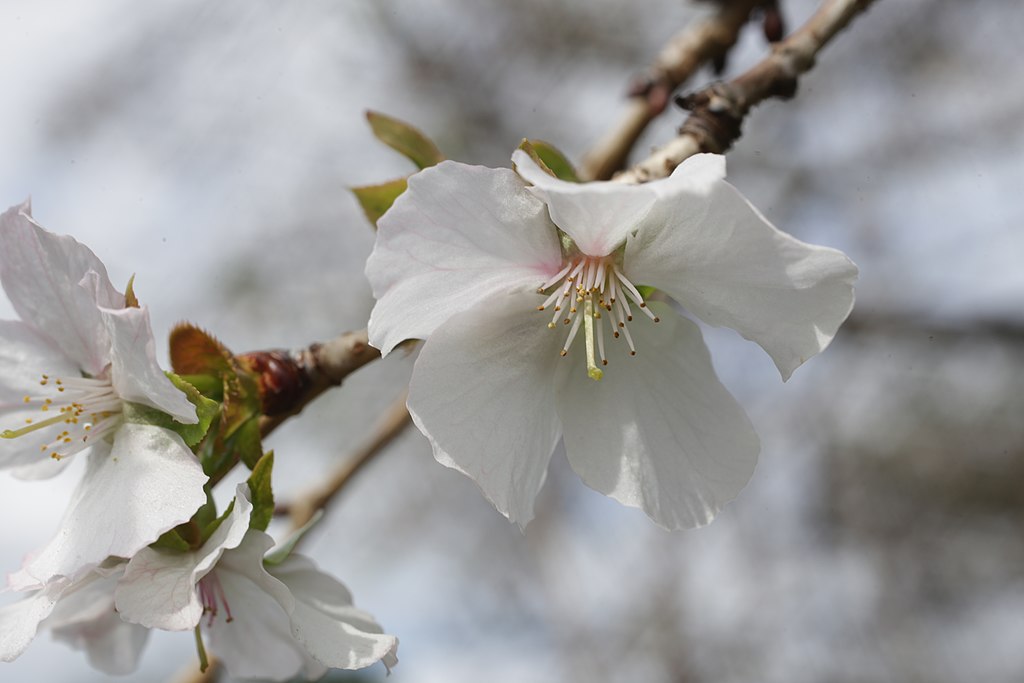
Another example of cherry blossoms, that’s lesser-known in the West are the wild cherry trees, or yama-zakura (ヤマザクラ) also known as the “Mountain Cherry”:

(Photo by 阿橋 HQ, CC BY-SA 2.0, via Wikimedia Commons)

If you compare the Yama-zakura to the classic Yoshino Cherry, you can see the color is a little more faded, kind of whitish in comparison. I think I have also read somewhere that the leaves and blossoms of a mountain cherry sprout at the same time, compared to a Yoshino Cherry where the blossoms comes first.

In antiquity, when the nobility of the capitol would go on a cherry blossom viewing, these are the trees they would most likely go to see. They are the subject of poem 66 as well.

Shidaré-zakura Cherry

Another iconic variety of cherry blossoms are the shidaré-zakura (シダレザクラ), or Hanging Cherry:

(Photo by Sakaori, CC BY-SA 3.0, via Wikimedia Commons)

You often see these grown in very scenic places, as well as on the grounds of Buddhist temples or Shinto shrines. The way the hanging branches sway in the wind is a sight to behold.

Kasumi-Zakura

One interesting variety that I was unaware of, until researching for this blog was the kasumi-zakura (カスミザクラ):

The word kasumi is a poetic term for haze or mist, especially a spring mist. You can see how the blossoms hang down somewhat, and are particularly large compared to other cherry blossoms varieties. They also seem to have a two-tone quality, where the edges are deeper color than the middle.

Fuyu-Zakura

Another example I wanted to share is an unusual variety that blooms in spring, and in winter, called the fuyu-zakura (フユザクラ):

This cherry variety, also known as a gobazakura (コバザクラ) has white blossoms and blooms both in April, and also in December.

Kanhi-zakura

Taken by me at University of Washington in April 2025

While visiting the University of Washington in 2025, I found another variety I hadn’t noticed before. This variety is listed on UW maps as “Hisakura”, but in digging around in Japanese I found that a more common name is Kanhi-zakura (カンヒザクラ), also called Taiwan-zakura (タイワンザクラ) after the island of Taiwan. The name Hizakura (ヒザクラ) is also used. As the name implies (and according to Wikipedia), this variety is found all over East Asia, including Taiwan, and blooms somewhat early. Based on my visit to the UW I can confirm this as an amateur cherry blossom nerd.

Amanogawa Cherry

Taken by me in my neighborhood, April of 2025

Yet another variety I stumbled upon recently in 2025 is the Amanogawa (アマノガワ, “Milky Way”) variety. You can see an extra layer of petals in this one, similar to the Kanzan variety, but a lighter, softer color. I couldn’t find much detail about this variety but it appears to be a form of sato-zakura plants also known as the Ōshima cherry, similar to the Kansan variety.

Conclusion

There are many more varieties of cherry blossoms than listed here, but many are obscure or only known to botanists and experts. Also, it’s important to point out that Korea also has a venerable cherry blossom tradition, though I confess I don’t have much information.

In any case, when spring comes, see if you can identify the different cherry blossoms you see. You may be pleasant surprised.

Visiting Kitano Tenmangu Shrine

I’ve been writing in my other blog several articles about my family’s visit to Kyoto and Nara in July 2023, but for this particular article, I wanted to write it on this blog instead. You’ll see why shortly. While in Kyoto, we made an unexpected stop at a Shinto shrine called the Kitano-Tenmangu Shrine (北野天満宮) right in the middle of the city.

Kitano-Tenmangu Shrine (English / Japanese homepages) is devoted to a Shinto kami named Tenjin, who’s essentially the God of Learning. Each year, thousands of kids trying to pass their entrance exams visit local shrines, and pray for success. I’ve prayed at the Yushima Tenmangu Shrine in Tokyo myself years ago when trying to pass a Japanese-language certification test (I passed). The one in Kyoto, though, Kitano Tenmangu, is the original shrine.

But what’s the big deal?

The kami Tenjin is a deified form of the poet and scholar, Sugawara no Michizane, who composed poem 24 in the Hyakunin Isshu. When he was ousted by the powerful rival Fujiwara no Tokihira (father of Atsutada, poem 43), and died in exile, people worried that his vengeful spirit had returned to plague the capitol. The untimely deaths Tokihira and Atsutada certainly didn’t help this. Michizane was posthumously re-instated to the Imperial Court bureaucracy, elevated to a high rank, and venerated as a Shinto kami1 to appease him.

Anyhow, Kitano Tenmangu is the original shrine devoted to Michizane and has since grown into a large network of shrines across Japan.

The Shrine itself is relatively small, since it’s inside the city, but it has lots of neat things in it. When you first come in, there is a walkway like so leading to the inner sanctum:

To the right, is a plum tree, though not blossomging in July:

Plum blossoms (umé 梅) are associated with Michizane due to a famous poem he wrote in exile:

JapaneseRomanizationTranslation
東風吹かばKochi fukabaWhen the east wind blows,
にほひをこせよNioi okose yolet it send your fragrance,
梅の花Ume no hanaoh plum blossoms.
主なしとてAruji nashi toteAlthough your master is gone,
春を忘るなHaru o wasuru nado not forget the spring.
Sugawara no Michizané (845 – 903), translation by Robert Borgen

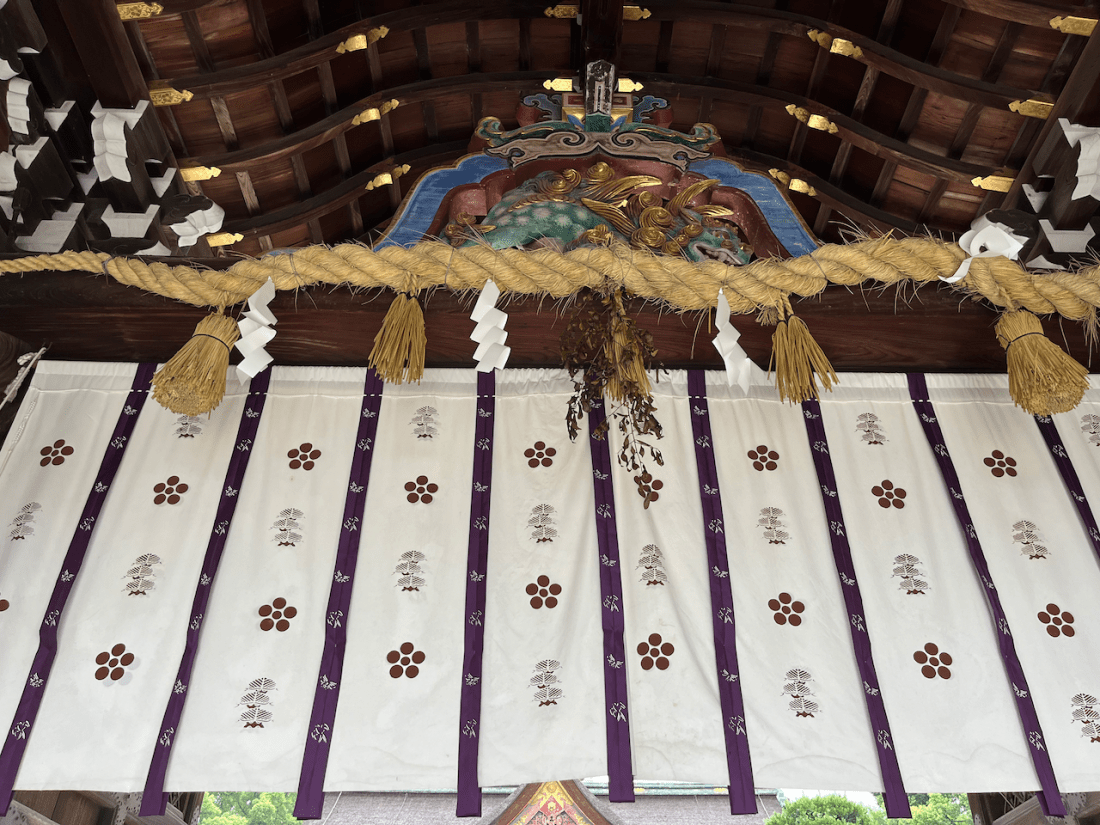
Anyhow, if you continue you get to the gate to the inner sanctum:

The inner sanctum is here (I prayed for my Japanese-language exam this year as well… we’ll see if I pass again 😄):

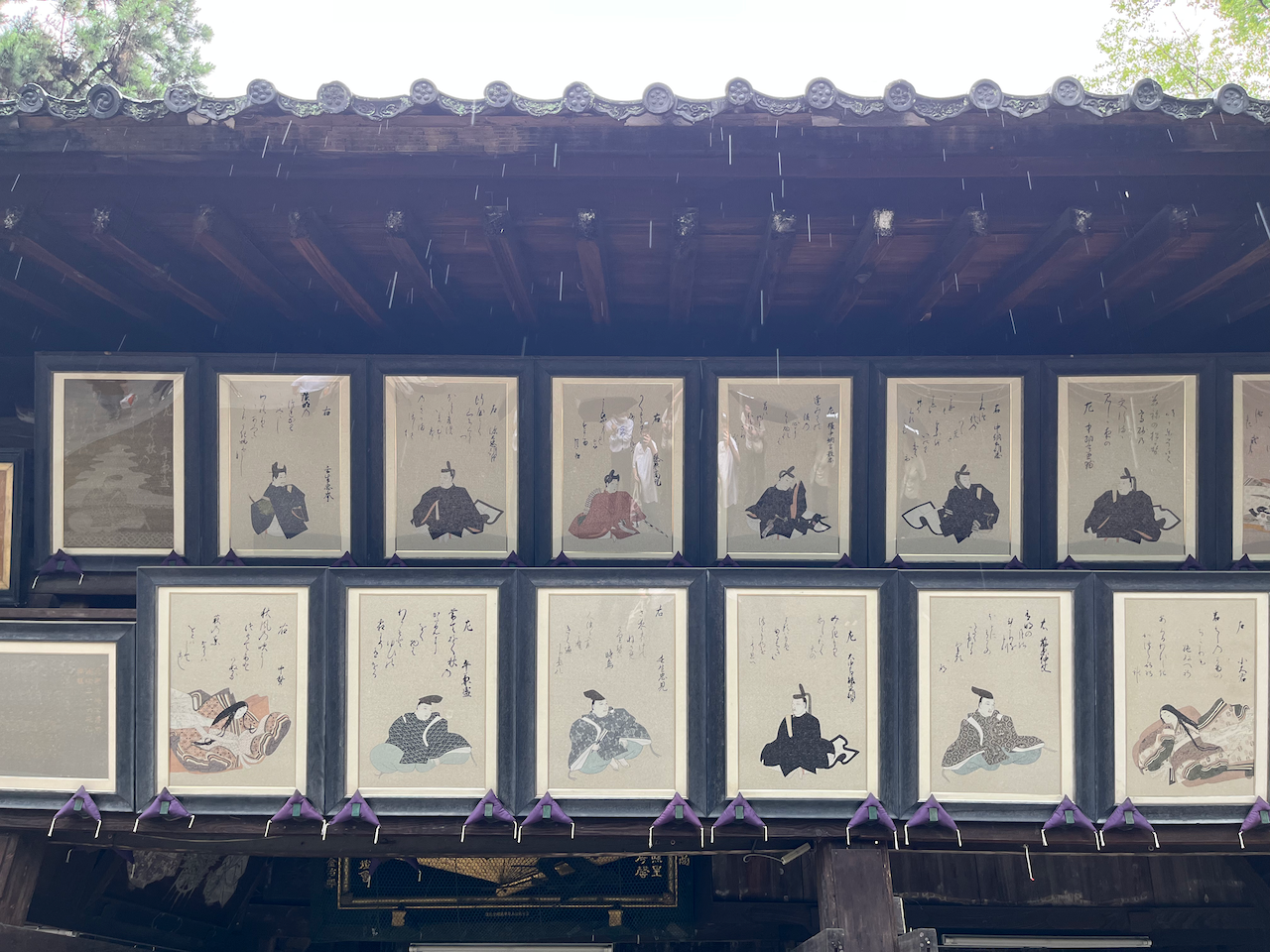
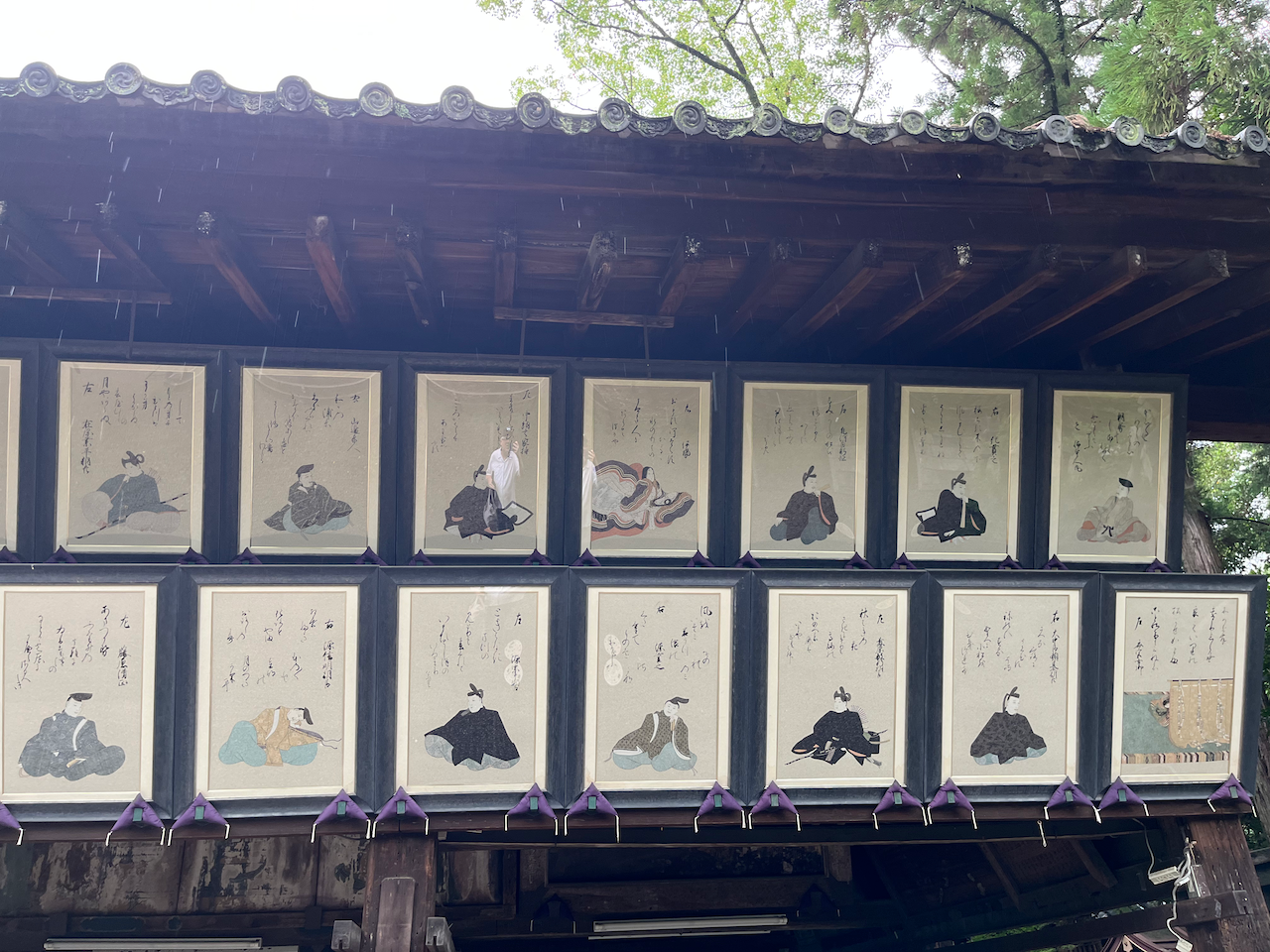
What’s really neat is that if you loop back around toward the main entrance, you’ll see this:

The pavilion near the front entrance had displays of various poems from the Hyakunin Isshu in the form of yomifuda karuta cards! If you look at the photos, you might even see my reflection, too. ;-p

The inside room of the pavilion was interesting too, with lots of really old pictures and paintings affixed:

I also picked up an omamori charm as well:

I keep this in my wallet.

Kitano Tenmangu is a great place to visit while you are in Kyoto, and its tribute to both the famous scholar, and to the Hyakunin Isshu really warmed my heart.

1 This isn’t that unusual in Shinto since the notion of a kami is very broad, and includes not just gods, but also nature spirits, great historical figures, and “anything else that inspires awe” according to one writer.

Visiting Kyoto, Tengu-do and New Karuta Set

Hello dear readers,

I recently came back from a family trip to Japan (mentioned here), and while there we took the kids to see the old capitol of Kyoto, where many of the poets of the Hyakunin Isshu lived,1 and where many events took place. But one thing on my bucket-list was to see was the Oishi Tengu-do karuta shop. Last year, I bought a karuta set at a local bookstore in Japan, and of the sets I bought the Tengu-do set was my favorite. And since we wanted to go to Kyoto anyway, it was a great opportunity to visit the home shop fo Tengu-do.

The Tengo-do shop is in the southeast part of Kyoto. If you get to Fushimi-Momoyama station, you can easily walk south 2-3 blocks to get there.

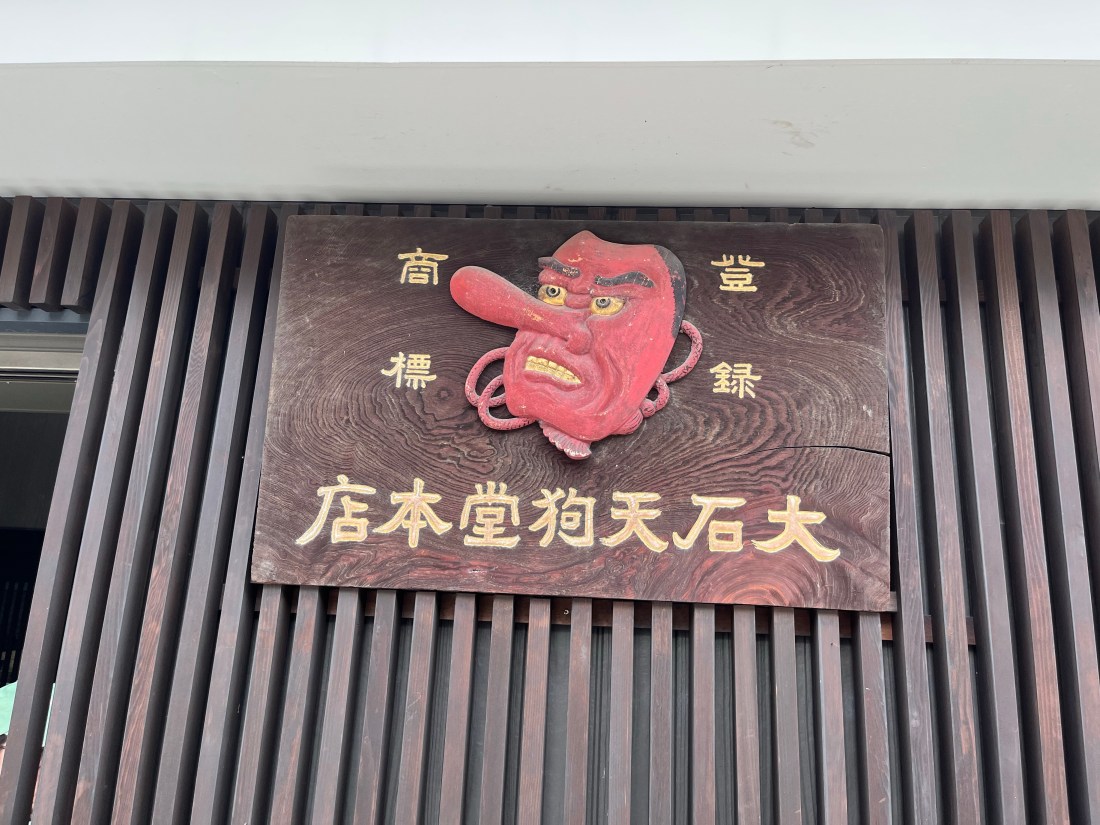
The shop is in a residential neighborhood, but if you look carefully, you can find the sign like so:

The inside of the shop is a single room, just enough room for myself and family, and I didn’t get a chance to take a photo, but I found some good photos online. The elderly lady minding the shop was very kind. We perused for a bit, and I found a few items that I wanted to get. The most important was this set:

This was one of more expensive sets, but I knew that I probably wouldn’t visit Kyoto again for another 10-15 years, so I figured I’d better go big or go broke.

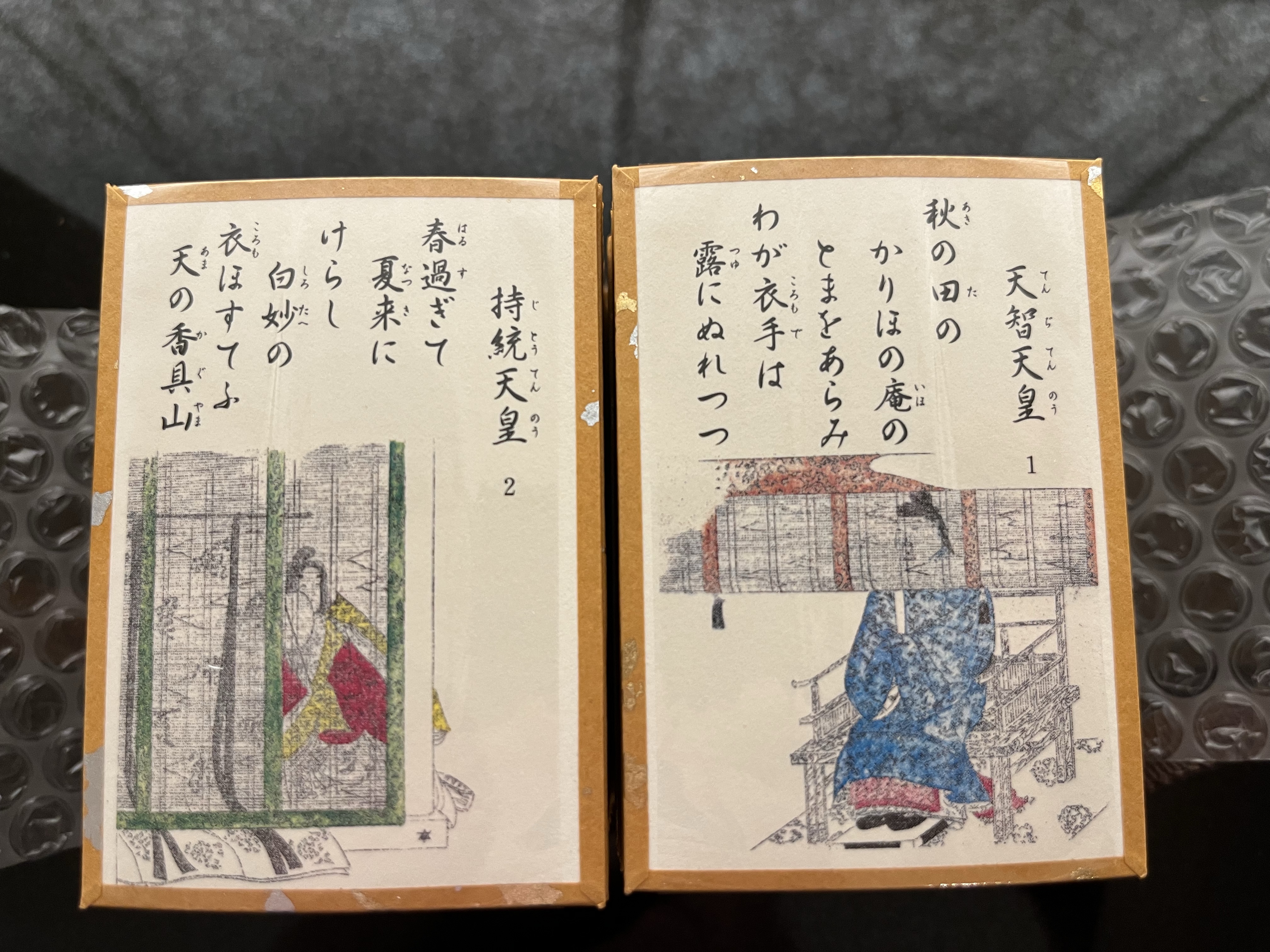
The detail on the cards, especially the border is simply amazing. The yomifuda cards below are for poems 1 and 2:

I also picked up a couple other odds and ends, but this was the real treasure. It was great to visit the home shop of Tengu-do, and to patronize a business like this. If you happen to be in Kyoto, and have an interest in the Hyakunin Isshu and/or karuta, definitely stop by!

1 Prior to Kyoto, the capitol of Japan was a city called Nara. Some of the earliest poets and figures of the Hyakunin Isshu lived when Nara was still the capitol, but I’d estimate at the remaining three-fourths lived in and around Kyoto until you get to the very last few poets who lived in the new capitol of Kamakura. That’s how much history the anthology spans.

Mount Ogura

Hi Folks,

Although I’ve finished all the poems in the Hyakunin Isshu, I wanted to share this cool photo I found on Twitter:

This is Mount Ogura (小倉山) also called Arashiyama (嵐山) near the city of Kyoto. The place name “Ogura” is where the Hyakunin Isshu gets its full-name: Ogura Hyakunin Isshu.

At that time, it was trendy for aristocrats to compile their own “hundred poems by a hundred poets” anthologies, all named “hyakunin isshu”, but the one that is by far the most famous is the Ogura Hyakunin Isshu, which of course is the source and inspiration of this blog. 🙂

Thanks to KyotoDailyPhoto on Twitter for taking this photo. It’s nice to see the place that inspired the anthology.

Update: I finally visited there in summer of 2024.

Short As A Reed: Poem Number 88

If you like word-play, you’ll enjoy this poem quite a bit:

JapaneseRomanizationTranslation
江のNaniwa-e noDue to that single night
あしのかりねのAshi no karine noof fitful sleep, short as a
reed’s joint cut at the root
一よゆHitoyo yuefrom Naniwa Bay,
みをつくしてやMi wo tsukushite yaam I to exhaust myself,
like the channel markers
わたるべきKoi wataru bekipassing my days in longing?
Translation by Dr Joshua Mostow

This poem was composed by Lady Bettō (dates unknown), known in the Anthology as Kōkamon’in no Bettō (皇嘉門院別当). Lady Bettō served in the house of Empress Seishi, wife of Emperor Sutoku (poem 77). Lady Bettō was also the daughter of Minamoto no Yoshitaka.

Although the life of Lady Bettō is relatively unknown, and she doesn’t appear in many anthologies, Professor Mostow points out that her poem is quite a technical feat. There are not one, but three “pivot words”, or words that carry multiple meanings, and lend multiple interpretations to the poem:

  1. karine can mean cutting a root (刈り根) or a brief nap (仮寝) such as when traveling.
  2. hitoyo can mean either a single segment of a reed (一節) or a single night (一夜).
  3. mi wo tsukushi can mean either to exhaust one’s body (身を尽くし) or one of the famous barriers in Osaka Bay (澪標, see also poem 20)

The poem itself uses many familiar themes too. We’ve seen a lot of poems that feature Osaka Bay, called Naniwa in ancient times, including poem 20, poem 19 and poem 72 among others. Similarly, we see references to reeds, just as we do in poem 39 and poem 19 (again).

What makes this poem stand out is the excellent use of word-play throughout. On the surface, it looks like just another love poem, but Lady Bettō knew what she was doing. 😌

P.S. Featured photo is of reeds (species Phragmites) in Amsterdam, photo by PersianDutchNetwork, CC BY-SA 3.0, via Wikimedia Commons

Catch Me If You Can: Poem Number 72

This is a more light-hearted poem in contrast to the previous one:

JapaneseRomanizationTranslation
音にきくOto ni kikuKnown far and wide,
高師の浜のTakashi no hama nothe unpredictable waves
あだ浪はAdanami waof Takashi’s beach—
かけじや袖のKakeji ya sode noI will not let them catch me—
ぬれもこそすれNure mo koso sureFor I’d be sorry should
my sleeves get wet!
Translation by Dr Joshua Mostow

The author of this poem was known only as Yūshi Naishinnō Ke no Kii (祐子内親王家紀伊, dates unknown) or “Kii of Princess Yūshi’s Household”. She served in the household of Imperial Princess Yūshi, and was the daughter of Taira no Tsunekata and one Lady Koben. The salon of Princess Yūshi included a number of poets and writers and it seems Kii was no exception. She participated in a number of poetry contests and her poems appear in various anthologies.

Speaking of contests, Professor Mostow explains that this poem actually was intended as a response to another poem in a competition held by Retired Emperor Horikawa. Kii was 70 years old at the time according to another source, which is impressive given that she expresses young love so easily after all these years.

The word adanami in the third verse is a particularly interesting phrase. It implies flowers that failed to bear fruit, and thus infidelity. Apparently the women in the poem is not a fool and won’t fall for a dishonest man.

But where is Takashi beach? I checked and it seems to be a famous beach in Osaka Bay, near modern-day Takaishi City in the Osaka Metropolitan Area.

Who’s Fault Is It? Poem Number 14

This poem has an interesting connection with the city and region of Fukushima as we shall see:

JapaneseRomanizationTranslation
みちのくのMichinoku noWhose fault is it
しのぶもずりShinobu mojizurithat my feelings have begun
to tangle
たれゆTare yue nilike the tangle-patterned prints
乱れそめにしMidare some niof Shinobu from the
distant north?
我ならなくにWare naranaku niSince it is not mine, it must be…
Translation by Dr Joshua Mostow

The author, Kawara no Sadaijin (河原左大臣, 822 – 895), “Riverbank Minister of the Left”. His personal name was Minamoto no Toru, renowned for his courtly elegance, and Professor Mostow thinks he may have served as a partial role-model for the famous hero of the Tale of Genji.

The poem is thought to be Toru’s defense to his wife or lover about his faithfulness, but he uses some interesting imagery to convey how upset he is that his faithfulness is questioned. Mostow points out that the poem is a subject of debate because it’s also been interpreted as an expression of secret love to someone else (i.e. “why did you make me feel this way”?).

The place referenced, Shinobu in Michinoku, is the old name for what is now the city of Fukushima in Fukushima Prefecture. Although it is now known for last year’s earthquake and nuclear disaster, the area was originally a frontier area during the time of the Nara and Heian periods, and as evinced in the poem above, famous for it’s patterned cloth called shinobu mojizuri.

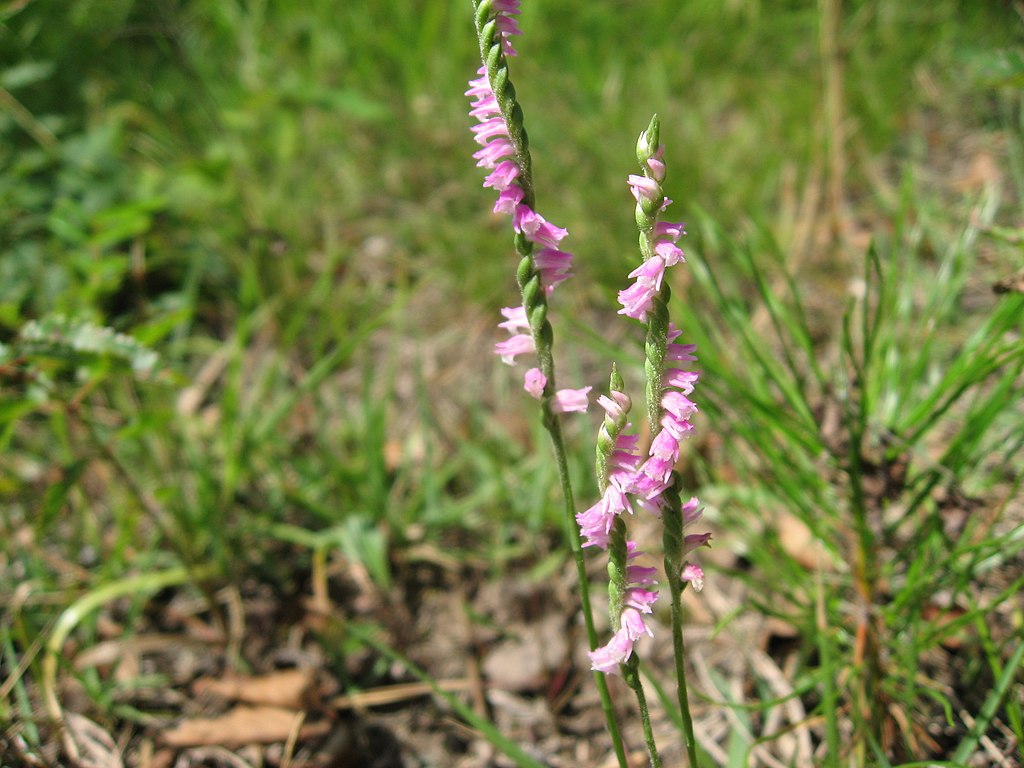
The term mojizuri refers to a type of plant, Spiranthes sinensis var. amoena pictured above (photo by Qwert1234, CC BY-SA 4.0, via Wikimedia Commons), a variety of orchid found in east Asia. It’s also called nejibana in modern Japanese. However, mojizuri also refers to a kind of dyed-cloth pattern made from the plant. The method involves pressing a cloth between the plant and a rock, forming dyed patterns like the ones shown here. This the context that Minamoto no Toru is using in the poem.

Meeting and Parting: Poem Number 10

This poem is a nice reminder that “traffic” and “commuting” are two things that haven’t really changed much in 1,000 years:

JapaneseRomanizationTranslation
これやこのKore ya konoThis it is! That
行くもかえるもYuku mo kaeru mogoing, too, and coming too,
別れてはWakarete wacontinually separating,
知るも知らぬもShiru mo shiranu mothose known and
those unknown,
おう坂の関Ōsaka no sekimeet at the Barrier of Ōsaka
Translation by Dr Joshua Mostow

This poem was composed by one Semimaru (蝉丸, dates unknown) who is reputedly a blind man who built a hut near Osaka Barrier and was famous for playing the biwa, but the authenticity of this story is questionable, and as Mostow points out, it’s not even certain he existed at all. The story about his life has also changed throughout the generations, so in some cases he’s the servant of the son of an Emperor, and in others he’s the son of an Emperor, abandoned by his blindness.

According to one account in my new book, a high-ranking official named Minamoto no Hiromasa (源博雅) once heard a rumor of a talented blind man with a biwa lute who lived near the Osaka Barrier (see below). He wanted to hear this man’s music, and sought him out for three years until he finally found him on the evening of 15th day of the 8th month (old lunar calendar), and from this man, Hiromasa learned to play the songs that he had been squirreling away. Songs titled such as 流泉 (ryūsen, “flowing spring”) and 啄木 (takuboku, “woodpecker”).

The place in question, Osaka Barrier, is a popular subject of poetry from this era. Poems 62 and 25 also mention the same place because it was a popular meeting spot for people coming and going from the capitol (modern-day Kyoto) eastward. Note that this Osaka has no relation to the modern city of Osaka, which was called Naniwa during that era. In fact the name of Osaka Barrier is also a pun. The Chinese characters are 逢坂, which means “meeting hill”, but is also the place-name.

Anyway, these kinds of check-points, or sekisho (関所) existed in Japan across major roads going in and out of the capitol, but were also popular meeting places for friends and lovers too, as well as having inns nearby for weary travelers. The featured photo above is an example of “sekisho” checkpoint, photo by 663highland, CC BY-SA 3.0, via Wikimedia Commons

The Osaka Barrier in particular was the first check-point leaving eastward from the capitol, so many people probably parted company here, or met old friends at this particular gate more than others. It’s fun to imagine what Osaka Barrier was like in those days. As Mostow points out, this poem probably was originally just a poem about Osaka Barrier, but by the medieval era, it took on an increasingly Buddhist tone in symbolizing the coming and going of all phenomena. Even modern Japanese books on the Hyakunin Isshu tend to reflect this sentiment. Pretty interesting metaphor I think.

One other interesting thing about this poem is its rhythm. If you read this one out loud, the rhythm is very easy to follow, and this is probably one of the easier poems to memorize if you’re looking for a place to start (poem 3 is another good choice in my opinion 😉).

Finally, one random note about Semimaru himself.

A picture of a karuta card depicting Semimaru (poem 10), with his poem above his head. His clothes look similar to a monk and he is holding a Buddhist rosary. His eyes are closed, as he was reputedly blind.

His artistic depiction in karuta cards, such as the yomifuda card above based on the famous Korin Karuta collection, leads to frequent confusion by people who play bozu mekuri: is he a monk or a nobleman? Even my new book mentions this conundrum among Japanese players. His lack of verified biographical information makes this question even more mysterious. The book jokes that the author’s house-rule is that if anyone pulls the Semimaru card, then everyone loses what their stack of cards. Feel free to make your own house-rule. 😊

Getting Exiled Isn’t Fun: Poem Number 11

Another random poem I found lately. Interesting enough, it has some relation to the much later poem by Emperor Gotoba (poem 99):

JapaneseRomanizationTranslation
わたの原Wata no haraO tell her, at least,
八十島かけてYasoshima kaketethat I’ve rowed out,
heading towards
こぎ出ぬとKogi idenu tothe innumerable isles
人には告げよHito ni wa tsugeyoof the ocean’s wide plain,
あまのつり舟Ama no tsuribunéyou fishing boats of
the sea-folk!
Translation by Dr Joshua Mostow

The poet author was Sangi Takamura (参議篁, 802 – 852), “Counselor Takamura”, also known as Ono no Takamura. He was one of the premiere poets of his time, particularly with Chinese poetry, which was very popular in that era. People considered him a rival to the famous Chinese poet Bo Juyi, which was quite a compliment. Bo Juyi’s poetry is frequently recited or mentioned in many works from the Nara and Heian periods (such as the works of Lady Murasaki, poem 57).

For his talent with Chinese poetry, Takamura was selected to be part of the 837 embassy to Tang Dynasty China, the same one as Abe no Nakamaro (poem 7). Such trips were prestigious, but also incredibly perilous, because Japanese ships were not designed to cross deep sea, and withstand frequent typhoons. Plus ambassadors had to stay for 10+ years at a time, and some never returned from China at all, as in Nakamaro’s case.

Takamura, while revered by Emperor Saga, also had a dubious reputation for being a straight-shooter. As an eccentric genius he had a tendency to annoy everyone, including Emperor Saga.

It was probably for these two reasons, his hesitancy to carry out his ambassadorial duties, and his lack of tact, that Takamura was exiled to Oki Island and sent this poem back home as he headed for exile.

Oki Island shown above in the featured photo (photo by Yuvalr, CC BY-SA 4.0, via Wikimedia Commons), is where Emperor Gotoba (poem 99) was also exiled centuries later and stayed there for 20 years before he died. It is a lonely island facing the cold, windy Japan Sea/East Sea and far removed from the Court. Noble-born members of the Court were often exiled here, among other locations (see poem 100) for some length of time until they either died, or the reigning Emperor granted clemency. Fortunately, Takamura was pardoned a year a later, and allowed to return home.

One other note is that the poem slightly violates the traditional 5-7-5-7-7 syllable count in most waka poems. The third verse has 6 verses. Poets did occasionally violate this rule, probably for good reasons, but it’s interesting when it comes up. Then again, in Takamura’s case, maybe he just wanted to annoy people, or he just didn’t care. 🤭

The Wonders of Mount Fuji: Poem Number 4

This was something I read recently that I felt like posting:

JapaneseRomanizationTranslation
田子の浦にTago no ura niAs I set out on
うち出でて見ればUchi idete mirebathe beach of Tago, and look,
白たShirotae noI see the snow
constantly falling
富士の高嶺にFuji no takane nion the high peak of Fuji,
雪は降りつつYuki wa furitsutsuwhite as mulberry cloth.
Translation by Dr Joshua Mostow

This poem was composed by Yamabe no Akahito (山部赤人, dates unknown ) who according to Mostow was a contemporary of Hitomaro (poem 3). He is also one of the Thirty Six Immortals of Poetry and was a leading poet during the reign of Emperor Shomu and contributed to the Manyoshu. He is revered alongside his contemporary, Kakinomoto no Hitomaro (poem 3) as a “saint of poetry”. Compared to Kakinomoto no Hitomaro, Yamabe is known for a poetry style focused on the beauty of nature such as this poem, rather than clever verse.

Yamabe, for his part, served as a court poet under the pious Emperor Shomu. Unfortunately there is no information about his life before he served in the Court. My new book points out that since he was never mentioned in the historical document the Shoku Nihongi, Yamabe was probably a low-ranking bureaucrat.

Mostow carefully explains that this poem, like many of the earlier poems in the Hyakunin Isshu were written in an old Japanese-Chinese hybrid script called manyōgana and was thus open to many interpretations. In fact, the poem has evolved over time and the version in the Hyakunin Isshu is only one such version. The version above, compiled by Fujiwara no Teika (poem 97), was in an imperial anthology called the Shin-Kokin Wakashu. But the original version, poem 318 in the Manyoshu, read like so:

JapaneseRomanizationRough Translation1
田子の浦ゆTago no ura yuAs I passed
うち出でて見ればUchi idete mirebathe bay of Tago, and looked,
ま白にそMashiro ni soI saw the white snow
富士の高嶺にFuji no takane nifalling on the high peak
雪は降りけるYuki wa furitsukeruof Mount Fuji.
1 apologies in advance for any mistakes or for quality of translation

In this version, it sounds like Akahito is describing something more in the past, and the poem doesn’t use a pillow word (see below) to describe the snow. It uses the more mundane description of “very white”, not “white as mulberry cloth”.

The aforementioned vagaries of Manyogana script also matter because there’s much debate about where Akahito actually was when composing this poem. The location of Tago no Ura is now Suruga Bay in Shizuoka Prefecture, but originally may have meant some place much closer to Mount Fuji, under it’s “shadow”, so to speak.

One other interesting note for readers of this blog is the middle line, shirotae no, which as you may recall from poem 2 is one of those special “pillow words” used in Japanese poetry. It is a very idiomatic term which conveys something that is gleaming white, or as Professor Mostow translates, white as mulberry cloth. At some point in history, the third verse changed from a more mundane description of snow to a much more impactful description.

P.S. Featured photo is Mount Fuji as seen from Suruga Bay, photo by Shinichi Morita, CC BY-SA 2.0, via Wikimedia Commons