According to Mostow’s book, this poem by Taira no Kanemori (平兼盛, ? – 990) was part of a famous poetry contest in 960, and was pitted against Mibu no Tadami (poem 41). Both were recited under the theme of hidden love. For fans of the anime Chihayafuru, this contest is also mentioned in season one episode 23.
The judges couldn’t decide which poem was the winner, so after consulting with other poetry experts (who also couldn’t decide), they came before Emperor Murakami and sought his opinion about which poem was superior. According to the story, the Emperor hummed to himself the verses from this poem under his breath, tactfully judging Taira no Kanemori’s poem the winner.
My new book points out that what makes this poem highly prized (along with Tadami’s poem) is the excellent use of prose. It isn’t just that the character is hiding love, but that it’s become painfully obvious to everyone around them, and they are compelled to ask. The ni keri in the second verse is an archaic way of expressing regret (poem 41 uses it too), or grumbling so it has a natural sound to it. Mostow’s opinion agrees with the excellent style, mixed with a more natural style at the end. Anyone who’s been secretly in love before can certainly sympathize.
Taira no Kanemori is also one of the Thirty-Six Immortals of Poetry (sanjūrokkasen, 三十六歌仙), and was friends with Egyo Hoshi (poem 47). According to my new book, there is a theory that his daughter is Akazomé Emon (poem 59). He had divorced Emon’s mother, but she was already pregnant. Further, after she remarried and gave birth to Emon, Kanemori petitioned to have parental rights but ultimately failed.
The Taira Clan or Heike (平家), which Kanemori belongs, was not particular powerful at this time, but would later dominate Japanese politics centuries later under Taira no Kiyomori, only to be tragically swept aside in the disastrous Genpei War by their rivals, the Minamoto.
The author, Fujiwara no Okikaze (藤原興風, dates unknown), was one of the Thirty-Six Immortals of Poetry according to Mostow, but few other details about his life are known. He is the great-grandson of nobleman Fujiwara no Hamanari, and is thought to have lived around the same time as Kii no Tsurayuki (poem 35) and Kii no Tomonari (poem 33).
Takasago is a famous city on Harima Bay in Japan, in what is now modern-day Hyōgo Prefecture. Since antiquity, Takasago was famous known for its pine forests. The featured photo above is a sacred pine tree at Takasago Shrine (photo by 弥, Public domain, via Wikimedia Commons). Takasago is also mentioned in poem 71. The most famous sacred pine tree at Takasago Shrine is the Aioi no Matsu (相生の松), which has been growing since the temple’s foundation. The pine trunk splits into two, and thus has become a symbol of marital harmony between husband and wife.
Further, my new book states that Takasago was such a iconic place, associations were often drawn between it and Sumi-no-e Bay (poem 18), with Sumi-no-e being the “husband” and Takasago the “wife”.
Even so, this poem takes as different turn and reflects on the loneliness of growing older. Given that Fujiwara no Teika (poem 97) was 79 at the time of compiling the Hyakunin Isshu, perhaps he felt a sense of kindred spirits when selecting this poem?
The author of this iconic poem was Jitō Tennō (持統天皇, 645 – 702) known in English as Empress Jitō. Originally Princess Unonosarara, she was the daughter of Emperor Tenji (poem 1), and later his sister-in-law after Tenji forced her to marry his brother (later Emperor Tenmu). In any case, she became the Empress after her husband Tenmu died, and reigned for 11 years. Female emperors were quite rare in Japanese history, by the way, so her reign was pretty noteworthy. Empress Jito proved to be a powerful and effective empress, a patron of the arts who promoted cherry-blossom viewing, completed the new capital of Fujiwara-kyō, but also ruthless toward potential political rivals as well as in the case of her step-son/nephew Prince Otsu.
This poem in general causes a lot of headaches for commentators and translators over generations because of the confusing relation between certain lines. Further, a second slightly different version of the poem exists in the Manyoshu poetry anthology (book 1, poem 28), with differences highlighted:
Original Manyogana
Japanese
Romanization
Translation adapted from Dr Mostow’s1
春過而
春過ぎて
Haru sugite
Spring has passed, and
夏来良之
夏来るらし
Natsu kitaru rashi
summer is coming, it seems
白妙能
白たへの
Shirotae no
Heavenly Mount Kagu
衣乾有
衣干したり
Koromo hoshitari
where, it is said, they are drying robes
天之香来山
天の香具山
Ame no kaguyama
of the whitest mulberry!
1 Special thanks to “Cameron” for helpful insights in making sense of the alternate version. Also, any translation mistakes are my own, not Dr Mostow’s.
According to Mostow, there’s a lot of uncertainty about what’s being dried, what does it stand for, and whether the scene is directly observed or not. One further note about the pillow word shirotae (白妙) in the third line, Mostow explains that the word tahe/tae refers to a kind of Paper Mulberry plant. So this is not just paper, but gleaming white paper.
Also, where is this famous Mount Kagu? Mount Kagu, more formally known as Amanokagu in Japanese,2 is one of three peaks called the Yamato Sanzan (大和三山, Three Peaks of [old] Yamato) or the Sanrinzan (三輪山) which are pictured here. These mountains are:
畝傍山, Unebi-yama
耳成山, Miminashi-yama
天香具山, Ama-no-kaguyama (e.g. Mount Kagu)
Yamato is among the oldest parts of Japan as we know it, so these mountains, while small by standards of Mt. Fuji, have held important cultural significance since the beginning. Since antiquity, it was believed that all three mountains were inhabited by Shinto kami,3 and thus sacred spaces. Miminashi-yama and Ama-no-kaguyama were said to be inhabited by male kami, who competed for the affection of Unebi-yama, a female kami.
Ama-no-kaguyama with purple Cosmos flowers in the foreground. The remnants of the ancient capital of Fujiwara-kyo can also be seen to the right. Photograph by Ajax, CC BY-SA 4.0, via Wikimedia Commons
The ancient imagery of such a venerable old mountain, couple with such vivid imagery of a sunny, warm summer day are among the reasons why I like this poem so much. 🙂
2 The Manyoshu version of the poem alternatively spells it as ame-no-kaguyama, which is an obscure though valid way to read 天. I am not sure why both versions of the poem are read slightly differently.
3 Although kami is usually translated as a “god” in English, it helps to think of them more like ancient Greek gods, than the modern concept. Ancient Greek religion had gods both large and small, so the English word “divinity” might be more accurate?
This poem is a great example of the word-play you often see in Japanese poetry of the time. The word “matsu” in the fourth line can mean a pine tree (松) or to wait (待つ), which are both applicable here. It even works in the English translation! You see this kind of thing a lot in Japanese because homonyms are so common compared to English. In particular the author is talking about the pine trees on Inaba Mountain (稲羽山) in Inaba Province as explained below.
As for the author, this was composed by Chūnagon Yukihira (中納言行平, 818-893), or “Middle Counselor Yukihira”, who was the older brother of Narihira (poem 17). Like all nobles who served in the Heian Court at the time, he was assigned to a post in a remote province for a term of service. In Yukihira’s case, he served a term as governor in Inaba Province (inaba no kuni 因幡の国), modern-day Tottori Prefecture, for two years, but this poem is his parting words at his farewell party.
The word inaba is a great example of a “pivot word” (kakekotoba, 掛け言葉) because it is both word-play and an central to the meaning of the poem. Inaba is the name of the province that Yukihira is assigned to, but it also means, according to Mostow, “(Even) if I leave”. Pretty clever.
Like many nobles of his time caught up in political intrigues, Yukihira was later exiled, and his exile along with his poetic association with pine trees became the subject of famous Nō dramas and in literature as well. According to Mostow, his exile was the inspiration behind part of the Tales of Genji.
The author of this poem Kakinomoto no Hitomaro (柿本人麻呂, dates unknown), was one of the pre-eminent poets of the Asuka Period in Japan, and contributed to the Manyoshu anthology as well. According to my new book, he served in the courts of emperors Tenmu, Jitō (poem 2), and Monmu as a kind of “court poet” (kyūtei-kajin, 宮廷歌人). During official outings, or former occasions, the court poet was relied upon to compose a fitting poem for the occasion. So revered was Hitomaro at his job that he, alongside his contemporary Yamabe no Akahito (poem 4), were later called kasei (歌聖, “saints of poetry”).
Hitomaro is also possible candidate for authorship of the famous iroha poem: a poem that uses every hiragana letter only once.
While the poem above looks like any other love poem, the composition, imagery, rhythm and such, make this one really stand out. 😁
The yamadori (山鳥) is actually a species of bird called the Copper Pheasant, known for its long tail, and is our featured photo for today (photo by KKPCW, CC BY-SA 4.0, via Wikimedia Commons). There’s a great photo here as well. Traditionally, it was thought that the male and female birds slept separately at night, hence Hitomaro was comparing this to his own feeling of loneliness.
One thing I like about this poem, and why I have a particular interest in it, is the repetitive sounds using の (no) throughout. If you recite the poem out loud, it has a particularly nice rhythm to it, and for me it is thus easy to memorize/recite. Try it out and you’ll see what I mean. The frequent use of の also links various words together in a way that stretches out the verse. Thus, Hitomaro isn’t sleeping alone, it feels like a looooooong night alone.
According to the Hyakunin Isshu Daijiten, there are certain birds in Japanese culture that are frequently used to represent autumn. In addition to the Copper Pheasant, other birds include:
The wild goose (kari, 雁)
The quail (uzura, うずら)
The bull-headed shrike, or Lanius bucephalus (mozu, もず)
The opening verse of this poem is also a nice example of pillow words in the Hyakunin Isshu, originally taken from the Manyoshu.
Finally, one thing to note is that my new book about the Hyakunin Isshu suggests the authorship of this poem is doubtful. In the original Manyoshu anthology, this poem was listed as “author unknown”, poem number 2802, and looked noticeably different:
Original Manyogana
Modern Japanese
Romanization
Rough Translation1
念友
思へども
Omoedomo
Even as I try not to think about it,
念毛金津
思ひもかねつ
Omoi mo kanetsu
I can’t help but think
足桧之
あしひきの
Ashihiki no
how long this night will
山鳥尾之
山鳥の尾の
Yamadori no ō no
be, like the tail of a
永此夜乎
長きこの夜を
Nagaki kono yo wo
copper pheasant.
1 Rough translation by me, apologies for any mistakes.
… but by the time of Fujiwara no Teika (poem 97, こぬ) who compiled the Hyakunin Isshu, it was probably assumed to be Hitomaro. Teika might know something we don’t today though, so it’s quite possibly Hitomaro’s poem, but sadly we’ll never know for sure. But this mystery of how the poem came to be will be covered in a future post someday.
The author, Ki no Tomonori (紀友則, ? – 905?), was the cousin of Ki no Tsurayuki (poem 35). Tomonori is one of the Thirty-Six Immortals of Poetry, and helped to compile another famous poetry anthology, the Kokinshū (古今集).
The Kokinshū, formerly known as the Kokin Waka Shū (古今和歌集 “Collection of Ancient and Modern Japanese Poetry”) was completed in 905 and was the first of many efforts by the ancient Court to compile the best poetry, past and present, into an official anthology. The Hyakunin Isshu by contrast was one man’s effort in his retirement. More on that in a later post. As for Tomonori, it is said that he didn’t live to see the completion of the Kokinshū, sadly.
As for this poem, this is one of the most famous in the collection and emblematic of Spring, but also the fleeting nature of the world, and the touch of melancholy that comes with it. Truly this is a lovely poem. It also has a textbook example of a pillow word in the form of ひさかたの (hisakata no) in its opening verse, also used in poem 76.
P.S. Special thanks to “E.G.” for some typo fixes in the poem.
Well, the book was actually published in 1996, but I came across this book only recently: Joshua S. Mostow’s Pictures of the Heart: The Hyakunin Isshu in Word and Image. The book is a serious effort to study the Hyakunin Isshu, and not for a casual reader, but also the history and culture around it, while offering fresh, new translations.
The first chapter alone, dealing with issues of historiography and deconstruction, makes my head hurt, but it makes an important argument: that only studying the poems themselves, and ignoring their role in Japanese culture leads readers to a one-sided view. Mastov demonstrates how some poems have even changed and evolved over time, depending on which book published the poem over the centuries. Sometimes, even in antiquity, poems were radically different depending on which book, so Mastov explores the various debates surrounding each poem. Who knew a few lines of verse could cause so much scholarly debate?
The book is a great read because for each poem, it carefully analyzes it, provides historical context, artwork and shows how the poem has been interpreted over the generations. It often debunks certain assumptions too. For example, Poem Number 6 is traditionally thought to allude to the story of Tanabata, but in fact Mastov demonstrates how this is a later interpretation.
The translations for the poems as well are quite good, readable, and well thought out in my opinion. The book is a weighty tome, but for any serious students of Japanese poetry, and in particular the Hyakunin Isshu, I highly recommend it.
As tonight is a Worm Moon, but also one where the moon is the closest in its orbit to Earth in 19 years, I thought this was a fitting poem, and also one of my favorite:
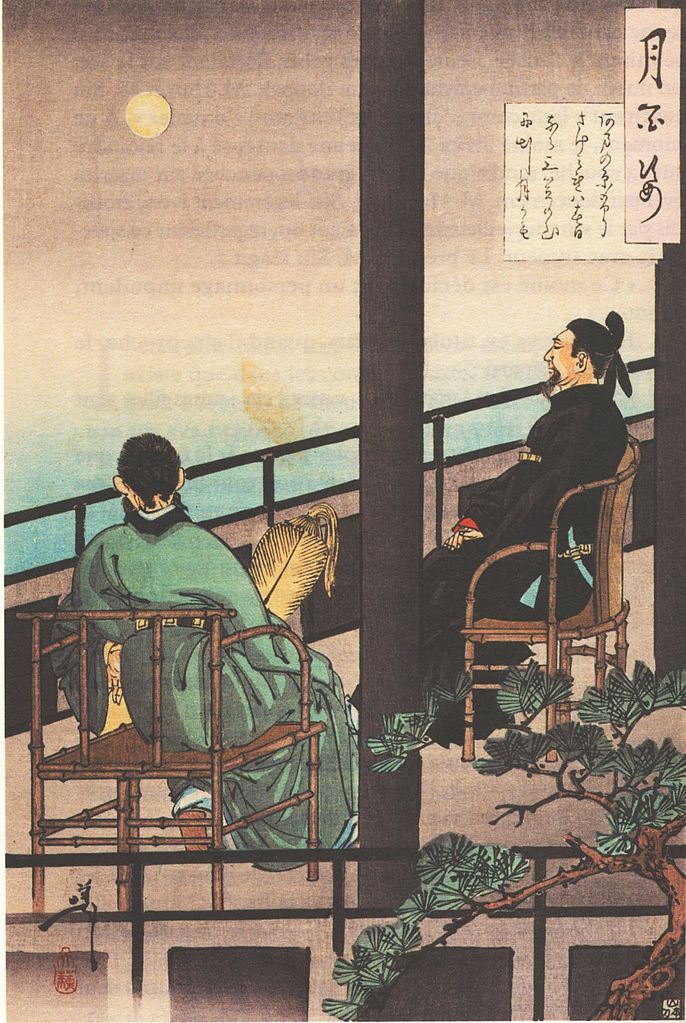
According to historical accounts, Abé no Nakamaro (阿倍仲麻呂, 701 – 770), the author, went to China to study at the age of 16. This was part of the yearly mission made by Japan to the Imperial Tang Court in China. The missions to China from Japan (or Kentō-shi 遣唐使) were perilous undertakings due to poor ship construction and storms from the south, so they didn’t come often, and sometimes got shipwrecked.
He spent many years in China and became friends with famous poets at the time such as Li Bo and Wang Wei, and was in the service of the Chinese emperor Xuan-Zong for a time. But after so many years of service, it was time for Nakamaro to return to Japan, and according to the story, on the night before he departed, his friends in China threw him a farewell feast. That evening, he looked up and saw a beautiful moon, and composed this poem. It was at Mount Mikasa many years before that Nakamaro prayed for safe return someday from China, and he remembered that same moon so many years ago. This is depicted in the featured photo above from a woodblock print collection (print number 64) called the One Hundred Aspects of the Moon by Yoshitoshi.
Sadly, his return trip failed, and the ship was blown off course to the land of Annam, where he then trekked back to China and eventually passed away never seeing his homeland again.
This poem was composed by Chūnagon Yakamochi (中納言家持, 718 – 785), or “Middle Councillor Yakamochi”. He is also known as Ōtomo no Yakamochi (大伴家持). Yakamochi was from a prestigious but declining family at the time, and is credited with compiling the Manyoshu, the earliest extant poetry anthology we have today. Yakamochi also contributed many of his own poems to the Manyoshu (compiler’s privilege?), and is considered one of the Thirty Six Immortals of Poetry.
Unfortunately, Yakamochi later got caught up in a series political intrigues, and after achieving the rank of Middle Counselor, he was first sidelined to a remote post, and later after drowning in a river. Worse, just after his death in 785, a powerful noble named Fujiwara no Tanetsugu was assassinated, and Yakamochi was implicated as part of the plot, despite being dead. Thus the Otomo family name was disgraced until 806 when Yakamochi was posthumously pardoned and his rank restored.
Anyhow, this poem’s reference to the Magpie’s Bridge comes from two places: the Imperial Palace at the time had a set of stairs called the Magpie’s Bridge, but also in later generations, this also referred to the famous legend of Tanabata. On the night when Orihime and Hikoboshi would meet every year, they could cross a bridge made of magpies whose wings were extended end to end.
In both ways, the poem expresses a lonely, long, and cold winter’s night.
Reading classical Japanese is hard enough as it is, what with its unusual spellings and archaic vocabulary, but what makes the Hyakunin Isshu interesting, among other things, is the colorful, poetic phrases sometimes used. These phrases are strictly literary, and tend to have a dramatic sound to them, but when translating to English sometimes the meaning is lost. These words are called makura kotoba (枕詞) or “pillow words”. The term “pillow” here has no romantic connotations whatsoever, but is simply a reference to poetry. Presumably, people in the old days sat in their rooms, leaning on a pillow, composing poetry in their idle time, I guess.
Anyway, pillow words can be thought of as “filler” phrases, because they don’t have much meaning themselves, but they dress up the poems a lot more. For example in this poem, number 17:
千早ぶる Chihayaburu 神代もきかず kamiyo mo kikazu 龍田川 Tatsutagawa からくれないに karakurenai ni 水くくるとは mizu kukuru to wa
The pillow words “Chihayaburu” (千早ぶる) can mean something like “1,000 swift [swords]” or something, but really just dresses up the next word, 神 (kami, “a god”). So in modern English, it’s not just a god, but an awesome, awe-inspiring god. Likewise, in poem 2 we see another shining example.
春過ぎて Haru sugite 夏来にけらし natsu ki ni kerashi 白妙の shirotae no 衣ほすてふ koromo hosu chō 天の香具山 Ama no Kaguyama
Here again the pillow word shirotae no (白妙の) means something like gleaming white. The sheets being dried on Kaguyama mountain are not just white, but gleaming white, and a lovely contrast to the sunny, summer day in which they are being dried.
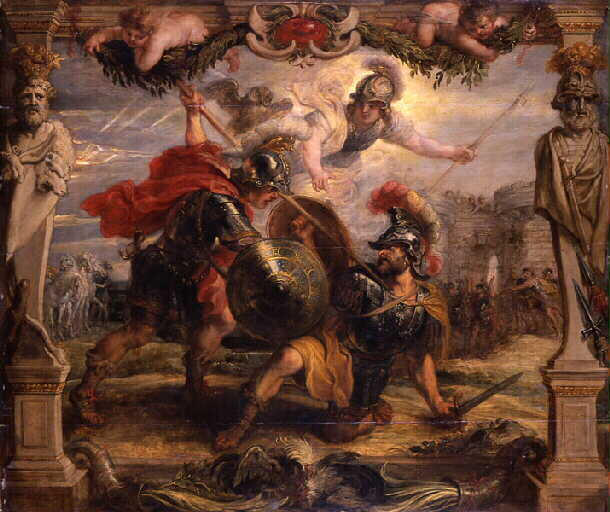
Such pillow-words don’t really exist in English, but they are very easy to find in classical Greek literature, especially the writings of Homer. Consider these epithets frequently used in the Iliad:
Goddess of the white arms, Hera: θεὰ λευκώλενος Ἥρη (thea leukōlenos Hērē)
Whenever I read the Iliad, I always find that these epithets really bring out the drama in the text.
Peter Paul Rubens – Achilles slays Hector
In the same way, the pillow-words in the Hyakunin Isshu are frequently used in certain common combinations:
chihayaburu (千早ぶる) – used to describe the Shinto divinities or Kami (神). See iconic poem 17.
shirotae no (白妙の) – used to describe something white, in particular snow, clouds or cloth. Its literal meaning is taken from the color of fresh mulberry paper. See poem 2 and poem 4.
ashibiki no (あしびきの) – used sometimes to describe mountains (山, “yama”) and peaks. Its meaning is something like “foot-drawn”. See poem 3.
hisakata no (ひさかたの) – used to describe things like the sky (空, “sora”), moon (月, “tsuki”), rain (雨, “amé”), clouds (雲, “kumo”), light (光, “hikari”), night (夜, “yoru”), and even the capitol (都, “miyako”). Its meaning is something like peaceful, shining, and especially everlasting. See poem 33 and poem 76.
Some examples of pillow words used in Japanese waka poetry, but not found in the Hyakunin Isshu are:
ubatama no (烏羽玉の) – describes the color “jet-black” and often used to describe hair or night. An example is found in the Kokinshuanthology, poem 647.
aoniyoshi (あをによし) – used to describe the old capital of Nara itself. Poem 328 in the Manyoshu is one such example. The word aoni (青丹) refers to a high-quality bluish-black pigment that was derived from soil around the Nara area.
umasaké (味酒) – used to describe the sacred mountains around Nara (see poem 2 in the Hyakunin Isshu) implying the essence of delicious rice wine. Think Dionysus from Greek mythology. You can an example in the Manyoshu, poem 17.
yasumishishi (八隅知し, or 安見知し) – refers to the august reign of an Emperor, spanning the eight cardinal directions.Manyoshu poems 50 and 923 both contain this phrase.
isanatori (いさなとり), originally from an archaic word for “whale” (いさな) is used with words such as the ocean, beach, etc. Poem 3852 in the Manyoshu is an example.
Many of these phrases are 5-syllable phrases (sometimes 4), so they “slot” in seamlessly in a typical waka poem (5-7-5-7-7 syllables). In later ages, the number of pillow words increased to about 1,200 phrases, though many of them remain pretty obscure. Even in modern poetry, these stock phrases are still very much in use.
Interestingly, my book on the Manyoshu explains that some of these phrases do not appear until they are used in poetry by Kakinomoto Hitomaro (poem 3, あし), implying that he coined some of these phrases himself. Of the hundreds of documented pillow words, at least 50 are attributed to Hitomaro including some listed above.
Pillow words are hard to translate, but they are a fascinating window into Japanese culture in antiquity.




 The Hyakunin Isshu


