The Gossamer Years

Hi all,

This somewhat different than my usual posts, but I after posting by poem by the Mother of Michitsuna (poem 53), I decided to read her diary, titled the Gossamer Years, or kagerō nikki (蜻蛉日記) in Japanese.

The “Mother of Michitsuna” is never named as per the culture of the Heian Period of Japan. She lived a generation or two before other famous female authors such as Sei Shonagon (poem 62), Lady Murasaki (poem 57), Lady Izumi (poem 56), etc. The translator, Professor Seidensticker, did a masterful job translating this difficult text. In reading the footnotes, you can see he struggled a lot with the vagaries of the text, and with the language, where it’s not always clear from the context who’s talking about whom.

At the time, she was from a lesser branch of the powerful Fujiwara Family, but she married Fujiwara no Kane’ie, who was gradually moving up the ranks of the Heian Court. Fujiwara clan, Kane’ie had to contend with various other members of the court, and even his own clan, to gain the prestigious position of Regent, which he finally accomplished in 986 as regent for Emperor Ichijō. His sons, Michinaga and Michitaka both became regents and the most powerful men in the Heian Court. Lady Murasaki (poem 57) served under Michinaga, by the way, and they are the subject of a Japanese historical drama in 2024.

Suffice to say, Kane’ie was a very ambitious and influential man. As such, he married a few women, as per Heian Period custom, and also carried on various affairs, having yet more children on top of this. One of these children is the author of poem 52.

The Mother of Michitsuna began her diary when Kane’ie first met her, and courted her. Her own father was the governor of a remote province, a mediocre position in the Court, but he gave his blessing and they were married. In the early part of the Diary, she writes about all the passionate love poems they exchanged and such. It seemed like a good relationship early on, but the Mother of Michitsuna wasn’t Kane’ie’s first wife. She was probably his second or third wife (the diary isn’t clear on this), and his time was divided between his wives. When he was not around, she stayed in one of the outer rooms of his mansion and just passed the time with her hand-maidens.

But as the diary shows, Kane’ie’s visits came less and less often. In time she tracked him down to an alleyway where he’d spend the night with some girl, presumably a bastard child of one of the emperors, and rumor has it that she had a son by him as well. The author was not surprisingly furious and jealous, but completely powerless to stop him. She writes about the sound of his carriage driving by the residence, but not even stopping by to say hello, while she spent night after night alone.

Later, in Book 3, she finds about more of his affairs and children, and adopts the daughter of another of his lovers so that she doesn’t have to spend her young life in a monastery. Strangely, Kane’ie’s brother takes an interest in the child (his own niece) and gets very pushy about marrying her which again was not unusual at the time among the nobility. The Mother of Michitsuna expends a lot of effort to delay and make excuses for the girl, and pleads with her husband to help her, with only modest success.

This agonizing loneliness and sense of abandonment is the primary theme of the Gossamer Years. There are times when Kane’ie and the Mother of Michitsuna grow closer briefly, such as when Kane’ie falls gravely ill or when the Mother of Michitsuna loses her own mother to old age, but after a while he forgets her again. Their relationship is quite strained in the diary though, because she is frequently enraged by his insensitivity, but Kane’ie gets frustrated by her “moods” and can’t seem to understand why she is mad at him. Worse, he blames her regularly as to why he doesn’t come anymore.

At one point, the Mother of Michitsuna, now old and a has-been, has had it with Kane’ie and abruptly moves out of the mansion and retreats to a monastery which causes quite a stir at the Court and humiliates Kane’ie. Furious he tries to send messenger after messenger to bring her back, but she refuses for a long time. Finally, after a combination of threats and pleading, she agrees to return home, but they soon fall into the old routine again.

The Mother of Michitsuna only had one child with Kane’ie, Michitsuna of course (who rose to be a minister of the Court, though not as powerful as his half-brothers), and Kane’ie seems to take much pride in his son, but also periodically uses him as a weapon for getting back at his mother.

Thus, the Gossamer Years is a long, and often very depressing diary of a noblewoman in a very unsatisfying marriage who spent many dreary days alone. The diary ends abruptly one day when there’s a knock at her residence, and it appears that she never took up the brush again. Nobody knows why. As for the diary itself, it is full of poems exchanged back and forth. Most of these are mediocre poems, though as you can see, Fujiwara no Teika did include one of them in his famous Hyakunin Isshu anthology. However, these other poems are also waka poems, just like the ones you read here on this blog, and it’s amazing how many poems people exchanged in those days just to express things like “how are you?” or “can you come over?”.

In today’s modern age where text-messages replace letters or poems, we can send messages much quicker now, but it’s amazing how much skill and subtlety it took to get a simple point across to someone back then. Not surprisingly, the kinds of feelings of frustration a broken-hearted woman might have were probably much worse then because they were traditionally very isolated in their homes. It was uncommon for women, especially powerful noblewomen, to go out on their own without permission from their husbands, and their lifestyle and huge robes made it difficult to travel far anyway. Customs and such would also get in the way too. In short, women spent most of their time indoors in their home with nothing to do.

As for the Mother of Michitsuna herself, it’s tempting to make her a tragic, almost saintly figure, but in reality she was prone to faults of her own. When the “woman in the alley” had the misfortune of losing her home to a fire, the author felt a moment of triumph and petty revenge without any remorse. In another, more troubling scene late in book one, she encounters a defeated rival (it’s not clear who) and gloats over her:

At the Hollyhock Festival in the Fourth Month I recognized the carriage of a lady who had once been my rival, and I deliberately had my own carriage stopped beside it. While we were waiting, rather bored, for the procession to go by, I sent over the first line of a poem, attached to an orange and a hollyhock: “The hollyhock should promise a meeting, but the orange tells us we have yet to wait.” After a time she sent back a line to complete the couplet: “Today for the first time I know the perverseness of her who sends this bitter yellow fruit.” “Why just today—she must have had similar feelings for years,” said one of my women. When I told the Prince [Kane’ie] of the incident, he remarked, to our considerable amusement, that the closing line the lady really had in mind was probably more like this: “This fruit you send me, I would like to grind it to bits with my teeth.”

pg. 59, trans. Seidensticker.

Clearly the Mother of Michitsuna was not above petty rivalries or revenge when it suited her.

Anyhow, what makes the Gossamer Years such a significant work of literature is that it was the first and only real diary of the Heian Period to really express how a woman felt in that small, cloistered world. The Heian Period had many great works of literature, both by men and women, but these works were either fiction (e.g. Tales of Genji), poetry (e.g. Tales of Ise) or just dry, stodgy journals about oval events. The Gossamer Years is much more “raw” and unfiltered than other works at the time. The Mother of Michitsuna is not a strong or witty writer like Sei Shonagon or Lady Murasaki, but you can really feel her pain at times, and wonder why she puts up with him. Then again, the customs of the time gave her few options.

But as you see later in Book 3, it was the culture of the time, not unlike the cloistered French Aristocracy centuries later. The marriage laws from the Taika Reform were vague and full of loopholes, so men could marry as often as they could afford, and affairs were pretty rampant as other poetry in the Hyakunin Isshu regularly show. So while I do enjoy the Hyakunin Isshu and the culture of the Heian Period very much, the Gossamer Years was a sobering reminder that there was a serious side to it as well.

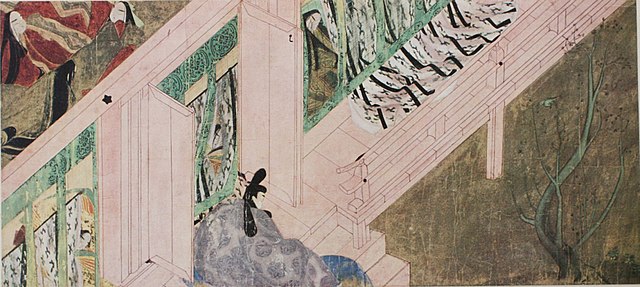
P.S. Featured photo is a scene from the Genji Monogatari (“The Tales of Genji)”, Chapter “YADORI GI”( mistletoe ), by Lady Murasaki (poem 57).  Imperial court in Kyoto, Public domain, via Wikimedia Commons

2012 in review: 100 Poets Blog

Thanks all for reading this blog. When I first started it, I didn’t expect much more than a few readers, but to my surprise it has grown a lot more than expected. Anyhow, the WordPress.com stats helper monkeys prepared a 2012 annual report for this blog and I felt like sharing it with readers.

Here’s an excerpt:

600 people reached the top of Mt. Everest in 2012. This blog got about 5,100 views in 2012. If every person who reached the top of Mt. Everest viewed this blog, it would have taken 9 years to get that many views.

Click here to see the complete report.

Waves Beating Against The Shore: Poem Number 48

I decided to post this one after Valentine’s Day for all those whose plans didn’t go well. You’re not alone, as we shall see.

JapaneseRomanizationTranslation
風をいたみKaze wo itamiWaves that beat against the rocks,
うつ波のIwa utsu nami nofanned by a fierce wind—
おのれのみOnore nomiit is I alone
くだけて物をKudakete mono wowho breaks, those times
おも頃かなOmou koro kanawhen I think of her!
Translation by Dr Joshua Mostow

The author, Minamoto no Shigeyuki (源重之, ? – 1001) was a well-associated poet who knew Kanemori (poem 40) and Sanekata (poem 51) according to Mostow. He is the last of the Thirty Six Immortals of Poetry featured in the blog (not all 36 are in the Hyakunin Isshu).

The poem, like poem 45 and poem 19, features the popular theme of a cold lover. For some reason, I had a difficult time understanding the analogy of this poem the first time, but Shigeyuki is comparing himself to the waves that crash on the shore. His lover is like the rocks that are unmoved by the waves.

It turns out though that this poem was actually composed for a poetry game involving a hundred-poem sequence “when Retired Emperor Reizei was still called the crown prince” according to Mostow. Such poetry games were popular in the late Heian Period, and influenced people like Fujiwara no Teika and the Hyakunin Isshu anthology.

The Cold Morning: Poem Number 52

For our final poem for Valentine’s Day, I thought this was another good choice:

JapaneseRomanizationTranslation
明けぬればAkenurebaBecause it has dawned,
暮るるものとはKururu mono to wait will become night again—
知りながらShiri nagarathis I know, and yet,
うらめしきNao urameshikiah, how hateful it is—
あさぼらけかなAsaborake kanathe first cold light of morning!
Translation by Dr Joshua Mostow

The author of the poem, Fujiwara no Michinobu Ason (藤原道信朝臣, 972-994), was the adopted son of the powerful Fujiwara no Kane’ie, husband of the mother of Michitsuna (poem 53) and subject of the Gossamer Years. His birth mother was the daughter of Fujiwara no Koretada (poem 45). Michinobu for his part, benefitted from his adoptive father’s influence, and rose to the Court rank of 4th-upper, and a position as part of the Imperial Guard (sakon no chūjō, 左近中将).

However, Michinobu seemed more interested in Waka poetry than in politics. He was close with Fujiwara no Sanekata (poem 51) and Fujiwara no Kinto (poem 55), and would often gather with them for poetry sessions. Further, Michinobu had a secret relationship with one of the court ladies under Emperor Kazan, named Enshi Jo-ō (婉子女王), but eventually he lost her to a political marriage with the powerful Fujiwara no Sanesuke. Sadly, Michinobu later died from due smallpox, which took his life at the age of 23.

This is another classic “Morning After” poem, which we’ve featured here, here and here.

Lord Michinobu dreads the rising sun because it means he has to sneak back to his own residence, away from his lover. Judging by his reaction, it must have been a night well-spent together. 😏

Happy Valentine’s Day!

Lost Without An Oar: Poem Number 46

Hello,

Continuing our theme for Valentine’s Day, this poem is quite fitting and another example of a “love poem” from the 40’s section of the Hyakunin Isshu:

JapaneseRomanizationTranslation
由良の門をYura no to woLike a boatman, crossing
わたる舟人Wataru funabitothe Strait of Yura,
をたえKaji wo taewhose oar-cord has snapped,
ゆくもしらぬYukue mo shiranuI’m lost and know not my way
こいの道かなKoi no michi kanaon the road of love!
Translation by Dr Joshua Mostow

The author, Sone no Yoshitada (曾禰好忠, dates unknown), lived toward the end of the 11th century, but as Mostow writes, very little else is known about him. Apparently he was a prolific poet and had his own collection, which was common among the aristocracy of day, but his style was considered unconventional and unappreciated until the time of Fujiwara no Teika (poem 97), who compiled the Hyakunin Isshu.

The poem is somewhat confusing, Mostow explains, for two reasons. The first is that the location of “Yura” isn’t know, but exists in both Kii and Tango provinces. Since Yoshitada was a secretary in the province Tango, perhaps he meant that Yura, but it’s only speculation on my part. The second is the phrase kaji wo tae (かぢをたえ), the third line. It can either be read as kaji wo tae (to lose an oar), or kaji-o tae (the oar cord snaps). Mostow makes a convincing argument for the latter.

But in any case, I think we all know that feeling when we were young and experienced love for the first time how happy, yet lost we were. Things haven’t changed in 900 years it seems. 🥰

A Cold Shoulder: Poem Number 45

This is another poem in our series leading up to Valentine’s Day. This one is perhaps a bit more unrequited, than the last poem I posted here:

JapaneseRomanizationTranslation
れともAwaré to moNot one person who would
べき人はIu beki hito wacall my plight pathetic
えでOmoedécomes at all to mind,
身のいたらにMi no itazura niand so, uselessly,
なりぬべきかなNarinu beki kanaI must surely die!
Translation by Dr Joshua Mostow

This poem was composed by Kentokukō (謙徳公, 924-972) also known as “Lord Kentoku”, or simply Fujiwara no Koremasa. Koremasa served as regent to the Emperor from 970 onward, and was frequently involved in compiling (and writing poems for) the second Imperial anthology of the time, the Gosenshō.

The poem, simply put, is Koremasa’s efforts to gain a girl’s attention, even after she spurned him previously. Mostow explains that according to the original sources, this poem was composed by Koremasa thinking “I will not be defeated!” and sent this poem as a last-ditch effort.

Nowadays, we might call such people stalkers, but at the time, this kind of persistent, dramatic effort wasn’t unusual. Men of the Court might try months if not years to gain a girl’s attention, and if she spurned him a few times, he might have chosen to persist, or possibly find a new lover.

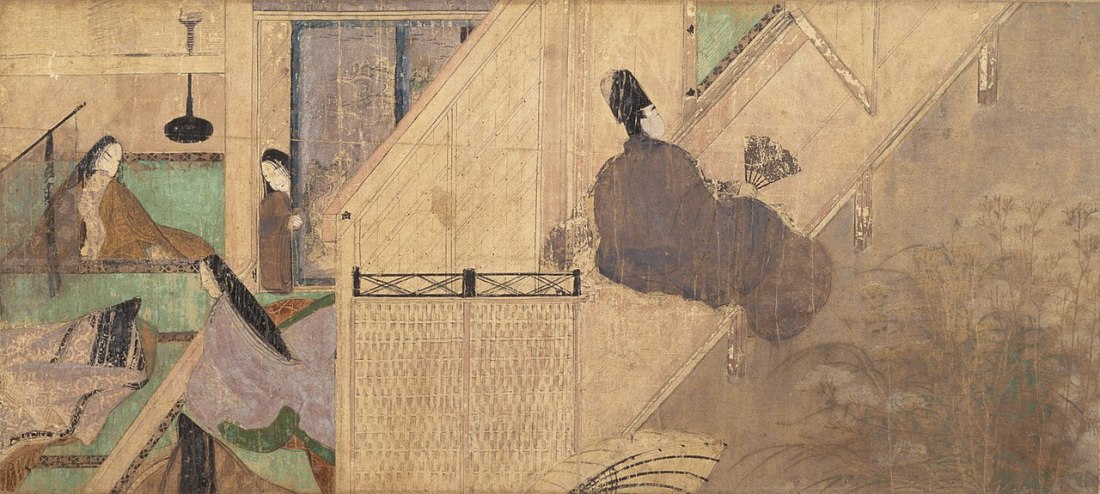
P.S. Featured photo is a scene of the Chapter “TAKEKAWA “(Bamboo River) of Illustrated handscroll of Tale of Genji (written by MURASAKI SHIKIBU(11th cent.)., Unknown author, Public domain, via Wikimedia Commons

Changed One’s Life: Poem Number 43

I can’t believe it’s been a year since my last series of love poems for Valentine’s Day. But, here we are again! This poem is the first in a series I’ll be posting before Valentine’s Day:

JapaneseRomanizationTranslation
見てのAi mite noWhen compared to
後の心にNochi no kokoro nithe feelings in my heart
くらぶればKuraburebaafter we’d met and loved,
むかしは物をMukashi wa mono woI realize that in the past
ざりけりOmowazari keriI had no cares at all.
Translation by Dr Joshua Mostow

The poet, Supernumerary Middle Counselor Atsutada (権中納言敦忠, 906-943), also known as Fujiwara no Atsutada, was among the sons of the power minister Fujiwara no Tokihira (the same man who had Sugawara no Michizane exiled, poem 24), and was one of the Thirty-Six Immortals of Poetry, as well as an accomplished poet all-around. Sadly, like his father Tokihira, Atsutada, according to my new book, died young in his 30’s and rumors swirled at the time that this was Michizane’s vengeful ghost. Such rumors help provide the impetus for Michizane’s later deification as a means of pacifying him.

The book also states that Atsutada was quite a playboy in his time. No sooner had he got into a relationship with Ukon (poem 38), then he dumped her, prompting her to write a bitter poem about it. On the other hand, Atsutada kept up a long, passionate correspondence with the daughter of Emperor Daigo, Masako, until she was sent away to be the high priestess of Ise Shrine. It was a heartbreaking separation we are told.

This is a classic “morning-after” poem (kinuginu no uta, 後朝の歌) which we’ve talked about in Poem 50 and Poem 30. The author’s love and longing have only increased, not decreased since their first meeting together.

As written before, meeting one’s lover was a huge ordeal among the aristocrats of the Heian Court in Japan. It wasn’t like meeting someone online today, or just going to have coffee together. Men and women were constantly separated from one another, and one would be lucky to catch sight of a woman’s sleeve back then, let alone her face. So, a first meeting required a long, drawn out courtship of exchanging poetry, and somehow arranging a way to meet that wouldn’t catch the public eye. Worse, if the meeting didn’t go well, then it was kind of a wasted effort and breaking up would be awkward as well. Or, if word got out, it could cause a scandal. Discretion was essential.

But, when things hit it off so well like this, it’s a cause to celebrate. 🙂

P.S. Featured photo is a scene (AZUMA YA: East Wing) from the Illustrated scroll of the Tale of Genji (written by MURASAKI SHIKIBU (11th cent.) Courtesy of Wikipedia