
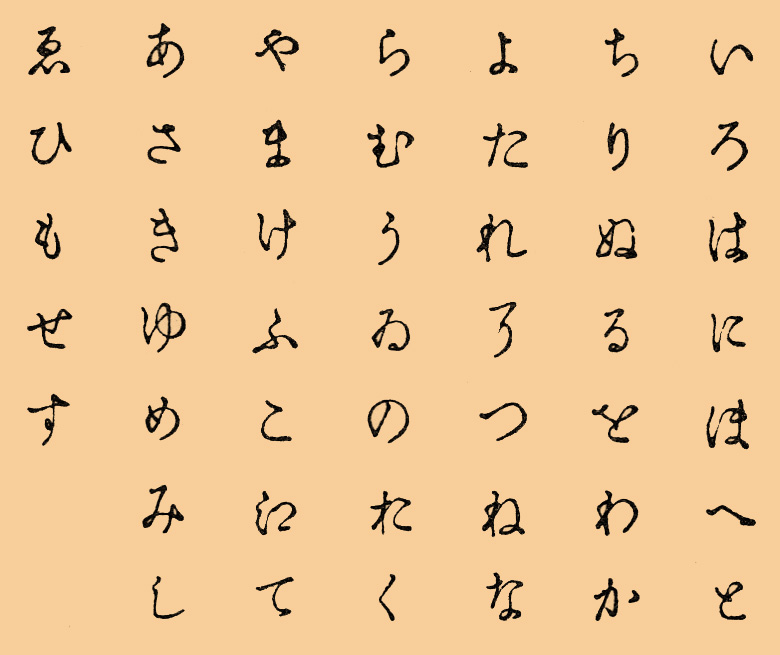
One of the most famous waka poems across Japanese history and even contemporary culture is a poem called the Iroha. The name “iroha” comes from the first three letters of the poem “i”, “ro” and “ha”. What makes this poem famous is that it uses each hiragana syllable exactly once, and still makes an intelligible, not to mention lovely, poem.
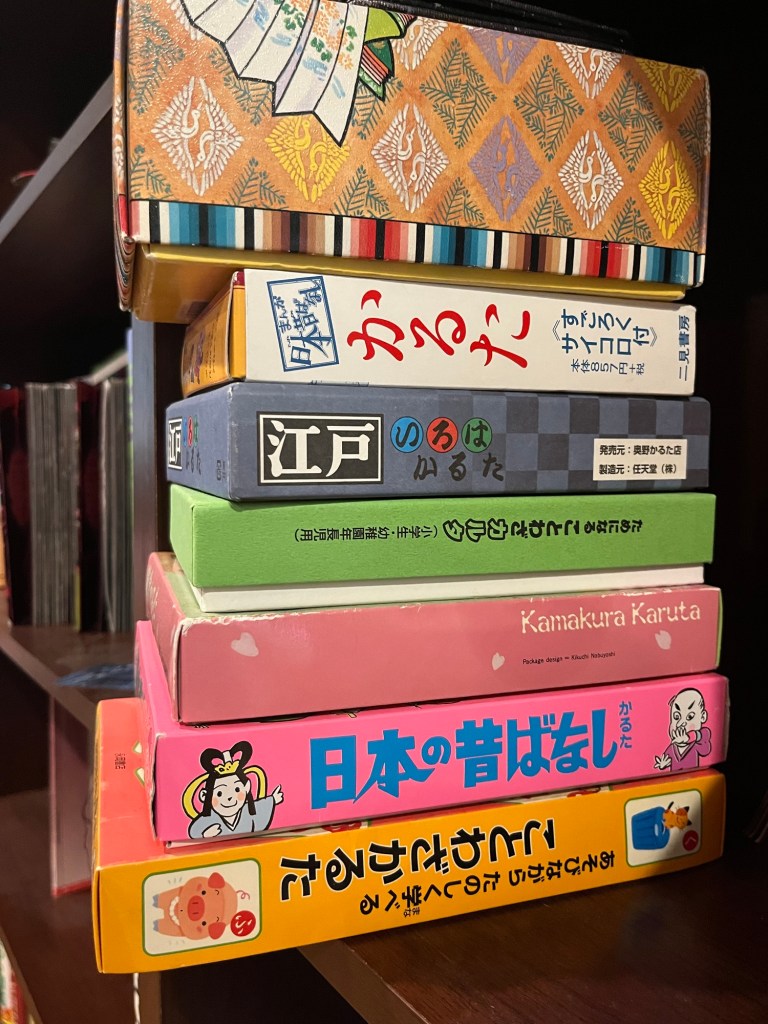
Because of this, it was often used in pre-industrial Japan as a way to organize things. Theater rows would be organized by the order in the Iroha letters, and so were firefighter brigades in pre-modern Tokyo (a.k.a. Edo). Even modern karuta sets are organized by iroha order. I don’t mean the Hyakunin Isshu karuta that I often discuss in the blog, but more informal karuta games that kids often play. We have a few sets here at home, given to us by my in-laws for the grandkids. You can see a nice selection of Iroha karuta sets on the Okuno Karuta online store, too.a
But I digress.
The Iroha poem’s author is unknown (more on that later), but it was originally composed in old Manyogana script, like other poems of the early Manyoshu anthology, then later in hiragana. It includes many old spellings, so it’s a bit hard to render in modern Japanese.
The poem is as follows:
| Manyogana | Modern Japanese | Romanization | Translation1 |
|---|---|---|---|
| 以呂波耳本部止 | いろはにほへと | I ro ha ni ho he to | Even the blossoming flowers |
| 千利奴流乎和加 | ちりぬるをわか | chi ri nu ru o wa ka | will eventually scatter |
| 餘多連曽津祢那 | よたれそつねな | yo ta re so tsu ne na | Who in this world shall |
| 良牟有為能於久 | らむうゐのおく | ra mu u i no o ku | remain unchanged? Let us today2 |
| 耶万計不己衣天 | やまけふこえて | ya ma kyo (ke fu) ko e te | cross the mountains of impermanence |
| 阿佐伎喩女美之 | あさきゆめみし | a sa ki yu me mi shi | and no longer have superficial |
| 恵比毛勢須 | ゑひもせす | e hi mo se su | dreams, nor be deluded |
2 有為 (u i) meaning “viccisitudes of life” or the impermanence of all phenomena
This poem has strong Buddhist allusions to such concepts as samsara (“the aimless wandering lifetime after lifetime”), the delusions that bind us to this existence, awakening to these delusions (e.g. “enlightenment”), and finally nirvana (“unbinding”). The poem itself shows considerable familiarity with earlier Buddhist texts such as the Perfection of Wisdom sutras, including the Heart Sutra, as well.
But I digress. Again. 😅
There are some really interesting aspects of this poem that are worth sharing. First, authorship. Given the strongly Buddhist undertones of the poem, it’s often been attributed to a famous Buddhist monk named Kukai (a.k.a. Kobo Daishi) who was a talented poet and calligrapher. Another theory states that this poem may attributed to none other than the famous court poet Kakinomoto no Hitomaro, who composed poem 3 in the Hyakunin Isshu (あしびきの).
But things get even more interesting.
Scholars have noted that if you take the last syllable of each line (highlighted above for convenience) it spells another sentence: toka (ga) nakute shisu (咎[が]無くて死す) meaning “he/she died without fault or blemish”. Another theory, mentioned in my new book, points out that the 5th column spells out ho(n) wo tsu no ko me (本を津の小女), which could mean “deliver this book to my wife in the town of Tsu”, which if taken together with the 7th column implies that “I will die without blemish, please deliver this poem to my wife”.
So, is the poem a tribute to someone else? Perhaps Kukai or Hitomaro? If so, then who wrote it, and why? Was the poem a coded message to someone who was executed for political reasons? Or was the poem simply an attempt at word-play?
We will never know, but the impact of the Iroha on Japanese poem can still be easily seen today.
a Although things like Chihayafuru and this blog tend to emphasize the competitive karuta of the Hyakunin Isshu, in reality that’s only a small subset of karuta gaming culture. Most of it is much more informal stuff you play at home with family, much like board games in Western culture, and often times doesn’t even relate to the Hyakunin Isshu. Maybe I’ll post about it some time, but thanks to grandparents in Japan, we have 4-5 sets here ranging from such subjects as places in the city of Kamakura, old folks-sayings, Japanese fairy-tales, and just really basic words in Japanese. Most of these list the cards using iroha-order, and are not related to the Hyakunin Isshu. We’ve played them with our kids from time to time, and they’re much easier than competitive karuta, though it’s still assumed you know at least some basic Japanese.
 The Hyakunin Isshu
.jpg)