A Look at Heian Period Japanese Language

Language is not static. Any language that is spoken and used changes and evolves over time. The English language started as a dialect of German, but through a series of invasions, and innovations has a lot of elements that look French, with layers of classical Latin and Greek. The Greek language has been in continual use since the days of the ancient Mycenaeans to modern Greek people today, and ancient words can be found in use, yet at the same time modern Greek is smoother, more streamlined than its ancient Bronze-Age speakers. The ancient Chinese spoke in the Bronze Age doesn’t sound like modern Chinese, and yet the echos are still there both in the writing system, and how words a pronounced across various regional dialects.

Japanese has been in continual usage for 2,000 years and it is possible to look at old poetry, such as the Hyakunin Isshu, and with a bit of effort still make sense of it as a modern, native speaker, or even as a language student. It also helps to explain why poems of the Hyakunin Isshu have such odd spellings compared to modern, standard Japanese.

And yet, Japanese has changed over time. Words and grammar have evolved, and so the poetry of the Hyakunin Isshu, as well as other writings of the time, look and sound in a certain way that might surprise modern people. This post is a brief exploration of the kind of Japanese used during the Heian Period (8th to 12th centuries) of Japanese history when most of the Hyakunin Isshu was composed. This period of Japanese is called “Early Middle Japanese” by English-speaking scholars, and chūko-nihongo in Japanese (中古日本語, lit. “middle-old Japanese”).

To give a quick demonstration, take a look at the video below, starting around 00:47. This is the first lines of the text, the Pillow Book, which we also talked about here.

A few things will jump out right away even to casual Japanese students.

First, all the “ha” syllables, namely ha (は), hi (ひ), hu (ふ), he (へ), and ho (ほ) are all pronounced with a “f” sound: fa, fi, fu, fe, fo. Even the subject-marking particle “wa” (also written as は) was pronounced as “fa” back then. Similarly, the “ta” syllables: ta (た), chi (ち), tsu (つ), te (て), and to (と) were all consistently pronounced as “t”: ta, ti, tu, te, to. In modern Japanese, people say omoitsutsu (思いつつ) to mean “even as I think about this…”, but back then the same word was pronounced omoitutu.

Finally there were more “wa” syllables back then, compared to now, and like the “ta” syllables, they were more consistently pronounced: wa (わ), wi (ゐ), we (ゑ), wo (を). In modern, Japanese, only “wa” is still pronounced with a “w” sound, and wi and we are no longer used, or pronounced simply as as equivalent “i” and “e”. Similarly, if you watch historical dramas, the old way of politely using the “negative”-form of a verb has shortened from nu (ぬ) to simply n (ん) : mairimasenu (“I will not come”) to mairimasen in modern-humble Japanese.

Languages tend to contract and streamline over time.

Using Greek language as a similar example, pronunciation of words in Homer’s Iliad sounds longer and clunkier than similar words in Koine Greek of the New Testament, and even more streamlined now in Modern Greek. Sanskrit in India was spoken 4,000 years ago, and lives on in many northern Indian languages such as Hindi, Marathi, Magadhi and so on, and each one looks like a smoother, simpler version of the old Sanskrit language. Japanese pronunciation of words has similarly contracted into shorter, smoother, more efficient forms.

What about grammar? That’s an interesting question. In some ways, the grammar of Japanese hasn’t changed all that much in the eons. Japanese verbs are inflected (like Latin, Greek and Sanskrit) and different endings convey different meanings. Many verb endings in Japanese, which you can see in Hyakunin Isshu poetry, no longer exist, or are replaced with other endings. Let’s look at a concrete example.

Poem 73 (たか) is a nice example of things that changed, and things that have remained the same.

JapaneseRomanizationTranslation
高砂のTakasago noAbove the lower slopes
の桜Onoe no sakuraof the high mountains,
the cherries
咲きにけりSaki ni kerihave blossomed!
とやまのかすみToyama no kasumiO, mist of the near mountains,
立たずもあらなTatazu mo arananhow I wish you would not rise!
Translation by Dr Joshua Mostow

Some words like sakura (cherry blossoms) and kasumi (mists) haven’t changed at all. The possessive particle no meaning “of, or belonging to” hasn’t changed either in terms of usage.1

On other other hand, we see some grammar not found in modern Japanese. For example, in old Japanese, especially poetry a verb-stem ending with ni keri meant that something has been done (from past to present). Modern Japanese uses verb endings like te kita, te itta, and so on to convey similar context.

Another example is –zu mo aranan, which I wasn’t able to find online, but based on verb tatsu (to rise, to stand), obviously means implies a negative connotation (i.e. not do something). In modern Japanese you can say something similar: tatazu ni (without standing…), so again you can see the continuity.

Something you often see, but not shown in this poem is adjective endings. Modern Japanese adjectives often end with an i sound, for example “cold” is samui, “fast” is hayai, and so on. But in old Japanese the i was often a ki: samuki, hayaki, and so on. I noticed both in the Hyakunin Isshu, but also in Japanese RPG games when they take place in old “fantasy times”, because it helps convey a sense of ages past.

Finally, some words just change meaning over time. I was surprised to learn that the word for “shadow” kagé used to mean “light”, as in tsuki-kagé (moonlight). So, even if the word stays the same, the nuance does evolve over time.

Finding information on Early Middle Japanese in English is pretty difficult, and often requires an academic background. Since I am just an amateur hobbyist, this is only a brief overview. There is a lot more to cover, but hopefully gives you a brief sense of how things have changed over time. Japanese is a language that shows a nice continuum over its long history, and it’s fascinating to see howd the same language looked and sounded so far back.

1 I think I read somewhere that in really, really old Japanese the “no” possessive particle used to be “na”. I don’t know if that relates somehow to the “na-adjectives” in Japanese language, but I do wonder.

The Dark Side of Heian Period Japan

The Hyakunin Isshu and its poets, the aristocracy of the Heian Period, represent a golden age of Japanese history, and a level of cultural refinement that was often imitated, but never surpassed in later generations. I have been celebrating that culture on this blog all the way back since 2011 (!), and it has always been a personal fascination of mine.

And yet, amidst all this culture and elegance there was very much a dark side to this culture too. This is encapsulated in works at the time, such as the melancholy and weariness of backbiting in the diary of Lady Murasaki, the isolation and frustration at her husband’s rampant infidelity in the Gossamer Years, among other sources. Further, the historical drama about Lady Murasaki highlights a particularly dark episode involving the succession to the Imperial Throne around the years 1000-1010.

The top positions at the Imperial Court were the Udaijin (右大臣, “Minister of the Right”) and Sadaijin (左大臣, “Minister of the Left”). The minister of the Left was higher rank than the minister of the Right. If you look at the authors of the Hyakunin Isshu, you’ll notice a few held such positions over the years: poems 14, 25, 81, and 93.

If you look at the list of poems, you’ll notice quite a few are composed by members of the elite Fujiwara clan (roughly 25-30%). In the 7th century or so, the Fujiwara had been instrumental in protecting the Imperial throne from a usurper, and handsomely rewarded for it. By the year 1000, the Fujiwara clan had grown so large and prosperous that it developed into multiple sub-clans, branches and rival groups.

I mention this because the episode I relate here relates to two powerful branches of the Fujiwara clan in their struggle for power. There’s an excellent article in Japanese about it, which I encourage you check out because it also includes scenes from the drama.

It all begins with one Fujiwara no Kaneie, husband of “Michitsuna no Haha” (poem 53) and the “villain” of the Gossamer Years. Kaneie was particularly ambitious, served under three emperors, and had three sons, who each held ministerial positions. The eldest son was Fujiawara no Michitaka whose wife was “Gidō Sanshi no Haha” (poem 54). He served as the regent for the young Emperor Ichijo, and later, Ichijo married his daughter, Teishi.

The third son of Kaneie was Fujiwara no Michinaga. Remember this name.

After Kaneie’s first son, Michitaka, died his son (Teishi’s brother) named Fujiwara no Korechika, took over that branch of the family. Korechika contended with his uncle, Michinaga, from the get-go, but Korechika made a fatal error. In a strange tale, Korechika believed that retired Emperor Kazan had been sleeping with Korechika’s own mistress. During one of Kazan’s nighttime travels, Korechika in a jealous fit shot an arrow at him and hit the retired Emperor’s sleeve. Michinaga capitalized on this incident to get his nephew Korechika banished from the capitol. This is probably something “Gidō Sanshi no Haha” would have never imagined happened to her son.

Korechika’s sister, Empress Teishi (also daughter of “Gidō Sanshi no Haha”), was now in a vulnerable position without her family to protect her. So, Michinaga pushed forward his own daughter, Shoshi, as a second wife for Emperor Ichijo. Later, the isolated and vulnerable Emperess Teishi died in childbirth. Teishi’s son, the Imperial prince Atsuyasu, appears later. The end result was that Ichijo’s remaining wife Shoshi (daughter of Michinaga) was the reigning empress now, and Michinaga used his influence to gain the title of Minister of the Left. The diary of Lady Murasaki covers this period when Shoshi gave birth to Emperor Ichijo’s second son, Atsuhira.

Let’s pause for a moment. Emperor Ichijo had married two women who were from rival factions of the Fujiwara clan: the exiled Korechika’s sister, and Minister of the Left Michinaga’s daughter, and each bore him a son.

Meanwhile, Korechika was later pardoned and made a junior minister in the Court. And yet Korechika was very bitter toward Michinaga, and his mental health took a downward spiral. He hired a Buddhist priest to help craft a series of curses against Michinaga. Eventually, this was discovered, and Korechika’s career was over and retired until his death in 1010.

Things took an unexpected turn when Ichijo retired early during the same year due to poor health, and his cousin ascended the throne as Emperor Sanjo (poem 68). Sanjo only reigned for a few years before a combination of ill-health and Michinaga’s machinations as the minister pushed him to abdicate too. This is why his poem in the Hyakunin Isshu is so melancholy: Sanjo finally ascended the throne, but ill health and Michinaga’s power-plays ended his reign soon after it began.

Emperor Sanjo’s retirement left Ichijo’s two sons as the next successor: one by Korechika’s sister (Teishi), and the other by Michinaga’s daughter (Shoshi). Which imperial prince do you think Michinaga, the Minister of the Left, wanted to ascend the throne? Michinaga obviously wanted his grandson to be next emperor, so Michinaga could assume the position of regent (Sessho).

Due to age, Atsuyasu, son of the first empress Teishi, should have been Emperor (Atsuhira was too young), but he was bypassed entirely and faded out of history. The child Atsuhira, grandson of Michinaga, ascended the throne as Emperor Go-Ichijo (“The latter Ichijo”).

Korechika’s own son, Michimasa (poem 63), was totally shut out of the Imperial Court as well, and mostly lived a reckless life, trolling Michinaga’s administration, and being just plain obnoxious. His life took a downward spiral much like his father had done, and that branch of the Fujiwara’s male line died out. Michimasa’s fate is particularly dark and tragic.

This multi-generational struggle between two branches of the Fujiwara clan to control the Imperial throne through marriage resulted in Michinaga being the most powerful man in Japan at the time. It also adversely affected many lives of poets in the Hyakunin Isshu. We saw the examples of Michimasa, son of Korechika, and Emperor Sanjo above.

In the case of Sei Shonagon (poem 62), who served Empress Teishi and was loyal to the losing faction, she faded away in retirement. Her Pillow Book is a last swan-song of the time spent serving Empress Teishi, and conveys a very rosy look. It’s not hard to see it was also a subtle middle-finger to Michinaga’s faction.

Many of the ladies in waiting to Michinaga’s daughter, Shoshi, were also poets of the Hyakunin Isshu:

  • Lady Izumi (poem 56),
  • Lady Murasaki (poem 57), author of the Tales of Genji
  • Akazome Emon (poem 59), her sister had an affair with Michinaga’s older brother Michitaka much to the chagrin of “Gidō Sanshi no Haha” (poem 54)
  • Ko-Shikibu no Naishi (poem 60), Lady Izumi’s daughter
  • Lady Ise (poem 61)

By association with Empress Shoshi, not Empress Teishi, they all benefitted and their daughters and family members rose to positions in the Court over time. Lady Murasaki’s daughter, Daini no Sanmi (poem 58), eventually became a wet nurse for future Emperor Reizei and attained the third rank in the Court which was quite high.

Additionally, men like Fujiwara no Kintō (poem 55) benefitted from the association with Michinaga as well.

In the end, there were obvious winners and losers in this struggle. It was not all poetry parties, moon-viewing, and romantic dalliances; people’s lives profited or were destroyed due to hair-splitting power struggles that took generations to complete.

As alluded in Lady Murasaki’s diary, the whole thing was golden sham.

The Hyakunin Isshu in the Edo Period

Since I began, this blog has focused on a period of Japanese history which I like to call “Classical Japan”, or “Japanese Antiquity”.1 That’s just a convenient name I call it.

But most researchers and historians tend to divide Japan’s history into “periods” (jidai, 時代) based on where the capitol was at the time. So, precisely speaking, this blog and the Hyakunin Isshu cover a 500-period of history overlapping the Asuka (6th – 8th c.), Nara (8th c.) and Heian Periods (8th – 12th c.), while dipping our toes just a bit into the the early Kamakura Period (12th – 14th c.) for certain poems (poems 93, 99 and 100 for example). For the sake of the Manyoshu we also ventured even further back to somewhat murkier periods of time since some of the very early poets of the Hyakunin Isshu (poems 1, 2, 3 and 4 for example) were also contributors.

But the blog has never really explored anything beyond the early 13th century because that’s when things effectively end. The Hyakunin Isshu was compiled, the aristocracy of the Heian Period were totally sidelined by the new samurai class, and Japan continued on in a new trajectory. The aristocracy still lived until the modern era, and Imperial poetry anthologies were issued from time to time, but the quality and popularity gradually petered out. As poem 100 above alludes to, this era embodied by the Hyakunin Isshu was effectively over.

For the purposes of this blog, why pay attention to anything that comes after?

Well, I attended Professor Mostow’s recent lecture at the University of Washington, and I learned that history of the Hyakunin Isshu kept going. In fact, it was all the rage in the much later Edo Period (17th – 19th c.).

Japan by the Edo Period was pretty different than the earlier Heian Period. By this point, Japan had been effectively ruled by one military government or another for centuries, while the capitol had shifted from Kyoto in central Japan, to a fortified castle town in eastern Japan called Edo (江戸). Edo started as a fishing town, but soon grew into a metropolis thanks to good urban planning and government policies that forced rival warlords to stay there every other year. Edo, later the modern capitol of Tokyo, was one of the largest cities in the world at one point.

After a century of constant warfare throughout Japan, the Edo Period brought unprecedented stability and cultural flourishing. Its isolation from European explorers and rival Asian powers meant that people turned inward and rediscovered Japanese culture that had been forgotten in ages past due to war and instability.

One aspect of this flourishing was the invention of block printing which suddenly allowed the masses to enjoy reading in a way that earlier generations had not. Books became far more affordable, and more available, and suddenly a variety of books about the Hyakunin Isshu were published. There were books about the Hyakunin Isshu as far back as the 15th century, namely the Ōei-shō (応永抄) composed in 1406, but mass-printing made books much more accessible and allowed for a greater variety.

Professor Mostow has collected and aggregated many examples on his website here. Take a look if you can, there are some neat scans of really old documents from the era.

One common usage of the Hyakunin Isshu at the time, according to Professor Mostow, was in the instruction of girls. Books about young women’s education were a popular subject, and such books would work lessons in along with poems of the Hyakunin Isshu. For example, Professor Mostow posted scans from a book called the Hyakunin Isshu Jokun Shō (“A Selection of the Hyakunin Isshu for Women’s Instruction” ?), published in 1849. Another example can be found here.

Men were often taught things like Confucian values and such. And yet, even the boys learned about the Hyakunin Isshu from their mothers who had been raised on it. Also, books that were published for men about the Hyakunin Isshu often did so under the theme of Kokugaku (“national learning”).

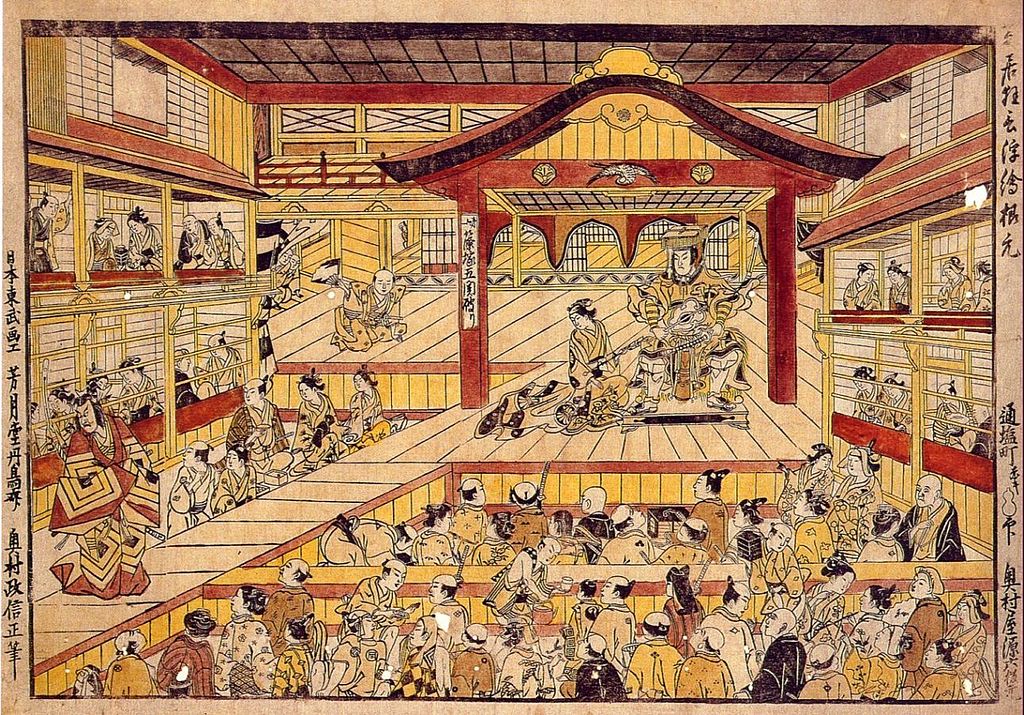
A block print of the Masanobu Kabuki theater, 1743. Hokusai, Masanobu, Kiyonobu, XVII-XIX century, Public domain, via Wikimedia Commons

The high point of Edo Period culture, and something that influences Tokyo even today was the Genroku Period (1688 – 1704). Many things people imagine of pre-modern Tokyo, such as Kabuki theater and Ukiyo-e prints, have their origin in this brief period. The Hyakunin Isshu was used in some Ukiyo-e block prints too. Since many of these images were racy or scandalous, publishers would work in poetry of the Hyakunin Isshu to either obfuscate the content from Edo government censors, or to lend a more “classy” air to the image. I found some examples here.

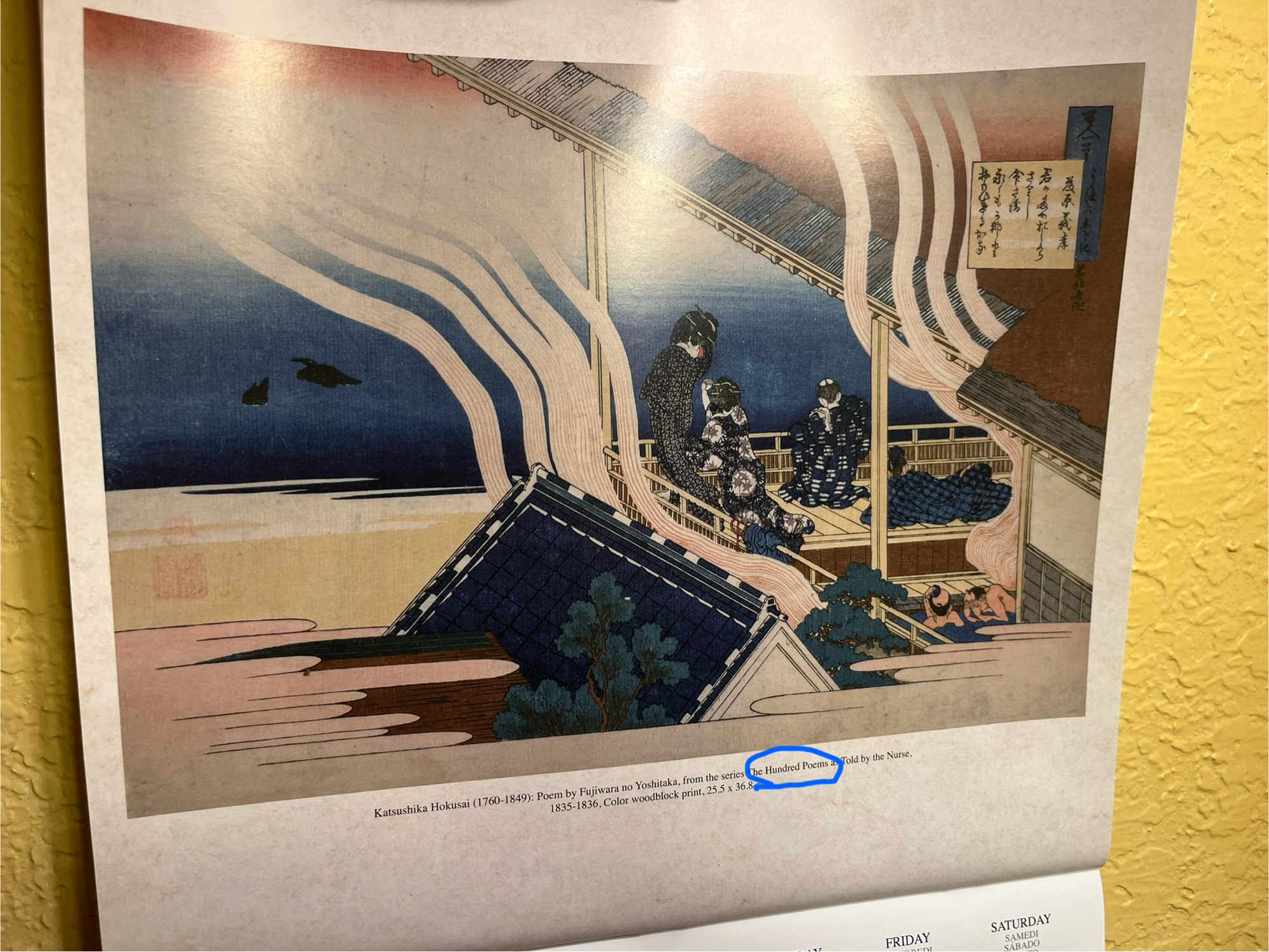
Even the famous artist Hokusai of “Great Wave” fame made block prints that would feature poems of the Hyakunin Isshu. We have a calendar at home and I was surprised to see this Hokusai block print with poem 50 (きみがためお) composed in cursive:

Our wall calendar featuring art by Hokusai. Turns out this page was from the Uba ga Etoki.
In blue, reads Hyakunin Isshu Uba Ga Toki, and in the yellow box poem 50 of the Hyakunin Isshu.

It turns out this is part of a series by Hokusai called the Uba ga Etoki (姥がゑとき), or more formally the 百人一首姥がゑとき2 , which means something like the “The Illustrated Hyakunin Isshu As Told By a Nurse(maid?)”. You can see more examples of this work here.

Anyhow, it’s fascinating that as literacy among the populace improved during the Edo Period, and access to information via books and printing increased, popular interpretations and illustrations of the Hyakunin Isshu took on a new life. The Hyakunin Isshu was, by that point, already 600 years old, and yet it enjoyed a revival that we benefit from today in the form of anime, karuta, and so on.3

Special thanks to Professor Mostow for his lecture and website! Also, check out Professor Mostow’s new book!4

1 I suppose my reason for doing this is that the end of the Heian Period and the subsequent change in Japan was somewhat similar to the fall of the Western Roman Empire in Europe, and how later generations of feudal lords kept up some of the trappings of the Romans, and yet it was still a different society altogether. But in the end, this is just one history nerd’s interpretation.

2 In modern Japanese 百人一首うばが絵解. See this post for more explanation.

3 Although social media and Internet reveal a pretty ugly side to humanity, it does also lead a similar explosion in cultural and accessibility. Two sides of the same coin, I suppose.

4 This is my associates link on Amazon. I get a small amount of credit for any purchases made through here. Feel free to purchase directly from University of Hawaii press instead though.