Stood Up: Poem Number 59

Our next poem in the series devoted to women in March deals with something women of today know all too well:

JapaneseRomanizationTranslation
やすらYasurawadeThough I’d have preferred
寝なまし物をNenamashi mono woto have gone off to bed
小夜更けてSayo fuketewithout hesitating,
かたぶくまでのKatabuku made nothe night deepened and
月を見しかなTsuki wo mishi kanaI watched the moon till it set!
Translation by Dr Joshua Mostow

The author, Akazome Emon (赤染衛門, 958? – 1041?), was another court lady in waiting for Empress Shoshi, along with Lady Murasaki (poem 57) and Lady Izumi (poem 56). Although her father is officially Akazome no Tokimochi, it is theorized that her father was actually Taira no Kanemori (poem 40) due to an affair by her mother.

Akazome Emon has an impressive 93 poems in the Shūishū Imperial anthology, and composed at least part of the Eiga Monogatari another classic from the era.

While Lady Murasaki had harsh words for some of her associates, according to Mostow, she describes Akazome Emon as having “great poise” and takes her poetry seriously, without composing verses just for the fun of it. Indeed, Lady Murasaki states she is “most accomplished”.

My new book also mentions that Akazome Emon was liked by the other ladies in waiting, and even by rival cliques including Sei Shonagon (poem 62) whom she corresponded with. It is even said she was happily married to her husband Oe no Masahira (大江匡衡), a rare thing in a world of political marriages.

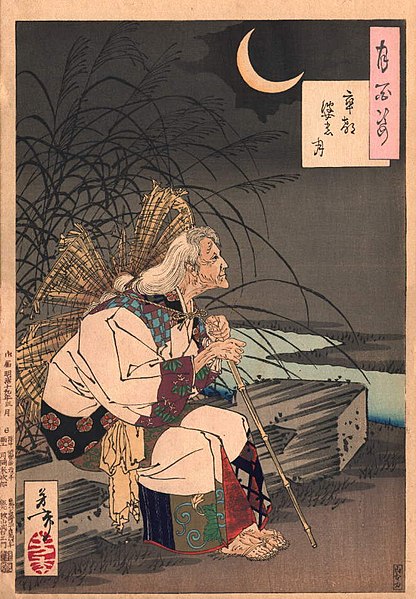
Akazome Emon depicted centuries later in Yoshitoshi’s “100 Aspects of the Moon“, Yoshitoshi, Public domain, via Wikimedia Commons

The poem above itself is a bit of a mystery though. The headnote to the poem is explained as Akazome Emon writing a poem on behalf of her sister who waited all night for her lover, Middle Regent Michitaka, but was stood up. Michitaka was an extremely powerful and charming man in his day and likely had multiple lovers even as he maintained his legitimate marriage to Takashina no Takako (aka Gidōsanshi no Haha, poem 54). Akazome writing this poetic complaint on behalf of her jilted sister was an increasingly common practice at the time.

As explained before, women lived sheltered lives in his era, and men rarely could see them except by secret arranged meetings, and yet sometimes a women might wait all night without her lover ever coming. This is a frequent topic in the Hyakunin Isshu anthology as well, both real and fictional.

However what makes this poem standout is that Akazome Emon complained to Michitaka in a sweet, unaccusing way, when she obviously meant the opposite. “Oh, it’s no big deal I stayed up all night waiting for you, I saw the full moon tonight. No big deal.”

There is some research that suggests that maybe Akazome didn’t author the poem, though it’s unclear who did. Nevertheless, whoever was stood up that night, I hope Michitaka apologised the next day. 😏

P.S. Featured photo by Brian Lazo on Pexels.com

Rustling of the Grass: Poem 58

The next poem in our series devoted to women was composed by the daughter of Lady Murasaki, Daini no Sanmi:

JapaneseRomanizationTranslation
ありま山ArimayamaWhen the wind blows
名の笹原Ina no sasawarathrough the bamboo-
grass field of Ina
風吹けばKaze fukebanear Arima Mountain
いでそよ人をIde soyo hito wosoyo—so it is:
忘れやするWasure ya wa suruhow could I forget you?
Translation by Dr Joshua Mostow

Daini no Sanmi (大弐三位, dates unknown), was the daughter of Lady Murasaki (poem 57) and was an accomplished poet as well. Her name in the Hyakunin Isshu is a sobriquet and comes from her husband’s position as Assistant Governor-general of Dazaifu province (daini). She served as the wet-nurse for Emperor Go-Reizei, she achieved the prestigious Third Rank in the Court hence “sanmi”.

This poem seems simple at first, which Professor Mostow explains as a poem composed about a man who had grown distant toward Daini no Sanmi, and that he was uneasy because he believed her feelings for him had changed. However, the poem contains some clever word-play too. The first three lines lead up to the word soyo which is an otomatopeoia for the sound of rustling grass, but also means “so it is!”. Professor Mostow explains that this is meant to convey to the man that she was the one was uneasy (because he was uneasy?). In other words, she was worried about his feelings because she cared about him. It’s amazing how one word can make all the difference like that when the context is just right.

Also, as a bit of reference, Arima Mountain, or arimayama (有馬山) is in the northern part of the city of Kobe, and boasts one of the most famous and oldest hot-spring resorts in all of Japan called Arima Onsen (有馬温泉). The Hyakunin Isshu Daijiten states that the combination of bamboo grasses at Ina (猪名) and Mount Arima was a popular setting used by many poets in antiquity.

One interesting aspect about the Hyakunin Isshu as a collection of poems is its tendency to have poets related to other poets in the anthology. The poems are not necessarily close to one another numerically, but quite a few poets in the anthology are related to another poet either as the child, parent, siblings, etc. You can see it through the women poets, but also through many of the male poets as well: Kiyohara no Motosuke (poem 42) is the father of Sei Shonagon (poem 62) and grandson of Kiyohara no Fukayabu (poem 36).

An Old Acquaintance: Poem Number 57

This next poem in our series devoted to women of the Hyakunin Isshu anthology is by one of the most famous women authors in Japanese history, Lady Murasaki:

JapaneseRomanizationTranslation
めぐりあMeguri aiteAs I was wondering
見しやそれともMishi ya sore tomowhether or not I had seen it
わかぬ間にWakanu ma niby chance,
雲がくれにしKumo-gakure ni shiit became cloud-hidden,
の月かなYowa no tsukikanathe face of the midnight moon!
Translation by Dr Joshua Mostow

Professor Mostow explains that the headnote for this poem describes an experience one night when Lady Murasaki had seen someone she had known long ago as a child, but she only saw them briefly in passing as they raced by. But there are many interpretations as to who that person had been. Many propose it was a fellow female acquaintance while others wonder if it was a male lover. Unfortunately we can’t be sure.

Lady Murasaki, known as murasaki shikibu (紫式部) in Japanese, was a somewhat unusual figure in the 11th century Heian Court, both for her talents and her personality. Compared to other women of that era, like Lady Izumi (poem 56) who was very passionate, and Sei Shonagon (poem 62) who was very bold and witty, Lady Murasaki was more introverted and sullen and prone to be alone, or exchange letters with other women who shared her frequent melancholy.

Lady Murasaki was among those rare women at the time who learned to read Classical Chinese, which normally was used by men of the Heian Court for official purposes, Buddhist liturgy, and of course Chinese-style poetry and literature. Women generally did not learn it, though the women listed above were exceptions. Indeed, Lady Murasaki’s father, Fujiwara no Tametoki, was said to have lamented that Lady Murasaki was born a woman, because her talents for literature was outstanding. In any case, it was Lady Murasaki’s talents that led her to being recruited as a lady-in-waiting (shikibu) to Empress Shoshi along with other dynamic women of her generation. She is often depicted in Japanese art like the painting below (she is at the bottom-right):

Empress Shoshi and son
Tokyo National Museum, Public domain, via Wikimedia Commons

Unfortunately, we know very little about Lady Murasaki today, apart from her writings: the Tales of Genji, her poetry, and of course her eponymous diary which covers a year or two of her life while serving the powerful Fujiwara no Michinaga. We don’t even know her real name. The term murasaki (紫, “purple”) refers to one of her characters in the Tales of Genji, of which several drafts circulated the Heian Court and people started to call her by that name. Her diary implies that the eminent poet of the time, Fujiwara no Kintō (poem 55), gave her this nickname as a nod to her skills. Later, her daughter Daini no Sanmi (poem 58) went on to become a talented woman herself.

Nevertheless, Lady Murasaki’s reputation has always endured throughout Japanese history as an author and poet of the highest caliber, and has a following even among Western audiences as well. She is celebrated and revered throughout the generations, and like Lady Izumi, enjoys a following in Japan among younger generations of women today. This page is a tribute to her as well.

P.S. Featured photo is of Lady Murasaki, as depicted by Tosa Mitsuoki (1617 – 1691), Public domain, via Wikimedia Commons

Last Meeting: Poem Number 56

This poem, the fifth in our series devoted to the women of the Hyakunin Isshu, is by one of the most famous women of her era, Lady Izumi:

JapaneseRomanizationTranslation
あらざらArazaranAmong my memories
この世の外のKono yo no hoka noof this world, from whence
出にOmoide niI will soon be gone,
今ひとたびのIma hitotabi nooh, how I wish there was
あふおうこともがなOu koto mo ganaone more meeting,
now, with you!
Translation by Dr Joshua Mostow

Izumi Shikibu (和泉式部, 978 – ?), known in the West as “Lady Izumi” was a very talented and passionate poet, but she also faced much tragedy and heartache as well. Apart from her skills with poetry, she was very famous for her public affairs with various men of the Court. Due to her unhappy marriage with Tachibana no Michisada, she left him and met Prince Tametaka, third son of Emperor Reizei. The ensuing affair was such a scandal that her husband divorced her for good and her father disowned her. Further, her daughter, Koshikibu no Naishi (poem 60) was in the custody of her ex-husband, and they remained separated for many years.

Sadly, Tametaka died soon after due to a plague, and Lady Izumi was devastated. She was later the subject of interest by Tametaka’s half-brother, Prince Atsumichi who was already married and slightly younger than her. Their affair was soon discovered, and Atsumichi’s wife was furious and left him. Undaunted, Izumi and Atsumichi moved in together and had a public relationship until Atsumichi died at the age of 27. This relationship is explained in 3rd person by Lady Izumi in her eponymous diary, izumi shikibu nikki (和泉式部日記, “Diary of Lady Izumi”).

At this time, Lady Izumi joined the inner circle of Empress Shoshi, and worked alongside other great women of her time including Lady Murasaki (poem 57) author of the Tales of Genji and Akazome Emon (poem 59). However, as Lady Murasaki’s writings show, the two definitely did not get along:

Izumi Shikibu is an amusing letter-writer; but there is something not very satisfactory about her. She has a gift for dashing off informal compositions in a careless running-hand; but in poetry she needs either an interesting subject or some classic model to imitate. Indeed it does not seem to me that in herself she is really a poet at all.
— trans. Waley, “Diary of Lady Murasaki

I wrote a much more detailed biography of Lazy Izumi on my other blog, but suffice to say Lady Izumi’s passion was her greatest strength and her greatest detriment. For all this and more, she’s been admired and remembered throughout the ages, and can be seen in young women’s comics in Japan even today:

Lady Izumi as depicted in a young women’s manga of love stories from the past.

Nevertheless, she eventually settled down and reuinted with her daughter, Koshikibu no Naishi, who shared her tremendous talent for verses (poem 60), though Lady Izumi likely outlived her. Once again, Lady Izumi could not escape death around her.

This poem reflects the end of her life and her desire to see someone one last time. According to Professor Mostow, commentators disagree as to whether she wrote this to a dear friend she wanted to see once more, her husband, or a lover. My new book strongly implies that due to the language used, it’s a plea a lover that she misses for one last intimate moment together. The word au/ou (逢う) ostensibly means “to meet”, but not in the generic sense as modern Japanese au (会う). As we also see in poem 25, the term 逢う meant to spend the night together romantically.

Nevertheless, to me the poem is also a sobering reminder that all good things must come to and end.

Waiting and Waiting: Poem Number 53

The fourth poem in our series dedicated to women is by the author of the famous diary, the Gossamer Years, or kagerō nikki (蜻蛉日記):

JapaneseRomanizationTranslation
なげきつつNageki tsutsuThe span of time
ひとりぬる夜のHitori nuru yo nothat I sleep alone, sighing,
明くる間はAkuru ma wauntil night lightens—
いかに久しきIkani hisashikican you know at all
ものとかは知るMono to ka wa shiruhow long that is?
Translation by Dr Joshua Mostow

The name of the author is unknown. She is only known as Udaishō Michitsuna no Haha (右大将道綱母, c. 937-995), or “The Mother of Michitsuna, Major Captain of the Right” both in the Hyakunin Isshu and in the Gossamer Years. Her son, Michitsuna, went on to be a Court official who held the prestigious post of Major Captain of the Right.

The Mother of Michitsuna, was the second wife of the powerful and ambitious Fujiwara no Kane’ie, and her diary, like this poem, reflects her pain and frustration as her husband slowly slips away from her and into the arms of other women. As the modern Japanese proverb goes: eiyū iro wo konomu (英雄色を好む), meaning “great men prefer color”. In other words, after Kane’ie had snagged his beautiful new bride, the mother of Michitsuna, he was off on his next conquest, and this pattern would continue throughout their marriage. His trophy wife was thus abandoned except when he needed her for some reason.

According to her diary, at times the couple reconciled somewhat, but over time they became more and more estranged, and the author thus felt more depressed and abandoned as the years wore on.

This poem actually comes from the Gossamer Years, book one, when her husband Kane’ie is spending his nights in a back-alley with a low-class woman in a short-lived affair (Kane’ie soon abandoned that woman even after she bore him a son). As she writes:

Two or three days later I was awakened toward dawn by a pounding on the gate. It was he, I knew, but I could not bring myself to let him in, and presently he went off, no doubt to the alley [and the mistress] that interested him so.

I felt that I could not let things stand as they were. Early the next morning I sent, attached to a withered chrysanthemum, a poem written with more care than usual.

translation by Edward Seidensticker, pg. 38

What’s important to understand is that this poem wasn’t something she composed for a poetry contest (i.e. poems 40 and 41), she was genuinely expressing her frustration and rage at being abandoned by her husband Kane’ie. Fujiwara no Teika, no doubt impressed with the poem and the story behind it, included it in the Hyakunin Isshu generations later.

P.S. Featured photo is of a gate at a Buddhist temple in Kyoto, Japan. No machine-readable author provided. Fg2 assumed (based on copyright claims)., Public domain, via Wikimedia Commons

A Vow Broken Before the Gods: Poem Number 38

The third poem in our series dedicated to women is another personal favorite:

JapaneseRomanizationTranslation
忘らるるWasuraruruForgotten by him,
身をば思Mi wo ba omowazuI do not think of myself.
ちかてしChikaite shiBut I can’t help worry
人の命のHito no inochi noabout the life of
the man who
しくもあるかなOshiku mo aru kanaswore so fervently
before the gods!
Translation by Dr Joshua Mostow

The author, Ukon (右近, dates unknown), takes her sobriquet after her father’s position in the Court as Lesser Captain of the Right Bodyguards, or ukon-e no shōshō (右近衛少将). She served as a lady in waiting to Empress Onshi. Apparently she was a busy woman. Like her father, she is said to have had a number of romantic liaisons, including Atsutada (poem 43), Asatada (poem 44), and Prince Motoyoshi (poem 20) among others. Her tryst with Atsutada is mentioned in a later text called the Tales of Yamato. Ukon also actively participated in poetry contests.

Professor Mostow explains that there are historically two interpretations to this poem. One interpretation is that she wrote the letter to her cold lover, conveying a mean, sarcastic tone. My new book favors this theory, and implies that the lover who spurned her was none other than Fujiwara no Atsutada mentioned above.

The other explanation is more of a private letter to herself. This second meaning then sounds less harsh in tone, and more tragic.

He Spurned Me: Poem Number 19

This is the second poem in “women only” theme for March, and another classic:

JapaneseRomanzationTranslation
Naniwa gataTo go through this life,
not meeting
みじかきあしのMijikaki ashi nofor even as short a time
as the space
ふしの間もFushi no ma mobetween two nodes of a reed
でこの世をAwade kono yo woin Naniwa Inlet—
すぐしてよとやSugushite yo to yais that what you are telling me?
Translation by Dr Joshua Mostow

The poet Ise (伊勢, c. 875- c. 938), or “Lady Ise” in English, is another celebrated female poet from antiquity. Her sobriquet comes from her father’s position as governor of the prosperous Ise Province, but she earned a name for herself through her extensive poetry both in her private collection, the Ise Shū, and through Imperial anthologies where her poetry is both frequent and prominent.

As Professor Mostow explains, the poem has two possible interpretations: one where she has been spurned by a cold lover, and the other where she cannot reveal her hidden love.

Naniwa Inlet is the bay of what is now the famous city of Osaka, though back then it was a far smaller city, with many waterways, streams and such. Naniwa (Osaka) is often associated with reeds at the time as other poems of the time show, and is mentioned in two other poems in the Hyakunin Isshu (poem 20 and poem 88).

Past Her Prime: Poem Number 9

For the first poem for March’s “women only” theme, I chose this poem, one of the earliest by a female author (after Empress Jitō, poem 2), but also one of the most famous:

JapaneseRomanizationTranslation
花の色はHana no iro waThe color of flowers
うつりにけりなUtsuri ni keri nahas faded indeed
いたらにItazura niin vain
わが身世にふるWaga mi yo ni furuhave I passed through
the world
ながめせしまにNagame seshi ma niwhile gazing at the
falling rains.
Translation by Dr Joshua Mostow

The author, Ono no Komachi (小野小町, dates unknown), is one of the most celebrated women of Japanese antiquity for both her reputed beauty and her poetry. She is one of the original Six Immortals of Poetry and the later Thirty-Six Immortals, and was said to have had relationships with various men, including Henjō (poem 12), and Fun’ya Yasuhide (poem 22) among others.

Reading this poem is something of an intimate look at the fear many women (and men, see poem 96) face then as much as now: the fear of getting old. For someone who was beautiful as Ono no Komachi, the loss may have been even more distressing.

Mostow describes this poem featured in the Hyakunin Isshu as a “technical tour-de-force”: the third line, meaning “in vain”, could technically modify either the previous line, or the one after, or both. Also, the poem uses word-play around furu which could mean to either “fall (as in rain)” or “to pass time”, while nagame could mean both “to gaze lost in thought” or “long rains” (長雨, naga-ame as Mostow explains). Further, this poem has been the object of much debate because of all the possible ways to interpret it, and is one of the most iconic in the anthology both for its technical prowess, but also it’s poignant message.

There are many legends that circulated in medieval Japan about Ono no Komachi’s good looks and her cruelty to men. In one famous story, she promised to love a certain suitor if he visited her 100 nights in a row. He completed 99 visits, but failed one night to visit her, and was so distraught that he fell ill and died. Ono no Komachi’s life and legends, including her decline, grew to become the subject of many Nō plays and art. Even 19th century woodblock prints depicted Ono no Komachi in her twilight years:

Yoshitoshi, One Hundred Aspects of the Moon, woodblock print #25, Public domain, via Wikimedia Commons
However, if you look at her other poems, mostly found in the Imperial anthology, the Kokin Wakashū, you can see she was more caring and sensitive than legend implies:

JapaneseRomanizationTranslation
思ひつつOmoitsutsuTormented by love
寝ればや人のNurebaya hito noI slept and saw him near me —
見えつらむMietsuranhad I known my love’s
夢と知りせばYume to shirisebavisit was but a dream I
覚めざらましをSamezaramashi oshould never have awakened.
Poem 552 in the Kokin Wakashū, translation by Laurel Rasplica Rodd and Mary Catherine Henkenius in Kokinshu: A Collection of Poems Ancient and Modern.

and:

JapaneseRomanizationTranslation
わびぬればWabinurebaI have sunk to the
身をうき草のMi o ukikusa nobottom and like the rootless
根を絶えてNe o taeteshifting water weeds
誘ふ水あらばSasou mizu arabashould the currents summon me
いなんとぞ思ふInan to zo omouI too would drift away
Poem 938 in the Kokin Wakashū, translation by Laurel Rasplica Rodd and Mary Catherine Henkenius in Kokinshu: A Collection of Poems Ancient and Modern.

So, Ono no Komachi wasn’t just a pretty face past her prime, she was a smart woman with a sharp wit, and a more sensitive side as well.

The Women of the Hyakunin Isshu

An illustration from chapter 5 of the Genji Monogatari (Tales of Genji), photo by Tosa Mitsuoki, Public domain, via Wikimedia Commons

March 3rd in Japan is Girls’ Day and to celebrate I’ve decided to devote all of March to poetry from the Hyakunin Isshu from female poets.

Although most of poems in the anthology were written by men, a considerable minority (20% of the poems) are written by women as well. Many of these are found in poems 55-65 but are also scattered before and after. Many of these women represent the first female authors in world history including Lady Murasaki who wrote the Tales of Genji and her eponymous diary, and Sei Shonagon who wrote the Pillow Book. In addition was the diary of Lady Sarashina, the Gossamer Years and the writings of Lady Izumi.

Poetry in the days of the ancient Heian Court was everywhere and women wrote poetry as much as men did if not more. Like men, they participated in Imperial contests as well and made a name for themselves. Not surprisingly, some of these have been preserved in the Hyakunin Isshu, just as they were in official Imperial anthologies, such as the Kokin Wakashū. However, one interesting custom to note is that the women poets never used their own name. Instead they often used sobriquets associated with where their family was affiliated with, or their position in the Court. Lady Izumi’s father was governor of Izumi province for example.

So this month, expect some awesome poetry from the women of the Hyakunin Isshu!

Once Was Enough: Poem Number 44

Although I have been posting love poetry from the Hyakunin Isshu all week in celebration of Valentine’s Day, I felt like posting this poem for all those who don’t like Valentine’s Day, or had a lousy time:

JapaneseRomanizationTranslation
あふおうことのAu(Ou)1 koto noIf there were no such things
絶えてしなくはTaete shi nakuwaas ever having met her, then,
中々にNakanaka nicontrary to all expectations,
人をも身をもHito wo mo mi wo moneither her coldness nor
my pain
恨みざらましUrami zaramashiwould I have to resent!
Translation by Dr Joshua Mostow

The author, Middle Counselor Asatada (中納言朝忠, 910 – 966), also known as Fujiwara no Asatada, was the fifth son of Fujiwara no Sadataka (poem 25) and one of the Thirty-Six Immortals of Poetry. I happen to consider this one of my favorite poems in the entire anthology, so I think it’s a fair ranking. 🙂

According to commentators, this poem was part of the same poetry contest as poems 40 and 41 and implies frustration that a woman has not consented to a visit by her presumed lover. Life would have been easier if they simply hadn’t bothered to try and meet.

However, Mostow also points out that the interpretation by Fujiwara no Teika (poem 97, who compiled the Hyakunin Isshu), was different, and implied that they had met, and she wouldn’t meet him again. It didn’t end well, in other words, and the lover is bitter over it.

P.S. Featured photo is a woodblock print of the Tale of Genji by Toyokuni Utagawa, Utagawa Kunisada, Public domain, via Wikimedia Commons

1 A good example of unusual spellings in the Hyakunin Isshu.