Death and Betrayal in the Hyakunin Isshu

In the Hyakunin Isshu poetry anthology, the subject of this blog for almost 15 years (!), there are many poems about love, nature, sadness, etc. But none about death. There are poems on betrayal, but in the context of infidelity, not on stabbing others in the back.

…. and yet, beneath the surface there are other stories to be told.

In the seventh century, with the death of Emperor Kōtoku in 654 CE, another power struggle erupted. One one side was the emperor’s son, Prince Arima (有間皇子, 640-658), and on the other was the emperor’s older sister and reigning sovereign Emperess Saimei. Empress Saimei had her own son named Prince Naka-no-ōe (中大兄皇子) and was a rival to Prince Arima, Because his mother was the reigning sovereign, Naka-no-ōe would be next in line for the throne, not cousin Prince Arima who was left in the cold.

According to historical accounts, Arima was quietly approached by one Soga no Akae (蘇我赤兄), grandson of the influential Soga no Umako, who promised to help him overthrow Empress Saimei and support his ascension to the throne. Initially, Arima was interested, but later got cold feet. He swore Soga no Akae not to tell anyone, and to call the whole thing off.

But what Arima didn’t know, was that the whole thing was a setup. Prince Naka-no-ōe had planned the whole thing, and Akae told him what happened.

Prince Arima was soon arrested, and taken outside the capitol for interrogation. On his way there, at a place called Iwashiro no Hama (“Iwashiro Beach”),1 he tied a cord, or a piece of grass to a pine branch. This was evidentially a tradition at the time to pray for good luck on one’s journeys.

Once the interrogations were complete, Prince Arima was sent back toward the capital, but was executed en route by hanging at a place called Muro no Yu (牟婁の湯), which is now a seaside resort town. He was 19 at the time, the year was 658 CE.

Forty-three years later (701 CE), Kakinomoto Hitomaro (poem 3 in the Hyakunin Isshu, あし) was serving the current Emperor Monmu, grandson of Empress Jito (poem 2, はるす), and during an an imperial outing they came to Muro no Yu. By now, Prince Arima’s demise was well-known, including the story of him tying cord to a pine tree branch. Hitomaro, remembering what happened, composed the following poem (poem 146 in the Manyoshu):

Original ManyoganaModern JapaneseRomanizationRough translation
後将見跡後見むとNochi mimu toThat pine branch that
君之結有君が結べるKimi ga musuberu you were going to visit
磐代乃磐代のIwashiro noafter tying a cord:
子松之宇礼乎小松がうれをKomatsu ga ure wo I wonder if you ever did
又将見香聞またも見むかもMata mo mimu kamosee it again…
Rough translation by me, apologies for any mistakes or nuance issues

Kakinomoto Hitomaro is reminiscing whether Prince Arima got to see the pine branch again one his way back, before he was executed. It’s a sad poem on the tragically short-lived prince.

But there’s more to the story.

Soga no Akae and his clan, the Soga were frequent troublemakers at this time, and both Empress Saimei and her son Prince Naka-no-ōe executed or assassinated multiple members of the clan at the instigation of the Nakatomi. The Nakatomi were later renamed “Fujiwara”, and if you look at the list of poems in the Hyakunin Isshu, you see a lot Fujiwara poets. There’s a very good reason for this. The final straw for the Soga Clan was in 672 when yet another power struggle put the Soga on the losing side of the war. Akae was among those exiled. The Soga permanently lost power.

And finally: what happened to the powerful and conniving Prince Naka-no-ōe?

He eventually ascended the throne as Emperor Tenji, poem 1 of the Hyakunin Isshu (あきの) and instigator of conflicts of his own.

So, it’s interesting to read his poem in the Hyakunin Isshu and its rosy picture of a fall harvest, knowing that the man had some blood on his hands too…

P.S. featured photo is a 17th century depiction of the power struggle between Empress Saimei and the Soga Clan. Courtesy of Wikipedia.

P.P.S. another post on the dark political history behind some poets of the Hyakunin Isshu.

1 You can see modern photos of the place here. It is in Wakayama Prefecture.

The Super Poetry Brothers

Interesting historical fact that I learned recently.

A long, long time ago in this blog, I wrote about the Six Immortals of Poetry: a list of eminent poets devised by Ki no Tsurayiki (poem 35 in the Hyakunin Isshu, ひさ). This list was in the preface to the Kokinshu imperial anthology, wherein he raised up these six poets, as prime examples of poetry at the time ….. then promptly tore them down for one reason for another.

However, my book about the Manyoshu explains that in the same preface, Tsurayuki elevates two other poets as being above reproach:

  • Kakinomoto Hitomaro (poem 3 in the Hyakunin Isshu, あし) and
  • Yamabe Akahito (poem 4, たご)

Together they were revered as Yamakaki no Mon (山柿の門) meaning the “Gate of Yama(be) and Kaki(nomoto)”. In modern terms, we can call them the Super Poetry Brothers…

I used to watch this show as a kid, every day after school. 😆

But I digress.

Kakinomoto and Yamabe were not exactly contemporaries. They were about a generation apart, and their poetry had different styles, but together they were seen as the epitome of poetic skill. So much so, that even Ki no Tsurayuki could find no fault in them.

Let’s look at each one.

Kakinomoto Hitomaro focused on expressing inner feelings. His poem in the Hyakunin Isshu shows his worry about sleeping alone one night, while this poem shows his passion for the one he loves. Or this one from the Manyoshu (poem 48):

Original ManyoganaModern JapaneseRomanizationRough Translation
東のHimugashi noTo the east I
野炎野にかぎろひのNo ni kagirohi nosee the rising sun
立所見而立つ見えてTatsumieteover the fields,
反見為者かへり見すればKaeri misurebabut if I look back [west]
月西渡月かたぶきぬTsuki katabukinuI see the moon setting.
Translation by me, apologies for any mistakes or nuance problems.

This poem has a hidden meaning, and was both a memorial to one Prince Kusakabe who was the only child of Empress Jito (poem 2 in the Hyakunin Isshu, はるす), and praise of Prince Kusakabe’s son, who later was crowned Emperor Monmu. Thus, the poem expresses both sadness at the passing one of beloved figure, and hopes for a bright future for his son.

Meanwhile, Yamabe Akahito was more focused on the beauty of nature. His poem in the Hyakunin Isshu about the snow on Mount Fuji is a good example. He wrote many poems on various subjects, but often did so through simile with nature. Or this one from the Manyoshu (poem 1424):

Original ManyoganaModern JapaneseRomanizationRough Translation
春野尓春の野に Haru no no niI went to go
須美礼採尓等すみれ摘みにとSumire tsumi ni topick some violets for
来師吾曽来し我そKoshiware soyou in a spring field,
野乎奈都可之美野を懐かしみNo wo natsukashimibut it was so charming
一夜宿二来一夜寝にけるHitoyo nenikeruI slept there all night.

Here, Yamabe is talking about a wonderful, charming violet field and how it made him so sleepy and relaxed that he slept all night there. There’s less of the heavy, emotional pull of Hitomaro, but it paints a really lovely scene that’s timeless.

That’s a very brief look at the Super Poetry Brothers!

Love Across Time and Place

The compiler of the Manyoshu poetry anthology, Ōtomo no Yakamochi (大伴家持, 718 – 785), who also composed poem 6 (かさ) in the Hyakunin Isshu, had a girlfriend named Kasa no Iratsumé (笠女郎, sometimes called “Lady Kasa” in English ) who was very devoted to him. She was second only to Yakamochi’s stepmother1 in her poetic contributions to the Manyoshu, and wrote many lovely poems to Yakamochi, including this one:

Original ManyoganaModern JapaneseRomanizationRough Translation
陸奥之陸奥のMichinoku noI can see your visage
真野乃草原真野の草原Mano no kayaharain the fields of
雖遠遠けどもTōkedomoMano no Kayahara in Michinoku,
面影為而面影にしてOmokage ni shiteyet why can I not
所見云物乎見ゆといふものをMiyu to iu no wosee you close?
Rough translation by me, apologies for any mistakes

This is a nice, touching poem about someone who misses her far away lover. Not unusual in the Manyoshu, because even a journey to a neighboring province was a lengthy affair, let alone a remote one.

So, why do I highlight this poem when Kasa no Iratsume contributed many others?

In the late 19th and early 20th centuries was a Japanese author named Mori Ōgai (森 鷗外, 1862 – 1922), who during Japan’s rapid modernization period, spent some time in Germany learning Western medicine. Ogai was also an excellent writer, and wrote several stories, including a famous short story Maihime (舞姫, “The Dancing Girl”) about a young German woman who fell in love with a Japanese man studying there. After the man returns to Japan, the German woman (now pregnant) pines for him, and eventually meets a tragic end even as he prepares to return to Japan. The story is, according to Ogai, not autobiographical, but taken from anecdotes of other Japanese students studying abroad.

What’s interesting is that Ogai was definitely fascinated by Iratsume’s poem and even borrowed the obscure term 面影 (omokagé) in the title of the work Omokagé (於母影): a collection of Western poems translated into Japanese by Ogai and other members of the Shinseisha Society (新声社) in 1889. The related story of a young woman pining for the one she loves in a remote place is not hard to miss either in Dancing Girl, so perhaps that was a source of inspiration.

Nonetheless, it’s amazing how one writer or poet can inspire another 1,000+ years later.

… then again, I suppose that’s how this blog got started. 😏

1 Yakamochi’s birth mother died when Yakamochi was very young, and so he was raised by his stepmother, Ōtomo no Saka no Ue no Iratsume (大伴坂上郎女). She herself was on her third marriage after her previous two husbands both died. This underscores how short the average lifespan was in those days, even for the wealthy, as a woman in her 20’s or 30’s might be on her third marriage by then. Something almost unthinkable in the 21st century. Lady Izumi (poem Poem 56 of the Hyakunin Isshu あらざらん) had a similar string of bad luck.

Shell Matching Game

I learned a neat little cultural facet from watching the historical drama about Lady Murasaki, but also from the anime Onmyoji.1 Since people in Heian-Period Japan did not have the technology to play Super Smash Brothers Ultimate,2 they passed the time in other ways.

One such pasttime, besides poetry contests and court music, was a neat little game originally called Kai-ōi (貝覆い, “Shell hiding”), but came to be more commonly known as Kai-awase (貝合わせ, “Shell matching”). Using shells from the common Meretrix lusoria or “Asiatic hard clam” (hamaguri in Japanese), the insides of the shells were painted so that both halves of the shell had the same picture. Then the shells would be put face down alongside many other similar shells for a matching game. In art, the game seems to be played mostly by women, and in later generations it was used as a wedding gift to upper-class brides.

The designs of shells started out fairly simple in the 11th and 12 centuries (i.e. the late Heian Period which we focus on so much here), but by the Edo Period, the designs were increasingly elaborate, and tended to hark back to the earlier period in history. Here’s a set of shells featuring scenes from Lady Murasaki’s novel The Tales of Genji:

Photo by Sailko, CC BY-SA 4.0, via Wikimedia Commons

This nice blog post below shows kids painting their own shells at the Toy Museum in Hyogo Prefecture:

The idea of a matching game is easy to find in many cultures, but the idea of painting the inside of shells, featuring scenes from a 12th century novel is awfully clever, and shows how the brilliance of the Heian Period culture still shines through even into modern times.

1 Onmyoji was pretty good, but I didn’t get very far. To be honest, I don’t watch anime very much. Even Chihayafuru; I only watched the first season.

2 Who would be the “main” for each poet in SSBU? My guess is:

  • Lady Murasaki – Sephiroth (dark and brooding)
  • Sei Shonagon – Samus
  • Lady Izumi – Bayonetta or Zero-suit Samus
  • Fujiwara no Teika – Metaknight (loyal to Gotoba-in)
  • Ono no Komachi – Peach
  • Ariwara no Narihira – Marth or Link (dashing guy)
  • Gotoba-in – King Dedede
  • Fujiwara no Mototoshi – Bowser (demanding)
  • Kakinomoto no Hitomaro – Kirby
  • Kanké – Dr Mario (scholarly guy)

As for me, I usually play “best dad” Chrom or his daughter Lucina. Byleth is fun to play sometimes, but kind of sluggish in the game.

P.S. I think I spent more time making this SSBU list than writing the rest of the post. 🤦🏼‍♂️

A Look at the Ise Stories: a Gentleman’s Tales

Hello dear readers,

Fall is approaching, and it reminds us of fall leaves, and famous poems of the Hyakunin Isshu such as the chihaya poem (poem 17) among others….

Throughout the blog, I’ve tended to focus on the lady authors and poets because it’s so rare to see women get credit for writing in the pre-modern era. There was an explosion of feminine talent in the Heian Period (8th – 12th century) that was not repeated until modern era in Japan, and it’s been fascinating.

However today, I wanted to highlight one particular text called the Ise Monogatari (伊勢物語). Our illustrious Dr. Joshua Mostow who has contributed much to this blog translates the title as the “Ise Stories” in his translation, but other translations call it the Tales of Ise. You can decide which one you prefer. Since Dr Mostow is a cool guy, and done much for the field, I will use his translated title. For this post, I am using the translation by Dr Mostow and Dr Royall Tyler.

Unfortunately, we still don’t know who the actual author of the Ise Stories was. In fact, Professor Mostow explains that the prevailing theory is that the Tales was composed over decades, in stages, possibly by different authors. Unlike the later Tales of Genji, or the Gossamer Years, or the Pillow Book, which were all clearly composed by one author, the Tales of Ise has a murkier development.

Anyhow, the Ise Stories is not a modern story, with narrative arc, nor does it have an ending. Instead, the Ise Stories are a series of short anecdotes about an anonymous prince who leaves the capitol of Heian (modern day Kyoto), and journeys east to the hinterlands for a time. In fact, you could probably call the Ise Stories the “Anecdotes of Ise With Lots of Poetry Thrown In”. The later work, the Tales of Genji, has a similar format.

The hero of the story, a young, charming prince who travels east with his entourage and has a few love trysts along the way, is a kind of idealized Heian-period aristocrat: a gentleman with an excellent pedigree, and talent for poetry to boot. Each story includes at least one waka poem, the same kind used in the Hyakunin Isshu, often more. Why so much poetry? Many times these were used as a back-and-forth way of greeting someone from afar, or saying “hello” to a promising lady, so a chapter might have multiple poems in the form of dialogue.

For example, section 14 deals with a tryst between our protagonist and a provincial lady in remote Michinoku province (a place also mentioned in poem 14 of the Hyakunin Isshu). She writes to him the following poem:1

Original textJapanese romanizationTranslation
なかなかにNaka-naka niSo if, after all,
恋に死なずはKoi ni shizanu waI am not to die of love,
桑子にぞKuhako ni zoI know just the thing;
なるべかりけるNarubekarikeruI should have been a silkworm,
玉の緒ばかりTama no wo bakarifor that little life’s short span.

Our protagonist was not impressed by her, as her poem “reeked of the country[side]”, but slept with her anyway. Classy guy.

Then, he left before dawn and she lamented:

Original textJapanese romanizationTranslation
夜も明けばYo mo akebaCome dawn’s early light
きつにはめなでKitsu ni hamenadeoh yes, in the tank you go,
くたかけのKutakake noyou obnoxious bird,
まだきに鳴きてMadaki ni nakiteto learn to cock-a-doodle
せなをやりつるSena wo yaritsurumy darling away too soon.

The protagonist then remarked he was going to the capitol, but left behind a “charming” poem:

Original textJapanese romanizationTranslation
栗原のKurihara noIf the Aneha
あねはの松のAneha no matsu noPine here at Kurihara
人ならばHito narabaonly were human
都のつとにMiyako no tsuto ni“Come along with me,” I’d say,
いざといましをIza to iwamashi wo“you’re my gift to the City.”

According to the Ise Stories, she was much impressed and thought he was in love with her, but the commentaries suggest he was being condescending by implying that “if only she were worthy of Courtly life at the capitol”. Damn.

But what’s the source for all this poetry and narrative?

The origins of the Ise Stories is somewhat of a mystery, but there is strong evidence that the central character was heavily based upon a real aristocrat named Ariwara no Narihira (825 – 880), the same man who composed the aforementioned poem 17 (ちはやふる), and also composed what’s considered the greatest poem about cherry blossoms ever composed. Some of his poems in the old Kokin Wakashu imperial anthology were re-used in the Ise Stories as well.

In addition to his poetic genius, the real life Narihira was a playboy and had many relationships, even by the standards of Heian-period aristocracy. Sometimes this got him into trouble. The Ise Stories begins with an explanation that the anonymous prince left the capitol after having an affair with Emperor Seiwa’s consort. Coincidence? I think not. 🤔

Nonetheless, the Ise Stories is a whimsical and irreverent look at Heian Period culture and how the aristocracy interacted with people in the provinces, even when it was somewhat condescending. Court culture was unlike anything else in Japan at the time, and this reveals some interesting things that are not always conveyed in other works of the time.

1 Mostow and Tyler explain that the young woman’s poem was a re-working of an older poem from the Manyoshu, poem 3086:

Original ManyoganaModern JapaneseJapanese romanizationTranslation
中々二なかなかにNaka naka niNot this lukewarm
人跡不在者人とあらずはHito to arazu walife that we humans live–
桑子尓毛桑子にもKuhako ni moa silkworm
成益物乎ならましものをNaramashi mono woI would rather be,
玉之緒許玉の緒ばかりTama no wo bakarihowever short its life.

Spring is Coming: Manyoshu Poem 1418

This was a particularly nice poem that I found in the Manyoshu heralding early Spring.

Original
Manyogana
JapaneseRomanizationRough
Translation
石激いわ走るIwa bashiruAre not
垂見之上乃垂水たるみの上のTarumi no ue nothe bracken buds
左和良妣乃 さわらびのSawarabi nosprouting next to a
毛要出春尓 萌えづる春にMoe-izuru haru niwaterfall
成来鴨なりにけるかもNarinikeru kamothe first sign of Spring?

This poem was composed by Shiki no Miko or Prince Shiki (志貴皇子, ? – 716), who was the seventh son of Emperor Tenji (poem 1 in the Hyakunin Isshu). Unlike his siblings who were embroiled in the political strife of the times, Prince Shiki retreated and focused on poetry instead. His talents with poetry earned him a place in the Manyoshu, and Japanese poetic history.

Ironically, despite staying out of succession struggles, Prince Shiki’s own son, Prince Shirakabe later ascended the throne as Emperor Kōnin despite not being the dominant line, and all subsequent emperors in Japan are descended from him. So, in the end, Prince Shiki won afterall.

The poem itself evokes a truly wonderful image of a tiny sprout peeking through the rocks by a riverbank, heralding the first signs of spring.

Note that in the traditional Japanese calendar, based off the Chinese model, Spring started much later than the modern meteorological Spring, namely at the start of the second lunar month. Hence, the holiday of Setsubun relates to the start of Spring, and helps conclude the Lunar New Year. Plum blossoms are also frequently associated with this time of year since they bloom earlier than cherry blossoms, and were highly prized by poets of Manyoshu, as we can see in this poem (also posted here):

Original ManyoganaModern JapaneseRomanizationMy Rough Translation
和何則能尓  我が園にWaga sono niPerhaps
宇米能波奈知流梅の花散るUme no hana chiruthe plum blossoms will
比佐可多能ひさかたのHisakata noscatter in my garden
阿米欲里由吉能天より雪のAma yori yuki nolike gleaming snow
那何久流加母流れ来るかもNagarekuru kamofrom the heavens

So, a happy spring to you all!

The Dark Side of Heian Period Japan

The Hyakunin Isshu and its poets, the aristocracy of the Heian Period, represent a golden age of Japanese history, and a level of cultural refinement that was often imitated, but never surpassed in later generations. I have been celebrating that culture on this blog all the way back since 2011 (!), and it has always been a personal fascination of mine.

And yet, amidst all this culture and elegance there was very much a dark side to this culture too. This is encapsulated in works at the time, such as the melancholy and weariness of backbiting in the diary of Lady Murasaki, the isolation and frustration at her husband’s rampant infidelity in the Gossamer Years, among other sources. Further, the historical drama about Lady Murasaki highlights a particularly dark episode involving the succession to the Imperial Throne around the years 1000-1010.

The top positions at the Imperial Court were the Udaijin (右大臣, “Minister of the Right”) and Sadaijin (左大臣, “Minister of the Left”). The minister of the Left was higher rank than the minister of the Right. If you look at the authors of the Hyakunin Isshu, you’ll notice a few held such positions over the years: poems 14, 25, 81, and 93.

If you look at the list of poems, you’ll notice quite a few are composed by members of the elite Fujiwara clan (roughly 25-30%). In the 7th century or so, the Fujiwara had been instrumental in protecting the Imperial throne from a usurper, and handsomely rewarded for it. By the year 1000, the Fujiwara clan had grown so large and prosperous that it developed into multiple sub-clans, branches and rival groups.

I mention this because the episode I relate here relates to two powerful branches of the Fujiwara clan in their struggle for power. There’s an excellent article in Japanese about it, which I encourage you check out because it also includes scenes from the drama.

It all begins with one Fujiwara no Kaneie, husband of “Michitsuna no Haha” (poem 53) and the “villain” of the Gossamer Years. Kaneie was particularly ambitious, served under three emperors, and had three sons, who each held ministerial positions. The eldest son was Fujiawara no Michitaka whose wife was “Gidō Sanshi no Haha” (poem 54). He served as the regent for the young Emperor Ichijo, and later, Ichijo married his daughter, Teishi.

The third son of Kaneie was Fujiwara no Michinaga. Remember this name.

After Kaneie’s first son, Michitaka, died his son (Teishi’s brother) named Fujiwara no Korechika, took over that branch of the family. Korechika contended with his uncle, Michinaga, from the get-go, but Korechika made a fatal error. In a strange tale, Korechika believed that retired Emperor Kazan had been sleeping with Korechika’s own mistress. During one of Kazan’s nighttime travels, Korechika in a jealous fit shot an arrow at him and hit the retired Emperor’s sleeve. Michinaga capitalized on this incident to get his nephew Korechika banished from the capitol. This is probably something “Gidō Sanshi no Haha” would have never imagined happened to her son.

Korechika’s sister, Empress Teishi (also daughter of “Gidō Sanshi no Haha”), was now in a vulnerable position without her family to protect her. So, Michinaga pushed forward his own daughter, Shoshi, as a second wife for Emperor Ichijo. Later, the isolated and vulnerable Emperess Teishi died in childbirth. Teishi’s son, the Imperial prince Atsuyasu, appears later. The end result was that Ichijo’s remaining wife Shoshi (daughter of Michinaga) was the reigning empress now, and Michinaga used his influence to gain the title of Minister of the Left. The diary of Lady Murasaki covers this period when Shoshi gave birth to Emperor Ichijo’s second son, Atsuhira.

Let’s pause for a moment. Emperor Ichijo had married two women who were from rival factions of the Fujiwara clan: the exiled Korechika’s sister, and Minister of the Left Michinaga’s daughter, and each bore him a son.

Meanwhile, Korechika was later pardoned and made a junior minister in the Court. And yet Korechika was very bitter toward Michinaga, and his mental health took a downward spiral. He hired a Buddhist priest to help craft a series of curses against Michinaga. Eventually, this was discovered, and Korechika’s career was over and retired until his death in 1010.

Things took an unexpected turn when Ichijo retired early during the same year due to poor health, and his cousin ascended the throne as Emperor Sanjo (poem 68). Sanjo only reigned for a few years before a combination of ill-health and Michinaga’s machinations as the minister pushed him to abdicate too. This is why his poem in the Hyakunin Isshu is so melancholy: Sanjo finally ascended the throne, but ill health and Michinaga’s power-plays ended his reign soon after it began.

Emperor Sanjo’s retirement left Ichijo’s two sons as the next successor: one by Korechika’s sister (Teishi), and the other by Michinaga’s daughter (Shoshi). Which imperial prince do you think Michinaga, the Minister of the Left, wanted to ascend the throne? Michinaga obviously wanted his grandson to be next emperor, so Michinaga could assume the position of regent (Sessho).

Due to age, Atsuyasu, son of the first empress Teishi, should have been Emperor (Atsuhira was too young), but he was bypassed entirely and faded out of history. The child Atsuhira, grandson of Michinaga, ascended the throne as Emperor Go-Ichijo (“The latter Ichijo”).

Korechika’s own son, Michimasa (poem 63), was totally shut out of the Imperial Court as well, and mostly lived a reckless life, trolling Michinaga’s administration, and being just plain obnoxious. His life took a downward spiral much like his father had done, and that branch of the Fujiwara’s male line died out. Michimasa’s fate is particularly dark and tragic.

This multi-generational struggle between two branches of the Fujiwara clan to control the Imperial throne through marriage resulted in Michinaga being the most powerful man in Japan at the time. It also adversely affected many lives of poets in the Hyakunin Isshu. We saw the examples of Michimasa, son of Korechika, and Emperor Sanjo above.

In the case of Sei Shonagon (poem 62), who served Empress Teishi and was loyal to the losing faction, she faded away in retirement. Her Pillow Book is a last swan-song of the time spent serving Empress Teishi, and conveys a very rosy look. It’s not hard to see it was also a subtle middle-finger to Michinaga’s faction.

Many of the ladies in waiting to Michinaga’s daughter, Shoshi, were also poets of the Hyakunin Isshu:

  • Lady Izumi (poem 56),
  • Lady Murasaki (poem 57), author of the Tales of Genji
  • Akazome Emon (poem 59), her sister had an affair with Michinaga’s older brother Michitaka much to the chagrin of “Gidō Sanshi no Haha” (poem 54)
  • Ko-Shikibu no Naishi (poem 60), Lady Izumi’s daughter
  • Lady Ise (poem 61)

By association with Empress Shoshi, not Empress Teishi, they all benefitted and their daughters and family members rose to positions in the Court over time. Lady Murasaki’s daughter, Daini no Sanmi (poem 58), eventually became a wet nurse for future Emperor Reizei and attained the third rank in the Court which was quite high.

Additionally, men like Fujiwara no Kintō (poem 55) benefitted from the association with Michinaga as well.

In the end, there were obvious winners and losers in this struggle. It was not all poetry parties, moon-viewing, and romantic dalliances; people’s lives profited or were destroyed due to hair-splitting power struggles that took generations to complete.

As alluded in Lady Murasaki’s diary, the whole thing was golden sham.

The Hyakunin Isshu in the Edo Period

Since I began, this blog has focused on a period of Japanese history which I like to call “Classical Japan”, or “Japanese Antiquity”.1 That’s just a convenient name I call it.

But most researchers and historians tend to divide Japan’s history into “periods” (jidai, 時代) based on where the capitol was at the time. So, precisely speaking, this blog and the Hyakunin Isshu cover a 500-period of history overlapping the Asuka (6th – 8th c.), Nara (8th c.) and Heian Periods (8th – 12th c.), while dipping our toes just a bit into the the early Kamakura Period (12th – 14th c.) for certain poems (poems 93, 99 and 100 for example). For the sake of the Manyoshu we also ventured even further back to somewhat murkier periods of time since some of the very early poets of the Hyakunin Isshu (poems 1, 2, 3 and 4 for example) were also contributors.

But the blog has never really explored anything beyond the early 13th century because that’s when things effectively end. The Hyakunin Isshu was compiled, the aristocracy of the Heian Period were totally sidelined by the new samurai class, and Japan continued on in a new trajectory. The aristocracy still lived until the modern era, and Imperial poetry anthologies were issued from time to time, but the quality and popularity gradually petered out. As poem 100 above alludes to, this era embodied by the Hyakunin Isshu was effectively over.

For the purposes of this blog, why pay attention to anything that comes after?

Well, I attended Professor Mostow’s recent lecture at the University of Washington, and I learned that history of the Hyakunin Isshu kept going. In fact, it was all the rage in the much later Edo Period (17th – 19th c.).

Japan by the Edo Period was pretty different than the earlier Heian Period. By this point, Japan had been effectively ruled by one military government or another for centuries, while the capitol had shifted from Kyoto in central Japan, to a fortified castle town in eastern Japan called Edo (江戸). Edo started as a fishing town, but soon grew into a metropolis thanks to good urban planning and government policies that forced rival warlords to stay there every other year. Edo, later the modern capitol of Tokyo, was one of the largest cities in the world at one point.

After a century of constant warfare throughout Japan, the Edo Period brought unprecedented stability and cultural flourishing. Its isolation from European explorers and rival Asian powers meant that people turned inward and rediscovered Japanese culture that had been forgotten in ages past due to war and instability.

One aspect of this flourishing was the invention of block printing which suddenly allowed the masses to enjoy reading in a way that earlier generations had not. Books became far more affordable, and more available, and suddenly a variety of books about the Hyakunin Isshu were published. There were books about the Hyakunin Isshu as far back as the 15th century, namely the Ōei-shō (応永抄) composed in 1406, but mass-printing made books much more accessible and allowed for a greater variety.

Professor Mostow has collected and aggregated many examples on his website here. Take a look if you can, there are some neat scans of really old documents from the era.

One common usage of the Hyakunin Isshu at the time, according to Professor Mostow, was in the instruction of girls. Books about young women’s education were a popular subject, and such books would work lessons in along with poems of the Hyakunin Isshu. For example, Professor Mostow posted scans from a book called the Hyakunin Isshu Jokun Shō (“A Selection of the Hyakunin Isshu for Women’s Instruction” ?), published in 1849. Another example can be found here.

Men were often taught things like Confucian values and such. And yet, even the boys learned about the Hyakunin Isshu from their mothers who had been raised on it. Also, books that were published for men about the Hyakunin Isshu often did so under the theme of Kokugaku (“national learning”).

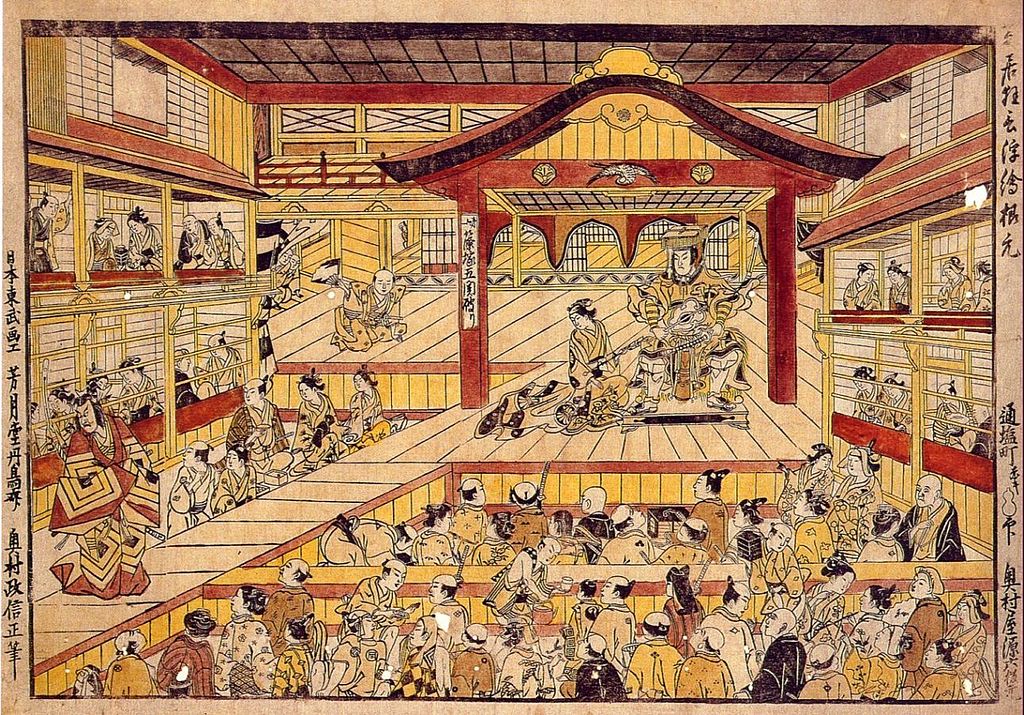
A block print of the Masanobu Kabuki theater, 1743. Hokusai, Masanobu, Kiyonobu, XVII-XIX century, Public domain, via Wikimedia Commons

The high point of Edo Period culture, and something that influences Tokyo even today was the Genroku Period (1688 – 1704). Many things people imagine of pre-modern Tokyo, such as Kabuki theater and Ukiyo-e prints, have their origin in this brief period. The Hyakunin Isshu was used in some Ukiyo-e block prints too. Since many of these images were racy or scandalous, publishers would work in poetry of the Hyakunin Isshu to either obfuscate the content from Edo government censors, or to lend a more “classy” air to the image. I found some examples here.

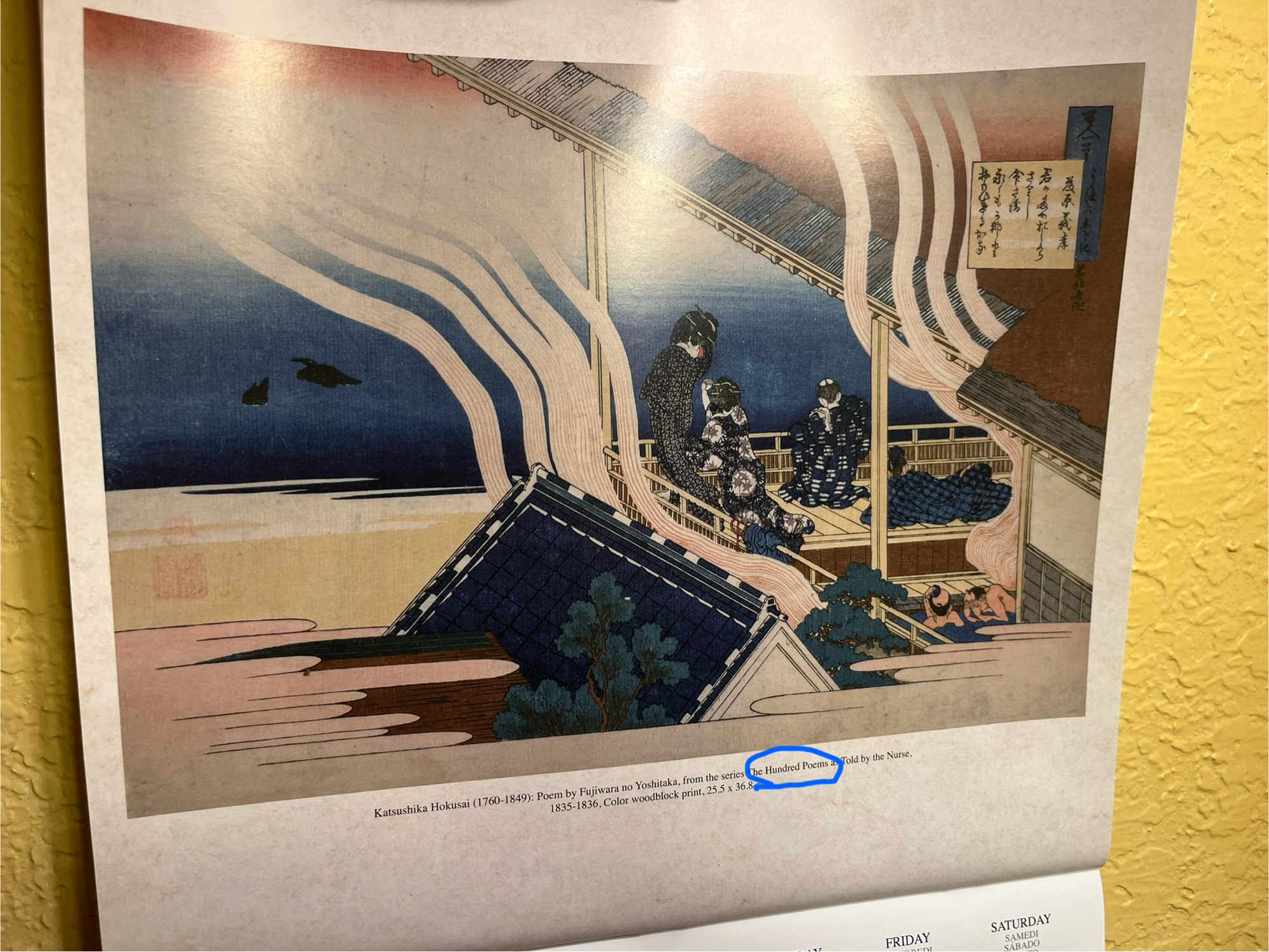
Even the famous artist Hokusai of “Great Wave” fame made block prints that would feature poems of the Hyakunin Isshu. We have a calendar at home and I was surprised to see this Hokusai block print with poem 50 (きみがためお) composed in cursive:

Our wall calendar featuring art by Hokusai. Turns out this page was from the Uba ga Etoki.
In blue, reads Hyakunin Isshu Uba Ga Toki, and in the yellow box poem 50 of the Hyakunin Isshu.

It turns out this is part of a series by Hokusai called the Uba ga Etoki (姥がゑとき), or more formally the 百人一首姥がゑとき2 , which means something like the “The Illustrated Hyakunin Isshu As Told By a Nurse(maid?)”. You can see more examples of this work here.

Anyhow, it’s fascinating that as literacy among the populace improved during the Edo Period, and access to information via books and printing increased, popular interpretations and illustrations of the Hyakunin Isshu took on a new life. The Hyakunin Isshu was, by that point, already 600 years old, and yet it enjoyed a revival that we benefit from today in the form of anime, karuta, and so on.3

Special thanks to Professor Mostow for his lecture and website! Also, check out Professor Mostow’s new book!4

1 I suppose my reason for doing this is that the end of the Heian Period and the subsequent change in Japan was somewhat similar to the fall of the Western Roman Empire in Europe, and how later generations of feudal lords kept up some of the trappings of the Romans, and yet it was still a different society altogether. But in the end, this is just one history nerd’s interpretation.

2 In modern Japanese 百人一首うばが絵解. See this post for more explanation.

3 Although social media and Internet reveal a pretty ugly side to humanity, it does also lead a similar explosion in cultural and accessibility. Two sides of the same coin, I suppose.

4 This is my associates link on Amazon. I get a small amount of credit for any purchases made through here. Feel free to purchase directly from University of Hawaii press instead though.

Poets Illustrated: The Thirty Six Immortals Edition

Recently, while watching the historical drama about Lady Murasaki (poem 57, め), I was surprised to learn that there is an hand-made collection of poems by the Thirty Six Immortals of Poetry that has survived the centuries. This collection is called the Sanju-rokunin Kashu (三十六人家集, “Collection of the Thirty Six Immortals of Poetry”):

Collected poems of Minamoto no Kintada (889–948), not in the Hyakunin Isshu. See page for author, Public domain, via Wikimedia Commons

To recap, the Thirty Six Immortals of Poetry was list of esteemed poets in antiquity, coined by the revered poet and critic Fujiawara no Kintō (poem 55 in the Hyakunin Isshu). It was, in Kinto’s mind, the who’s-who of Japanese poetry up to that point in history. Two-thirds of the poets (24 out of 36) also appear Hyakunin Isshu, but otherwise there is no other overlap. Fujiwara no Teika clearly had differing tastes than his earlier kinsmen Kinto.

In any case, this collection was handmade in the early 12th century by ladies of the court for the birthday of Emperor Toba, and each book includes a unique design: a mix of paper collage, marbling and so on.

SYOGEI, Vol.5 No.6, 1935, August, Tokyo, Japan, Public domain, via Wikimedia Commons

The pages above show collected poetry by the Buddhist priest Sosei (poem 21 of the Hyakunin Isshu). You can see the collage here, using torn pieces of paper. Below is a page of poetry by Ōshikōchi no Mitsune (poem 29) shows an example of paper marbling.

MITSUNE-SHU, 1938, TAKEDA BOKUSAIDO, TOKYO, Public domain, via Wikimedia Commons

What makes the collection so amazing is that the pages aren’t just gorgeous, they often allude to some aspect of the poet in question. Some are quite obscure, some are easier for modern people to piece together. This page of poetry by Yamabe no Akahito (poem 4):

See page for author, Public domain, via Wikimedia Commons

The sky-blue color with snowy looking white surfaces evoke the image of Mount Fuji, which Yamabe wrote about in the iconic 4th poem in the Hyakunin Isshu. I am not certain if they are related, but it certainly seems likely.

As for the collection itself, over the century it changed hands a few times before finally being entrusted to the Nishi Honganji Temple in Kyoto, where it remains. Sadly, one volume was dismembered and the individual sheets were sold off to private collectors by a Japanese industrialist in 1929 to raise funds for a local university, but much of the original still remains.

My historical drama does a nice job showing how the ladies in waiting carefully constructed each page, each one a personal work of art, encapsulating a different kind of art. In Japanese literature there has never been anything quite like it since. Truly brilliant stuff.

P.S. apologies for the stupid title of this post. It just popped into my head.

The Iroha Poem

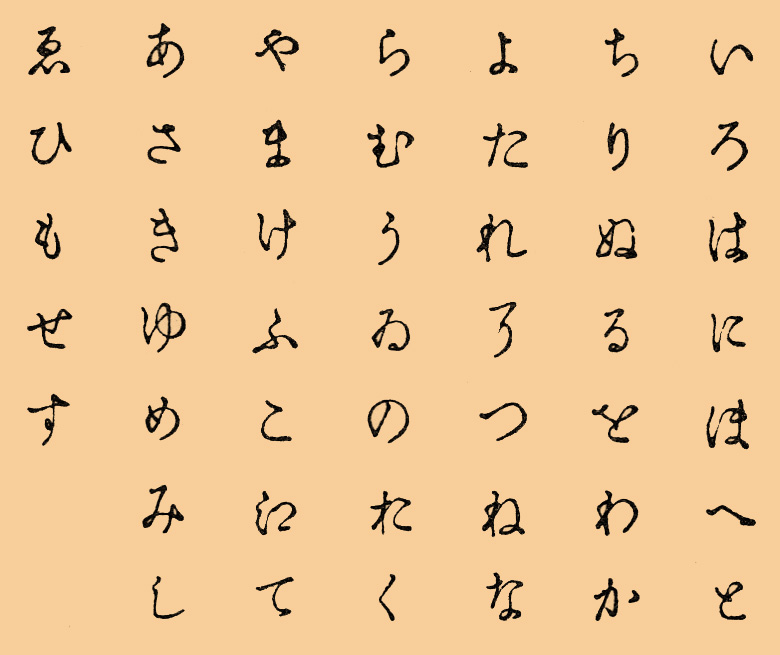
y. One of the most famous poems across Japanese history and even contemporary culture is a poem called the Iroha. The name “iroha” comes from the first three letters of the poem “i”, “ro” and “ha”. What makes this poem famous is that it uses each hiragana syllable exactly once, and still makes an intelligible, not to mention lovely, poem.

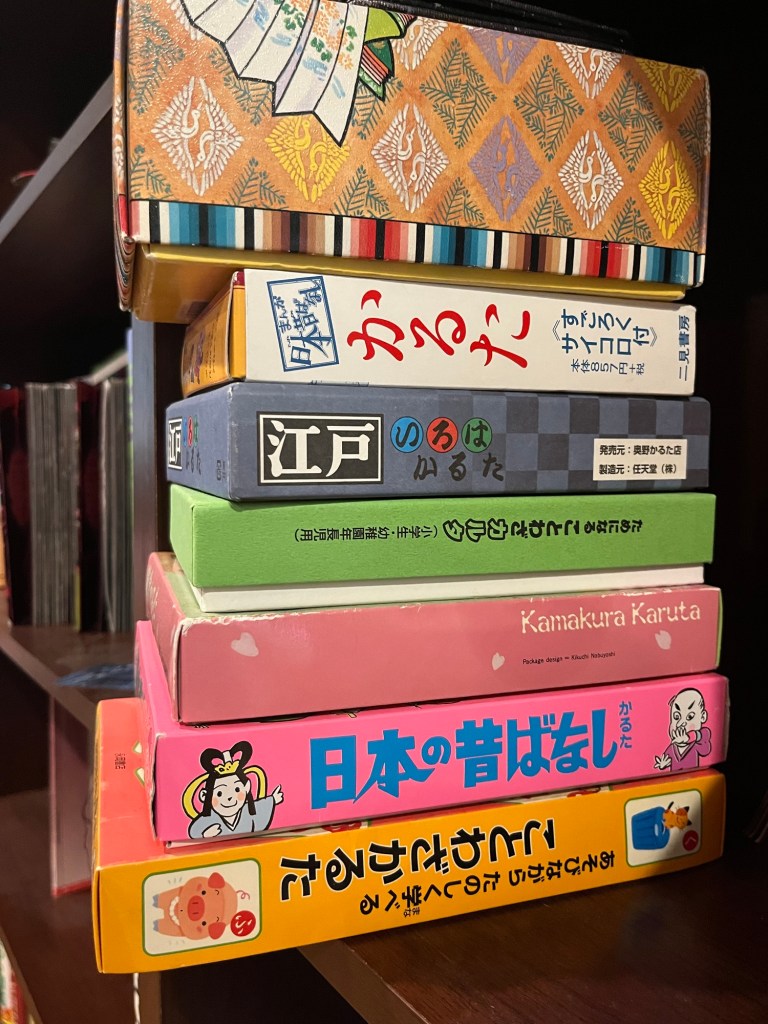
Because of this, it was often used in pre-industrial Japan as a way to organize things. Theater rows would be organized by the order in the Iroha letters, and so were firefighter brigades in pre-modern Tokyo (a.k.a. Edo). Even modern karuta sets are organized by iroha order. I don’t mean the Hyakunin Isshu karuta that I often discuss in the blog, but more informal karuta games that kids often play. We have a few sets here at home, given to us by my in-laws for the grandkids. You can see a nice selection of Iroha karuta sets on the Okuno Karuta online store, too.a

Various karuta sets my in-laws in Japan sent us. The top one is my wife’s original Hyakunin Isshu she had from grade-school.

But I digress.

The Iroha poem’s author is unknown (more on that later), but it was originally composed in old Manyogana script, like other poems of the early Manyoshu anthology, then later in hiragana. It includes many old spellings, so it’s a bit hard to render in modern Japanese.

The poem is as follows:

ManyoganaModern JapaneseRomanizationTranslation1
以呂波耳本部止いろはにほへI ro ha ni ho he toEven the blossoming flowers
千利奴流乎和加ちりぬるをわchi ri nu ru o wa kawill eventually scatter
餘多連曽津祢那よたれそつねyo ta re so tsu ne naWho in this world shall
良牟有為能於久らむうゐのおra mu u i no o kuremain unchanged? Let us today2
耶万計不己衣天やまけふこえya ma kyo (ke fu) ko e tecross the mountains of impermanence
阿佐伎喩女美之あさきゆめみa sa ki yu me mi shiand no longer have superficial
恵比毛勢須ゑひもせe hi mo se sudreams, nor be deluded
1 adapted translation from Wikipedia, plus a few modifications of my own
2 有為 (u i) meaning “viccisitudes of life” or the impermanence of all phenomena

This poem has strong Buddhist allusions to such concepts as samsara (“the aimless wandering lifetime after lifetime”), the delusions that bind us to this existence, awakening to these delusions (e.g. “enlightenment”), and finally nirvana (“unbinding”). The poem itself shows considerable familiarity with earlier Buddhist texts such as the Perfection of Wisdom sutras, including the Heart Sutra, as well.

But I digress. Again. 😅

There are some really interesting aspects of this poem that are worth sharing. First, authorship. Given the strongly Buddhist undertones of the poem, it’s often been attributed to a famous Buddhist monk named Kukai (a.k.a. Kobo Daishi) who was a talented poet and calligrapher. Another theory states that this poem may attributed to none other than the famous court poet Kakinomoto no Hitomaro, who composed poem 3 in the Hyakunin Isshu (あしびきの).

But things get even more interesting.

Scholars have noted that if you take the last syllable of each line (highlighted above for convenience) it spells another sentence: toka (ga) nakute shisu (咎[が]無くて死す) meaning “he/she died without fault or blemish”. Another theory, mentioned in my new book, points out that the 5th column spells out ho(n) wo tsu no ko me (本を津の小女), which could mean “deliver this book to my wife in the town of Tsu”, which if taken together with the 7th column implies that “I will die without blemish, please deliver this poem to my wife”.

So, is the poem a tribute to someone else? Perhaps Kukai or Hitomaro? If so, then who wrote it, and why? Was the poem a coded message to someone who was executed for political reasons? Or was the poem simply an attempt at word-play?

We will never know, but the impact of the Iroha on Japanese poem can still be easily seen today.

a Although things like Chihayafuru and this blog tend to emphasize the competitive karuta of the Hyakunin Isshu, in reality that’s only a small subset of karuta gaming culture. Most of it is much more informal stuff you play at home with family, much like board games in Western culture, and often times doesn’t even relate to the Hyakunin Isshu. Maybe I’ll post about it some time, but thanks to grandparents in Japan, we have 4-5 sets here ranging from such subjects as places in the city of Kamakura, old folks-sayings, Japanese fairy-tales, and just really basic words in Japanese. Most of these list the cards using iroha-order, and are not related to the Hyakunin Isshu. We’ve played them with our kids from time to time, and they’re much easier than competitive karuta, though it’s still assumed you know at least some basic Japanese.