Lamentations: Poem Number 86

Another Autumn moon poem, but with an interesting twist:

JapaneseRomanizationTranslation
なげけとてNageke tote“Lament!” does it say?
月やは物をTsuki ya wa mono woIs it the moon that makes me
するOmowasurudwell on things? —No,
and yet,
かこちがおなるKakochi gao narulook at the tears flowing
down
わがなみだかなWaga namida kanamy reproachful face!
Translation by Dr Joshua Mostow

This poem was composed by the Saigyō Hōshi (西行法師, 1118 – 1190), or “Dharma Master Saigyō” a famous Buddhist monk and poet from the era. Saigyo’s story is interesting in of itself, and I blogged more about it on the other blog, including additional poetry, but let me post a summary here.

In his youth, his name was Sato no Norikiyo and he was a promising young man in the Heian Court, and caught the attention of Emperor Toba, Emperor Sutoku (poem 77) and also Taira no Kiyomori, the most powerful man at the time and who later featured as a villain in the famous Tales of the Heike and a many dramas on Japanese TV.

However, Norikiyo grew disillusioned with the nasty politics and infighting in the Court, and abruptly decided to throw it all away. He left behind his career, his wife and children, and became a wandering mendicant. He took on the Buddhist name Saigyo (西行) and stayed at the famous mountain-monastery of Koyasan for monastic training. Later, he returned to the capitol to find everything had changed. The Hogen Rebellion had destroyed much of the capitol, Emperor Sutoku was exiled (having lost), and Kiyomori ruled as a warlord. A few years later, Kiyomori and the entire Heike clan were utterly destroyed in the famous Genpei War, which also spelled the end of the historical Heian Period. What might have happened had Norikiyo stayed and followed his career, rather than leave the capitol?

In any case, with the new samurai government at Kamakura (thus, the Kamakura Period of Japanese history), things settled down in Japan and Saigyo traveled around. He devoted his life to writing poetry, lamenting the loss of his former patrons, admiring the beautiful nature in Japan, and about life in general. He finally settled down in the outskirts of Osaka, and passed away at the age of 73. It was said that when he passed away, the cherry blossoms were in full bloom and that he died on the same day that Shakyamuni Buddha died (February 15th according to solar calendar).

He was also friends with Shunzei (poem 83), according to Professor Mostow.

Anyhow, this poem is, according to Professor Mostow, possibly inspired by a poem by famous Chinese poet Bo Juyi centuries earlier, and is supposed the express the feelings of a resentful lover. Is the moon making him/her tearful? Maybe, maybe not, but gazing up at the moon brings them such sadness anyway.

Saigyo’s talent with poetry and his interesting life story have certainly helped him earn a place in the Hyakunin Isshu, but also inspired many later poets such as Basho and others. Basho the Haiku master, in his travels, went to visit places frequented by Saigyo among others.
Not Quite Done Yet: Poem Number 68

This poem is something that touches on an important theme here on the blog, but first, let’s take a look:

JapaneseRomanizationTranslation
心にもKokoro ni moThough it is not what’s
in my heart,
あらで浮世にArade ukiyo niif in this world of pain
ながらNagaraebaI should linger, then
こいしかるべきKoishikaru bekino doubt I shall remember
fondly
の月かなYowa no tsuki kanathe bright moon of
this dark night!
Translation by Dr Joshua Mostow

This poem was composed by Sanjō-in (三条院, 976 – 1017), known in English as the “retired Emperor Sanjo“. He only reigned briefly for 5 years until his regent, Fujiwara no Michinaga, forced him to abdicate so that his own grandson could become Emperor (Emperor Go-ichijo). Fujiwara no Michinaga will be remembered as the main character of Lady Murasaki’s Diary, plus he employed a number of the female authors in the Hyakunin Isshu to be ladies in waiting for his daughter. Fujiwara no Sadayori (poem 64)’s family also lost in the same struggle.

To make matters worse, Emperor Sanjo was frequently ill, and this added further pressure for him to abdicate.

The poem above, according to Mostow, is thought to have been composed toward the end of his reign when he was ill and considering abdication. Was he concerned that night about his illness, or about the prospect of losing the throne? What made him savor that moon so?

As mentioned in this post, the later poems of the Hyakunin Isshu reflect a more somber era when political scheming and conflict replaced the earlier enthusiasm of previous generations. By this time, the Emperors had lost much of their power to ministers (mainly from the Fujiwara family) and were increasingly isolated, or even battling one another.

The 400-year Heian Period, the height of aristocratic culture in Japanese history, which the Hyakunin Isshu covers, would come crashing down about 100 years later.

The World Moves On: Poem 93

I was reminded of this poem recently and felt like sharing it with readers. It is one of the most poignant in the anthology, I think:

JapaneseRomanizationTranslation
世の中はYo no naka waIf only this world
つねにもがもなTsune ni mo ga mo nacould always remain the same!
なぎさこぐNagisa koguThe sight of them towing
あまのぶねのAma no obune nothe small boats of the fishermen who row in the tide
綱手かなしもTsuna de kanashi mois touching indeed!
Translation by Dr Joshua Mostow

This poem was composed by the Kamakura no Udaijin (鎌倉右大臣, 1192-1219), or “Kamakura Minister of the Right”. He is also known as Minamoto no Sanetomo. Sanetomo was the third shogun of the new Kamamura Shogunate, the same military government opposed by Emperor Gotoba (poem 99) and Emperor Juntoku (poem 100).

Sanetomo was a more gentler ruler than some of his predecessors, and even studied poetry under Fujiwara no Teika (poem 97), the compiler of the Hyakunin Isshu anthology and contributed to other Imperial anthologies as well.

However, he lived at a time when the old Heian court (which included most of the authors in this anthology) had been reduced to a shadow of its former self (see poem 100 above). The power had shifted away from the Imperial Court to the eastern city of Kamakura, and the country was still rebuilding itself after war. Sadly, this new center of power was unstable, and as the third Shogun, he was surrounded by ambitious family members and retainers who either plotted to replace him with their chosen candidate, or ruled “on his behalf”. Sanetomo was a tragic, powerless figure who was given to drink and poetry because he had little else to look forward to.

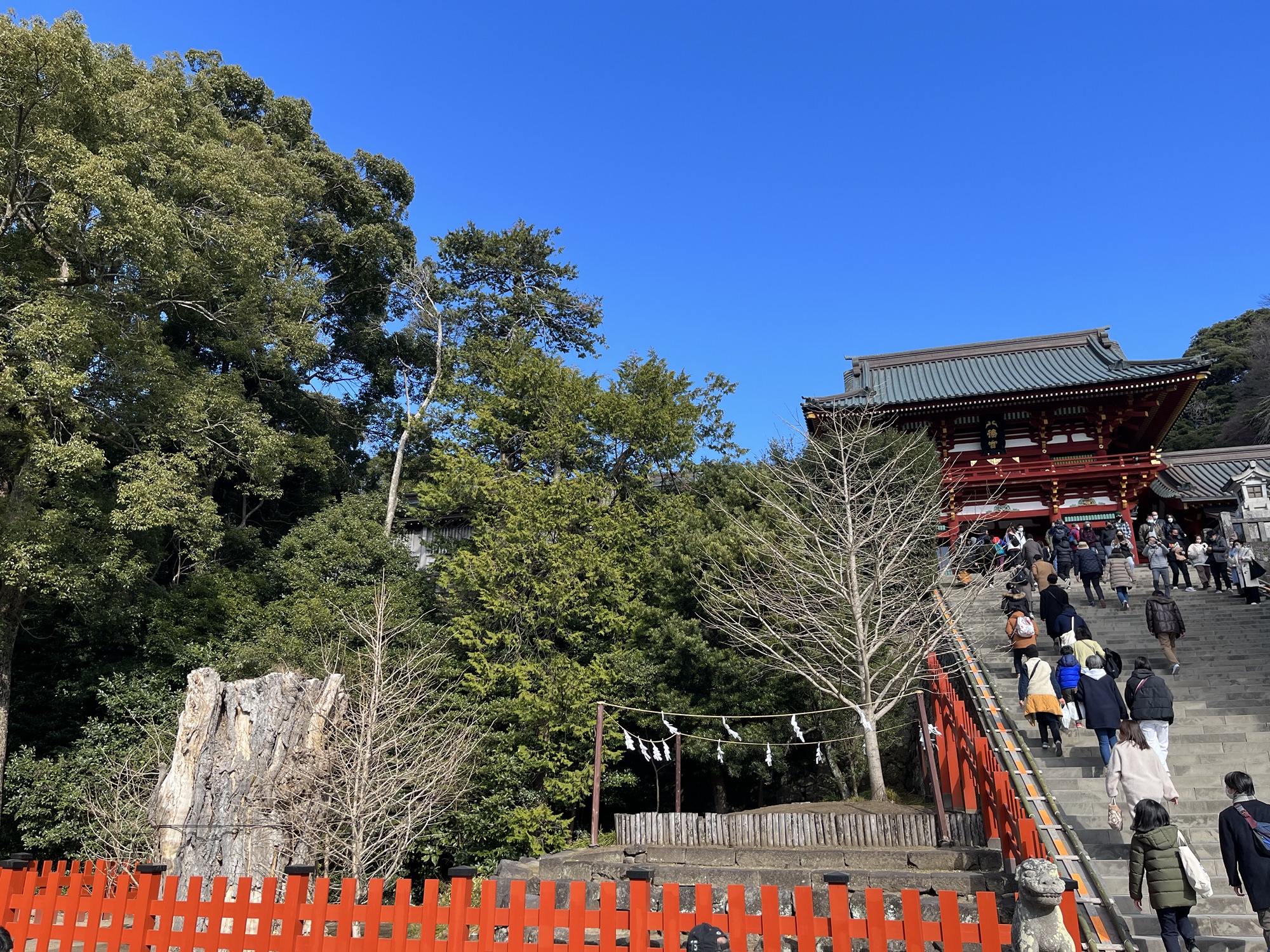
After escaping other assassination attempts, Sanetomo was killed at age 28 at Tsurugaoka Hachimangu shrine (English site here). His nephew, Kugyo, was hiding behind a ginkgo tree which can be seen to the left of the stairs in the photo above. As Sanetomo descended the stairs, Kugyo leapt out and cut him down with a sword. The ginkgo tree still stood for another 800+ years, but finally fell over in March of 2010 due to age and disease. Efforts to resuscitate the tree are underway. The photos in this post were both taken by me in the winter of 2023: the stump of the dead tree is on the left, while the restored sapling is fenced off in the middle. The grand stairs leading up to the shrine is where Sanetomo was assassinated.

This poem reflects his melancholy as he views the shores of Kamakura, and wishing this peaceful scene would always remain, in contrast to the turbulent life he lived.

Politics and power are a dangerous thing.

The Hyakunin Isshu as a Rough Historical Tour

As you may have started to notice, the Hyakunin Isshu anthology provides a subtle historical overview of the classical period in Japanese history. This may have been intention on the part of Fujiwara no Teika, or just reflects the sentiment of his time. Either way, it’s an interesting tour of Japan from the 8th to 12th centuries.

The anthology begins with poems in the Nara Period, when Japanese culture, flush with cultural imports from China (e.g. Confucian ethics, Buddhism, technology, administration, poetry, etc). It was an exciting time in Japanese history. And if you look at the poems from this era, you can see that they tend to feature benevolent rulers (poem 1), bright and happy natural scenes (poems 2 and poem 4), or just often dealt with frivolous issues of love (poem 3 and poem 12) or just life in general around the capitol (poem 10).

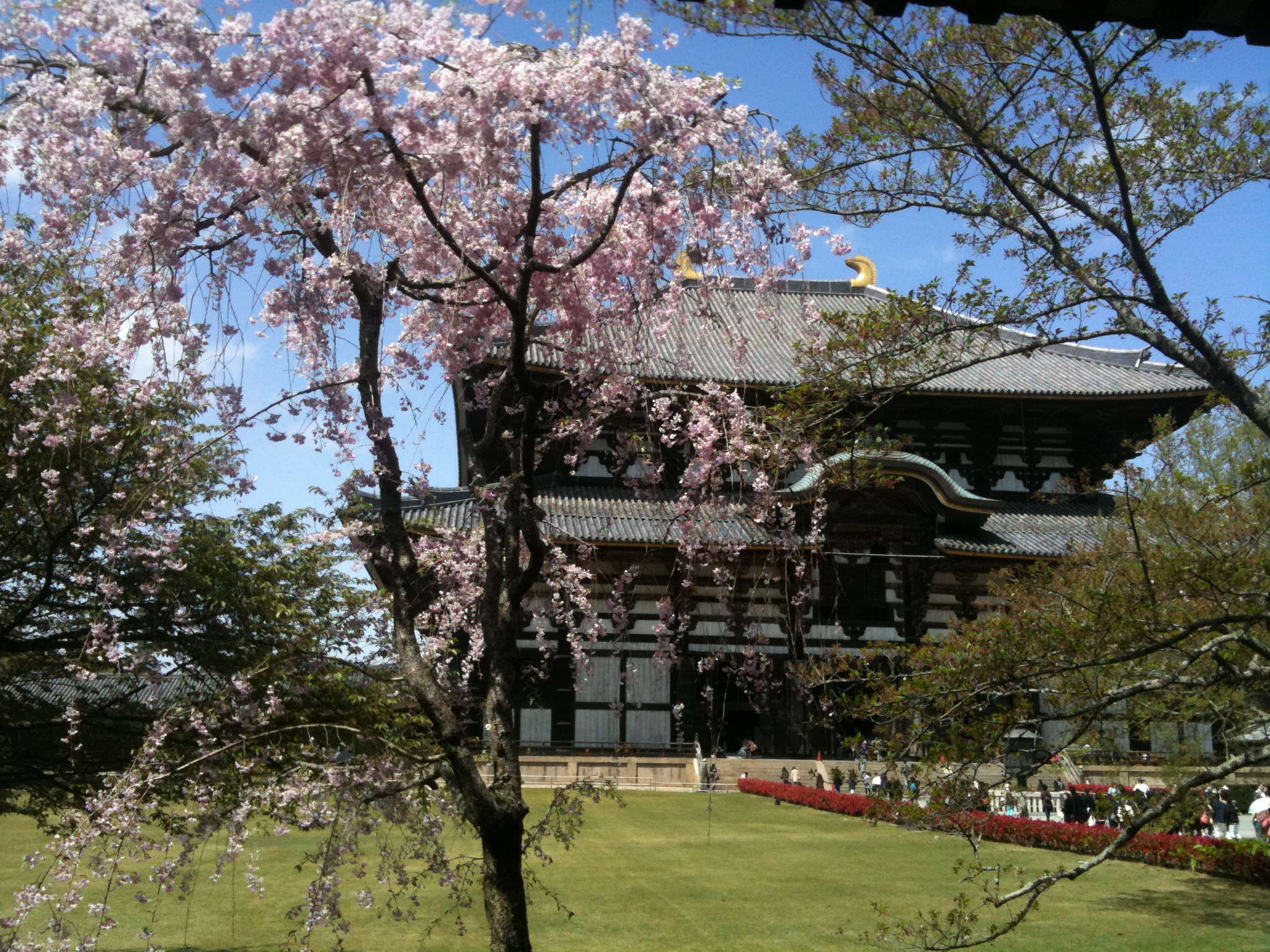
Todaiji Temple in Nara on a warm April day in 2010. Taken by author.

Even when the poems were more melancholy (poem 9, poem 11) they still reflected a more genteel time, and were probably included by Fujiwara no Teika to demonstrate the range of poetic skills of the nobility during that bygone time.

However, the Nara Period eventually gave way to the Heian Period, which was a 400-year flowering of Japanese culture that is still revered today. The transition was slow, and much remained the same generations later, but eventually things started to change:

  • Japan’s contact with China and the Asian mainland eventually stopped, and Japanese culture turned more and more inward for several centuries. Poetry and culture at this time reflected more “native” styles by and by.
  • Politically, the northern-branch of the Fujiwara clan gradually monopolized power around the Emperor through political marriages. In the early period, the nobility included several families who supported the family, but by the 11th century, the Fujiwara controlled every major position in government and most emperors were related to them in one way or another. This is what led in part to Sugawara no Michizan’e exile for example. You’ll notice too how many of the poets have the surname “Fujiwara” in the anthology as well, including Fujiwara no Teika the compiler himself.
  • Toward the end, conflict began to arise again and again, culminating in the famous Genpei War and the fall of the Heike clan. The new samurai class (originally bodyguards to the noble families) clashed with one another for control of Japan and ultimately swept aside the nobility, while still trying to imitate the courtly culture.

As such, if you look at poems toward the very end of the Hyakunin Isshu, they tend to be more dismal in tone. Starting with poem 77 onward, you get an increasing melancholy tone to many poems, culminating at the end when poets often speak of longing for the past (poem 100), complaints about life (poem 83, poem 99) or just expressions of people suffering (poem 95).

Indeed, by this time the flowering culture that started in the Nara Period and flourished in the Heian Period had declined, and war and politics had taken their toll on society. The final few poems begin in the militaristic Kamakura Period, and reflect both nostalgia and unease by people of that era. Small wonder that Fujiwara no Teika, who took tonsure after Emperor Go-Daigo was exiled, decided to compile the Hyakunin Isshu the way he did.

An Offering To The Gods: Poem Number 24

Hi folks, after a long break due to work obligations, I am back and happy to post this excellent poem by my favorite author in the Hyakunin Isshu:

JapaneseRomanizationTranslation
このたびはKono tabi waThis time around
ぬさもとりあNusa motori aezuI couldn’t even bring the
sacred streamers
手向山Tamuke yama—Offering Hill—
もみのにしきMomiji no nishikibut if this brocade of leaves
神のまにまにKami no mani maniis to the gods’ liking….
Translation by Dr Joshua Mostow

The poem is signed as Kanké (菅家, 845 – 903), which is the Sinified (Chinese) way to read the Sugawara Family name (lit. “House of Sugawara”). You see similar names used for the Taira Clan (e.g. Heike 平家) and Minamoto Clan (e.g. Genji 源氏) in later times. Anyhow, the author is none other than the famous poet/scholar Sugawara no Michizane who in later generations was deified as a sort of god of learning named “Tenjin” after he was wrongfully exiled through political intrigue.

The term nusa (幣) means a special wand used in Shinto religious ceremonies. The photo above is an example of a nusa, more formally a gohei (御幣) “wand” used in Shinto religious ceremonies, with the paper streamers used for purification (photo by nnh, Public domain, via Wikimedia Commons). At this time in history, according to the Hyakunin Isshu Daijiten, small nusa were often made from thin strips of paper and cloth and offered to the gods for a safe journey.

The poem was composed by Michizane after going on an excursion with his patron, Emperor Uda. Compare with another outing made years later by (then retired) Emperor Uda later in poem 26. In this case, Michizane had little time to prepare, and couldn’t make a proper offering to the gods for a safe trip. However, admiring the beautiful autumn scene on Mount Tamuke, he hopes that this will make a suitable offering instead. Sadly Michizane would be disgraced and exiled only a short time later.

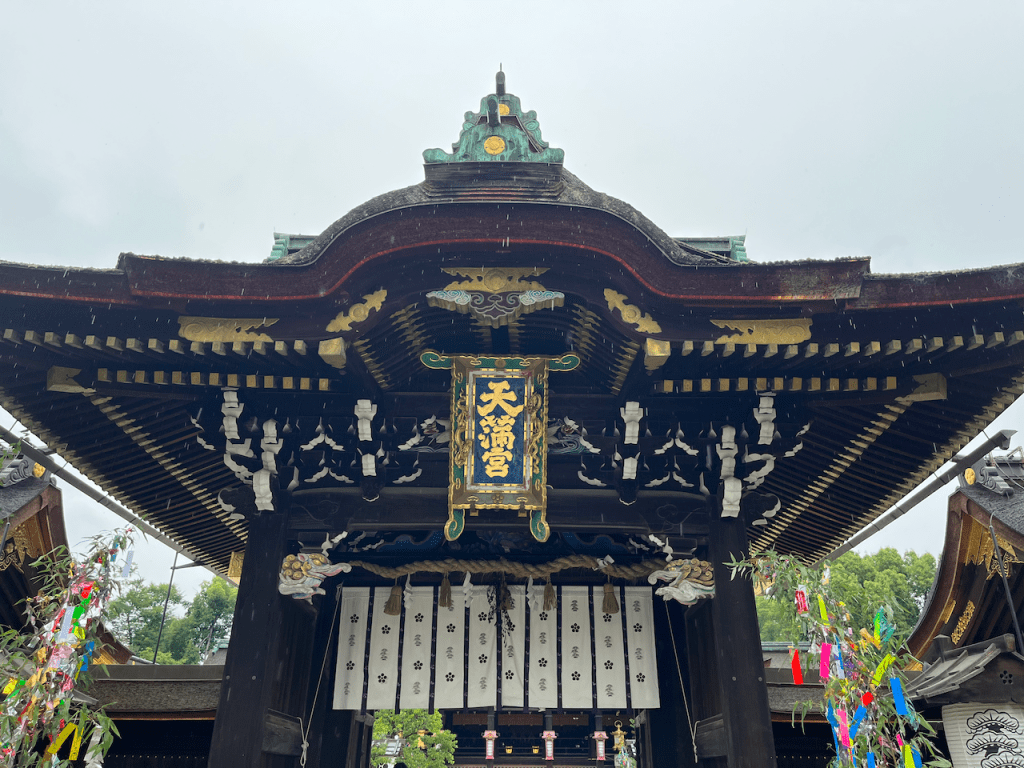
My interest in Sugawara no Michizane mostly comes because I admire him as a fellow scholar. I visited one of his shrines in Tokyo a couple times over the years, and usually try to pay respects. In July 2023, I visited the home shrine of Kitano Tenmangu as well.

Kitano Tenmangu shrine in Kyoto, Japan. Taken in July 2023.

The real life Michizane was no god of learning, but his real-life contributions to poetry and Chinese literature in Japan helped the culture flourish at that time, and earned his place as a trusted adviser to the Emperor, despite his more humble background. This also helped explain his status centuries later as a god of learning. Every year in Japan in April, students pay respects hoping that they can pass entrance exams, and it’s nice to see his legacy carry on so many years later.

The End of an Era: Poem 100

The very last poem in the anthology goes along with the previous one in our theme on the end of the Heian Court era:

JapaneseRomanizationTranslation
百敷やMomoshiki yaThe hundredfold palace!
古き軒端のFuruki nokiba noeven in the shinobu grass
しのぶにもShinobu ni moon its old eaves
あまりあるNao amari aruI find a past for which
むかしなりけりMukashi narikeriI long yet ever more.
Translation by Dr Joshua Mostow

This poem was composed by Juntoku-in (順徳院. 1197 – 1242), or “Retired Emperor Juntoku”. Emperor Juntoku‘s father, Emperor Go-toba (poem 99), led the disastrous Jōkyū Disturbance in a last-ditch effort to wrest back power from the new samurai military government in 1221. Like his father, Juntoku was exiled after the rebellion was crushed, but he was sent to Sado Island instead, and lived there for 20 years before his death.

This poem, though, was composed in 1216, five years before the war, and recalls the glory days of the Imperial Court before the downfall in the late 12th century. When we look at the lengthy history of the poetry included in the Hyakunin Isshu anthology, spanning 400+ years, you can see how much poems like this one contrast with the upbeat, optimistic ones from earlier generations. By the time that Emperor Juntoku had assumed the throne, the capitol of Kyoto was already a shadow of its former self, and his reign a greatly diminished one.

In fact, in the Hyakunin Isshu Daijiten, the book points out that the Hyakunin Isshu begins with a poem by an Emperor (poem 1) writing on the harvest, a prosperous subject, and ends with another Emperor longing for bygone times. Fujiwara no Teika (poem 97), the compiler of the anthology obviously knew what he was implying.

Also, the phrase momoshiki is an interesting one. According to Professor Mostow, the phrase is borrowed from a much earlier poem in the Manyoshu:

JapaneseRomanizationRough translation
ももしきのMomoshiki noAre the people of the
大宮人はŌmiyabito waHundred Fold Palace
暇あれやItoma areyaso carefree that they
梅をかざしてUme wo kazashitegather plum blossoms
ここにつどへるKoko ni tsudoeruto decorate their hair?
Book 10, poem 1883

This poem colorfully describes how people in the palace are decorating their hair with plum blossoms they’ve collected, and playfully suggests that life at the palace is well and carefree.

So, it’s really interesting to see how Emperor Juntoku revives this ancient phrase in a poem that conveys the opposite meaning. The sun has set on the Imperial Court, and the palace looks tired and worn now. 

Further, Professor Mostow translates momoshiki as the Hundred-fold Palace which is as good a translation as any in English. But the Chinese characters (kanji) are 百敷 or “hundred seats laid out”, but alternatively, momoshiki can be written as 百石城 meaning “100-stones castle”. Both meanings refer to the Imperial Palace or kyūchū (宮中) in Japanese. The first word implies a hundred mats laid out for sitting (i.e. many people attending the court), while the latter means 100 stones, implying a palace with firm foundations.

But it’s a poignant reminder that all things decline some day.

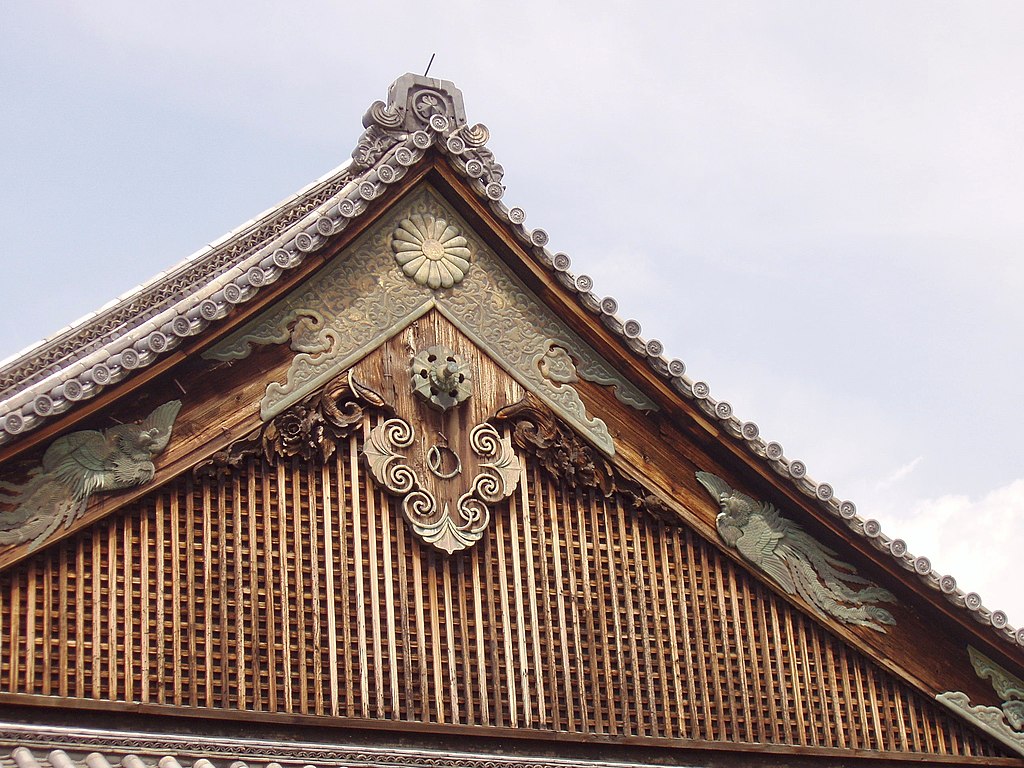
P.S. The featured photo above is the Ninomaru Palace, Kyoto, Japan (photo by Daderot, CC BY-SA 3.0, via Wikimedia Commons).

Brooding: Poem Number 99

Since I touched upon the end of the Court-era in Japanese history, I thought it would be fitting to post this poem:

JapaneseRomanizationTranslation
人もHito mo oshiPeople seem dear and
人もうらめしHito mo urameshipeople also seem hateful
きなくAjiki nakuwhen vainly
世を思Yo wo omou yue niI brood about the world—
もの思身はMono omou mi wathis self who broods about things.
Translation by Dr Joshua Mostow

The author of this poem was Gotoba-in (後鳥羽院, 1180 – 1239), or “Retired Emperor Gotoba”. Emperor Gotoba was one of the most noteworthy Emperors in Japanese antiquity. Gotoba was responsible for a revival in Waka poetry. He commissioned Fujiwara Teika (poem 97), who compiled the Hyakunin Isshu, among others to make a new official anthology after the Kokin Wakashū centuries before, and this new edition became the Shin Kokinshū which is still an important part of Japanese literature.

Gotoba was a bold character, and sought to restore power which had recently been wrested from the Imperial family by the new samurai class based in Kamakura, Japan (cf. poem 93). So, he and his son Emperor Juntoku, poem 100, organized a last-stand rebellion in 1221 called the Jōkyū Disturbance (or Jōkyū War) where he rallied the samurai back to his banner. Unfortunately, most didn’t want to lose their recent gains, and sided with the Kamakura government under the persuasion of Hojo Masako, the famous “Nun Warlord”.

Thus, the Jokyu Disturbance was a disaster and the Emperor’s forces were quickly destroyed. The young firebrand of an Emperor was then exiled to the Oki Islands and lived their for another 18 years.

This poem though, predates the rebellion and exile. According to Professor Mostow, it was composed as part of a series in 1212, which included Fujiwara no Teika, with the topic of “personal grievance”.

As to “who” he was referring to in the poem, that’s tricky. The word hito means “person or persons”, so it’s pretty generic. Mostow suggestions some traditional interpretations, such as those who oppose the Kamakura government, and those who uphold it (whom he detests), or another traditional interpretation was the common folk vs. those who opposed the rebellion (whom he obviously didn’t like).

We will never really know. But certainly after his exile, we can be sure he spent many days brooding.

P.S. Featured photo is another patron of the arts, Victor Hugo, brooding in this photograph from 1853. Photo by Charles Hugo, Public domain, via Wikimedia Commons

Parting Ways: Poem Number 77

In honor of my wife’s birthday, I thought I’d write about her favorite poem from the Hyakunin Isshu:

JapaneseRomanizationTranslation
瀬をはやみSe wo hayamiBecause the current is swift,
いわにせかるるIwa ni sekarurueven though the rapids,
がわTakigawa noblocked by a boulder,
われてもすWarete mo sue niare divided, like them, in the end,
とぞ思Awan to zo omouwe will surely meet, I know.
Translation by Dr Joshua Mostow

This poem was composed by Sutoku-in (崇徳院, 1119 – 1164), of “Retired Emperor Sutoku“. My new book notes that Sutoku had very tragic fortune in life. Sutoku was the son of Emperor Toba, but there were persistent rumors, and some limited historical evidence that his real father was Toba’s grandfather, Emperor Shirakawa. 😮😮 This strained Sutoku’s relationship with his father Toba, and so Toba did not step down as emperor until 23, despite installing Sutoku as the next emperor at age 5. Though his reign was long, and oversaw many poetry competitions, it ended poorly when he was forced to abdicate, and later exiled.

You see, his father Toba was infatuated with one of his other wive, Fujiwara no Nariko, and designated her son, Konoe as the next Emperor after Sutoku at age 3. Konoe however died at age 17 before ascending, and Nariko believed that a jealous Sutoku had cursed her son. This scandal eventually forced Sutoku off the throne, and his younger brother, Go-Shirakawa was installed next.

After Toba passed away, the bitter Sutoku became embroiled in a succession dispute with the regent Tadamichi (poem 76) that boiled over into the Hōgen Rebellion in 1156. The Rebellion was a disaster, and being on the losing side of the conflict, Sutoku was exiled to Sanuki Province, lived a monastic life until he died in 1164.

Coincidentally, the Hōgen Disturbance marks the beginning of the end of the Heian Court,1 and the rise of the samurai class, so legends existed that Sutoku’s angry spirit helped bring down the Court. A related legend is that while in exile, Sutoku lived a monastic life and sometimes sent poetry back to the Court, but the Court refused them on the grounds that they might be cursed. Evidentially, rumors of his curse from the death of Konoe, plus his ill-will from rebellion and exile, dogged him even later in life.

Sutoku was said to have taken great offense at this:

Vengeful Sutoku in Japanese art
“The Lightning Bolt”, a famous painting depicting Sutoku’s vengeful spirit, by Utagawa Yoshitsuya (same artist with the name Ichieisai Yoshitsuya), Public domain, via Wikimedia Commons

I mention all this because this poem on its own is quite lovely, and because it’s signed as “Retired Emperor Sutoku” it’s quite possible he wrote this while in exile, pining for someone he left behind in the capitol. Was it rejected as the legend says? If so, it’s a tragic waste of great poetry, and fuel for supernatural speculation. But if not, then this poem is still a lovely read and a reminder that old friends and loved ones will reunite again someday.

In any case, Happy Birthday, honey!

1 This is reflected quite a bit in the “mood” of the later poems of the Hyakunin Isshu, especially in the 90’s onward. Some of them have a sense of lost glory as the Heian Period ends, and the Court nobles become utterly powerless to the samurai class.