Fashion of the Hyakunin Isshu

The fashion of the nobility of the Heian Period of Japanese history is fairly different than later, more familiar styles we often see in Japanese media like anime, manga, etc., because it reflects early Chinese influence, but also increasingly local innovations and culture. Further, as we’ll see, because the aristocracy was socially rigid and had many complex customs and rules, this affected how people dressed as well. Everyone knew their place, and their fashion reflected this too. I have touched on the subject a little bit here and here, but I always wanted to explore in depth. The issue was (until recently) a lack of resources and time. But, here we go.

Some great online resources for fashion during the Heian Period of Japanese history (c. 8th century to 12th century) can be found on this website (Google translated version here), and this site. The second link has some English in it, so even if you can’t read Japanese, it’s a great place to visit and look around.

However, for us Hyakunin Isshu poetry (and karuta) fans, you can see many great examples in the yomifuda cards too.

Women’s Fashion

This card, depicts Daini no Sanmi (poem 58, ありま) of the Hyakunin Isshu. The illustration, part of the Ogata Korin collection, shows her in full formal dress.

Like many women of the Heian Period, during formal occasions, she would wear multiple layers of kimono robes called junihito-é (十二単) which literally translates to “twelve robes”. The women of the court did not actually wear 12 layers, but it was much heavier and bulkier than kimono fashion of later centuries.

Here’s another example: Suō no Naishi (poem 67, はるの):

And another: Kōkamonin no Bettō (poem 88, なにはえ):
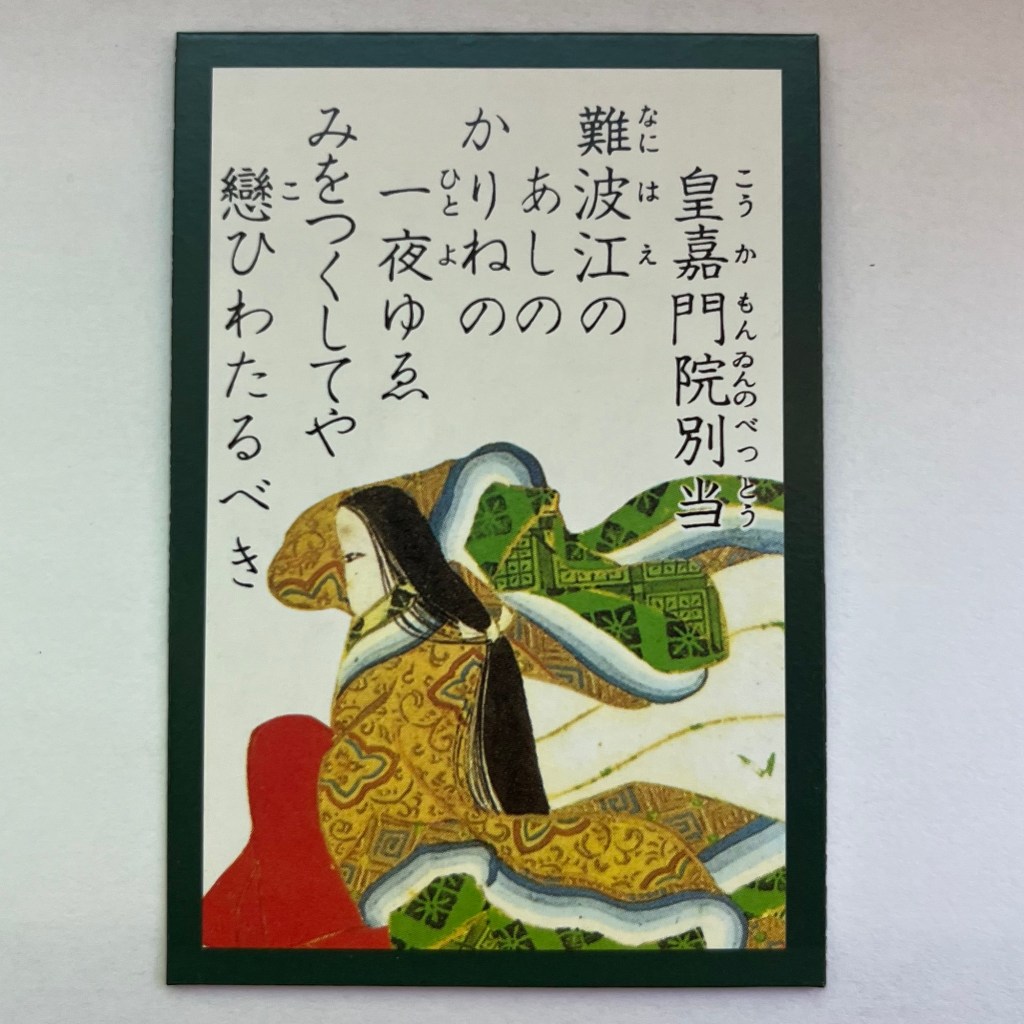
A few things worth pointing out…

  • The robes (hitoé, 単) were very long and thus hard to walk in.
  • Over the layers of robes, the women would wear a “Chinese jacket” (karaginu, 唐衣).
  • The white train in the back was called a mo (裳), which tied around the waist.
  • The women wore hakama (袴) trousers much like Japanese traditional clothing today.

You can see a really good example of this kind of fashion here. Definitely check out the link.

Men’s Fashion

Men’s formal wear, if you can believe it, was actually more complicated than women’s. Broadly speaking, it could be divided into three categories: civil bureaucrats, warriors (e.g. palace guards), and upper class nobility including the Emperor.

Imperial Advisors

Because the Imperial court of Japan was modeled after the Chinese-Confucian bureaucracy from antiquity, there are some similarities in the fashion of the civil servants (bunkan, 文官): black robes, similar hats, etc. We can see some examples here: Middle Counselor Yakamochi (poem 6, かさ):

and Middle Counselor Yukihira (poem 16, たち):

Some things to point out here:

  • The hat they wore, the sui-ei-kan (垂纓冠) was a black lacquer helmet, but in this case, also had a ribbon hanging down the back too.
  • Black silk overcoat called a ho (枹), based on Chinese-Confucian style.
  • The high collar in the back was called an agekubi (盤領)
  • In formal settings, men would also wield a small, flat wooden scepter called a shaku (笏).
  • The silk pants were a variation of the modern Japanese hakama called an ué-no-hakama (表袴).
  • Finally, the shoes were a kind of black lacquer clogs called asagutsu (浅沓). Similarly to the women’s formal wear, it was hard to walk in.

You can see some great examples of both the summer dress and the winter dress.

One thing to note is that even samurai warlords who ruled the country in later periods (see Sanetomo), when they came to the capital (jōraku 上洛) were expected to wear this kind of court dress befitting whatever rank they had been bestowed. Although the samurai class held true power, they were still technically part of the Imperial court so customs persisted.

Guards

For the palace guards and other military figures, the formal dress was similar to the bureaucrats above, but with some notable differences. A good example from the Hyakunin Isshu is Fujiwara no Michinobu (poem 52, あけ):

Noting the differences here:

  • Guards and military figures were equipped with a sword (ken, 剣), bow (yumi, 弓), and a quiver of arrows (ya, 矢).
  • The crown on their head was shaped in a loop, not a long trailing one. It was called a ken-ei-kan (巻纓冠) instead.
  • The crown also had two fan-like protrusions called oikake (緌).
  • Instead of black-lacquer clogs, the shoes were often pointed-toe boots called kanokutsu (靴).

You can see an example here.

Upper Nobility

The upper nobility wore clothing that was pretty similar to other members court, but with one major exception: the colors of their robes. Here you can see Prince Motoyoshi (poem 20, わび):
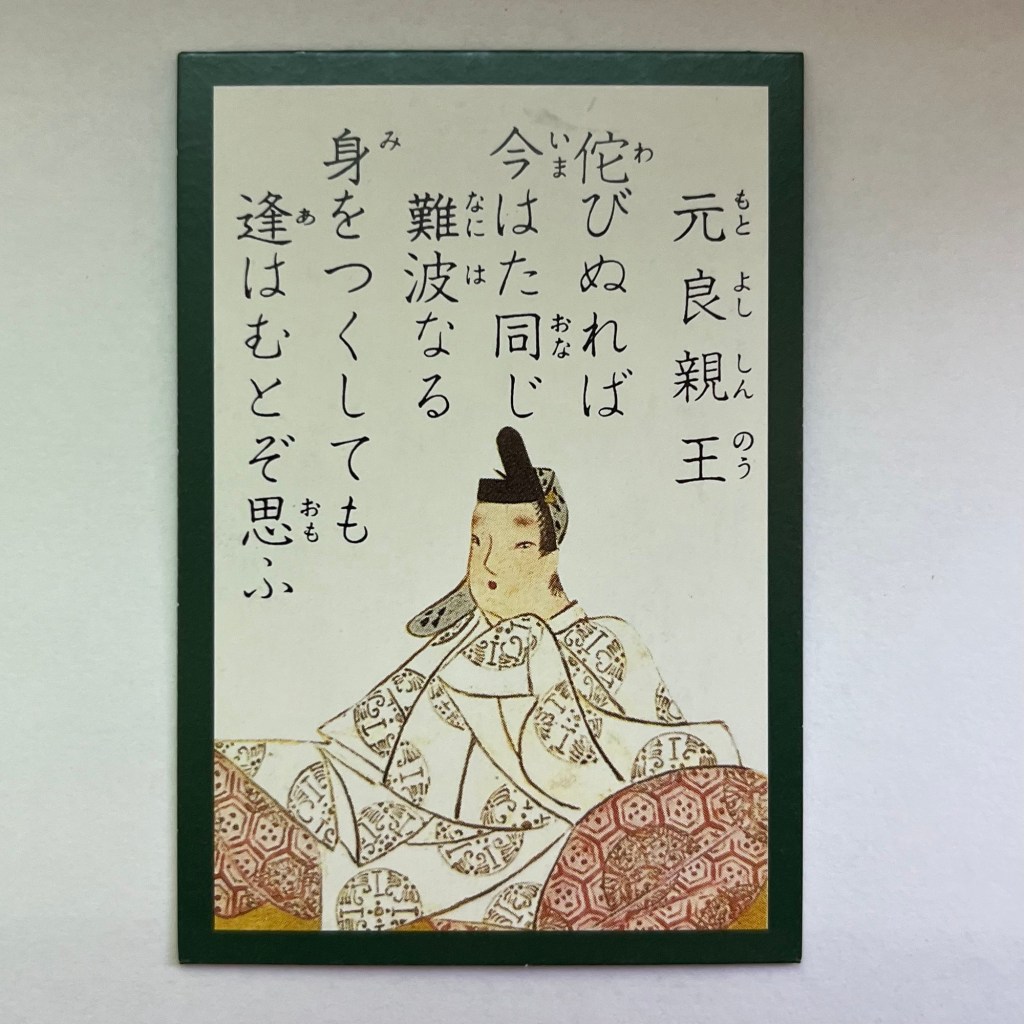
As eluded to in Lady Murasaki’s diary and other sources, there was a strict hierarchy within the Court nobility, which was reinforced by which colors of robes people were permitted to wear. This included colors such as green (shown here), orange (shown here) or white (shown here). The green linked above was, for example, permitted to courtiers of the sixth rank, or palace servants of the fourth rank. Wikipedia has list of forbidden colors, and what ranks were associated with each. The point is is that just by looking at someone’s robes, members of the aristocracy knew each other’s place.

The very upper class nobility, namely those of the Emperor and his family, are often depicted in white robes with red trimming, which is similar to those used by Shinto priests (shown here). It’s probable this was intended to reinforce the Imperial family’s divine lineage, but that’s just a guess on my part.

The fashion used in the yomifuda Karuta cards really tells us a lot about the culture that the poets of the Hyakunin Isshu lived in.

The Birds of the Hyakunin Isshu

Waka poetry, including the Hyakunin Isshu has a lot of conventions and symbols used to express certain seasons or sentiments. This is not so unusual. For example, if someone in the US writes a poem about the smell of cinnamon, it definitely brings to mind late autumn or winter.

One common example in the Hyakunin Isshu of poetic symbolism are birds. Birds have distinctive calls, and different species tend to be prominent at different times of year, among other things. For this post, I included a lot of poetry from the Imperial anthology, the Kokin Wakashu, which is much larger than the 100 poems of the Hyakunin Isshu, and thus easier to find examples.

Spring

The most prominent bird in Spring is the uguisu, the Japanese Bush Warbler, also called the Japanese Mountain Thrush:

Photo by Alpsdake, CC BY-SA 3.0, via Wikimedia Commons

The uguisu’s distinctive bird call is very emblematic of the season.

The bird call of the uguisu sounds like ho-ho-ke-kyo, which to Japanese people sounds similar to a famous Buddhist text called the Lotus Sutra (hokekyo in Japanese). I’ve written much about the Lotus Sutra in my other blog, so I do not need to repeat here. Needless to say, when Spring comes, people in Japan inevitably hear this lovely sound, even in urban areas.

Oddly, there are no poems in the Hyakunin Isshu about the uguisu, however, I found many poems in the official anthology, the Kokin Wakashu. Here are a few of my favorites thus far. This first one is poem 4 by Fujiwara no Takako (藤原高子; 842–910) later Nijo-kisaki (二条后, “Nijō Consort”):

JapaneseRomanizationTranslation
雪の内にYuki no uchi niSpring has come amidst
春はきにけりHaru wa kinikerithe icy lingering snows
うぐひすのUguisu noof winter
れる涙Kōreru namidasurely now the frozen of the
今やとくらIma ya toku ranmountain thrush will melt away
Translation by Laurel Rasplica Rodd and Mary Catherine Henkenius from Kokinshu: A Collection of Poems Ancient and Modern

and this one, poem 10, by one Fujiwara no Kotonao:

JapaneseRomanizationTranslation
はるやときHana ya tokiHas spring come early—
花やおそきとHana ya osoki toor are the plum blossoms late—
ききわかKiki wakanI would like to know
鶯だにもUguisu dani mobut not even the song of the
なかずもあるかなNakazu mo aru kanamountain thrush trills the answer
Translation by Laurel Rasplica Rodd and Mary Catherine Henkenius from Kokinshu: A Collection of Poems Ancient and Modern

and finally this one by Mibu no Tadaminé whom we know from poem 30 in the Hyakunin Isshu (ありあ):

JapaneseRomanizationTranslation
春来ぬとHaru kinu toAlready they say
人はいどもHIto wa iedomoSpring is here but as for me
うぐひすのUguisu nowhile yet there is no
なかぬかぎりはNakanu kagiri wasong from the mountain thrush
あらじとぞ思Araji to zo omouI cannot believe spring has come
Translation by Laurel Rasplica Rodd and Mary Catherine Henkenius from Kokinshu: A Collection of Poems Ancient and Modern

Summer

In summer, the most iconic bird is the hototogisu, the Lesser Cuckoo.

Photo by christoph_moning, CC BY 4.0, via Wikimedia Commons

And it’s call sounds like so:

We’ve seen the Lesser Cuckoo in poem 81 (ほ) of the Hyakunin Isshu by Gotokudaiji no Sadaijin.

It is also found in Imperial anthologies such as the Kokin Wakashu by an anonymous source:

JapaneseRomanizationTranslation
郭公ほととぎすHototogisuWhen nightingales sing
鳴くや五月のNaku ya satsuki noin the sweet purple iris
あやめ草Ayamegusaof the Fifth Month
あやめも知らぬAyame mo shiranuI am unmindful of the warp on
恋もするかなKoi mo suru kanawhich we weave love’s pattern
Translation by Laurel Rasplica Rodd and Mary Catherine Henkenius from Kokinshu: A Collection of Poems Ancient and Modern

Apparently, the bird was highly praised during the aristocratic court culture of the Heian Period, and Sei Shonagon (poem 62) mentions an expedition in her Pillow Book:

[94] …it had been overcast and tending to rain since the first day of the [fifth] month. Some of us were sitting about at a loose end, when I came up with the suggestion that it would be fun to go off on an expedition to hear the hototogisu….

[ later ] … and as for the hototogisu, they were indeed calling back and forth, so loudly in fact that they made almost too much of a din for comfort.

Translation by Dr Meredith McKinney

The anecdote is quite long, but Sei Shonagon and the other ladies-in-waiting do encounter the hototogisu, and meant to write poetry about them, but then through a series of interactions forgot the poetry entirely and came back to the Empress empty handed, followed by various witty comments back and forth.

Autumn

Unlike the Spring, where the call of the bird is highly praised in poetry, in the Autumn, the Hyakunin Isshu Daijiten lists a few birds that were revered in poetry. For example, migratory birds, such as the Wild Goose (kari):

Photo by Piotr Kuczynski, CC BY-SA 3.0, via Wikimedia Commons

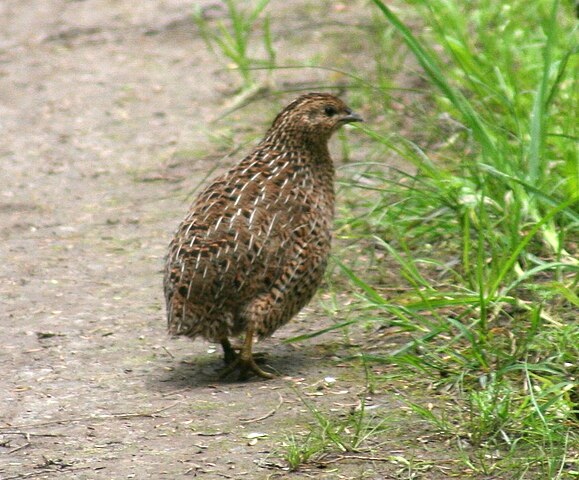
Or birds with autumnal colors such as the Quail (uzura):

Photo by Duncan Wright, CC BY-SA 3.0, via Wikimedia Commons

Or the swift Shrike (mozu):

Photo by Antonios Tsaknakis, CC BY-SA 4.0, via Wikimedia Commons

I had some trouble finding poems for the fall birds listed in either the Hyakunin Isshu or the Kokin Wakashu anthology, but there seems to be a lot in the later Shin-Kokin Wakashu anthology. I don’t have a reliable translation of the Shin-Kokin Wakashu, so I may update later.

I did find this poem under the section “Miscellany 2” in the Kokin Wakashu, poem 497 by an anonymous poet:

JapaneseRomanizationTranslation
野とならばNo to narabaIf all becomes dense fields
うづらとなきてUzura to nakiteI will pass my years
年はへToshi wa hencrying like a quail—
かりにだにやKari ni dani ya wafor surely you will come
君がこざらKimi wa kozaranif only for a few days’ hunt.
Translation by Laurel Rasplica Rodd and Mary Catherine Henkenius from Kokinshu: A Collection of Poems Ancient and Modern

Winter

The birds associated with winter, were birds whose cries were melancholy and said. First and foremost is the plover, which we saw in poem 78 (あわじ) of the Hyakunin Isshu:

Photo by J.M.Garg, CC BY 3.0, via Wikimedia Commons

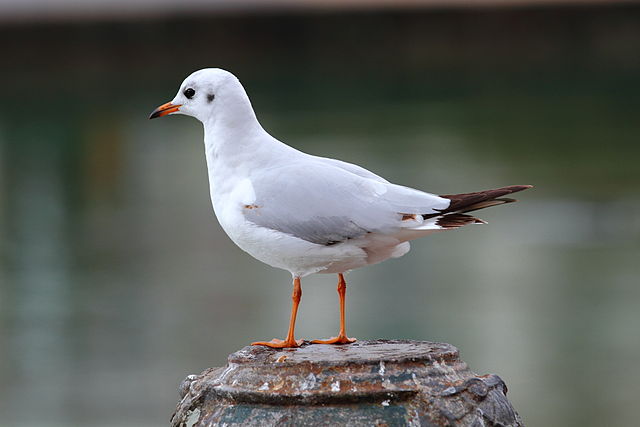
Or the Black-headed Gull (miyako-dori, meaning “bird of the capital”):

The miyakodori in particular stood out due to its unusual name. The Hyakunin Isshu Daijiten lists a poem from the official Kokin Wakashu anthology of note, poem 411 under the section “Travel Poems”:

JapaneseRomanizationTranslation
名にしおはばNa ni shi owabaOh capital bird
いざ言問はむIza koto towanif you are true to your name
都鳥Miyako-doriyou will know
わが思ふ人Waga omou hito watell me if the one whom I love is
ありやなしやとAri ya nashi ya tostill in this world of partings
Translation by Laurel Rasplica Rodd and Mary Catherine Henkenius from Kokinshu: A Collection of Poems Ancient and Modern

The headline for this poem explaining the backstory is unusually long, but basically the poet, Ariwara no Narihira (who also wrote poem 17, ちはやふる, in the Hyakunin Isshu) was away in eastern Japan with some companions, and longing for home in the capital, they saw a miyako-dori bird (lit. “capital bird”) and recited this poem.

And finally there is the Mallard (kamo):

Photo by Chuck Homler d/b/a FocusOnwWildlife, CC BY-SA 4.0, via Wikimedia Commons

The Mallard in particular had dual-association with romance and with the melancholy of winter. This poem in the Kokin Wakashu, number 533, by an anonymous author illustrates this:

JapaneseRomanizationTranslation
葦鴨のAshigamo noNo more than do
騒ぐ入江のSawagu irie noWhite waves dancing across the
白浪のShiranami noinlet, where reed ducks
知らずや人をShirazu ya hito wocry out noisily, no more
かく恋ひKaku koin to wadoes my love know my yearning.
Translation by Laurel Rasplica Rodd and Mary Catherine Henkenius from Kokinshu: A Collection of Poems Ancient and Modern

Other Birds

Certain birds were also used in Japanese poetry for symbolic purposes, but not necessarily for seasonal expression.

We’ve talked about birds associated with seasons thus far, but there’s a couple worth calling out that are an important part of Japanese poetry, but not related to seasons. The first is the Copper Pheasant, called yamadori, which we saw in poem 3 of the Hyakunin Isshu (あしびきの).

In antiquity, it was thought that Copper Pheasants mated for life (true), but slept in separate nests at night. Thus, the poet Kakinomoto no Hitomaro likened himself to a Copper Pheasant sleeping alone at night part from his lover.

And finally we come to the magpie. In poem 6 of the Hyakunin Isshu (かさ), the poet Chūnagon Yakamochi describes frost growing under moonlight on the so-called Magpie Bridge of the Imperial Palace. The magpie (kasasagi) was associated with a Chinese myth that evolved into the Qīxī Festival (七夕), celebrated as Tanabata in Japan.

The Magpie Bridge, illustration by ScribblingGeek, CC BY-SA 4.0, via Wikimedia Commons

In this tale, two star-crossed lovers, a celestial princess and a cowherd, were forcibly separated in the heavens by her father the Jade Emperor, but allowed to reunite one night a year. It was said they would reunite by crossing a bridge made of magpie birds who put their outstretched wings together. Thus, the magpie was always associated with this famous tale.

Love Triange, Part Two: Manyoshu Book One, Poem 21

A while back I wrote about a famous poem in the Manyoshu anthology by Princess Nukata addressed to her ex-husband Prince Oama (later Emperor Tenmu). It seems that the story of this forbidden encounter in a field of grass did not end there, because Prince Oama replied back…

ManyoganaJapaneseRomanizationRough Translation1
紫草能 紫草のMurasaki noHow could I possibly
尓保敝類妹乎にほへる妹をNioeru imo obe bitter to one so lovely
尓苦久有者憎くあらばNiku arabaas gromwell grass,
人嬬故尓人妻ゆゑにHitozuma yue niwhen even as someone’s wife
吾戀目八方我恋ひめやもAre koi me ya moI harbor feelings for you?
1 Apologies for any mistakes in this translation. This poem was particularly difficult for me.
Flowers from a Lithospermum erythrorhizon (murasaki) plant. Photo by titanium22 on Flickr, CC BY-SA 2.0, via Wikimedia Commons

Before we discuss the poet and the context, I wanted to briefly explain the plant described: murasaki (紫草). I had some trouble finding information on this plant, but it seems to be the species Lithospermum erythrorhizon which in English has a variety of names: purple gromwellred stonerootred gromwell, etc.

Princess Nukata was Prince Oama’s ex-wife, but had remarried his older brother, Emperor Tenji (poem 1 in the Hyakunin Isshu), while the emperor had compelled Prince Oama to marry his own niece (Tenji’s daughter) Princess Unononosasara to strengthen the family line. Relations in the family were complicated. Later after Emperor Tenji died, Prince Oama went to war against Tenji’s son, and overthrew him to become Emperor Tenmu. Game of Thrones, Japanese ediiton.

Yet what makes this exchange of poems surprising is that both Princess Nukata’s poem, and Prince Oama’s were recited not in secret, but at a big public banquet in front of Emperor Tenji.

So, what’s going on here? Are they professing their love in defiance of the Emperor?

Well … no. My book on the Manyoshu strongly suggests that given the circumstances these poems were likely recited in jest. Maybe they did still have lingering feelings for one another, but the poems were not meant to reflect real life; they were meant to paint a beautiful, but surreal scene. The imagery is fantastic, and a testament to their poetic skills, but the scene described likely did not happen. This is not unusual with the poetry we’ve seen thus far on the blog: many poems paint idealistic scenes that might be based on real life, but didn’t necessarily happen.

Then again…. what if they recited their poems in jest in order to hide true feelings after all?

One can’t help but wonder…. 🤔

June Updates and Lazy Izumi Poem

Hi all,

You may have noticed the blog looks a bit different now. I have been struggling since the big blog refresh I started in December 2022 to get the appearance just right. Design isn’t my forte (I am a history nerd), so I’ve struggled with finding the right design for this blog. The original blog template on WordPress was so old (this blog was started in 2011) that it was no longer supported by WordPress, so I had to find something else that works. After dabbling with a few designs this past year, I’ve settled on current blog template as of last week and I am pretty happy with it. I hope you all like the new design. I liked it so much I applied the same template to the other blog.

Next news: I will be off to Japan again this summer … though only briefly. The family and I will visit the ancient capitol of Kyoto, just like last year,1 but the visit overall is much more limited and I probably won’t get to see many things related to this blog. I won’t have time to visit Oishi Tengudo again, or Kitano Tenmangu Shrine, but I do however plan to make a stop at Kurumazaki Shrine (mentioned here) to pick up one of those Sei Shonagon (poem 62, yo wo komete) charms. I may try to work in a few other tourist spots related to the Lady Murasaki drama given that it’s popular right now. I also expect to melt under 35C(95F)-degree weather with 75% humidity again like last year.2

I have a few more posts coming up between now and the trip (late July), and I hope you will find them interesting.

Finally, just as a fun bonus, I wanted to share a one-off poem by Lady Izumi (poem 56, arazan) that I recently heard on a different Japanese historical drama. Lady Izumi is one of my personal favorite figures in the Hyakunin Isshu, and this poem was first recorded in an Imperial anthology, the Goshūi Wakashū (後拾遺和歌集), poem 755:

JapaneseRomanizationTranslation
黒髪のKuro kami noMy black hair’s
みだれもしらずmidarete shirazuin disarray — uncaring
うち臥せばuchi fusebahe lay down, and
まづかきやりしmazu kakiyarishifirst, gently smoothed it:
人ぞ恋しきhito zo koishikimy darling love.
Translation source: http://www.wakapoetry.net/gsis-xiii-755/

It’s not clear from this poem which lover she is referring to, since she had a number of relationships over the years, nonetheless it is a very sincere, romantic poem and expresses her passionate style nicely.

Happy Summer!

P.S. speaking of history nerd, I’ve debated about making a Japan / history podcast (like many other fine podcasts I follow), but have struggled to find a good theme. I might simply do the “history of the hyakunin isshu” podcast someday. It’s a bit commitment though, so we shall see.

1 While we do visit Japan yearly so my kids can spend the summer with their grandparents and extended family, visits to Kyoto are rare because of cost, time, and so on. Our last visit was almost 15 years ago. It just so happens that we could make two trips in two years. After that, who knows when we will visit next?

2 Without going into too many details, the humidity, heat and fluid loss aggravated an old medical issue I have. A reminder to stay hydrated, and avoid junk food. I like getting older in many ways, except at times like this. 😋

Omi Shrine

One of most iconic places in the world of Karuta is a placed called Omi Shrine, also called Omi Jingu (近江神宮, おうみじんぐう) in Japanese. It is here that the big championship events are often held, and it is a big part of season one of the anime series Chihayafuru. Not to sound like a cliché, but it is a kind of mecca for the Karuta world and the Hyakunin Isshu.

A scene from Chihayafuru as Chihaya approaches the Rōmon gate.

What is Omi Shrine though?

You see, Japan has essentially two religions that co-exist: the native Shinto religion and imported Buddhist one. We don’t need to go into detail about how they differ; I have an entire blog on the subject. Suffice to say, they differ. Even the place names are different. Buddhist temples are called otera or end with -ji. Shinto shrines are called jinja, jingu or taisha.

Anyhow, Omi is a Shinto shrine located in the city of Ōtsu, in Shiga Prefecture. This area was once the province of Omi, hence the name. The shrine’s constructed began in 1937 and finished by 1940. It is a young shrine, but has a deep connection to the past.

Like all Shinto shrines, Omi Shrine venerates a kami, a divine figure. A kami can be a god (think ancient Greek gods) from Japanese mythology, a local spirit, or even a historical figure. Some shrines venerate more than one kami.

Omi Shrine venerates none other than Emperor Tenji, who wrote poem one of the Hyakunin Isshu (あきの). During his reign, the capitol of Japan was moved to Otsu city and there he reigned until his death. Here, he carried out many essential reforms that provided the foundation for Japanese society for centuries. Because Tenji also wrote the opening poem of the Hyakunin Isshu, the shrine became quickly associated with the anthology and with Karuta.

The shrine website even has a handy catalog of the Hyakunin Isshu poems, not unlike mine. 😉

The English website is pretty limited, but the Japanese site has a lot of great information about the shrine, Karuta and so on.

The shrine is a bit removed from the usual touristy areas, so you might not be able to get there. However if you do go, it’s good etiquette to pay respects to the kami there. Per Shinto tradition (explained here) the process is:

  1. Bow deeply at the waist twice.
  2. In reverence, clap twice.
  3. Bow once more.

You can also use the water font nearby to wash your hands a bit (just watch how other Japanese do it) and your face a bit before facing the kami.

You can also pick up an omamori charm too.

I haven’t been to Omi Shrine myself but it seems like a lovely, scenic location, and I would love to play Karuta there someday even if I get crushed.

P.S. Featured photo is the Rōmon (楼門, “Sakura Gate”), photo by Kenpei, courtesy of Commons Wikimedia.

Teika’s Handwriting!

In other recent, exciting news, I found this article on the Asahi Shimbun newspaper: the discovery of some of Fujiwara no Teika’s personal notes. This is called the kenchū mikkan (顕注密勘).

Long before Fujiwara no Teika (poem 97) compiled the Hyakunin Isshu, he served as a minister under Emperor Gotoba (poem 99). Among his duties, Teika was commissioned in 1201 to compile a new Imperial poetry anthology, which later became the Shin Kokin Wakashu (新古今和歌集).

Here you can see some of his notes and thought process as he’s compiling the poems together. It’s a fascinating discovery.

You can click here to see more detailed photos of his notes. They are read from right to left, vertically not horizontally.

You can also see another example of his handwriting here, courtesy of Wikipedia, from diary:

Teika himself had a pretty rocky career and after his liege lord was exiled, Teika spent the rest of his days living as a Buddhist monk. Nonetheless, his legacy lives on.

A Brief Introduction to Japanese Cherry Blossoms

As spring approaches, people eagerly anticipate when cherry blossoms (sakura in Japanese, 桜), but as I have learned recently in my book, the Hyakunin Isshu Daijiten, there are many types of sakura, some of them even referenced in the Hyakunin Isshu. Let’s explore a few and learn how to spot one versus another.

If you’re curious about how to even spot a cherry tree, my alma mater has a nice video introduction from the Pandemic era on spotting various trees in your own neighborhood:

A Brief History Lesson of Cherry Blossoms

Cherry blossoms have been a part of Japanese culture for a very long time, but were not always revered as they are now. In antiquity, the plum blossom, imported from China, were more highly revered as one can see in the Manyoshu, but over the centuries the roles reversed. The tradition of outings to view cherry blossoms is credited to Empress Jitō (poem 2). Nowadays, this tradition continues as ohanami (お花見), and can be a fun outing with friends and family or co-workers. In places like Ueno Park in Tokyo, the grounds are crowded with picnic blankets, visitors, and plenty of food and saké to go around.

The most famous, most iconic poem about cherry blossoms was composed by Ariwara no Narihara (who also wrote poem 17):

JapaneseRomanizationTranslation
世の中にYo no naka niIf in all the world
絶えて桜のTaete sakura nothere were of cherry blossoms
なかりせばKanarisebano trace anywhere
春の心はHaru no kokoro waah, how truly peaceful then
のどけからましNodokekaramashispring would be for everyone!
Translation by Dr Josha Mostow and Dr Royall Tyler from the Ise Stories, the poem is also number 53 in the Kokin Wakashū.

Varieties of Cherry Blossoms

Big thanks to this site for providing additional references. I also relied on some details from the Hyakunin Isshu Daijiten book I’ve used for the blog.

Yoshino Cherry

The most common, most well-known type are the Somei Yoshino (ソメイヨシノ) or “Yoshino Cherry” in English:

(Photo by Tak1701d, Public domain, via Wikimedia Commons)

This is a relatively recent variety that was bred for gardening, then gained popularity abroad. It is named after the famous village of Yoshino. For many, this is the classic “cherry blossom” and the one you’re most likely to see outside of Japan.

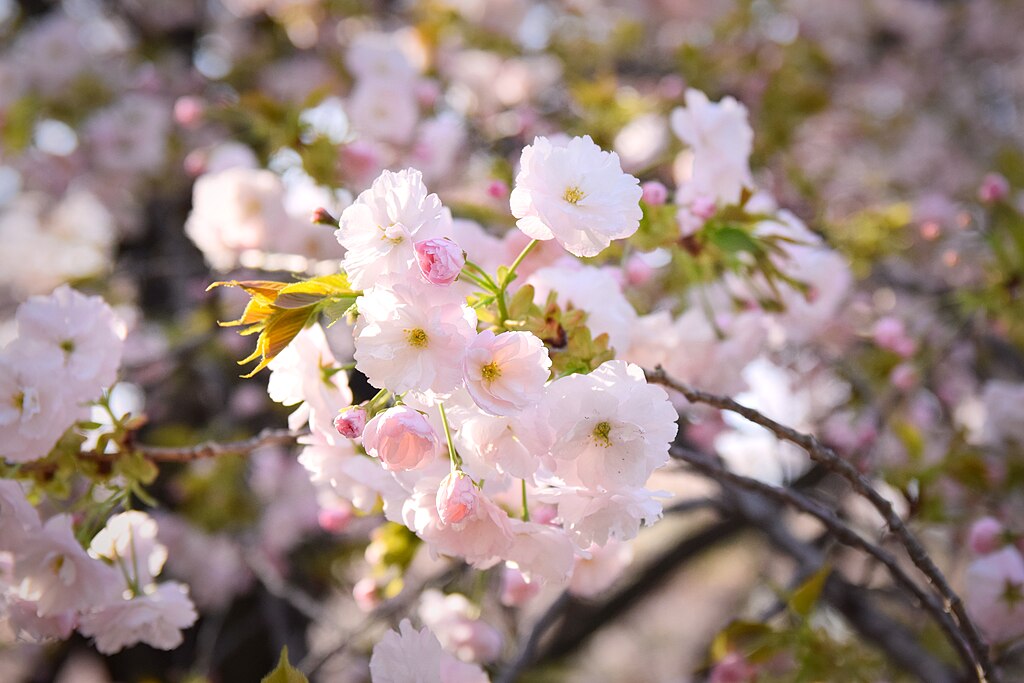
Yae-Zakura Cherry

Another famous example is the Yae-Zakura (ヤエザクラ):

(Photo by Raita Futo from Tokyo, Japan, CC BY 2.0, via Wikimedia Commons)

The term yae (八重) means something like “eight layers” or “eight levels”, which helps describe it’s thicker, multi-layered blossoms. It is also the subject of poem 61.

To be honest, yae-zakura are my personal favorite.

Kanzan Cherry

A popular variety that I only learned about recently is a hybrid variety called the kanzan (カンザン, sometimes archaically spelled Kwanzan). I didn’t find this one online at first, but was able to take a photo during a recent visit to the University of Washington.

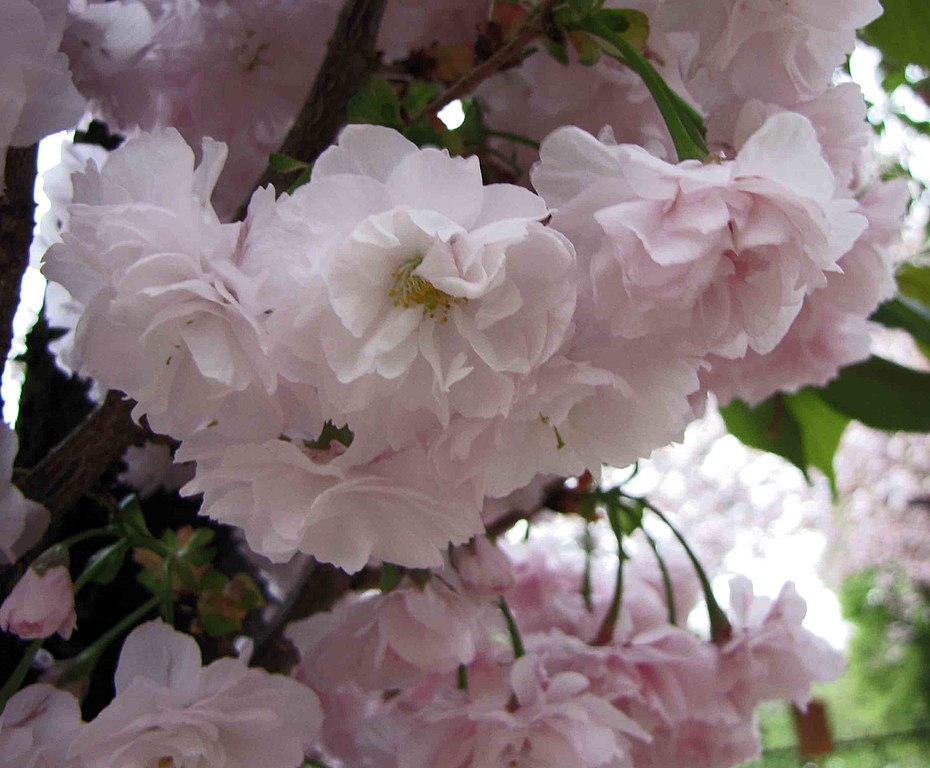
This variety was, similar to the Yoshino, a relatively recent variety, and a result of hybrid breeding with Ōshima cherry. What makes this one interesting is the both the rich pink color, and the multiple layers of blossoms (similar to the Kasumi cherry below).

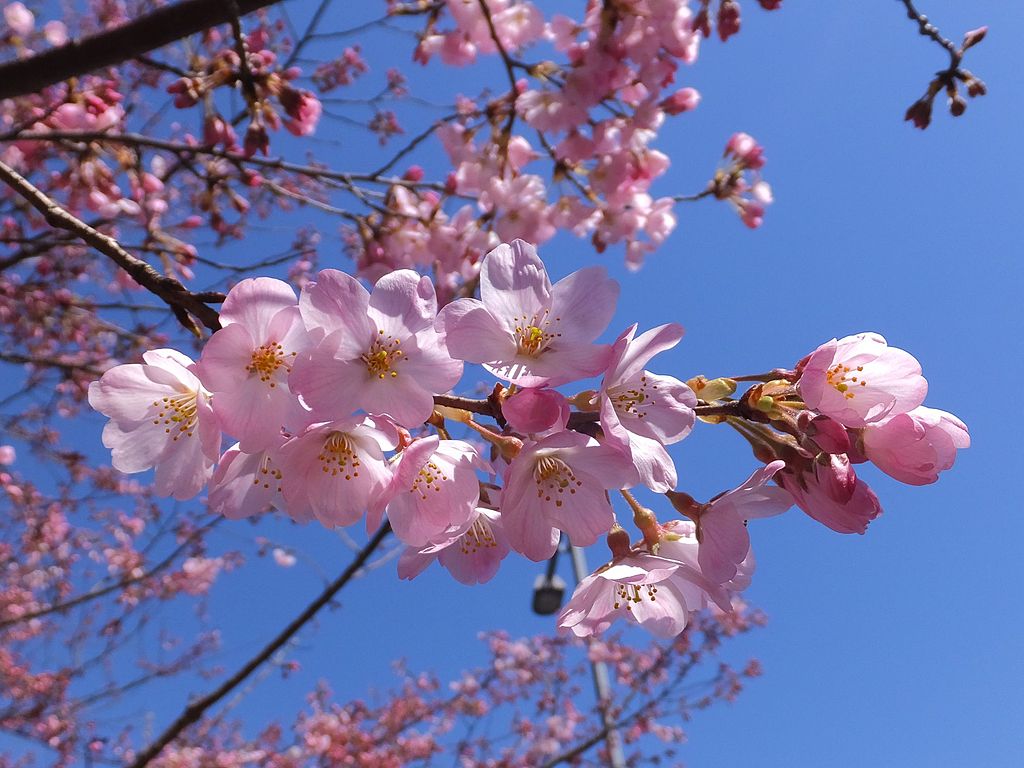
Mountain Cherry

Another example of cherry blossoms, that’s lesser-known in the West are the wild cherry trees, or yama-zakura (ヤマザクラ) also known as the “Mountain Cherry”:

(Photo by 阿橋 HQ, CC BY-SA 2.0, via Wikimedia Commons)

If you compare the Yama-zakura to the classic Yoshino Cherry, you can see the color is a little more faded, kind of whitish in comparison. I think I have also read somewhere that the leaves and blossoms of a mountain cherry sprout at the same time, compared to a Yoshino Cherry where the blossoms comes first.

In antiquity, when the nobility of the capitol would go on a cherry blossom viewing, these are the trees they would most likely go to see. They are the subject of poem 66 as well.

Shidaré-zakura Cherry

Another iconic variety of cherry blossoms are the shidaré-zakura (シダレザクラ), or Hanging Cherry:

(Photo by Sakaori, CC BY-SA 3.0, via Wikimedia Commons)

You often see these grown in very scenic places, as well as on the grounds of Buddhist temples or Shinto shrines. The way the hanging branches sway in the wind is a sight to behold.

Kasumi-Zakura

One interesting variety that I was unaware of, until researching for this blog was the kasumi-zakura (カスミザクラ):

The word kasumi is a poetic term for haze or mist, especially a spring mist. You can see how the blossoms hang down somewhat, and are particularly large compared to other cherry blossoms varieties. They also seem to have a two-tone quality, where the edges are deeper color than the middle.

Fuyu-Zakura

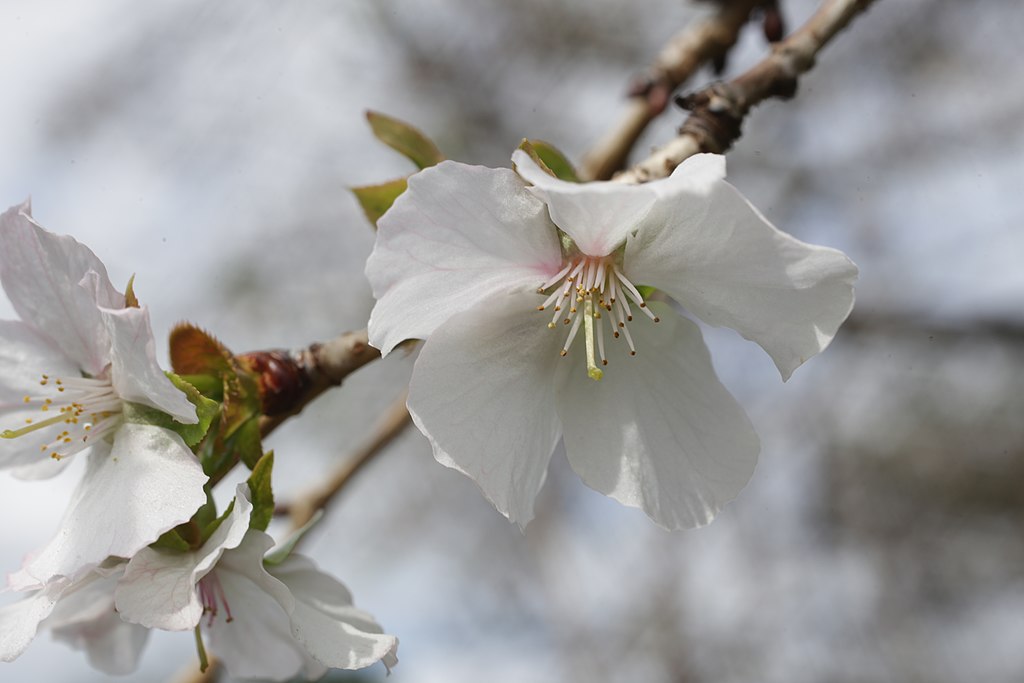
Another example I wanted to share is an unusual variety that blooms in spring, and in winter, called the fuyu-zakura (フユザクラ):

This cherry variety, also known as a gobazakura (コバザクラ) has white blossoms and blooms both in April, and also in December.

Kanhi-zakura

Taken by me at University of Washington in April 2025

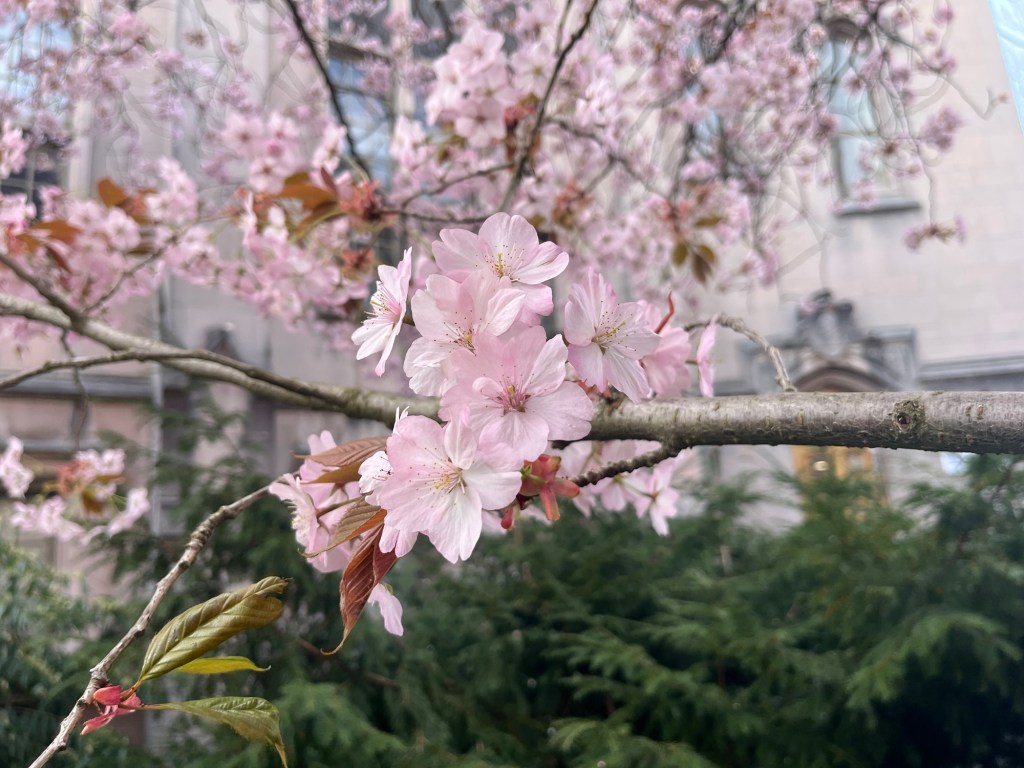
While visiting the University of Washington in 2025, I found another variety I hadn’t noticed before. This variety is listed on UW maps as “Hisakura”, but in digging around in Japanese I found that a more common name is Kanhi-zakura (カンヒザクラ), also called Taiwan-zakura (タイワンザクラ) after the island of Taiwan. The name Hizakura (ヒザクラ) is also used. As the name implies (and according to Wikipedia), this variety is found all over East Asia, including Taiwan, and blooms somewhat early. Based on my visit to the UW I can confirm this as an amateur cherry blossom nerd.

Amanogawa Cherry

Taken by me in my neighborhood, April of 2025

Yet another variety I stumbled upon recently in 2025 is the Amanogawa (アマノガワ, “Milky Way”) variety. You can see an extra layer of petals in this one, similar to the Kanzan variety, but a lighter, softer color. I couldn’t find much detail about this variety but it appears to be a form of sato-zakura plants also known as the Ōshima cherry, similar to the Kansan variety.

Conclusion

There are many more varieties of cherry blossoms than listed here, but many are obscure or only known to botanists and experts. Also, it’s important to point out that Korea also has a venerable cherry blossom tradition, though I confess I don’t have much information.

In any case, when spring comes, see if you can identify the different cherry blossoms you see. You may be pleasant surprised.

Names in the Hyakunin Isshu

Hello readers,

If you’ve been following this blog for a while, and gotten to know some of the authors of the Hyakunin Isshu, then you may have noticed some patterns with the names of the authors. The authors are rarely listed by their birth name, and instead are listed under a sobriquet, or just their official title in the Imperial Court.

Why was this done?

My book, the Hyakunin Isshu Daijiten, explains that this was because in this period of Japanese history, names were thought to be tied to one’s life. People at this time, both the Nara (8th c.) and increasingly in the Heian (9th – 12th c) periods, were often worried about curses, evil spirits, and such, and went to elaborate lengths to avoid spiritual calamities (see background for poem 24 for example). So, to avoid risk of one’s name (and thus one’s life) being subject to evil magic, people often hesitated to share their personal names with others.

It’s unclear how commoners in the Nara/Heian Period named themselves; there is just not enough information, but for the nobility who all belong to the hierarchical Imperial Court, certain naming conventions developed.

Men

Men with important titles, or positions in the court often used their titles as their sobriquet. Lower-ranking men in the Hyakunin Isshu did not have this privilege.

  • Titles for members of the Imperial FamilyEmperor Tenji, (poem 1), Retired Emperor Go-toba (poem 99), and Prince Motoyoshi (poem 20).
  • Positions in the Imperial CourtSanjō Minister of the Right (poem 25), Major Counselor Fujiwara no Kintō (poem 55), and Master of the Grand Empress’s Palace (poem 83)
  • Clerical namesDharma Master Jakuren (poem 87) and Former Major Archbishop Gyōson (poem 66)
  • Poetic namesSarumaru Dayū (poem 5)

Women

Due to the Confucian, paternalistic culture of the Japan in antiquity, women were not given titles wihtin the Imperial Court (though they did earn rank just as men did), and seldom used their real name. Instead, they used a different naming convention.

  • Male relatives or spouses – Lady Ise (poem 19), whose husband served as governor of Ise Province, Lady Izumi (poem 56) whose tenure as governor of Izumi Province, “The Mother of Michitsuna, Major Captain of the Right” (poem 53), Taiyu of the Household of Princess Ryōshi (poem 90), and Ukon (poem 38) named after her father’s position as Captain of the Guards.
  • Poetic sobriquets – Lady Murasaki (poem 57) named after a character from her own novel the Tales of Genji, Akazome Emon (poem 58).

Because women were more often kept out of sight than men in the Imperial Court, biographical information about women authors of the Hyakunin Isshu is often much thinner than the men (except lower-ranking men). This makes learning about women like Lady Murasaki or Lady Izumi difficult.

In any case, the idea that names are tied to one’s lifespan is a fascinating cultural belief, and it’s likely you would find this in other pre-modern cultures as well.

2024 Meijin and Queen Championships

Hello,

The 2024 championships for 70th men’s Meijin (名人) and 68th women’s Queen (クイーン) titles, were streamed on YouTube this weekend!

And sub-channel here:

It seems that the Meijin-Queen championships are held every year shortly after Japanese New Year (oshōgatsu, January 1st through 3rd), and are played as “best of 3” (out of 5) battle.

The battles this year, particularly for the Queen title, were especially intense. The reigning Queen, Yamazoe (山添), ultimately lost to Inoue (井上), but each of the matches was a nail-biter. Many of them came to unmeisen (運命戦, “sudden death”), where each player is down to their last card. The Meijin battle finished in three consecutive wins for Kawase (川瀬), keeping is title.

Even if you’re not an expert player karuta player, it’s pretty fun to watch. I watched the first few matches with fellow karuta players on Discord (invite here), and we had a great time.

Also, it’s neat to see the best of the best play, learn some good techniques, and see the tradition of the Hyakunin Isshu live on for another generation.

Interview with Karuta Peru Club: History of the Hyakunin Isshu

Hello readers,

Recently I mentioned an upcoming interview with the Karuta Peru Club via Steph, a fellow karuta player.

I am happy to report that we finished our interview and it is available on YouTube!

Also available on Spotify in podcast form:

In this episode, Steph and I mostly discuss the history of the blog, but then talk about some of my favorite historical figures in the Hyakunin Isshu, such as Sugawara no Michigan’s (poem 24) and Lady Izumi (poem 56), among other things. It was a fun conversation and Steph was a terrific host.

I do sometimes use the word “um” a lot, especially when I am a bit nervous (this was my first interview), but I hope viewers and listeners learn something new, and enjoy the conversation too!

In the next episode, we plan to focus more on our experiences playing kyōgi Karuta (competitive karuta). Stay tuned!

Big thanks to Steph for making all this happen. 🎉

P.S. books cited in the interview (non-Amazon links below):