Fall is approaching, and it reminds us of fall leaves, and famous poems of the Hyakunin Isshu such as the chihaya poem (poem 17) among others….
Throughout the blog, I’ve tended to focus on the lady authors and poets because it’s so rare to see women get credit for writing in the pre-modern era. There was an explosion of feminine talent in the Heian Period (8th – 12th century) that was not repeated until modern era in Japan, and it’s been fascinating.
However today, I wanted to highlight one particular text called the Ise Monogatari (伊勢物語). Our illustrious Dr. Joshua Mostow who has contributed much to this blog translates the title as the “Ise Stories” in his translation, but other translations call it the Tales of Ise. You can decide which one you prefer. Since Dr Mostow is a cool guy, and done much for the field, I will use his translated title. For this post, I am using the translation by Dr Mostow and Dr Royall Tyler.
Unfortunately, we still don’t know who the actual author of the Ise Stories was. In fact, Professor Mostow explains that the prevailing theory is that the Tales was composed over decades, in stages, possibly by different authors. Unlike the later Tales of Genji, or the Gossamer Years, or the Pillow Book, which were all clearly composed by one author, the Tales of Ise has a murkier development.
Anyhow, the Ise Stories is not a modern story, with narrative arc, nor does it have an ending. Instead, the Ise Stories are a series of short anecdotes about an anonymous prince who leaves the capitol of Heian (modern day Kyoto), and journeys east to the hinterlands for a time. In fact, you could probably call the Ise Stories the “Anecdotes of Ise With Lots of Poetry Thrown In”. The later work, the Tales of Genji, has a similar format.
The hero of the story, a young, charming prince who travels east with his entourage and has a few love trysts along the way, is a kind of idealized Heian-period aristocrat: a gentleman with an excellent pedigree, and talent for poetry to boot. Each story includes at least one waka poem, the same kind used in the Hyakunin Isshu, often more. Why so much poetry? Many times these were used as a back-and-forth way of greeting someone from afar, or saying “hello” to a promising lady, so a chapter might have multiple poems in the form of dialogue.
For example, section 14 deals with a tryst between our protagonist and a provincial lady in remote Michinoku province (a place also mentioned in poem 14 of the Hyakunin Isshu). She writes to him the following poem:1
Original text
Japanese romanization
Translation
なかなかに
Naka-naka ni
So if, after all,
恋に死なずは
Koi ni shizanu wa
I am not to die of love,
桑子にぞ
Kuhako ni zo
I know just the thing;
なるべかりける
Narubekarikeru
I should have been a silkworm,
玉の緒ばかり
Tama no wo bakari
for that little life’s short span.
Our protagonist was not impressed by her, as her poem “reeked of the country[side]”, but slept with her anyway. Classy guy.
Then, he left before dawn and she lamented:
Original text
Japanese romanization
Translation
夜も明けば
Yo mo akeba
Come dawn’s early light
きつにはめなで
Kitsu ni hamenade
oh yes, in the tank you go,
くたかけの
Kutakake no
you obnoxious bird,
まだきに鳴きて
Madaki ni nakite
to learn to cock-a-doodle
せなをやりつる
Sena wo yaritsuru
my darling away too soon.
The protagonist then remarked he was going to the capitol, but left behind a “charming” poem:
Original text
Japanese romanization
Translation
栗原の
Kurihara no
If the Aneha
あねはの松の
Aneha no matsu no
Pine here at Kurihara
人ならば
Hito naraba
only were human
都のつとに
Miyako no tsuto ni
“Come along with me,” I’d say,
いざといはましを
Iza to iwamashi wo
“you’re my gift to the City.”
According to the Ise Stories, she was much impressed and thought he was in love with her, but the commentaries suggest he was being condescending by implying that “if only she were worthy of Courtly life at the capitol”. Damn.
But what’s the source for all this poetry and narrative?
The origins of the Ise Stories is somewhat of a mystery, but there is strong evidence that the central character was heavily based upon a real aristocrat named Ariwara no Narihira (825 – 880), the same man who composed the aforementioned poem 17 (ちはやふる), and also composed what’s considered the greatest poem about cherry blossoms ever composed. Some of his poems in the old Kokin Wakashu imperial anthology were re-used in the Ise Stories as well.
In addition to his poetic genius, the real life Narihira was a playboy and had many relationships, even by the standards of Heian-period aristocracy. Sometimes this got him into trouble. The Ise Stories begins with an explanation that the anonymous prince left the capitol after having an affair with Emperor Seiwa’s consort. Coincidence? I think not. 🤔
Nonetheless, the Ise Stories is a whimsical and irreverent look at Heian Period culture and how the aristocracy interacted with people in the provinces, even when it was somewhat condescending. Court culture was unlike anything else in Japan at the time, and this reveals some interesting things that are not always conveyed in other works of the time.
1 Mostow and Tyler explain that the young woman’s poem was a re-working of an older poem from the Manyoshu, poem 3086:
At last, the historical drama about Lady Murasaki has come to an end this week, and sadly I watched the last episode. The drama was slower than other past Taiga Drama on NHK, but it was a lovely tribute to an amazing woman. Lady Murasaki, author of the Tales of Genji, her eponymous diary, and a famous poem in the Hyakunin Isshu left a lasting mark on Japanese culture and world literature.
The concluding title card for the historical drama: hikaru kimi é (光る君へ, “to you, my radiant one”).
Details of Lady Murasaki’s final years are pretty sketchy, but it seems that she eventually retired from service in Fujiwara no Michinaga’s household, and gradually took up travel. She was born in the year 973, but some scholars believe she may have passed away in 1014 at the age of 41. Others believe she may have lived to the year 1025 (age 52). For the premodern era, this is a pretty typical lifespan for many people, including nobility. Still, as someone who’s older than her, it’s hard to imagine her dying so young.1
With her passing, a couple attempts were made to preserve and edit her magnum opus. Fujiwara no Teika (poem 97, こぬ) who compiled the Hyakunin Isshu itself undertook one of these efforts, creating the Aobyōshibon (青表紙本) edition. At this time in Japan, manuscripts had to be hand-copied, and so across several centuries, limited efforts were made to hand-copy works from Lady Murasaki’s time, which helped preserve them across the medieval period, but were inaccessible to general audiences.
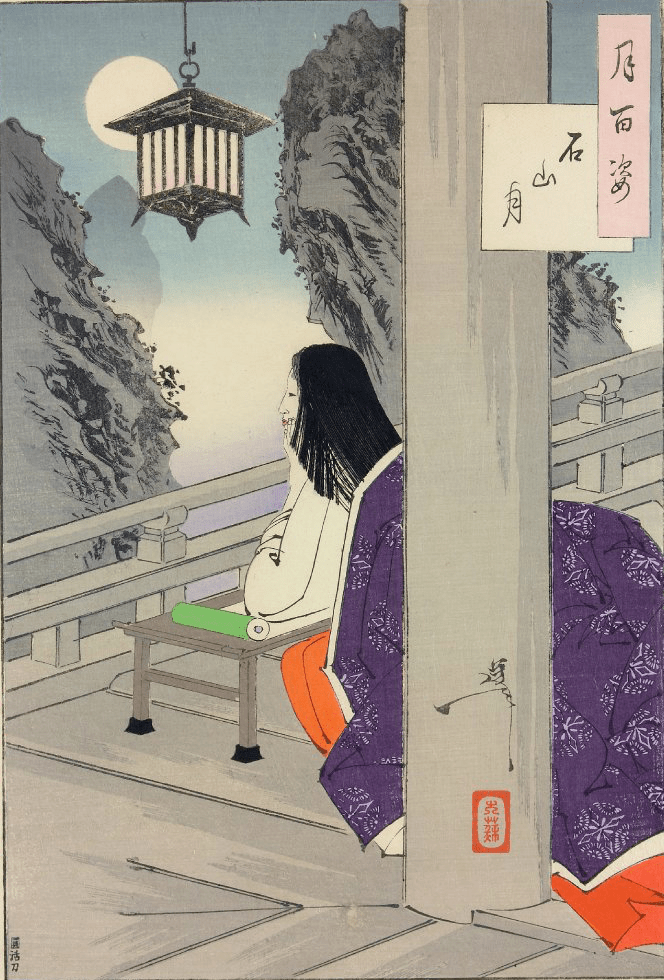
A woodblock print of Lady Murasaki from 1889 made by Yoshitoshi, Public domain, via Wikimedia Commons
By the Edo Period, 17th century, block printing and a flourishing of “book culture” greatly expanded the audience of the Tales of Genji, and Lady Murasaki enjoyed a surge in popularity, rescued from obscurity, and even today is high revered. Lady Murasaki is to Japanese culture what Shakespeare is to the English-speaking world. The historical drama that concluded is arguably an extension of this revival.
Finally, I wanted to explore the relationship between Lady Murasaki and her patron, Fujiwara no Michinaga. In the historical drama, they shared a relationship since childhood (historically improbable), and even had a love child together even though they never married. Political marriages were common among the nobilty at the time, as was infidelity, and so Fujiwara no Michinaga having an official marriage yet carrying a number of romantic trysts would not be surprising. The Hyakunin Isshu poetry is rife with such romances.
And the real, historical relationship between Lady Murasaki and Michinaga is unclear. It’s widely believed that the main character of the Tales of Genji was patterned from Michinaga. Her diary also shows her flirting with Michinaga somewhat. And yet, it’s also implied that she fended off his romantic advances too. The fact that she worked under him, the most powerful political figure in Japan at the time, made their relationship even more complicated. If her daughter, Daini no Sanmi (poem 58 of the Hyakunin Isshu, ありま) was indeed Michinaga’s, as the drama depicts, it may help explain how she was brought into the court inner circle too, alongside her mother. And yet, evidence one way or another is pretty limited, so one can only speculate.
Lady Murasaki herself was woman perpetually out of place in the courtly life of the late Heian Period. Her diary shows her frequently introverted, melancholy, out of place, and exhausted by the back-biting of other women, or the rowdiness of drunk men. Her father had lamented that in spite of her literary talents, her being born a woman in that era meant her talents would go to waste. Such was the period of the time.
One can easily imagine a brilliant woman like Lady Murasaki in modern times sitting in cafe, writing a romance novel, feeling alone, yet observing the world around her in a way that is beautiful and poetic, pouring her heart into her work. What Lady Murasaki conveyed through her writing was something can we can appreciate even today, eleven centuries later.
Out of all the literature of the time, nothing quite epitomizes the sentiments and milieu of the Heian Period, an era now lost to time, yet strangely familiar, quite like Lady Murasaki did.
P.S. The drama definitely took some historical liberties for the sake of drama, but I have to admit that it did a nice job of showing Lady Murasaki as a complex person, and all the different challenges she had to deal with. The last several episodes were really touching and brought tied up things nicely. I might try to purchase the drama next year if I can, but it’s quite expensive ($300-$500 USD), so time will tell.
1 As someone who also spent some time in the ER earlier this year with emergency surgery, I can imagine that I too would have likely died in my 40’s without modern medical care. Modern people often forget how brutal and short life was for the average person before medical science, and how many people never lived past 50, or did so with crippling conditions.
Language is not static. Any language that is spoken and used changes and evolves over time. The English language started as a dialect of German, but through a series of invasions, and innovations has a lot of elements that look French, with layers of classical Latin and Greek. The Greek language has been in continual use since the days of the ancient Mycenaeans to modern Greek people today, and ancient words can be found in use, yet at the same time modern Greek is smoother, more streamlined than its ancient Bronze-Age speakers. The ancient Chinese spoke in the Bronze Age doesn’t sound like modern Chinese, and yet the echos are still there both in the writing system, and how words a pronounced across various regional dialects.
Japanese has been in continual usage for 2,000 years and it is possible to look at old poetry, such as the Hyakunin Isshu, and with a bit of effort still make sense of it as a modern, native speaker, or even as a language student. It also helps to explain why poems of the Hyakunin Isshu have such odd spellings compared to modern, standard Japanese.
And yet, Japanese has changed over time. Words and grammar have evolved, and so the poetry of the Hyakunin Isshu, as well as other writings of the time, look and sound in a certain way that might surprise modern people. This post is a brief exploration of the kind of Japanese used during the Heian Period (8th to 12th centuries) of Japanese history when most of the Hyakunin Isshu was composed. This period of Japanese is called “Early Middle Japanese” by English-speaking scholars, and chūko-nihongo in Japanese (中古日本語, lit. “middle-old Japanese”).
To give a quick demonstration, take a look at the video below, starting around 00:47. This is the first lines of the text, the Pillow Book, which we also talked about here.
A few things will jump out right away even to casual Japanese students.
First, all the “ha” syllables, namely ha (は), hi (ひ), hu (ふ), he (へ), and ho (ほ) are all pronounced with a “f” sound: fa, fi, fu, fe, fo. Even the subject-marking particle “wa” (also written as は) was pronounced as “fa” back then. Similarly, the “ta” syllables: ta (た), chi (ち), tsu (つ), te (て), and to (と) were all consistently pronounced as “t”: ta, ti, tu, te, to. In modern Japanese, people say omoitsutsu (思いつつ) to mean “even as I think about this…”, but back then the same word was pronounced omoitutu.
Finally there were more “wa” syllables back then, compared to now, and like the “ta” syllables, they were more consistently pronounced: wa (わ), wi (ゐ), we (ゑ), wo (を). In modern, Japanese, only “wa” is still pronounced with a “w” sound, and wi and we are no longer used, or pronounced simply as as equivalent “i” and “e”. Similarly, if you watch historical dramas, the old way of politely using the “negative”-form of a verb has shortened from nu (ぬ) to simply n (ん) : mairimasenu (“I will not come”) to mairimasen in modern-humble Japanese.
Languages tend to contract and streamline over time.
Using Greek language as a similar example, pronunciation of words in Homer’s Iliad sounds longer and clunkier than similar words in Koine Greek of the New Testament, and even more streamlined now in Modern Greek. Sanskrit in India was spoken 4,000 years ago, and lives on in many northern Indian languages such as Hindi, Marathi, Magadhi and so on, and each one looks like a smoother, simpler version of the old Sanskrit language. Japanese pronunciation of words has similarly contracted into shorter, smoother, more efficient forms.
What about grammar? That’s an interesting question. In some ways, the grammar of Japanese hasn’t changed all that much in the eons. Japanese verbs are inflected (like Latin, Greek and Sanskrit) and different endings convey different meanings. Many verb endings in Japanese, which you can see in Hyakunin Isshu poetry, no longer exist, or are replaced with other endings. Let’s look at a concrete example.
Poem 73 (たか) is a nice example of things that changed, and things that have remained the same.
Some words like sakura (cherry blossoms) and kasumi (mists) haven’t changed at all. The possessive particle no meaning “of, or belonging to” hasn’t changed either in terms of usage.1
On other other hand, we see some grammar not found in modern Japanese. For example, in old Japanese, especially poetry a verb-stem ending with ni keri meant that something has been done (from past to present). Modern Japanese uses verb endings like te kita, te itta, and so on to convey similar context.
Another example is –zu mo aranan, which I wasn’t able to find online, but based on verb tatsu (to rise, to stand), obviously means implies a negative connotation (i.e. not do something). In modern Japanese you can say something similar: tatazu ni (without standing…), so again you can see the continuity.
Something you often see, but not shown in this poem is adjective endings. Modern Japanese adjectives often end with an i sound, for example “cold” is samui, “fast” is hayai, and so on. But in old Japanese the i was often a ki: samuki, hayaki, and so on. I noticed both in the Hyakunin Isshu, but also in Japanese RPG games when they take place in old “fantasy times”, because it helps convey a sense of ages past.
Finally, some words just change meaning over time. I was surprised to learn that the word for “shadow” kagé used to mean “light”, as in tsuki-kagé (moonlight). So, even if the word stays the same, the nuance does evolve over time.
Finding information on Early Middle Japanese in English is pretty difficult, and often requires an academic background. Since I am just an amateur hobbyist, this is only a brief overview. There is a lot more to cover, but hopefully gives you a brief sense of how things have changed over time. Japanese is a language that shows a nice continuum over its long history, and it’s fascinating to see howd the same language looked and sounded so far back.
1 I think I read somewhere that in really, really old Japanese the “no” possessive particle used to be “na”. I don’t know if that relates somehow to the “na-adjectives” in Japanese language, but I do wonder.
Recently, while watching the historical drama about Lady Murasaki (poem 57, め), I was surprised to learn that there is an hand-made collection of poems by the Thirty Six Immortals of Poetry that has survived the centuries. This collection is called the Sanju-rokunin Kashu (三十六人家集, “Collection of the Thirty Six Immortals of Poetry”):
Collected poems of Minamoto no Kintada (889–948), not in the Hyakunin Isshu. See page for author, Public domain, via Wikimedia Commons
To recap, the Thirty Six Immortals of Poetry was list of esteemed poets in antiquity, coined by the revered poet and critic Fujiawara no Kintō (poem 55 in the Hyakunin Isshu). It was, in Kinto’s mind, the who’s-who of Japanese poetry up to that point in history. Two-thirds of the poets (24 out of 36) also appear Hyakunin Isshu, but otherwise there is no other overlap. Fujiwara no Teika clearly had differing tastes than his earlier kinsmen Kinto.
In any case, this collection was handmade in the early 12th century by ladies of the court for the birthday of Emperor Toba, and each book includes a unique design: a mix of paper collage, marbling and so on.
The pages above show collected poetry by the Buddhist priest Sosei (poem 21 of the Hyakunin Isshu). You can see the collage here, using torn pieces of paper. Below is a page of poetry by Ōshikōchi no Mitsune (poem 29) shows an example of paper marbling.
What makes the collection so amazing is that the pages aren’t just gorgeous, they often allude to some aspect of the poet in question. Some are quite obscure, some are easier for modern people to piece together. This page of poetry by Yamabe no Akahito (poem 4):
The sky-blue color with snowy looking white surfaces evoke the image of Mount Fuji, which Yamabe wrote about in the iconic 4th poem in the Hyakunin Isshu. I am not certain if they are related, but it certainly seems likely.
As for the collection itself, over the century it changed hands a few times before finally being entrusted to the Nishi Honganji Temple in Kyoto, where it remains. Sadly, one volume was dismembered and the individual sheets were sold off to private collectors by a Japanese industrialist in 1929 to raise funds for a local university, but much of the original still remains.
My historical drama does a nice job showing how the ladies in waiting carefully constructed each page, each one a personal work of art, encapsulating a different kind of art. In Japanese literature there has never been anything quite like it since. Truly brilliant stuff.
P.S. apologies for the stupid title of this post. It just popped into my head.
I am writing this post while staying with my in-laws house in Japan. We will be doing a bit of traveling later, but are mostly fighting jet lag and record heat + humidity for now.
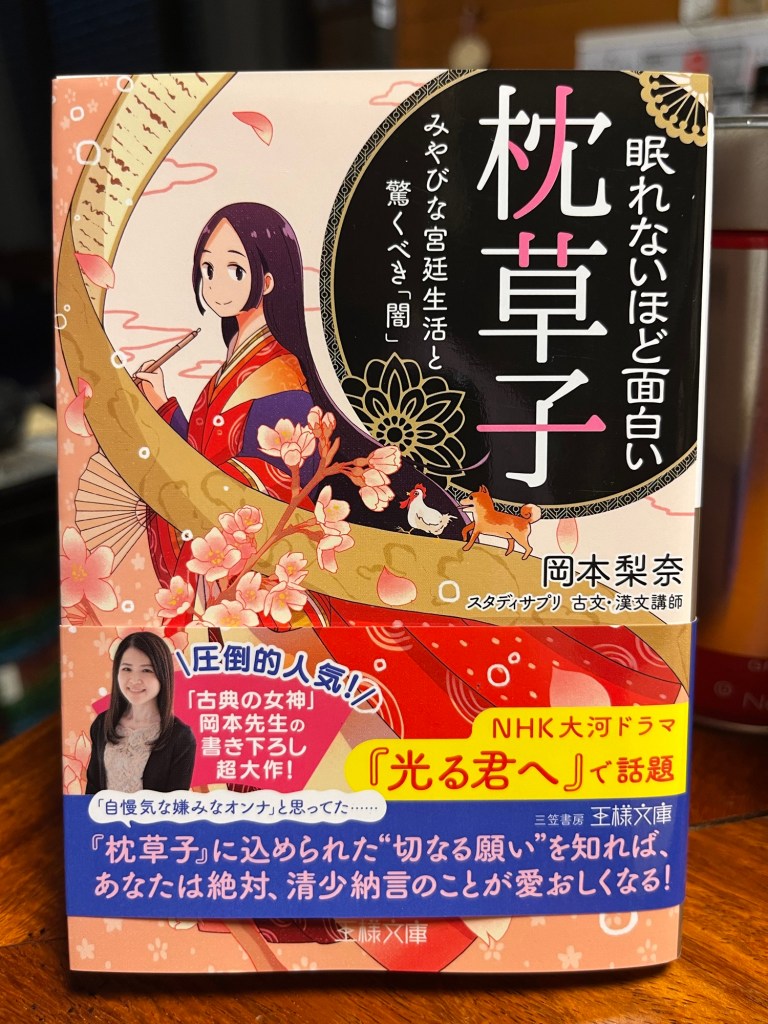
In the meantime I am excited to share some items I picked up, including these new books:
The first book explores the Pillow Book by Sei Shonagon, the second Lady Murasaki’s diary. These texts are both pivotal to appreciating the life and culture of people back then, the same people who composed the poetry of the Hyakunin Isshu. It’s a window to a world that simply doesn’t exist anymore.
Further, this book series, 眠れないほど面白い (nemurenai hodo omoshiroi, “so interesting you can’t sleep!”) has been a hugeboon for the blog. It’s provided a lot of fun, historical information about the Heian Period, the Hyakunin Isshu, the Manyoshu, etc., that is simply not available in English. The Japanese is sometimes difficult to read at my level, but it’s been a labor of love, so I enjoy the challenge and have been learning a lot. So I am excited to delve into these two books as well.
Also, it’s noteworthy that both books above mention the current drama series 「光る君へ」as a tie-in.
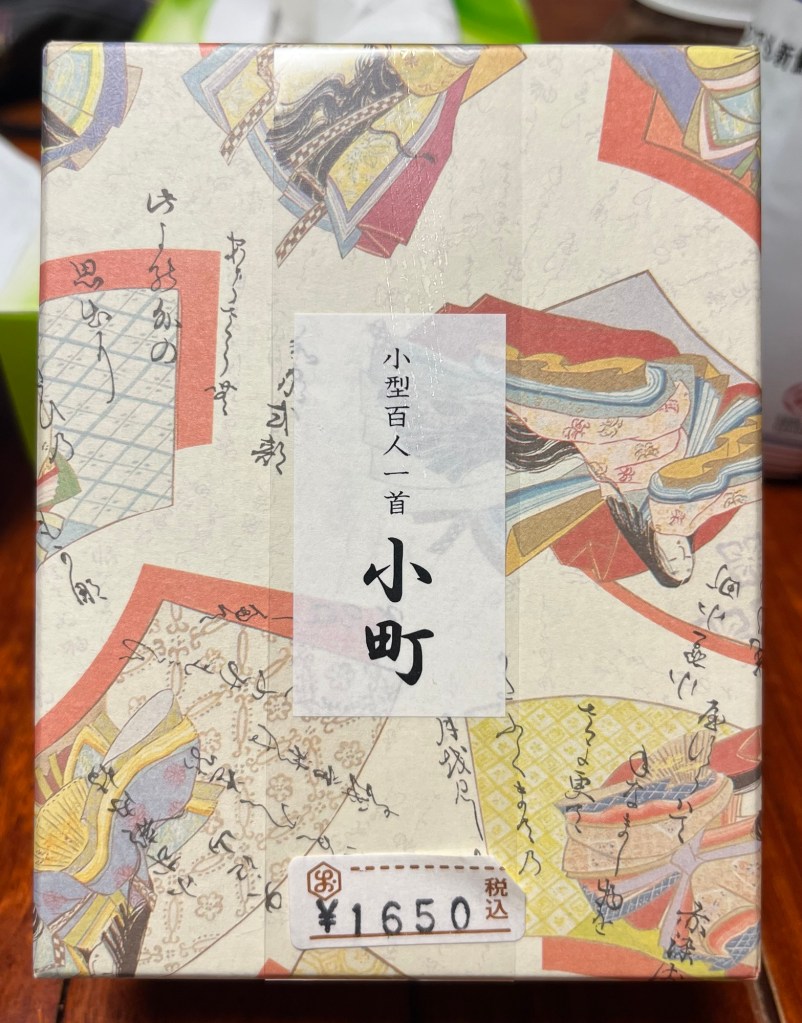
Yesterday, on a day trip to Tokyo I visited the Karuta shop Okuno Karuta (奥野かるた店). It was very easy to find from the Jinbocho train station (just head left and walk down a few blocks). The store was larger than the Tengu-do and includes lots of neat card sets not related to Karuta. I was on a budget so I tried not to spend too much. I did pick up a mini Karuta set though:
This set looks just like the first set I got, both Tengu-dō brand, but roughly half the size. It’s not suitable for competitive karuta but it’s cute and fun to own.
Anyhow, the staff at Okuno Karuta were very nice and helpful. While I was perusing, a tour group of elderly Japanese came through for a while, and the staff had to handle the rush of customers, before things quieted down again.
Hopefully I can post more updates soon.
P.S. also picked up an obscure Fire Emblem game too:
In the book Hyakunin Isshu Daijiten, which I mentioned here, it explains that the fourth verse, karakurenai (唐紅), is in fact a traditional color word in Japanese. The Chinese characters read something like “Chinese (lit. Tang Dynasty China) scarlet or vermillion”. There is no one-to-one equivalent in English.1
You can see an example of what karakurenai looks like on this amazing website, among other tradition colors. You can also see a list of colors on Wikipedia as well. Both sites also include the HTML codes (a # sign, followed by 6 alpha-numeric characters) if you want to reproduce yourself. For example using the HTML hex code #C91F37 I get:
karakurenai
In truth, many of these colors would be obscure to modern audiences, except in some literary circles, but some, such as yamabuki-iro (山吹色, “golden yellow”) are still used in common vernacular. Further, as is common with other Asian languages, colors green and blue are often conflated (e.g. 信号は青, shingō wa ao, “the traffic light is blue/green”).
In any case, try it out the website above, and see what other colors you might find!
Update: I decided to update the blog appearance and apply a new background color based on the HTML codes above. For the blog background color, I am using Haizakura (灰桜, code #d7c4bb).
1 Similarly, I bet some English tradition colors would have no translation in Japanese. Such is the way with language and cultures.
While watching competitivekaruta online, and in person, I noticed that there is a certain poem that is read at the outset of a match, but what’s interesting is that this is a poem that is not actually part of the Hyakunin Isshu.
This poem is called the joka (序歌), or preliminary poem, and reads:
What’s interesting from a historical standpoint is that this poem was composed by a 3rd century immigrant to Japan named Wani (王仁), who came from the Korean kingdom of Baekje1 and is credited with introducing the Analects of Confucius and the Thousand-Character Classic to Japan at a time when it was actively trying to import knowledge and culture from the mainland. I’ve talked about Japan and Baekje here as well.
The poem by Wani was so highly-praised it was felt in antiquity that if you were going to know any Waka poem, you had to at least know this one. Hence over time it became the opening poem for karuta competitions. Like many poems of the Hyakunin Isshu, it was originally preserved in the official Imperial anthology, the Kokinshū.
In karuta matches, the poem is always read before the match begins. My guess is that reciting this poem helps to calibrate or warm-up the players before the match actually begins. Apparently, the last two verses, the shimo no ku (下の句) in karuta, are repeated twice. Once it’s read twice, the match begins.
It’s fascinating to note that this poem has been in existence for 1,700 years, and is still going strong!
1 A time when the Korean peninsula was divided into three warring kingdoms. Baekje probably had the closest relationship with the early Yamato Court of Japan due to proximity and mutually beneficial relations.
Of all the poets of the Hyakunin Isshu anthology, arguably the most famous, especially overseas is Lady Murasaki (poem 57), who in Japanese is called Murasaki Shikibu (紫式部). She is the author of the Tales of Genji, which epitomized life in Japanese antiquity, and is among the first novels in history. But another work by Lady Murasaki that’s notable here is her eponymous diary, of which an illustrated version appeared centuries later. In English this is simply known as the Diary of Lady Murasaki (murasaki shikibu no nikki, 紫式部の日記).
The diary covers the period from years 1008 to 1010, and provides a first hand account of her life serving the powerful regent, Fujiwara no Michinaga. Michinaga is not featured in the Hyakunin Isshu, but his power as regent was great enough to ruin the lives of a few poets in the anthology:
Michinaga was locked in a power-struggle between his branch of the Fujiwara Clan, and another branch, led by Morechika. Both had daughters married to Emperor Ichijō, and both were fighting to be the regent (kanpaku, 関白) of Ichijō’s heir. In the end, Michinaga’s daughter, Empress Shōshi, gave birth to the future Emperor Go-Ichijō (Ichijō the Latter). With it, Michinaga became the most powerful man in Japan.
At the beginning of the diary, Lady Murasaki describes the events leading up to Empress Shōshi giving birth, and the elaborate ceremonies to protect her and the unborn child from evil spirits. Although it was technically a private ceremony, Michinaga hired an army of priests and shamans to both bless the child, and also to ward off evil spirits. Lady Murasaki, as a member of the household, describes sitting in the crowded audience chamber for hours, listening to the fevered chanting and elaborate rituals.
Then the diary skips ahead to the first weeks of the child’s birth, and further ceremonies. Michinaga spares no expense to protect his grandson (whom he will be the regent of, and thus the true power behind the throne) from diseases, evil spirits and so on. In elaborate rituals, members of the household are selected to read the Confucian Classics to the baby to ensure he will be an august ruler. More priests are called into ward off evil, and so on.
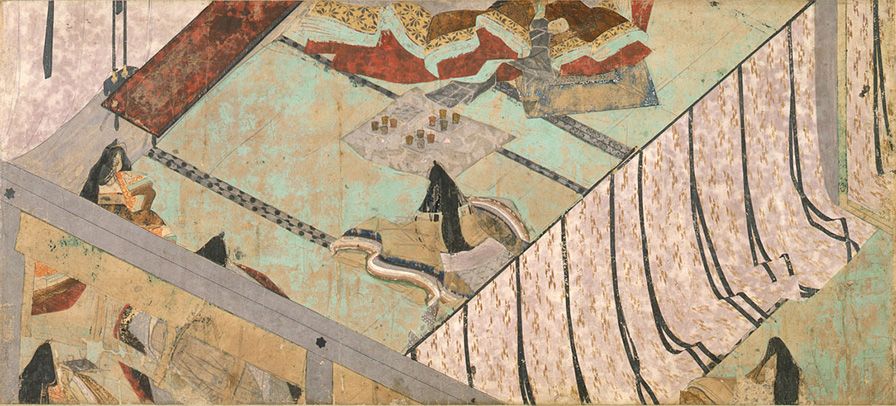
A 13th century illustration of Empress Shōshi and her infant son, with Lady Murasaki in attendance from the Murasaki Shikibu Nikki Emaki (illustrated diary of Lady Murasaki). Tokyo National Museum, Public domain, via Wikimedia Commons
But what about Lady Murasaki?
Lady Murasaki herself comes from a lesser branch of the Fujiwara clan, and since her husband already died some time ago, she describes herself as “washed up”. She held no official appointment in the Imperial Court. And yet, through Michinaga, she becomes a trusted confidant and tutor of the Empress. Michinaga knew talent when he saw it, and wasn’t shy about packing his household with as much as he could get away with.
Lady Murasaki was but one of several famous ladies-in-waiting recruited by Fujiwara no Michinaga to increase the status of his daughter, Empress Shōshi, vis-a-vis the Emperor’s first wife, Teishi (Morechika’s daughter).
Lady Murasaki’s diary implies that life as a lady-in-waiting is a lot of “hurry up, then wait”: periods of great activity and ceremony, followed by long periods of boredom. The period after the child’s birth eventually winds down and leads to a lot of free time, where Lady Murasaki reflects on many things, as well as disparaging some of the other ladies-in-waiting. Here are some examples of her contemporaries who also happen to appear in the Hyakunin Isshu:
Lady Izumi (poem 56) – “She does have a rather unsavory side to her character but has a talent for tossing off letters with ease and seems to make the most banal statement sound special.“
Akazome Emon (poem 59) – “She may not be a genius but she has great poise and does not feel she has to compose a poem on eveyrthing she sees, merely because she is a poet.“
Sei Shonagon (poem 62), part of the rival clique under Empress Teishi – “…was dreadfully conceited. She though herself so clever and littered her writings with Chinese characters; but if you examined them closely, they left a great deal to be desired.“
She also grapples with persistent depression. Her sullen, introverted nature often wins her few friends among other ladies of the Court:
And when I play my koto rather badly to myself in the cool breeze of the evening, I worry lest someone might hear me and recognize how I am just ‘adding to the sadness of it all’; how vain and sad of me. So now both of my instruments, the one with thirteen strings and the one with six, stand in a miserable, sooty little closet still ready-strung.
The diary then jumps forward into a letter written at a later date. The intended recipient is unknown, but is thought to be her daughter Daini no Sanmi (poem 58). Here the diary includes a great deal more self-reflection, and further analysis of the other ladies in waiting, including her grievances with another clique of ladies centered around the high priestess of the Kamo Shrine, Princess Senshi (daughter of Emperor Murakami).
Finally, the diary jumps around a few more times in narrative, and then abruptly stops. Richard Bowring points to theories that other fragments of the diary once existed, possibly some in the Eiga Monagatari, or some possibly in possession by Fujiwara no Teika (poem 97, and compiler of the Hyakunin Isshu), but these are all speculation.
The Diary is pretty short; you can read it cover to cover in a couple of hours. And yet it’s a fascinating blend of historical perspective, and very relatable personal reflection. Loneliness and depression affect people of today as much as it did people of her time, and yet she has to carry on through stodgy court ceremony, pressures of the insular life in the aristocracy, and constant back-biting amongst the ladies-in-waiting.
In one lengthy anecdote, she describes a prank that the other ladies-in-waiting decide to pull on one Lady Sakyō, who apparently had retired from service, then returned to serve another nobleman. The prank was to send a luxurious “gift”, but with a lot of symbolism regarding youth, implying ironically that Lady Sakyō was an old has-been.
The diary lists several incidents where drunken nobles harass attractive servants during dinner, servants who are unable to really do anything about it since they owe their entire livelihood to those nobles. Alternatively, the noblemen, bored themselves, play mean pranks on the ladies, steal their robes, or pull their skirts. Because of the power imbalance (also frequently alluded to in the Gossamer Years), it was just an accepted part of life, and the ladies often had to regularly dodge that minefield.
Middle Counselor Elect Taka’ie, who was leaning against a corner pillar, started pulling at Lady Hyōbu’s robes and singing dreadful songs. His Excellency [Michinaga] said nothing….Realizing that it was bound to [be, sic] a terribly drunken affair this evening, Lady Saishō and I decided to retire once the formal part was over.
trans. by Richard Bowring
Michinaga himself frequently bursts in on Lady Murasaki, sometimes drunk, demanding a quick poem or a verse for particular occasions. Although Michinaga never makes advances on Lady Murasaki, his overbearing demeanor exhausts her, yet she also admires his quick wit and ambition. I can imagine Michinaga in moderns times being a flashy, talented CEO with a dubious reputation :
I felt depressed and went to my room for a while to rest. I had intended to go over later if I felt better, but then Kohyōe and Kohyōbu came in and sat themselves down by the hibachi. ‘It’s so crowded over there, you can hardly see a thing!’ they complained. His Excellency [Michinaga] appeared.
‘What do you think you’re all doing, sitting around like this?’ he said. ‘Come along with me!’
I did not really feel up to it but went at his insistence.
trans. by Richard Bowring
Another frustration that Lady Murasaki describes is the rigid social hierarchy within the aristocracy. Lady Murasaki was from a middle-ranked family, and while not a menial servant herself, she was frequently reminded of her place. This included things like being unable to wear the “forbidden colors“, where she sat during court ceremonies, and whom she was allowed to address directly. Lady Murasaki sums it like so:
The water-music that greeted the Emperor was enchanting. As the procession approach, the bearers — despite being of low rank — hosted the palanquin right up the steps and then had to kneel face down beneath it in considerable distress. ‘Are we really that different?’ I thought to myself as I watched. ‘Even those of us who mix with nobility are bound by rank. How very difficult!’
trans. by Richard Bowring
What she often describes, when reading between the lines, is that for all its pomp, culture and beauty, life in the Heian Period aristocracy was a kind golden sham:2
I returned to the Palace on the twenty-ninth of the twelfth month [after a month absence]. Now I come to think of it, it was on this very night that I first entered service at court. When I remember what a daze I was in then I find my present somewhat blasé attitude quite uncomfortable.
trans. by Richard Bowring
One other thing to note is that her diary alludes to the Tales of Genji frequently. By the time she was recruited by Michinaga, a few drafts of the work had already been in circulation, and this probably helped her reputation. Even the illustrious Fujiwara no Kintō (poem 55) pays her a brief visit in the diary calling her “Murasaki” (e.g. purple) as an allusion to one of her characters in the novel. Richard Bowring implies that this moment might be how Lady Murasaki got her sobriquet.3 We saw this with Nijōin no Sanuki (poem 92) in later generations as well. Sadly, it seems that these copies of the Tales of Genji were sometimes borrowed and never returned, or copied by other people, and since each copy took so long to compose, Richard Bowring implies that it is a miracle that the work survived at all.
In any case, the Diary of Lady Murasaki is probably one of the best descriptions of life in the Imperial Court and its (often oppressive) aristocracy. It was a world of beauty and also of frustration and bitterness.
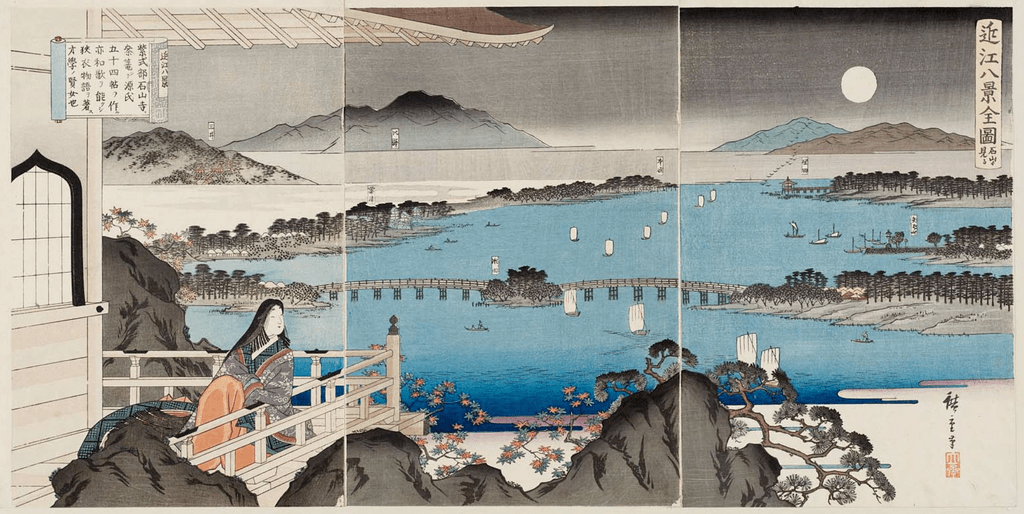
P.S. Photo is a famous woodblock print by Utagawa Hiroshige (Public domain, via Wikimedia Commons), depicting a legend about Murasaki Shikibu at Ishiyama Temple. These are the 3 panels of the nishiki-e: “Eight Views of Omi Province as Seen from Ishiyama” (Ômi hakkei zenzu, Ishiyama yori miru). Notice her purple (murasaki) robes.
1 Sei Shonagon was a lady in waiting for Empress Teishi, who was a daughter of Michinaga’s rival. When Michinaga’s rival is driven out by a scandal, Teishi is relegated to the background, and Sei Shonagon retires in obscurity.
2 Valkyrie in the movie Thor: Ragnarok had said much the same thing about Asgard, too.
3 Her true name is not known, but is thought to be Fujiwara no Kaoriko (藤原香子).
Reading classical Japanese is hard enough as it is, what with its unusual spellings and archaic vocabulary, but what makes the Hyakunin Isshu interesting, among other things, is the colorful, poetic phrases sometimes used. These phrases are strictly literary, and tend to have a dramatic sound to them, but when translating to English sometimes the meaning is lost. These words are called makura kotoba (枕詞) or “pillow words”. The term “pillow” here has no romantic connotations whatsoever, but is simply a reference to poetry. Presumably, people in the old days sat in their rooms, leaning on a pillow, composing poetry in their idle time, I guess.
Anyway, pillow words can be thought of as “filler” phrases, because they don’t have much meaning themselves, but they dress up the poems a lot more. For example in this poem, number 17:
千早ぶる Chihayaburu 神代もきかず kamiyo mo kikazu 龍田川 Tatsutagawa からくれないに karakurenai ni 水くくるとは mizu kukuru to wa
The pillow words “Chihayaburu” (千早ぶる) can mean something like “1,000 swift [swords]” or something, but really just dresses up the next word, 神 (kami, “a god”). So in modern English, it’s not just a god, but an awesome, awe-inspiring god. Likewise, in poem 2 we see another shining example.
春過ぎて Haru sugite 夏来にけらし natsu ki ni kerashi 白妙の shirotae no 衣ほすてふ koromo hosu chō 天の香具山 Ama no Kaguyama
Here again the pillow word shirotae no (白妙の) means something like gleaming white. The sheets being dried on Kaguyama mountain are not just white, but gleaming white, and a lovely contrast to the sunny, summer day in which they are being dried.
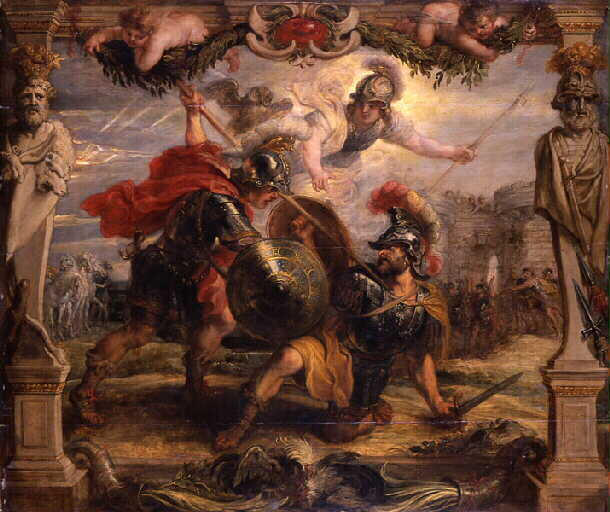
Such pillow-words don’t really exist in English, but they are very easy to find in classical Greek literature, especially the writings of Homer. Consider these epithets frequently used in the Iliad:
Goddess of the white arms, Hera: θεὰ λευκώλενος Ἥρη (thea leukōlenos Hērē)
Whenever I read the Iliad, I always find that these epithets really bring out the drama in the text.
Peter Paul Rubens – Achilles slays Hector
In the same way, the pillow-words in the Hyakunin Isshu are frequently used in certain common combinations:
chihayaburu (千早ぶる) – used to describe the Shinto divinities or Kami (神). See iconic poem 17.
shirotae no (白妙の) – used to describe something white, in particular snow, clouds or cloth. Its literal meaning is taken from the color of fresh mulberry paper. See poem 2 and poem 4.
ashibiki no (あしびきの) – used sometimes to describe mountains (山, “yama”) and peaks. Its meaning is something like “foot-drawn”. See poem 3.
hisakata no (ひさかたの) – used to describe things like the sky (空, “sora”), moon (月, “tsuki”), rain (雨, “amé”), clouds (雲, “kumo”), light (光, “hikari”), night (夜, “yoru”), and even the capitol (都, “miyako”). Its meaning is something like peaceful, shining, and especially everlasting. See poem 33 and poem 76.
Some examples of pillow words used in Japanese waka poetry, but not found in the Hyakunin Isshu are:
ubatama no (烏羽玉の) – describes the color “jet-black” and often used to describe hair or night. An example is found in the Kokinshuanthology, poem 647.
aoniyoshi (あをによし) – used to describe the old capital of Nara itself. Poem 328 in the Manyoshu is one such example. The word aoni (青丹) refers to a high-quality bluish-black pigment that was derived from soil around the Nara area.
umasaké (味酒) – used to describe the sacred mountains around Nara (see poem 2 in the Hyakunin Isshu) implying the essence of delicious rice wine. Think Dionysus from Greek mythology. You can an example in the Manyoshu, poem 17.
yasumishishi (八隅知し, or 安見知し) – refers to the august reign of an Emperor, spanning the eight cardinal directions.Manyoshu poems 50 and 923 both contain this phrase.
isanatori (いさなとり), originally from an archaic word for “whale” (いさな) is used with words such as the ocean, beach, etc. Poem 3852 in the Manyoshu is an example.
Many of these phrases are 5-syllable phrases (sometimes 4), so they “slot” in seamlessly in a typical waka poem (5-7-5-7-7 syllables). In later ages, the number of pillow words increased to about 1,200 phrases, though many of them remain pretty obscure. Even in modern poetry, these stock phrases are still very much in use.
Interestingly, my book on the Manyoshu explains that some of these phrases do not appear until they are used in poetry by Kakinomoto Hitomaro (poem 3, あし), implying that he coined some of these phrases himself. Of the hundreds of documented pillow words, at least 50 are attributed to Hitomaro including some listed above.
Pillow words are hard to translate, but they are a fascinating window into Japanese culture in antiquity.









 The Hyakunin Isshu


_4.jpg)
_6.jpg)
