While watching competitivekaruta online, and in person, I noticed that there is a certain poem that is read at the outset of a match, but what’s interesting is that this is a poem that is not actually part of the Hyakunin Isshu.
This poem is called the joka (序歌), or preliminary poem, and reads:
What’s interesting from a historical standpoint is that this poem was composed by a 3rd century immigrant to Japan named Wani (王仁), who came from the Korean kingdom of Baekje1 and is credited with introducing the Analects of Confucius and the Thousand-Character Classic to Japan at a time when it was actively trying to import knowledge and culture from the mainland. I’ve talked about Japan and Baekje here as well.
The poem by Wani was so highly-praised it was felt in antiquity that if you were going to know any Waka poem, you had to at least know this one. Hence over time it became the opening poem for karuta competitions. Like many poems of the Hyakunin Isshu, it was originally preserved in the official Imperial anthology, the Kokinshū.
In karuta matches, the poem is always read before the match begins. My guess is that reciting this poem helps to calibrate or warm-up the players before the match actually begins. Apparently, the last two verses, the shimo no ku (下の句) in karuta, are repeated twice. Once it’s read twice, the match begins.
It’s fascinating to note that this poem has been in existence for 1,700 years, and is still going strong!
1 A time when the Korean peninsula was divided into three warring kingdoms. Baekje probably had the closest relationship with the early Yamato Court of Japan due to proximity and mutually beneficial relations.
I’ve been running this blog since 2011, but until very recently I had no idea other non-Japanese people around me even knew about the Hyakunin Isshu, let alone play the competitive version. I honestly thought I was the only one around.
Enter the local karuta club called the Seattle Karuta Club (homepage).
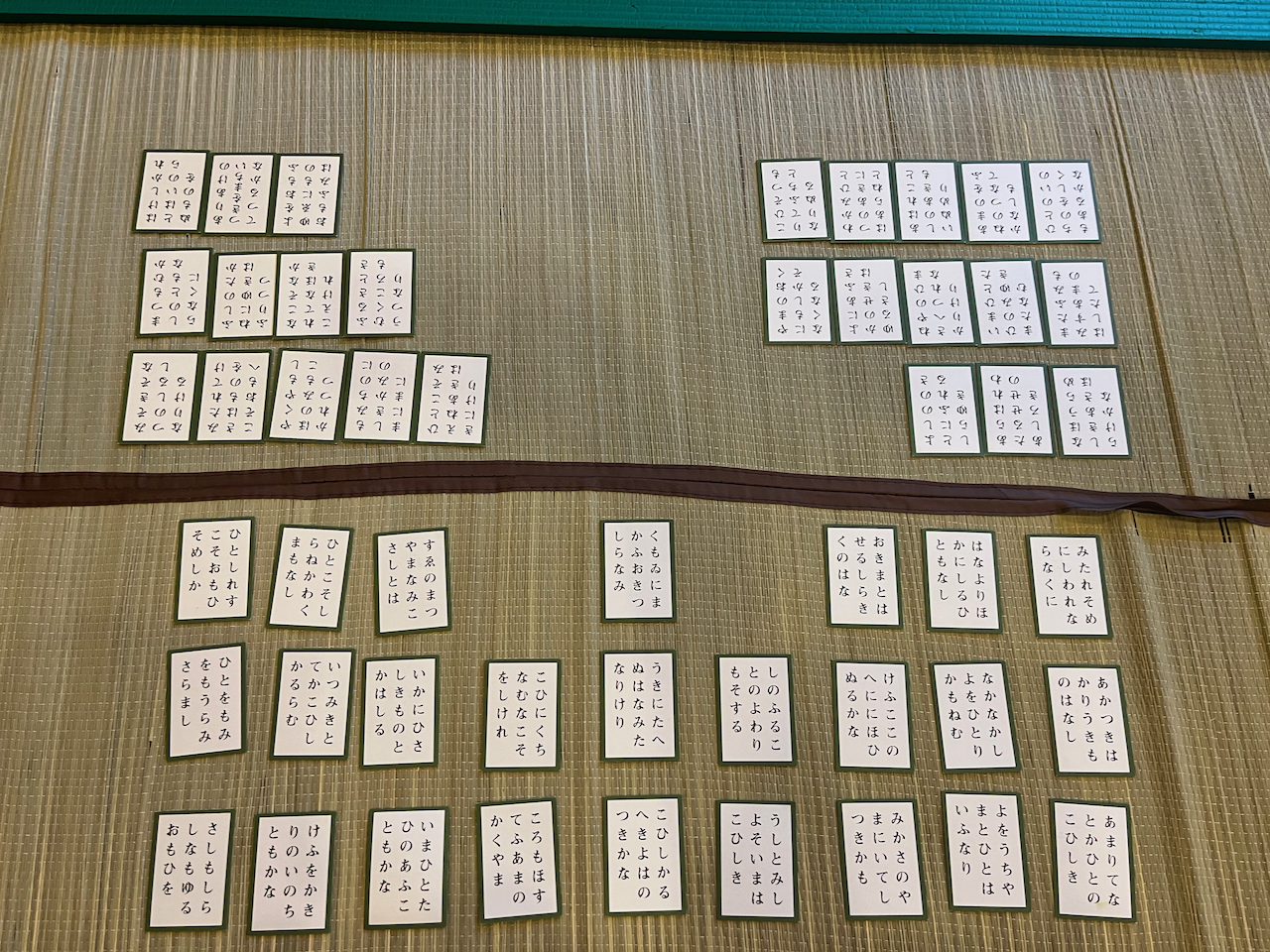
I stumbled upon their website last month, and being intrigued, came to a recent session. The people at Seattle Karuta Club were super nice and helped me get acquainted with my first game. My first opponent was Lore, one of the founding members. Above, you can see a view of my side of the board as we were setting up. I call this arrangement the “chaos strategy” because I had noooo idea what I was doing. 😅
Another view of me overlooking my cards and trying to make sense of them.
One of the things that immediately struck me was that the torifuda (取り札), that is the cards you take, have no marks to distinguish hiragana て versus で, or ち versus ぢ, etc. I presume this is by design, and yet after all this time I had simply never noticed before. 😅 In any case, my brain struggled to make sense of my board for the first few minutes until I started to pick out verses I knew. But it was too little, too late.
The card on the right, the yomifuda (読み札) uses normal Japanese syntax. The card on the left, the torifuda (取り札) is very streamlined for visual simplicity.
Further, I realized quickly that knowing a poem, and being able to listen to a poem are two different skills. If your ears aren’t tuned to the reading, you’ll totally miss a poem you might otherwise know. For example, poem 24 is near and dear to my heart, but when it did come up in a match, my brain registered it much too slow.
So, in the end, I lost 25-0. Lore was amazing. They really knew their stuff, and not only helped me through etiquette and good arrangement strategy, but also some pointers about what to listen for, mnemonics, etc.
Afterwards, the club members and I had a fun chat about all things related to the Hyakunin Isshu, how folks met, and so on. I was surprised by how many people were inspired but the Japanese anime Chihayafuru (which embarrassingly, I never watched 😅), and how useful that anime is for learning strategy.
Then, abruptly, we had to relocate venues due to shutting down from inclement heat, and club member Rachel gave us all a ride. Thanks Rachel!
For my second match, I played again Kiri, another founding member. As with Lore, Kiri was another sharp player and super nice. Kiri also drew amazing illustrations on the back of their cards. This is recommended by the club to help keep track of one’s own deck versus others, but Kiri definitely went the extra mile. 😊
My match with Kiri was similarly 25-0, but this time around, my brain had adjusted somewhat to the rhythm of poetry recitation, and I could pick out a cards I could now recognize. Further, I started to develop a crude strategy for arranging my cards. I haven’t covered the concept of kimari-ji in this post but have one coming up soon. That’s a topic worth its own blog post (or three).
I knew going into this I’d be poorly prepared, but I also really wanted the experience, because I knew reading about and watching YouTube videos just wasn’t enough. Even if I got clobbered, I’d learn a lot and the Seattle Karuta Club did not disappoint. I genuinely had a great time and was fired up about learning Karuta for next time.
After I got home, I busted out my decks from Japan and starting practicing a few things, including listening, kimari-ji and so on. Also, my daughter had some old copies of the manga Chihayafuru in Japanese which I am borrowing.
Issue 1 of the Chihayafuru manga, Japanese versionA special edition of the manga, devoted toward learning to play Karuta.
All in all, competitive karuta was super fun. Compared to my days playing Magic the Gathering where it was all about money, and competitive dude-bros, “grifters”, “grinders”, etc, the karuta scene, by contrast, was much more about fun.
Rachel, Kiri and Lore were all solid, no-nonsense players, but they knew how to have fun and make people feel welcome too. I can’t tell you the last time I was at something like this that didn’t make you feel dumb or awkward. Everyone is learning together.
Further, compared to a hobby like Magic, Karuta has more cost upfront (for a deck, goza mat, etc) plus memorizing the kimari-ji, but then that’s it. It becomes something you just enjoy and perfect over a lifetime. Further, the deeper you go, the more you get out of it.
So, I am already thinking ahead toward the next meeting, and practicing for my next game.
I recently came back from a family trip to Japan (mentioned here), and while there we took the kids to see the old capitol of Kyoto, where many of the poets of the Hyakunin Isshu lived,1 and where many events took place. But one thing on my bucket-list was to see was the Oishi Tengu-do karuta shop. Last year, I bought a karuta set at a local bookstore in Japan, and of the sets I bought the Tengu-do set was my favorite. And since we wanted to go to Kyoto anyway, it was a great opportunity to visit the home shop fo Tengu-do.
The Tengo-do shop is in the southeast part of Kyoto. If you get to Fushimi-Momoyama station, you can easily walk south 2-3 blocks to get there.
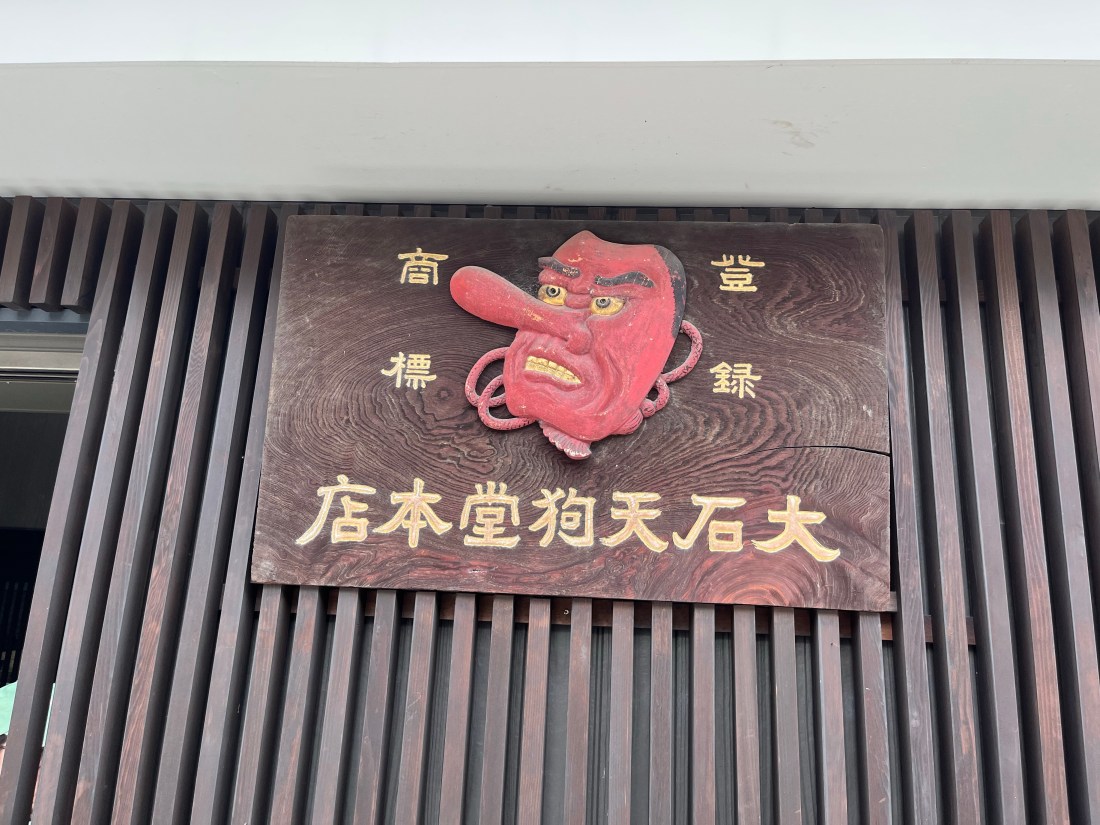
The shop is in a residential neighborhood, but if you look carefully, you can find the sign like so:
The inside of the shop is a single room, just enough room for myself and family, and I didn’t get a chance to take a photo, but I found some good photos online. The elderly lady minding the shop was very kind. We perused for a bit, and I found a few items that I wanted to get. The most important was this set:
This was one of more expensive sets, but I knew that I probably wouldn’t visit Kyoto again for another 10-15 years, so I figured I’d better go big or go broke.
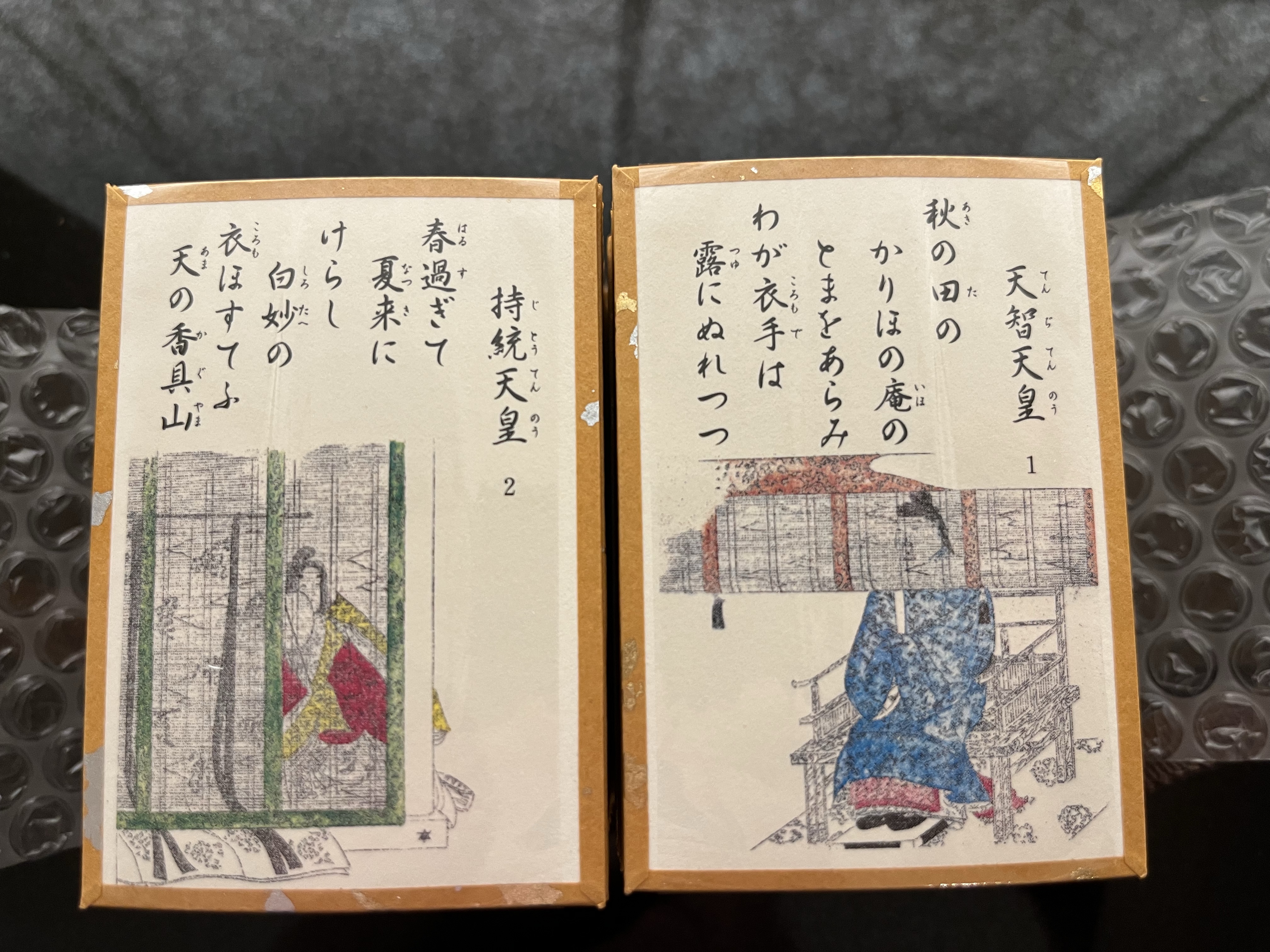
The detail on the cards, especially the border is simply amazing. The yomifuda cards below are for poems 1 and 2:
I also picked up a couple other odds and ends, but this was the real treasure. It was great to visit the home shop of Tengu-do, and to patronize a business like this. If you happen to be in Kyoto, and have an interest in the Hyakunin Isshu and/or karuta, definitely stop by!
1 Prior to Kyoto, the capitol of Japan was a city called Nara. Some of the earliest poets and figures of the Hyakunin Isshu lived when Nara was still the capitol, but I’d estimate at the remaining three-fourths lived in and around Kyoto until you get to the very last few poets who lived in the new capitol of Kamakura. That’s how much history the anthology spans.
Hello from Japan! The family and I are here visiting family, but we are also using the time to visit some sites my youngest son hasn’t seen before (Pandemic ruined past travel plans).
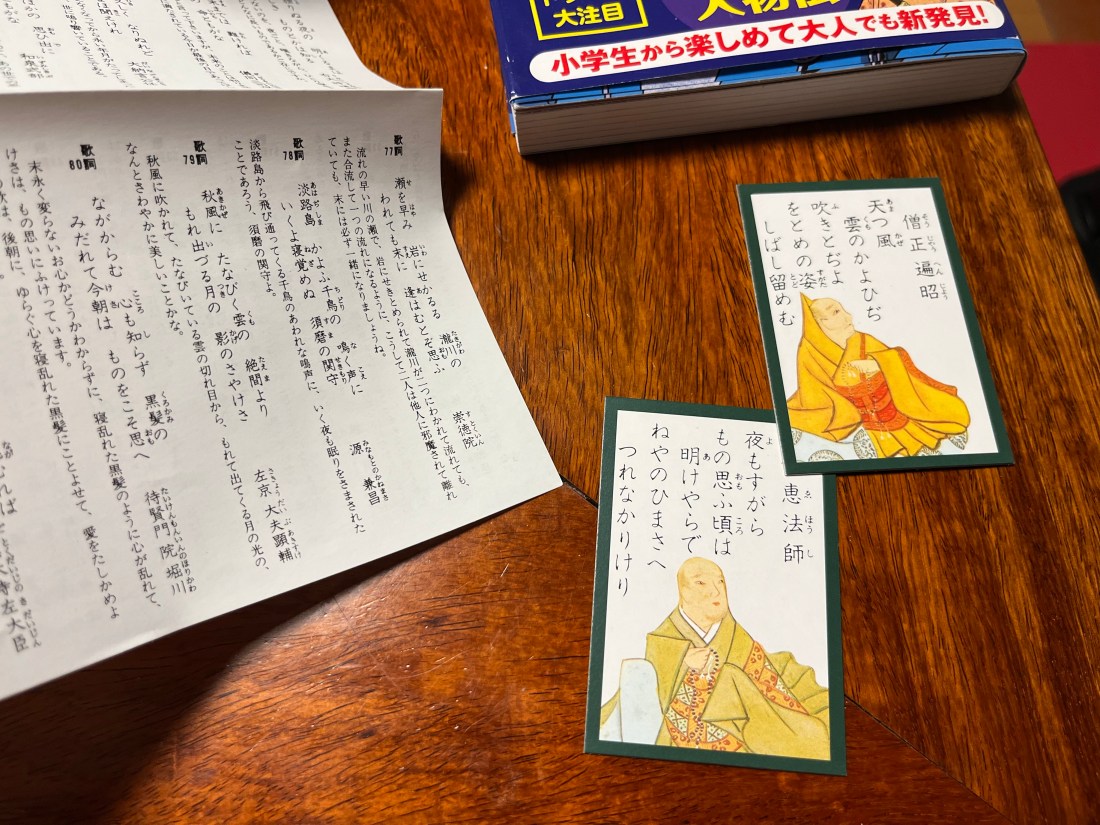
Anyhow, yesterday my wife and I stumbled upon a fascinating book at the local bookstore titled Nemurenai Hodo Omoshiroi Hyakunin Isshu (眠れないおもしろい百人一首), meaning “[Facts about the] Hyakunin Isshu that are so interesting, you can’t sleep”. The publisher’s product link is here.
The book groups the 100 poems in a different order and seeks to get inside the mind of Fujiwara no Teika (poem 97), the compiler of the anthology, in order to determine why he selected these poems above thousands of others. The book tends to favor more salacious aspects of the authors and theories about why they composed the poems they did, but much of it lines up with Professor Mostow’s book too.
For example, I am currently memorizing poem 61, and the book explains some of the backstory of why the Ise no Tayu, and not someone more senior like Lady Murasaki (poem 57) got the privilege of reciting the poem for that occasion.
The illustrations in the book are amazing. The fantastic artwork really brings the stories of the authors to life.
Anyhow, as I read more, and as I come across more stuff related to the Hyakunin Isshu, I’ll be sure to post here, and update existing poem entries with more backstory details.
Throughout this blog, I’ve alluded many times to poetry contests, called uta-awase (歌合), as the origin of many of the poems of the Hyakunin Isshu. These contests were a popular past-time among the nobility of Nara and Heian periods of Japanese history, and onward. The first such contest was recorded as far back as 885, and became a staple of nobility since.
The poetry contest was a ritualized affair, and worth exploring here.
An excerpt from an illustrated copy of the Tales of Ise showing two contestants in a poetry contest, with an incense brazier on between. The lady here serves as the judge of their poetry.
This image comes from an illustrated copy of the classic Japanese text, the Ise Monogatari (Tales of Ise)1 and shows an example of a typical poetry contest. The contestants sit facing one another as a pair, while some contests had multiple pairs facing off.
Presiding over the contest was a judge or hanja (判者) who would provide a topic for the contest. A small incense brazier would burn between the two contestants (方人, kata-udo), who would each come up with one poem to fit the given theme. Each participant would also trash-talk the opponent’s poem while praising their own, or their Allie’s (if multiple sets of participants). Basically, an ancient Japanese rap-battle. Once the winner was declared, the contest could go another round, and each contestant would come up with another poem.
According to the Hyakunin Isshu Daijiten, the longest recorded poetry contest during the classic Heian Period was said to have continued for 500 rounds!
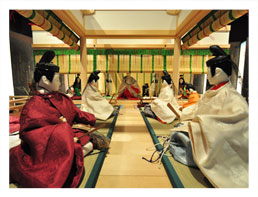
In more formal settings, usually held at the Imperial palace,2 with a director overseeing the contest (a tokushi, 読師), with the poems and their theme recorded by a scribe (kazusashi, 籌刺) who sat off to the side. Musical accompaniments were often added to formal poetry contests, too. Finally, the particularly good poems often ended up later in Imperial Anthologies.
You can see an example of an Imperial uta-awase from a popular manga here:
The good news is that I cross the halfway point in late March and memorized 50 of the poems! 🎉 When I started in January, I wasn’t I’d get very far before life got in the way. It has gotten in the way since returning to the US, but I have been able to manage learning the Hyakunin Isshu amidst the chaos.
The bad news is is that I stopped to review the 50 cards that I learned so far, and discovered that even those that I knew well are already starting to fade from memory! 😮
This has reinforced for me that periodic review is required for weeks, maybe months on old cards. Even if I feel I have “nailed it”, my mind gets rusty pretty quick. So, I had to go back and start reviewing old cards again, which takes away from learning the remaining 50.
Thus, I am experimenting with a hybrid method whereby I review a small number of cards per day (3-5 max), with a mix of old and new. I found that powering through more cards per day was exhausting and not always feasible with my schedule, and one card per day wasn’t quite enough. So, I settled on 3-5, and keep it on my desk at work so that i can review for a minute or two. Small, frequent reviews seem to work better than “power sessions”.
By mixing old and new, I hope I can also trim down the cards that I need to review, but also keep the momentum going in learning the remaining poems.
One nice thing to consider is that once I’ve memorized all 100, then it’s just review for the rest of my life. No need to learn more poems (unless I delve into Imperial anthologies or other works). So, part of me just wants to hurry up and power through the last 50, but until we get closer to the end, I think it’s essential to keep an even pace of learning a few poems at a time, while also reviewing old ones bit by bit.
Time will tell.
P.S. Thanks to everyone who’s been submitting ideas, suggestions, translations and so on for the Hyakunin Isshu. I am not always able to respond, but I do read and appreciate them. 🙂
P.P.S I am posting this at the end of March, despite the title. I just assume that as April is imminent, people won’t always read this post right away.
My progress in memorizing the Hyakunin Isshu poems, for the sake of learning to playkaruta, continues, but since returning to the US, it has taken some twists and turns.
When I got back home, it became clear how busy my day to day life is compared to Japan, where I didn’t have to worry about work commitments, and had fewer natural distractions from hobbies, projects, etc. So, my original strategy of learning one poem a day quickly unraveled.
Further, as the number of cards I memorized has grown (38 out of 100 as of writing), the effort to review them all has grown too. As the number grows even larger, it gets harder and harder to review all of them daily.
So, I started switching to a spaced-repetition style of learning to help manage the load. This means I focus more on the cards I still need to improve on, and focus less on the ones I know well, while still reviewing periodically. To accomplish this, I needed a way to not only organize my cards, but also manage the progress of each one.
I brushed off one of my old Legion brand deck boxes from when I used to actively play Magic the Gathering (yes, I am a giant nerd).
Inside, I used a few card dividers (some borrowed from other deck boxes) into sections. The section in the back represents cards that I know well and can recite with little or no effort. The section in the middle represents cards I am still struggling with. The section in the front is the “new” queue: cards I have yet to learn but have lined up next.
I mostly focus on the middle queue, since I am actively learning them, but not comfortable enough yet to move them to the “back” queue. I also review the back queue from time to time, and occasionally have to move cards from there to the middle queue in situations where I feel a poem needs a bit more active review. I also try to add a new card from the “front” queue every 1-2 days.
This process took some trial and error to get right, and it may not work for everyone, but it has helped me regain my pace in memorizing the Hyakunin Isshu after some interruptions after coming back to the States.
My original goal was to finish by end of April, and this is still possible, but I have lost some time and now I am hopeful I can memorize all one hundred poems by June.
Edit: since writing this post, I took up the game of karuta, which requires learning only certain verses of each poem. This post is not for playing karuta, but for learning the poems for aesthetic reasons. You can always do both, but I learned the hard way that knowing the full poem still won’t help with karuta due to speed required.
I started this blog in 2011, and after a long lull, I have picked it up again and added a lot more to it. One thing I never did though was memorize the Hyakunin Isshu anthology. I had a poem or two (poems 24 and 33) that I kind of remembered, but never really put in much effort beyond that. It seemed daunting, and yet as I have learned, many kids in Japan do it as part of high school competitions and other things [correction: they learned the kimari-ji for playing karuta]. My wife used to learn it in school too.
Further, after a long stay in my room due to Covid, I had a lot of time to revisit various hobbies, and I realized that I truly enjoyed the Hyakunin Isshu above many other things. Between this, and visiting Japan in December 2022, I finally decided it to make the effort.
You might be asking yourself why someone who’s not Japanese would go to the trouble of memorizing 100 poems, especially if they’re not written in modern, standard Japanese. But recently I’ve come to appreciate a few things:
Translations are just translations. Even the really excellent translations by Joshua Mostow don’t quite convey things the way the original author intended. It’s not because of bad translations; it’s just the reality of language.
I discovered that reciting the poems in Japanese out loud sometimes reveals things that simply reading them cannot. It’s hard to explain, but for example Lady Izumi’s poem (poem 56) sounds a lot nicer to me when recited as-is even in my badly accented Japanese. Same with Emperor Koko’s poem (poem 15).
Memorizing the poems is helpful for the karutacard game. At the very least, when you learn to play karuta, you need to learn the kimari-ji for each poem. However, if you learn the poems as whole, and not just the first syllables, you gain a deeper understanding of the poem, and it brings the game to life.
Finally, to my surprise, I’ve discovered that if you do know even some Japanese, the poems are still understandable to a modern (let alone a foreign) audience. It’s amazing how much of the language has carried over across the centuries.1
So, how does one memorize the Hyakunin Isshu? Here’s some tips:
Learn Hiragana, Optional
First, while not required, it is really useful to learn Hiragana script in Japanese especially if you want to play the karuta game. Kanji (Chinese characters) are also nice to know, but not strictly required. You can rely on Romanized Japanese (rōmaji), but you’ll often hit limitations. If you’re interested in Japanese culture anyway, hiragana opens a lot of doors, and makes learning the Hyakunin Isshu a lot more fun. If you’d like to learn more about hiragana script, check out my other blog here and here.
Keep in mind that spelling of words has changed over time, so modern omou (おもう) was often spelled as omofu (おもふ) in pre-modern times even if the pronuncation was the same. There are not many spelling differences, and they are predictable, but just be aware that they exist. The good news is that modern pronunciations are usually provided beside the poem.
Get a Karuta Set, Optional
This is another optional suggestion, but I find it really helpful for using spaced repetition: purchase a karuta set. If you are not able to get a hold of one, 3×5 cards can work too.
In either case, I like having something tactile that I can use to learn something. However, your learning style may be different.
Use Spaced-Repetition
The notion of spaced repetition is a technique for memorizing a lot of content by dividing it up into small chunks (hence the need for 3×5 cards or a karuta set) and then gradually sorting out the ones that are easy to learn vs. the ones that aren’t.
I started only learning 1-2 poems a day, randomly selected from my karuta set, and then reviewing everything I had learned up to this point. Some cards naturally floated to the top as “easy” cards (the poems were just easier to memorize) and get sorted into the easier pile. Other cards have more tricky poems, and I sort these into a harder pile, and focus on memorizing that harder pile until they all go into the easy pile.
Sometimes you’ll still forget an “easy” poem. This is natural. In such cases, you just move it to the hard pile for that day and re-learn it.
Memorize As A Song
Many experts and educators will tell you that learning new information through verses, songs or rhymes is often a handy method to easily memorize the content, and the poems of the Hyakunin Isshu have in fact been recited out loud across the ages. This is often true of haiku as well: the poems come to life when recited out loud in a sing-song style.
Japanese people often recite the poems in a style like that shown below:
Notice how the first three verses are recited, then after a pause the final two verses are recited. This is the same style used for playingkaruta, by the way. Even if you are tone-deaf, like me, you can still pick up this style of recitation easily enough to help you practice the poems out loud.
Find A Sustainable Pattern
Finally, unless you are Vulcan or an Android, it is quite difficult to take in all the poems at one time. I found it better to focus on a poem or two at a time, and keep reviewing old ones. Eventually, the review pile grows longer and longer, but as of writing I’ve memorized 15 poems in about 3 weeks. Maybe some people can do it faster, others might be slower.
It’s important to find a sustainable pace so it doesn’t become a source of stress (then you’re more likely to give up), but still gives a consistent sense of progress and reward. Since you have a fixed goal, each poem you learn reduces the number you have to learn by that much.
Good luck and happy memorizing!
1 Compare with English, which has undergone many radical transformations and now Old English is barely readable to a modern audience without sufficient training.
While here in Japan for a couple weeks, I picked up my first karuta set of the Hyakunin Isshu at the local bookstore when I realized that getting to the more famous store was harder than I expected, and I just won’t be here long enough for local delivery.
However, my interest in the Hyakunin Isshu was not sated with a single set, and so, when the family I went to a local Kinokuniya bookstore (we have them in the US too), I found another set that I liked, shown above.
This set, by Silverback, linked here, is another set of karuta cards, but this one includes a CD of someone reciting the poems (読み手, yomité) just like in a karuta game. As you can see from the linked product description, this set has the cards color-coded. The illustrated cards (yomifuda) have a beige background, while the verses cards (torifuda) are blank white for easy searching.
When I got back home, I imported the CD into my iTunes playlist, so I can shuffle the album. That allows me to practice the karuta game since the next card read out loud will be random.
I can’t decide with of the two sets I like better. The artistic detail on the Kyoto set (the first purchase) is really quite amazing, while the character illustration on the Silverback set is more what I am familiar with. The CD the Silverback set is quite handy (and sounds very nice), while the box and presentation on the Kyoto set is more sturdy.
I suspect I will probably continue collecting sets over time. Each one is a work of art by itself. I also learned alot how and where to purchase karuta sets and will be updating my blog post about it as a result.
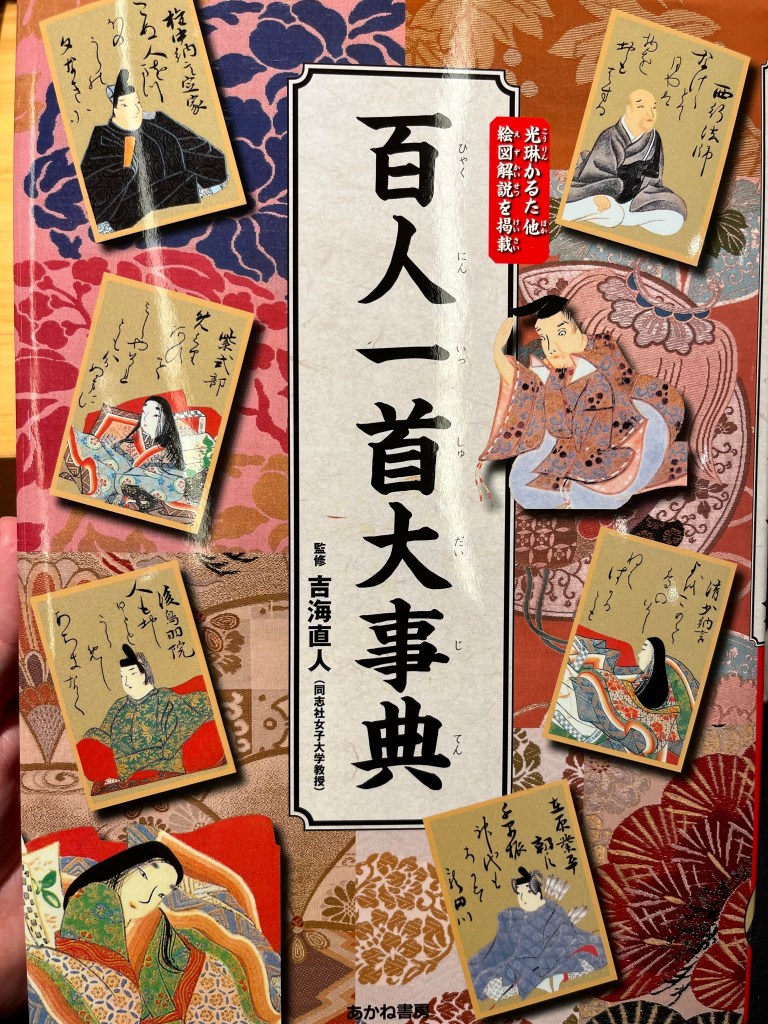
Separately, while at Kinokuniya though, my wife noticed this fascinating book (publisher’s link):
This is a comprehensive book (大辞典, daijiten) all about the Hyakunin Isshu. I like this book because it’s geared for younger audiences, so it’s easier to read, but it’s very comprehensive in detail about each poem, old vocabulary, famous places mentioned in the anthology and so on. I will likely be drawing on this book in the future.
One other interesting note about the book is that it does not present the poems in the usual numerical order, instead it sorts by topic (love, spring, autumn, etc) which is (coincidentially?) closer to how Waka poems were organized in official Imperial anthologies.
Anyhow, it’s been a very lucrative haul, and gives me plenty to admire and practice with. I have been busy memorizing poems of the Hyakunin Isshu over the past few weeks and will write more about how to accomplish that.
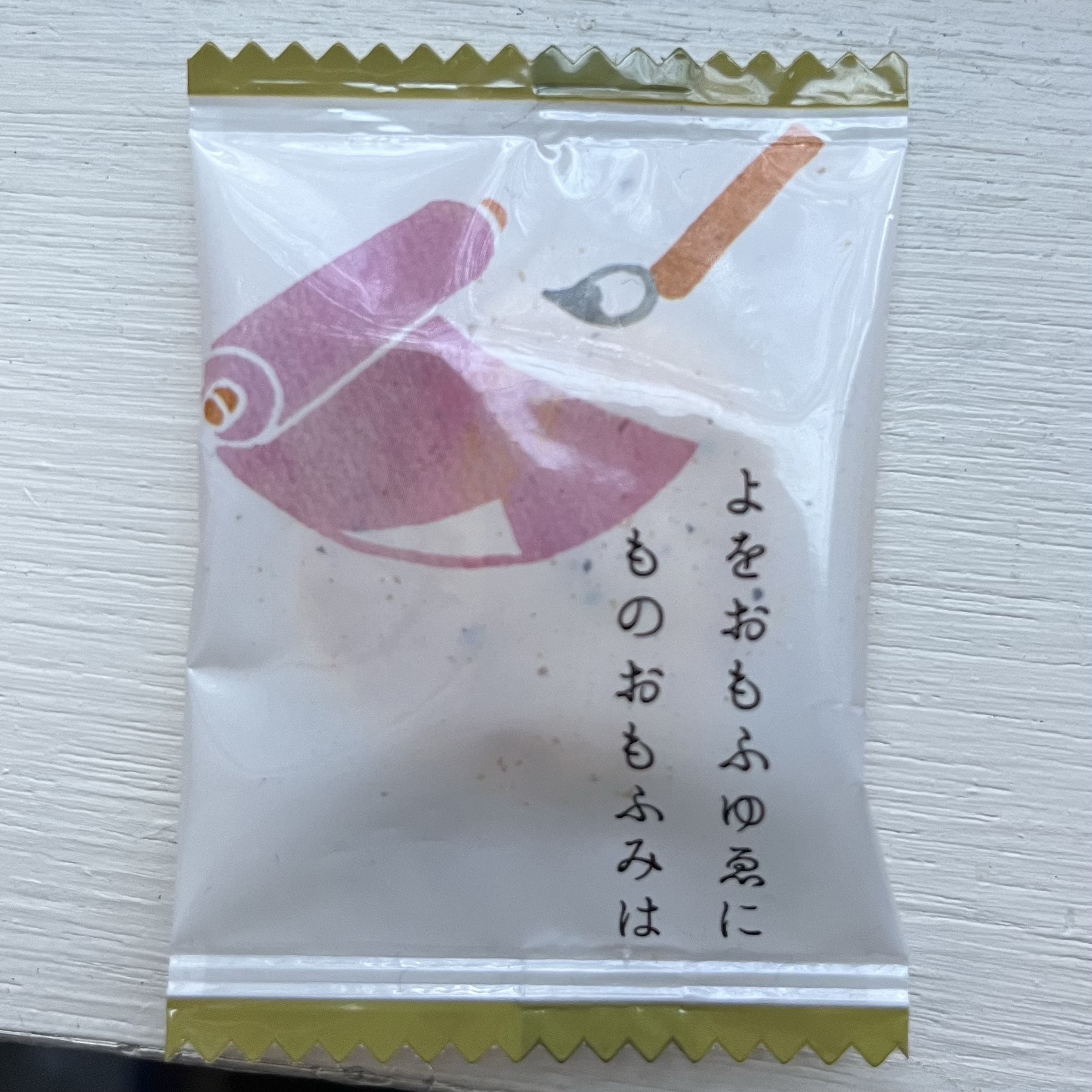
In Japan, gift-giving (omiyagé お土産) among friends and relatives is a common tradition, and recently a friend returned from Japan and gave us some special crackers (senbei) featuring poems from the Hyakunin Isshu. The crackers come in different flavors, and the wrapper each has a random poem.
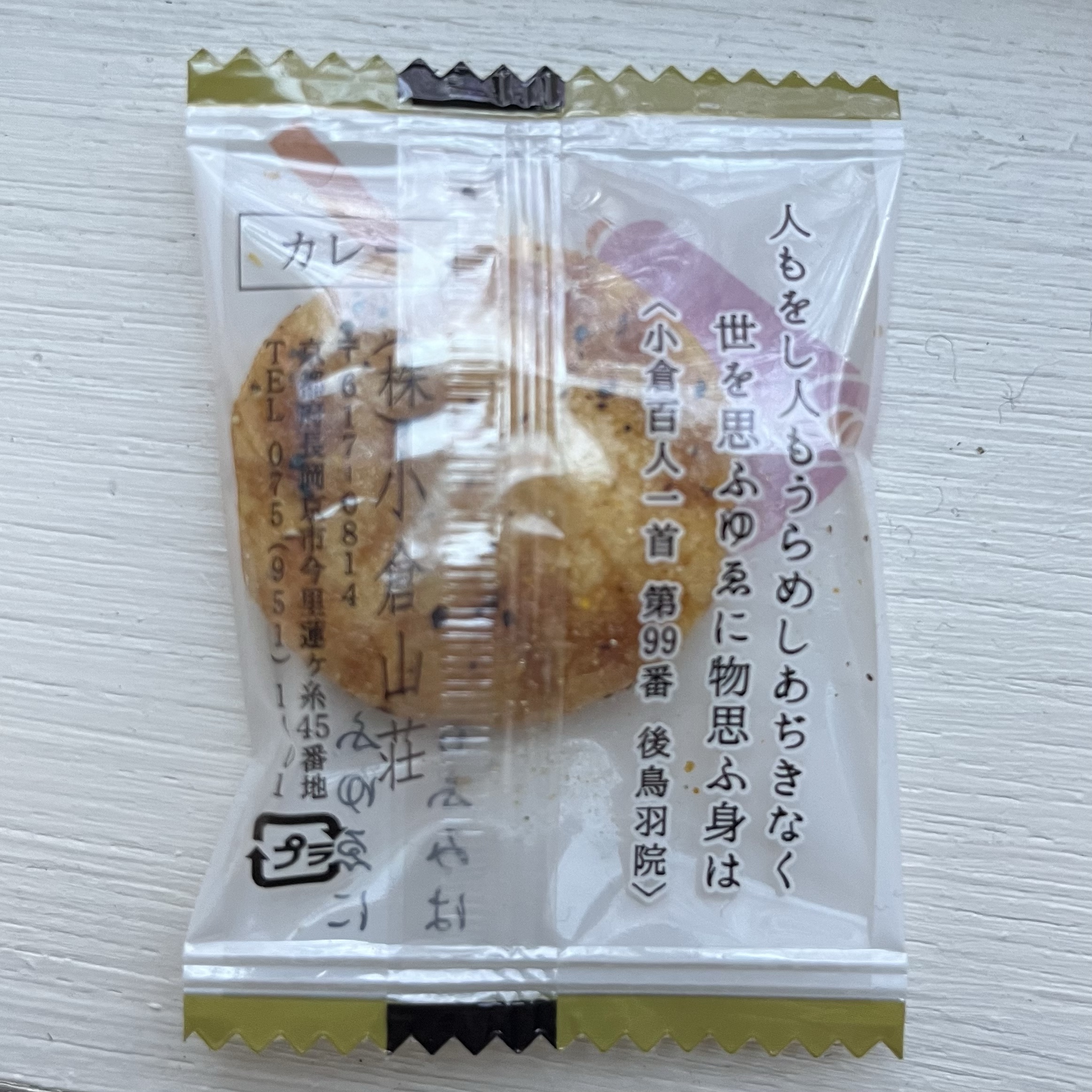
I got a curry-flavored one:
The first two verses of the poem, poem 99, are written on the front. On the back are the remaining verses:
Hyakunin Isshu-themed crackers are sold here and there, and I’ve posted about it in the past, but it’s still nice to get them from time to time.
P.S. This vendor sells Hyakunin Isshu themed senbei crackers as well (it was the vendor featured in the original post).










 The Hyakunin Isshu

.jpg)
_(CBL_J_1050.2,_ff.11b-12a).jpg)