Poet Ariwara no Narihira, who wrote poem 17 (ちは) in the Hyakunin Isshu, and quite possibly the best poem on cherry blossoms ever, is also the model for the protagonist of the Ise Stories. In it, he delivers yet another banger of a cherry blossom poem. This is episode 29 of the Ise Stories:
Back then, when called to attend the cherry-blossom jubilee held at the reside of the Heir Apparent‘s mother [he recited the following]:
This is a really good cherry blossom poem, but Professors Mostow and Tyler explain that there is more to the story too. The heir apparent, later the ill-fated Emperor Yozei (poem 13, つく) in the Hyakunin Isshu, had a mother named Fujiwara no Takaiko. And within the Ise Stories, episode 6, there is a famous anecdote where:
Back then there was this man. Year after year he courted a lady he was unlikely ever to win, until at last he managed to abduct her under cover of darkness.
Translation by Mostow and Tyler
Later, the pair take cover in a storehouse during a bad rainstorm, but while he stood guard outside, a demon came and swallowed her, losing her forever. The episode then explains that the demon was in fact Takaiko’s brothers who brought her back to the capitol. Thus, it’s strongly implied in the story that Narihira and Takaiko briefly eloped before she was found by her family and brought home.
The poem above was composed after Takaiko was already wed to Emperor Seiwa and had given birth to a son, Yozei. It’s not hard to imagine that Narihira maybe still had feelings for Takaiko, though modern scholarship seems to reject this, and suggest it is simply polite felicitations.
Was this a hidden love poem, or a really colorful description of cherry blossoms? Who knows?
I have been quietly doing a number of updates to existing blog content. This includes fixing some inconsistent formatting, and fixing broken or outdated links. Tags and categories were cleaned up and standardized as well. This was long overdue.
In addition, all references to Amazon.com have been removed.
Finally, it’s that time again: cherry blossom season. It is still a bit early where I live, but if you are planning to view cherry blossoms (ohanami, お花見), then feel free use my handy guide.
Thanks everyone and happy spring to readers in the Northern Hemisphere!
As fall is approaching, I wanted to share an interesting anecdote provided by my book on the Manyoshu. It seems that throughout Japanese antiquity, poets frequently debated which is better: spring or fall.
The first example comes from Princess Nukata in the 7th century, whom we discussed here and here, she wrote a lengthy poem (a chōka poem, not the usual tanka poem) in the Manyoshu (poem 16). She discusses the pros and cons of spring and of fall:
Original Manyogana1
Japanese
Romanization
Rough Translation2
冬木成 春去來者
冬ごもり 春さり來れば
Fuyu gomori haru sari kureba
When winter passes and spring comes
不喧有之 鳥毛来鳴奴
鳴かざりし鳥も來鳴きぬ
Nakazarishi tori mo nakinu
Birds that didn’t sing before, now come and sing
不開有之 花毛佐家礼抒 山乎茂
咲かざりし 花も咲けれど 山を茂み
Sakazarishi hana mo sakeredo yama wo shigemi
Flowers that didn’t bloom before now bloom, but because the mountains grass is so thick
入而毛不取 草深 執手母不見
入りても取らず 草深み 取り手も見ず
Irite mo torazu kusabukami torite me mizu
One cannot go and pick flowers, let alone see them.
秋山乃 木葉乎見而者
秋山の 木の葉を見ては
Aki yama no ko no ba wo mite wa
When you look at the leaves in the mountains during fall,
黄葉乎婆 取而曾思努布
黄葉をば 取りてそしのふ
Momiji wo ba torite soshi no fu
collecting the yellow leaves is especially prized.
青乎者 置而曾歎久
青きをば 置きてそ歎く
Aoki wo ba okite so nageku
Leaving the green leaves as they are is regrettable.
曾許之恨之 秋山吾者
そこし恨めし 秋山われは
Sokoshi urameshi akiyama ware wa
In spite of that, autumn in the mountains is spectacular…
a – I am heavily indebted to this site for both the original text. Translation is based in part on that site, but also my Manyoshu book, but probably lots of mistakes. Translating a five-line poem in archaic Japanese is hard enough… 😅
Speaking of the Manyoshu, its compiler Otomo no Yakamochi (poem 6 of the Hyakunin Isshu, かさ) left us some very nice poetry about spring:
Original Manyogana1
Japanese
Romanization
Rough Translation2
春苑
春の苑
Haru no sono
Beneath
紅尓保布
紅にほふ
Kurenai ni hofu
the shining crimson
桃花
桃の花
Momo no hana
orchard of
下照道尓
下照る道に
Shita deru michi ni
peach blossoms
出立オ嬬
出で立つ少女
Idetatsu otome
a young maiden lingers.
Poem 4139, book 19
and about fall:
Original Manyogana1
Japanese
Romanization
Rough Translation2
秋去者
秋さらば
Aki saraba
When fall comes
見乍思跡
見つつ思へと
Mitsutsu shinoe to
think fondly of those
妹之殖之
妹が植ゑし
Imo ga ue shi
pink blossoms
屋前乃石竹
やどのなでしこ
Yado no nadeshiko
of days gone by
開家流香聞
咲きにけるかも
Saki ni keru kamo
and remember me.
Poem 464, book 3
Otomo no Yakamochi wrote both of these poems about his beloved wife, but the second was composed shortly after her parting. The word nadeshiko has special meaning in Japan and has a very feminine, demure3 meaning.
Returning to the debate between spring and fall, Ki no Tsurayuki (poem 35 of the Hyakunin Isshu, ひとは) took up the same topic centuries later. This is poem 509 from an imperial anthology, the Shuishu :
Japanese
Romanization
Rough Translation2
春秋に
Haru aki ni
Spring or Fall?
おもひみたれて
Omoi mitarete
My thoughts are a mess,
わきかねつ
Waki kanetsu
and I cannot decide.
時につけつつ
Toki ni tsuketsutsu
The more time passes,
うつるこころは
Utsuru kokoro wa
the more my heart shifts back and forth.
1 This is a rough translation, all mistakes are my own.
The debate was even cited in the famous 12th century novel Tales of Genji written by Lady Murasaki (poem 57 of the Hyakunin Isshu, め):
“Since antiquity, in the debate about spring versus fall, many people lean toward fall, and yet some very noteworthy people who view the Imperial gardens in spring may yet change their mind, as is the way of the world.”
Princess Nukata all the way back in the Manyoshu seemed to imply that autumn was preferable, and it seems that most of the aristocracy shared this view. In fact if we divide up the poems of the Hyakunin Isshu by season, there are more fall poems than spring:
Note: summer only has 4 poems, winter has 9 (same as spring).
But what do you think? Are you Team Spring, or Team Fall?
Edit: added Hyakunin Isshu poetry chart.
1 If you’re wondering why I post Manyogana for some poems, but not others, it depends on the era. The Manyoshu is the oldest anthology by far, and at that time, there was a brief writing system that took Chinese characters, but used them in a phonetic way for Japanese language (a.k.a. Manyogana). By the time of Ki no Tsurayuki and Lady Murasaki, centuries later, this had been replaced with hiragana script. This blog strives to both be accurate and accessible, so I try to balance both needs.
2 These are all rough translations on my part, and likely have mistakes. Any such mistakes are entirely my own.
3 Not to be confused with the “very demure, very mindful” meme. 😛
The author, Nyūdō Saki no Daijōdaijin (入道前太政大臣, 1171 – 1244), or “Buddhist novice and former Chancellor of the Realm”. His personal name was Fujiwara no Kintsune. He was a powerful member of the elite Fujiwara clan and extended his support to the Hyakunin Isshu’s compiler, Fujiwara no Teika (poem 97), after Teika married Kintsune’s older sister. He was also well-liked by members of the old Imperial Court and the new military government at Kamakura.
According to Mostow, Kintsune married a niece of Minamoto no Yoritomo, the first shogun of the new military government. After Yoritomo’s son Sanetomo (poem 93) died a tragic death with no heir, Kintsune pushed to make his grandson Kujō Yoritsune, a distant relation to Sanetomo, the next shogun. My new book states that his reputation worsens in his later years as he kept manipulating the power of shoguns from behind the throne.
It also implies that Kintsune may have helped tip off the new military government about Emperor Gotoba’s (poem 99) plans to wrest back control, helping to contribute to the demise of the Emperor and his son (poem 100).
Ah, times had changed since the earlier generations of the Hyakunin Isshu mostly worried about poetry contests and marriage arrangements.
But I digress.
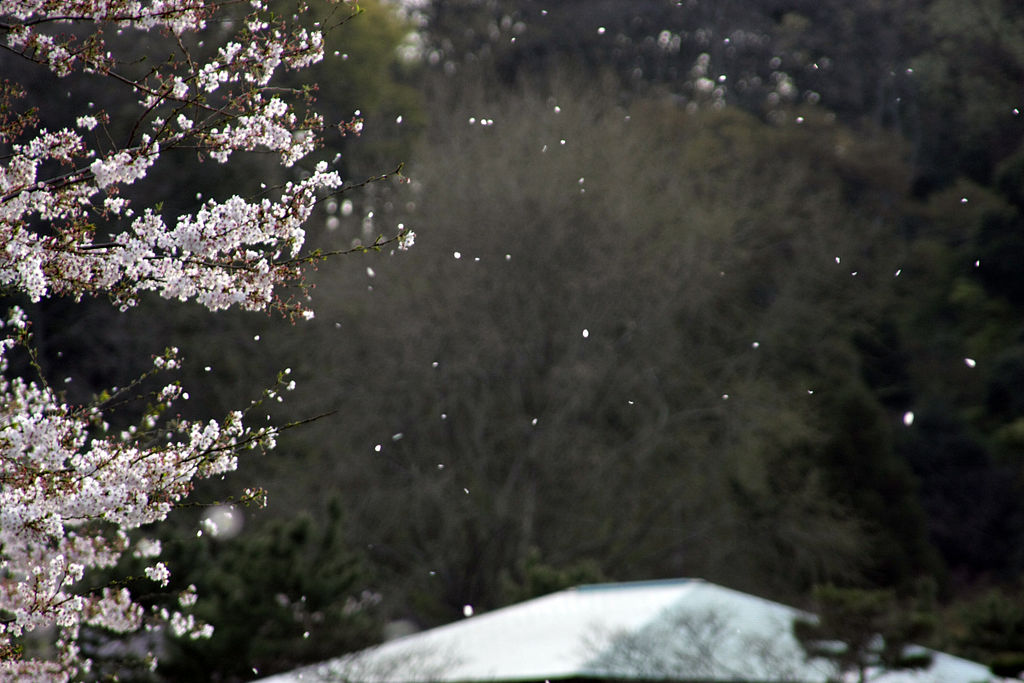
This poem, unlike other poems recently posted which were more clear-cut in meaning, often was the subject of much interpretation. The contrast between the aging man and the scattering of flowers in the wind, called hana fubuki (花吹雪) led to many interpretations by later commentators particularly about the man growing old, according to Professor Mostow. Perhaps he won’t be back next year?
The image of hana fubuki also is noteworthy, because it isn’t a small scattering of flowers. It refers to great scattering of blossoms in the wind, just like a snowfall. Thus Kintsune is witnessing this great scattering even as he contemplates his own decline even after so many years in power.
Pretty awesome poem, really, for a man who lived a noteworthy life.
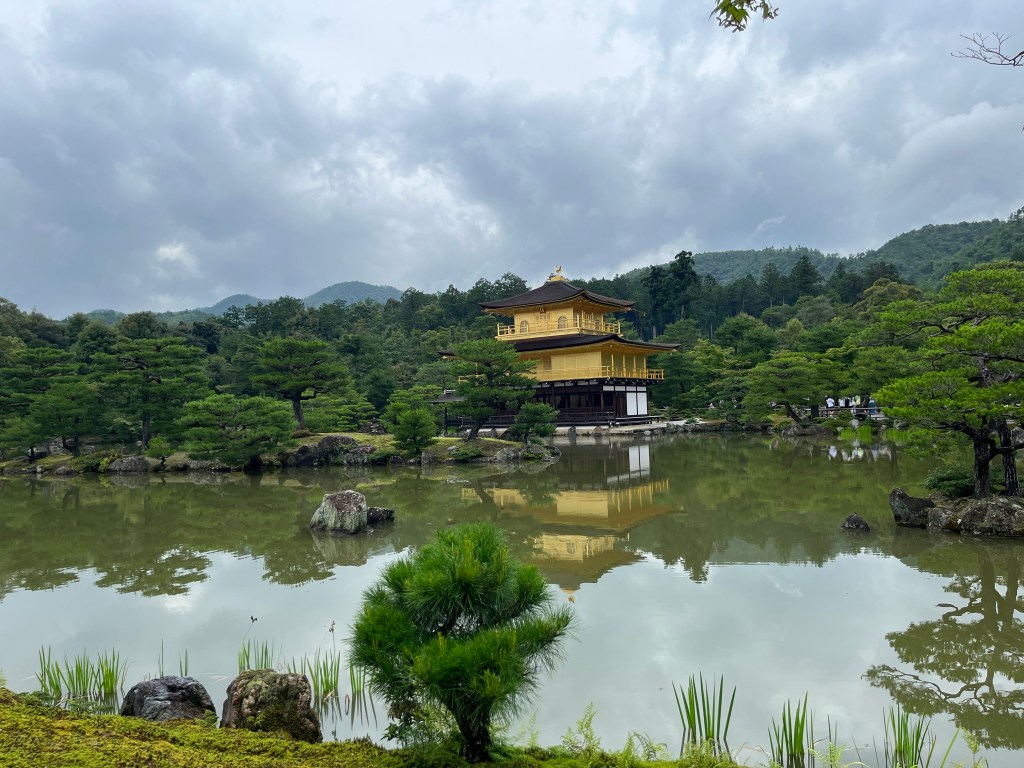
Speaking of scenic views, Kintsune’s residence of Saionji (西園寺), which was also established as his clan’s new name (Saionji), later became the famous Golden Pavilion.
Taken by me in July 2023
Indeed Kintsune’s contribution to Japanese culture and history, dubious as it may be, can be felt even today.
The author, known as Suō no Naishi (周防内侍, dates unknown), the “Suō Handmaid”, was so named because her father was governor Suō Province. As mentioned before, this was a common method used by female authors (cf. poem 65), so unfortunately, their real names are rarely known. This is another poem that speaks to the importance of a woman’s reputation in the ancient Court of Japan, just like poem 65. However, this one is much more playful and shows a lot of wit.
According to the back-story, there was a social gathering at the Nijō-In (二条院), the woman’s quarters at the palace. The woman there were relaxing, and the author of this poem said, “I wish I had a pillow”. At that moment, one Fujiwara no Tada’ie happen to walk by, and hearing this stuck his arm through the bamboo screen (御簾, misu) and said, “Here, takes this as your pillow!”.
In reply, the author composed this poem. As Professor Mostow points out, the word for arm here (kaina) is a pun for pointless (kainaku).
People flirted pretty clever back in those days. 😏
The poem was composed by a young Kōkō Tennō (光孝天皇, 830 – 887), Emperor Kōkō in English, who was traditionally, the 55th Emperor in Japan. He ascended the throne somewhat late (age 55) after Yōzei (poem 13, つく) abruptly retired. Koko’s own reign was similarly short, and power rested in the hands of his minister Fujiwara no Mototsune.
Nonetheless, Koko had a reputation for being a rather bright and easy-going youth. Despite being a Prince of the Blood, he was unlikely to inherit the Throne anytime soon (Yozei was still young, and Koko wasn’t directly related), and thus lived in obscurity. It’s said that he even had to cook his own meals. A poem mourning his passing states that his Imperial chambers still had black soot in them from cooking his own meals even after becoming Emperor.
The poem above is from those younger days, after he picked some wild flowers and herbs and sent them to someone as a New Year’s greeting. The poem was included in the offering. Young greens (wakana, 若菜) were the seven herbs used in the traditional holiday of Nanakusa on January 7th.
Even in the old Lunar Calendar, Nanakusa would fall around late January to early February. This helps to explain why snow was falling on the young prince’s sleeves.
Who was the recipient? It’s not known who received the poem and herbs, but since Nanakusa herbs are meant to bring safety, plus the language used (kimi ga tamé, きみがため), it definitely implies a young woman he cared about. ❤️ One theory suggests it was a beautiful girl named Tachibana no Kachiko (橘嘉智子), who was the consort of Emperor Saga.
This poem doesn’t use a lot of clever wordplays, the meaning is fairly straightforward, and it paints a nice image. It is a remarkably sweet, easy to grasp poem, that even foreign students of the Hyakunin Isshu can easily learn.
The author, Gonchūnagon (権中納言匡房, 1041 – 1111) or “Supernumerary Middle Counselor Masafusa”, was a prolific poet both in Japanese and in Chinese-style, and was a close confidant of Emperor Horikawa after retirement. His personal name was Ōe no Masafusa. As Professor Mostow notes, the poem’s meaning is very clear from the headnote, so there’s little if any debate about its meaning (unlike many poems in the Hyakunin Isshu). Masafusa hopes that the mist will not rise and block the view of the blossoms.
This poem brings to mind a time-honored tradition in Japan called hanami (花見) or “cherry-blossom viewing”. 🌸 This is a tradition you can see alive and well in Japan today, and each year there are plenty of websites and helpful guides for Japanese and foreigners to find a good spot for viewing.
However, during the time of the Heian Court and the poets of the Hyakunin Isshu, it was more of an outing for elite members of the court only. Such excursions, just like now, included lots of music, singing and drinking as well as impromptu poetry. The only difference, really, was that back then it was a very isolated affair between good friends and a private spot, whereas now people really have to fight for a good spot in places like Tokyo or Kyoto, and often times involve one’s boss and associates from work. 😏
Still, while some things have changed, it’s nice to see such a tradition live on for so many generations.
P.S. Featured photo is of cherry blossom viewing (hanami) in Oyamazaki, Kyoto Prefecture, Japan. Photo by Oilstreet, CC BY-SA 3.0, via Wikimedia Commons
The poem was composed by Saki no Daisōjō Gyōson (前大僧正行尊, 1055 – 1135), or “Former Major Archbishop Gyōson”, who according to Mostow, was a famed yamabushi or mountain ascetic, who dwelt on Mount Ōmine near Nara for a long time. He was the great-grandson of Emperor Sanjo (poem 68), and also a very prolific author in his day.
At the age of 10, his father passed away, and by age 12, Gyōson took tonsure at the Buddhist temple of Mii-dera, a major temple of the powerful Tendai sect. According to one episode in my new book, Gyōson had a reputation for being an expert at supplication of the Buddhist deities (lit. kaijikitō 加持祈禱). According to one story, when the newborn baby of Emperor Toba suddenly stopped breathing. Gyōson beseeched the gods, and somehow saved the baby, gaining trust of the Imperial family.
As for the poem, Mostow comments that the poem itself is fairly straightforward, but the poem’s headnote has confused many scholars over time, stating that it was composed “when he saw cherry blossoms unexpectedly at Ōmine.” Was it the time of year, or the location that made it so unexpected? No one really knows for sure.
Also, the term yamazakura (山桜) refers to mountain cherry blossoms. This is a wild variety of cherry blossom that differs from the typical cherry blossoms (somei-yoshino) often seen in gardens. The blossoms are more whitish than pink in color, and bloom at the same time that the leaves do.
Mount Ōmine (大峰山) near Nara was, among places, a popular mountain retreat for yamabushi practitioners. The phrase morotomoni means “you and me”, and implies intimate familiarity.
But, the joy of seeing cherry blossoms at this time of year is hard to deny. 🙂
P.S. Featured photo shows mountain cherry blossoms in Gunma Prefecture, Japan, taken by mahlervv, CC BY 3.0, via Wikimedia Commons
Sorry for the lengthy hiatus everyone. Been a long couple of weeks, but I am excited to post this poem in honor of women poets this month, and timely because of the coming of spring:
Isé no Tayū (伊勢大輔, dates unknown), also known in English as “Lady Ise” was another lady in waiting for Empress Shoshi, as was Lady Murasaki (poem 57) and Lady Izumi (poem 56), but was the newbie apparently.
According to Lady Ise’s own diary, she had to present a poem on the fly to the Bishop from the ancient capital of Nara and its Buddhist institutions, who had brought a lovely eight-petaled cherry blossom as a gift. This variety of cherry blossom is known as yae-zakura (八重桜) in Japanese. Further, the capitol of Japan had moved to Kyoto centuries earlier, but people in Kyoto still looked back to Nara at times for nostalgic reasons. Empress Shoshi’s father, Fujiwara no Michinaga (the same one mentioned in Lady Murasaki’s diary) had asked Lady Murasaki to compose the poem, but for reasons not understood, she deferred to Lady Ise because she was new.
Thankfully, her poem was a success. As Professor Mostow notes, it does a really nice job balancing the “ancient” with the modern, and the eight petals of the blossom with the metaphorical nine-layers of the Imperial court.
No wonder she made the inner-circle of Empress Shoshi. 😌
Happy Spring everyone!
P.S. Nara is a pretty awesome place to visit in Japan, definitely recommend.
P.P.S. Featured photo is of cherry blossoms at the University of Washington in 2022, taken by me
For the first poem for March’s “women only” theme, I chose this poem, one of the earliest by a female author (after Empress Jitō, poem 2), but also one of the most famous:
The author, Ono no Komachi (小野小町, dates unknown), is one of the most celebrated women of Japanese antiquity for both her reputed beauty and her poetry. She is one of the original Six Immortals of Poetry and the later Thirty-Six Immortals, and was said to have had relationships with various men, including Henjō (poem 12), and Fun’ya Yasuhide (poem 22) among others.
Reading this poem is something of an intimate look at the fear many women (and men, see poem 96) face then as much as now: the fear of getting old. For someone who was beautiful as Ono no Komachi, the loss may have been even more distressing.
Mostow describes this poem featured in the Hyakunin Isshu as a “technical tour-de-force”: the third line, meaning “in vain”, could technically modify either the previous line, or the one after, or both. Also, the poem uses word-play around furu which could mean to either “fall (as in rain)” or “to pass time”, while nagame could mean both “to gaze lost in thought” or “long rains” (長雨, naga-ame as Mostow explains). Further, this poem has been the object of much debate because of all the possible ways to interpret it, and is one of the most iconic in the anthology both for its technical prowess, but also it’s poignant message.
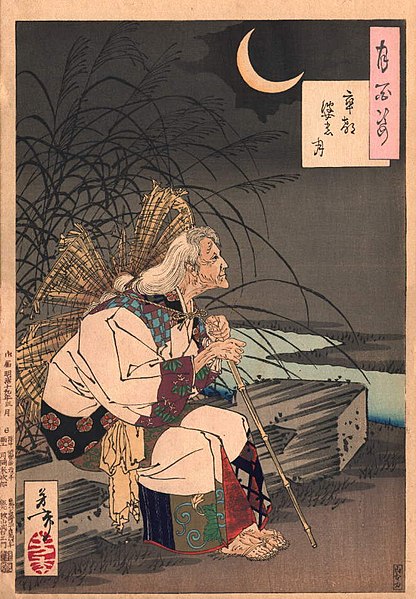
There are many legends that circulated in medieval Japan about Ono no Komachi’s good looks and her cruelty to men. In one famous story, she promised to love a certain suitor if he visited her 100 nights in a row. He completed 99 visits, but failed one night to visit her, and was so distraught that he fell ill and died. Ono no Komachi’s life and legends, including her decline, grew to become the subject of many Nō plays and art. Even 19th century woodblock prints depicted Ono no Komachi in her twilight years:
However, if you look at her other poems, mostly found in the Imperial anthology, the Kokin Wakashū, you can see she was more caring and sensitive than legend implies:



 The Hyakunin Isshu


