The Scattering Years of My Life: Poem 96

Something we all have to face in the end:

JapaneseRomanizationTranslation
花さそHana sasouIt entices the flowers—
あらしのにわArashi no niwa nothe storm—but through
the garden’s white,
雪ならでYuki nara deit is not snow,
ふりゆくものはFuri yuku mono waand what it is that’s scattering
わが身なりけりWa ga mi narikeriare, in fact, the years of my life!
Translation by Dr Joshua Mostow

The author, Nyūdō Saki no Daijōdaijin (入道前太政大臣, 1171 – 1244), or “Buddhist novice and former Chancellor of the Realm”. His personal name was Fujiwara no Kintsune. He was a powerful member of the elite Fujiwara clan and extended his support to the Hyakunin Isshu’s compiler, Fujiwara no Teika (poem 97), after Teika married Kintsune’s older sister. He was also well-liked by members of the old Imperial Court and the new military government at Kamakura.

According to Mostow, Kintsune married a niece of Minamoto no Yoritomo, the first shogun of the new military government. After Yoritomo’s son Sanetomo (poem 93) died a tragic death with no heir, Kintsune pushed to make his grandson Kujō Yoritsune, a distant relation to Sanetomo, the next shogun. My new book states that his reputation worsens in his later years as he kept manipulating the power of shoguns from behind the throne.

It also implies that Kintsune may have helped tip off the new military government about Emperor Gotoba’s (poem 99) plans to wrest back control, helping to contribute to the demise of the Emperor and his son (poem 100).

Ah, times had changed since the earlier generations of the Hyakunin Isshu mostly worried about poetry contests and marriage arrangements.

But I digress.

This poem, unlike other poems recently posted which were more clear-cut in meaning, often was the subject of much interpretation. The contrast between the aging man and the scattering of flowers in the wind, called hana fubuki (花吹雪) led to many interpretations by later commentators particularly about the man growing old, according to Professor Mostow. Perhaps he won’t be back next year?

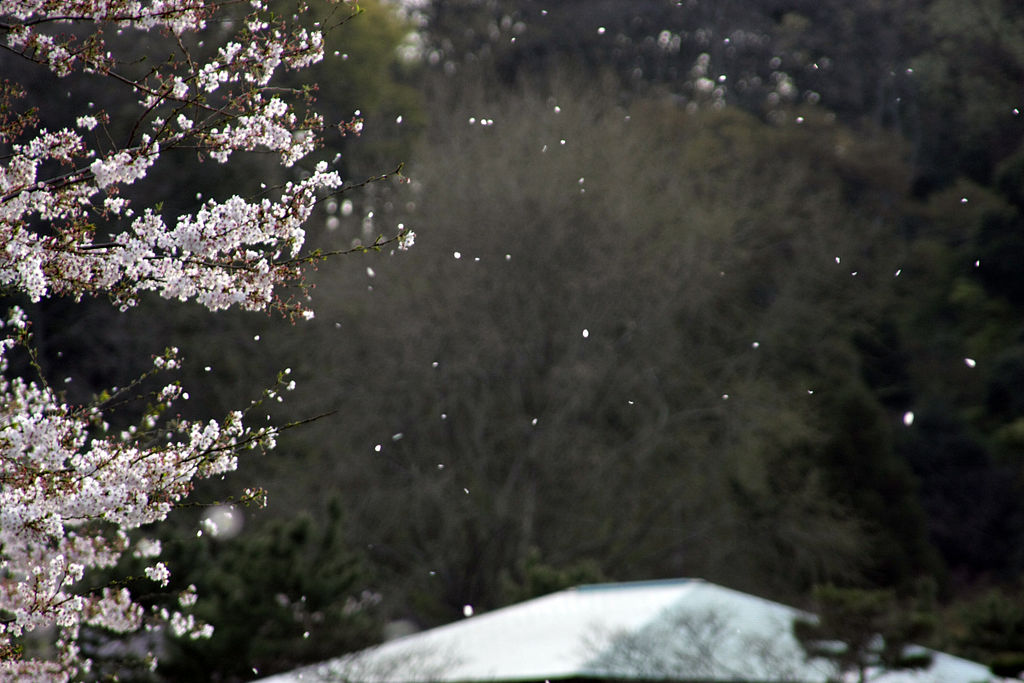
The image of hana fubuki also is noteworthy, because it isn’t a small scattering of flowers. It refers to great scattering of blossoms in the wind, just like a snowfall. Thus Kintsune is witnessing this great scattering even as he contemplates his own decline even after so many years in power.

Pretty awesome poem, really, for a man who lived a noteworthy life.

Speaking of scenic views, Kintsune’s residence of Saionji (西園寺), which was also established as his clan’s new name (Saionji), later became the famous Golden Pavilion.
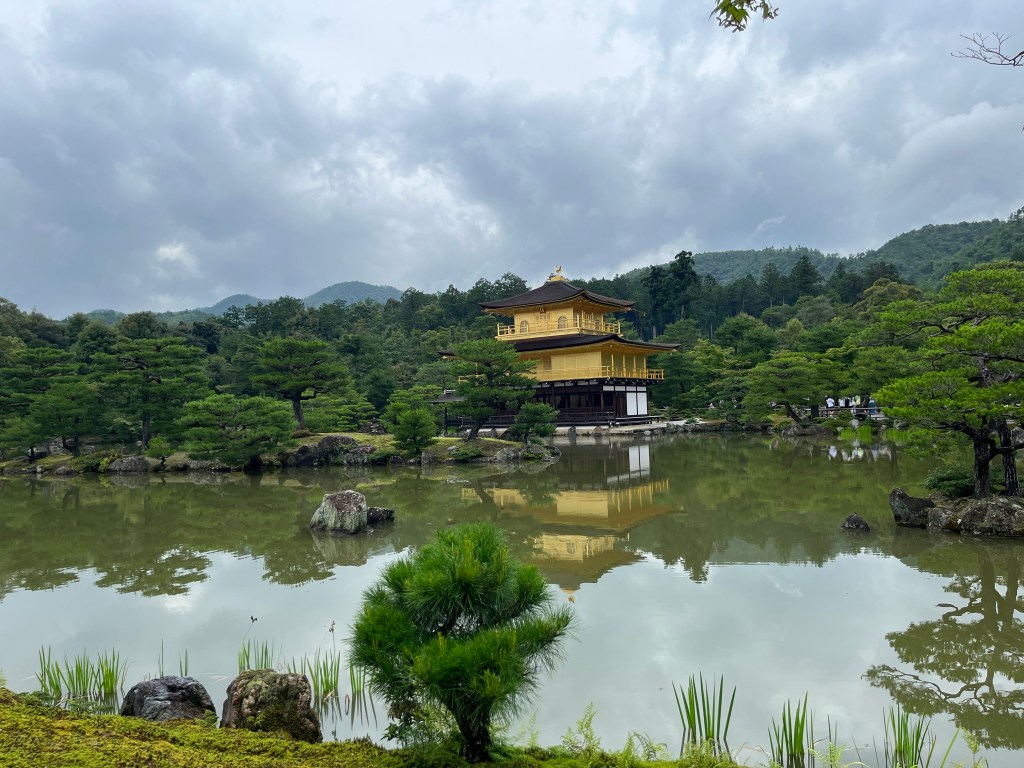
Taken by me in July 2023

Indeed Kintsune’s contribution to Japanese culture and history, dubious as it may be, can be felt even today.

Nostalgia: Poem Number 84

This is kind of a cool, unusual poem to find in the Hyakunin Isshu, but something we can all appreciate:

JapaneseRomanizationTranslation
ながらNagaraebaIf I live on longer,
またこのごろやMata kono goro yashall I again, I wonder,
しのばれShinobarenyearn for these days?
うしと見し世ぞUshi to mishi yo zoThe world that I once saw as
今はこいしきIma wa koishikibitter, now, is dear to me.
Translation by Dr Joshua Mostow

This poem was composed by Fujiwara no Kiyosuke Ason (藤原清輔朝臣, 1104 – 1177), “Sir Fujiwara no Kiyosuke”, who was the second son of Fujiwara no Akisuke (poem 79). Kiyosuke’s grandfather, Fujiwara no Akisué (藤原顕季) had founded the Rokujo School of poetry, and passed it along to Akisuke. However, there is evidence that Akisuke and his son Kiyosuke got along poorly. Real poorly.

The Rokujo School published an Imperially-sponsored anthology titled the Shikashiyū (詞花集), Kiyosuke was snubbed and not a single poem of his was included. Ouch. Further, in Kiyosuke’s career ambitions, Akisuke went out of his way to hinder his son finding lucrative positions in the Imperial Court. Thus, Kiyosuke never succeeded in the Court bureaucracy.

Ironically, Professor Mostow states that after his father Akisuke died, Kiyosuke inherited his position as head of the Rokujo School anyway. From here, he officiated poetry contests, and the Rokujo School took in success, so much so that it eventually developed a rivalry with Fujiwara no Shunzei (poem 83). Sadly, his efforts to publish another anthology, the Shokushikashu (続詞花集) dried up after Emperor Nijo died.

At heart, this poem is about nostalgia, how bitter things now somehow soften over time. It is thought that Kiyosuke may have recited this poem around the age of 60, and was thus looking back. Given his harsh upbringing, you can probably imagine why. But even the modern reader can think of a bitter time in their life, but when looking back nostalgia makes it seem sweeter than it was at the time. It’s also a reminder that if we are going through a hard time now, it won’t always be that way in the future.

Professor Mostow points out that some commentators think this may have, more concretely, alluded to the decline of the times, and in particular the disastrous Hōgen Rebellion, mentioned also in poem 76 and poem 77, and poem 86. That same rebellion ultimately began the rapid decline of the aristocratic Heian Period, epitomized in poem 100.

But even if that were true, it’s interesting how we tend to look back on this era with a kind of bitter-sweet nostalgia, far removed from the pain and destruction caused at the time.

Last Meeting: Poem Number 56

This poem, the fifth in our series devoted to the women of the Hyakunin Isshu, is by one of the most famous women of her era, Lady Izumi:

JapaneseRomanizationTranslation
あらざらArazaranAmong my memories
この世の外のKono yo no hoka noof this world, from whence
出にOmoide niI will soon be gone,
今ひとたびのIma hitotabi nooh, how I wish there was
あふおうこともがなOu koto mo ganaone more meeting,
now, with you!
Translation by Dr Joshua Mostow

Izumi Shikibu (和泉式部, 978 – ?), known in the West as “Lady Izumi” was a very talented and passionate poet, but she also faced much tragedy and heartache as well. Apart from her skills with poetry, she was very famous for her public affairs with various men of the Court. Due to her unhappy marriage with Tachibana no Michisada, she left him and met Prince Tametaka, third son of Emperor Reizei. The ensuing affair was such a scandal that her husband divorced her for good and her father disowned her. Further, her daughter, Koshikibu no Naishi (poem 60) was in the custody of her ex-husband, and they remained separated for many years.

Sadly, Tametaka died soon after due to a plague, and Lady Izumi was devastated. She was later the subject of interest by Tametaka’s half-brother, Prince Atsumichi who was already married and slightly younger than her. Their affair was soon discovered, and Atsumichi’s wife was furious and left him. Undaunted, Izumi and Atsumichi moved in together and had a public relationship until Atsumichi died at the age of 27. This relationship is explained in 3rd person by Lady Izumi in her eponymous diary, izumi shikibu nikki (和泉式部日記, “Diary of Lady Izumi”).

At this time, Lady Izumi joined the inner circle of Empress Shoshi, and worked alongside other great women of her time including Lady Murasaki (poem 57) author of the Tales of Genji and Akazome Emon (poem 59). However, as Lady Murasaki’s writings show, the two definitely did not get along:

Izumi Shikibu is an amusing letter-writer; but there is something not very satisfactory about her. She has a gift for dashing off informal compositions in a careless running-hand; but in poetry she needs either an interesting subject or some classic model to imitate. Indeed it does not seem to me that in herself she is really a poet at all.
— trans. Waley, “Diary of Lady Murasaki

I wrote a much more detailed biography of Lazy Izumi on my other blog, but suffice to say Lady Izumi’s passion was her greatest strength and her greatest detriment. For all this and more, she’s been admired and remembered throughout the ages, and can be seen in young women’s comics in Japan even today:

Lady Izumi as depicted in a young women’s manga of love stories from the past.

Nevertheless, she eventually settled down and reuinted with her daughter, Koshikibu no Naishi, who shared her tremendous talent for verses (poem 60), though Lady Izumi likely outlived her. Once again, Lady Izumi could not escape death around her.

This poem reflects the end of her life and her desire to see someone one last time. According to Professor Mostow, commentators disagree as to whether she wrote this to a dear friend she wanted to see once more, her husband, or a lover. My new book strongly implies that due to the language used, it’s a plea a lover that she misses for one last intimate moment together. The word au/ou (逢う) ostensibly means “to meet”, but not in the generic sense as modern Japanese au (会う). As we also see in poem 25, the term 逢う meant to spend the night together romantically.

Nevertheless, to me the poem is also a sobering reminder that all good things must come to and end.

Past Her Prime: Poem Number 9

For the first poem for March’s “women only” theme, I chose this poem, one of the earliest by a female author (after Empress Jitō, poem 2), but also one of the most famous:

JapaneseRomanizationTranslation
花の色はHana no iro waThe color of flowers
うつりにけりなUtsuri ni keri nahas faded indeed
いたらにItazura niin vain
わが身世にふるWaga mi yo ni furuhave I passed through
the world
ながめせしまにNagame seshi ma niwhile gazing at the
falling rains.
Translation by Dr Joshua Mostow

The author, Ono no Komachi (小野小町, dates unknown), is one of the most celebrated women of Japanese antiquity for both her reputed beauty and her poetry. She is one of the original Six Immortals of Poetry and the later Thirty-Six Immortals, and was said to have had relationships with various men, including Henjō (poem 12), and Fun’ya Yasuhide (poem 22) among others.

Reading this poem is something of an intimate look at the fear many women (and men, see poem 96) face then as much as now: the fear of getting old. For someone who was beautiful as Ono no Komachi, the loss may have been even more distressing.

Mostow describes this poem featured in the Hyakunin Isshu as a “technical tour-de-force”: the third line, meaning “in vain”, could technically modify either the previous line, or the one after, or both. Also, the poem uses word-play around furu which could mean to either “fall (as in rain)” or “to pass time”, while nagame could mean both “to gaze lost in thought” or “long rains” (長雨, naga-ame as Mostow explains). Further, this poem has been the object of much debate because of all the possible ways to interpret it, and is one of the most iconic in the anthology both for its technical prowess, but also it’s poignant message.

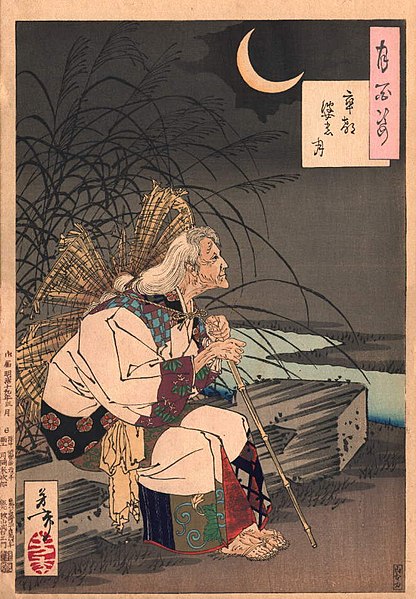
There are many legends that circulated in medieval Japan about Ono no Komachi’s good looks and her cruelty to men. In one famous story, she promised to love a certain suitor if he visited her 100 nights in a row. He completed 99 visits, but failed one night to visit her, and was so distraught that he fell ill and died. Ono no Komachi’s life and legends, including her decline, grew to become the subject of many Nō plays and art. Even 19th century woodblock prints depicted Ono no Komachi in her twilight years:

Yoshitoshi, One Hundred Aspects of the Moon, woodblock print #25, Public domain, via Wikimedia Commons

However, if you look at her other poems, mostly found in the Imperial anthology, the Kokin Wakashū, you can see she was more caring and sensitive than legend implies:

JapaneseRomanizationTranslation
思ひつつOmoitsutsuTormented by love
寝ればや人のNurebaya hito noI slept and saw him near me —
見えつらむMietsuranhad I known my love’s
夢と知りせばYume to shirisebavisit was but a dream I
覚めざらましをSamezaramashi oshould never have awakened.
Poem 552 in the Kokin Wakashū, translation by Laurel Rasplica Rodd and Mary Catherine Henkenius in Kokinshu: A Collection of Poems Ancient and Modern.

and:

JapaneseRomanizationTranslation
わびぬればWabinurebaI have sunk to the
身をうき草のMi o ukikusa nobottom and like the rootless
根を絶えてNe o taeteshifting water weeds
誘ふ水あらばSasou mizu arabashould the currents summon me
いなんとぞ思ふInan to zo omouI too would drift away
Poem 938 in the Kokin Wakashū, translation by Laurel Rasplica Rodd and Mary Catherine Henkenius in Kokinshu: A Collection of Poems Ancient and Modern.

So, Ono no Komachi wasn’t just a pretty face past her prime, she was a smart woman with a sharp wit, and a more sensitive side as well.

Getting Old: Poem Number 34

A nice reminder about getting older is poem number 34:

JapaneseRomanizationTranslation
誰をかもTare o kamoWhom, then, shall I have
知る人にせShiru hito ni senas someone who knows me—
高砂のTakasago nosince even the ancient pines
松もむかしのMatsu mo mukashi noof Takasago
友ならなくにTomo nara naku niare not friends from my past.
Translation by Dr Joshua Mostow

The author, Fujiwara no Okikaze (藤原興風, dates unknown), was one of the Thirty-Six Immortals of Poetry according to Mostow, but few other details about his life are known. He is the great-grandson of nobleman Fujiwara no Hamanari, and is thought to have lived around the same time as Kii no Tsurayuki (poem 35) and Kii no Tomonari (poem 33).

Takasago is a famous city on Harima Bay in Japan, in what is now modern-day Hyōgo Prefecture. Since antiquity, Takasago was famous known for its pine forests. The featured photo above is a sacred pine tree at Takasago Shrine (photo by , Public domain, via Wikimedia Commons). Takasago is also mentioned in poem 71. The most famous sacred pine tree at Takasago Shrine is the Aioi no Matsu (相生の松), which has been growing since the temple’s foundation. The pine trunk splits into two, and thus has become a symbol of marital harmony between husband and wife.

Further, my new book states that Takasago was such a iconic place, associations were often drawn between it and Sumi-no-e Bay (poem 18), with Sumi-no-e being the “husband” and Takasago the “wife”.

Even so, this poem takes as different turn and reflects on the loneliness of growing older. Given that Fujiwara no Teika (poem 97) was 79 at the time of compiling the Hyakunin Isshu, perhaps he felt a sense of kindred spirits when selecting this poem?

The First Signs of Spring: Poem Number 35

Early Spring is always an exciting time to look forward to, and this is a great poem for that time of year:

JapaneseRomanizationTranslation
人はいさHito wa isaWith people, well
心も知らずKokoro mo shirazuyou can never know their hearts;
ふるさとはFurusato wabut in my old village
花ぞむかしのHana zo mukashi nothe flowers brightly bloom with
香ににほひおいけるKa ni nioi keruthe scent of the days of old.
Translation by Dr Joshua Mostow

The author, Ki no Tsurayuki (紀貫之, ? – 945), is among the primary composers of the official anthology, the Kokin Wakashū (古今和歌集), and the person who coined the Six Immortals of Poetry therein. He wrote the famous and fictional Tosa Diary, and is also the cousin of Ki no Tomonori who composed poem 33.

The Kokin Wakashu explains the background to this poem. Whenever Ki no Tsurayuki would make a pilgrimage to Hatsuse (初瀬, modern day Hasedera Temple in Nara), he would stay at a friend’s house along the way. After an extended absence, when Tsurayuki visited again, the owner sent this poem to him with a branch of plum blossoms attached. Mostow hints that in one interpretation, the owner might have been a woman who was sad that he hadn’t visited in a long time, though other interpretations imply the author was a man, and the meaning was more platonic.

Here the reference to “blossoms” is for plum blossoms in particular, called umé (梅). We’ve seen the popularity of plum blossoms over cherry blossoms (sakura 桜) in antiquity even as far back as the Manyoshu.