The author, Nōin Hōshi (能因法師, 988 – ?) or “Dharma Master Nōin” was originally Tachibana no Nagayasu until the age of 26 when he took tonsure. From there, he traveled the provinces, composing poetry and contributed to various anthologies at the time. Because he was not tied to a politically prominent temple, he had more freedom than other monks in the Capitol to roam the countryside and write in his travels. My new book points out that he was eventually emulated by Saigyō Hōshi (poem 86) generations later.
Professor Mostow notes that this poem is unusual because it’s very straightforward with no hidden wordplay or anything. It’s just a nice, solid poem about Autumn.
As for the geography, Mt. Mimuro (三室山, mimuroyama) is in Nara Prefecture in Ikoma-gun, Ikaruga Village, while the famous Tatsuta-gawa River (竜田川) flows beside it. It was said in the old days that the gods would dwell at the mountain from time to time. In fact, you might recall hearing this river mentioned before all the way back in Poem 17. 😉
Mt Mimuro (Mimuroyama) and the Tatsuta-gawa River, photo by Kansai explorer, CC BY 3.0, via Wikimedia Commons
In those days, travel to places like Mimuro Mountain were generally hard to do for people, even the nobility. A day-hike into the mountains to see such a river was an expensive and exhausting affair as one had to bring their retinue, plan for food and supplies, etc.
So, many poems in the Hyakunin Isshu allowed contemporary people in those days to at least imagine what it would be like to visit even if they couldn’t afford to actually see it in person. Like a poetic “guidebook” in a sense. This is what makes poems like Nōin Hōshi’s so impactful, and why his travel writings were valued so highly: not only could he describe a place he had visited, but do skillfully using poetic verse. It helped to stir the imagination, just as it does for people living outside Japan today. 😏
P.S. For some reason, the last part of the Hyakunin Isshu has a lot of poems about Autumn in particular, so expect to see these soon amidst other things.
The author of this poem is Ju-ni-i Ietaka (従二位家隆, 1158 – 1237), or “Ietaka of Junior Second Rank”. His personal name was Fujiwara no Ietaka, and that he was the son-in-law of Jakuren (poem 87), and studied poetry under Fujiwara no Shunzei (poem 83). In fact he was so talented that he became the tutor for a young Emperor Gotoba (poem 99). After the Emperor’s exile following the Jokyu War, Ietaka and Gotoba still corresponded and shared poems.
My new book suggests that this might be why Teika (poem 97), compiler of the Hyakunin Isshu, put them next to one another (poems 98 and 99) numerically.
The notion of ablution or misogi (禊ぎ) is a Shinto ritual involving purification through cold water, prayer, etc. The practice is still alive and well today, and is often done in the summer months, but it varies depending on the particular Shinto shrine. In Shinto, people accumulate impurities through bad actions or traumatic events, and have to expunge them through ritual to balance their lives. As Professor Mostow explains, it was also popular in the author’s time as a well of making up for carrying on illicit affairs too. 😉
According to the Hyakunin Isshu Daijiten, the second verse of the poem is a good example of a kakekotoba ( 掛詞) wordplay, in that it has two meanings. First, nara can mean an oak tree (楢), especially Quercus serrata trees. The second meaning, nara no ogawa, refers to the font at the upper Kamo Shrine also called the Kamigamo Shrine (kamigamo-jinja, 上賀茂神社). The homepage can be found here.
The nara-no-ogawa next to the Kamigamo Shrine. Photo courtesy of 663highland, CC BY-SA 3.0, via Wikimedia Commons
Another concept in late summer is the notion of zansho (残暑) which is the long, hot, humid summer that comes after the monsoon season in June-July. Speaking from first-hand experience, it’s stifling hot, but here the poem implies that the summer is nearly over, and only the ablutions remain.
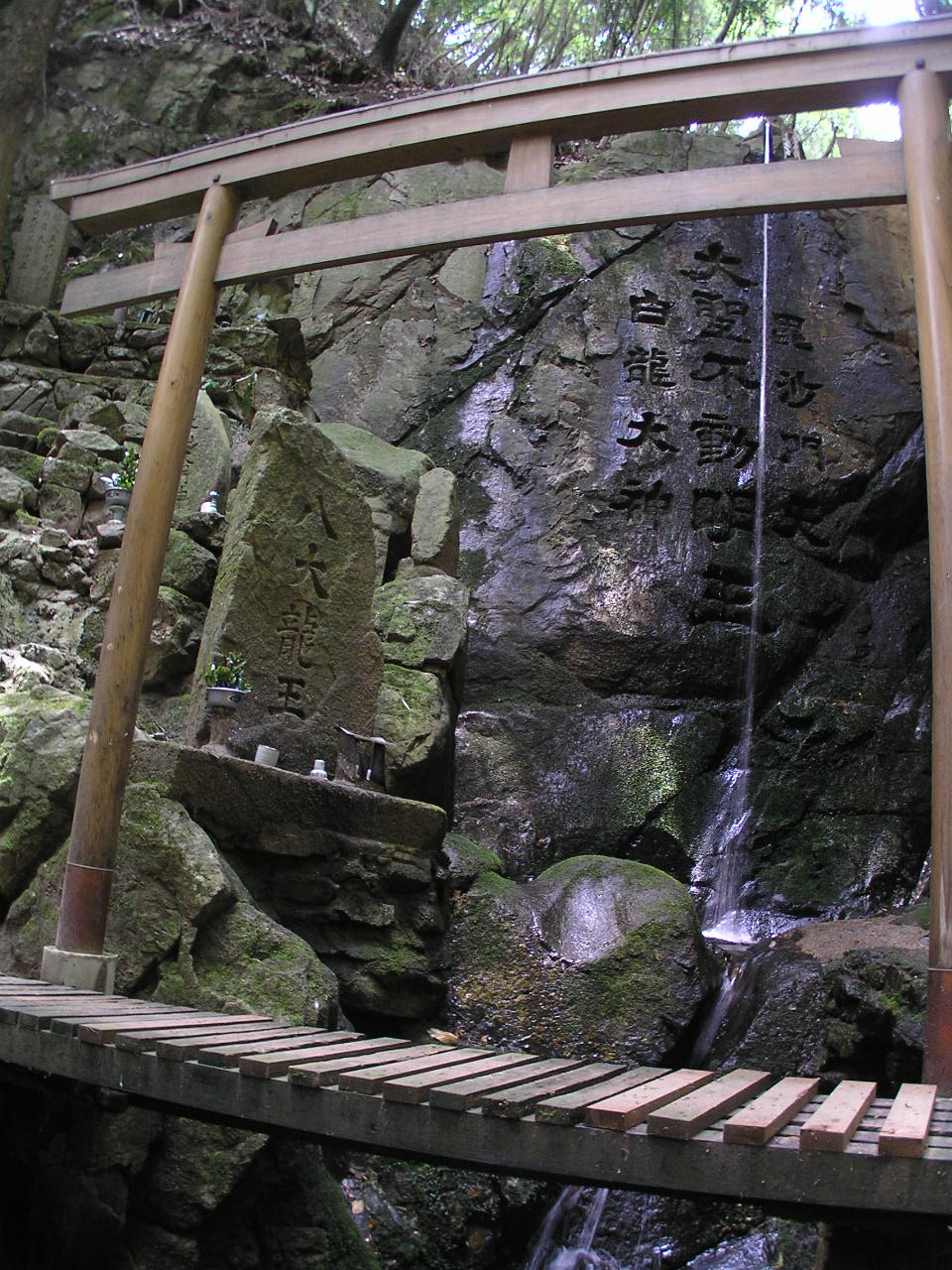
P.S. Featured photo is of Iyagatani (伊屋ヶ谷) waterfall, of Ryujuin (龍樹院) Temple. Photo by 松岡明芳, CC BY-SA 3.0, via Wikimedia Commons
The author is Minamoto no Toshiyori Ason (源俊頼朝臣, 1055 – 1129), “Sir Minamoto no Toshiyori”, who is the son of Tsunenobu (poem 71) and father of Shun’e (poem 85) and was also a leading poet of his era, along with Mototoshi (poem 75). Toshiyori’s talents were not limited to poetry. According to my new book, he excelled at playing an instrument called the hichiriki, enough that he was invited to serve in the Imperial court under Emperor Horikawa. We went on to serve three Emperors in this capacity, and helped compile the unusually eclectic Imperial Anthology the Kinyō Wakashū, as well as many poems of his own in various anthologies.
The poem above was actually composed during a poetry contest held at the residence of Fujiwara no Toshitada, grandfather of Fujiwara no Teika (poem 97) who compiled the Hyakunin Isshu. The topic of the contest was “unfulfilled love so strong that one even prays to the gods”. The poem expresses frustration after having prayed to be able to meet a certain woman, and somehow she became even more resistant. As Professor Mostow explains, Teika valued this poem very highly because of its depth of feeling, excellent word choices, and clever story-telling (see below).
The name “Hatsuse Temple” is another name for a famous Buddhist temple in Nara, Japan called Hasedera. Hasedera is very well-known in Japan, and apparently was a frequent pilgrimage site for lovers and those with romantic interests. If you ever do happen to be in Japan, especially in the Nara area, I’d highly recommend visiting Hasedera temple.
This poem is listed as a “winter” poem, but I was really confused why this is since the topic sounds more like unrequited love. I checked my source, which explains that Toshiyori went up to Hatsuse Temple to pray, and then came back down (yama-oroshi, 山おろし) in the third verse. This symbolism of coming back down the mountain is evidentially considered a powerful symbol of winter. Perhaps this relates to New Year’s prayers and such. This third verse is also a neat dividing technique between the first half, praying at the temple, and the second half, the girl he was fond of despising him even more.
The author of this poem was known only as Yūshi Naishinnō Ke no Kii (祐子内親王家紀伊, dates unknown) or “Kii of Princess Yūshi’s Household”. She served in the household of Imperial Princess Yūshi, and was the daughter of Taira no Tsunekata and one Lady Koben. The salon of Princess Yūshi included a number of poets and writers and it seems Kii was no exception. She participated in a number of poetry contests and her poems appear in various anthologies.
Speaking of contests, Professor Mostow explains that this poem actually was intended as a response to another poem in a competition held by Retired Emperor Horikawa. Kii was 70 years old at the time according to another source, which is impressive given that she expresses young love so easily after all these years.
The word adanami in the third verse is a particularly interesting phrase. It implies flowers that failed to bear fruit, and thus infidelity. Apparently the women in the poem is not a fool and won’t fall for a dishonest man.
But where is Takashi beach? I checked and it seems to be a famous beach in Osaka Bay, near modern-day Takaishi City in the Osaka Metropolitan Area.
This poem was composed by Sanjō-in (三条院, 976 – 1017), known in English as the “retired Emperor Sanjo“. He only reigned briefly for 5 years until his regent, Fujiwara no Michinaga, forced him to abdicate so that his own grandson could become Emperor (Emperor Go-ichijo). Fujiwara no Michinaga will be remembered as the main character of Lady Murasaki’s Diary, plus he employed a number of the female authors in the Hyakunin Isshu to be ladies in waiting for his daughter. Fujiwara no Sadayori (poem 64)’s family also lost in the same struggle.
To make matters worse, Emperor Sanjo was frequently ill, and this added further pressure for him to abdicate.
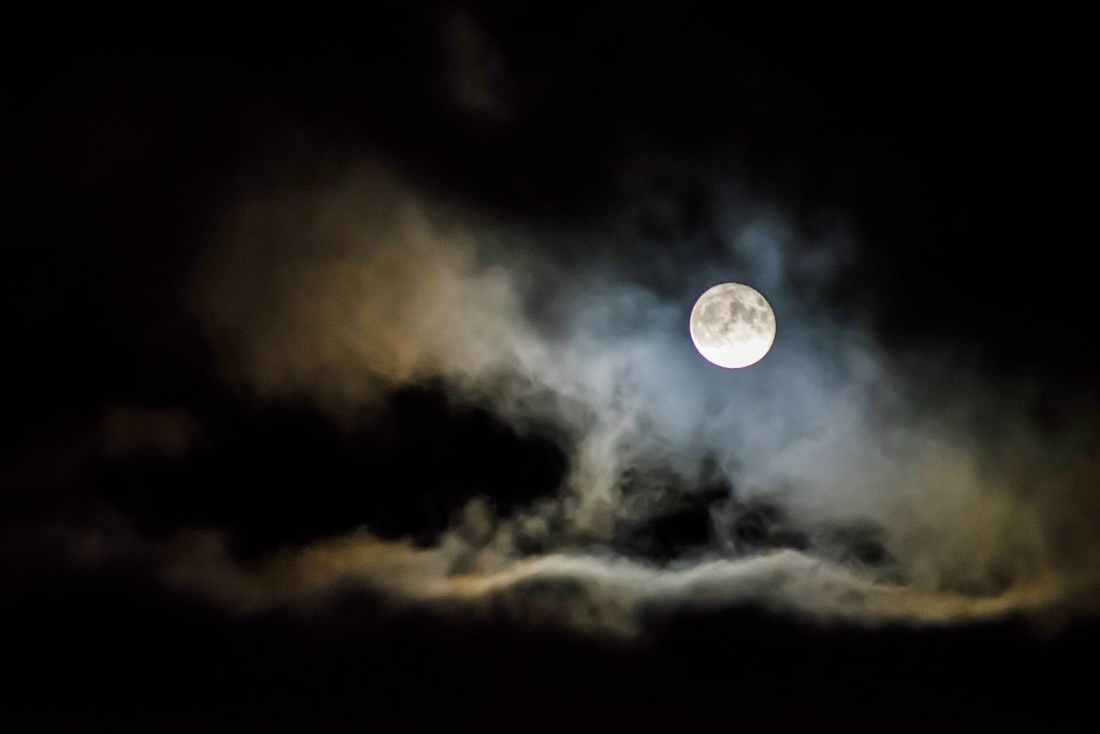
The poem above, according to Mostow, is thought to have been composed toward the end of his reign when he was ill and considering abdication. Was he concerned that night about his illness, or about the prospect of losing the throne? What made him savor that moon so?
As mentioned in this post, the later poems of the Hyakunin Isshu reflect a more somber era when political scheming and conflict replaced the earlier enthusiasm of previous generations. By this time, the Emperors had lost much of their power to ministers (mainly from the Fujiwara family) and were increasingly isolated, or even battling one another.
The 400-year Heian Period, the height of aristocratic culture in Japanese history, which the Hyakunin Isshu covers, would come crashing down about 100 years later.
The author of this poem known by the lofty title of Gonchūnagon Sadayori (権中納言定頼, 995 – 1045), or “Supernumerary Middle Counselor Sadayori”, was also known as Fujiwara no Sadayori, son of the eminent poet and critic of the era, Fujiwara no Kintō (poem 55).
Sadayori was also a respectable poet in his own right. According to my new book, when father and son took part in the Imperial precession by Emperor Ichijo to the Ōi River (大堰川, ōi-gawa), part of the modern Katsura River, he was tasked with composing a poem for the occasion and came up with this:
Japanese
Romanization
Rough Translation
水もなく
Mizu mo naku
How can one possibly
見えこそわたれ
Miekoso watare
look out over
大堰川
Ōi-gawa
the Oi River,
岸の紅葉は
Kishi no momiji wa
when the fall leaves
雨と降れども
Ame to furedomo
rain down on the shore?
Translation by myself
It was a clever way to point out the beauty of fall, and both Kintō and the Emperor were impressed. Later, Sadayori was supposedly flummoxed by Lady Izumi’s daughter, Koshikibu no Naishi in a famous poetry contest (namely poem 60).
In any case, back to the Hyakunin Isshu poem. The phrase asaboraké is apparently short for asa ga oboroge ni aketekuru koro (朝がおぼろげに明けてくる頃) meaning “that time at dawn when things are hazy”, particularly in autumn or winter. It is also used in poem 31, and a challenge for karuta players as a result.
Sadayori’s usage of the Uji River (宇治川, uji-gawa), now known as the Yodo River (淀川, yodo-gawa), may not seem like much to modern audiences, but it carries much meaning in Japanese antiquity. The Uji River was frequently cited Japanese poetry, and runs through the Osaka metropolitan area. It is mentioned in the earliest Japanese poem anthology, such as the Manyoshu, and others. It was a pivotal place at the end of the Tales of Genji, written by Lady Murasaki (poem 57), when the heroine Ukifuné attempts to take her own life, but is rescued from the river and takes tonsure as a Buddhist nun instead. The Uji River was often deeply associated with turbulent relationships between men and women. In a more practical sense, it was also a place where the nobility of Kyoto often had second villas, and was a popular meeting place.
I actually had to look up what “fishing stakes” are. The term, ajirogi (網代木), refers to stakes in the water, like a fence or weir. Fish swim into these places and they were easier to catch with nets because they had fewer places to escape. You can see an illustration here. Side note: the Salish people here in the Pacific Northwest had a particularly ingenious system of fishing stakes as well.
Professor Mostow notes that the combination of the Uji River and the fishing stakes was a very famous image in ancient Japanese poetry, and this coupled with the image of a cold winter’s dawn make this a powerful poem. Unlike other poems in the Hyakunin Isshu which might be hypothetical, exaggerated or talk about something abstract such as love, Mostow points out that this poem likely was written exactly as Sadayori saw it. I can only wonder what it was like watching the fishermen go to work early that icy morning.
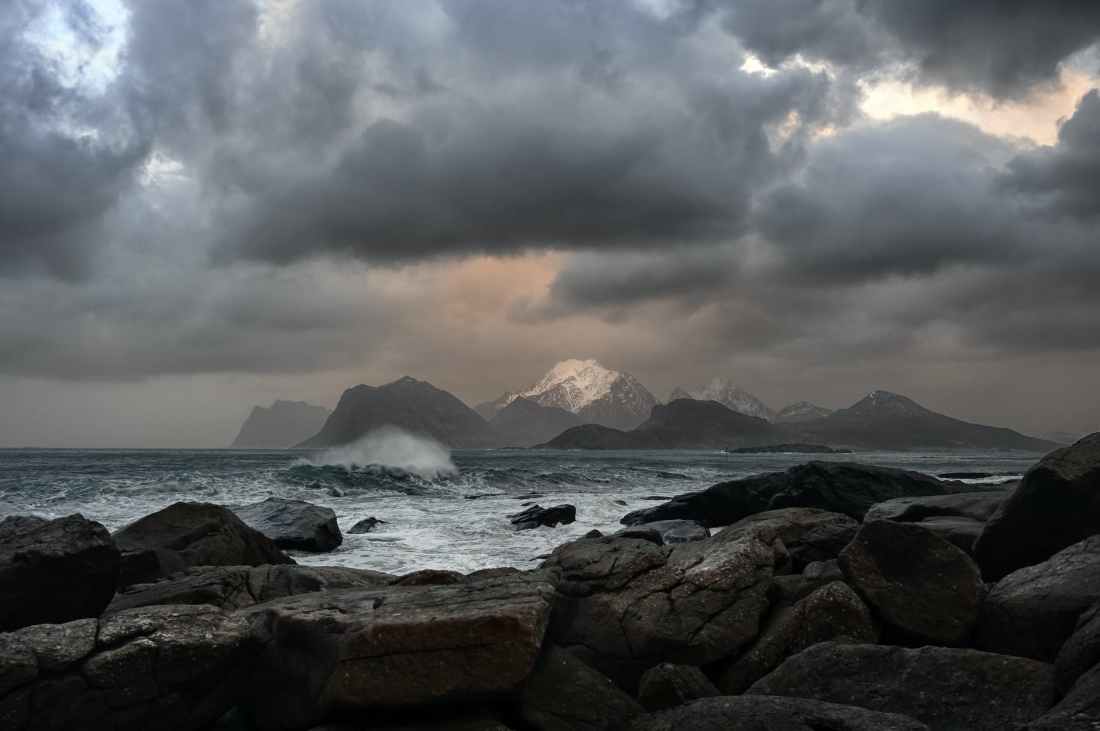
P.S. The featured photo is the Kennebunk River during fog, photo by David Lounsbury, CC BY-SA 2.0, via Wikimedia Commons
The author, known as Suō no Naishi (周防内侍, dates unknown), the “Suō Handmaid”, was so named because her father was governor Suō Province. As mentioned before, this was a common method used by female authors (cf. poem 65), so unfortunately, their real names are rarely known. This is another poem that speaks to the importance of a woman’s reputation in the ancient Court of Japan, just like poem 65. However, this one is much more playful and shows a lot of wit.
According to the back-story, there was a social gathering at the Nijō-In (二条院), the woman’s quarters at the palace. The woman there were relaxing, and the author of this poem said, “I wish I had a pillow”. At that moment, one Fujiwara no Tada’ie happen to walk by, and hearing this stuck his arm through the bamboo screen (御簾, misu) and said, “Here, takes this as your pillow!”.
In reply, the author composed this poem. As Professor Mostow points out, the word for arm here (kaina) is a pun for pointless (kainaku).
People flirted pretty clever back in those days. 😏
The author is Sagami (相模, 998? – 1068?) also known as “Lady Sagami”. Her name is taken from her father who served the governor of Sagami Province at one point, hence this became her sobriquet.
The poem is somewhat typical of the era, a woman is jilted and because of the public scrutiny her reputation is ruined. Because the Court society was so closed and small, rumors and reputation were a big part of the social life there. This is expressed in other poems in the Hyakunin Isshu, such as poem 18 or in the Gossamer Years. A woman who’s reputation was marred by an embarrassing incident, bad fashion choice or an unfaithful spouse would lose her standing in the court, and may not recover. She couldn’t really go pick up and start a new life either.
The motif tear-soaked sleeves was a popular poetic device, and you can find it in other poems in the Hyakunin Isshu, poem 42 for example. Sleeves (袖, sodé) in general are featured in a surprising number of poems from the Hyakunin Isshu:
Sleeves covered in dew from the overnight watch (poem 1)
Sleeves of a Buddhist monk, shielding the world (poem 95)
Further, fashion in this time was somewhat different than the kimono we are familiar with from the medieval Japanese era. The photo above, taken by ロリ (CC BY-SA 3.0, via Wikimedia Commons) is an example of the jū-ni-hitoé (十二単) robes worn by ladies of the court during formal occasions. This multi-layered garment was difficult to put on as it comprised of up to 12 layers of garments. It was also difficult to walk in. And yet the junihitoé is an iconic fashion for the time, and as we can see in the Diary of Lady Murasaki, women of the Court would be heavily scrutinized for their sense of taste during such occasions.
It’s not hard to imagine a broken-hearted woman with tear-soaked sleeves nevertheless, and how it became an important expression of Japanese sentiment at the time.
The poem was composed by Sakyō Daibu Michimasa (左京大夫道雅, 993 – 1054) who title means “Master of the Western Capital Michimasa”. He also known by his personal name as Fujiwara no Michimasa.
Michimasa was the son of Fujiwara no Korechika, and Michimasa’s grandmother wrote poem 54. Despite their power and influence, Michimasa’s family was on the losing side of a struggle with a rival clan faction, led by his great-uncle Fujiwara no Michinaga. Michimasa. According to Mostow, Michimasa spent the remainder of his life in “elegant retirement” after their family lost the power struggle.
According to Mostow, the story behind this poem was a famous affair involving Michimasa and the former High Priestess of the Ise Shrine, Masako Naishinnō (当子内親王, “Princess Masako”). My new book explains that Michimasa was 24 at the time and she was 15, and had just returned to the capitol after fulfilling her duties as the high priestess. More on that below.
This affair is described in the Eiga Monogatari, an important historical source at the time, possibly composed by Akazome Emon (poem 55).
In any case, news of the affair angered her father, the Retired Emperor Sanjo (poem 68) and the retired emperor subsequently assigned bodyguards to her to prevent Michimasa from seeing her again. As you can see, Michimasa is lamenting that he can’t even say a proper goodbye to her in person anymore. Princess Masako eventually took tonsure as a Buddhist nun, and soon after died due to illness. They never met again.
But there is a bit more to the story. Michimasa, like his father Korechika, had a bad reputation that dogged him throughout his life, and kept him shut of out any official posts in the government. With the loss of Masako, and no hope of success in society, Michimasa took a dramatic turn for the worse. My new book explains that Michimasa fell headlong into gambling, and violence, so much so that he earned the nicknames such as Arasanmi (荒三位, “Wild third rank”) and Akusanmi (悪三位, “evil third rank”). The “third rank” was his aristocratic rank in the Imperial court.
Worse still, Michimasa was implicated in the murder of Emperor Kazan’s daughter in 1024 in the dread Jotomon-in Incident (上東門院女房殺害事件, jōtōmon-in nyōbō satsugai jiken). The murderer confessed to killing her on Michimasa’s orders. Yikes.
Michimasa was finally demoted and in his final years took tonsure as a Buddhist monk, and faded from history.
Let’s talk about Princess Masako’s role of High Priestess, though.
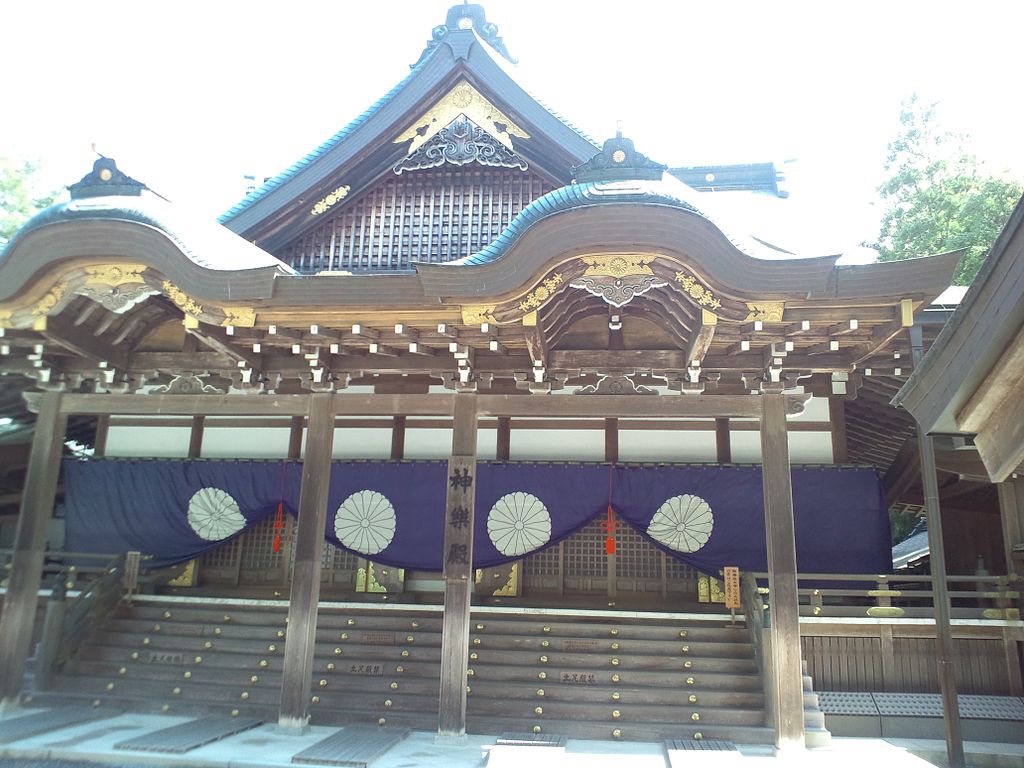
The Ise Grand Shrine is probably one of the most sacred, if not the most sacred, in all of Japanese Shinto religion. The featured photo above shows the inner sanctum (photo by Yanajin33, CC BY-SA 3.0, via Wikimedia Commons).
Due to shrine’s connection with the Imperial Family, who were said to be descended from its primary deity, Amaterasu Omi-no-Kami, the Imperial Family always had one member serving as the High Priestess or saiin (斎院). Usually this was the reigning Emperor’s daughter, and when that Emperor stepped down, she would return to the capitol. This tradition still continues to this day, even with the modern Imperial family. Another example within the Hyakunin Isshu is Shokushi Naishinnō (poem 89).
In those days, the High Priestess was a vestal virgin, similar to the ancient priestesses of Rome, and was supposed to remain so during her tenure. However, as other writings of the time showed, such women still corresponded with men from time to time and kept a social circle of women around them. Lady Murasaki (poem 57) lamented in her diary about the rival social circle around the High Priestess at the time outshining the Court itself.
Nevertheless, the life of High Priestess was very demanding and required strict ritual purity, part of Shinto religion. One could not come into the presence of the gods, particularly at more sacred sites, without it. Thus, Princess Masako’s affair with the dubious Michimasa apparently went too far and Emperor Sanjo’s reaction was quite harsh.
The tragic story of Fujiwara no Michimasa and Princess Masako, encapsulated in this short poem, is a complex and dark tale. Michimasa was in a sense doomed from the start due to his family’s loss of grace and dubious reputation. Princess Masako, being a teen and cloistered in the Imperial family duties probably didn’t know better. Their romance was doomed from the start, but the evil turn by Michimasa only makes the story sadder. What if Michimasa had been able to continue his romance with Masako, or maybe wasn’t shunned by society in his youth? What might the two have become? What if they had simply never met?
The author, Dainagon Kintō (大納言公任, 966 – 1041), better known as Major Counselor Fujiwara no Kintō, was one of the top poets of the Heian Period, and the grandson of Tadahira (poem 26) and father of Sadayori (poem 64).
Kinto was more than just a good poet, he was something of a genius renaissance man for his era. There is a famous anecdote taken from a historical text of the time called the Ō-kagami (大鏡, “great mirror”). In this anecdote his kinsman, the statesman Fujiwara no Michinaga, had three boats docked for a party, and invited the literati of the time to board one of three boats: one for Japanese poetry (waka, 和歌), one for Chinese poetry (kanshi, 漢詩), and one for wind and string music (kangen, 管弦) according to their skill. Michinaga then realized that Kinto was so multi-talented he could board any of the three boats so he let Kinto decide. Thus, Kinto earned the nickname Sanshū-no-sai (三船の才, “three boat genius”).
As a side note, when he considered the “waka” boat, he recited the following verses:
My own translation, apologies for any mistakes or clumsy translations
This was recorded in the aforementioned Ō-kagami as an example of his cleverness.
Among other accomplishments, Kintō was a respected critic who compiled the Thirty Six Immortals of Poetry list. Kinto compiled imperialanthologies that still represent Japanese Waka poetry of that era. In short, Kinto was the ultimate cultural authority of his time. He is also credited by Lady Murasaki (poem 57, め) or “Lady Purple” for giving her that nickname according to her diary. This was a playful allusion to her Tales of Genji that was circulating at the time and a major nod by Kinto.
Finally, Kinto also served in the Imperial court under the aforementioned Michinaga, and proved to be an able administrator. While he mostly stayed out of the power struggle at the time, he benefitted nonetheless.
But I digress.
According to Mostow, the poem itself was composed after a number of people visited a famous Buddhist temple called Daikakuji, which is in the western part of the capitol of Kyoto. Interestingly, Mostow also points out that this poem is found nowhere else despite the fact that Kinto was a famous poet and had an extensive collection for Fujiwara no Teika to draw from. One suggestion is that Daikakuji is in the same area as Mount Ogura, which is where Teika’s villa resided. The full name of the Hyakunin Isshu anthology is actually the Ogura Hyakunin Isshu by the way.
In any case, this poem is pretty interesting because of the sense of change over time. The waterfall that existed long ago still exists, but in name only. In the same way, life as we know it know will become a dim memory or a misplaced name for future generations. Although Japanese culture has been influenced by Buddhism and its notion of transience since early history, I think this is a point that anyone, anywhere can appreciate.
Also, Kinto’s ability to express this sense of change and impermanence to life seems to me to demonstrate his poetic talent all too well. 🙂







 The Hyakunin Isshu


