While re-reading the Pillow Book lately, one of the people in Sei Shonagon’s anecdotes recites a poem from an Imperial anthology: the Kokin Wakashu (Kokinshu for short).1 When I looked up the poem, it really struck me when I read it. Since I have an English translation of the Kokin Wakashu, and since many of the poems from the Hyakunin Isshu were originally published in the Kokin Wakashu, I figured it would be fun to post other poems from the same anthology.
This poem, poem number 52 of the Kokin Wakashu, reads as follows:
Japanese
Romanization
Translation
年ふれば
Toshi fureba
As the years stream by
よはひは老いぬ
Yowai wa oinu
my own life passes from me
しかはあれど
Shika wa aredo
still I am renewed
花をし見れば
Hana oshi mireba
when I but see the blossoms
物思もなし
Mono omoi mo nashi
my heart’s sorrows disappear
Translation by Laurel Rasplica Rodd and Mary Catherine Henkenius
The headline of this poem reads “seeing cherry blossoms in a vase before the Somedono Consort [Empress]“.2
The author of the poem, Fujiwara no Yoshifusa (藤原良房, 804 – 872), was the first member of the Fujiwara clan to assume the post of Regent to the emperor. This was at a time when the Fujiwara were a rising star in the Imperial court, had married into the Imperial family, and Yoshifusa was the grandfather of the young Emperor Seiwa. So, he had much to celebrate. However, even the powerful grow old and die, and Yoshifusa was no exception.
What I really like about this poem is that in spite of his own fears of growing old, he still can enjoy life here and now and feel young again.
I am at the age where I can definitely start to feel my age, and the years ahead of me are likely fewer than the years behind me, and yet I am rarely bothered by it. I often find moments of joy in life, playing with my kids, enjoying nerdy fandom, and savoring poetry like this, so I know how Yoshifusa feels.
1 Nowadays, people quote movies, TV shows and such. I can quote more gags from The Simpsons than I care to admit. Back then, people quoted poetry from earlier generations.
2 Many poems in the Kokin Wakashu included a headline to explain the scene of the poem, or provide some background. These were not carried over when the poems were collected in the Hyakunin Isshu since they were already well-known poems, or possibly just for the sake of brevity.
You may have noticed the blog looks a bit different now. I have been struggling since the big blog refresh I started in December 2022 to get the appearance just right. Design isn’t my forte (I am a history nerd), so I’ve struggled with finding the right design for this blog. The original blog template on WordPress was so old (this blog was started in 2011) that it was no longer supported by WordPress, so I had to find something else that works. After dabbling with a few designs this past year, I’ve settled on current blog template as of last week and I am pretty happy with it. I hope you all like the new design. I liked it so much I applied the same template to the other blog.
Next news: I will be off to Japan again this summer … though only briefly. The family and I will visit the ancient capitol of Kyoto, just like last year,1 but the visit overall is much more limited and I probably won’t get to see many things related to this blog. I won’t have time to visit Oishi Tengudo again, or Kitano Tenmangu Shrine, but I do however plan to make a stop at Kurumazaki Shrine (mentioned here) to pick up one of those Sei Shonagon (poem 62, yo wo komete) charms. I may try to work in a few other tourist spots related to the Lady Murasaki drama given that it’s popular right now. I also expect to melt under 35C(95F)-degree weather with 75% humidity again like last year.2
I have a few more posts coming up between now and the trip (late July), and I hope you will find them interesting.
Finally, just as a fun bonus, I wanted to share a one-off poem by Lady Izumi (poem 56, arazan) that I recently heard on a different Japanese historical drama. Lady Izumi is one of my personal favorite figures in the Hyakunin Isshu, and this poem was first recorded in an Imperial anthology, the Goshūi Wakashū (後拾遺和歌集), poem 755:
It’s not clear from this poem which lover she is referring to, since she had a number of relationships over the years, nonetheless it is a very sincere, romantic poem and expresses her passionate style nicely.
Happy Summer!
P.S. speaking of history nerd, I’ve debated about making a Japan / history podcast (like many other fine podcasts I follow), but have struggled to find a good theme. I might simply do the “history of the hyakunin isshu” podcast someday. It’s a bit commitment though, so we shall see.
1 While we do visit Japan yearly so my kids can spend the summer with their grandparents and extended family, visits to Kyoto are rare because of cost, time, and so on. Our last visit was almost 15 years ago. It just so happens that we could make two trips in two years. After that, who knows when we will visit next?
2 Without going into too many details, the humidity, heat and fluid loss aggravated an old medical issue I have. A reminder to stay hydrated, and avoid junk food. I like getting older in many ways, except at times like this. 😋
One of most iconic places in the world of Karuta is a placed called Omi Shrine, also called Omi Jingu (近江神宮, おうみじんぐう) in Japanese. It is here that the big championship events are often held, and it is a big part of season one of the anime series Chihayafuru. Not to sound like a cliché, but it is a kind of mecca for the Karuta world and the Hyakunin Isshu.
A scene from Chihayafuru as Chihaya approaches the Rōmon gate.
What is Omi Shrine though?
You see, Japan has essentially two religions that co-exist: the native Shinto religion and imported Buddhist one. We don’t need to go into detail about how they differ; I have an entire blog on the subject. Suffice to say, they differ. Even the place names are different. Buddhist temples are called otera or end with -ji. Shinto shrines are called jinja, jingu or taisha.
Anyhow, Omi is a Shinto shrine located in the city of Ōtsu, in Shiga Prefecture. This area was once the province of Omi, hence the name. The shrine’s constructed began in 1937 and finished by 1940. It is a young shrine, but has a deep connection to the past.
Like all Shinto shrines, Omi Shrine venerates a kami, a divine figure. A kami can be a god (think ancient Greek gods) from Japanese mythology, a local spirit, or even a historical figure. Some shrines venerate more than one kami.
Omi Shrine venerates none other than Emperor Tenji, who wrote poem one of the Hyakunin Isshu (あきの). During his reign, the capitol of Japan was moved to Otsu city and there he reigned until his death. Here, he carried out many essential reforms that provided the foundation for Japanese society for centuries. Because Tenji also wrote the opening poem of the Hyakunin Isshu, the shrine became quickly associated with the anthology and with Karuta.
The shrine website even has a handy catalog of the Hyakunin Isshu poems, not unlike mine. 😉
The English website is pretty limited, but the Japanese site has a lot of great information about the shrine, Karuta and so on.
The shrine is a bit removed from the usual touristy areas, so you might not be able to get there. However if you do go, it’s good etiquette to pay respects to the kami there. Per Shinto tradition (explained here) the process is:
Bow deeply at the waist twice.
In reverence, clap twice.
Bow once more.
You can also use the water font nearby to wash your hands a bit (just watch how other Japanese do it) and your face a bit before facing the kami.
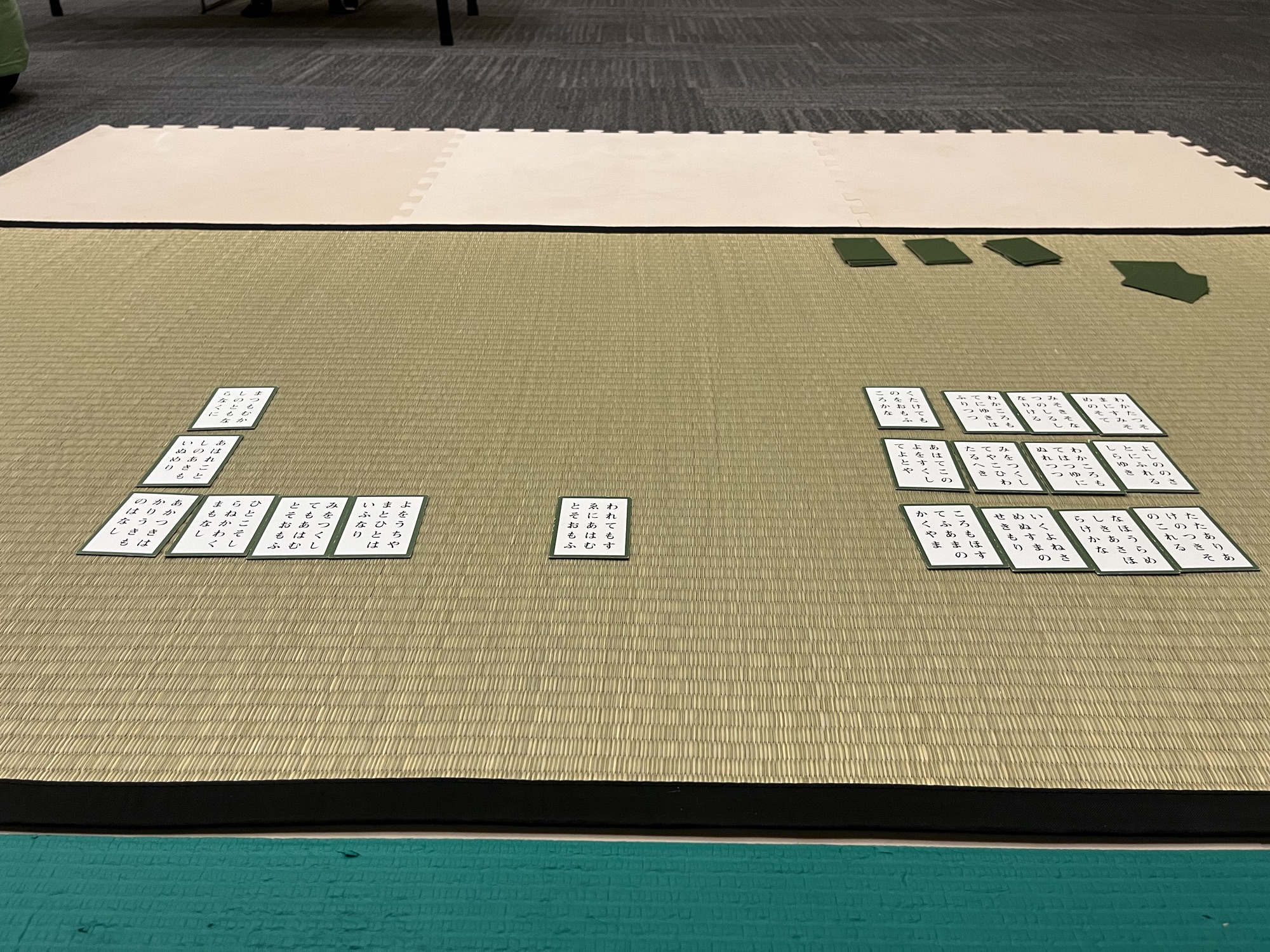
One of the first challenges when you start a game of karuta is to figure out where to put your cards. You’ve been dealt 25 torifuda cards out of 100 total (or 8 if you’re playing online) and they need to be arranged somehow in 3 rows (2 online) such that you can remember where they are, and hopefully make it harder for your opponent to take your cards.
An arrangement of cards, might look something like the picture above: 3 horizontal rows, 1cm between them, and cards arranged across these three rows usually clumped into corners.
Sounds easy … right?
Nope.
The concept of card position or tei-ichi (定位置) has plenty of strategy, and also plenty of personal habits. The first time I ever played, I didn’t know any of this and so my tei-ichi made no sense. I called it the “chaos strategy” as a joke:
It wasn’t even using the correct arrangement or spacing, but I lost 25-0 so I guess it didn’t matter. In time, my arrangement got somewhat better:
In any case, along as you adhere to the basic dimensions of the game layout, you can arrange your cards anyway you like. But also keep in mind that you have constantly remember the current board state (i.e. where every card is) because they often move around as the game progresses. This takes considerable concentration and good mastery of the kimari-ji.
During the start of the match, a lot of people, myself included, like to place their favorite cards in certain areas, or arrange them in a certain way to help relieve the pressure of memorizing so many card positions. I am told by much better players that if you play an opponent enough times you’ll start to figure out where they usually put their cards and can anticipate this (making it easier to remember board state). I have yet to reach this state.
If you watch the anime Chihayafuru1 you may recall that the chubby kid Nishida2 explains some basic tips for good tei-ichi:
Keep the one-syllable kimari-ji cards on the row closest to you. SInce they are taken very quickly, that little extra bit of distance may help you.
Keep the tomofuda (友札) cards, the ones with similar kimari-ji, separate from each other. We’ll get to that in a moment.
These are merely suggestions though. Some players seem to prefer to a more offensive style of play, where they focus more on getting their opponent’s cards and less on their own card arrangement. Other players prefer a more defensive style where they focus on taking their own cards first, and making it as difficult for the opponent as possible.
A very common strategy I see for new and veteran players is to keep your tomofuda together (despite Nishida saying not to). For example, if I have the two cards starting with kono (poem 24) and konu (poem 97) as their kimari-ji, I might go ahead and keep them together. That way, I know where all my “ko” cards are. If I also have koi, then I might put all 3 together.
On the one hand, it’s easier for me to remember. On the other hand, your opponent will likely notice this too, and it makes their job easier.
You can also do as Nishida suggests and intentionally keep them separate. More work for you, but also more work for them.
Notice too that people often keep their cards towards the left and right edges. As with the single-syllable kimari-ji, that extra bit of distance makes it harder for your opponent to reach over and take the card before you do. In close games every bit counts.3
By the way, it is possible, within certain rules and customs, to rearrange cards into new positions during the match. People often do this in the late game when they have only 3-4 cards left and just want to clump them into a single spot, but this is a personal choice. I am told that moving your cards too often is frowned upon. However, if a card in between others was taken, it’s quite alright to shuffle the remaining cards on the row to the edges to take its place (keeping everything neat and tidy).
Since I am kind of a lousy player, I am not adverse to sharing my strategy here, but keep in mind that it is neither expert strategy, nor is it static. It changes and evolves as I gain more experience.
Because of my experience with Japanese language, I like to arrange mine based on columns of the hiragana syllabary, not so much tomofuda:
For example, if I have cards that start with “a” or “i” kimari-ji, for example, I’ll lump them together since they’re in the same column of the hiragana chart. I often group “yo”, “ya” and “yu” together similarly. Of course, I often have tomofuda among them, but that’s not always the case. I have areas where I almost always lump the “a”-row cards, the “ya”, “wa”, and “mi” cards, the “o” cards and so on. It can vary quite a bit depending on which cards I get at the start of the game, but I’ve definitely evolved some habits, for better or worse.
If I have too many cards like this, then I might break them up into two groups so they don’t clump too much. If I get seven “a”-row cards, it’s a bit silly to keep “all my eggs in one basket”.
I do follow Nishida’s advice and keep my one-syllable cards in the corners, but that’s almost a universal strategy, I’ve noticed. Even if you’re reflexes aren’t great, that extra little bit of distance away from your opponent can help.
Further, sometimes, if there’s a card that I am pretty comfortable with, such as the ooe card (poem 60), wasura (Poem 38), or shira (poem 37), I like to isolate it in the middle of the back row. It’s very easy for me to grab, and its unique position is easy for me to remember. Sometimes I do that with the iconic chiha card (poem 17) as well, though it rarely works for me. Of course, this strategy sometimes backfires too.
Thus far, we’ve talked a lot about starting positions. Let’s talk about things moving around.
As cards move around either due to penalties, or because a card from the opponent’s side was taken, things will move around. This can make things hard to remember when you’ve barely got a grasp on where the cards were previously, and that can lead to penalties. One advice I found in Japanese was to send cards to your opponent that have lots of impact (i.e. easy to remember), so you have an easier time remembering the new board state. You can also send tomofuda cards to your opponent so that they are forced to keep them together, or keep them separate. You can also break up your own tomofuda this way.
In any case, as gameplay continues, I try to scan and rescan the board state over and over again to refresh the current card positions. I even close my eyes and try to remember the board state in my mind without any visual distractions. I found closing my eyes to be especially helpful. I think in Chihayafuru, the kids even played a game where the cards were face-down, so the entire game was done from memory. I haven’t tried this yet, but might try it with a smaller set of cards someday.
Based on limited experience, I have noticed that if I stay focused and keep re-scanning the board state over and over, while paying close attention to what the reader is reciting, I tend to play better. When I lose focus, everything goes off the rails.
So, initial card position is something important to consider, but even more important is updating that “mental map”, and of course good listening skills.
Good luck!
P.S. This is pretty amateur advice, so take this with a grain of salt.
1 To be honest, I never finished season one of Chihayafuru. I watch plenty of Japanese TV, but I just don’t watch anime very much. I don’t really watch Ghibli movies either. However, in a feat of hypocrisy, I loveFire Emblem: Three Houses.
2 I forget his English nickname, but his Japanese nickname is Nikuman-kun where nikuman are just the Japanese version of Chinese hum-bao. Anyhow, you probably know the guy, right? Right? 😅
3 If you’re playing against me though, you’re probably going to win. I think my win rate is about 2-3% thus far.
Since I spent so much time gushing over First Summer Uika and her portrayal of Sei Shonagon in the Japanese drama Hikaru Kimi É (“Addressed To You, My Radiant One”), this seemed like a good time to talk about the Pillow Book, or Makura no Sōshi (枕草子).
Despite the name “Pillow Book”, the book has no erotic content. Instead, it is a collection of witty musings about life in the Heian Period aristocracy, early 11th century. The image is of a person lying on their pillow, composing thoughts in a diary.
The author, Sei Shonagan (poem 62), was one of the pre-eminent writers of her generation, in a field of many excellenttalentedwomen.
I had read the book many years ago, and I felt it was a bit dry at times since it has no narrative. But back then, I also had a much more limited understanding of Heian Period culture, and many of the things mentioned in the Pillow Book are also alluded to in the Hyakunin Isshu, as well as the Diary of Lady Murasaki. So, even if the format is different, all three collections draw from the same “cultural well”.
I thought I had lost my copy of the Pillow Book (the Penguin Classics version, translated by Dr Meredith McKinney) a long time ago, but was amazed to discover that it was just buried behind other books. So, I dusted off the book and have been reading through it again.
Sei Shonagon is a keen observer of life in the Heian Period, and makes lists for all kinds of obscure things:
[23] Occasions that induce half-heartedness — The religious services on days of Buddhist fasting. Preparations for something still far in the future. Long periods of seclusion at a temple.
Or she adds things to lists that were probably drawn from personal experience:
[132] Occasions when time drags by — An abstinence that you must observe away from home. A game of sugoroku when you can’t manage to get your pieces off the board. The house of someone who’s failed to get a promotion in the Appointments List. And of course the worst of all is simply a day of heavy rain.
It’s also clear that Sei Shonagon had a pretty haughty attitude, especially when compared to Lady Murasaki’s (poem 57) withdrawn, melancholy tone or Lady Izumi’s (poem 56) whimsical passion. As they say in modern Japanese: seikaku ga deru (性格が出る, “people’s personalities come out”). In one anecdote, section 94, she grumbles about encountering “worthless peasants”. I wouldn’t be surprised if she was the only one among the nobility at the time who held such views, but it is nonetheless painful to read.
One thing I do particularly enjoy about the Pillow Book though are the anecdotes. While many of the entries are just lists and her opinions, she often reminisces about funny, sad or strange occurrences she witnessed during her 10-year tenure serving the ill-fated Empress Teishi. Some of these anecdotes and observations are quite long, while others are brief. Some happened long ago, and Sei Shonagon’s memory is a bit fuzzy, others are more recent.
For example in one anecdote, number 79, she talks about how her relationship with one Officer of the Left Gate Watch named Norimitsu had soured after an incident where he covered for her. She had gone somewhere and only Norimitsu knew her whereabouts, but the Captain Consultant demanded to know where she had gone and Norimitsu tried to keep his mouth shut. Later when Norimitsu complained, she sent a piece of dried seaweed in reply, and Norimitsu got annoyed. She criticized his lack of sense, and he was frustrated at her for putting him in such a difficult position. Later she muses that they grew more and more distant after that incident until “later, Norimitsu was promoted to Deputy Governor of Tōtōmi Province, and the relationship ended in hostility.”
Sei Shonagon discusses many people of the Court, including other ladies in waiting, but does not mention Lady Murasaki and other famous women of the Hyakunin Isshu. Such women served under the second empress, Shoshi, and thus came a bit later anyway. By the time Emperor Ichijo married a second time, Teishi’s status had greatly declined and her retinue (including Sei Shonagon) were on their way out the door. Teishi herself soon died in childbirth.
The Pillow Book is a really nice “slice of life” look at the court culture of the time: sometimes amusing, sometimes exquisite, and sometimes depressing. Her wit really shows through the ages and even today kids in Japan (and people outside Japan) still read her book.
P.S. Featured photo is a drawing of Sei Shonagon from a 13th-century illustrated copy of the Pillow Book. Courtesy of Wikimedia Commons.
I started playing Karuta last August with the Seattle Karuta Club, and from time to time I play the computer on the Karuta online app. There’s been a lot of ups and downs in my life, but I’ve tried to stay focused and practice when time allows.
However until today I was never able to beat the hard mode on the Karuta app. At first, I played the easy or solo modes for a long time, afraid to get demolished. I eventually moved up to medium difficulty for a time and got used to it.
But every time I play hard mode, I get destroyed. I get nervous, get penalties, and lose track of where cards are because I am thinking too much about losing.
Finally, I won a match. I made a single penalty (oku vs. ogu) and yet otherwise everything else went surprisingly smooth for me. I even got three of the one-character kimarji cards (se, fu and mu) which I usually struggle with.
It was weird.
For once, I was relaxed and focused on where each card was. My mind was clear. Everything just clicked. In spite of the penalty, I played solid Karuta and won.
In other recent, exciting news, I found this article on the Asahi Shimbun newspaper: the discovery of some of Fujiwara no Teika’s personal notes. This is called the kenchū mikkan (顕注密勘).
Long before Fujiwara no Teika (poem 97) compiled the Hyakunin Isshu, he served as a minister under Emperor Gotoba (poem 99). Among his duties, Teika was commissioned in 1201 to compile a new Imperial poetry anthology, which later became the Shin Kokin Wakashu (新古今和歌集).
Here you can see some of his notes and thought process as he’s compiling the poems together. It’s a fascinating discovery.
You can click here to see more detailed photos of his notes. They are read from right to left, vertically not horizontally.
You can also see another example of his handwriting here, courtesy of Wikipedia, from diary:
Teika himself had a pretty rocky career and after his liege lord was exiled, Teika spent the rest of his days living as a Buddhist monk. Nonetheless, his legacy lives on.
I have been away for a while due to variouslifecircumstances, but I’ve been wanting to share this news with readers.
The Japanese public TV station, NHK, broadcasts a new Taiga Drama (大河ドラマ) every year. These are big productions featuring some aspect of Japanese history, with big name actors and so on. I was very fond of the last one. Usually these cover periods of warfare or conflict, and male historical figures from Japan’s long history, but this year’s drama, titled Hikaru Kimi E (ひかる君へ, “Addressed to You [my dear Radiant One]”), features Lady Murasaki as the main character!
(Image by NHK, all rights reserved)
Lady Murasaki, poem 57 of the Hyakunin Isshu, needs little introduction. She composed the Tales of Genji, as well as her eponymous diary. She was the first female novelist in Japanese history, and has been a subject of interest ever since. The biographical details of her life are somewhat scant, unfortunately, and the drama does embellish quite a bit, including hinting strongly at a romance that probably didn’t happen in real life. My impression is that they are using romantic themes from her novel, the Tales of Genji, as the backdrop for the drama.
Nonetheless, I have been watching this series on Japanese TV1 and I enjoy it. It is somewhat different than past Taiga Drama, since it features a female main character, and this period of history (the late Heian Period), had little warfare, but it does have tons of scandal and intrigue as the Fujiwara clan tighten their grip on the reins of government. This drama is surprisingly risqué in parts, something you usually don’t see in a conservative Japanese drama. However, such scenes remind me more a more subdued Victorian romance than something in modern, American television.
That said, it’s a darn good drama thus far.
The drama frequently shows other people of the Heian period aristrocracy, many of whom were poets of the Hyakunin Isshu. To name a few who have been featured in the drama:
I admit I am particularly fond of the character Sei Shonagon. In historical pop culture, Sei Shonagon and Lady Murasaki are treated as rivals as they were both famous writers of the same generation who belong to rival cliques in the aristocracy, but in reality they probably didn’t interact much. Nonetheless, they frequently talk in the drama, and the actress who plays Sei Shonagon, stage name is “First Summer Uika” (ファーストサマーウイカ), is a talented actress and total babe:
First Summer Uika also recently visited a Shinto shrine devoted to Sei Shonagon in Kyoto called Kurumazaki Jinja (車折神社), which even sells Sei Shonagon charms (omamori):2
Because the drama features so many people related to the Hyakunin Isshu, the drama subtly works in many poems from the anthology. It’s been great to suddenly recognize a poem being recited, even if I am a bit slow to recall. The settings, costumes, and cast are all amazing, and even though the historicity is questionable, it’s been a great watch.
I really hope they eventually make an English subtitle version so people outside Japan can watch. The quality of Taiga Dramas are terrific, and they are well worth watching if you can.
Update: while visitingKyoto in 2024, we found a local NHK display of the drama:
The second photo above is First Summer Uika as Sei Shonagon.
1 Sadly there are not foreign translations, and no subtitles, and it is not always modern Japanese, so I admit I struggle at times to follow the story. At other times, I can follow easily enough.
2 We are going to visit Japan again this year (the last for our teenage daughter), including Kyoto. Visiting this shrine is definitely on the itinerary, even thought it’s pretty small.
As spring approaches, people eagerly anticipate when cherry blossoms (sakura in Japanese, 桜), but as I have learned recently in my book, the Hyakunin Isshu Daijiten, there are many types of sakura, some of them even referenced in the Hyakunin Isshu. Let’s explore a few and learn how to spot one versus another.
If you’re curious about how to even spot a cherry tree, my alma mater has a nice video introduction from the Pandemic era on spotting various trees in your own neighborhood:
A Brief History Lesson of Cherry Blossoms
Cherry blossoms have been a part of Japanese culture for a very long time, but were not always revered as they are now. In antiquity, the plum blossom, imported from China, were more highly revered as one can see in the Manyoshu, but over the centuries the roles reversed. The tradition of outings to view cherry blossoms is credited to Empress Jitō (poem 2). Nowadays, this tradition continues as ohanami (お花見), and can be a fun outing with friends and family or co-workers. In places like Ueno Park in Tokyo, the grounds are crowded with picnic blankets, visitors, and plenty of food and saké to go around.
The most famous, most iconic poem about cherry blossoms was composed by Ariwara no Narihara (who also wrote poem 17):
Japanese
Romanization
Translation
世の中に
Yo no naka ni
If in all the world
絶えて桜の
Taete sakura no
there were of cherry blossoms
なかりせば
Kanariseba
no trace anywhere
春の心は
Haru no kokoro wa
ah, how truly peaceful then
のどけからまし
Nodokekaramashi
spring would be for everyone!
Translation by Dr Josha Mostow and Dr Royall Tyler from the Ise Stories, the poem is also number 53 in the Kokin Wakashū.
Varieties of Cherry Blossoms
Big thanks to this site for providing additional references. I also relied on some details from the Hyakunin Isshu Daijiten book I’ve used for the blog.
Yoshino Cherry
The most common, most well-known type are the Somei Yoshino (ソメイヨシノ) or “Yoshino Cherry” in English:
(Photo by Tak1701d, Public domain, via Wikimedia Commons)
This is a relatively recent variety that was bred for gardening, then gained popularity abroad. It is named after the famous village of Yoshino. For many, this is the classic “cherry blossom” and the one you’re most likely to see outside of Japan.
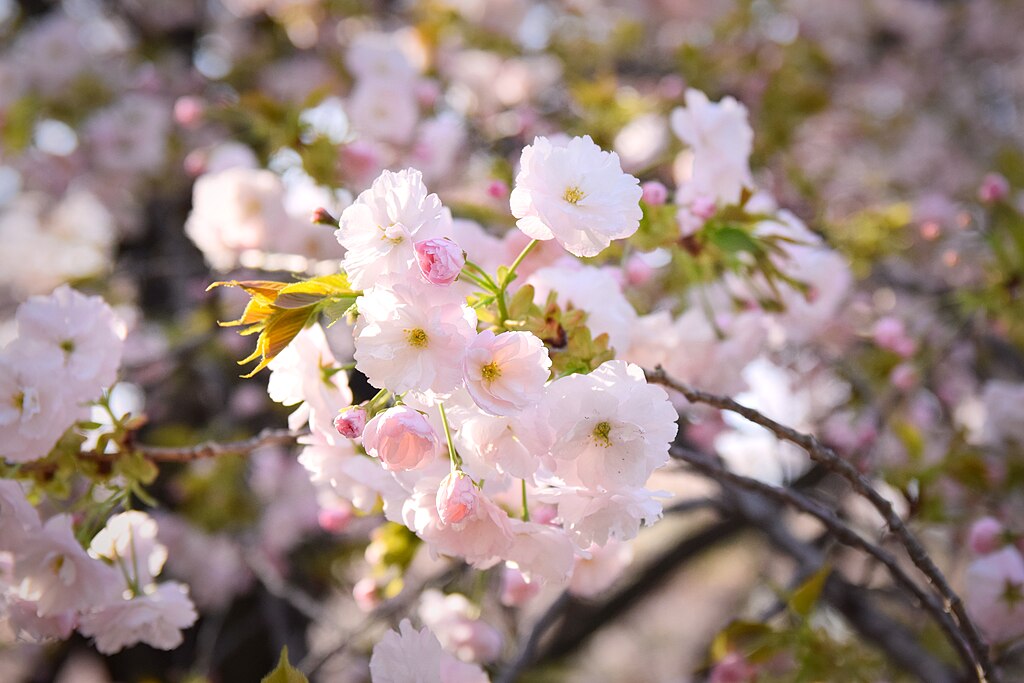
The term yae (八重) means something like “eight layers” or “eight levels”, which helps describe it’s thicker, multi-layered blossoms. It is also the subject of poem 61.
To be honest, yae-zakura are my personal favorite.
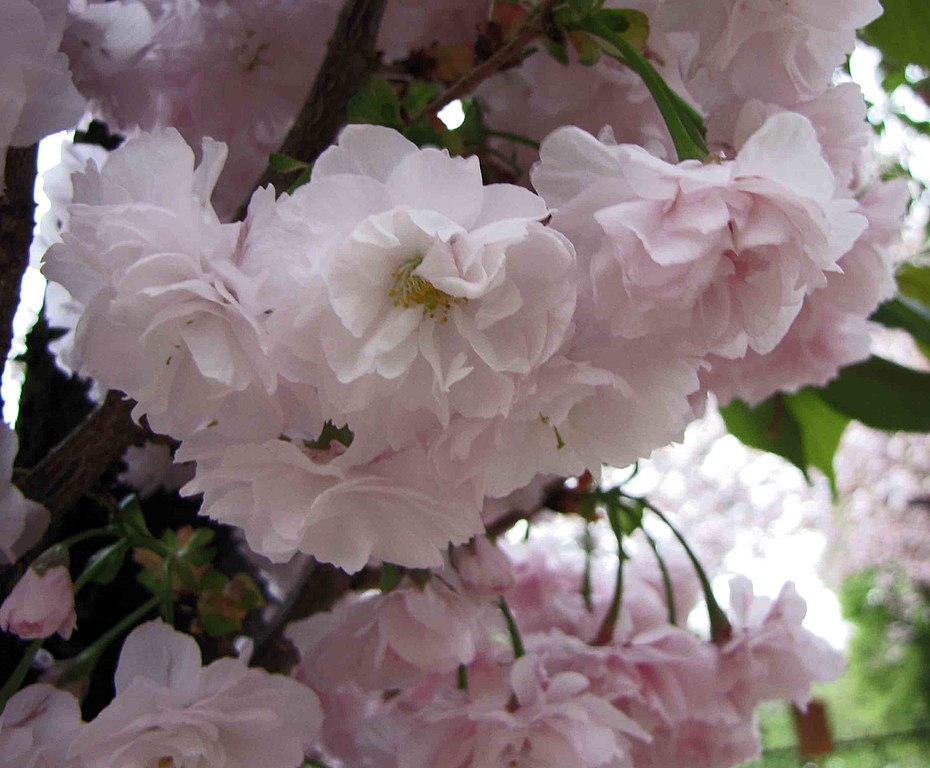
Kanzan Cherry
A popular variety that I only learned about recently is a hybrid variety called the kanzan (カンザン, sometimes archaically spelled Kwanzan). I didn’t find this one online at first, but was able to take a photo during a recent visit to the University of Washington.
This variety was, similar to the Yoshino, a relatively recent variety, and a result of hybrid breeding with Ōshima cherry. What makes this one interesting is the both the rich pink color, and the multiple layers of blossoms (similar to the Kasumi cherry below).
Fugenzo Cherry
Taken at the University of Washington in 2026
Another variety descended from the Ōshima cherry is called the fugenzo (フゲンゾウ, “Fugen’s elephant”) variety, sometimes called the shirofugen (シロフゲン, “white Fugen”) variety. The name is derived from the pistil of the flower resembling the shape of an elephant’s trunk, and since a revered bodhisattva named Fugen rides a sacred white elephant, that’s how it got its name.
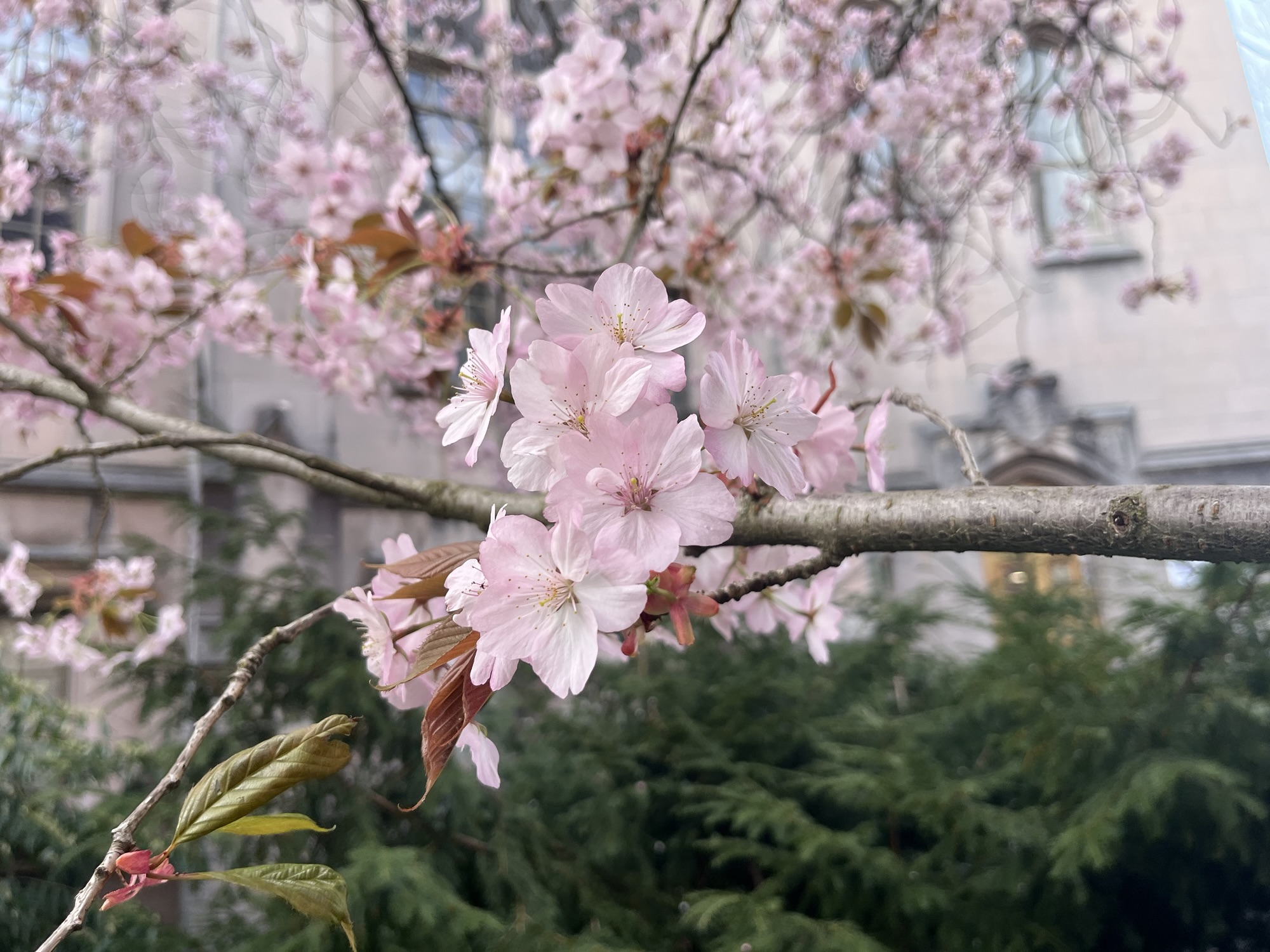
Mountain Cherry
Another example of cherry blossoms, that’s lesser-known in the West are the wild cherry trees, or yama-zakura (ヤマザクラ) also known as the “Mountain Cherry”:
If you compare the Yama-zakura to the classic Yoshino Cherry, you can see the color is a little more faded, kind of whitish in comparison. I think I have also read somewhere that the leaves and blossoms of a mountain cherry sprout at the same time, compared to a Yoshino Cherry where the blossoms comes first.
In antiquity, when the nobility of the capitol would go on a cherry blossom viewing, these are the trees they would most likely go to see. They are the subject of poem 66 as well.
Shidaré-zakura Cherry
Another iconic variety of cherry blossoms are the shidaré-zakura (シダレザクラ), or Hanging Cherry:
You often see these grown in very scenic places, as well as on the grounds of Buddhist temples or Shinto shrines. The way the hanging branches sway in the wind is a sight to behold.
Kasumi-Zakura
One interesting variety that I was unaware of, until researching for this blog was the kasumi-zakura (カスミザクラ):
The word kasumi is a poetic term for haze or mist, especially a spring mist. You can see how the blossoms hang down somewhat, and are particularly large compared to other cherry blossoms varieties. They also seem to have a two-tone quality, where the edges are deeper color than the middle.
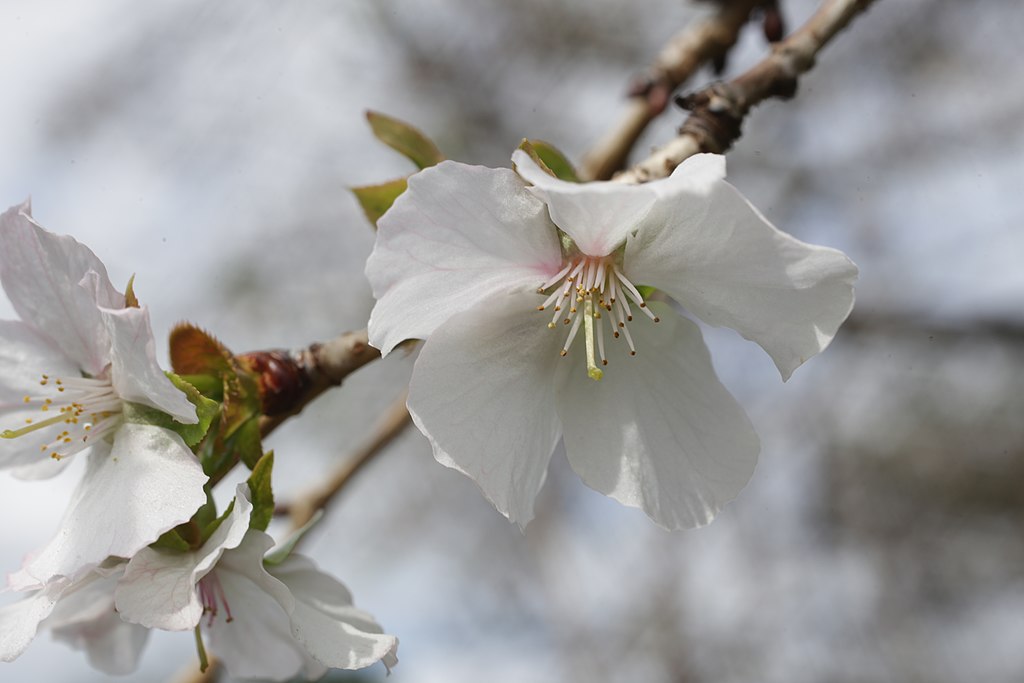
Fuyu-Zakura
Another example I wanted to share is an unusual variety that blooms in spring, and in winter, called the fuyu-zakura (フユザクラ):
This cherry variety, also known as a gobazakura (コバザクラ) has white blossoms and blooms both in April, and also in December.
Kanhi-zakura
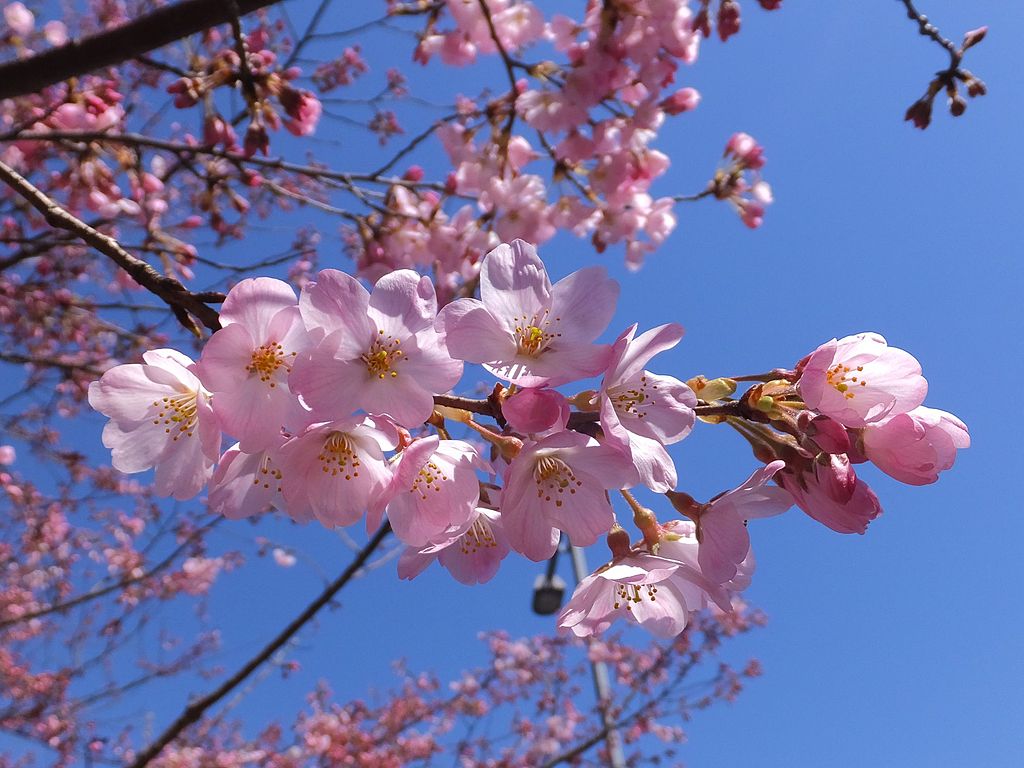
Taken by me at University of Washington in April 2025
While visiting the University of Washington in 2025, I found another variety I hadn’t noticed before. This variety is listed on UW maps as “Hisakura”, but in digging around in Japanese I found that a more common name is Kanhi-zakura (カンヒザクラ), also called Taiwan-zakura (タイワンザクラ) after the island of Taiwan. The name Hizakura (ヒザクラ) is also used. As the name implies (and according to Wikipedia), this variety is found all over East Asia, including Taiwan, and blooms somewhat early. Based on my visit to the UW I can confirm this as an amateur cherry blossom nerd.
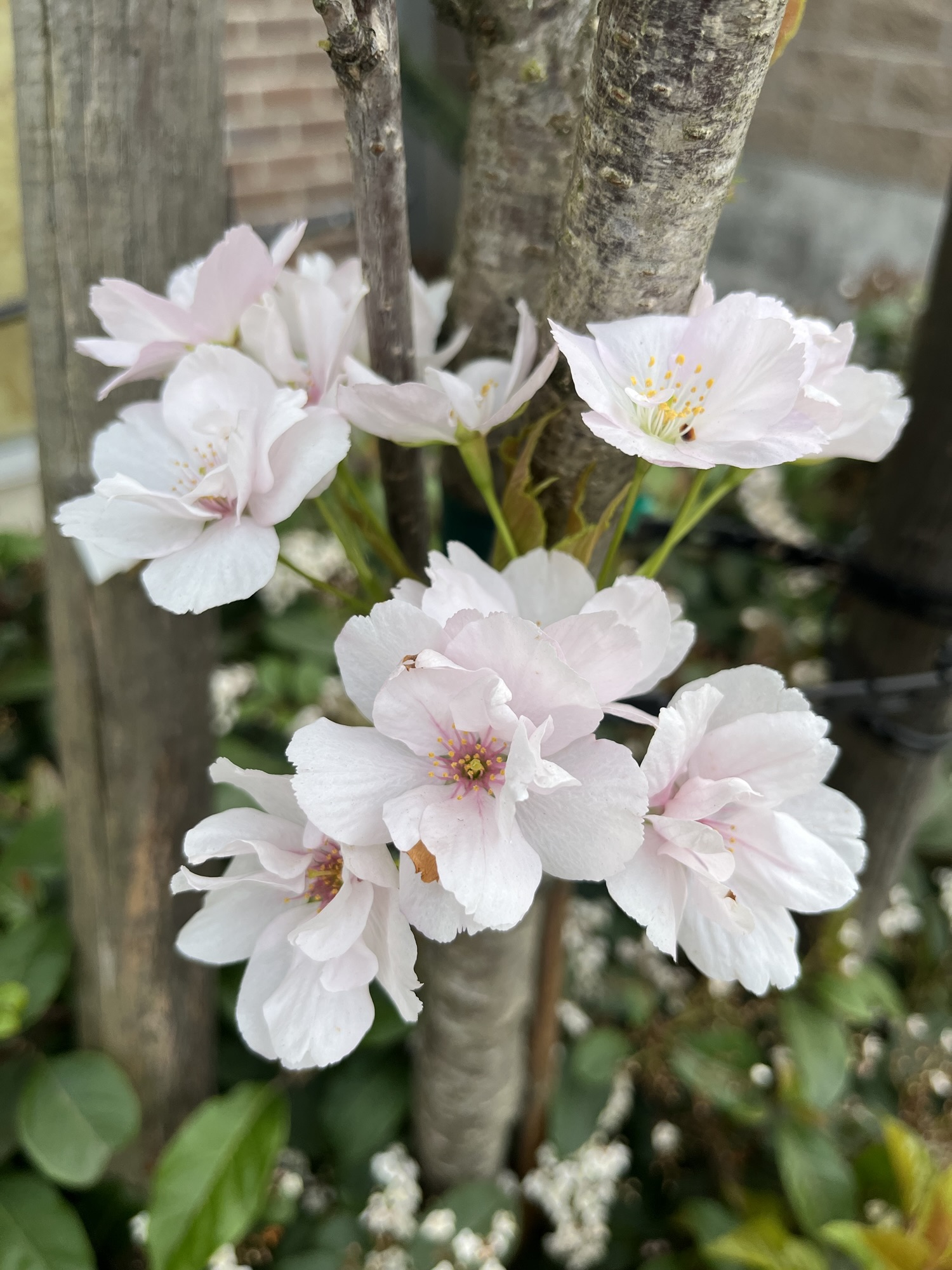
Amanogawa Cherry
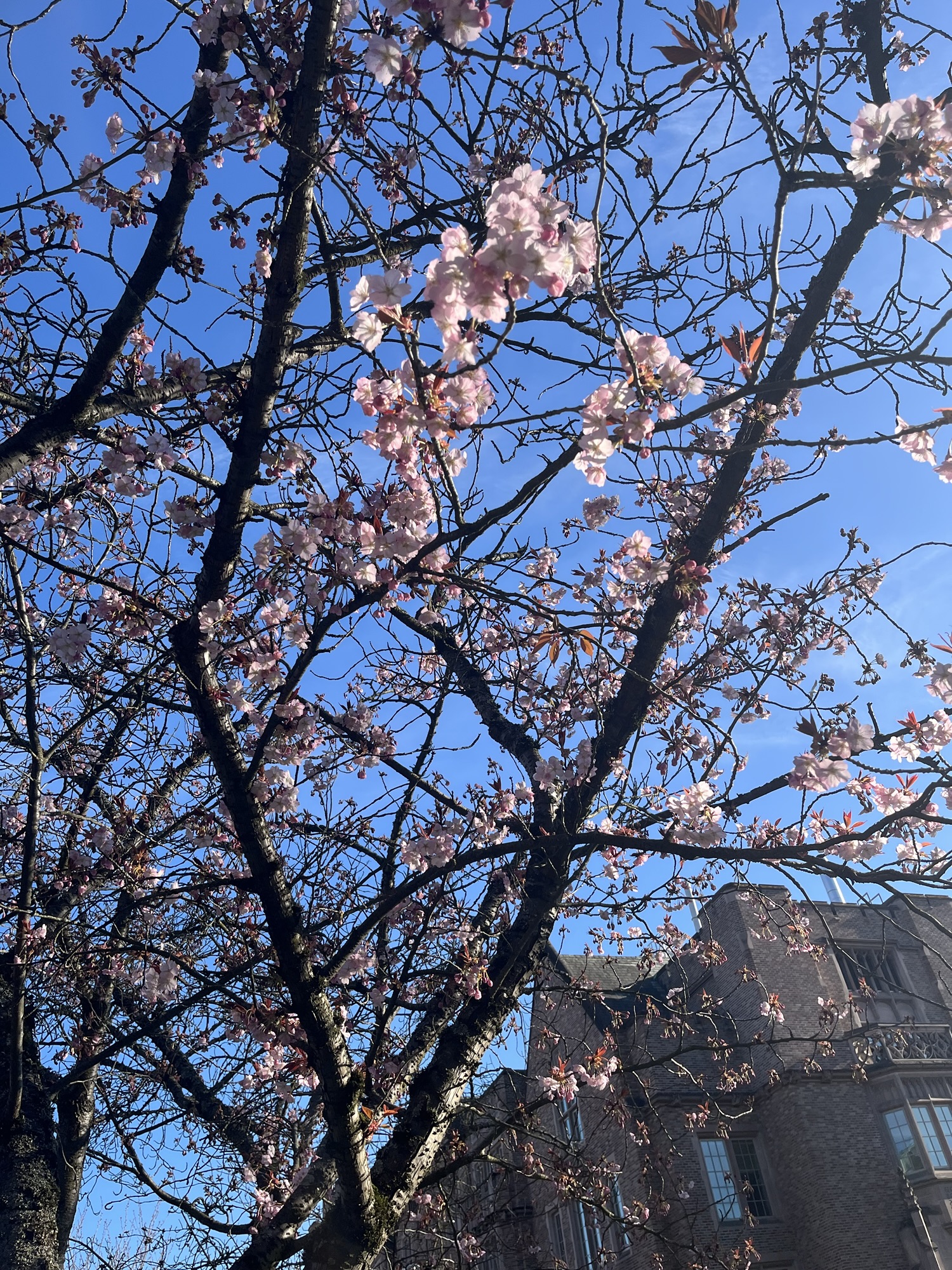
Taken by me in my neighborhood, April of 2025
Yet another variety I stumbled upon recently in 2025 is the Amanogawa (アマノガワ, “Milky Way”) variety. You can see an extra layer of petals in this one, similar to the Kanzan variety, but a lighter, softer color. I couldn’t find much detail about this variety but it appears to be a form of sato-zakura plants also known as the Ōshima cherry, similar to the Kanzan and Fugenzo varieties.
Conclusion
There are many more varieties of cherry blossoms than listed here, but many are obscure or only known to botanists and experts. Also, it’s important to point out that Korea also has a venerable cherry blossom tradition, though I confess I don’t have much information.
In any case, when spring comes, see if you can identify the different cherry blossoms you see. You may be pleasant surprised.
The 2024 championships for 70th men’s Meijin (名人) and 68th women’s Queen (クイーン) titles, were streamed on YouTube this weekend!
And sub-channel here:
It seems that the Meijin-Queen championships are held every year shortly after Japanese New Year (oshōgatsu, January 1st through 3rd), and are played as “best of 3” (out of 5) battle.
The battles this year, particularly for the Queen title, were especially intense. The reigning Queen, Yamazoe (山添), ultimately lost to Inoue (井上), but each of the matches was a nail-biter. Many of them came to unmeisen (運命戦, “sudden death”), where each player is down to their last card. The Meijin battle finished in three consecutive wins for Kawase (川瀬), keeping is title.
Even if you’re not an expert player karuta player, it’s pretty fun to watch. I watched the first few matches with fellow karuta players on Discord (invite here), and we had a great time.
Also, it’s neat to see the best of the best play, learn some good techniques, and see the tradition of the Hyakunin Isshu live on for another generation.











 The Hyakunin Isshu


.jpg)
.jpg)
