The Hyakunin Isshu Cracker trilogy continues! Way back in 2011, when I first wrote this blog, I posted about some neat Japanese senbei (deep fried crackers made from rice dough), featuring poems of the Hyakunin Isshu. The pictures were lost however, and so I can’t really show what they looked like.
Then in 2022, I wrote another post about a different set of Hyakunin Isshu crackers we got in Japan. However, I only had a couple examples, not the complete set.
This time, I have the complete set. My father-in-law sometimes receives them as periodic gifts during the summer (a.k.a. Ochūgen, お中元) from business partners and such. The company website for these crackers is here.
There are six varieties in the set, each featuring a poem of the Hyakunin Isshu.
These first two are poems 98 (left, かぜそ) which has a spicy, wasabi (?) flavor, and 36 (right, なつ) which has baked shrimp flavor.
These two are poems 2 (left, はるす) which has leaf-shaped crackers with a salty taste, and 81 (right, ほ) is baked with nori seaweed.
The one on the left is also written with poem 98 (left, かぜそ), but has a light salty cracker flavor. This one is my favorite. The one on the right didn’t have a poem written on the front, but the back was printed with poem 97 (こぬ), and has some lightly flicked baked seaweed on it.
There might be more poems and/or flavors, but this is what I got from the boxed set we brought back to the US. Anyhow, it’s neat to see the poems written in a traditional cursive script (rather than standard printed Japanese), and I wonder if there’s some association between certain poems and certain flavors but I don’t see a connection yet.
As with the handwriting book, it’s interesting to see how the Hyakunin Isshu lives on in Japanese culture in fun, friendly ways like this.
The Hyakunin Isshu anthology, the subject of this blog, is not known for bawdy subjects as Japanese poetry by that time had become increasingly refined and codified in style. By contrast, the much older Manyoshu included a wider variety of poems and topics. This includes drinking poetry.
In fact, the compiler of the Manyoshu, Ōtomo no Yakamochi (大伴家持, 718 – 785) who also composed poem 6 in the Hyakunin Isshu (かさ), was the son of a famous literati and booze-hound: Ōtomo no Tabito (大伴旅人, 665 – 731). Tabito was a contemporary of Hyakunin Isshu poet Hitomaro (poem 3, あし), though not quite as successful.
Tabito was dispatched by the Imperial bureaucracy at the time to serve a term as governor of Daizafu in western Japan, and while there he formed a poetry circle called the Tsukushi Kadan (筑紫歌壇, “Tsukushi Poetry Circle”), where Tsukushi is the name of an old district in Dazaifu. Of Tabito’s 50+ poems in the Manyoshu, 13 of them were contributed by Tabito, known as the Sake wo Homuru Uta Ju-san-shu (酒を讃むる歌13首) or “The Thirteen Poems Praising Saké [rice wine]”.
Although I joke about Tabito’s possible alcoholism, the poems are not necessarily meant to be taken as literal. My book on the Manyoshu points out that these poems may have intended to imitate a famous 3rd century literati group in China called the Seven Sages of the Bamboo Grove, sometimes known as the Seven Sages of the Western Jin [Dynasty]. In Japanese they are called the chikurin-shichiken (竹林七賢). The enduring image of these seven musicians, poets and scholars is a band of bohemian, drunken geniuses, and Tabito and his poetry circle was likely inspired by them. You can see other examples of artistic inspiration in this post from my other blog. Between this collection of poems, and the Zen artwork in my other blog, I had no idea that the Seven Sages were such a popular topic in art.
But I digress.
There is another side to this poetry as well : evidentially on the move from the capital (Kyoto) to Dazaifu to the west, Tabito’s wife apparently fell ill and died. So, my book alludes to the idea that Ōtomo no Tabito took up drinking not just as a literati trend, but also to deal with the grief of losing his wife. Marriages at this time were often political as various noble families vied for position in the tightly stratified hierarchy in the Imperial Court. However, even political marriages could be happy ones at a personal level, so Tabito may have genuinely been grieving for a wife that he loved, plus the isolation from the capital.
Tabito’s poems, celebrating the virtues of rice wine, are technically very good poems, but also cover a subject that is omitted in later anthologies where style and form were pretty much codified by then. So, by the time the Hyakunin Isshu was compiled, 4 centuries later, no one would write such crass poetry about booze and girls (atleastnotopenly). Further, while the Manyoshu lacks the refinement of the Hyakunin Isshu, it does have a raw, visceral tone that’s often missing in later anthologies, and resonates differently with readers. Personally, I love both anthologies, but for different reasons.
P.S. I’m finally back, and have a few upcoming topics. Please enjoy.
1 This kind of rice wine seems to be a style from China, where the fluid is cloudy rather than clear.
Lately, I’ve been having some fun conversations with coworkers introducing them to the Hyakunin Isshu, and while describing the poems, I realized that learning the kimari-ji of each poem is a handy way to keep track of which poem is which. When I first learned the Hyakunin Isshu way back in the early days of this blog, I tried to learn the poems by number. They are listed in numerical order in many publications, so this made sense.
However, many publications in Japan also list the poems by their kimari-ji too.
But if you’re not playing karuta (casual or competitive) why bother? Think Michael Jackson.
The album cover for Michael’s Jacksons Thriller, courtesy of Wikipedia.
Michael Jackson’s songs are tremendously famous. As soon as I say out loud, “Eddie are you OK?”, or “Billie Jean”, anyone listening beyond a certain age range will know how to finish the next lyric. It’s not necessary to know the whole song, simply knowing a key lyric triggers the rest of the song, or at least recognition of the song.
Think of kimari-ji the same way. Since the Hyakunin Isshu was meant to be a compilation of the very 100 best waka poems in Japanese antiquity (as chosen by Fujiwara no Teika), you can think of them as a “Best of Michael Jackson” album collection.
Thus, rather than remembering poem 29 it may be easier to remember it as the ko-ko-ro-a poem since the first line starts with that verse (kokoro até ni), and that’s enough to distinguish itself from other poems.
This fun website will let you pick a Hyakunin Isshu poem at random, and that will be your fortune for the day. After your poem is selected it is shown in the upper right corner:
On the left hand side is your “lucky color” for the day, and in middle is a fortune for you. You can see the matching karuta card on the bottom. The site is entirely in Japanese, so you will have to use an online translator. It reminds me of those page-a-day calendars I used to buy for work.
In any case, this is a terrific site and worth visiting. Enjoy!
This was a particularly nice poem that I found in the Manyoshu heralding early Spring.
Original Manyogana
Japanese
Romanization
Rough Translation
石激
石走る
Iwa bashiru
Are not
垂見之上乃
垂水の上の
Tarumi no ue no
the bracken buds
左和良妣乃
さわらびの
Sawarabi no
sprouting next to a
毛要出春尓
萌え出づる春に
Moe-izuru haru ni
waterfall
成来鴨
なりにけるかも
Narinikeru kamo
the first sign of Spring?
This poem was composed by Shiki no Miko or Prince Shiki (志貴皇子, ? – 716), who was the seventh son of Emperor Tenji (poem 1 in the Hyakunin Isshu). Unlike his siblings who were embroiled in the political strife of the times, Prince Shiki retreated and focused on poetry instead. His talents with poetry earned him a place in the Manyoshu, and Japanese poetic history.
Ironically, despite staying out of succession struggles, Prince Shiki’s own son, Prince Shirakabe later ascended the throne as Emperor Kōnin despite not being the dominant line, and all subsequent emperors in Japan are descended from him. So, in the end, Prince Shiki won afterall.
The poem itself evokes a truly wonderful image of a tiny sprout peeking through the rocks by a riverbank, heralding the first signs of spring.
Note that in the traditional Japanese calendar, based off the Chinese model, Spring started much later than the modern meteorological Spring, namely at the start of the second lunar month. Hence, the holiday of Setsubun relates to the start of Spring, and helps conclude the Lunar New Year. Plum blossoms are also frequently associated with this time of year since they bloom earlier than cherry blossoms, and were highly prized by poets of Manyoshu, as we can see in this poem (also posted here):
At last, the historical drama about Lady Murasaki has come to an end this week, and sadly I watched the last episode. The drama was slower than other past Taiga Drama on NHK, but it was a lovely tribute to an amazing woman. Lady Murasaki, author of the Tales of Genji, her eponymous diary, and a famous poem in the Hyakunin Isshu left a lasting mark on Japanese culture and world literature.
The concluding title card for the historical drama: hikaru kimi é (光る君へ, “to you, my radiant one”).
Details of Lady Murasaki’s final years are pretty sketchy, but it seems that she eventually retired from service in Fujiwara no Michinaga’s household, and gradually took up travel. She was born in the year 973, but some scholars believe she may have passed away in 1014 at the age of 41. Others believe she may have lived to the year 1025 (age 52). For the premodern era, this is a pretty typical lifespan for many people, including nobility. Still, as someone who’s older than her, it’s hard to imagine her dying so young.1
With her passing, a couple attempts were made to preserve and edit her magnum opus. Fujiwara no Teika (poem 97, こぬ) who compiled the Hyakunin Isshu itself undertook one of these efforts, creating the Aobyōshibon (青表紙本) edition. At this time in Japan, manuscripts had to be hand-copied, and so across several centuries, limited efforts were made to hand-copy works from Lady Murasaki’s time, which helped preserve them across the medieval period, but were inaccessible to general audiences.
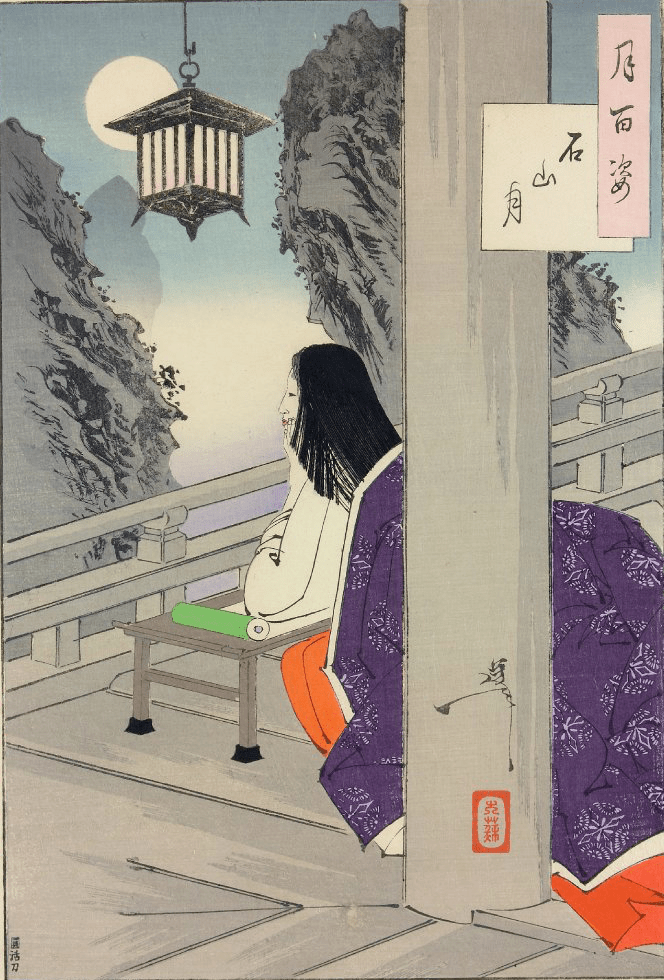
A woodblock print of Lady Murasaki from 1889 made by Yoshitoshi, Public domain, via Wikimedia Commons
By the Edo Period, 17th century, block printing and a flourishing of “book culture” greatly expanded the audience of the Tales of Genji, and Lady Murasaki enjoyed a surge in popularity, rescued from obscurity, and even today is high revered. Lady Murasaki is to Japanese culture what Shakespeare is to the English-speaking world. The historical drama that concluded is arguably an extension of this revival.
Finally, I wanted to explore the relationship between Lady Murasaki and her patron, Fujiwara no Michinaga. In the historical drama, they shared a relationship since childhood (historically improbable), and even had a love child together even though they never married. Political marriages were common among the nobilty at the time, as was infidelity, and so Fujiwara no Michinaga having an official marriage yet carrying a number of romantic trysts would not be surprising. The Hyakunin Isshu poetry is rife with such romances.
And the real, historical relationship between Lady Murasaki and Michinaga is unclear. It’s widely believed that the main character of the Tales of Genji was patterned from Michinaga. Her diary also shows her flirting with Michinaga somewhat. And yet, it’s also implied that she fended off his romantic advances too. The fact that she worked under him, the most powerful political figure in Japan at the time, made their relationship even more complicated. If her daughter, Daini no Sanmi (poem 58 of the Hyakunin Isshu, ありま) was indeed Michinaga’s, as the drama depicts, it may help explain how she was brought into the court inner circle too, alongside her mother. And yet, evidence one way or another is pretty limited, so one can only speculate.
Lady Murasaki herself was woman perpetually out of place in the courtly life of the late Heian Period. Her diary shows her frequently introverted, melancholy, out of place, and exhausted by the back-biting of other women, or the rowdiness of drunk men. Her father had lamented that in spite of her literary talents, her being born a woman in that era meant her talents would go to waste. Such was the period of the time.
One can easily imagine a brilliant woman like Lady Murasaki in modern times sitting in cafe, writing a romance novel, feeling alone, yet observing the world around her in a way that is beautiful and poetic, pouring her heart into her work. What Lady Murasaki conveyed through her writing was something can we can appreciate even today, eleven centuries later.
Out of all the literature of the time, nothing quite epitomizes the sentiments and milieu of the Heian Period, an era now lost to time, yet strangely familiar, quite like Lady Murasaki did.
P.S. The drama definitely took some historical liberties for the sake of drama, but I have to admit that it did a nice job of showing Lady Murasaki as a complex person, and all the different challenges she had to deal with. The last several episodes were really touching and brought tied up things nicely. I might try to purchase the drama next year if I can, but it’s quite expensive ($300-$500 USD), so time will tell.
1 As someone who also spent some time in the ER earlier this year with emergency surgery, I can imagine that I too would have likely died in my 40’s without modern medical care. Modern people often forget how brutal and short life was for the average person before medical science, and how many people never lived past 50, or did so with crippling conditions.
Language is not static. Any language that is spoken and used changes and evolves over time. The English language started as a dialect of German, but through a series of invasions, and innovations has a lot of elements that look French, with layers of classical Latin and Greek. The Greek language has been in continual use since the days of the ancient Mycenaeans to modern Greek people today, and ancient words can be found in use, yet at the same time modern Greek is smoother, more streamlined than its ancient Bronze-Age speakers. The ancient Chinese spoke in the Bronze Age doesn’t sound like modern Chinese, and yet the echos are still there both in the writing system, and how words a pronounced across various regional dialects.
Japanese has been in continual usage for 2,000 years and it is possible to look at old poetry, such as the Hyakunin Isshu, and with a bit of effort still make sense of it as a modern, native speaker, or even as a language student. It also helps to explain why poems of the Hyakunin Isshu have such odd spellings compared to modern, standard Japanese.
And yet, Japanese has changed over time. Words and grammar have evolved, and so the poetry of the Hyakunin Isshu, as well as other writings of the time, look and sound in a certain way that might surprise modern people. This post is a brief exploration of the kind of Japanese used during the Heian Period (8th to 12th centuries) of Japanese history when most of the Hyakunin Isshu was composed. This period of Japanese is called “Early Middle Japanese” by English-speaking scholars, and chūko-nihongo in Japanese (中古日本語, lit. “middle-old Japanese”).
To give a quick demonstration, take a look at the video below, starting around 00:47. This is the first lines of the text, the Pillow Book, which we also talked about here.
A few things will jump out right away even to casual Japanese students.
First, all the “ha” syllables, namely ha (は), hi (ひ), hu (ふ), he (へ), and ho (ほ) are all pronounced with a “f” sound: fa, fi, fu, fe, fo. Even the subject-marking particle “wa” (also written as は) was pronounced as “fa” back then. Similarly, the “ta” syllables: ta (た), chi (ち), tsu (つ), te (て), and to (と) were all consistently pronounced as “t”: ta, ti, tu, te, to. In modern Japanese, people say omoitsutsu (思いつつ) to mean “even as I think about this…”, but back then the same word was pronounced omoitutu.
Finally there were more “wa” syllables back then, compared to now, and like the “ta” syllables, they were more consistently pronounced: wa (わ), wi (ゐ), we (ゑ), wo (を). In modern, Japanese, only “wa” is still pronounced with a “w” sound, and wi and we are no longer used, or pronounced simply as as equivalent “i” and “e”. Similarly, if you watch historical dramas, the old way of politely using the “negative”-form of a verb has shortened from nu (ぬ) to simply n (ん) : mairimasenu (“I will not come”) to mairimasen in modern-humble Japanese.
Languages tend to contract and streamline over time.
Using Greek language as a similar example, pronunciation of words in Homer’s Iliad sounds longer and clunkier than similar words in Koine Greek of the New Testament, and even more streamlined now in Modern Greek. Sanskrit in India was spoken 4,000 years ago, and lives on in many northern Indian languages such as Hindi, Marathi, Magadhi and so on, and each one looks like a smoother, simpler version of the old Sanskrit language. Japanese pronunciation of words has similarly contracted into shorter, smoother, more efficient forms.
What about grammar? That’s an interesting question. In some ways, the grammar of Japanese hasn’t changed all that much in the eons. Japanese verbs are inflected (like Latin, Greek and Sanskrit) and different endings convey different meanings. Many verb endings in Japanese, which you can see in Hyakunin Isshu poetry, no longer exist, or are replaced with other endings. Let’s look at a concrete example.
Poem 73 (たか) is a nice example of things that changed, and things that have remained the same.
Some words like sakura (cherry blossoms) and kasumi (mists) haven’t changed at all. The possessive particle no meaning “of, or belonging to” hasn’t changed either in terms of usage.1
On other other hand, we see some grammar not found in modern Japanese. For example, in old Japanese, especially poetry a verb-stem ending with ni keri meant that something has been done (from past to present). Modern Japanese uses verb endings like te kita, te itta, and so on to convey similar context.
Another example is –zu mo aranan, which I wasn’t able to find online, but based on verb tatsu (to rise, to stand), obviously means implies a negative connotation (i.e. not do something). In modern Japanese you can say something similar: tatazu ni (without standing…), so again you can see the continuity.
Something you often see, but not shown in this poem is adjective endings. Modern Japanese adjectives often end with an i sound, for example “cold” is samui, “fast” is hayai, and so on. But in old Japanese the i was often a ki: samuki, hayaki, and so on. I noticed both in the Hyakunin Isshu, but also in Japanese RPG games when they take place in old “fantasy times”, because it helps convey a sense of ages past.
Finally, some words just change meaning over time. I was surprised to learn that the word for “shadow” kagé used to mean “light”, as in tsuki-kagé (moonlight). So, even if the word stays the same, the nuance does evolve over time.
Finding information on Early Middle Japanese in English is pretty difficult, and often requires an academic background. Since I am just an amateur hobbyist, this is only a brief overview. There is a lot more to cover, but hopefully gives you a brief sense of how things have changed over time. Japanese is a language that shows a nice continuum over its long history, and it’s fascinating to see howd the same language looked and sounded so far back.
1 I think I read somewhere that in really, really old Japanese the “no” possessive particle used to be “na”. I don’t know if that relates somehow to the “na-adjectives” in Japanese language, but I do wonder.
Since I began, this blog has focused on a period of Japanese history which I like to call “Classical Japan”, or “Japanese Antiquity”.1 That’s just a convenient name I call it.
But most researchers and historians tend to divide Japan’s history into “periods” (jidai, 時代) based on where the capitol was at the time. So, precisely speaking, this blog and the Hyakunin Isshu cover a 500-period of history overlapping the Asuka (6th – 8th c.), Nara (8th c.) and Heian Periods (8th – 12th c.), while dipping our toes just a bit into the the early Kamakura Period (12th – 14th c.) for certain poems (poems 93, 99 and 100 for example). For the sake of the Manyoshu we also ventured even further back to somewhat murkier periods of time since some of the very early poets of the Hyakunin Isshu (poems 1, 2, 3 and 4 for example) were also contributors.
But the blog has never really explored anything beyond the early 13th century because that’s when things effectively end. The Hyakunin Isshu was compiled, the aristocracy of the Heian Period were totally sidelined by the new samurai class, and Japan continued on in a new trajectory. The aristocracy still lived until the modern era, and Imperial poetry anthologies were issued from time to time, but the quality and popularity gradually petered out. As poem 100 above alludes to, this era embodied by the Hyakunin Isshu was effectively over.
For the purposes of this blog, why pay attention to anything that comes after?
Well, I attended Professor Mostow’s recent lecture at the University of Washington, and I learned that history of the Hyakunin Isshu kept going. In fact, it was all the rage in the much later Edo Period (17th – 19th c.).
Japan by the Edo Period was pretty different than the earlier Heian Period. By this point, Japan had been effectively ruled by one military government or another for centuries, while the capitol had shifted from Kyoto in central Japan, to a fortified castle town in eastern Japan called Edo (江戸). Edo started as a fishing town, but soon grew into a metropolis thanks to good urban planning and government policies that forced rival warlords to stay there every other year. Edo, later the modern capitol of Tokyo, was one of the largest cities in the world at one point.
After a century of constant warfare throughout Japan, the Edo Period brought unprecedented stability and cultural flourishing. Its isolation from European explorers and rival Asian powers meant that people turned inward and rediscovered Japanese culture that had been forgotten in ages past due to war and instability.
One aspect of this flourishing was the invention of block printing which suddenly allowed the masses to enjoy reading in a way that earlier generations had not. Books became far more affordable, and more available, and suddenly a variety of books about the Hyakunin Isshu were published. There were books about the Hyakunin Isshu as far back as the 15th century, namely the Ōei-shō (応永抄) composed in 1406, but mass-printing made books much more accessible and allowed for a greater variety.
Professor Mostow has collected and aggregated many examples on his website here. Take a look if you can, there are some neat scans of really old documents from the era.
One common usage of the Hyakunin Isshu at the time, according to Professor Mostow, was in the instruction of girls. Books about young women’s education were a popular subject, and such books would work lessons in along with poems of the Hyakunin Isshu. For example, Professor Mostow posted scans from a book called the Hyakunin Isshu Jokun Shō (“A Selection of the Hyakunin Isshu for Women’s Instruction” ?), published in 1849. Another example can be found here.
Men were often taught things like Confucian values and such. And yet, even the boys learned about the Hyakunin Isshu from their mothers who had been raised on it. Also, books that were published for men about the Hyakunin Isshu often did so under the theme of Kokugaku (“national learning”).
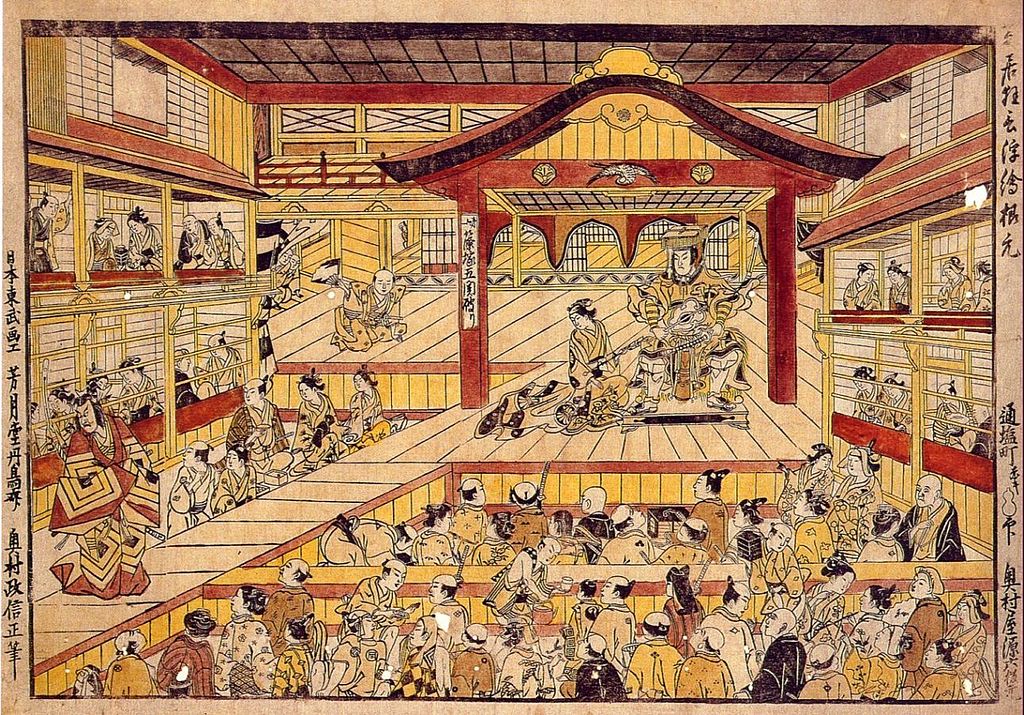
The high point of Edo Period culture, and something that influences Tokyo even today was the Genroku Period (1688 – 1704). Many things people imagine of pre-modern Tokyo, such as Kabuki theater and Ukiyo-e prints, have their origin in this brief period. The Hyakunin Isshu was used in some Ukiyo-e block prints too. Since many of these images were racy or scandalous, publishers would work in poetry of the Hyakunin Isshu to either obfuscate the content from Edo government censors, or to lend a more “classy” air to the image. I found some examples here.
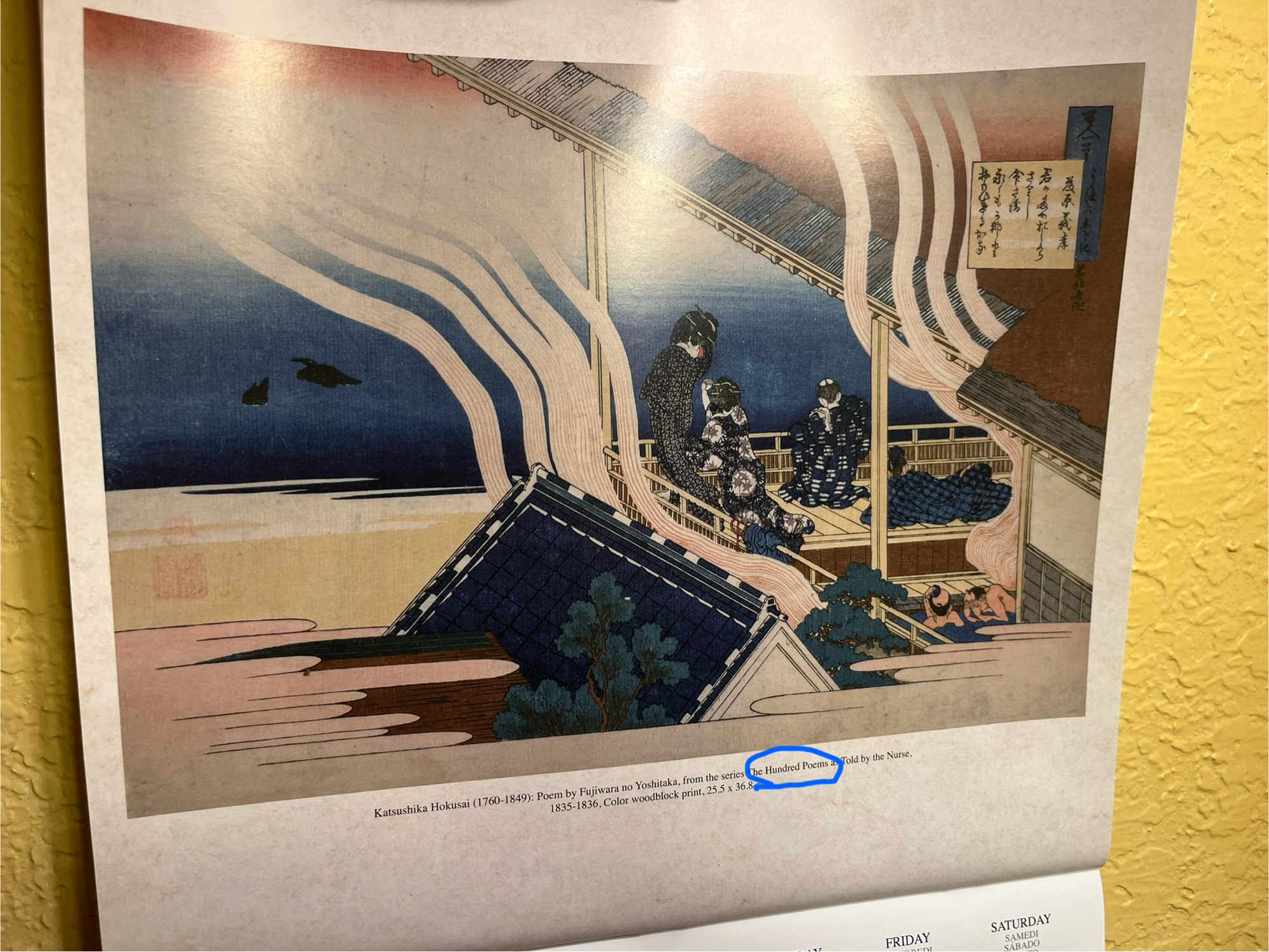
Even the famous artist Hokusai of “Great Wave” fame made block prints that would feature poems of the Hyakunin Isshu. We have a calendar at home and I was surprised to see this Hokusai block print with poem 50 (きみがためお) composed in cursive:
Our wall calendar featuring art by Hokusai. Turns out this page was from the Uba ga Etoki.
In blue, reads Hyakunin Isshu Uba Ga Toki, and in the yellow box poem 50 of the Hyakunin Isshu.
It turns out this is part of a series by Hokusai called theUba ga Etoki (姥がゑとき), or more formally the 百人一首姥がゑとき2, which means something like the “The Illustrated Hyakunin Isshu As Told By a Nurse(maid?)”. You can see more examples of this work here.
Anyhow, it’s fascinating that as literacy among the populace improved during the Edo Period, and access to information via books and printing increased, popular interpretations and illustrations of the Hyakunin Isshu took on a new life. The Hyakunin Isshu was, by that point, already 600 years old, and yet it enjoyed a revival that we benefit from today in the form of anime, karuta, and so on.3
Special thanks to Professor Mostow for his lecture and website! Also, check out Professor Mostow’s new book!4
1 I suppose my reason for doing this is that the end of the Heian Period and the subsequent change in Japan was somewhat similar to the fall of the Western Roman Empire in Europe, and how later generations of feudal lords kept up some of the trappings of the Romans, and yet it was still a different society altogether. But in the end, this is just one history nerd’s interpretation.
2 In modern Japanese 百人一首うばが絵解. See this post for more explanation.
3 Although social media and Internet reveal a pretty ugly side to humanity, it does also lead a similar explosion in cultural and accessibility. Two sides of the same coin, I suppose.
4 This is my associates link on Amazon. I get a small amount of credit for any purchases made through here. Feel free to purchase directly from University of Hawaii press instead though.
If you’re here reading the blog, chances are you like the poetry of the Hyakunin Isshu. Who doesn’t? Maybe you like it so much, you’ve tried to memorize your favorite poems too (I do). But what’s better than memorizing your favorite poems? Reciting them!
When I first learned to play karuta, I realized that poems of the Hyakunin Isshu are recited in a specific style in Japanese. This is necessary for the players to hear clearly, but also reflects a traditional singing method for reciting waka poetry.1 Even on kids shows about Japanese language, when waka or haiku are recited, they’re recited in the same way. Of course, this is not required, but it is cool to learn, and doesn’t take that much effort.
First, let’s look at this Youtube playlist of Hyakunin Isshu poems.2 In particular, let’s look at poem 2:
Poem 2, はるす
All waka poems, including the Hyakunin Isshu have five verses, and are usually written top to bottom, right to left. The poems are further divided by the first three “upper verses” (kami no ku, 上の句) and last two “lower verses” (shimo no ku, 下の句) for structured, reciting, and for games.
It really helps if you can read hiragana script, but even if not, listen to the intonation of the poem, and the way some syllables are drawn out longer (expressed above as vertical “|” lines). That’s how you recite waka poetry.
The syllables that are drawn out are not always in the same place, by the way. Poem 24 of the Hyakunin Isshu does not always match poem 2 especially the fourth verse (fourth column from the right):
Poem 24, この
Or take a look at poem 11 which has a slightly unusual format. This makes the pacing different, and affects where syllables are drawn out:
Poem 11, わたのはらや
Poem 11 is a particularly tricky poem to recite, in my opinion, but also fun because the first two lines sound really neat.
Reciting isn’t just for showing off by the way.
In my book on the Manyoshu, it talks about how many poems come alive when they are recited. This was true during Japanese antiquity, and centuries later when the Hyakunin Isshu was compiled too. There are sounds and expressions that have a nice ring to them and it’s not always apparent if you are just reading the poem in your mind. For example poem 3 of the Hyakunin Isshu uses a lot of “no” (の) sounds that come alive when recited aloud:
Poem 3, あし
Another example is poem 58 which simply has a nice ring to it:
Poem 58, ありま
Anyhow, unless you’re training to be a professional yomité reader in karuta, it’s not necessary to master reciting all 100 poems, or to even sound this nice. However, if you have a handful of poems you like, learning to master the recitation is a great way to bring poems to life. You can use the excellent Youtube list above, or if you are a tactile person (like me), you might consider getting a set of yomite cards like the ones sold by Oishi Tengu-do, direct link here. I purchased mine in Japan this year and enjoy flipping through them and practicing poems I like.
In truth, I am a TERRIBLE singer. I am truly tone-deaf. But, with a bit of practice you get used to the rhythm of a poem and can recite it without much effort. Some poems are easier than others (poem 11 is tough), but with a bit of practice and familiarity anyone can learn to recite their favorite poem.
1 Roughly 99% of the poems I’ve posted in this blog for the past 13 years are all waka poems. These poems almost always have a pattern of 5-7-5-7-7 syllables, as opposed to later haiku poetry that only have 5-7-5 syllables.
2 If you want to search other Youtube examples, search for 百人一首 読み上げ (reading Hyakunin Isshu aloud).
Back to our regularly scheduled program, I wanted to share a neat little poem, composed by none other than Princess Nukata using the theme of Autumn and of a night tryst:
Original Manyogana
Modern Japanese
Romanization
Rough Translation
君待跡
君待つと
Kimi matsu to
As I wait for you
吾戀居者
我が恋ひをれば
A ga koi oreba
in anticipation
我屋戸乃
我が宿戸の
A ga yado no
the blinds
簾令動
簾動かし
Sudare ugokashi
of my window flutter
秋之風吹
秋の風吹く
Aki no kaze fuku
but it is only the autumn breeze…
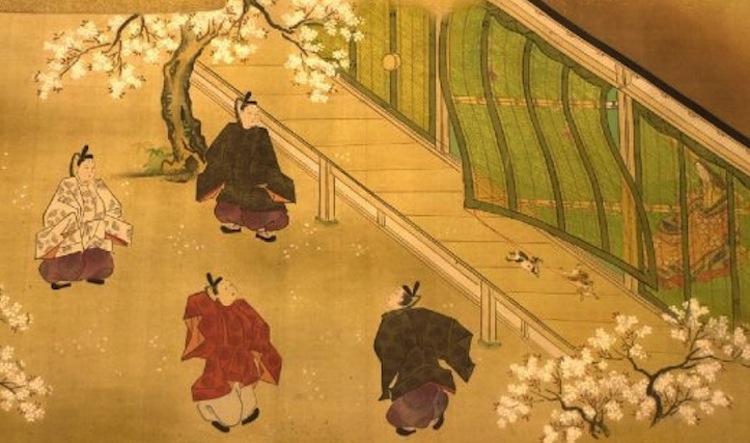
Princess Nukata needs little introduction in the blog. She was the loveinterest of two powerful men, issued a call to war, and made quite a contribution to the Manyoshu anthology which the Hyakunin Isshu and other later anthologies are all based upon. My book about the Manyoshu, in talking about spring versus fall, listed this poem as an early, early example in Japanese poetry of using autumn to symbolize other things. In this case, a romantic meeting at night, and a woman who eagerly awaits her lover. The blinds alluded to here are sudaré blinds used in Japanese culture since antiquity and even to this day.
Illustrated scroll of the Tales of Genji, chapter 34, 17th century. Courtesy of Wikimedia Commons.






 The Hyakunin Isshu


.jpg)