Learning Karuta For Fun

My journey with the game of Karuta began one August day in 2023 with the kind folks at a local karuta club, and right away I loved the game. However, over time, I realized that the competitive style of karuta, like you see in the anime Chihayafuru, was not for me. The constant pressure to grind out game after game to make incremental improvements, especially as a working parent with little time or energy for such endeavors, made me feel increasingly hopeless about making any real gains.1 Finally, with my children getting older, and one of them graduating, I had to take a long break from karuta. It just wasn’t fun anymore.

Recently, I’ve been playing again with a small informal group where we just mess around a bit, and play shorter Karuta games using the casual format. This is how most Japanese people play in Japan, by the way.

Thus, I wanted to share my experiences lately with readers in hopes that they may find ways to keep enjoying karuta, or help introduce it to people outside of Japan who didn’t learn it in grade school.

For starters, I ordered this 5-color Hyakunin Isshu set online from the good people at Oishi Tengudo last year,2 and after using the set a few times, I finally realized this five-color set is different than the more well-known version sold in Japan. It uses different colors, and divides the cards differently. My karuta reader apps were not set to recite poems according to Oishi Tengudo groupings, so I was really confused at first.

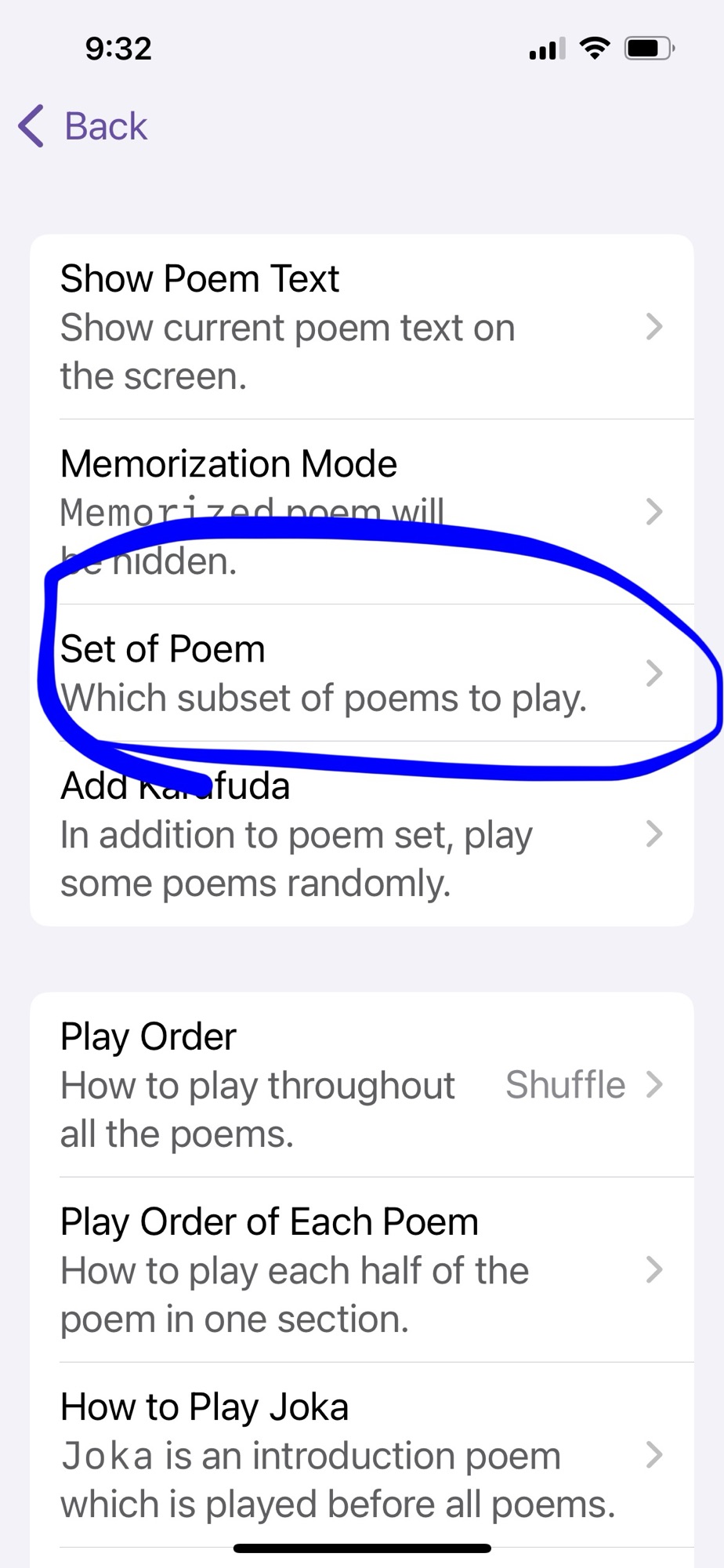
Using my favorite karuta reader app, Wasuramoti (Android and iOS), I decided to make custom lists based on the Oishi Tengudo groupings. You can do this too in Wasuramoti by selecting Advanced Config, then Set of Poem:
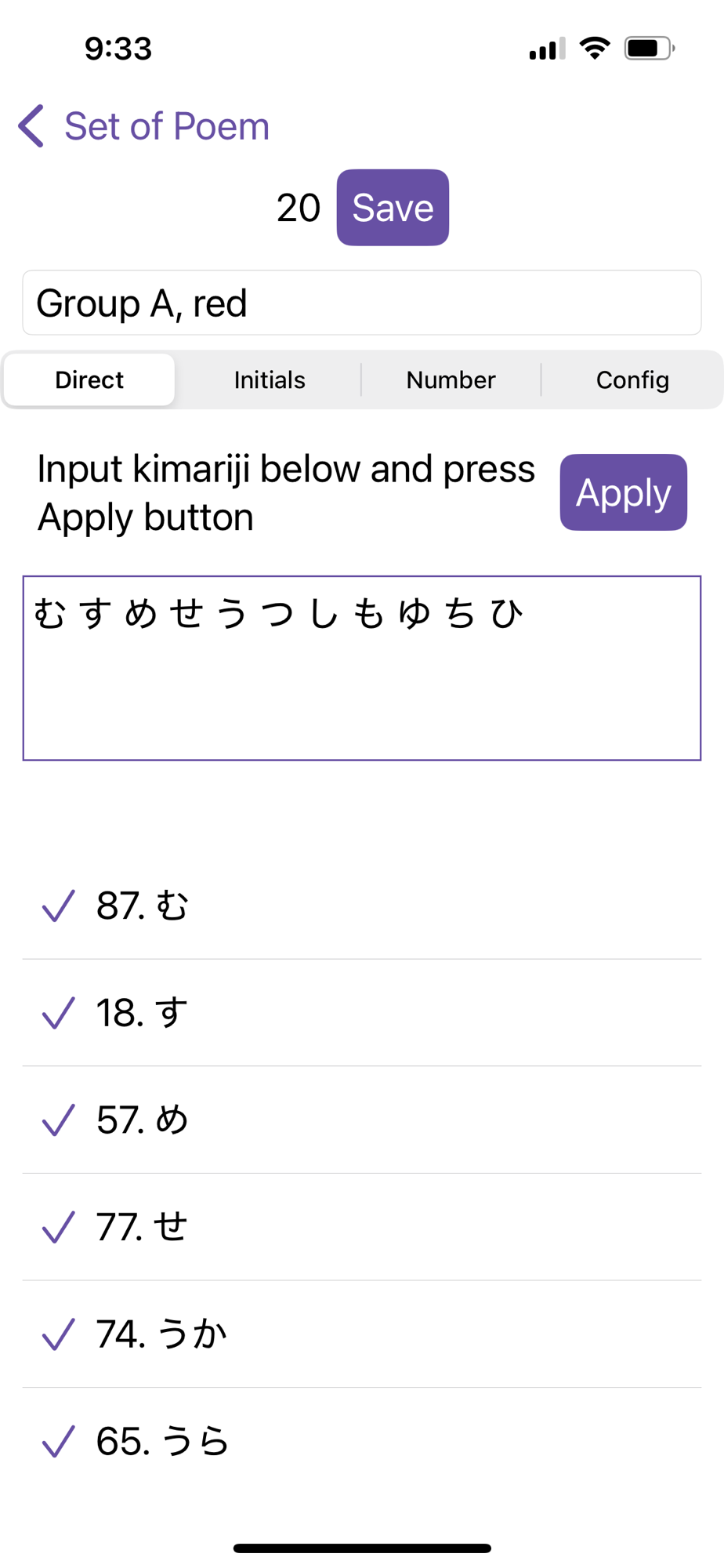
In the Oishi Tengudo set, the “red” group (also called Group A), is comprised of poems whose kimari-ji (starting syllables) start with む (mu), す (su), め (me), せ (se), う (u), つ (tsu), し (shi), も (mo), ゆ (yu), ち (chi), and ひ (hi). These cards have very few or no tomofuda (cards with similar kimari-ji), so they’re distinct and easy to learn first. I created my custom list with 20 cards, just like my physical set.
I made a similar custom list for Group B (“blue”) as well. This group is a bit harder because it includes cards whose kimari-ji have slightly more tomofuda cards (3-4): い (i), み (mi), た (ta), and こ (ko). So, there’s a bit more effort required to distinguish one card from another. Yet it’s still the second easiest group.

… and so on.

When I practice, I just grab the color I want to play (“red”, or Group A in this case) and scatter then on my desk, casual-style.

Then in the Wasuramoti app, I select the group of poems I want (see above), set the app to display the torifuda, same as cards on my desk, and set the reader to “auto” mode so it doesn’t stop with each poem. I just want to see if I can recognize the poem before too late. I don’t care very much about speed.
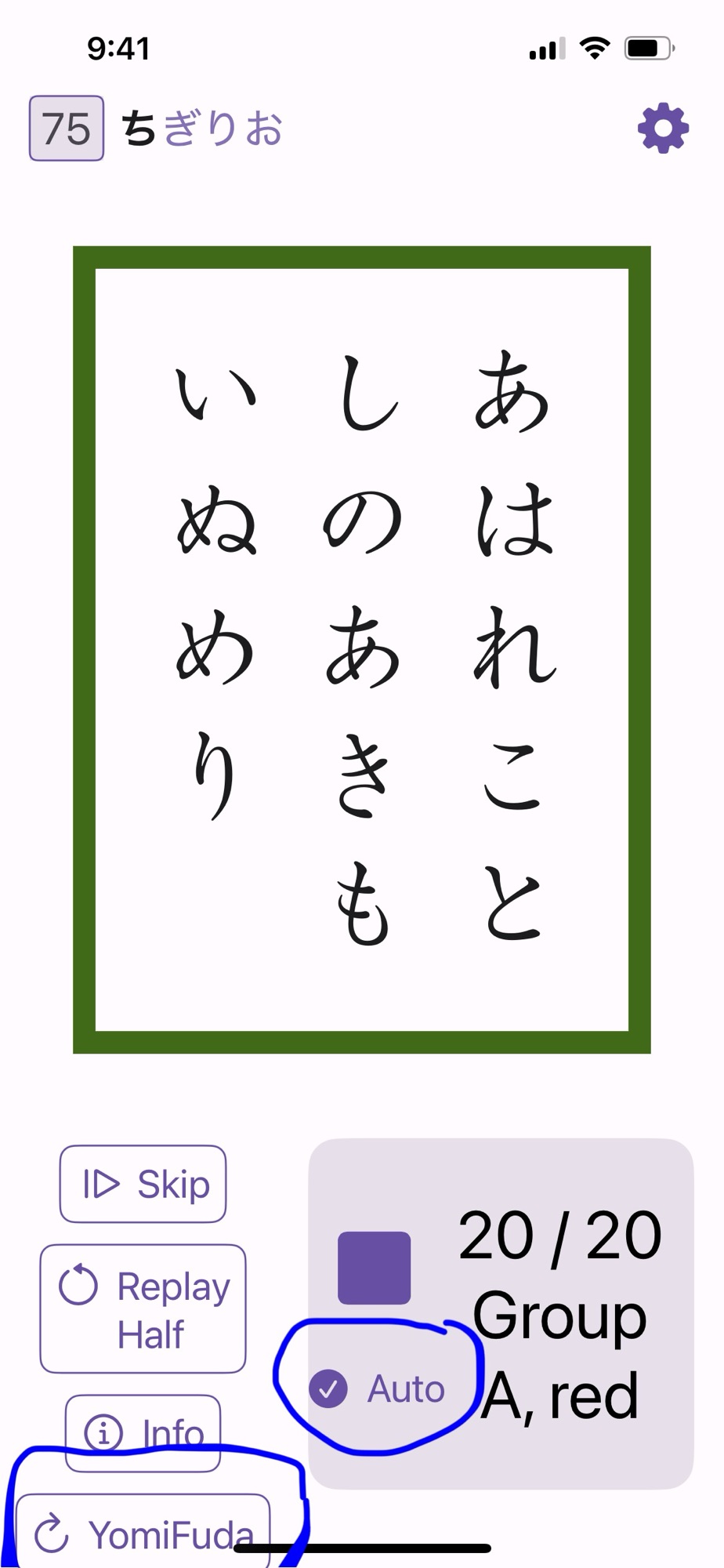
It is fun to play this way. I can finish a game pretty quickly (roughly ten minutes) and it is not very exhausting. Since I chose the easiest set of cards first, I remembered many of them pretty quickly despite the long hiatus, which was gratifying.

This format of playing smaller sets of cards, with optional levels of difficulty, and no threat of penalties, seems to be a great way to introduce to new players as well. I was happy to see that a new player, who had experience with Japanese language, quickly pick up the game, took a few cards of her own, and had a great time. If people aren’t having a great time, why play karuta?

Karuta is super fun, and a great game to enjoy throughout one’s life. However, if you are struggling, don’t blame yourself. Instead, find what you enjoy about karuta, pick a more gentle format, and focus on that, not what the A-rank players are doing.

Happy gaming!

1 The final nail in the coffin was when I joined some online communities which I soon realized were very focused on competition, and very little on actually enjoying the culture of the Hyakunin Isshu. It was just another sport, with physical training regimens, and techniques to edge out your opponent. That is not why I created this blog back in 2011, and not why I continue to enjoy the Hyakunin Isshu now. I had left the world of competitive card games behind when I quit playing Magic the Gathering before the Pandemic, and didn’t want to resume.

2 They only ship in Japan as far as I can tell, and with tariffs making things more expensive, it might be hard to get outside of Japan. Thus, I am adding a new index page for five-color Hyakunin Isshu to help readers make their own sets

Why Learn the Kimari-ji

Lately, I’ve been having some fun conversations with coworkers introducing them to the Hyakunin Isshu, and while describing the poems, I realized that learning the kimari-ji of each poem is a handy way to keep track of which poem is which. When I first learned the Hyakunin Isshu way back in the early days of this blog, I tried to learn the poems by number. They are listed in numerical order in many publications, so this made sense.

However, many publications in Japan also list the poems by their kimari-ji too.

But if you’re not playing karuta (casual or competitive) why bother? Think Michael Jackson.

The album cover for Michael’s Jacksons Thriller, courtesy of Wikipedia.

Michael Jackson’s songs are tremendously famous. As soon as I say out loud, “Eddie are you OK?”, or “Billie Jean”, anyone listening beyond a certain age range will know how to finish the next lyric. It’s not necessary to know the whole song, simply knowing a key lyric triggers the rest of the song, or at least recognition of the song.

Think of kimari-ji the same way. Since the Hyakunin Isshu was meant to be a compilation of the very 100 best waka poems in Japanese antiquity (as chosen by Fujiwara no Teika), you can think of them as a “Best of Michael Jackson” album collection.

Thus, rather than remembering poem 29 it may be easier to remember it as the ko-ko-ro-a poem since the first line starts with that verse (kokoro até ni), and that’s enough to distinguish itself from other poems.

So Long Flashcards

In 2023, during a visit to Kyoto, I picked up some flashcards for memorizing the kimari-ji syllables of the Hyakunin Isshu poems (product link here). These flashcards were really helpful in those first few months of learning to play karuta, and although I don’t really use them anymore, I kept them around for nostalgia…

But… after I took my flashcards to the office one day recently to show some curious co-workers about the Hyakunin Isshu and Karuta, I forgot to take them out of my pants pocket. This is what happened after they got washed…

Initially, I tried to just let the ring dry out, but it’s pretty water-logged. Plus, I found that if was careful, I could peel the cards apart one by one, so they could dry much faster….

Sadly, a few cards ripped in the process, but I think I have salvaged about 80% of the cards. In reality, I will likely purchase it again anyway (preferably with extras to give out to others) since it is very cheap. However, shipping overseas is pretty expensive, so I have to wait until I am in Japan again.

And so, like cherry blossoms and moonlit nights, all things fade. Unlike cherry blossoms and moonlit nights, my flashcards faded in my pants pocket in the washing machine.

Karuta Training through Nakama-Waké

As I wrote previously, I have been spending a lot of time trying find more effective training methods for myself and for new, foreign Karuta players because of the scarcity of resources. One website that has been particularly helpful in Japanese is Karuta Club, managed by the Meijin (master player) Kawase Masayoshi and his wife.

It’s a pretty nice site and has a ton of training and resources, though almost all of it is in Japanese. There is a nice English-language introduction that is worth reading.

But for this post I wanted to focus on one particularly helpful article. This teaches a method of memorization called nakama-waké.

The method seems a bit complicated upfront but really helps in those 15 minutes (or 30 seconds on the app) when you have to memorize the board, and uses knowledge you probably already know: the kimari-ji.

Let’s look at my kimari-ji chart here. You can see how the cards are group by first syllable : “ha” cards, “tsu” cards, “ki” cards, “wa” cards and so on.

Kawase’s article suggests that after you learn the kimari-ji, next invest time memorizing how many are in each group. If you look at the chart, there are only two cards in the “tsu” (つ) group, compared to seven in the “wa” (わ) group, or 16 in the “a” (あ) group. Some groups are very large, some are very small.

Let’s use the examples of the “ha” group. From the chart we can see that there are four cards that start with “ha” (は):

Kami no Ku
(upper verses)
Shimo nu Ku
(lower verses)
Poem No.
はなさそう あらしのにわの ゆきならでふりゆくものはわかみなりけり96
はなのいろは うつりにけりな いたずらにわかみよにふるなかめせしまに9
はるすぎて なつきにけらし しろたえのころもほすてふあまのかくやま2
はるのよの ゆめばかりなる たまくらにかひなくたたむなこそをしけれ67

If we remember that the “ha” group has 4 cards total, and when you are memorizing at the start of the match, you can determine which of the four are on the board. The rest can be safely ignored as kara-fuda (“empty cards”).

This separation of similar cards (“friends”) between the ones on the board and the ones that aren’t is why this is called nakama-waké (仲間わけ): “separating friends”.

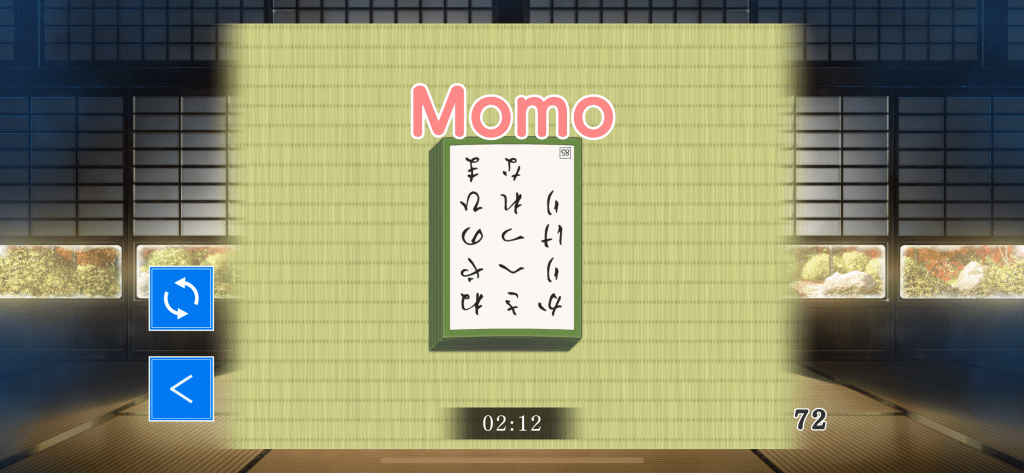
Using the online karuta app, let’s demonstrate this. Here’s a game I played earlier, using default settings: 8 cards per side, only 30 seconds to memorize. The cards are all laid out, and my opponent (the computer) and I are memorizing.

Of the four “ha” cards, I can see two on the board, highlighted in purple. The two cards are “haruno” (はるの) on my side and “harusu” (はるす) on the opponent’s side. That means the other two in the group “hanano” (はなそ) and “hanasa” (はなさ) can be totally ignored if they are read aloud. That helps me avoid accidentally taking the wrong “ha” card and getting a penalty.

While we’re here, you might notice that both “shi” (し) cards are on the board, highlighted in green: “shira” (しら) and “shino” (しの). Even better they are on my side. That means I can just put group them together and simply listen for “shi” (し). Of course, the danger is that the opponent knows this too. Position matters.

Similarly, both cards of the “tsu” (つ) group are on the board too, highlighted in red. They are on opposite sides of the board though, so I still have to be careful to distinguish which is which when read. But it also means there are no “empty” tsu cards either.

Finally, of the seven unique “one syllable” cards, only one of them is on the board: “sa” (さ) which I’ve highlighted in blue. That means I can totally ignore the other six: “mu” (む), “su” (す), “me” (め), “fu” (ふ), “ho” (ほ) and “se” (せ) if they are read.

This may seem like more work upfront, and it does take time to get used to thinking like this, but it really helps in a couple ways:

  1. Your memorization process is more structured, less haphazard, and so you can memorize a full board of 50 cards more easily.
  2. Less risk of penalties because you’re only paying attention to the cards you know are on the board per group, and disregarding the rest.

If you’re relatively new to karuta and you find this process intimidating, you can focus on smaller, easier groups of cards for now: the one, two, and three card groups. With experience, and familiarity, you can then expand to larger, more difficult groups and even use this trick with the huge “a” group.

Karuta Practice: Fuda-waké

As part of my efforts to improve my practice routine and make small, incremental gains, I got some helpful advice from the Seattle Karuta Club, and was pointed toward this website. This Karuta Club, the Akita Kohohana Karuta Club, in Akita Prefecture demonstrates how to practice Karuta using a method called fuda-waké (札分け), meaning “distributing cards” or “dividing up cards”, etc.

This technique takes a bit of setup at first but is a great way to both reinforce kimari-ji and also positioning your cards (tei’ichi 定位置).

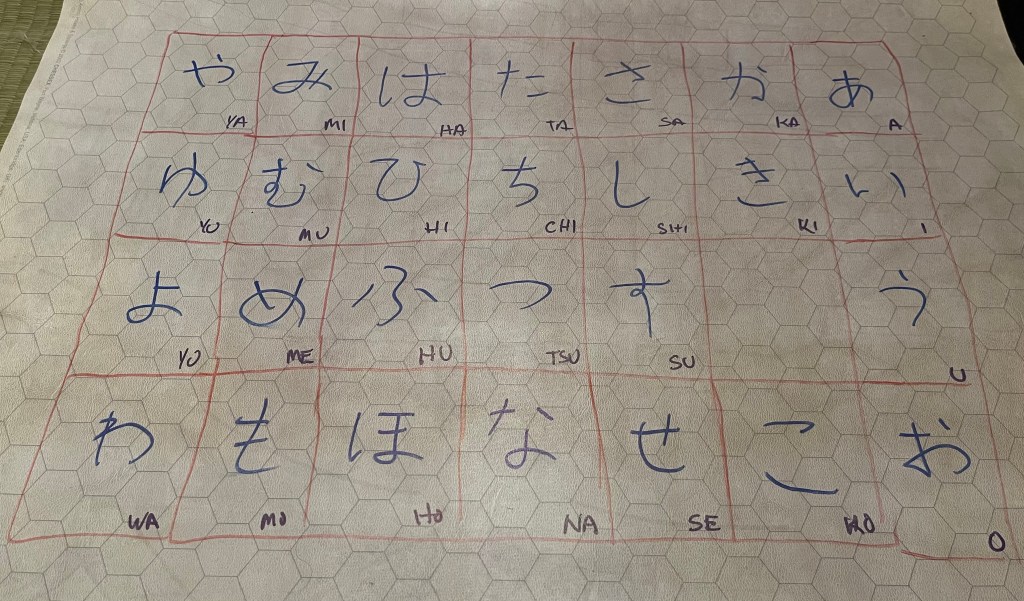
First, you need to make a chart large enough to place your cards on a 7×4 grid, like so:


Then fill in the Japanese hiragana like so. I’ve added both romaji (Roman alphabet) and kiriji (Cyrillic alphabet) for convenience.

や ya яみ mi миは ha хаた ta таさ sa саか ka каあ a a
ゆ yu юむ mu муひ hi хиち chi тиし shi сиき ki киい i и/й
よ yo ёめ me мэふ fu фуつ tsu цуす su суう u у
わ wa ваも mo моほ ho хоな na наせ se сэこ ko коお o o

I wanted to try out this method, so I used my old battle-map from Dungeons and Dragons, and drew the same chart on there:

My handwriting is terrible, but hopefully legible. You can see a close-up here:

To be honest, I made my grid a bit too small, so as I piled cards, I couldn’t see which space was which. If you make something similar, make sure the squares are extra big.

Anyhow, the method for fudawaké is to pile up your torifuda cards to the side, then time yourself:

  • Grab a handful (doesn’t matter how many)
  • One by one, put them in the right square based on the first letter of their kimari-ji.
  • Grab more cards as needed.
  • When you place all 100 cards, stop the timer.

According to the Akita Konohana Karuta Club website, their team standard is 1:40, which is quite fast. You can see that some members finish in less than one minute!

When I tried it the first time, it took me 8:05, and then on my second try, it took 6:07. Not even close to their standard, but it was a fun exercise. It is more challenging than fuda-nagashi, but still teaches many of the same skills. It also helps with the initial board setup too, because you can correctly remember where to group your cards based on common kimari-ji.

Try it out and let me know what you think!

Karuta Practice: Fuda-nagashi

One of the most essential skills in playing karuta is to quickly and accurately recall the Kimari-ji for each card. Speaking from experience, if you recall the cards too slow, your opponent takes them first. If you are not accurate you take otetsuki penalties which are painful. As a new player, I tend to do both. 🤦🏼‍♂️

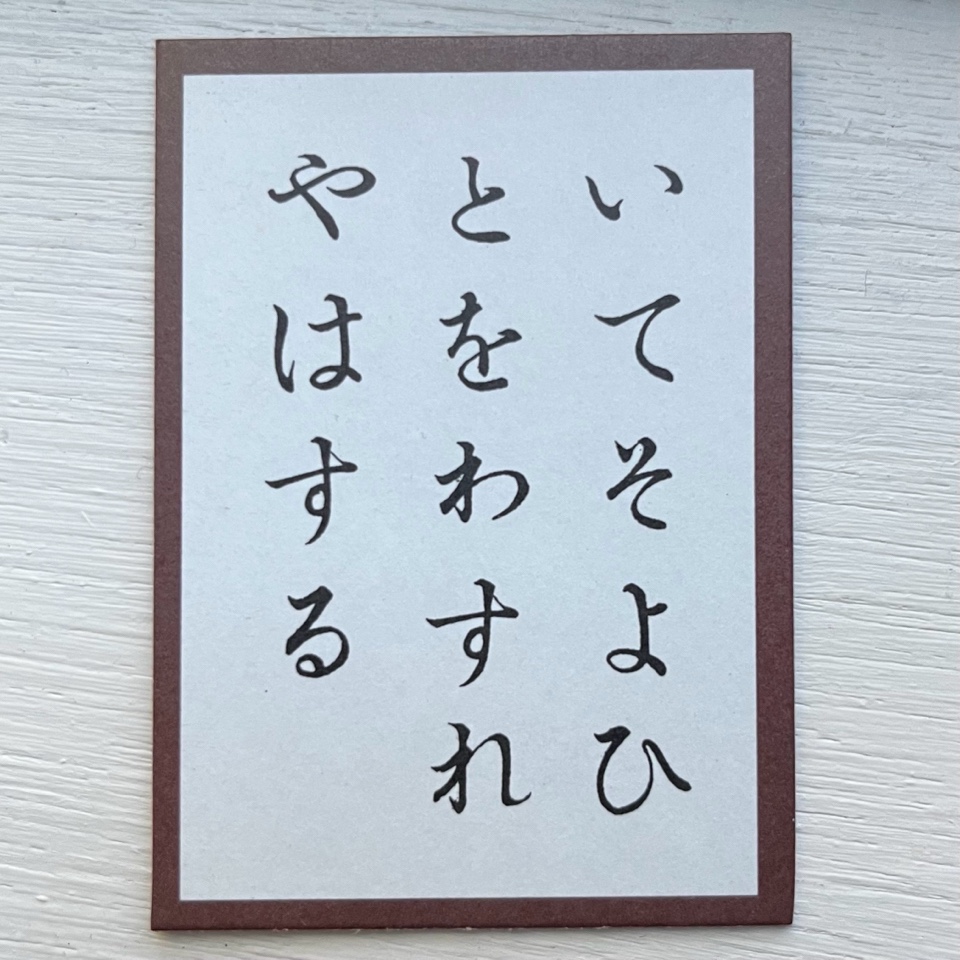
An example torifuda card. The kimari-ji is ありま, by the way.

The trick is looking at the torifuda card, the last two verses of the poem, and from that recall what the kimari-ji is. This is not easy to do with 100 cards possible, but with practice it is possible to get good at this. With even more practice you can do this both accurately and quickly. Since there are only 100 cards possible, it is a finite set of information to learn.

The online app provides a handy mini game called “Flashcard” that’s lets you practice this. In Japanese, this method is called fudanagashi (札流し, “flow of cards”). This means to quickly sift through flash cards and correctly guessing the kimari-ji.

The app will let you practice this easily, and posts the correct answer in red. It also randomly shows the cards upside down (since half the cards on the board would be upside down anyway):

But you can also do this using flash cards. In Japan they often sell cards like this. I bought this ring of flashcards at the Tengu-dō store in Kyoto (product link here):

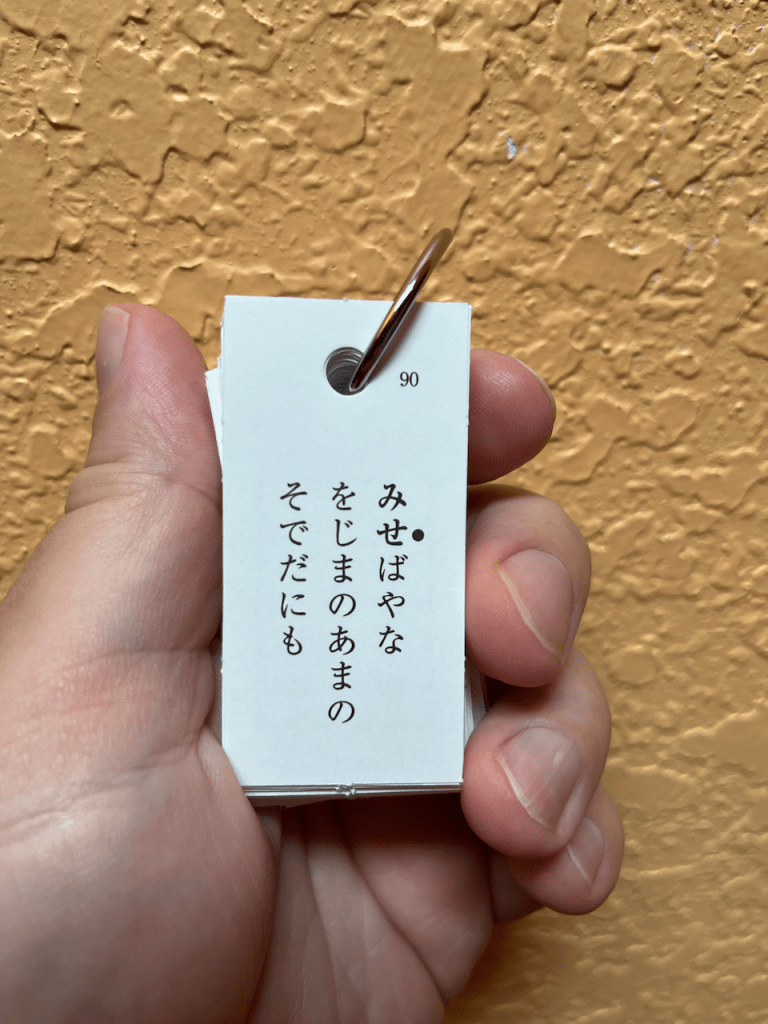
On the other side is the kimari-ji:

Sometimes I take this with me when walking around the neighborhood and just practice a few cards here and there.

As for the flashcard game on the online app, my first run-through I finished in 7:33 (7 minutes, 33 seconds), but also made several mistakes. Within two days, I narrowed the time down to 4:23 and fewer mistakes. After that, I decided to be more strict about mistakes (as they are costly in the game) and would reset the stack even if I made one mistake.

That was difficult at first, but I learned each time I mess up, even when I made the same mistake more than once. I probably had to reset 12-15 times but eventually I finished without errors and with a time of 4:21. Yay.

Finally, you can do this while blasting your favorite Fire Emblem: Three Houses song to keep you motivated:

The point is, is that fuda-nagashi is an essential skill for any karuta player, and there’s many ways to approach it. Find what works, and make it fun. If you do, you’ll be surprised how quick you can improve.

Edit: after writing this post, got to 04:18.

Edit #2: as of December 2023, I am down to 3:14.

Stay Focused, Keep Trying

After taking up karuta with the local community, I was soon introduced to the international Karuta Discord group (Discord invite link here). The international karuta community is great, and you get to meet people from places like Brazil, Russia, Germany, etc. If you are even casually interested in karuta, or the hyakunin isshu, it’s a nice community and worth joining.

Further, the community has been organizing periodic tournaments using the online Karuta app. I started learning karuta 2-3 months ago, and finally got to the point where I know (more or less), the 100 kimari-ji. So, I decided to throw my hat into the ring and register for the October competition.

Right away, I realized that I might be in over my head.

I lost a couple matches, both very decisively, and felt pretty of embarrassed. At the end of that day, I played poorly. In addition to slow reaction time to take cards, I tilted (in Magic: the Gathering speak) and fell apart under pressure.

I was pretty disheartened by this and I wondered if maybe I am just hopeless. Since I am starting karuta pretty late in life, I feared that maybe I am just getting too old for the game.

But, then I got to thinking. In my spare time, I’ve been playing a game called Fire Emblem: Three Houses (mentioned in my other blog here, among other places). The game, at its core, is about taking a team of amateur students and gradually turning them into an elite force through training, trial, etc. The instructor and main character, Byleth (catchphrase: “stay focused”), develops their individual talents, addressing weaknesses, taking them on training missions, etc.

I kind of felt inspired by this (and frankly, it’s an awesome game), so I got to thinking: I really do want to improve. However, if I want to improve at karuta, I need to get back to basics, stay focused, and work towards small improvements at a time:

  • Get back to basics – practice memorizing kimariji. I sometimes recalled the cards too slowly, or incorrectly. Also, card placement at the beginning of the match (tei’ichi 定位置) is important.
  • Stay focused – learning to stay calm, no matter what situation, and just pay attention to where each card is on the board. When I do get flustered, take a moment to calm myself and re-focus.
  • Work towards small improvements – I can’t expect to win tournaments overnight. But if I focus on making small, incremental improvements, inevitably my game play will improve. Things such as:
    • Better card placement on the board for easier recall / taking.
    • Cutting down on penalties
    • Small improvements to taking cards faster.
    • Getting better acquainted with rules and etiquette. The online app handles most of that, but it’s still essential to learn.

So, if you’re playing karuta, or any competitive game, and you’ve been crushed in defeat, take heart. Given enough time and dedication you will definitely improve. Don’t worry how well other people play, focus on how well you’re playing now.

Edit: if you are a fellow Three Houses fan, I challenge you to boldly declare “I am Ferdinand von Aegir” during your next Karuta match and swipe half the cards from the board Chihayafuru style.

Either you’ll make a new friend (since they are a fan), or they’ll think you’re nutty.

P.S. Featured image source is from Nintendo, and depicts both genders of Byleth (you can play either one, which is neat).