One of the most essential skills in playing karuta is to quickly and accurately recall the Kimari-jifor each card. Speaking from experience, if you recall the cards too slow, your opponent takes them first. If you are not accurate you take otetsuki penalties which are painful. As a new player, I tend to do both. 🤦🏼♂️
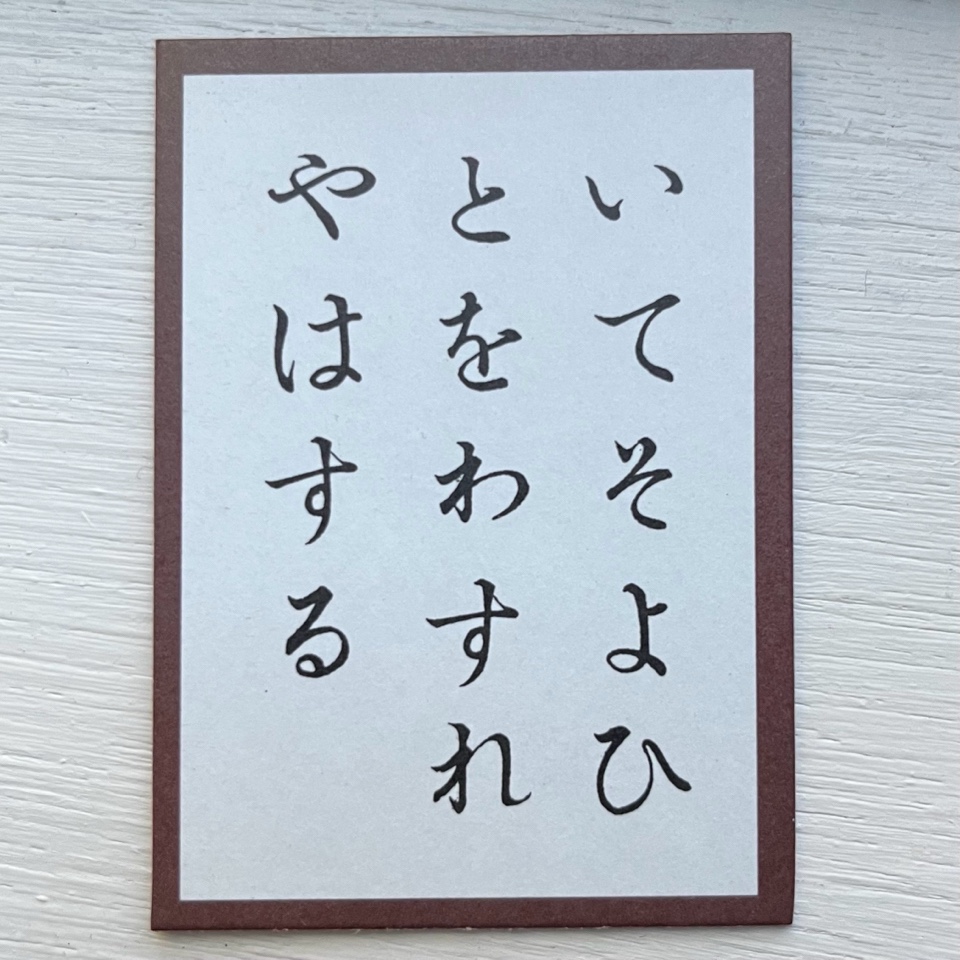
An example torifuda card. The kimari-ji is ありま, by the way.
The trick is looking at the torifuda card, the last two verses of the poem, and from that recall what the kimari-ji is. This is not easy to do with 100 cards possible, but with practice it is possible to get good at this. With even more practice you can do this both accurately and quickly. Since there are only 100 cards possible, it is a finite set of information to learn.
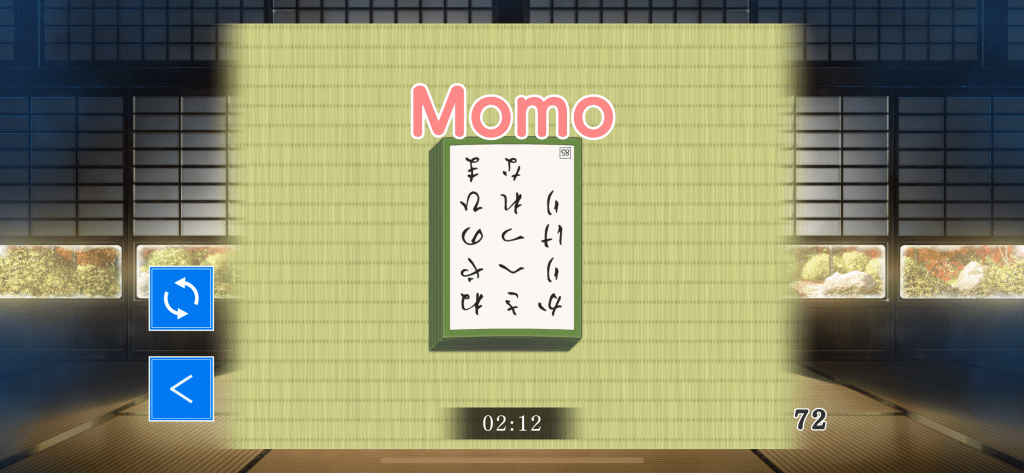
The online app provides a handy mini game called “Flashcard” that’s lets you practice this. In Japanese, this method is called fudanagashi (札流し, “flow of cards”). This means to quickly sift through flash cards and correctly guessing the kimari-ji.
The app will let you practice this easily, and posts the correct answer in red. It also randomly shows the cards upside down (since half the cards on the board would be upside down anyway):
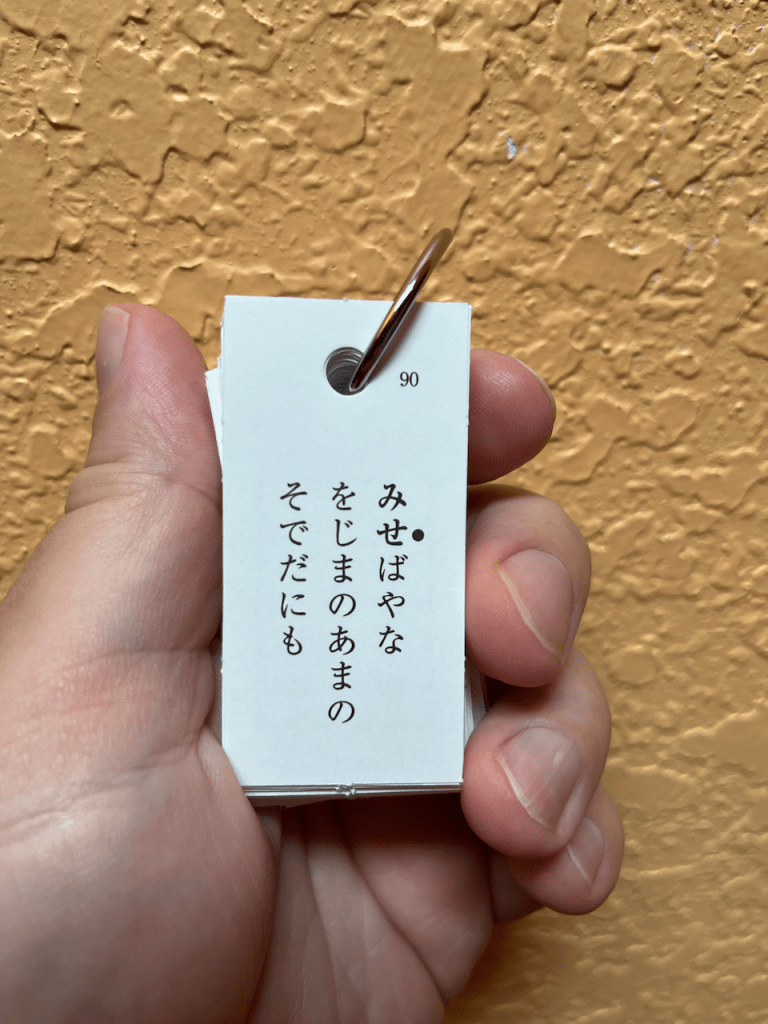
But you can also do this using flash cards. In Japan they often sell cards like this. I bought this ring of flashcards at the Tengu-dō store in Kyoto (product link here):
On the other side is the kimari-ji:
Sometimes I take this with me when walking around the neighborhood and just practice a few cards here and there.
As for the flashcard game on the online app, my first run-through I finished in 7:33 (7 minutes, 33 seconds), but also made several mistakes. Within two days, I narrowed the time down to 4:23 and fewer mistakes. After that, I decided to be more strict about mistakes (as they are costly in the game) and would reset the stack even if I made one mistake.
That was difficult at first, but I learned each time I mess up, even when I made the same mistake more than once. I probably had to reset 12-15 times but eventually I finished without errors and with a time of 4:21. Yay.
Finally, you can do this while blasting your favorite Fire Emblem: Three Houses song to keep you motivated:
The point is, is that fuda-nagashi is an essential skill for any karuta player, and there’s many ways to approach it. Find what works, and make it fun. If you do, you’ll be surprised how quick you can improve.
I’ve been writing in my other blog several articles about my family’s visit to Kyoto and Nara in July 2023, but for this particular article, I wanted to write it on this blog instead. You’ll see why shortly. While in Kyoto, we made an unexpected stop at a Shinto shrine called the Kitano-Tenmangu Shrine (北野天満宮) right in the middle of the city.
Kitano-Tenmangu Shrine (English / Japanese homepages) is devoted to a Shinto kami named Tenjin, who’s essentially the God of Learning. Each year, thousands of kids trying to pass their entrance exams visit local shrines, and pray for success. I’ve prayed at the Yushima Tenmangu Shrine in Tokyo myself years ago when trying to pass a Japanese-language certification test (I passed). The one in Kyoto, though, Kitano Tenmangu, is the original shrine.
But what’s the big deal?
The kami Tenjin is a deified form of the poet and scholar, Sugawara no Michizane, who composed poem 24 in the Hyakunin Isshu. When he was ousted by the powerful rival Fujiwara no Tokihira (father of Atsutada, poem 43), and died in exile, people worried that his vengeful spirit had returned to plague the capitol. The untimely deaths Tokihira and Atsutada certainly didn’t help this. Michizane was posthumously re-instated to the Imperial Court bureaucracy, elevated to a high rank, and venerated as a Shinto kami1 to appease him.
Anyhow, Kitano Tenmangu is the original shrine devoted to Michizane and has since grown into a large network of shrines across Japan.
The Shrine itself is relatively small, since it’s inside the city, but it has lots of neat things in it. When you first come in, there is a walkway like so leading to the inner sanctum:
To the right, is a plum tree, though not blossomging in July:
Plum blossoms (umé 梅) are associated with Michizane due to a famous poem he wrote in exile:
Japanese
Romanization
Translation
東風吹かば
Kochi fukaba
When the east wind blows,
にほひをこせよ
Nioi okose yo
let it send your fragrance,
梅の花
Ume no hana
oh plum blossoms.
主なしとて
Aruji nashi tote
Although your master is gone,
春を忘るな
Haru o wasuru na
do not forget the spring.
Sugawara no Michizané (845 – 903), translation by Robert Borgen
Anyhow, if you continue you get to the gate to the inner sanctum:
The inner sanctum is here (I prayed for my Japanese-language exam this year as well… we’ll see if I pass again 😄):
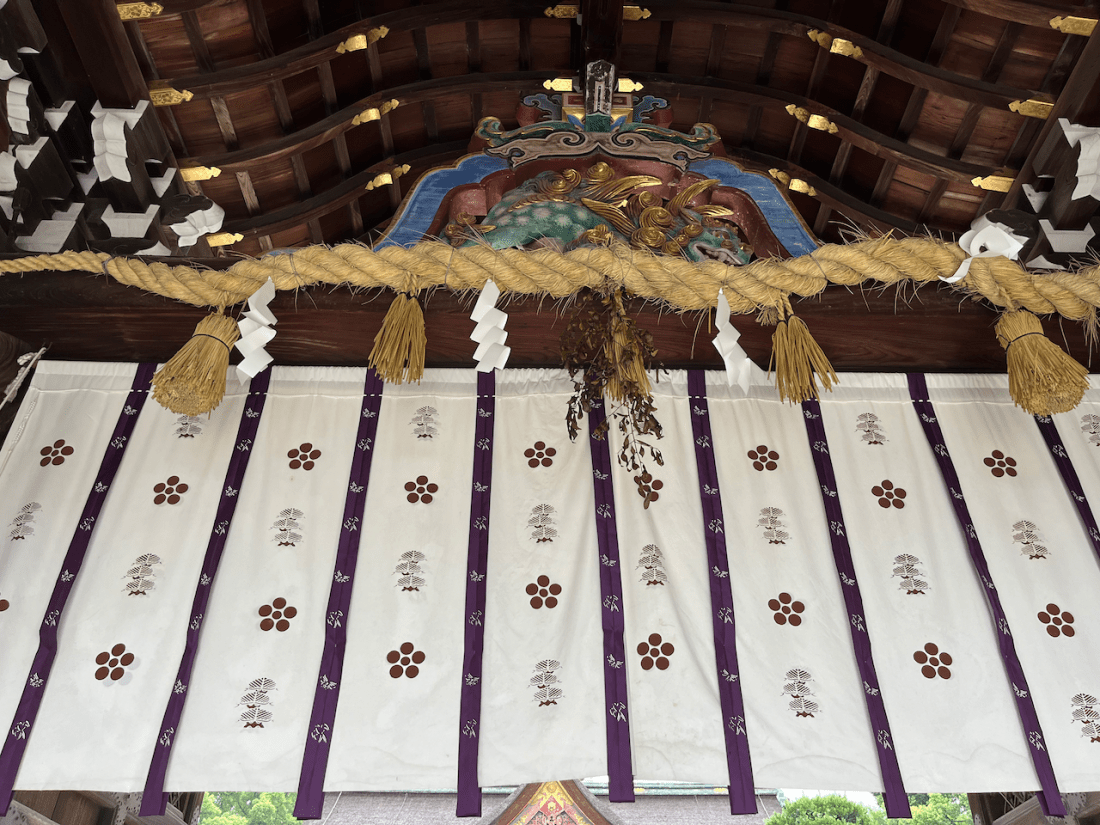
What’s really neat is that if you loop back around toward the main entrance, you’ll see this:
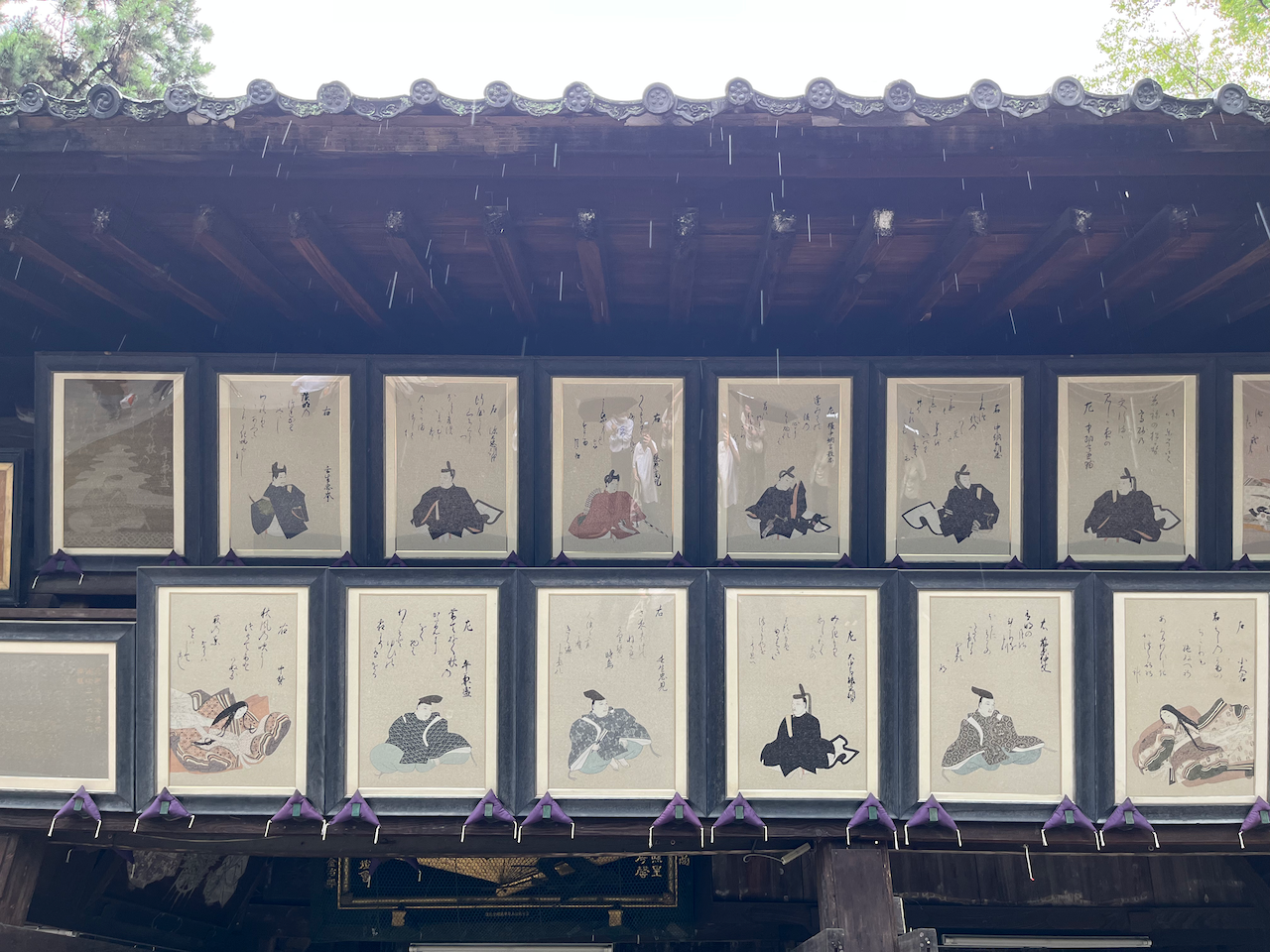
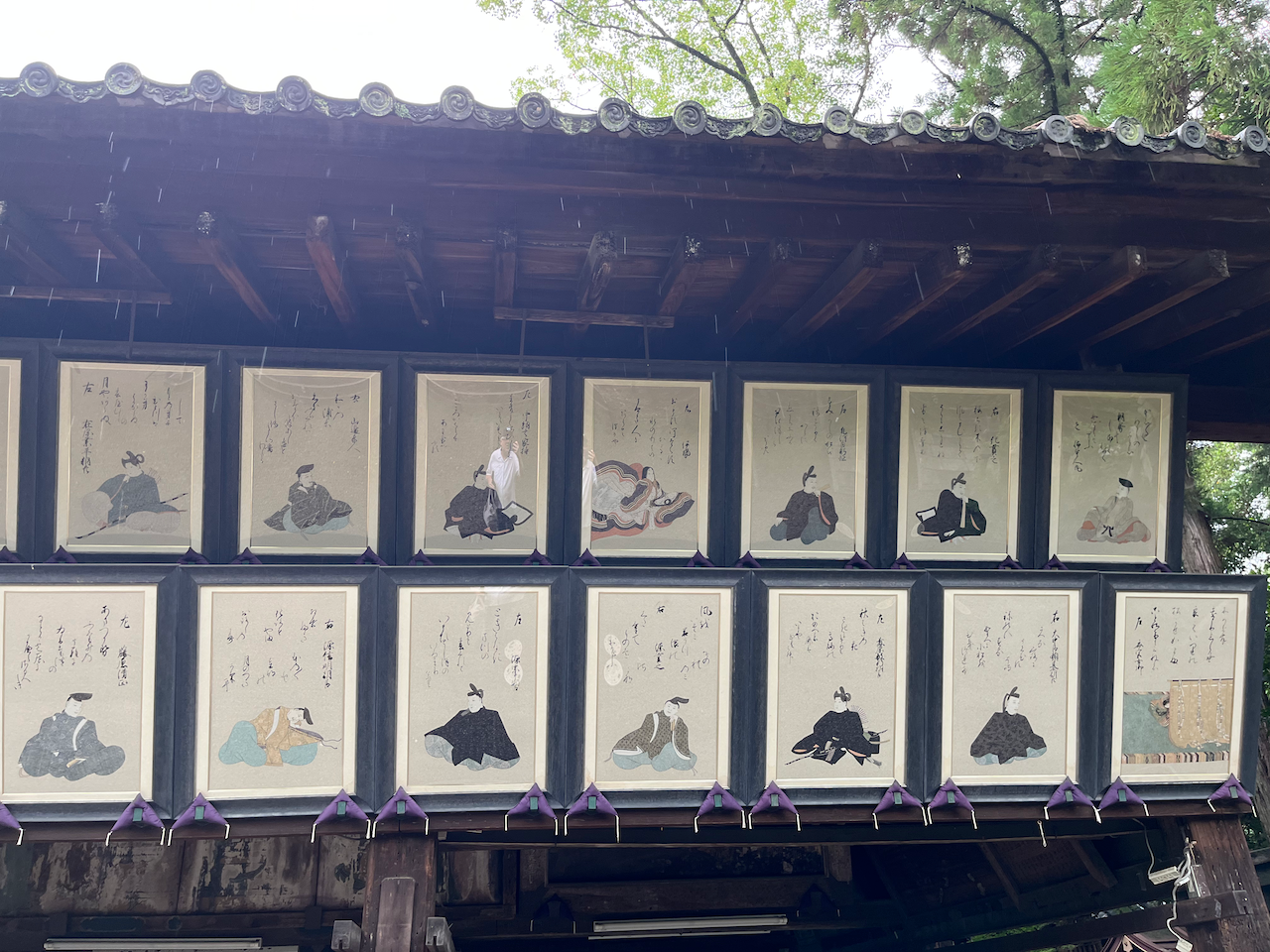
The pavilion near the front entrance had displays of various poems from the Hyakunin Isshu in the form of yomifuda karuta cards! If you look at the photos, you might even see my reflection, too. ;-p
The inside room of the pavilion was interesting too, with lots of really old pictures and paintings affixed:
I also picked up an omamori charm as well:
I keep this in my wallet.
Kitano Tenmangu is a great place to visit while you are in Kyoto, and its tribute to both the famous scholar, and to the Hyakunin Isshu really warmed my heart.
1 This isn’t that unusual in Shinto since the notion of a kami is very broad, and includes not just gods, but also nature spirits, great historical figures, and “anything else that inspires awe” according to one writer.
I recently came back from a family trip to Japan (mentioned here), and while there we took the kids to see the old capitol of Kyoto, where many of the poets of the Hyakunin Isshu lived,1 and where many events took place. But one thing on my bucket-list was to see was the Oishi Tengu-do karuta shop. Last year, I bought a karuta set at a local bookstore in Japan, and of the sets I bought the Tengu-do set was my favorite. And since we wanted to go to Kyoto anyway, it was a great opportunity to visit the home shop fo Tengu-do.
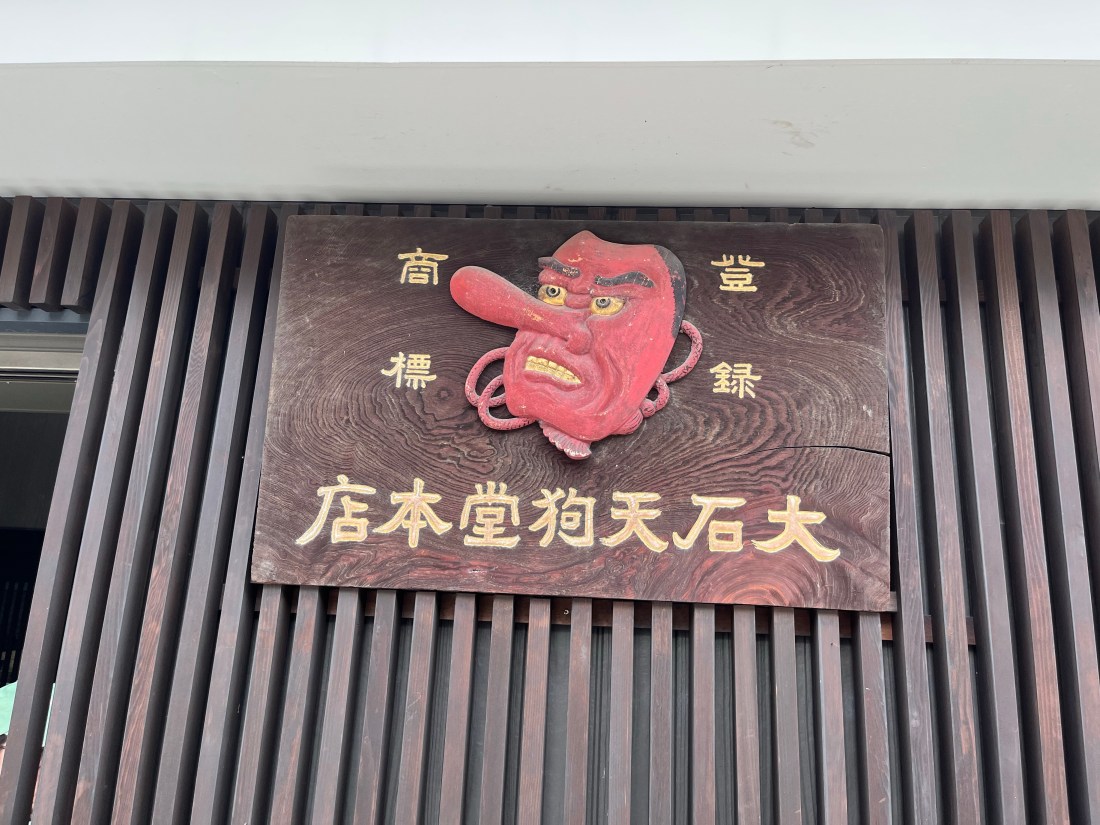
The Tengo-do shop is in the southeast part of Kyoto. If you get to Fushimi-Momoyama station, you can easily walk south 2-3 blocks to get there.
The shop is in a residential neighborhood, but if you look carefully, you can find the sign like so:
The inside of the shop is a single room, just enough room for myself and family, and I didn’t get a chance to take a photo, but I found some good photos online. The elderly lady minding the shop was very kind. We perused for a bit, and I found a few items that I wanted to get. The most important was this set:
This was one of more expensive sets, but I knew that I probably wouldn’t visit Kyoto again for another 10-15 years, so I figured I’d better go big or go broke.
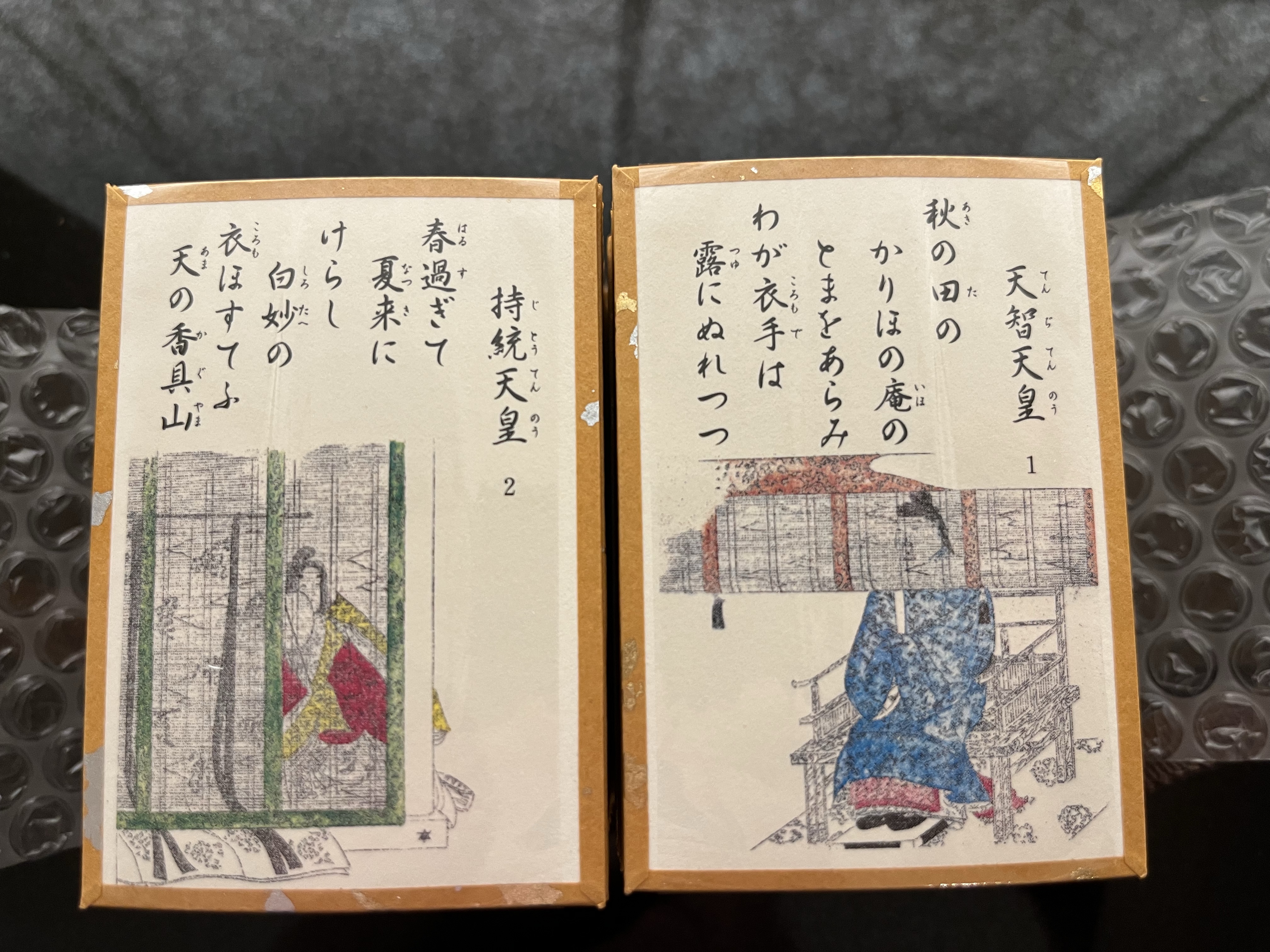
The detail on the cards, especially the border is simply amazing. The yomifuda cards below are for poems 1 and 2:
I also picked up a couple other odds and ends, but this was the real treasure. It was great to visit the home shop of Tengu-do, and to patronize a business like this. If you happen to be in Kyoto, and have an interest in the Hyakunin Isshu and/or karuta, definitely stop by!
1 Prior to Kyoto, the capitol of Japan was a city called Nara. Some of the earliest poets and figures of the Hyakunin Isshu lived when Nara was still the capitol, but I’d estimate at the remaining three-fourths lived in and around Kyoto until you get to the very last few poets who lived in the new capitol of Kamakura. That’s how much history the anthology spans.
I finally did it! I got my very own karuta set of the hyakunin isshu.
Since we came to Japan earlier this week (just ahead of snowy weather, no less), my original plan was to go to the famous karuta shop in Tokyo: Okuno Karuta.
However, since we are here primarily for family matters, we are here for a narrow window of time, and because it’s fairly deep in Tokyo (and thus far removed from my in-laws home), getting there is probably not feasible. Plans might change, but I don’t think I will be able to visit this time around.
On the other hand, at a local bookstore I found a really nice, affordable set!
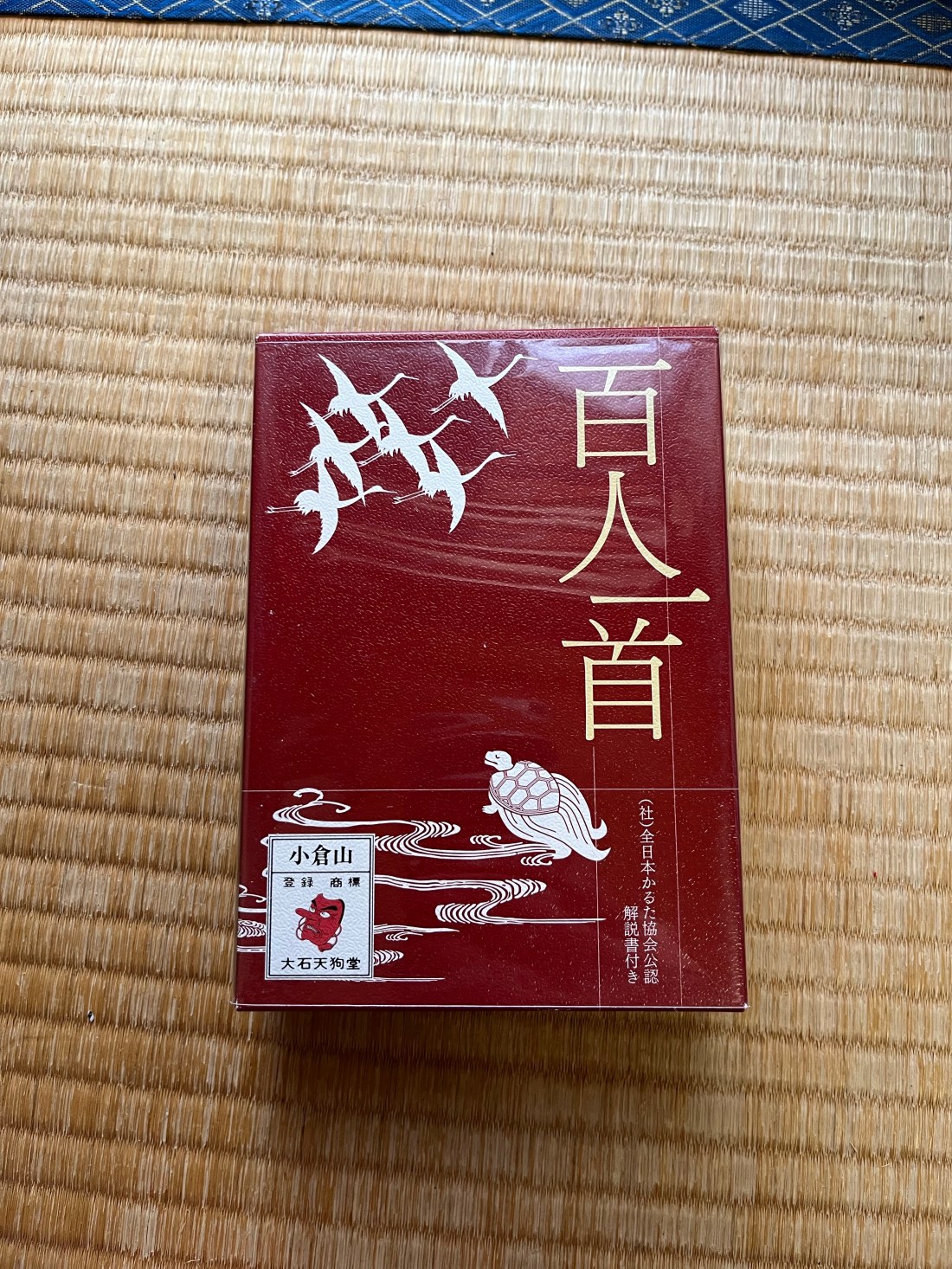
This set is made by Kyoto Tengu-dō, another famous karuta company. I love the box design. Inside, you can see the full set of yomifuda and torifuda cards:
As the product link shows, this set was designed for beginners to karuta games, and the torifuda cards (the ones without pictures) are written in a very legible font, so they’re easier to newcomers to find cards on the fly.
The illustrations are different than what I normally see on karuta cards, but I found out later that this is more typical of handicrafts from Kyoto, versus more Tokyo-style art. Also, the more I look at them, the more I appreciate the amazing detail, such as the clothing patterns, curtains, etc. It’s really fun just to flip through the cards and look.
This set cost me ¥1700, so about $12-15 (depending on exchange rate), which as a gorgeous starter set is quite good deal in my opinion.
Also, I suspect that this won’t be the last set I collect either. 😜
P.S. I had also thought about ordering from Okuno Karuta, but I can’t be sure it would arrive at my in-laws house in time due to holidays and our short schedule. Like I said, I am in no rush and will visit another time.
This is Mount Ogura (小倉山) also called Arashiyama (嵐山) near the city of Kyoto. The place name “Ogura” is where the Hyakunin Isshu gets its full-name: Ogura Hyakunin Isshu.
At that time, it was trendy for aristocrats to compile their own “hundred poems by a hundred poets” anthologies, all named “hyakunin isshu”, but the one that is by far the most famous is the Ogura Hyakunin Isshu, which of course is the source and inspiration of this blog. 🙂
Thanks to KyotoDailyPhoto on Twitter for taking this photo. It’s nice to see the place that inspired the anthology.
This poem was composed by Supernumerary Middle Counselor Sada’ie (権中納言定家, 1162-1241), better known as Fujiwara no Teika, or alternatively Fujiwara no Sadaie.1 He is considered one of the greatest poets in all of Japanese history. Teika was the compiler of this Hyakunin Isshu anthology and was also one of the major compilers of the officialShin Kokin Wakashū anthology. He was also the tutor for Shokushi Naishinno (poem 89), and it is thought that they had a romantic relationship too, though eventually they would be separated for good. In any case, his talent and his family’s influence were so great that the family virtually monopolized the Court poetry for centuries to come. But we’ll talk more about that shortly.
Fujiwara no Teika composed many of his own poems in his lifetime, and yet in compiling the Hyakunin Isshu, why did he select this particular poem for inclusion?
Like many of the later poems in the anthology (poem 90, 91 and 94), this poem alludes to a much older one. In Teika’s case, his poem alludes all the way back to the original anthology in Japan, the Manyoshu. Unlike later anthologies, the Manyoshu was a loose connection of poems, compiled 400+ years before Teika, and the particular poem he alludes to was written from the perspective of a man whose love was burning for a woman like the boiling of seaweed at Matsuo Bay. As you can see, Teika reversed the perspective to be that of a woman, while still alluding to the original. Additionally, Teika gives his poem a sadder tone than the poem from the Manyoshu, which came to be a hallmark of Teika’s style.
Incidentally, Matsuo Bay (written as Matsuho 松帆 here) is on the very northern tip of the famous Awaji Island in the Inland Sea. It is a scenic part of Awaji Island, and even has its own homepage. Awaji Island is also the scene for poem 78. The technique of extracting salt by boiling seaweed, or moshio (藻塩) is a time-honored tradition in Japan, and the seaweed gives the salt a special flavor. There’s a really good article about it here.
Fujiwara no Teika was a master of expressing yūgen (幽玄) or subtle, profound beauty in his poetry. This kind of subtle beauty centuries later came to influence other arts in time in Japan including Noh theater, tea-ceremony, etc.
But who was Fujiwara no Teika?
Teika, alternatively read as Sada’ie, was born from an illustrious family of poets though a minor branch of the powerful Fujiwara clan. His grandfather was Fujiwara no Toshitada and his father was Shunzei (poem 83). As a youth, Teika was a sickly boy but as the eldest son, he was obligated to carry on the family legacy. Unfortunately due to complex court politics, Teika was overlooked for much of his early life. However after a fortunate turn of events, he was noticed by Emperor Go-Toba (poem 99) who eventually commissioned him to compile two new anthologies, including the Shin Kokin Wakashū.
Over time though, Teika and Emperor Gotoba disagreed over poetry and compiling the anthology, leading to an increasingly distant and cold relationship. Teika found Gotoba overbearing, while Gotoba didn’t care for Teika’s free-wheeling style. At times, Teika and Gotoba openly criticized one another through poetry, or in their diary entries, and Gotoba even banished Teika for a year from the capitol. Teika meanwhile grew closer to Gotoba’s son who later became Emperor Juntoku (poem 100), while Gotoba became increasingly occupied with the martial arts, and with wresting power back from the samurai rulers in Kamakura (cf. poem 93)
Unfortunately for Emperor Gotoba, his meager forces were utterly routed by the Kamakura army in the short-lived Jōkyū War, and Gotoba was sent into exile (since it was sacrilege to kill the Emperor). Teika was not involved in the war, so he remained in Kyoto, and even reached the Imperial post of Middle Counselor. During this time, he also completed another Imperial anthology, the Shin Chokusen Wakashū, which shows more of his down-to-earth later style.
Finally though, his health declined from old age and from the famine at the time, so he retired and took Buddhist tonsure. It was during his final years in a Buddhist monastery that he was invited by his son’s father-in-law, Lord Utsunomiya no Yoritsuna, to his villa at Mount Ogura near Kyoto.
This stone marker at Jojakko-ji Temple in west Kyoto, near Arashiyama, marks where Teika had compiled the Hyakunin Isshu. More on that in this post. Photo taken in August 2024.
Lord Utsunomiya asked Teika to compile 100 poems in his own hand, so that they could be adorned on the silk screens of his villa, and these 100 eventually became the collection that we know today.
After Teika died at the age of 80, he was interred at Shokoku-ji Temple in Kyoto. The featured photo above shows his grave marker (Photo courtesy of Wikimedia Commons.). His grandchildren formed into three rival schools of Waka poetry that dominated the poetry scene for centuries:
Nijō School (nijō-ha 二条派) – the conservative and dominant school at first. Over time, a series of misfortunes eventually caused the school to decline and fade by the medieval period in Japanese history.
Reizei School (reizei-ke 冷泉家) – the more liberal branch, but a few generations later became the dominant branch. By the middle of the Muromachi Period, two branches had formed: the upper Reizei school (kamireizei 上冷泉家) and the lower Reizei school (shimoreizei 下冷泉家), which the upper school prevailing in the long-run. This school still maintains a large compound in Kyoto to this day.
Kyōgoku School (kyōgoku-ha 京極派) – this school died out in only a couple generations.
But more importantly, the legacy of Fujiwara no Teika is in his celebrated poetry anthologies, particularly this one. Even today, many kids in Japan enjoy playinguta-garuta in school competitions, and there are even Japanese anime about the Hyakunin Isshu. All of this is due to Teika’s talent and taste for selecting good poetry.
And now, this anthology is enjoyed by international readers like yourself. This blog was a originally a little experiment of mine, but I have enjoyed your readership, your comments, and of course your support. Thank you everyone from the bottom of my heart.
As this is the 100th and final poem of the Hyakunin Isshu, that is all I have to offer on this blog. I may take it up again sometime in the future and cover other anthologies like the Kokinshu and the Shinkokinshu, but for now, I decided that I prefer to leave it as it is.
1 The Chinese characters (kanji) for his given name (定家) have multiple readings possible, and both are seemingly correct. However, based on a cursory glance in Japanese, it seems that “Teika” is the more common reading.
The author, Nyūdō Saki no Daijōdaijin (入道前太政大臣, 1171 – 1244), or “Buddhist novice and former Chancellor of the Realm”. His personal name was Fujiwara no Kintsune. He was a powerful member of the elite Fujiwara clan and extended his support to the Hyakunin Isshu’s compiler, Fujiwara no Teika (poem 97), after Teika married Kintsune’s older sister. He was also well-liked by members of the old Imperial Court and the new military government at Kamakura.
According to Mostow, Kintsune married a niece of Minamoto no Yoritomo, the first shogun of the new military government. After Yoritomo’s son Sanetomo (poem 93) died a tragic death with no heir, Kintsune pushed to make his grandson Kujō Yoritsune, a distant relation to Sanetomo, the next shogun. My new book states that his reputation worsens in his later years as he kept manipulating the power of shoguns from behind the throne.
It also implies that Kintsune may have helped tip off the new military government about Emperor Gotoba’s (poem 99) plans to wrest back control, helping to contribute to the demise of the Emperor and his son (poem 100).
Ah, times had changed since the earlier generations of the Hyakunin Isshu mostly worried about poetry contests and marriage arrangements.
But I digress.
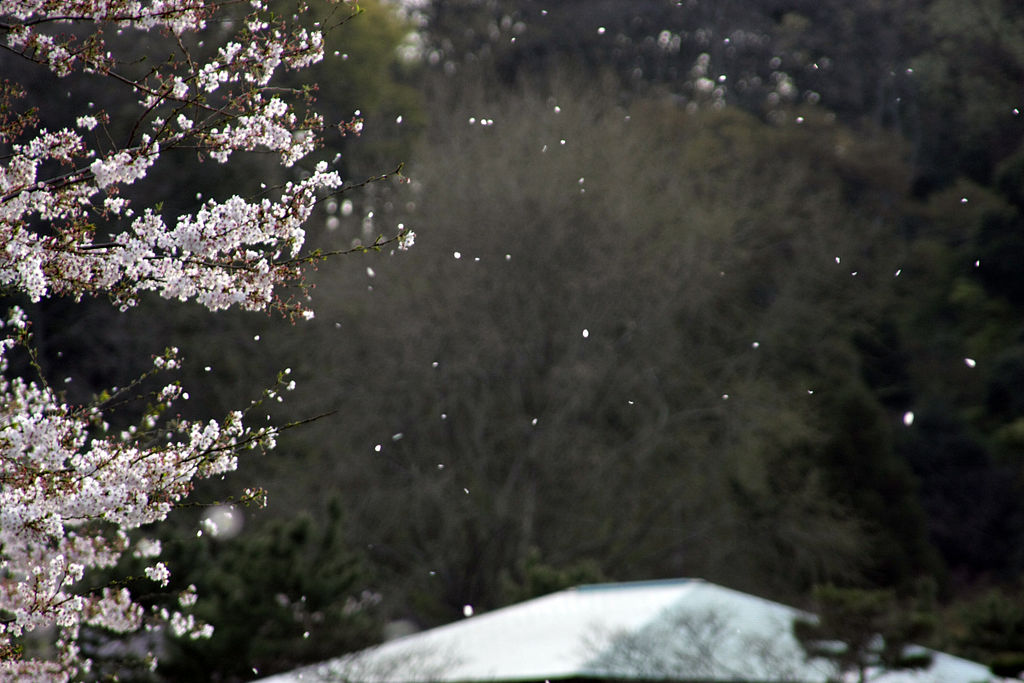
This poem, unlike other poems recently posted which were more clear-cut in meaning, often was the subject of much interpretation. The contrast between the aging man and the scattering of flowers in the wind, called hana fubuki (花吹雪) led to many interpretations by later commentators particularly about the man growing old, according to Professor Mostow. Perhaps he won’t be back next year?
The image of hana fubuki also is noteworthy, because it isn’t a small scattering of flowers. It refers to great scattering of blossoms in the wind, just like a snowfall. Thus Kintsune is witnessing this great scattering even as he contemplates his own decline even after so many years in power.
Pretty awesome poem, really, for a man who lived a noteworthy life.
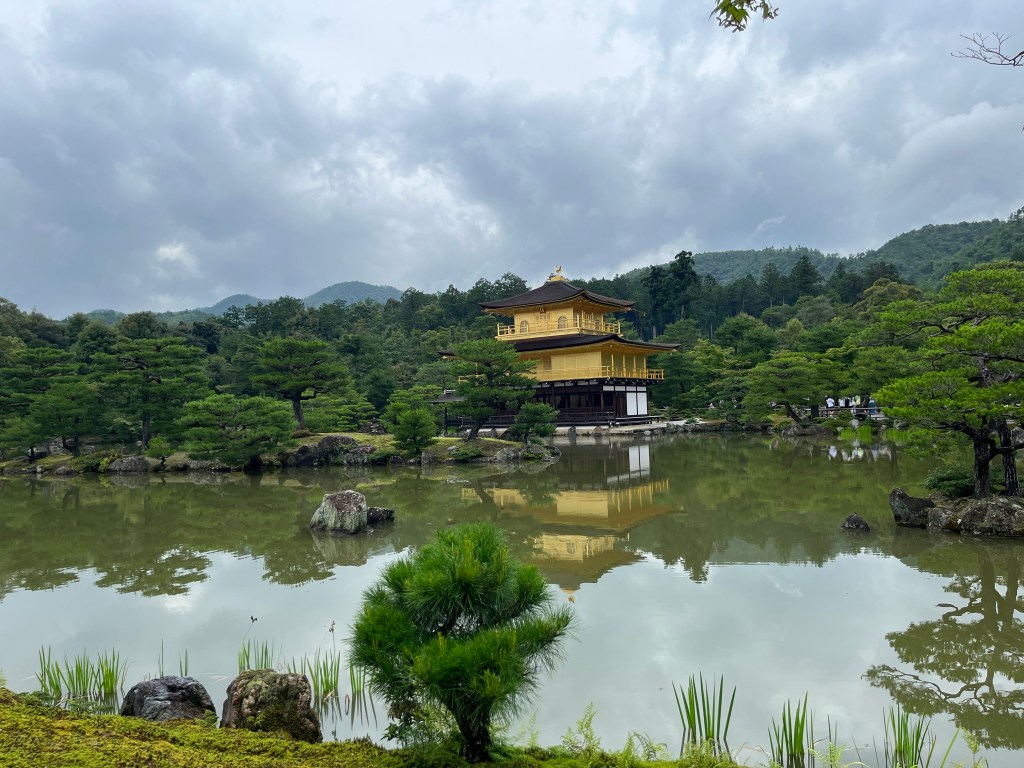
Speaking of scenic views, Kintsune’s residence of Saionji (西園寺), which was also established as his clan’s new name (Saionji), later became the famous Golden Pavilion.
Taken by me in July 2023
Indeed Kintsune’s contribution to Japanese culture and history, dubious as it may be, can be felt even today.
The author, Sangi Masatsune (参議雅経, “Counselor Masatsune”, 1170-1221), also as known as Fujiwara no Masatsune, was another editor of the Shin Kokin Wakashū like Yoshitsune (poem 91) and went on to found the poetic house of Asukai (also famous for calligraphy). He also studied under Shunzei (poem 83) earlier in his career.
I had to look up what fulling cloth meant, but apparently it’s the process of beating cloth, especially wool, to improve the texture, or in the case of Japan, give the cloth a nice glossy sheen. You can see an example of this above, in a painting made in the 1800’s, almost 700 years later. I can’t imagine the process changed much within that time. The process was to place the cloth on a wood or stone surface and pound it with a wooden mallet. In Japanese, the process called koromo utsu (衣打つ) just as it is mentioned in this poem.
Also, this poem, like other poems we’ve looked at recently (poem 90 and poem 91), alludes to a much older poem by Korenori (poem 31), which also mentions snow in the village of Yoshino (yoshino-chō, 吉野町), near the old capitol of Nara.
Interestingly, the “former capitol” is referred to by the poetic phrase furusato, which in modern Japanese means one’s hometown. Nara was the capitol of Japan during the early Nara Period, and personally my most favorite place to visit in Japan. The culture at that time was an interesting fusion of early Japanese culture, Chinese art and culture, and Indian Buddhism (via Silk Road). Even after the capitol was moved to Kyoto (another great place), there existed many euphemisms to the “former capitol” by later poets and authors (poem 61, for example) as a kind of nostalgia or the “good ol’ days”. Hence the use of the term furusato I believe.
P.S. Featured photo is Surimono, Woman Fulling Cloth in the Moonlight, by Shigenobu, Brooklyn Museum, No restrictions, via Wikimedia Commons
Edit: Revamped this page in January 2023 with a lot more information, updated Google Maps links and so on.
Edit 2: Revamped again in August 2023 with even more information.
One of the best ways to appreciate and celebrate the Hyakunin Isshu anthology (besides reading and reciting the poetry) is to play the traditional card game called karuta. I’ve written about it here, here and here before, but for a long time I never owned a set. My wife, who is Japanese, owns a set from when she was young, complete with a cassette tape for reciting the poems, but I wanted to own my own set while respecting her property.
It turns out that purchasing a karuta set can be reallyeasy or somewhat hard, depending on whether you are in Japan or overseas. In Japan, they are easy to find in any local bookstore because kids in Japan often grow up learning the anthology and playing games (even if they lose interest later).
The good news is that you can get a set for relatively cheap (shipping might be pricey though) and there are plenty of good choices. A basic set, minus shipping, is about ¥1800 or $15 USD at current rates, while fancier sets get much more expensive.
This guide is to help folks who are interested in owning a karuta set navigate their options. If you are living outside of Japan, feel free to jump down to the “Purchasing Online” section.
In Tokyo
A while back, I found a good article on the Japan Times about a famous karuta store in Tokyo that has been selling karuta cards for 90 years named Okuno Karuta (奥野カルタ). This is the premiere place to go if you are in Tokyo, particularly in the Chiyoda Ward. You can find it here (Google Maps link):
According to their website they are:
3-min walk from Tokyo Metro Jimbocho Station, A4 exit. This is usually done using the Hanzomon train line.
The Jinbocho Station is the nearest one, and speaking from limited experience the Hanzomon Line is pretty easy to find and covers much of Tokyo.
I did contact Okuno Karuta about ordering online, and while they do have an online store, it usually only ships from within Japan. Your best bet is to simply visit the store in person, or plan to purchase online and ship to some place in Japan you can then pickup.
In Kyoto
If you are closer to the western half of Japan, or traveling through the Kyoto Area, there’s many great karuta shops to visit since it is essentially the home of the Hyakunin Isshu anthology.
My personal favorite is Tengudo (大石天狗堂), founded in 1800. This is the company that made the first karuta set that I purchased, and are located in the Fushimi ward of Kyoto (Google Maps link):
According to their website, the easiest ways to get there by train are:
Similar to Okuno Karuta, you can also order online, but it ships only within Japan.
Local Bookstores in Japan
Further, if you are in Japan, but not near Tokyo or Kyoto (as was my case in December 2022), you can also just visit any local bookstore and find karuta sets there. The selection can be more limited than a dedicated store. The first shop I went to had only one set, but Kinokuniya had several to choose from.
This is a nice middle-ground between big online sites like Amazon or Rakuten, and the smaller but hard to access mom-and-pop stores.
However, again, the shipping options will almost always be limited to Japan only.
Purchasing Online
And finally we come to the last, but most likely option: purchasing online.
If you can’t afford to go to Japan, and just want to get a set of Hyakunin Isshu cards for yourself, there are options for purchasing online.
If you only plan to play, and not read the cards, Tengu-do provides a minimal, tournament-standard set of torifuda cards, available on Amazon JP and Amazon US.1 English is available on Amazon JP.
The torifuda set from Tengu-do. It is a basic, no-nonsense set but still very nice.
But if you’re looking for a full set, maybe with a CD other things, Seattle Karuta Club has other helpful recommendations.
In some countries, Kinokuniya Bookstore has international online stores as well (example link for the USA) which can also ship karuta sets. The USA store can ship to Canada, USA and Mexico for example.
Finally, another option is proxy-buying. This is a niche option that lets you buy Japanese goods from smaller shops like Okuno Karuta or Tengudo, while still being accessible overseas. Japan Rabbit (formerly White Rabbit Express) is one such choice, Rakuten Global Express is another. I haven’t personally use either one, however.
If you go the Rakuten route, they usually have some English translations available, but it’s probably simplest to search for 百人一首カルタ to get accurate results, and then go from there.
Good luck and happy card hunting!
1 These Amazon links are “associate” links, so any purchases made through them give me a small amount of credit in the future.
The author is Sakyō Dayū Akisuke (左京大夫顕輔, 1090 – 1155), or “Grand Master of the West Akisuke”. His personal was Fujiwara no Akisuké, and he served as the administrator of the western “left” half of the capitol of Kyoto. In those days, the capitol was modeled off of the Chinese capitol of Chang-an of the illustrious Tang Dynasty, and was divided into a “western” and “eastern” half with an administrator for each one.
Additionally, Professor Mostow explains that Akisuke was the father of Kiyosuke (poem 84) with whom he had a poor relationship. Akisuke also inherited the Rokujō School of poetry in opposition to Shunzei (poem 83)’s Miko-Hidariké (御子左家) School. Although Akisuke was the rival of the father of Fujiwara no Teika (poem 97), the compiler of the Hyakunin Isshu, Teika apparently didn’t mind including his poems in the anthology anyway. Being a pre-eminent poet, Emperor Sutoku (poem 77) also commissioned him to compile a new anthology, the Shika Wakashū.
The poem itself is somewhat unusual in the Hyakunin Isshu, because the poem is completely straightforward. The poem literally paints a wonderful image of a hazy autumn moon-lit night, with no additional allusions. When you compare otherpoemsintheHyakunin Isshuabout the moon, usually they have some additional meaning. This poem is unusually genuine and still well-composed.
So, as you enjoy the Harvest Moon this evening, take a moment to enjoy this poem if you can. If you’re in Japan, happy o-Tsukimi!















 The Hyakunin Isshu

