The Autumn Wind: Poem Number 71

Another great poem for Autumn:

JapaneseRomanzationTranslation
ゆうさればYū sarebaAs evening falls,
門田の稲葉Kadota no inabathrough the rice-plants before the gate,
おとれてOtozureteit comes visiting, and rustling
あしのまろやにAshi no maroya nion the reeds of the simple hut—
秋風ぞふくAkikaze zo fukuthe autumn wind does blow!
Translation by Dr Joshua Mostow

The poet, Dainagon Tsunenobu (大納言経信, 1016 – 1097) or “Major Counselor Tsunenobu”, also known as Minamoto no Tsunenobu, had a number of poets in his family. He was the father of Toshiyori (poem 74) and grandfather of Shun’e (poem 85), contributed a number of poems to the official anthologies and had a rival or two in his time.

Rice fields in Chiba prefecture, taken while aboard a moving train in 2019 by author

According to Mostow, this poem was composed by Tsunenobu when he was visiting the villa of his friend, Minamoto no Morokata. Unlike other poems of the era which are often composed for poetry contests, apparently he composed this while watching the view from the villa. The villa in question was in a place called Umezu (梅津), on the outskirts of Kyoto the capital. Nowadays, you can find Umezu within the suburbs of Kyoto now, but it’s interesting to imagine an earlier time when it was a country villa surrounded by rice fields, and to imagine a cold autumn wind blowing across them.

This poem catches the spirit of autumn better than many others, I feel. 🙂

A Foggy Winter’s Morn: Poem Number 64

This is a great poem for the deep of winter:

JapaneseRomanizationTranslation
朝ぼらけAsaborakéAs the winter dawn
がわぎりUji no kawagiribreaks, the Uji River mist
たえだえにTaedae nithings in patches and
あられわたるArawaré watarurevealed, here and there, are
せぜの網代木Seze no ajirogiall the shallows’ fishing stakes.
Translation by Dr Joshua Mostow

The author of this poem known by the lofty title of Gonchūnagon Sadayori (権中納言定頼, 995 – 1045), or “Supernumerary Middle Counselor Sadayori”, was also known as Fujiwara no Sadayori, son of the eminent poet and critic of the era, Fujiwara no Kintō (poem 55).

Sadayori was also a respectable poet in his own right. According to my new book, when father and son took part in the Imperial precession by Emperor Ichijo to the Ōi River (大堰川, ōi-gawa), part of the modern Katsura River, he was tasked with composing a poem for the occasion and came up with this:

JapaneseRomanizationRough Translation
水もなくMizu mo nakuHow can one possibly
見えこそわたれMiekoso watarelook out over
大堰川Ōi-gawathe Oi River,
岸の紅葉はKishi no momiji wawhen the fall leaves
雨と降れどもAme to furedomorain down on the shore?
Translation by myself

It was a clever way to point out the beauty of fall, and both Kintō and the Emperor were impressed. Later, Sadayori was supposedly flummoxed by Lady Izumi’s daughter, Koshikibu no Naishi in a famous poetry contest (namely poem 60).

In any case, back to the Hyakunin Isshu poem. The phrase asaboraké is apparently short for asa ga oboroge ni aketekuru koro (朝がおぼろげに明けてくる頃) meaning “that time at dawn when things are hazy”, particularly in autumn or winter. It is also used in poem 31, and a challenge for karuta players as a result.

Sadayori’s usage of the Uji River (宇治川, uji-gawa), now known as the Yodo River (淀川, yodo-gawa), may not seem like much to modern audiences, but it carries much meaning in Japanese antiquity. The Uji River was frequently cited Japanese poetry, and runs through the Osaka metropolitan area. It is mentioned in the earliest Japanese poem anthology, such as the Manyoshu, and others. It was a pivotal place at the end of the Tales of Genji, written by Lady Murasaki (poem 57), when the heroine Ukifuné attempts to take her own life, but is rescued from the river and takes tonsure as a Buddhist nun instead. The Uji River was often deeply associated with turbulent relationships between men and women. In a more practical sense, it was also a place where the nobility of Kyoto often had second villas, and was a popular meeting place.

I actually had to look up what “fishing stakes” are. The term, ajirogi (網代木), refers to stakes in the water, like a fence or weir. Fish swim into these places and they were easier to catch with nets because they had fewer places to escape. You can see an illustration here. Side note: the Salish people here in the Pacific Northwest had a particularly ingenious system of fishing stakes as well.

Professor Mostow notes that the combination of the Uji River and the fishing stakes was a very famous image in ancient Japanese poetry, and this coupled with the image of a cold winter’s dawn make this a powerful poem. Unlike other poems in the Hyakunin Isshu which might be hypothetical, exaggerated or talk about something abstract such as love, Mostow points out that this poem likely was written exactly as Sadayori saw it. I can only wonder what it was like watching the fishermen go to work early that icy morning.

P.S. The featured photo is the Kennebunk River during fog, photo by David Lounsbury, CC BY-SA 2.0, via Wikimedia Commons

In Memory Only: Poem 55

Another poem on the transience of life:

JapaneseRomanizationTranslation
滝の音はTaki no oto waAlthough the sound of
絶えて久しくTaete hisashikuthe waterfull has ceased,
なりぬれどNarinuredoand that long ago,
名こそ流れてNa koso nagareteits name, indeed, has carried on
聞えけれNao kikoe kereand is still heard!
Translation by Dr Joshua Mostow

The author, Dainagon Kintō (大納言公任, 966 – 1041), better known as Major Counselor Fujiwara no Kintō, was one of the top poets of the Heian Period, and the grandson of Tadahira (poem 26) and father of Sadayori (poem 64).

Kinto was more than just a good poet, he was something of a genius renaissance man for his era. There is a famous anecdote taken from a historical text of the time called the Ō-kagami (大鏡, “great mirror”). In this anecdote his kinsman, the statesman Fujiwara no Michinaga, had three boats docked for a party, and invited the literati of the time to board one of three boats: one for Japanese poetry (waka, 和歌), one for Chinese poetry (kanshi, 漢詩), and one for wind and string music (kangen, 管弦) according to their skill. Michinaga then realized that Kinto was so multi-talented he could board any of the three boats so he let Kinto decide. Thus, Kinto earned the nickname Sanshū-no-sai (三船の才, “three boat genius”).

As a side note, when he considered the “waka” boat, he recited the following verses:

JapaneseRomanizationRough Translation
小倉山Ogura-yamaThe cold, stormy
嵐の風のArashi no kazé nowind blowing from
寒ければSamukerebaMount Ogura
紅葉の錦Momiji no nishikiscatters nobles in finery
着「き」ぬ人ぞなきKinu hito zo nakilike autumn leaves!
My own translation, apologies for any mistakes or clumsy translations

This was recorded in the aforementioned Ō-kagami as an example of his cleverness.

Among other accomplishments, Kintō was a respected critic who compiled the Thirty Six Immortals of Poetry list. Kinto compiled imperial anthologies that still represent Japanese Waka poetry of that era. In short, Kinto was the ultimate cultural authority of his time. He is also credited by Lady Murasaki (poem 57, め) or “Lady Purple” for giving her that nickname according to her diary. This was a playful allusion to her Tales of Genji that was circulating at the time and a major nod by Kinto.

Finally, Kinto also served in the Imperial court under the aforementioned Michinaga, and proved to be an able administrator. While he mostly stayed out of the power struggle at the time, he benefitted nonetheless.

But I digress.

According to Mostow, the poem itself was composed after a number of people visited a famous Buddhist temple called Daikakuji, which is in the western part of the capitol of Kyoto. Interestingly, Mostow also points out that this poem is found nowhere else despite the fact that Kinto was a famous poet and had an extensive collection for Fujiwara no Teika to draw from. One suggestion is that Daikakuji is in the same area as Mount Ogura, which is where Teika’s villa resided. The full name of the Hyakunin Isshu anthology is actually the Ogura Hyakunin Isshu by the way.

In any case, this poem is pretty interesting because of the sense of change over time. The waterfall that existed long ago still exists, but in name only. In the same way, life as we know it know will become a dim memory or a misplaced name for future generations. Although Japanese culture has been influenced by Buddhism and its notion of transience since early history, I think this is a point that anyone, anywhere can appreciate.

Also, Kinto’s ability to express this sense of change and impermanence to life seems to me to demonstrate his poetic talent all too well. 🙂

P.S. Featured photo is of the “Materiya” Waterfall in Kagoshima Prefecture, photo by Si-take. at Japanese Wikipedia, CC BY-SA 3.0, via Wikimedia Commons

The Gossamer Years

Hi all,

This somewhat different than my usual posts, but I after posting by poem by the Mother of Michitsuna (poem 53), I decided to read her diary, titled the Gossamer Years, or kagerō nikki (蜻蛉日記) in Japanese.

The “Mother of Michitsuna” is never named as per the culture of the Heian Period of Japan. She lived a generation or two before other famous female authors such as Sei Shonagon (poem 62), Lady Murasaki (poem 57), Lady Izumi (poem 56), etc. The translator, Professor Seidensticker, did a masterful job translating this difficult text. In reading the footnotes, you can see he struggled a lot with the vagaries of the text, and with the language, where it’s not always clear from the context who’s talking about whom.

At the time, she was from a lesser branch of the powerful Fujiwara Family, but she married Fujiwara no Kane’ie, who was gradually moving up the ranks of the Heian Court. Fujiwara clan, Kane’ie had to contend with various other members of the court, and even his own clan, to gain the prestigious position of Regent, which he finally accomplished in 986 as regent for Emperor Ichijō. His sons, Michinaga and Michitaka both became regents and the most powerful men in the Heian Court. Lady Murasaki (poem 57) served under Michinaga, by the way, and they are the subject of a Japanese historical drama in 2024.

Suffice to say, Kane’ie was a very ambitious and influential man. As such, he married a few women, as per Heian Period custom, and also carried on various affairs, having yet more children on top of this. One of these children is the author of poem 52.

The Mother of Michitsuna began her diary when Kane’ie first met her, and courted her. Her own father was the governor of a remote province, a mediocre position in the Court, but he gave his blessing and they were married. In the early part of the Diary, she writes about all the passionate love poems they exchanged and such. It seemed like a good relationship early on, but the Mother of Michitsuna wasn’t Kane’ie’s first wife. She was probably his second or third wife (the diary isn’t clear on this), and his time was divided between his wives. When he was not around, she stayed in one of the outer rooms of his mansion and just passed the time with her hand-maidens.

But as the diary shows, Kane’ie’s visits came less and less often. In time she tracked him down to an alleyway where he’d spend the night with some girl, presumably a bastard child of one of the emperors, and rumor has it that she had a son by him as well. The author was not surprisingly furious and jealous, but completely powerless to stop him. She writes about the sound of his carriage driving by the residence, but not even stopping by to say hello, while she spent night after night alone.

Later, in Book 3, she finds about more of his affairs and children, and adopts the daughter of another of his lovers so that she doesn’t have to spend her young life in a monastery. Strangely, Kane’ie’s brother takes an interest in the child (his own niece) and gets very pushy about marrying her which again was not unusual at the time among the nobility. The Mother of Michitsuna expends a lot of effort to delay and make excuses for the girl, and pleads with her husband to help her, with only modest success.

This agonizing loneliness and sense of abandonment is the primary theme of the Gossamer Years. There are times when Kane’ie and the Mother of Michitsuna grow closer briefly, such as when Kane’ie falls gravely ill or when the Mother of Michitsuna loses her own mother to old age, but after a while he forgets her again. Their relationship is quite strained in the diary though, because she is frequently enraged by his insensitivity, but Kane’ie gets frustrated by her “moods” and can’t seem to understand why she is mad at him. Worse, he blames her regularly as to why he doesn’t come anymore.

At one point, the Mother of Michitsuna, now old and a has-been, has had it with Kane’ie and abruptly moves out of the mansion and retreats to a monastery which causes quite a stir at the Court and humiliates Kane’ie. Furious he tries to send messenger after messenger to bring her back, but she refuses for a long time. Finally, after a combination of threats and pleading, she agrees to return home, but they soon fall into the old routine again.

The Mother of Michitsuna only had one child with Kane’ie, Michitsuna of course (who rose to be a minister of the Court, though not as powerful as his half-brothers), and Kane’ie seems to take much pride in his son, but also periodically uses him as a weapon for getting back at his mother.

Thus, the Gossamer Years is a long, and often very depressing diary of a noblewoman in a very unsatisfying marriage who spent many dreary days alone. The diary ends abruptly one day when there’s a knock at her residence, and it appears that she never took up the brush again. Nobody knows why. As for the diary itself, it is full of poems exchanged back and forth. Most of these are mediocre poems, though as you can see, Fujiwara no Teika did include one of them in his famous Hyakunin Isshu anthology. However, these other poems are also waka poems, just like the ones you read here on this blog, and it’s amazing how many poems people exchanged in those days just to express things like “how are you?” or “can you come over?”.

In today’s modern age where text-messages replace letters or poems, we can send messages much quicker now, but it’s amazing how much skill and subtlety it took to get a simple point across to someone back then. Not surprisingly, the kinds of feelings of frustration a broken-hearted woman might have were probably much worse then because they were traditionally very isolated in their homes. It was uncommon for women, especially powerful noblewomen, to go out on their own without permission from their husbands, and their lifestyle and huge robes made it difficult to travel far anyway. Customs and such would also get in the way too. In short, women spent most of their time indoors in their home with nothing to do.

As for the Mother of Michitsuna herself, it’s tempting to make her a tragic, almost saintly figure, but in reality she was prone to faults of her own. When the “woman in the alley” had the misfortune of losing her home to a fire, the author felt a moment of triumph and petty revenge without any remorse. In another, more troubling scene late in book one, she encounters a defeated rival (it’s not clear who) and gloats over her:

At the Hollyhock Festival in the Fourth Month I recognized the carriage of a lady who had once been my rival, and I deliberately had my own carriage stopped beside it. While we were waiting, rather bored, for the procession to go by, I sent over the first line of a poem, attached to an orange and a hollyhock: “The hollyhock should promise a meeting, but the orange tells us we have yet to wait.” After a time she sent back a line to complete the couplet: “Today for the first time I know the perverseness of her who sends this bitter yellow fruit.” “Why just today—she must have had similar feelings for years,” said one of my women. When I told the Prince [Kane’ie] of the incident, he remarked, to our considerable amusement, that the closing line the lady really had in mind was probably more like this: “This fruit you send me, I would like to grind it to bits with my teeth.”

pg. 59, trans. Seidensticker.

Clearly the Mother of Michitsuna was not above petty rivalries or revenge when it suited her.

Anyhow, what makes the Gossamer Years such a significant work of literature is that it was the first and only real diary of the Heian Period to really express how a woman felt in that small, cloistered world. The Heian Period had many great works of literature, both by men and women, but these works were either fiction (e.g. Tales of Genji), poetry (e.g. Tales of Ise) or just dry, stodgy journals about oval events. The Gossamer Years is much more “raw” and unfiltered than other works at the time. The Mother of Michitsuna is not a strong or witty writer like Sei Shonagon or Lady Murasaki, but you can really feel her pain at times, and wonder why she puts up with him. Then again, the customs of the time gave her few options.

But as you see later in Book 3, it was the culture of the time, not unlike the cloistered French Aristocracy centuries later. The marriage laws from the Taika Reform were vague and full of loopholes, so men could marry as often as they could afford, and affairs were pretty rampant as other poetry in the Hyakunin Isshu regularly show. So while I do enjoy the Hyakunin Isshu and the culture of the Heian Period very much, the Gossamer Years was a sobering reminder that there was a serious side to it as well.

P.S. Featured photo is a scene from the Genji Monogatari (“The Tales of Genji)”, Chapter “YADORI GI”( mistletoe ), by Lady Murasaki (poem 57).  Imperial court in Kyoto, Public domain, via Wikimedia Commons

Have We Met? Poem Number 27

This poem may look straightforward, but it turns out that this is a technical masterpiece:

JapaneseRomanizationTranslation
みかの原Mika no haraLike Izumi River
わきてながるるWakite nagaruruthat wells up and flows,
泉川いずみがわIzumi-gawadividing the Moors of Urns
いつ見きとてかItsu mi kitote kawhen did I see her, I wonder,
こいしかるらKoishi karuranthat I should yearn for her so?
Translation by Dr Joshua Mostow

This poem was composed by Chūnagon Kanesuke (中納言兼輔, 877 – 933), or “Middle Counselor Kanésuké”. He is also known as Fujiwara no Kanésuké. He was the cousin of Sadataka (poem 25), and the great-grandfather of Lady Murasaki (poem 57). Lady Murasaki even used some of his poetry in her work, The Tales of Genji.

Because Kanesuke had a particularly nice residence just beside the dam of the Kamo River, he was also nicknamed the Tsutsumi (堤, “river bank”) Middle Counselor. This residence was a popular gathering place for the who’s-who of his time including Tsurayuki (poem 35) and Mitsune (poem 29). He is also listed among the Thirty-Six Immortals of Poetry as well.

As Mostow points out, this poem is quite clever on a technical level. It uses a preface (the first three lines are a preface to the 4th), poetic place names (Izumi River is actually a real river called the Kizu-gawa 木津川 pictured above from Wikipedia), and pivot-words. The pivot word is izumi which can mean a spring (泉) which wells up, but also rhymes somewhat with the 4th line which says itsu mi as in “when did I see (her?)” (いつ見).

Interestingly though, Mostow points out that this poem may not actually be composed by Kanesuke given that it was originally listed as “anonymous” in the original anthology it came from. Also, as Mostow explains, it’s unclear from the poem whether this is a poem about lovers who met and cannot meet again, or lovers who actually haven’t met yet.

All in all, an interesting poem to examine by a famed poet of the day.

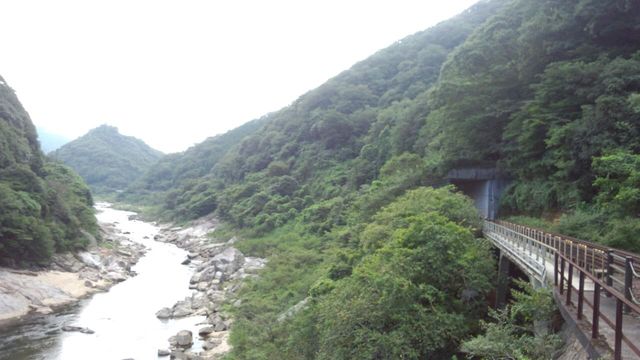
P.S. featured photo is of the Izumi River, near Kyoto, in modern times. Photo by 吉田宅浪, CC BY-SA 3.0, via Wikimedia Commons

The Hyakunin Isshu as a Rough Historical Tour

As you may have started to notice, the Hyakunin Isshu anthology provides a subtle historical overview of the classical period in Japanese history. This may have been intention on the part of Fujiwara no Teika, or just reflects the sentiment of his time. Either way, it’s an interesting tour of Japan from the 8th to 12th centuries.

The anthology begins with poems in the Nara Period, when Japanese culture, flush with cultural imports from China (e.g. Confucian ethics, Buddhism, technology, administration, poetry, etc). It was an exciting time in Japanese history. And if you look at the poems from this era, you can see that they tend to feature benevolent rulers (poem 1), bright and happy natural scenes (poems 2 and poem 4), or just often dealt with frivolous issues of love (poem 3 and poem 12) or just life in general around the capitol (poem 10).

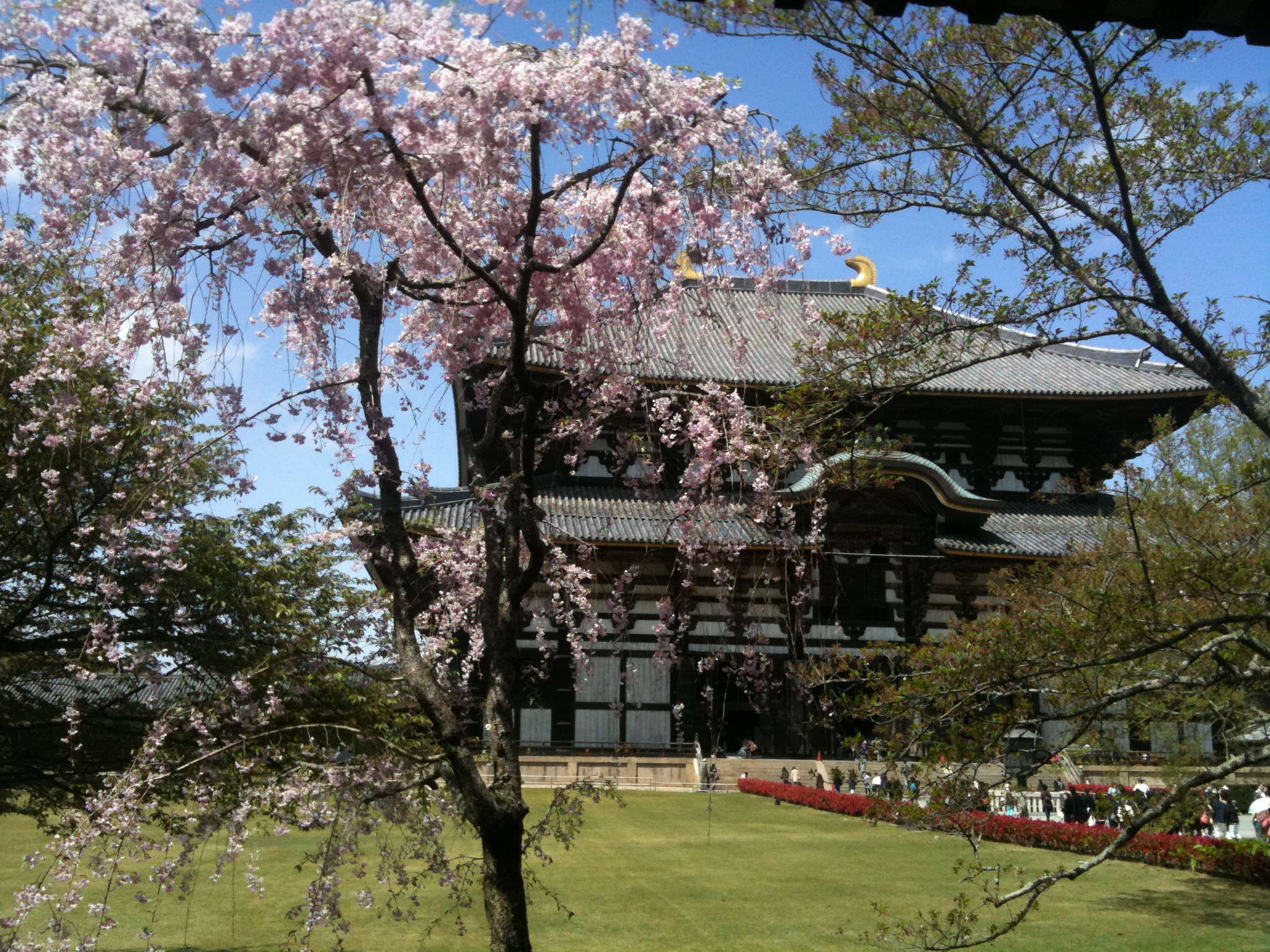
Todaiji Temple in Nara on a warm April day in 2010. Taken by author.

Even when the poems were more melancholy (poem 9, poem 11) they still reflected a more genteel time, and were probably included by Fujiwara no Teika to demonstrate the range of poetic skills of the nobility during that bygone time.

However, the Nara Period eventually gave way to the Heian Period, which was a 400-year flowering of Japanese culture that is still revered today. The transition was slow, and much remained the same generations later, but eventually things started to change:

  • Japan’s contact with China and the Asian mainland eventually stopped, and Japanese culture turned more and more inward for several centuries. Poetry and culture at this time reflected more “native” styles by and by.
  • Politically, the northern-branch of the Fujiwara clan gradually monopolized power around the Emperor through political marriages. In the early period, the nobility included several families who supported the family, but by the 11th century, the Fujiwara controlled every major position in government and most emperors were related to them in one way or another. This is what led in part to Sugawara no Michizan’e exile for example. You’ll notice too how many of the poets have the surname “Fujiwara” in the anthology as well, including Fujiwara no Teika the compiler himself.
  • Toward the end, conflict began to arise again and again, culminating in the famous Genpei War and the fall of the Heike clan. The new samurai class (originally bodyguards to the noble families) clashed with one another for control of Japan and ultimately swept aside the nobility, while still trying to imitate the courtly culture.

As such, if you look at poems toward the very end of the Hyakunin Isshu, they tend to be more dismal in tone. Starting with poem 77 onward, you get an increasing melancholy tone to many poems, culminating at the end when poets often speak of longing for the past (poem 100), complaints about life (poem 83, poem 99) or just expressions of people suffering (poem 95).

Indeed, by this time the flowering culture that started in the Nara Period and flourished in the Heian Period had declined, and war and politics had taken their toll on society. The final few poems begin in the militaristic Kamakura Period, and reflect both nostalgia and unease by people of that era. Small wonder that Fujiwara no Teika, who took tonsure after Emperor Go-Daigo was exiled, decided to compile the Hyakunin Isshu the way he did.

Meeting and Parting: Poem Number 10

This poem is a nice reminder that “traffic” and “commuting” are two things that haven’t really changed much in 1,000 years:

JapaneseRomanizationTranslation
これやこのKore ya konoThis it is! That
行くもかえるもYuku mo kaeru mogoing, too, and coming too,
別れてはWakarete wacontinually separating,
知るも知らぬもShiru mo shiranu mothose known and
those unknown,
おう坂の関Ōsaka no sekimeet at the Barrier of Ōsaka
Translation by Dr Joshua Mostow

This poem was composed by one Semimaru (蝉丸, dates unknown) who is reputedly a blind man who built a hut near Osaka Barrier and was famous for playing the biwa, but the authenticity of this story is questionable, and as Mostow points out, it’s not even certain he existed at all. The story about his life has also changed throughout the generations, so in some cases he’s the servant of the son of an Emperor, and in others he’s the son of an Emperor, abandoned by his blindness.

According to one account in my new book, a high-ranking official named Minamoto no Hiromasa (源博雅) once heard a rumor of a talented blind man with a biwa lute who lived near the Osaka Barrier (see below). He wanted to hear this man’s music, and sought him out for three years until he finally found him on the evening of 15th day of the 8th month (old lunar calendar), and from this man, Hiromasa learned to play the songs that he had been squirreling away. Songs titled such as 流泉 (ryūsen, “flowing spring”) and 啄木 (takuboku, “woodpecker”).

The place in question, Osaka Barrier, is a popular subject of poetry from this era. Poems 62 and 25 also mention the same place because it was a popular meeting spot for people coming and going from the capitol (modern-day Kyoto) eastward. Note that this Osaka has no relation to the modern city of Osaka, which was called Naniwa during that era. In fact the name of Osaka Barrier is also a pun. The Chinese characters are 逢坂, which means “meeting hill”, but is also the place-name.

Anyway, these kinds of check-points, or sekisho (関所) existed in Japan across major roads going in and out of the capitol, but were also popular meeting places for friends and lovers too, as well as having inns nearby for weary travelers. The featured photo above is an example of “sekisho” checkpoint, photo by 663highland, CC BY-SA 3.0, via Wikimedia Commons

The Osaka Barrier in particular was the first check-point leaving eastward from the capitol, so many people probably parted company here, or met old friends at this particular gate more than others. It’s fun to imagine what Osaka Barrier was like in those days. As Mostow points out, this poem probably was originally just a poem about Osaka Barrier, but by the medieval era, it took on an increasingly Buddhist tone in symbolizing the coming and going of all phenomena. Even modern Japanese books on the Hyakunin Isshu tend to reflect this sentiment. Pretty interesting metaphor I think.

One other interesting thing about this poem is its rhythm. If you read this one out loud, the rhythm is very easy to follow, and this is probably one of the easier poems to memorize if you’re looking for a place to start (poem 3 is another good choice in my opinion 😉).

Finally, one random note about Semimaru himself.

A picture of a karuta card depicting Semimaru (poem 10), with his poem above his head. His clothes look similar to a monk and he is holding a Buddhist rosary. His eyes are closed, as he was reputedly blind.

His artistic depiction in karuta cards, such as the yomifuda card above based on the famous Korin Karuta collection, leads to frequent confusion by people who play bozu mekuri: is he a monk or a nobleman? Even my new book mentions this conundrum among Japanese players. His lack of verified biographical information makes this question even more mysterious. The book jokes that the author’s house-rule is that if anyone pulls the Semimaru card, then everyone loses what their stack of cards. Feel free to make your own house-rule. 😊

The End of an Era: Poem 100

The very last poem in the anthology goes along with the previous one in our theme on the end of the Heian Court era:

JapaneseRomanizationTranslation
百敷やMomoshiki yaThe hundredfold palace!
古き軒端のFuruki nokiba noeven in the shinobu grass
しのぶにもShinobu ni moon its old eaves
あまりあるNao amari aruI find a past for which
むかしなりけりMukashi narikeriI long yet ever more.
Translation by Dr Joshua Mostow

This poem was composed by Juntoku-in (順徳院. 1197 – 1242), or “Retired Emperor Juntoku”. Emperor Juntoku‘s father, Emperor Go-toba (poem 99), led the disastrous Jōkyū Disturbance in a last-ditch effort to wrest back power from the new samurai military government in 1221. Like his father, Juntoku was exiled after the rebellion was crushed, but he was sent to Sado Island instead, and lived there for 20 years before his death.

This poem, though, was composed in 1216, five years before the war, and recalls the glory days of the Imperial Court before the downfall in the late 12th century. When we look at the lengthy history of the poetry included in the Hyakunin Isshu anthology, spanning 400+ years, you can see how much poems like this one contrast with the upbeat, optimistic ones from earlier generations. By the time that Emperor Juntoku had assumed the throne, the capitol of Kyoto was already a shadow of its former self, and his reign a greatly diminished one.

In fact, in the Hyakunin Isshu Daijiten, the book points out that the Hyakunin Isshu begins with a poem by an Emperor (poem 1) writing on the harvest, a prosperous subject, and ends with another Emperor longing for bygone times. Fujiwara no Teika (poem 97), the compiler of the anthology obviously knew what he was implying.

Also, the phrase momoshiki is an interesting one. According to Professor Mostow, the phrase is borrowed from a much earlier poem in the Manyoshu:

JapaneseRomanizationRough translation
ももしきのMomoshiki noAre the people of the
大宮人はŌmiyabito waHundred Fold Palace
暇あれやItoma areyaso carefree that they
梅をかざしてUme wo kazashitegather plum blossoms
ここにつどへるKoko ni tsudoeruto decorate their hair?
Book 10, poem 1883

This poem colorfully describes how people in the palace are decorating their hair with plum blossoms they’ve collected, and playfully suggests that life at the palace is well and carefree.

So, it’s really interesting to see how Emperor Juntoku revives this ancient phrase in a poem that conveys the opposite meaning. The sun has set on the Imperial Court, and the palace looks tired and worn now. 

Further, Professor Mostow translates momoshiki as the Hundred-fold Palace which is as good a translation as any in English. But the Chinese characters (kanji) are 百敷 or “hundred seats laid out”, but alternatively, momoshiki can be written as 百石城 meaning “100-stones castle”. Both meanings refer to the Imperial Palace or kyūchū (宮中) in Japanese. The first word implies a hundred mats laid out for sitting (i.e. many people attending the court), while the latter means 100 stones, implying a palace with firm foundations.

But it’s a poignant reminder that all things decline some day.

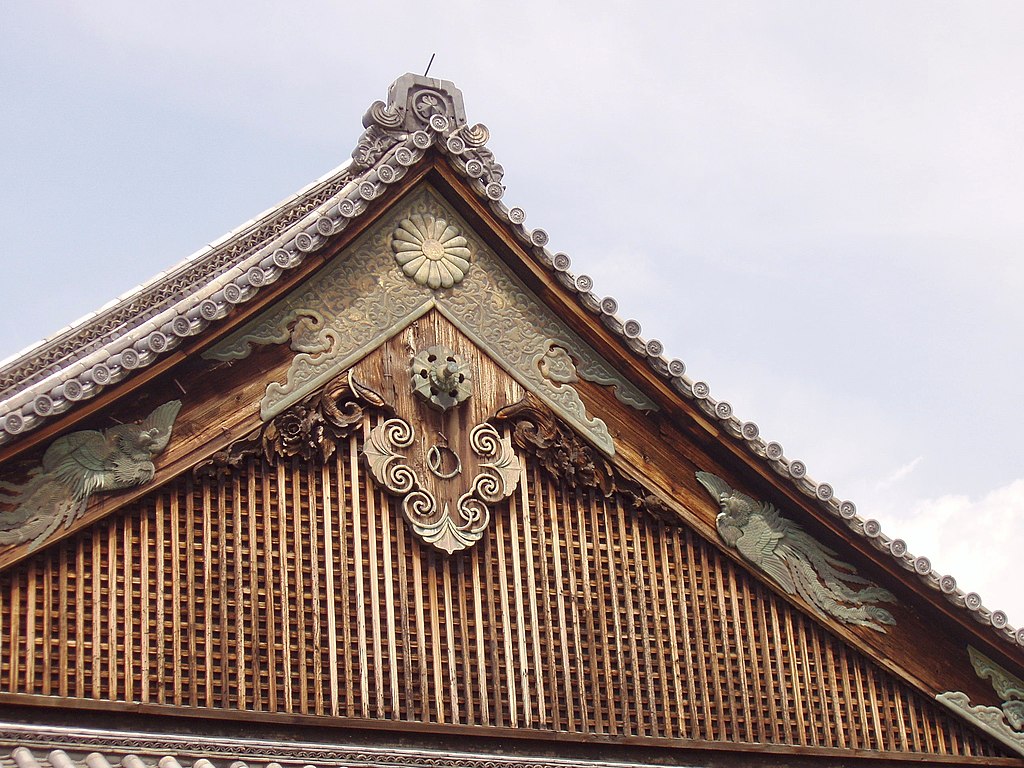
P.S. The featured photo above is the Ninomaru Palace, Kyoto, Japan (photo by Daderot, CC BY-SA 3.0, via Wikimedia Commons).

Contentment: Poem Number 8

An early poem by an obscure and mysterious figure:

JapaneseRomanizationTranslations
わがいWaga io waMy hut is to
都のたつみMiyako no tatsumithe capital’s southeast
しかぞすむShika zo sumuand thus I live. But
世をう山とYo wo ujiyama topeople call it “Uji, hill
人はいなりhito wa iu nariof one weary of the world,” I hear.
Translation by Dr Joshua Mostow

The poem was composed by a Buddhist monk named Kisen Hōshi (喜撰法師, dates unknown), in English lit. “Dharma master Kisen”. Kisen Hōshi lived in the mid-9th century, and this is the only poem known to be his, though others may exist. He is considered one of the original Six Immortals of Poetry and is mentioned in the preface of the official anthology, the kokin wakashū.

The location is a place called ujiyama (宇治山), located on the Tatsumi region southeast of Kyoto, which in turn is named after the twelve animals of the Chinese zodiac. In this context, tatsumi (辰巳) meaning literally “dragon-snake” refers to the direction (southeast) relative to the capitol of Kyoto, then Heian-kyō.

Due to word-play of “uji” meaning either 宇治 (“uji”) or 喜し[つらい] (“ushi[tsurai]”), this place was associated with sorry or grief, so few poeple chose to live here. Since that time, it has been renamed in honor of its resident and is now called kisenzan (喜撰山). Someone did a really nice write-up on their visit to Kisen-zan with photos and a view of what is purported to be Kisen’s original hut. Also, the famous Buddhist temple of Byōdōin also can be found there. It was located south of the capital at the time, Kyoto.

The poem is a tricky one and lends itself to two possible interpretations according to Professor Mostow. One interpretation has been that Kisen came there out of grief and weariness of the world, and made it his home. Mostow provides evidence that instead, Kisen lived there contentedly, and only heard from others that it was called brief mountain.

As there is a Buddhist tradition since the time of the Buddha to withdraw from the entanglement of the world, and find peace of mind. This tradition has led to the Buddhist monastic community that exists today in various parts of the world. Kisen is one of many who sought solace in places like Ujiyama. Question is, did he find only sorrow, or did he find contentedness?

Maybe only Kisen will ever know that.

Memories of the Old Capitol: Poem Number 61

Sorry for the lengthy hiatus everyone. Been a long couple of weeks, but I am excited to post this poem in honor of women poets this month, and timely because of the coming of spring:

JapaneseRomanizationTranslation
いにしInishie noThe eight-petalled cherries
奈良の都のNara no miyako nofrom the Nara capital
Yae-zakuraof the ancient past
けふきょうKyo kokonoe nitoday nine layers thick
ほひおいぬるかなNioi nuru kanahave bloomed within your court!
Translation by Dr Joshua Mostow

Isé no Tayū (伊勢大輔, dates unknown), also known in English as “Lady Ise” was another lady in waiting for Empress Shoshi, as was Lady Murasaki (poem 57) and Lady Izumi (poem 56), but was the newbie apparently.

According to Lady Ise’s own diary, she had to present a poem on the fly to the Bishop from the ancient capital of Nara and its Buddhist institutions, who had brought a lovely eight-petaled cherry blossom as a gift. This variety of cherry blossom is known as yae-zakura (八重桜) in Japanese. Further, the capitol of Japan had moved to Kyoto centuries earlier, but people in Kyoto still looked back to Nara at times for nostalgic reasons. Empress Shoshi’s father, Fujiwara no Michinaga (the same one mentioned in Lady Murasaki’s diary) had asked Lady Murasaki to compose the poem, but for reasons not understood, she deferred to Lady Ise because she was new. 

Thankfully, her poem was a success. As Professor Mostow notes, it does a really nice job balancing the “ancient” with the modern, and the eight petals of the blossom with the metaphorical nine-layers of the Imperial court.

No wonder she made the inner-circle of Empress Shoshi. 😌

Happy Spring everyone!

P.S. Nara is a pretty awesome place to visit in Japan, definitely recommend.

P.P.S. Featured photo is of cherry blossoms at the University of Washington in 2022, taken by me