Wishing This Moment Wouldn’t End: Poem Number 73

Cherry-blossom season doesn’t last long, so while there’s still time, I wanted to post one last poem on the subject:

JapaneseRomanizationTranslation
高砂のTakasago noAbove the lower slopes
の桜Onoe no sakuraof the high mountains,
the cherries
咲きにけりSaki ni kerihave blossomed!
とやまのかすみToyama no kasumiO, mist of the near mountains,
立たずもあらなTatazu mo arananhow I wish you would not rise!
Translation by Dr Joshua Mostow

The author, Gonchūnagon (権中納言匡房, 1041 – 1111) or “Supernumerary Middle Counselor Masafusa”, was a prolific poet both in Japanese and in Chinese-style, and was a close confidant of Emperor Horikawa after retirement. His personal name was Ōe no Masafusa. As Professor Mostow notes, the poem’s meaning is very clear from the headnote, so there’s little if any debate about its meaning (unlike many poems in the Hyakunin Isshu). Masafusa hopes that the mist will not rise and block the view of the blossoms.

This poem brings to mind a time-honored tradition in Japan called hanami (花見) or “cherry-blossom viewing”. 🌸 This is a tradition you can see alive and well in Japan today, and each year there are plenty of websites and helpful guides for Japanese and foreigners to find a good spot for viewing.

However, during the time of the Heian Court and the poets of the Hyakunin Isshu, it was more of an outing for elite members of the court only. Such excursions, just like now, included lots of music, singing and drinking as well as impromptu poetry. The only difference, really, was that back then it was a very isolated affair between good friends and a private spot, whereas now people really have to fight for a good spot in places like Tokyo or Kyoto, and often times involve one’s boss and associates from work. 😏

Still, while some things have changed, it’s nice to see such a tradition live on for so many generations.

P.S. Featured photo is of cherry blossom viewing (hanami) in Oyamazaki, Kyoto Prefecture, Japan. Photo by Oilstreet, CC BY-SA 3.0, via Wikimedia Commons

Cherry Blossoms in Unexpected Places: Poem Number 66

Now that Spring is finally here, and cherry blossoms are blooming in Japan, I thought this poem was especially fitting:

JapaneseRomanizationTranslation
もろともにMorotomo niLet us think of each
れと思Aware to omoeother fondly,
山桜Yama-zakuraO mountain cherries!
花より外にHana yori hoka niFor, outside of your blossoms,
知る人もなしShiru hito mo nashithere’s no one who
knows my feelings.
Translation by Dr Joshua Mostow

The poem was composed by Saki no Daisōjō Gyōson (前大僧正行尊, 1055 – 1135), or “Former Major Archbishop Gyōson”, who according to Mostow, was a famed yamabushi or mountain ascetic, who dwelt on Mount Ōmine near Nara for a long time. He was the great-grandson of Emperor Sanjo (poem 68), and also a very prolific author in his day.

At the age of 10, his father passed away, and by age 12, Gyōson took tonsure at the Buddhist temple of Mii-dera, a major temple of the powerful Tendai sect. According to one episode in my new book, Gyōson had a reputation for being an expert at supplication of the Buddhist deities (lit. kaijikitō 加持祈禱). According to one story, when the newborn baby of Emperor Toba suddenly stopped breathing. Gyōson beseeched the gods, and somehow saved the baby, gaining trust of the Imperial family.

As for the poem, Mostow comments that the poem itself is fairly straightforward, but the poem’s headnote has confused many scholars over time, stating that it was composed “when he saw cherry blossoms unexpectedly at Ōmine.” Was it the time of year, or the location that made it so unexpected? No one really knows for sure.

Also, the term yamazakura (山桜) refers to mountain cherry blossoms. This is a wild variety of cherry blossom that differs from the typical cherry blossoms (somei-yoshino) often seen in gardens. The blossoms are more whitish than pink in color, and bloom at the same time that the leaves do.

Mount Ōmine (大峰山) near Nara was, among places, a popular mountain retreat for yamabushi practitioners. The phrase morotomoni means “you and me”, and implies intimate familiarity.

But, the joy of seeing cherry blossoms at this time of year is hard to deny. 🙂

P.S. Featured photo shows mountain cherry blossoms in Gunma Prefecture, Japan, taken by mahlervv, CC BY 3.0, via Wikimedia Commons

Memories of the Old Capitol: Poem Number 61

Sorry for the lengthy hiatus everyone. Been a long couple of weeks, but I am excited to post this poem in honor of women poets this month, and timely because of the coming of spring:

JapaneseRomanizationTranslation
いにしInishie noThe eight-petalled cherries
奈良の都のNara no miyako nofrom the Nara capital
Yae-zakuraof the ancient past
けふきょうKyo kokonoe nitoday nine layers thick
ほひおいぬるかなNioi nuru kanahave bloomed within your court!
Translation by Dr Joshua Mostow

Isé no Tayū (伊勢大輔, dates unknown), also known in English as “Lady Ise” was another lady in waiting for Empress Shoshi, as was Lady Murasaki (poem 57) and Lady Izumi (poem 56), but was the newbie apparently.

According to Lady Ise’s own diary, she had to present a poem on the fly to the Bishop from the ancient capital of Nara and its Buddhist institutions, who had brought a lovely eight-petaled cherry blossom as a gift. This variety of cherry blossom is known as yae-zakura (八重桜) in Japanese. Further, the capitol of Japan had moved to Kyoto centuries earlier, but people in Kyoto still looked back to Nara at times for nostalgic reasons. Empress Shoshi’s father, Fujiwara no Michinaga (the same one mentioned in Lady Murasaki’s diary) had asked Lady Murasaki to compose the poem, but for reasons not understood, she deferred to Lady Ise because she was new. 

Thankfully, her poem was a success. As Professor Mostow notes, it does a really nice job balancing the “ancient” with the modern, and the eight petals of the blossom with the metaphorical nine-layers of the Imperial court.

No wonder she made the inner-circle of Empress Shoshi. 😌

Happy Spring everyone!

P.S. Nara is a pretty awesome place to visit in Japan, definitely recommend.

P.P.S. Featured photo is of cherry blossoms at the University of Washington in 2022, taken by me

Past Her Prime: Poem Number 9

For the first poem for March’s “women only” theme, I chose this poem, one of the earliest by a female author (after Empress Jitō, poem 2), but also one of the most famous:

JapaneseRomanizationTranslation
花の色はHana no iro waThe color of flowers
うつりにけりなUtsuri ni keri nahas faded indeed
いたらにItazura niin vain
わが身世にふるWaga mi yo ni furuhave I passed through
the world
ながめせしまにNagame seshi ma niwhile gazing at the
falling rains.
Translation by Dr Joshua Mostow

The author, Ono no Komachi (小野小町, dates unknown), is one of the most celebrated women of Japanese antiquity for both her reputed beauty and her poetry. She is one of the original Six Immortals of Poetry and the later Thirty-Six Immortals, and was said to have had relationships with various men, including Henjō (poem 12), and Fun’ya Yasuhide (poem 22) among others.

Reading this poem is something of an intimate look at the fear many women (and men, see poem 96) face then as much as now: the fear of getting old. For someone who was beautiful as Ono no Komachi, the loss may have been even more distressing.

Mostow describes this poem featured in the Hyakunin Isshu as a “technical tour-de-force”: the third line, meaning “in vain”, could technically modify either the previous line, or the one after, or both. Also, the poem uses word-play around furu which could mean to either “fall (as in rain)” or “to pass time”, while nagame could mean both “to gaze lost in thought” or “long rains” (長雨, naga-ame as Mostow explains). Further, this poem has been the object of much debate because of all the possible ways to interpret it, and is one of the most iconic in the anthology both for its technical prowess, but also it’s poignant message.

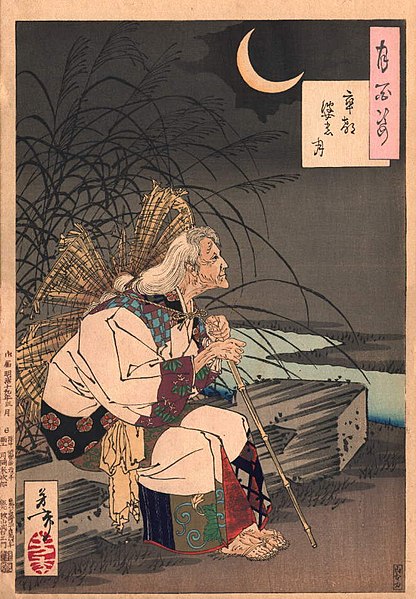
There are many legends that circulated in medieval Japan about Ono no Komachi’s good looks and her cruelty to men. In one famous story, she promised to love a certain suitor if he visited her 100 nights in a row. He completed 99 visits, but failed one night to visit her, and was so distraught that he fell ill and died. Ono no Komachi’s life and legends, including her decline, grew to become the subject of many Nō plays and art. Even 19th century woodblock prints depicted Ono no Komachi in her twilight years:

Yoshitoshi, One Hundred Aspects of the Moon, woodblock print #25, Public domain, via Wikimedia Commons

However, if you look at her other poems, mostly found in the Imperial anthology, the Kokin Wakashū, you can see she was more caring and sensitive than legend implies:

JapaneseRomanizationTranslation
思ひつつOmoitsutsuTormented by love
寝ればや人のNurebaya hito noI slept and saw him near me —
見えつらむMietsuranhad I known my love’s
夢と知りせばYume to shirisebavisit was but a dream I
覚めざらましをSamezaramashi oshould never have awakened.
Poem 552 in the Kokin Wakashū, translation by Laurel Rasplica Rodd and Mary Catherine Henkenius in Kokinshu: A Collection of Poems Ancient and Modern.

and:

JapaneseRomanizationTranslation
わびぬればWabinurebaI have sunk to the
身をうき草のMi o ukikusa nobottom and like the rootless
根を絶えてNe o taeteshifting water weeds
誘ふ水あらばSasou mizu arabashould the currents summon me
いなんとぞ思ふInan to zo omouI too would drift away
Poem 938 in the Kokin Wakashū, translation by Laurel Rasplica Rodd and Mary Catherine Henkenius in Kokinshu: A Collection of Poems Ancient and Modern.

So, Ono no Komachi wasn’t just a pretty face past her prime, she was a smart woman with a sharp wit, and a more sensitive side as well.

Spring is here: Poem Number 33

One of my personal favorite poems in the entire collection is this one:

JapaneseRomanizationTranslation
ひさかたのHisakata noIn these spring days
光のどけきHikari no dokekiwith the tranquil light
encompassing
春の日にHaru no hi niThe four directions
心なくShizu gokoro nakuwhy should the blossoms scatter
花のちるらHana no chiruranwith uneasy hearts?
Translation by Dr Joshua Mostow

The author, Ki no Tomonori (紀友則, ? – 905?), was the cousin of Ki no Tsurayuki (poem 35). Tomonori is one of the Thirty-Six Immortals of Poetry, and helped to compile another famous poetry anthology, the Kokinshū (古今集).

The Kokinshū, formerly known as the Kokin Waka Shū (古今和歌集 “Collection of Ancient and Modern Japanese Poetry”) was completed in 905 and was the first of many efforts by the ancient Court to compile the best poetry, past and present, into an official anthology. The Hyakunin Isshu by contrast was one man’s effort in his retirement. More on that in a later post. As for Tomonori, it is said that he didn’t live to see the completion of the Kokinshū, sadly.

As for this poem, this is one of the most famous in the collection and emblematic of Spring, but also the fleeting nature of the world, and the touch of melancholy that comes with it. Truly this is a lovely poem. It also has a textbook example of a pillow word in the form of ひさかたの (hisakata no) in its opening verse, also used in poem 76.

The First Signs of Spring: Poem Number 35

Early Spring is always an exciting time to look forward to, and this is a great poem for that time of year:

JapaneseRomanizationTranslation
人はいさHito wa isaWith people, well
心も知らずKokoro mo shirazuyou can never know their hearts;
ふるさとはFurusato wabut in my old village
花ぞむかしのHana zo mukashi nothe flowers brightly bloom with
香ににほひおいけるKa ni nioi keruthe scent of the days of old.
Translation by Dr Joshua Mostow

The author, Ki no Tsurayuki (紀貫之, ? – 945), is among the primary composers of the official anthology, the Kokin Wakashū (古今和歌集), and the person who coined the Six Immortals of Poetry therein. He wrote the famous and fictional Tosa Diary, and is also the cousin of Ki no Tomonori who composed poem 33.

The Kokin Wakashu explains the background to this poem. Whenever Ki no Tsurayuki would make a pilgrimage to Hatsuse (初瀬, modern day Hasedera Temple in Nara), he would stay at a friend’s house along the way. After an extended absence, when Tsurayuki visited again, the owner sent this poem to him with a branch of plum blossoms attached. Mostow hints that in one interpretation, the owner might have been a woman who was sad that he hadn’t visited in a long time, though other interpretations imply the author was a man, and the meaning was more platonic.

Here the reference to “blossoms” is for plum blossoms in particular, called umé (梅). We’ve seen the popularity of plum blossoms over cherry blossoms (sakura 桜) in antiquity even as far back as the Manyoshu.