Karuta Training through Nakama-Waké

As I wrote previously, I have been spending a lot of time trying find more effective training methods for myself and for new, foreign Karuta players because of the scarcity of resources. One website that has been particularly helpful in Japanese is Karuta Club, managed by the Meijin (master player) Kawase Masayoshi and his wife.

It’s a pretty nice site and has a ton of training and resources, though almost all of it is in Japanese. There is a nice English-language introduction that is worth reading.

But for this post I wanted to focus on one particularly helpful article. This teaches a method of memorization called nakama-waké.

The method seems a bit complicated upfront but really helps in those 15 minutes (or 30 seconds on the app) when you have to memorize the board, and uses knowledge you probably already know: the kimari-ji.

Let’s look at my kimari-ji chart here. You can see how the cards are group by first syllable : “ha” cards, “tsu” cards, “ki” cards, “wa” cards and so on.

Kawase’s article suggests that after you learn the kimari-ji, next invest time memorizing how many are in each group. If you look at the chart, there are only two cards in the “tsu” (つ) group, compared to seven in the “wa” (わ) group, or 16 in the “a” (あ) group. Some groups are very large, some are very small.

Let’s use the examples of the “ha” group. From the chart we can see that there are four cards that start with “ha” (は):

Kami no Ku
(upper verses)
Shimo nu Ku
(lower verses)
Poem No.
はなさそう あらしのにわの ゆきならでふりゆくものはわかみなりけり96
はなのいろは うつりにけりな いたずらにわかみよにふるなかめせしまに9
はるすぎて なつきにけらし しろたえのころもほすてふあまのかくやま2
はるのよの ゆめばかりなる たまくらにかひなくたたむなこそをしけれ67

If we remember that the “ha” group has 4 cards total, and when you are memorizing at the start of the match, you can determine which of the four are on the board. The rest can be safely ignored as kara-fuda (“empty cards”).

This separation of similar cards (“friends”) between the ones on the board and the ones that aren’t is why this is called nakama-waké (仲間わけ): “separating friends”.

Using the online karuta app, let’s demonstrate this. Here’s a game I played earlier, using default settings: 8 cards per side, only 30 seconds to memorize. The cards are all laid out, and my opponent (the computer) and I are memorizing.

Of the four “ha” cards, I can see two on the board, highlighted in purple. The two cards are “haruno” (はるの) on my side and “harusu” (はるす) on the opponent’s side. That means the other two in the group “hanano” (はなそ) and “hanasa” (はなさ) can be totally ignored if they are read aloud. That helps me avoid accidentally taking the wrong “ha” card and getting a penalty.

While we’re here, you might notice that both “shi” (し) cards are on the board, highlighted in green: “shira” (しら) and “shino” (しの). Even better they are on my side. That means I can just put group them together and simply listen for “shi” (し). Of course, the danger is that the opponent knows this too. Position matters.

Similarly, both cards of the “tsu” (つ) group are on the board too, highlighted in red. They are on opposite sides of the board though, so I still have to be careful to distinguish which is which when read. But it also means there are no “empty” tsu cards either.

Finally, of the seven unique “one syllable” cards, only one of them is on the board: “sa” (さ) which I’ve highlighted in blue. That means I can totally ignore the other six: “mu” (む), “su” (す), “me” (め), “fu” (ふ), “ho” (ほ) and “se” (せ) if they are read.

This may seem like more work upfront, and it does take time to get used to thinking like this, but it really helps in a couple ways:

  1. Your memorization process is more structured, less haphazard, and so you can memorize a full board of 50 cards more easily.
  2. Less risk of penalties because you’re only paying attention to the cards you know are on the board per group, and disregarding the rest.

If you’re relatively new to karuta and you find this process intimidating, you can focus on smaller, easier groups of cards for now: the one, two, and three card groups. With experience, and familiarity, you can then expand to larger, more difficult groups and even use this trick with the huge “a” group.

Otetsuki Penalties

One of my biggest challenges with learning to play karuta are penalties (otetsuki, お手付き). A penalty happens in one of there scenarios:

  • The correct card is on the opponents side, but you touch a card on your side for any reason.
  • The correct card is on your side, but for any reason you touch a card on the opponent’s side.
  • The card is not on the board (karafuda, から札), but for any reason you touch a card on the board.

In all three cases the result is the same: your opponent is allowed to send a card over to you. Their card count is reduced by one (advantage), and your card count also increases by one (disadvantage).

If you think about it, a penalty is more costly than simply letting your opponent take the card. In the rare case of a double penalty, it is extremely costly because your opponent will send over two cards.

However, the pressure to correctly identify and then take the correct card before your opponent makes penalties possible, even for pro players. However, the more you prevent penalties the better your gameplay overall.

In my case, I get penalties often under pressure. In some games, I get as many as 8-9 penalties which is disastrous. The featured photo is a game I lost recently where I had 6 penalties. I would have still lost but the margin was much bigger due to penalties and panic (i.e. “tilting”).

If I calm down and focus, I can reduce this far fewer. Sometimes when I panic, I have to remind myself that it is better to be slow, than to be wrong.

For the past month, I have been striving to reduce my penalty rate and found a great article in Japanese. It identifies a few different patterns of penalties people tend to do, and how to counteract each. I won’t explain the article word for word, but some of the more common patterns are:

  • Forgetting (or mis-remembering) the position of cards on the board. This requires a grasp of the kimariji for quick recognition, and focus to maintain a “mental map” in your head. Personally, I find it helpful to focus on an empty spot on the board as a meditation “focal point”, so I can visualize without looking.
  • Hitting cards on both sides of the board on accident. This requires physically practicing how you move your hand and being quick, but more precise.
  • Listening incorrectly (or jumping the gun) and taking the wrong card. This is very common and a good habit to break quickly.

One method I have used and wrote about before is playing solo and reducing the pressure while focusing on being correct, not fast.

Another, general method for reducing penalties is practicing kikiwaké (聞き分け): “separating sounds”. This is a form of teaming and a mini-game in the online karuta app called “Branching Cards” in English. The Japanese kikiwake means to listen and differentiate.

“Branching Card” in English

In each round you will be presented with 2-3 tomofuda (友札), or cards with similar kimariji. Your job is to listen and take the correct one. There are no empty cards; the correct one is always on the board somewhere.

As the article explains above, you should focus on the last syllable of each kimariji so that you can more easily differentiate which is being read.

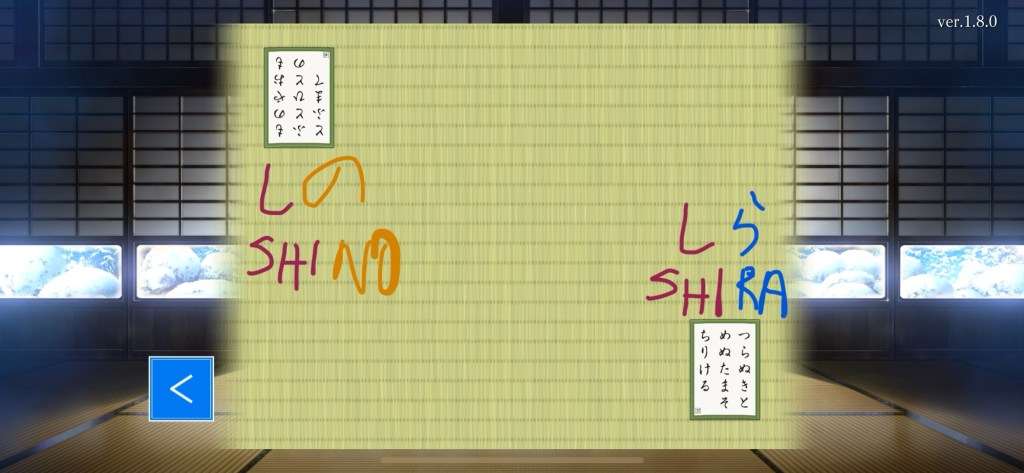
In the example below, there are two cards with kimariji of しの (shino) and しら (shira). The の and ら are what differentiate the two.

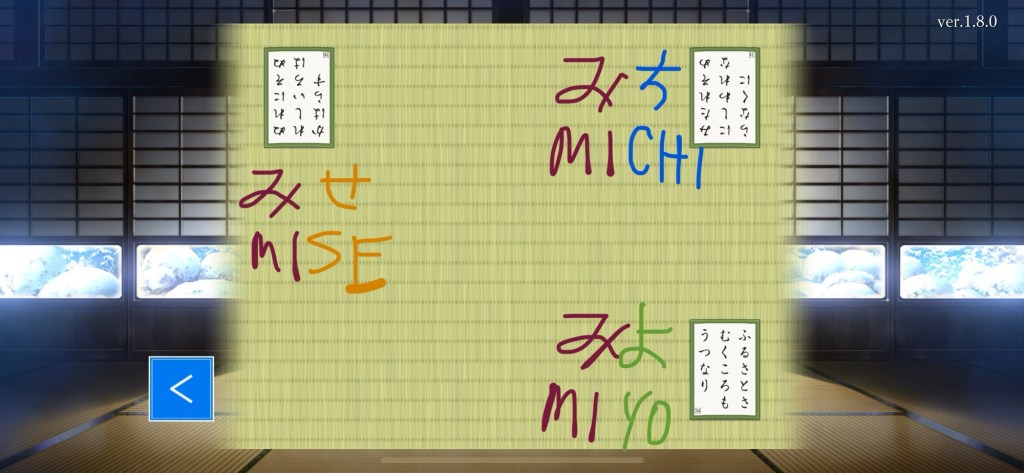
In a more challenging example, there are cards with kimariji of みせ (mise), みち (michi) and みよ (miyo). The せ, ち, and よ are what differentiate the three.

At first this is surprisingly tough to do. You have to recognize the cards quickly, and then listen for the important syllable. I made many mistakes at first, but after a couple weeks, I’ve gotten better about waiting until the correct syllable is read.

As always keep practicing fudawake, but also strive to improve your listening and self-discipline too.

Good luck!

Karuta Practice: Fuda-waké

As part of my efforts to improve my practice routine and make small, incremental gains, I got some helpful advice from the Seattle Karuta Club, and was pointed toward this website. This Karuta Club, the Akita Kohohana Karuta Club, in Akita Prefecture demonstrates how to practice Karuta using a method called fuda-waké (札分け), meaning “distributing cards” or “dividing up cards”, etc.

This technique takes a bit of setup at first but is a great way to both reinforce kimari-ji and also positioning your cards (tei’ichi 定位置).

First, you need to make a chart large enough to place your cards on a 7×4 grid, like so:


Then fill in the Japanese hiragana like so. I’ve added both romaji (Roman alphabet) and kiriji (Cyrillic alphabet) for convenience.

や ya яみ mi миは ha хаた ta таさ sa саか ka каあ a a
ゆ yu юむ mu муひ hi хиち chi тиし shi сиき ki киい i и/й
よ yo ёめ me мэふ fu фуつ tsu цуす su суう u у
わ wa ваも mo моほ ho хоな na наせ se сэこ ko коお o o

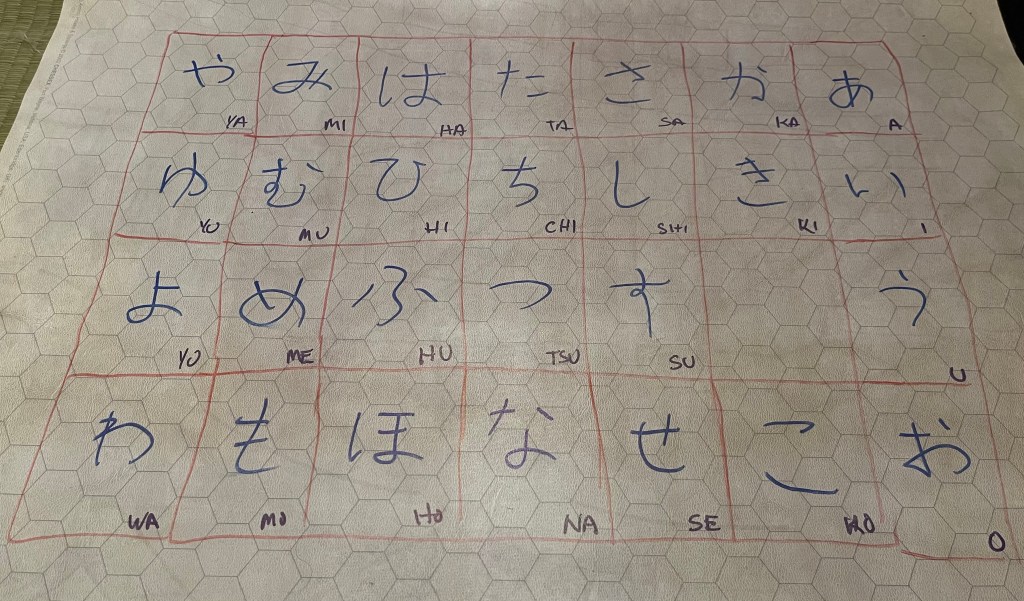
I wanted to try out this method, so I used my old battle-map from Dungeons and Dragons, and drew the same chart on there:

My handwriting is terrible, but hopefully legible. You can see a close-up here:

To be honest, I made my grid a bit too small, so as I piled cards, I couldn’t see which space was which. If you make something similar, make sure the squares are extra big.

Anyhow, the method for fudawaké is to pile up your torifuda cards to the side, then time yourself:

  • Grab a handful (doesn’t matter how many)
  • One by one, put them in the right square based on the first letter of their kimari-ji.
  • Grab more cards as needed.
  • When you place all 100 cards, stop the timer.

According to the Akita Konohana Karuta Club website, their team standard is 1:40, which is quite fast. You can see that some members finish in less than one minute!

When I tried it the first time, it took me 8:05, and then on my second try, it took 6:07. Not even close to their standard, but it was a fun exercise. It is more challenging than fuda-nagashi, but still teaches many of the same skills. It also helps with the initial board setup too, because you can correctly remember where to group your cards based on common kimari-ji.

Try it out and let me know what you think!

Five Color Hyakunin Isshu

Recently I learned about the concept of go-shoku Hyakunin Isshu (五色百人一首), or five color Hyakunin Isshu.

During my recent trips to Japan, while shopping for Karuta sets, I did see some advertised as “five color sets” but didn’t understand the significance, and there is no information in English.

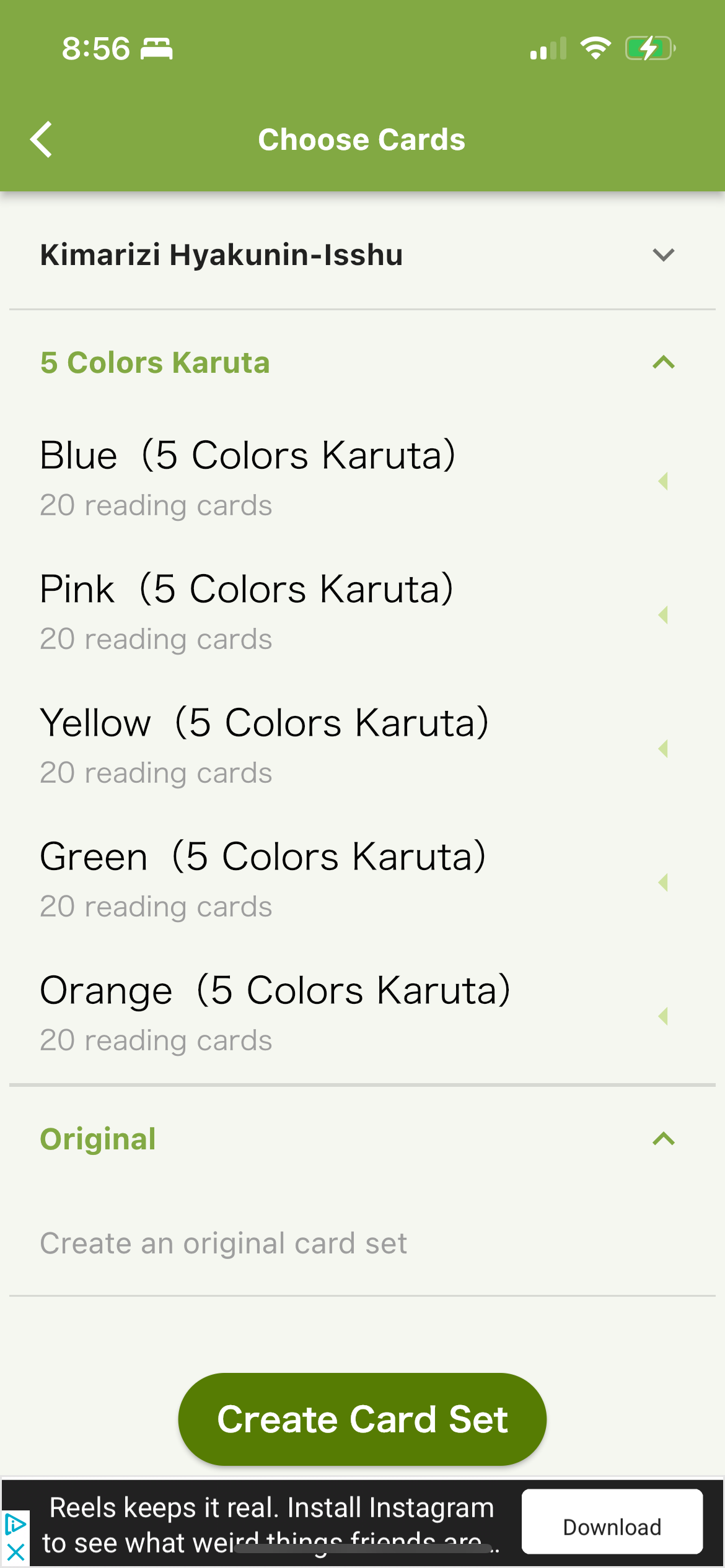
According to this helpful website, it’s a kind of teaching aid for grade school kids to learn Karuta by diving the cards into 5 sets of 20, color-coded: Blue, Pink, Yellow, Green and Orange. The website above has a comprehensive chart for each color, and which poems belong to each.

The cards are grouped this way to ease the memorization of the kimari-ji for playing karuta by organizing easier versus more difficult cards into different groups. The website above suggests the following game to help (my rough translation below):

  1. This is a 1v1 game
  2. Of the five color groups, select one at random (or however you want to decide).
  3. Shuffle the 20 cards and then divide into two piles. Using rock-paper-scissors to decide, the winner can pick their preferred pile.
  4. Each player will lay out their cards in two rows of 5 cards each. Lay your cards out so that you can read them.
  5. The tops of your cards on the top row will touch the top of your opponent’s cards on their top row. Your cards do not have to be touching each other.
  6. You have one minute to memorize your cards.
  7. The reader will reader the upper verses of the poem, then the lower verses, one time each.
  8. When you are going to take the card, yell hai!
  9. If both players touch the card at the same time, you can decide the winner using rock-paper-scissors.
  10. If one player’s hand is on top of another, the player who’s hand is at the bottom is the winner.
  11. When the reader is not reading cards, you are allowed to flip the cards over to see the upper verses. (Me: I guess the official five color cards print on both sides?)
  12. When 17 cards have been read, the match is over.
  13. Whoever took the most cards wins.

There is a helpful instructional video too (sorry, no English):

It also points out some penalties: touching the wrong card (even if you touch the correct one later) and such. Most of this is geared towards grade school kids, so adults would not likely make such mistakes.

Also, some groups seem easier than others. Based on reviews in the website above, yellow and blue seemed easiest, while orange and green were the hardest.

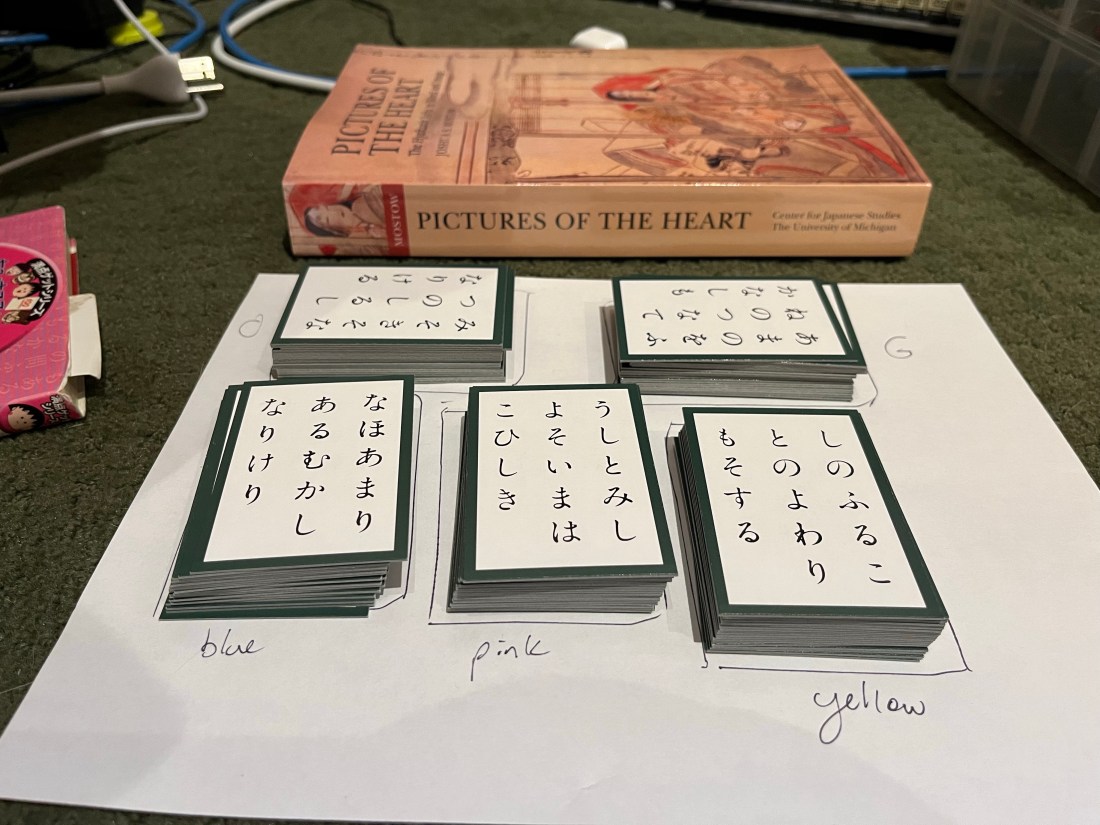
Since I don’t own an official five-color set (yet), I decided to make my own set by using one of my non-competitive sets, and dividing it up into the five color groups. You can see my efforts above in the featured photo. Also, please buy Dr Mostow’s book on the Hyakunin Isshu. This blog is graciously his debt. 😌

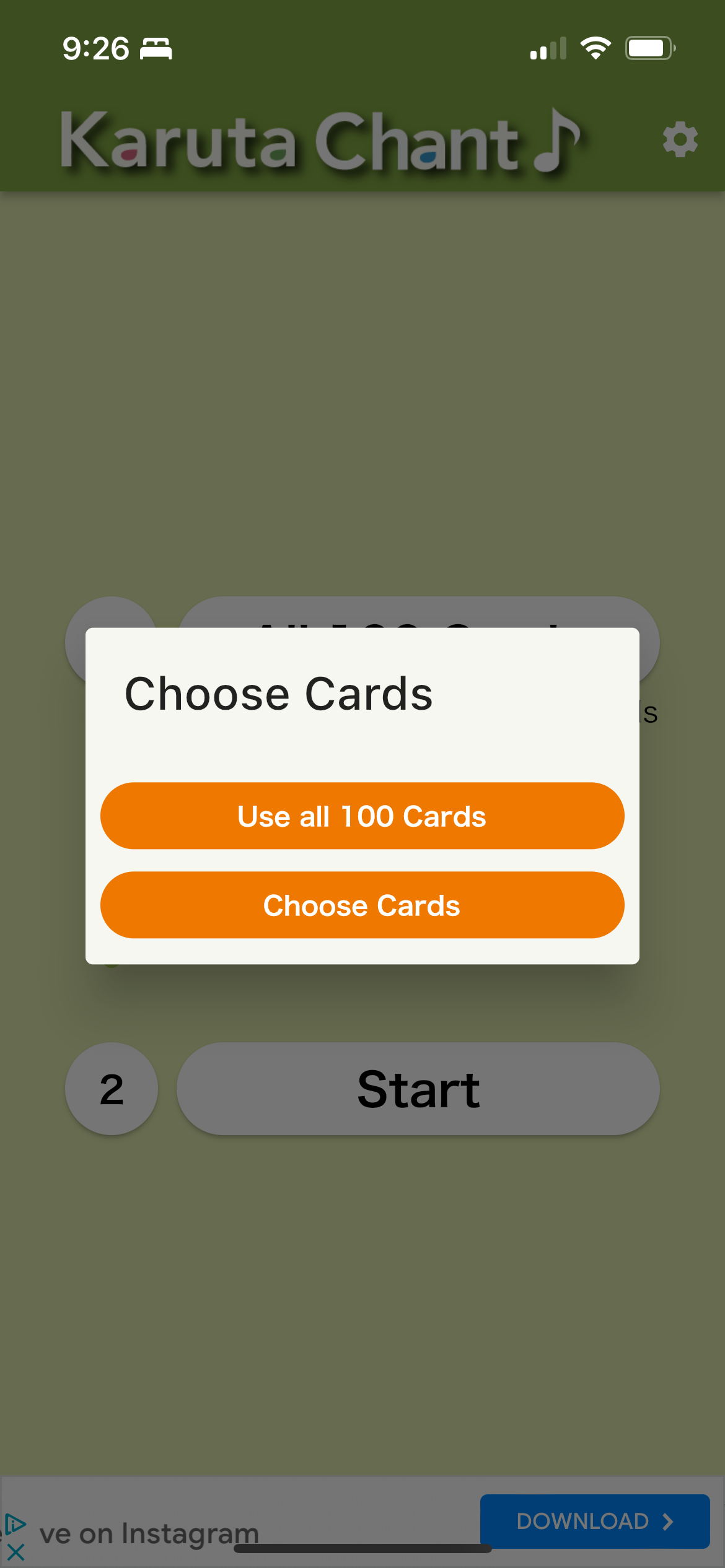
Even if you don’t play the five color Hyakunin Isshu game, you can still use an online reader app like Karuta Chant (iOS and Android). The app even has options for reading only the specified color group:

This established method of dividing up the cards into five colored groups is a very handy way to divide and conquer in your efforts to learn the karuta cards.

Try it out and let me know what you think in the comments!

Each Battle, A Chance to Grow

Dedicated to “Rachel” and “Lore”, and to blog reader . Thank you all for the encouragement!

In my last post, I talked about taking stock after a bad loss in karuta and focusing on small, incremental improvements rather than “shooting for the moon”. I used the Nintendo Switch game Fire Emblem: Three Houses as a source of inspiration.

The blog post title comes from the main character Byleth, who sometimes says this after combat. In the game, if your students defeat a foe in combat, they gain experience points making them grow stronger. If they are attacked by an enemy, they still gain experience. If they dodge an attack, do something supportive or other things non-combat related they also gain experience.

In other words, the characters get stronger not just from defeating foes, but from many other things too.

In the same way, I realized that Karuta isn’t just winning battles. It’s lots of small things you do and get gradually better at.

If you use the flash card “minigame” on the karuta app, how long did it take you to finish all 100 cards? Did you beat your time? If so, experience gained. If not, experience still gained.

If you tried a new way to arrange your cards on the board (tei’ichi 定位置), did it work better or worse? Experience gained either way.

If you practice listening and distinguishing tomofuda cards (cards with very similar kimari-ji), did you succeed? Even if not, experience gained.

If you listen to audio readings of the Hyakunin Isshu is it starting to sink in? Experience gained.

And so on.

Like Byleth says, each encounter or task is a chance to grow. It may not seem like it, but given a few weeks or months, you’ll begin to see the difference.

If you’re feeling down or discouraged, keep looking toward the skies and take it one step at a time.

Good luck and happy karuta’ing!

P.S. Fire Emblem: Three Houses is a criminally underrated game. Definitely check it out if you can. Also, image source above is from Nintendo.

Stay Focused, Keep Trying

After taking up karuta with the local community, I was soon introduced to the international Karuta Discord group (Discord invite link here). The international karuta community is great, and you get to meet people from places like Brazil, Russia, Germany, etc. If you are even casually interested in karuta, or the hyakunin isshu, it’s a nice community and worth joining.

Further, the community has been organizing periodic tournaments using the online Karuta app. I started learning karuta 2-3 months ago, and finally got to the point where I know (more or less), the 100 kimari-ji. So, I decided to throw my hat into the ring and register for the October competition.

Right away, I realized that I might be in over my head.

I lost a couple matches, both very decisively, and felt pretty of embarrassed. At the end of that day, I played poorly. In addition to slow reaction time to take cards, I tilted (in Magic: the Gathering speak) and fell apart under pressure.

I was pretty disheartened by this and I wondered if maybe I am just hopeless. Since I am starting karuta pretty late in life, I feared that maybe I am just getting too old for the game.

But, then I got to thinking. In my spare time, I’ve been playing a game called Fire Emblem: Three Houses (mentioned in my other blog here, among other places). The game, at its core, is about taking a team of amateur students and gradually turning them into an elite force through training, trial, etc. The instructor and main character, Byleth (catchphrase: “stay focused”), develops their individual talents, addressing weaknesses, taking them on training missions, etc.

I kind of felt inspired by this (and frankly, it’s an awesome game), so I got to thinking: I really do want to improve. However, if I want to improve at karuta, I need to get back to basics, stay focused, and work towards small improvements at a time:

  • Get back to basics – practice memorizing kimariji. I sometimes recalled the cards too slowly, or incorrectly. Also, card placement at the beginning of the match (tei’ichi 定位置) is important.
  • Stay focused – learning to stay calm, no matter what situation, and just pay attention to where each card is on the board. When I do get flustered, take a moment to calm myself and re-focus.
  • Work towards small improvements – I can’t expect to win tournaments overnight. But if I focus on making small, incremental improvements, inevitably my game play will improve. Things such as:
    • Better card placement on the board for easier recall / taking.
    • Cutting down on penalties
    • Small improvements to taking cards faster.
    • Getting better acquainted with rules and etiquette. The online app handles most of that, but it’s still essential to learn.

So, if you’re playing karuta, or any competitive game, and you’ve been crushed in defeat, take heart. Given enough time and dedication you will definitely improve. Don’t worry how well other people play, focus on how well you’re playing now.

Edit: if you are a fellow Three Houses fan, I challenge you to boldly declare “I am Ferdinand von Aegir” during your next Karuta match and swipe half the cards from the board Chihayafuru style.

Either you’ll make a new friend (since they are a fan), or they’ll think you’re nutty.

P.S. Featured image source is from Nintendo, and depicts both genders of Byleth (you can play either one, which is neat).