
Reading classical Japanese is hard enough as it is, what with its unusual spellings and archaic vocabulary, but what makes the Hyakunin Isshu interesting, among other things, is the colorful, poetic phrases sometimes used. These phrases are strictly literary, and tend to have a dramatic sound to them, but when translating to English sometimes the meaning is lost. These words are called makura kotoba (枕詞) or “pillow words”. The term “pillow” here has no romantic connotations whatsoever, but is simply a reference to poetry. Presumably, people in the old days sat in their rooms, leaning on a pillow, composing poetry in their idle time, I guess.
Anyway, pillow words can be thought of as “filler” phrases, because they don’t have much meaning themselves, but they dress up the poems a lot more. For example in this poem, number 17:
千早ぶる Chihayaburu
神代もきかず kamiyo mo kikazu
龍田川 Tatsutagawa
からくれないに karakurenai ni
水くくるとは mizu kukuru to wa
The pillow words “Chihayaburu” (千早ぶる) can mean something like “1,000 swift [swords]” or something, but really just dresses up the next word, 神 (kami, “a god”). So in modern English, it’s not just a god, but an awesome, awe-inspiring god. Likewise, in poem 2 we see another shining example.
春過ぎて Haru sugite
夏来にけらし natsu ki ni kerashi
白妙の shirotae no
衣ほすてふ koromo hosu chō
天の香具山 Ama no Kaguyama
Here again the pillow word shirotae no (白妙の) means something like gleaming white. The sheets being dried on Kaguyama mountain are not just white, but gleaming white, and a lovely contrast to the sunny, summer day in which they are being dried.
Such pillow-words don’t really exist in English, but they are very easy to find in classical Greek literature, especially the writings of Homer. Consider these epithets frequently used in the Iliad:
- Agamemnon, son of Atreus: Ἀτρείδης (Atreídēs)
- Swift-footed Achilleus: πόδας ὠκύς (podas ōkús)
- Rosy-fingered Dawn: ῥοδο-δάκτυλος Ἠώς (rhodo-dáktylos Ēṓs)
- Goddess of the white arms, Hera: θεὰ λευκώλενος Ἥρη (thea leukōlenos Hērē)
Whenever I read the Iliad, I always find that these epithets really bring out the drama in the text.
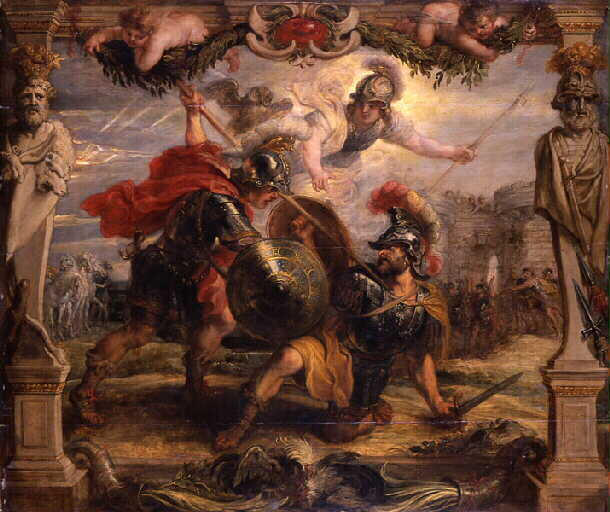
In the same way, the pillow-words in the Hyakunin Isshu are frequently used in certain common combinations:
- chihayaburu (千早ぶる) – used to describe the Shinto divinities or Kami (神). See iconic poem 17.
- shirotae no (白妙の) – used to describe something white, in particular snow, clouds or cloth. Its literal meaning is taken from the color of fresh mulberry paper. See poem 2 and poem 4.
- ashibiki no (あしびきの) – used sometimes to describe mountains (山, “yama”) and peaks. Its meaning is something like “foot-drawn”. See poem 3.
- hisakata no (ひさかたの) – used to describe things like the sky (空, “sora”), moon (月, “tsuki”), rain (雨, “amé”), clouds (雲, “kumo”), light (光, “hikari”), night (夜, “yoru”), and even the capitol (都, “miyako”). Its meaning is something like peaceful, shining, and especially everlasting. See poem 33 and poem 76.
Some examples of pillow words used in Japanese waka poetry, but not found in the Hyakunin Isshu are:
- ubatama no (烏羽玉の) – describes the color “jet-black” and often used to describe hair or night. An example is found in the Kokinshu anthology, poem 647.
- aoniyoshi (あをによし) – used to describe the old capital of Nara itself. Poem 328 in the Manyoshu is one such example. The word aoni (青丹) refers to a high-quality bluish-black pigment that was derived from soil around the Nara area.
- umasaké (味酒) – used to describe the sacred mountains around Nara (see poem 2 in the Hyakunin Isshu) implying the essence of delicious rice wine. Think Dionysus from Greek mythology. You can an example in the Manyoshu, poem 17.
- yasumishishi (八隅知し, or 安見知し) – refers to the august reign of an Emperor, spanning the eight cardinal directions. Manyoshu poems 50 and 923 both contain this phrase.
- isanatori (いさなとり), originally from an archaic word for “whale” (いさな) is used with words such as the ocean, beach, etc. Poem 3852 in the Manyoshu is an example.
Many of these phrases are 5-syllable phrases (sometimes 4), so they “slot” in seamlessly in a typical waka poem (5-7-5-7-7 syllables). In later ages, the number of pillow words increased to about 1,200 phrases, though many of them remain pretty obscure. Even in modern poetry, these stock phrases are still very much in use.
Interestingly, my book on the Manyoshu explains that some of these phrases do not appear until they are used in poetry by Kakinomoto Hitomaro (poem 3, あし), implying that he coined some of these phrases himself. Of the hundreds of documented pillow words, at least 50 are attributed to Hitomaro including some listed above.
Pillow words are hard to translate, but they are a fascinating window into Japanese culture in antiquity.
Discover more from The Hyakunin Isshu
Subscribe to get the latest posts sent to your email.
 The Hyakunin Isshu
Omg, thank you for this article. Comparing makurakotoba to Homer’s poetry makes it so much easier to understand.
I knew about 枕詞 today, struggling to translate school’s newsletter where it was mentioned.
My first idea was that its like symbolism in European literature. When some words stand for some other words and definitions and really mean something ( like some religious or politic connotations). But now I see it as just something to brighten up a poem.
Hi Kate, and welcome. I am very glad you found this message useful. It’s certainly obscure information in English, and probably in Japanese as well. I hope that my comment about comparing makura-kotoba with Homeric epithets is accurate, but it felt to me the best analogy I could come up with.
Good luck on translating your school’s newsletter and good luck in your endeavors.
I knew close to nothing about classical Japanese before, but I am in awe of your depth of knowledge and clear way of communicating! What a service to the internet! Thank you
Thank you very much. I am glad you found it useful.