
For the first poem for March’s “women only” theme, I chose this poem, one of the earliest by a female author (after Empress Jitō, poem 2), but also one of the most famous:
| Japanese | Romanization | Translation |
|---|---|---|
| 花の色は | Hana no iro wa | The color of flowers |
| うつりにけりな | Utsuri ni keri na | has faded indeed |
| いたづらに | Itazura ni | in vain |
| わが身世にふる | Waga mi yo ni furu | have I passed through the world |
| ながめせしまに | Nagame seshi ma ni | while gazing at the falling rains. |
The author, Ono no Komachi (小野小町, dates unknown), is one of the most celebrated women of Japanese antiquity for both her reputed beauty and her poetry. She is one of the original Six Immortals of Poetry and the later Thirty-Six Immortals, and was said to have had relationships with various men, including Henjō (poem 12), and Fun’ya Yasuhide (poem 22) among others.
Reading this poem is something of an intimate look at the fear many women (and men, see poem 96) face then as much as now: the fear of getting old. For someone who was beautiful as Ono no Komachi, the loss may have been even more distressing.
Mostow describes this poem featured in the Hyakunin Isshu as a “technical tour-de-force”: the third line, meaning “in vain”, could technically modify either the previous line, or the one after, or both. Also, the poem uses word-play around furu which could mean to either “fall (as in rain)” or “to pass time”, while nagame could mean both “to gaze lost in thought” or “long rains” (長雨, naga-ame as Mostow explains). Further, this poem has been the object of much debate because of all the possible ways to interpret it, and is one of the most iconic in the anthology both for its technical prowess, but also it’s poignant message.
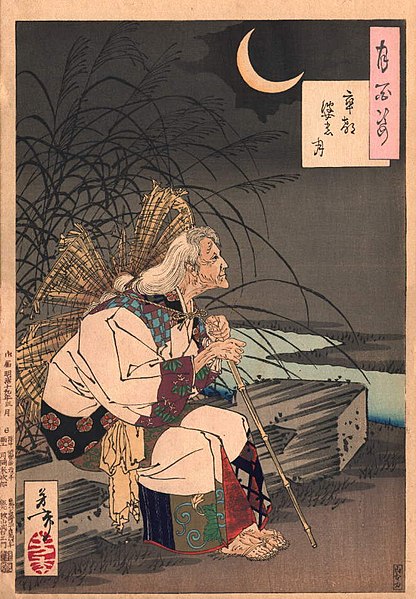
There are many legends that circulated in medieval Japan about Ono no Komachi’s good looks and her cruelty to men. In one famous story, she promised to love a certain suitor if he visited her 100 nights in a row. He completed 99 visits, but failed one night to visit her, and was so distraught that he fell ill and died. Ono no Komachi’s life and legends, including her decline, grew to become the subject of many Nō plays and art. Even 19th century woodblock prints depicted Ono no Komachi in her twilight years:
However, if you look at her other poems, mostly found in the Imperial anthology, the Kokin Wakashū, you can see she was more caring and sensitive than legend implies:
| Japanese | Romanization | Translation |
| 思ひつつ | Omoitsutsu | Tormented by love |
| 寝ればや人の | Nurebaya hito no | I slept and saw him near me — |
| 見えつらむ | Mietsuran | had I known my love’s |
| 夢と知りせば | Yume to shiriseba | visit was but a dream I |
| 覚めざらましを | Samezaramashi o | should never have awakened. |
and:
| Japanese | Romanization | Translation |
| わびぬれば | Wabinureba | I have sunk to the |
| 身をうき草の | Mi o ukikusa no | bottom and like the rootless |
| 根を絶えて | Ne o taete | shifting water weeds |
| 誘ふ水あらば | Sasou mizu araba | should the currents summon me |
| いなんとぞ思ふ | Inan to zo omou | I too would drift away |
So, Ono no Komachi wasn’t just a pretty face past her prime, she was a smart woman with a sharp wit, and a more sensitive side as well.
Discover more from The Hyakunin Isshu
Subscribe to get the latest posts sent to your email.
 The Hyakunin Isshu

“花の色は Haru no iro wa”
The correct is “Hana ni iro wa”
Thanks very much. I have corrected the poem. 🙂