If you’re here reading the blog, chances are you like the poetry of the Hyakunin Isshu. Who doesn’t? Maybe you like it so much, you’ve tried to memorize your favorite poems too (I do). But what’s better than memorizing your favorite poems? Reciting them!
When I first learned to play karuta, I realized that poems of the Hyakunin Isshu are recited in a specific style in Japanese. This is necessary for the players to hear clearly, but also reflects a traditional singing method for reciting waka poetry.1 Even on kids shows about Japanese language, when waka or haiku are recited, they’re recited in the same way. Of course, this is not required, but it is cool to learn, and doesn’t take that much effort.
First, let’s look at this Youtube playlist of Hyakunin Isshu poems.2 In particular, let’s look at poem 2:
Poem 2, はるす
All waka poems, including the Hyakunin Isshu have five verses, and are usually written top to bottom, right to left. The poems are further divided by the first three “upper verses” (kami no ku, 上の句) and last two “lower verses” (shimo no ku, 下の句) for structured, reciting, and for games.
It really helps if you can read hiragana script, but even if not, listen to the intonation of the poem, and the way some syllables are drawn out longer (expressed above as vertical “|” lines). That’s how you recite waka poetry.
The syllables that are drawn out are not always in the same place, by the way. Poem 24 of the Hyakunin Isshu does not always match poem 2 especially the fourth verse (fourth column from the right):
Poem 24, この
Or take a look at poem 11 which has a slightly unusual format. This makes the pacing different, and affects where syllables are drawn out:
Poem 11, わたのはらや
Poem 11 is a particularly tricky poem to recite, in my opinion, but also fun because the first two lines sound really neat.
Reciting isn’t just for showing off by the way.
In my book on the Manyoshu, it talks about how many poems come alive when they are recited. This was true during Japanese antiquity, and centuries later when the Hyakunin Isshu was compiled too. There are sounds and expressions that have a nice ring to them and it’s not always apparent if you are just reading the poem in your mind. For example poem 3 of the Hyakunin Isshu uses a lot of “no” (の) sounds that come alive when recited aloud:
Poem 3, あし
Another example is poem 58 which simply has a nice ring to it:
Poem 58, ありま
Anyhow, unless you’re training to be a professional yomité reader in karuta, it’s not necessary to master reciting all 100 poems, or to even sound this nice. However, if you have a handful of poems you like, learning to master the recitation is a great way to bring poems to life. You can use the excellent Youtube list above, or if you are a tactile person (like me), you might consider getting a set of yomite cards like the ones sold by Oishi Tengu-do, direct link here. I purchased mine in Japan this year and enjoy flipping through them and practicing poems I like.
In truth, I am a TERRIBLE singer. I am truly tone-deaf. But, with a bit of practice you get used to the rhythm of a poem and can recite it without much effort. Some poems are easier than others (poem 11 is tough), but with a bit of practice and familiarity anyone can learn to recite their favorite poem.
1 Roughly 99% of the poems I’ve posted in this blog for the past 13 years are all waka poems. These poems almost always have a pattern of 5-7-5-7-7 syllables, as opposed to later haiku poetry that only have 5-7-5 syllables.
2 If you want to search other Youtube examples, search for 百人一首 読み上げ (reading Hyakunin Isshu aloud).
Back to our regularly scheduled program, I wanted to share a neat little poem, composed by none other than Princess Nukata using the theme of Autumn and of a night tryst:
Original Manyogana
Modern Japanese
Romanization
Rough Translation
君待跡
君待つと
Kimi matsu to
As I wait for you
吾戀居者
我が恋ひをれば
A ga koi oreba
in anticipation
我屋戸乃
我が宿戸の
A ga yado no
the blinds
簾令動
簾動かし
Sudare ugokashi
of my window flutter
秋之風吹
秋の風吹く
Aki no kaze fuku
but it is only the autumn breeze…
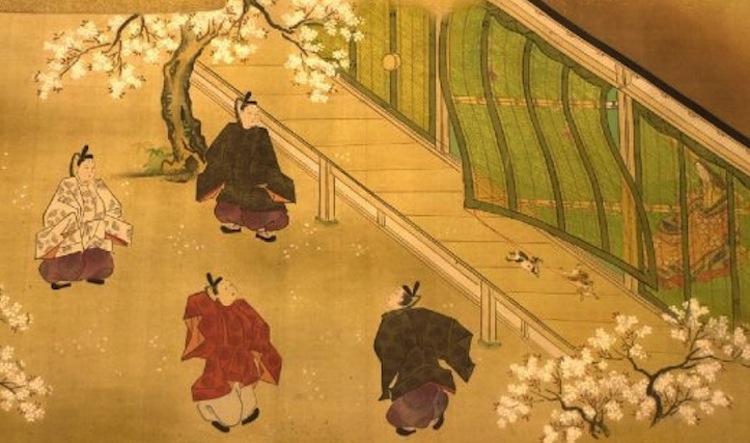
Princess Nukata needs little introduction in the blog. She was the loveinterest of two powerful men, issued a call to war, and made quite a contribution to the Manyoshu anthology which the Hyakunin Isshu and other later anthologies are all based upon. My book about the Manyoshu, in talking about spring versus fall, listed this poem as an early, early example in Japanese poetry of using autumn to symbolize other things. In this case, a romantic meeting at night, and a woman who eagerly awaits her lover. The blinds alluded to here are sudaré blinds used in Japanese culture since antiquity and even to this day.
Illustrated scroll of the Tales of Genji, chapter 34, 17th century. Courtesy of Wikimedia Commons.
In the past year, I’ve spent a fair amount of time talking about what’s called competitive karuta (kyōgi karuta, 競技カルタ in Japanese) after my first encounters, and subsequentefforts to learn to play the game. The truth is is in that in recent months, for various reasons, I’ve really started to wind down my involvement in the competitive karuta scene. I do enjoy playing karuta games, but frankly just not a very competitive person at heart, and the thought of investing what little time I have to increasingly small, incremental gains in an obscure sport doesn’t really appeal to me. I learned how to play the game, and consider myself decent at it, but the poetic side of the Hyakunin Isshu is still what appeals to me most.
Further, I realized through talking with Japanese people that a lot of people play casual karuta games, not competitive. This mundane side of karuta gaming is not featured in animé such as Chihayafuru. However it is a common past-time for people who enjoy karuta and the Hyakunin Isshu poems,1 but don’t necessarily want to invest countless hours in practice, drills, and so on. So, I wanted to explore the casual side of karuta gaming, and help casual players find ways to enjoy the game without the intense stress of competition.2
Japanese “Karuta”, especially karuta games based on the Hyakunin Isshu, come in many forms. There is a spectrum of very easy games on one end, and competitive karuta on the other. If you think of it like a video game with difficult settings, then games like bozu-mekuri are easy mode. You don’t have to know anything about the cards, it is visual only, and the rules are simple. On the other hand, competitive karuta is hard mode: you are playing against some very good players, the margin of error is very small (in higher ranks), and every bit counts including hand-techniques, card position, mental training, and so on. It’s a tough struggle, with lots of exciting moments, but sometimes also crushing defeats.
So between “easy mode” of bozu-mekuri, and “hard mode” of competitive karuta, isn’t there anything in between? Turns out, yes.
I found good examples of casual karuta games through my Hyakunin Isshu Daijiten book, mentioned here, as well as subsequent information online. Let’s look at the games of chirashi-tori and genpei gassen.
Chirashi-Tori
The game of chirashi-tori (散らし取り), meaning “scatter and take”, can be thought of as a lightweight version of competitive karuta. You don’t have to know the kimariji, but it helps, nor do you have to think about card position. In the same way, penalties don’t exist. You do need to know how to read the hiragana script though, even if slowly.
The game basically works like so:
Take all 100 torifuda cards (the ones that are not illustrated) and spread them around face up. Players sit around the pile, spread out evenly.
Similar to competitive karuta, someone else (not a player) reads a random yomifuda card (the illustrated ones). It’s customary to read the last two verses twice.
You can also use one of several nice karuta reader apps on your mobile phone too.
As the poem is being read, whoever finds it’ll the corresponding card touches it, or takes it. If they are correct, they remove the card from the field and keep it in a stack next to them, face down.
The reader then draws another card and a new round begins until there are no more cards on the field.
Whoever took the most cards by the end of the game wins. 🏆
In terms of difficulty, this is the next step up from bozu-mekuri in that you do have to be able to read hiragana, but it’s a nice first step to getting familiar with the poems with little or no training. Even though knowing the kimariji is not required, knowing some can help you recognize some cards on the field quicker.
Genpei Gassen
The name of this game comes from the climatic war in 12th-century Japanese history: the Genpei War, pitting the Genji (“Gen”) clan versus the Heike (“pei”) clan. Unlike Chirashi-tori where each person plays separately, in Genpei Gassen people divide into even teams. Ostensibly one side plays the Heike clan, and the other the Genji clan.
There are a few other differences to Chirashi-tori:
The two teams sit facing one another, with teammates sitting side by side. Ideally, 5 or 7 people will play. The odd-man-out is the reader (see below).
The 100 torifuda cards (non-illustrated ones) are evenly divided into two groups of 50. Half the cards go to one side (i.e. facing them), and the other 50 go to the other team. Arrange the cards into three rows, roughly equal.
To play the game, a separate person reads a random yomifuda card (the illustrated ones), one at a time. It’s customary to read the last two verses twice.
You can also use one of several nice karuta reader apps on your mobile phone too.
As the poem is being read, players from both sides try to find the corresponding card somewhere on the field. If someone finds the poem, they may touch it, or take it. If they are correct, they remove the card from the field and keep it in a stack, face down.
The first team to get to zero cards on their side wins. 🏆
Similar to competitive karuta, if you take a card from the opponent’s side, you send over a card from your side. This way, their number stays the same, but since you correctly took a card, your side reduces by one.
This games has the advantage of being a gentler version of competitive karuta, but still keeping the look and feel of it. As with Chirashi-tori, you will need to be able to read hiragana script, and knowing the kimariji, even some of them, gives you an advantage, but these are things you’d learn anyway from repeated play. Also, having a team develops some fun and interesting strategies.
Five Color Hyakunin Isshu
Finally, if you still want the look and feel of competitive Karuta, but an easier version, you can look at Five Color Hyakunin Isshu. This way you can play a much smaller set of cards and warm up to the full competitive version. The catch is that it requires a custom set, or you will have to make your own by customizing a standard set.
Non-Hyakunin Isshu Karuta
If, like me, you somehow get a hold of a karuta set not featuring the Hyakunin Isshu poems (there are a surprising number in Japan), the games above will still work. Many karuta sets, regardless of theme, use the same basic format: two sets of cards for reading and taking. They are all meant to be read by someone, with other players finding the correct, corresponding card.
Conclusion
The game of Karuta at heart is just that : a game. It’s a great way to savor the poetry of the Hyakunin Isshu in a fun interactive way, and the more I explore it the more I realize that there are games to suit every player. If you purchase a set, you can try any number of games with friends or even by yourself. The most important thing is HAVE FUN! If poem 96 teaches us anything, it’s that life is short.
P.S. Speaking from experience, playing
1 Fun story, in summer of 2024, I was in Japan again briefly to visit my wife’s family, and found the famous Okuno Karuta store in Tokyo. I didn’t post about it as there wasn’t much to say (I didn’t find what I was looking for, tbh). I did see a tour group of elderly Japanese people come into the store in a single mass, and many of them bought karuta goods in one form or another before leaving again. So, it’s definitely a pasttime, but not quite the way I expected when I first learned about the game.
2 I don’t mean this lightly either. Some people definitely revel in competition, but I find such situations always make me intensely nervous, and uncomfortable, even when I win. Used to feel this way about Magic the Gathering competitions too. I thought maybe it was just me until I spoke to someone Japanese who also felt that way when playing competitive karuta. They just wanted to play casual games. That’s when I started to realize that there were different games for different crowds, but all of them celebrate the Hyakunin Isshu poetry in some way.
Similarly, some people want to play Pokemon TCG or Magic the Gathering at home with friends, rather than big competitions. Other people live for the thrill of competition. There’s enough room in the game for both types of players. I personally prefer Hyakunin Isshu karuta myself.
Recently, while watching the historical drama about Lady Murasaki (poem 57, め), I was surprised to learn that there is an hand-made collection of poems by the Thirty Six Immortals of Poetry that has survived the centuries. This collection is called the Sanju-rokunin Kashu (三十六人家集, “Collection of the Thirty Six Immortals of Poetry”):
Collected poems of Minamoto no Kintada (889–948), not in the Hyakunin Isshu. See page for author, Public domain, via Wikimedia Commons
To recap, the Thirty Six Immortals of Poetry was list of esteemed poets in antiquity, coined by the revered poet and critic Fujiawara no Kintō (poem 55 in the Hyakunin Isshu). It was, in Kinto’s mind, the who’s-who of Japanese poetry up to that point in history. Two-thirds of the poets (24 out of 36) also appear Hyakunin Isshu, but otherwise there is no other overlap. Fujiwara no Teika clearly had differing tastes than his earlier kinsmen Kinto.
In any case, this collection was handmade in the early 12th century by ladies of the court for the birthday of Emperor Toba, and each book includes a unique design: a mix of paper collage, marbling and so on.
The pages above show collected poetry by the Buddhist priest Sosei (poem 21 of the Hyakunin Isshu). You can see the collage here, using torn pieces of paper. Below is a page of poetry by Ōshikōchi no Mitsune (poem 29) shows an example of paper marbling.
What makes the collection so amazing is that the pages aren’t just gorgeous, they often allude to some aspect of the poet in question. Some are quite obscure, some are easier for modern people to piece together. This page of poetry by Yamabe no Akahito (poem 4):
The sky-blue color with snowy looking white surfaces evoke the image of Mount Fuji, which Yamabe wrote about in the iconic 4th poem in the Hyakunin Isshu. I am not certain if they are related, but it certainly seems likely.
As for the collection itself, over the century it changed hands a few times before finally being entrusted to the Nishi Honganji Temple in Kyoto, where it remains. Sadly, one volume was dismembered and the individual sheets were sold off to private collectors by a Japanese industrialist in 1929 to raise funds for a local university, but much of the original still remains.
My historical drama does a nice job showing how the ladies in waiting carefully constructed each page, each one a personal work of art, encapsulating a different kind of art. In Japanese literature there has never been anything quite like it since. Truly brilliant stuff.
P.S. apologies for the stupid title of this post. It just popped into my head.




 The Hyakunin Isshu
.jpg)


