Hello readers and happy 2026! Today I wanted to share something that is both familiar and yet new: Iroha Karuta (イロハカルタ).
I’ve talked about the game of karuta before, but this is in the context of Hyakunin Isshu poetry (which is the main topic of this blog 😉).
However karuta (from Portuguese carta) includes many similar games, not just the Hyakunin Isshu poetry. Many such games use a format called Iroha Karuta.
The iroha poem is a very famous poem, possibly composed by Kakinomoto Hitomaro (poem 3, あし) which uses exactly one of each Japanese kana syllable to form a lovely waka poem. It’s frequently used to alphabetize things in Japan, assign seats, etc.
So, in the same way, karuta cards can be organized by Iroha letters too. This is an easier game than Hyakunin Isshu karuta because instead of learning the poems, their verses, etc., you just need to know the basic Hiragana syllabary. Then, when cards are read, you are listening for the first syllable and find the matching card.
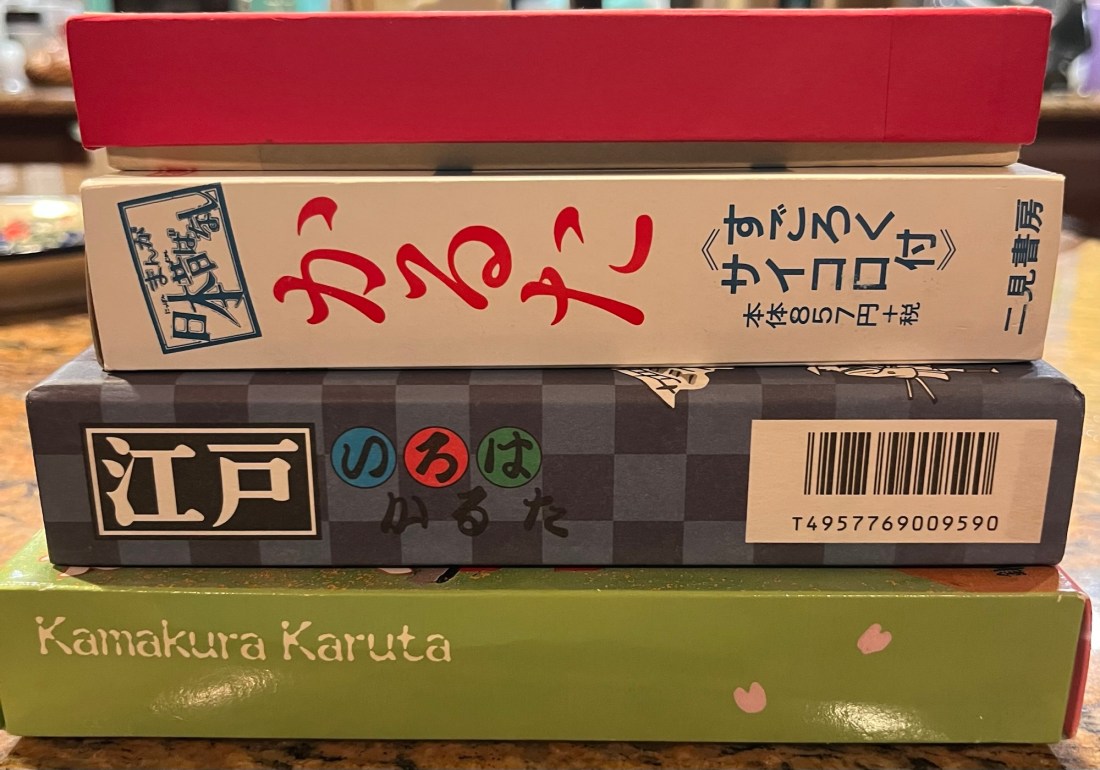
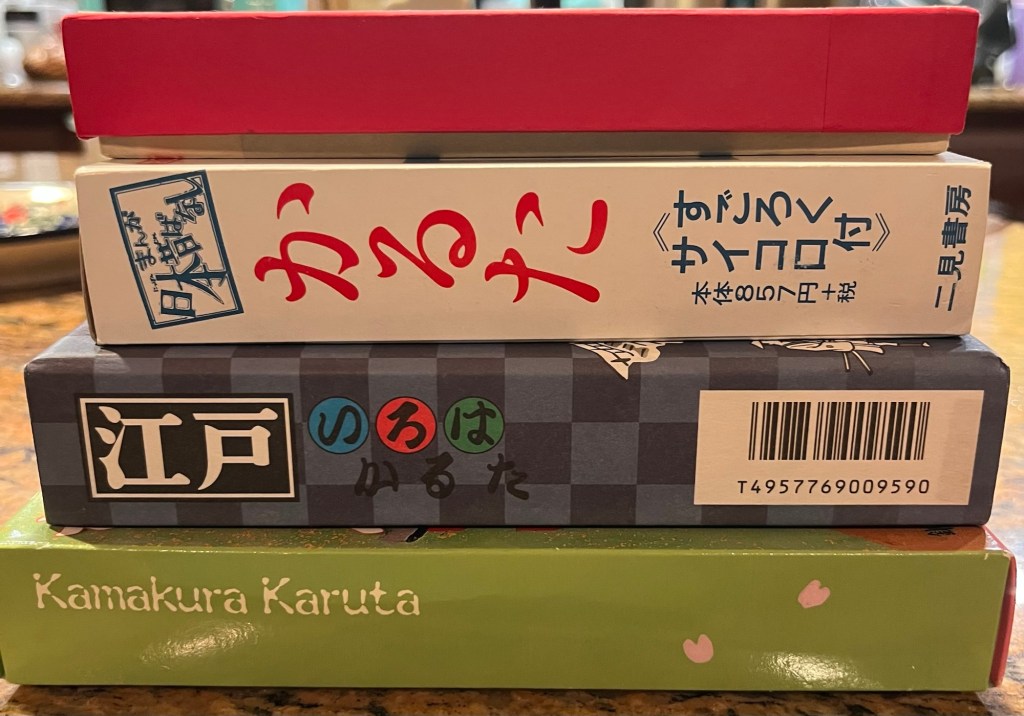
Over the years, my in-laws have sent us various karuta sets to my kids:
… but we didn’t really use them until recently. My youngest child understands enough Japanese now that we can play as a family.
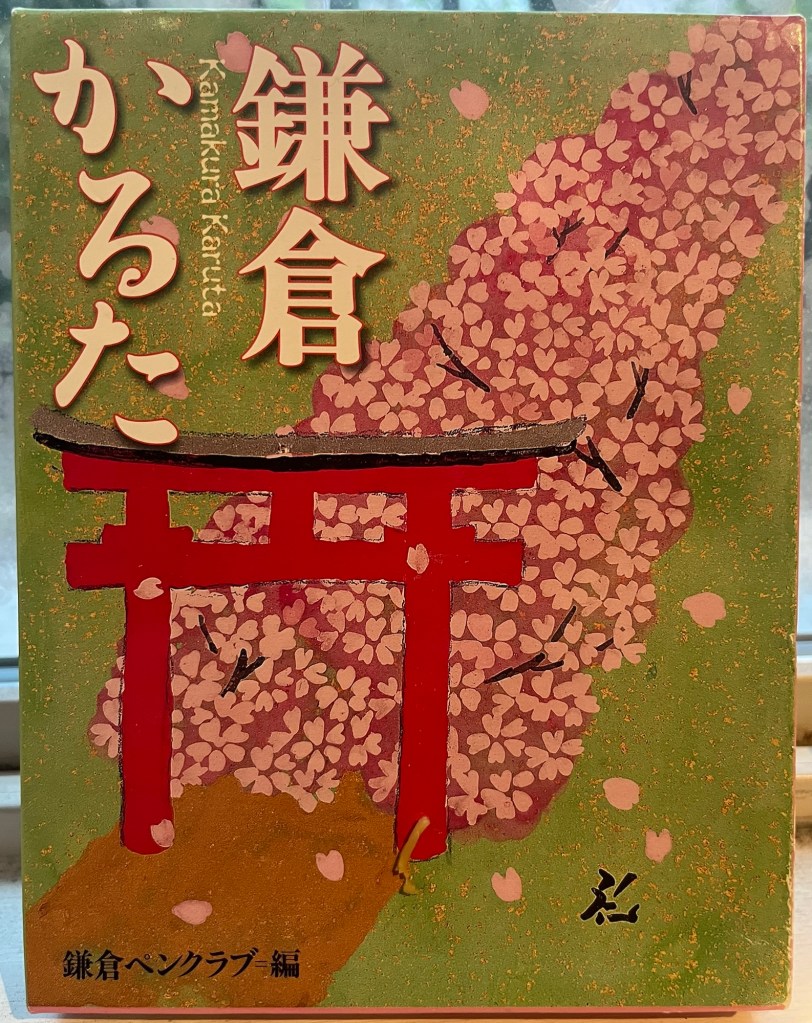
Karuta in general is often played just after Japanese new year, so this year we finally opened some of our old sets and played them one by one. My favorite set is this one:
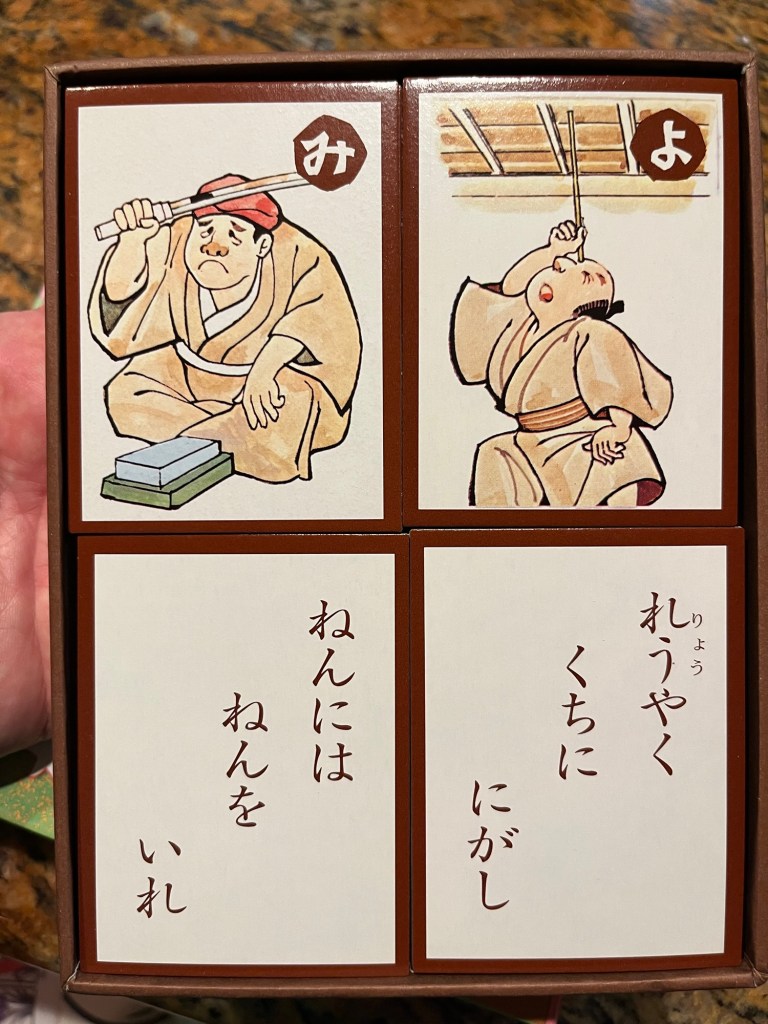
This set features the city of Kamakura, both past and present, using amazing artwork contributed by local artists. Sadly it is not sold anymore. The contents are below:
Similar to Hyakunin Isshu karuta, the cards are divided between “reading” cards (yomifuda, 読み札), and cards to take (torifuda, 取り札), with some short verses written on them. You lay out the cards like in chirashi-dori style (i.e. just spread around between players), and someone reads the cards (a.k.a. yomite 読み手) while other players try to find and take the card based on the first syllables.
The difference is that the artwork is on the torifuda cards, and you don’t have to memorize kimariji. The two cards on the left are related by the letter う (“u”) for uguisu, a famous bird in Japan.
Some other examples we (apparently 😅) own:
The theme of this one is old Tokyo (Edo 江戸) and features proverbs from back then.
This set above features famous Japanese fairy tales from an old NHK series, and surprisingly includes romaji letters (maybe to help foreign players). It also includes dice for a sugoroku style game. We own the related book series, published by Kodansha with English translation, and I used to read them to my kids when they were little. So, these illustrations are very nostalgic.
One nice thing about Iroha karuta is that you can use any possible theme. A quick Google search shows many sets, with themes such as Kyoto (京), old proverbs, and modern silly ones too. I even found a karuta set for the Manyoshu (!).
Hyakunin Karuta, by comparison, has a more refined image but also has a steeper learning curve, even when playing casual style. So, if you’re looking to play a quick game of Karuta and can read hiragana (or find a set with romaji), Iroha Karuta might be a suitable game for you. Since I own both, I like switching between the quick-and-easy Iroha karuta games, and the more refined and ambient Hyakunin Isshu karuta.
Many of the samestores that sell Hyakunin Isshu sets also sell Iroha sets, so don’t hesitate to look. Happy gaming!
I learned a neat little cultural facet from watching the historical drama about Lady Murasaki, but also from the anime Onmyoji.1 Since people in Heian-Period Japan did not have the technology to play Super Smash Brothers Ultimate,2 they passed the time in other ways.
One such pasttime, besides poetry contests and court music, was a neat little game originally called Kai-ōi (貝覆い, “Shell hiding”), but came to be more commonly known as Kai-awase (貝合わせ, “Shell matching”). Using shells from the common Meretrix lusoria or “Asiatic hard clam” (hamaguri in Japanese), the insides of the shells were painted so that both halves of the shell had the same picture. Then the shells would be put face down alongside many other similar shells for a matching game. In art, the game seems to be played mostly by women, and in later generations it was used as a wedding gift to upper-class brides.
The designs of shells started out fairly simple in the 11th and 12 centuries (i.e. the late Heian Period which we focus on so much here), but by the Edo Period, the designs were increasingly elaborate, and tended to hark back to the earlier period in history. Here’s a set of shells featuring scenes from Lady Murasaki’s novel The Tales of Genji:
The idea of a matching game is easy to find in many cultures, but the idea of painting the inside of shells, featuring scenes from a 12th century novel is awfully clever, and shows how the brilliance of the Heian Period culture still shines through even into modern times.
1Onmyoji was pretty good, but I didn’t get very far. To be honest, I don’t watch anime very much. Even Chihayafuru; I only watched the first season.
2 Who would be the “main” for each poet in SSBU? My guess is:
Lady Murasaki – Sephiroth (dark and brooding)
Sei Shonagon – Samus
Lady Izumi – Bayonetta or Zero-suit Samus
Fujiwara no Teika – Metaknight (loyal to Gotoba-in)
Ono no Komachi – Peach
Ariwara no Narihira – Marth or Link (dashing guy)
Gotoba-in – King Dedede
Fujiwara no Mototoshi – Bowser (demanding)
Kakinomoto no Hitomaro – Kirby
Kanké – Dr Mario (scholarly guy)
As for me, I usually play “best dad” Chrom or his daughter Lucina. Byleth is fun to play sometimes, but kind of sluggish in the game.
P.S. I think I spent more time making this SSBU list than writing the rest of the post. 🤦🏼♂️
The Hyakunin Isshu anthology, the subject of this blog, is not known for bawdy subjects as Japanese poetry by that time had become increasingly refined and codified in style. By contrast, the much older Manyoshu included a wider variety of poems and topics. This includes drinking poetry.
In fact, the compiler of the Manyoshu, Ōtomo no Yakamochi (大伴家持, 718 – 785) who also composed poem 6 in the Hyakunin Isshu (かさ), was the son of a famous literati and booze-hound: Ōtomo no Tabito (大伴旅人, 665 – 731). Tabito was a contemporary of Hyakunin Isshu poet Hitomaro (poem 3, あし), though not quite as successful.
Tabito was dispatched by the Imperial bureaucracy at the time to serve a term as governor of Daizafu in western Japan, and while there he formed a poetry circle called the Tsukushi Kadan (筑紫歌壇, “Tsukushi Poetry Circle”), where Tsukushi is the name of an old district in Dazaifu. Of Tabito’s 50+ poems in the Manyoshu, 13 of them were contributed by Tabito, known as the Sake wo Homuru Uta Ju-san-shu (酒を讃むる歌13首) or “The Thirteen Poems Praising Saké [rice wine]”.
Although I joke about Tabito’s possible alcoholism, the poems are not necessarily meant to be taken as literal. My book on the Manyoshu points out that these poems may have intended to imitate a famous 3rd century literati group in China called the Seven Sages of the Bamboo Grove, sometimes known as the Seven Sages of the Western Jin [Dynasty]. In Japanese they are called the chikurin-shichiken (竹林七賢). The enduring image of these seven musicians, poets and scholars is a band of bohemian, drunken geniuses, and Tabito and his poetry circle was likely inspired by them. You can see other examples of artistic inspiration in this post from my other blog. Between this collection of poems, and the Zen artwork in my other blog, I had no idea that the Seven Sages were such a popular topic in art.
But I digress.
There is another side to this poetry as well : evidentially on the move from the capital (Kyoto) to Dazaifu to the west, Tabito’s wife apparently fell ill and died. So, my book alludes to the idea that Ōtomo no Tabito took up drinking not just as a literati trend, but also to deal with the grief of losing his wife. Marriages at this time were often political as various noble families vied for position in the tightly stratified hierarchy in the Imperial Court. However, even political marriages could be happy ones at a personal level, so Tabito may have genuinely been grieving for a wife that he loved, plus the isolation from the capital.
Tabito’s poems, celebrating the virtues of rice wine, are technically very good poems, but also cover a subject that is omitted in later anthologies where style and form were pretty much codified by then. So, by the time the Hyakunin Isshu was compiled, 4 centuries later, no one would write such crass poetry about booze and girls (atleastnotopenly). Further, while the Manyoshu lacks the refinement of the Hyakunin Isshu, it does have a raw, visceral tone that’s often missing in later anthologies, and resonates differently with readers. Personally, I love both anthologies, but for different reasons.
P.S. I’m finally back, and have a few upcoming topics. Please enjoy.
1 This kind of rice wine seems to be a style from China, where the fluid is cloudy rather than clear.
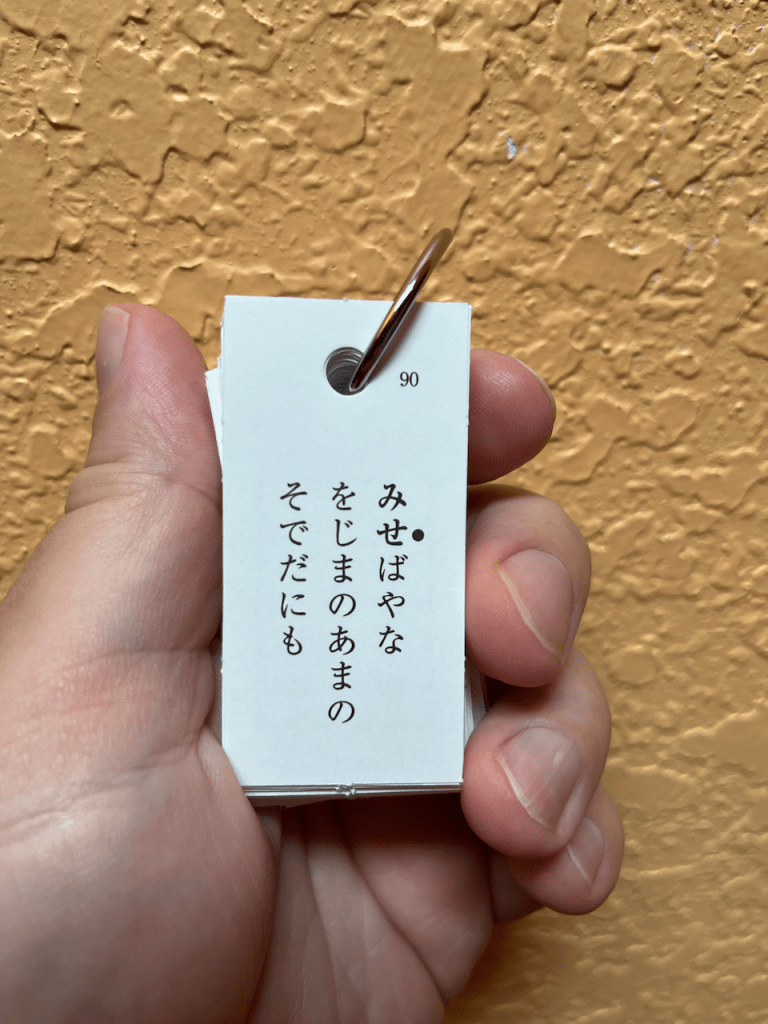
In 2023, during a visit to Kyoto, I picked up some flashcards for memorizing the kimari-ji syllables of the Hyakunin Isshu poems (product link here). These flashcards were really helpful in those first few months of learning to play karuta, and although I don’t really use them anymore, I kept them around for nostalgia…
But… after I took my flashcards to the office one day recently to show some curious co-workers about the Hyakunin Isshu and Karuta, I forgot to take them out of my pants pocket. This is what happened after they got washed…
Initially, I tried to just let the ring dry out, but it’s pretty water-logged. Plus, I found that if was careful, I could peel the cards apart one by one, so they could dry much faster….
Sadly, a few cards ripped in the process, but I think I have salvaged about 80% of the cards. In reality, I will likely purchase it again anyway (preferably with extras to give out to others) since it is very cheap. However, shipping overseas is pretty expensive, so I have to wait until I am in Japan again.
And so, like cherry blossoms and moonlit nights, all things fade. Unlike cherry blossoms and moonlit nights, my flashcards faded in my pants pocket in the washing machine.
Welcome to the New Year and Happy 2025 to you all. The blog also celebrates its blogoversary on January 26th, 2011! The blog is 14 years old. 🥳
The first posts, posted on the same day, are here and here. At the time this blog was meant to be a side project. However it outlasted my other blogs.
The blog has had its periods of activity, and periods of quiet. Lately, the blog has been quiet as I have been preoccupied with holidays, family, and other hobbies. I haven’t played karuta in months, and haven’t been reading any pertinent books lately either.
However, I am working quietly on the back-end to make some improvements to searching the blog and making certain information more easily accessible (based on recent feedback), and shuffling a few pages around.1 What happens after that, time will tell.
But it has also been nice to just recharge and take a break.
Nonetheless, I am happy to celebrate this blog lasting as long as it has, inactivity notwithstanding. And of course, thank you readers and Hyakunin Isshu for your support and encouragement.
As for 2025, best wishes to everyone, and may the new year bring you many smiles.
1 It’s interesting to look at anonymous blog stats and see people’s viewing habits. Oftentimes, they surprise me: what I think people will want to read versus what people are actually looking for.
In the past year, I’ve spent a fair amount of time talking about what’s called competitive karuta (kyōgi karuta, 競技カルタ in Japanese) after my first encounters, and subsequentefforts to learn to play the game. The truth is is in that in recent months, for various reasons, I’ve really started to wind down my involvement in the competitive karuta scene. I do enjoy playing karuta games, but frankly just not a very competitive person at heart, and the thought of investing what little time I have to increasingly small, incremental gains in an obscure sport doesn’t really appeal to me. I learned how to play the game, and consider myself decent at it, but the poetic side of the Hyakunin Isshu is still what appeals to me most.
Further, I realized through talking with Japanese people that a lot of people play casual karuta games, not competitive. This mundane side of karuta gaming is not featured in animé such as Chihayafuru. However it is a common past-time for people who enjoy karuta and the Hyakunin Isshu poems,1 but don’t necessarily want to invest countless hours in practice, drills, and so on. So, I wanted to explore the casual side of karuta gaming, and help casual players find ways to enjoy the game without the intense stress of competition.2
Japanese “Karuta”, especially karuta games based on the Hyakunin Isshu, come in many forms. There is a spectrum of very easy games on one end, and competitive karuta on the other. If you think of it like a video game with difficult settings, then games like bozu-mekuri are easy mode. You don’t have to know anything about the cards, it is visual only, and the rules are simple. On the other hand, competitive karuta is hard mode: you are playing against some very good players, the margin of error is very small (in higher ranks), and every bit counts including hand-techniques, card position, mental training, and so on. It’s a tough struggle, with lots of exciting moments, but sometimes also crushing defeats.
So between “easy mode” of bozu-mekuri, and “hard mode” of competitive karuta, isn’t there anything in between? Turns out, yes.
I found good examples of casual karuta games through my Hyakunin Isshu Daijiten book, mentioned here, as well as subsequent information online. Let’s look at the games of chirashi-tori and genpei gassen.
Chirashi-Tori
The game of chirashi-tori (散らし取り), meaning “scatter and take”, can be thought of as a lightweight version of competitive karuta. You don’t have to know the kimariji, but it helps, nor do you have to think about card position. In the same way, penalties don’t exist. You do need to know how to read the hiragana script though, even if slowly.
The game basically works like so:
Take all 100 torifuda cards (the ones that are not illustrated) and spread them around face up. Players sit around the pile, spread out evenly.
Similar to competitive karuta, someone else (not a player) reads a random yomifuda card (the illustrated ones). It’s customary to read the last two verses twice.
You can also use one of several nice karuta reader apps on your mobile phone too.
As the poem is being read, whoever finds it’ll the corresponding card touches it, or takes it. If they are correct, they remove the card from the field and keep it in a stack next to them, face down.
The reader then draws another card and a new round begins until there are no more cards on the field.
Whoever took the most cards by the end of the game wins. 🏆
In terms of difficulty, this is the next step up from bozu-mekuri in that you do have to be able to read hiragana, but it’s a nice first step to getting familiar with the poems with little or no training. Even though knowing the kimariji is not required, knowing some can help you recognize some cards on the field quicker.
Genpei Gassen
The name of this game comes from the climatic war in 12th-century Japanese history: the Genpei War, pitting the Genji (“Gen”) clan versus the Heike (“pei”) clan. Unlike Chirashi-tori where each person plays separately, in Genpei Gassen people divide into even teams. Ostensibly one side plays the Heike clan, and the other the Genji clan.
There are a few other differences to Chirashi-tori:
The two teams sit facing one another, with teammates sitting side by side. Ideally, 5 or 7 people will play. The odd-man-out is the reader (see below).
The 100 torifuda cards (non-illustrated ones) are evenly divided into two groups of 50. Half the cards go to one side (i.e. facing them), and the other 50 go to the other team. Arrange the cards into three rows, roughly equal.
To play the game, a separate person reads a random yomifuda card (the illustrated ones), one at a time. It’s customary to read the last two verses twice.
You can also use one of several nice karuta reader apps on your mobile phone too.
As the poem is being read, players from both sides try to find the corresponding card somewhere on the field. If someone finds the poem, they may touch it, or take it. If they are correct, they remove the card from the field and keep it in a stack, face down.
The first team to get to zero cards on their side wins. 🏆
Similar to competitive karuta, if you take a card from the opponent’s side, you send over a card from your side. This way, their number stays the same, but since you correctly took a card, your side reduces by one.
This games has the advantage of being a gentler version of competitive karuta, but still keeping the look and feel of it. As with Chirashi-tori, you will need to be able to read hiragana script, and knowing the kimariji, even some of them, gives you an advantage, but these are things you’d learn anyway from repeated play. Also, having a team develops some fun and interesting strategies.
Five Color Hyakunin Isshu
Finally, if you still want the look and feel of competitive Karuta, but an easier version, you can look at Five Color Hyakunin Isshu. This way you can play a much smaller set of cards and warm up to the full competitive version. The catch is that it requires a custom set, or you will have to make your own by customizing a standard set.
Non-Hyakunin Isshu Karuta
If, like me, you somehow get a hold of a karuta set not featuring the Hyakunin Isshu poems (there are a surprising number in Japan), the games above will still work. Many karuta sets, regardless of theme, use the same basic format: two sets of cards for reading and taking. They are all meant to be read by someone, with other players finding the correct, corresponding card.
Conclusion
The game of Karuta at heart is just that : a game. It’s a great way to savor the poetry of the Hyakunin Isshu in a fun interactive way, and the more I explore it the more I realize that there are games to suit every player. If you purchase a set, you can try any number of games with friends or even by yourself. The most important thing is HAVE FUN! If poem 96 teaches us anything, it’s that life is short.
P.S. Speaking from experience, playing
1 Fun story, in summer of 2024, I was in Japan again briefly to visit my wife’s family, and found the famous Okuno Karuta store in Tokyo. I didn’t post about it as there wasn’t much to say (I didn’t find what I was looking for, tbh). I did see a tour group of elderly Japanese people come into the store in a single mass, and many of them bought karuta goods in one form or another before leaving again. So, it’s definitely a pasttime, but not quite the way I expected when I first learned about the game.
2 I don’t mean this lightly either. Some people definitely revel in competition, but I find such situations always make me intensely nervous, and uncomfortable, even when I win. Used to feel this way about Magic the Gathering competitions too. I thought maybe it was just me until I spoke to someone Japanese who also felt that way when playing competitive karuta. They just wanted to play casual games. That’s when I started to realize that there were different games for different crowds, but all of them celebrate the Hyakunin Isshu poetry in some way.
Similarly, some people want to play Pokemon TCG or Magic the Gathering at home with friends, rather than big competitions. Other people live for the thrill of competition. There’s enough room in the game for both types of players. I personally prefer Hyakunin Isshu karuta myself.
Every March 3rd in Japan,1 families with daughters celebrate a holiday called Hinamatsuri (ひな祭り) also known as the Doll Festival, or usually in English it is called Girls’ Day.
The derives from a kind of doll called hina that are usually on display in the family home starting one month earlier (February 3rd). The displays can be very simple as shown above which we have at home, or, the displays can be very ornate:
A full display at Uwajimaya store in Seattle, Washington. I took this photo years ago, and submitted to Wikimedia Commons here.
This display recreates an Imperial wedding between a prince and his bridge, not unlike those that high-ranking authors of the Hyakunin Isshu probably celebrated back in the day complete with ox-drawn carts of gifts, musicians, ladies-in-waiting, and so on. This tradition is to celebrate daughters, and to wish them a happy wedding in the future. This may seem a bit old-fashioned, but it’s also a great time to wish your daughters prosperity and happiness, regardless of how they choose to live their life.
It’s also fascinating that while the Heian Period culture of Japan is long gone, you can see traces of it today even in modern Japan. When someone like Takako (poem 54) married the powerful Fujiwara no Michinaga, I can’t help but wonder if her wedding looked something like this…
Wow, it’s been a while. Recently, while playing with my wife and kids a game of karuta with our Hyakunin Isshu set, I learned about a simple, introductory way to enjoy the game without spending a lot of time learning the poems or mastering the rules of the competition. This simple game is called bōzu-mekuri (坊主めくり).
A recent game (Jan 2023) of bozu mekuri my family and I played on a Saturday night. We use the two-pile yamafuda setup (almost depleted now). The discarded cards are in the middle, with the remaining yamafuda on either side. My cards are in the foreground.
The rules are nicely explained here in Japanese, but goes like this:
Two or more people sit around in a circle.
Shuffle all 100 of the picture cards (yomifuda), then make a stack face-down. This stack is called the yamafuda (lit. “card mountain”).
Alternatively, you can split the stack into two stacks, three stacks, or even a ring of cards. My family plays with two stacks as shown above.
No matter how you deal the cards, they need to be face down.
Players take turns drawing one card from any yamafuda stack.
Depending on what kind of card a person gets, one of three things will happen:
If the card is a picture of a nobleman (tono), simply add it to your personal pile.
If the card is a picture of a Buddhist monk (bōzu), you lose all your cards. Put your cards into a pile somewhere in the middle, near the original yamafuda stack, but face up. If there are cards already there, just add to the pile.
If the card is a court lady (himé) then you get all the cards from the face-up pile.
Once done, pass the turn to the next player.
When all the yamafuda cards are exhausted, whoever has the most cards at the end wins the game.
One quick note: the poet Semimaru (poem 10) looks like a monk card, but the poet wasn’t a monk. This leads to a frequent confusion by players: does Semimaru count as a monk, or as a nobleman, or … something else? This actually did come up in a recent game I played with friends: we couldn’t figure how if he was tono or bōzu and apparently many Japanese people have been stumped by this.
The Hyakunin Isshu Daijiiten, which I mentioned here, considers Semimaru a bōzu (monk) for the purposes of the game, even though he wasn’t actually an ordained monk.
However, my other new book jokes that the author has a house-rule whereby if anyone draws the Semimaru card, then everyone loses their cards.
You can treat Semimaru the way you treat a Joker in poker cards: decide ahead of time what it means, and play accordingly.
Anyhow, once you get a set of hyakunin isshu karuta cards, try it out with your friends some time! I found the game very easy to learn, and fun to play with 3-4 people. More people the better. There are lots of house-rules possible in bozu-mekuri, so feel free to choose rules that you and the other players enjoy.
I just wanted to give a brief update to patient readers. If you saw on my other blog, you might have seen an announcement a few months ago: my wife is pregnant with our second child. Due date is in mid-October, so we’ve been busy preparing, plus I’m trying to be more helpful at home.
However, that doesn’t mean the blog has fallen away either. I had to focus on other projects for a while, but I am back and will be posting more poems soon. Are we’re nearing the end of the Hyakunin Isshu, I hope to finish all poems before the end of the year (before the baby is born if possible). 🙂
Plus I have a few other interesting posts related to the Hyakunin Isshu as well I hope to post soon.
Edit: you can read a more up to date and detailed post about how to play karutahere.
On a recent Saturday, my daughter, wife and I were stuck at home and a little bored, so we decided to play a little game. I took out a box of Hyakunin Isshu karuta or “cards” in Japanese my wife had since she was a young, and my daughter and I set them up. This is a game known in Japanese as uta-garuta or “poetry cards” featuring the Hyakunin Isshu. I’ve mentioned it before here and here. Usually, it’s played on or around Japanese New Year’s, but as the links above show, there are youth clubs devoted to it too as an extra-curricular activity. To play, you need minimum 3 people: one to read the poems, and the others to compete at collecting them.
As you can see in the photo, the cards are all laid on a table. Those ones only have the last 2 verses of each poem, and no pictures, while someone “reads” a card from the other stack with pictures. This stack has the full poems plus pictures of each poet as you can see above. Here’s a photo for clarity:
The card on the left is the full poem, plus illustration, while the card on the right shows on the last 2 lines of verse.
Anyhow, as the reader recites the poem out loud, the other people try to find the card that matches the last half of the poem, hopefully before their opponent person does. Since my daughter is 5 years old, and Japanese is my second language, it was slow going, and there were only 2 of us playing. One of us would read the illustrated card awkwardly, and then we’d both try to find the one that had the last 2 verses of the same poem. It was fun, but took a little while, especially with 100 poems to wade through.
Later, my wife joined us. Since she’s a native Japanese speaker, she could recite the poems faster, freeing up my daughter and I to find the related card. Mommy and daughter teamed up together, but we all took turns reading cards so that my wife would have a chance too. By the end of the game, they won by a ratio of 2:1, but I am happy to still found some cards. 😉
It was my first time playing uta-garuta and we had a great time. If you are in Japan and/or can read Japanese well enough, you may want to pick up a deck yourself. They look great because of the illustrated cards, and are fun for a rainy afternoon. Especially if you 3 or more people, and one of them happens to be a native speaker.
P.S. Have been busy with other projects related to other blog, but hoping to get back into this one soon. My goal is to get to 50 poems or halfway in the near future.






 The Hyakunin Isshu
.jpg)
