Now that the year is winding down, I have had time to catch up on some personal projects, and that includes watching the anime Chihayafuru. In season one episode 12, I was surprised to see one of the characters recite a poem, not from the Hyakunin Isshu, but from the Manyoshu, so I wanted to share it here:
Original Manyogana1
Modern Japanese
Romanization
Translation
茜草指
あかねさす
Akanesasu
The crimson sunset
武良前野逝
紫野行き
Murasaki no yuki
sets these forbidden fields
標野行
標野行き
Shime no yuki
aglow.
野守者不見哉
野守は見ずや
Nomori wa mizuya
Wave not,
君之袖布流
君が袖振る
Kimi ga sodé furu
for the guards might find us.
Translation provided by Chihayafuru
This poem was composed by Princess Nukata (額田王, Nukata no Ōkimi), who was the wife of Emperor Tenji (who composed poem 1 in the Hyakunin Isshu). According to Chihayafuru, Princess Nukata had formerly been married to Tenji’s younger brother, Prince Oama (大海人皇子, Ōama no Miko). Although they had separated, Prince Oama snuck into the Emperor’s lands and waved to her. She was worried that they would be seen, hence the poem.
But, here’s where things get interesting: Princess Nukata recited this poem at a banquet attended by her husband, Tenji, and her ex-husband Prince Oama. What’s going on?
My book on the Manyoshu provides further context. Prince Oama and Emperor Tenji had a …. complicated relationship. Tenji was ambitious and wanted to strengthen his own family lineage, so he pressured Prince Oama to marry his daughter Princess Unonosarara better known as Empress Jito (poem 2 of the Hyakunin Isshu). Tenmu was thus forced to marry his own niece. Further, Tenji designated Prince Oama as his heir until much later when he finally gave birth to a son. Later, after Tenji’s passing, the son was made Emperor briefly, but Prince Oama quickly raised an army and marched on the capitol and became the next Emperor, Tenmu.
Nonetheless, this poem is brilliant because of the visual imagery, but also relatable feeling of unresolved feelings towards someone you still care about.
But as we shall see, the story doesn’t end there… stay tuned.
I am happy to report that I’ll be appearing in a podcast about the Hyakunin Isshu and Karuta coming up in a few weeks! It is exciting to collaborate with a fellow karuta player, “Steph”, who hosts the Karuta Chat podcast.
(Also available on Apple Podcast and many other feeds too)
I’ll have more details soon, but it will be a chance to share my experiences with the Hyakunin Isshu, karuta and more with a wider audience. If you’d like to know, I hope you’ll consider giving the Karuta Chat podcast a listen.
After playing some recent matches with the good folks at the Competitive Karuta Club (Discord invite link here), and also in person with the Seattle Karuta Club, I realized that, as of writing, I’ve been learning to play for 11 weeks. It felt longer somehow. I even double-checked the calendar and, sure enough, it has only been eleven weeks from my very first karuta experience.
In that time I have managed to memorize all 100 kimari-ji. It wasn’t always easy, and I recall some of them faster than others, but practicing fuda-nagashi does help.
Further, I haven’t won a single match yet (online or in person), but I feel like more confident than before, am more aware of my opponents card arrangement (tei’ichi 定位置), sometimes able to keep track of cards that have already been read, and even take a few cards now and then. My rate of penalties is still higher than I like, but that’s still a work in progress.
In short, I have grown as a Karuta player. Not a lot, but it’s nice to look back and actually see progress.
Using the analogy Fire Emblem: Three Houses again, if I may,* there is a part of the story where your students have the option to face the dreaded Death Knight. Unless your student’s name is Lysithea, very few characters can defeat the Death Knight without considerable luck and strategy. It’s not that the characters are weak, they’re just not ready. So the game encourages you to know your limits, and just skip if you’re not prepared. Much later in the game, when your characters are much stronger, you will encounter the Death Knight again and have a much better chance to emerge victorious.
In the same way, battling an advanced player in Karuta probably won’t result in victory, but those little incremental wins, each card taken, each penalty avoided, is still a sign of growth.
As a game, karuta is more difficult to learn upfront compared to things like Magic: the Gathering, Pokemon TCG, etc. However, once you pass that hurdle, it becomes a game you can carry with you the rest of your life. You don’t have to keep buying new sets of cards, dealing with “power creep” with new card sets, etc. The 100 poems of the Hyakunin Isshu have been around for centuries and will continue to be around for many more. The more you play, the more your skills refine. There’s no rush, come as you are, enjoy the poems, learn a little bit each time.
Finding a community of players isn’t always easy, but the budding international community continues to grow and we are always welcoming new people.
If you’re unsure, feel free to take the plunge anyway. Hopefully, you’ll be glad you did. I was.
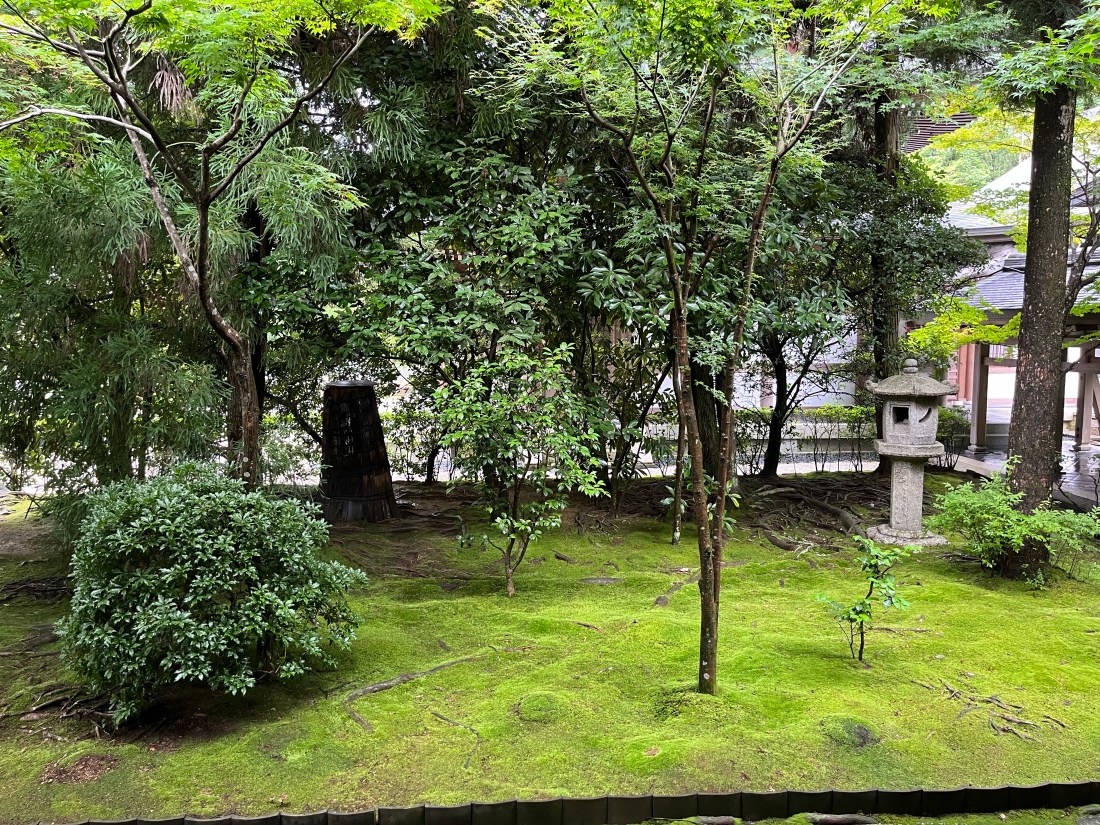
P.S. featured photo taken at Ryonaji temple in Kyoto, Japan, in summer of 2023.
* the best part of owning your own blog is that you can write whatever silly stuff you want. 😋 Also, if you own a Switch, please try FE:3H. It’s a pretty neat game.
Due to length and complexity of poem, plus it’s very old Japanese, I can only offer a rough translation (based on modern Japanese ones) like so:
A basket. The beauty holding the basket. A digging tool (lit. a spatula-like tool). The beauty holding the digging tool. You who are on the hill gathering vegetables, tell me, what family do you come from? Do you not know? I am the sovereign of this land (lit. Yamato, old name for Japan), and that every corner is under my dominion? So, tell me, what is your family’s name and origin?
This poem was composed by Emperor Yūryaku, who reigned in the 5th century, before recorded history. Technically, the title of “Emperor” was not used by ancestors of the Japanese imperial family at this time, and was later implemented by the time of Emperor Tenmu, brother of Tenji (poem 1), but this is a retroactive title. At this time, Yūryaku and others of the lineage were more like great kings (daiō 大王). Interestingly, although this point in Japanese history is pretty murky, Yūryaku is mentioned on a dedication inscribed on an ancient sword, providing historical evidence that he did in fact exist.
Yūryaku was described in early historical documents as a strong ruler, who slew his brothers following the death of the last king/emperor to get to his position. In later years, he helped consolidate power, but also was described as tyrannical as well.
The poor girl whom the poem was addressed to probably wasn’t in any position to say “no”, in any case.
The reason why I posted this poem is two-fold.
First, this poem is noticeably different than the tanka (短歌, “short poem”) style poems of the Hyakunin Isshu. This is a chōka (長歌, “long poem”) style poem. Tanka poems, including all poems of the Hyakunin Isshu, follow the style of 5-7-5-7-7 syllables. Chōka poems were 5-7-5-7-5-7…..5-7-7 syllables, with as many 5-7 syllable verses as needed. The Manyoshu has both formats, but by the time of the Hyakunin Isshu, the chōka format had fallen out of favor, probably because it was simply too long and difficult to fire off verses quickly.
Yūryaku’s poem doesn’t fit the chōka format very closely though, so it’s hard to say how strict poetry was back then. Over the centuries, and by the time we get towards the end of the Hyakunin Isshu, the style poetry had definitely solidified into a very rigid format with many specific rules, customs, and phrases. Yūryaku’s poem reflects an earlier, looser style of poetry. Or, as a powerful sovereign, maybe he just didn’t care. Who’s to say?
Second, the tone of the poem (ignoring the power-imbalance between him and the girl1) is a very lighthearted and romantic tone. Early poems in the Hyakunin Isshu tended to have a similar tone, but gradually the tone tended to get more somber centuries later as the aristocratic culture came to an end. Compare poems 95-100 to poem 1-5 in the Hyakunin Ishsu, and you’ll see what I mean. Yūryaku’s poem definitely belongs to this earlier, more bucolic time.
Anyhow, it’s interesting how poetry reflects history as well.
1 When you look at Lady Murasaki’s diary as well, when Michinaga makes a pass at one of the servant girls, it’s strongly implied a visit later will certainly follow. Again, women back then had less agency, and would have been hard-put to say no to powerful, ambitious men like that.
Centuries before the Hyakunin Isshu was compiled and before official Imperial anthologies such as the Kokin Wakashū were promulgated there was the Manyoshu (万葉集) or “collection of ten thousand leaves”.
The Manyoshu is the oldest extant poetry collection, completed in 759 CE for the pious Emperor Shomu, and has much that resembles the Hyakunin Isshu, but also much that differs. I have been reading all about it in a fun book, which is in the same series as this one.
The Manyoshu was purportedly compiled by one Ōtomo no Yakamochi (大伴家持, 718-785), author of poem 6 (かささぎの) in the Hyakunin Isshu, but it’s also likely that he only compiled the collection toward the end, and that others were involved too.
Sadly, English translations are very few in number and usually quite expensive. Translating the Hyakunin Isshu hard enough, and this is even more true with a larger, more obscure volume like the Manyoshu.
Format
The Manyoshu is a collection of poems from a diverse set of sources, including members of the Imperial family and the aristocracy, but also from many provinces across the country and people from many walks of life. In fact, 40% of the poems in the collection are anonymous, with sources unknown. It also includes a few different styles of poetry:
265 chōka (長歌), long poems that have 5-7 syllable format over and over (e.g. 5-7-5-7-5-7…etc), until they end with a 5-7-7 syllable ending. These are often read aloud during public functions. Kakinomoto no Hitomaro (柿本 人麻呂, 653–655, or 707–710?), who wrote poem 3 in the Hyakunin Isshu, was considered the foremost poet of this format, but the longest was composed by one Takechi no Miko (高市皇子) at 149 verses.
4,207 tanka(短歌), short poems as opposed to the long poems above. The “tanka” style poems are usually 5-7-5-7-7 syllables long, and are what we see in later anthologies such as the Hyakunin Isshu. At the time, they were often included as prologues to long poems above. The Hyakunin Isshu is entirely tanka poetry, by the way.
One bussokusekika (a poem in the form 5-7-5-7-7-7; named for the poems inscribed on the Buddha’s footprints at Yakushi-ji temple in Nara),
Four kanshi (漢詩), Chinese-style poems often popular with male aristocrats that contrasted with more Japanese-style poetry.
22 Chinese prose passages.
Additionally, these poems were often grouped by certain subjects:
Sōmonka (相聞歌) – Originally poems to enquire how someone was doing, but gradually involved into couples expressing romantic feelings for one another.
Banka (挽歌) – Funerary poems honoring the deceased.
Zōka (雑歌) – Miscellaneous poems about many topics. Basically everything else that is not included into the other two topics.
Manyogana
One of the interesting aspects of the Manyoshu compared to the later Hyakunin Isshu, and other related anthologies, is the written script used. When people think of karuta or Hyakunin Isshu, they think of the hiragana script, but the hiragana script didn’t exist in the 8th century when texts such as the Manyoshu, the Kojiki or Nihon Shoki were composed. Such texts were composed purely using Chinese characters, but in a phonetic style native to Japanese later called Manyogana. Confusing? Let’s take a look.
The book above explains that in Manyogana, Chinese characters such as 安 and 以 are read phonetically in the Manyoshu as “a” and “i” respectively. Even modern Japanese people can easily intuit this.
Then you get more difficult examples such as 相 (saga) and 鴨 (kamo) in Manyogana. These are more obscure, but still possible for native Japanese speakers to understand them.
Then you get much harder examples such as 慍 (ikari) and 炊 (kashiki).
And finally you get even more difficult examples such as 五十 (also read as “i“) and 可愛 (just “e“). My wife, who has an extensive background in Japanese calligraphy, struggled with these.
In any case, words in the Manyoshu were all spelled out using Chinese characters like this, with no phonetic guide. You just had to know how to read or spell them, and as you can imagine this was a clunky system that only well-educated members of the aristocracy could make sense of. However in spite of its issues, this system of phonetic Chinese characters is how the later hiragana script gradually evolved.
Technique
When we compare the Manyoshu with the Hyakunin Isshu, there are many similarities. Both have tanka poetry (5-7-5-7-7 syllables), and cover a variety of topics. Further, both collections make good use of pillow words. In fact the same pillow words you see in the Hyakunin Isshu, such as hisakata no (poems 33 and 76), also show up centuries earlier in the Manyoshu:
Original Manyogana
Modern Japanese
Romanization
Rough Translation1
和何則能尓
我が園に
Waga sono ni
Perhaps
宇米能波奈知流
梅の花散る
Ume no hana chiru
the plum blossoms will
比佐可多能
ひさかたの
Hisakata no
scatter in my garden
阿米欲里由吉能
天より雪の
Ama yori yuki no
like falling snow
那何久流加母
流れ来るかも
Nagarekuru kamo
from the gleaming heavens
1 Amateur translation, apologies for any mistakes
This poem, incidentally was composed by Yakamochi’s father, Ōtomo no Tabito, when he organized a flower viewing party at his villa (book 5, poem 822).
Another commonality, the book explains, is the use of preface verses or jo-kotoba (序詞) where the first verses are just one long-winded comparison to whatever comes after. Poem 39 in the Hyakunin Isshu is a great example of this since the first 3 verses describe various grasses in order to make a point: that love is hard to hide.
The Manyoshu used this technique as well:
Original Manyogana
Modern Japanese
Romanization
Rough Translation
千鳥鳴
千鳥鳴く
Chidori naku
Just as the plovers’ cries
佐保乃河瀬之
佐保の川瀬の
Sabo no kawase no
along the wavelets
小浪
さざれ波
Sazare nami
of the Sabo river
止時毛無
やむ時もなし
Yamu toki mo nashi
never end,
吾戀者
我が恋ふらくは
A ga ko furaku wa
so too are my feelings of love.
Author: Ōtomo no Saka no Ue no Iratsume (大伴坂上郎女), book 4, poem 526
Historicity
Similar to the Hyakunin Isshu, the Manyoshu covers a fairly broad span of history, but much of it is now pretty obscure to historians. Even so, the poems in the Mayonshu can be grouped somewhat reliably into 4 specific eras:
first half of 5th century to 672 CE, starting with the reign of Emperor Nintoku onward.
672 to 710 CE
710 to 733 CE
733 to 759 CE
These periods mostly coincide with certain authors who contributed poetry, but also appear to have breaks due to historical events such as conflicts, temporary political upheavals, etc.
Differences with the Hyakunin Isshu
Although there are many commonalities between the Hyakunin Isshu and the Manyoshu, there are also differences. The most obvious is that the Manyoshu is a mixed-format collection, so it includes poetry other than Tanka style. Another difference is its broad sources for poetry, not just contributions by the elite aristocracy.
However, the book above notes that on a technical level there are other differences.
For example, the use of “pivot words” frequently used in the Hyakunin Isshu ( poems 16, 20, 27, and 88 for example) is a technique that is almost absent in the Manyoshu. Similarly, puns are also rarely used.
Legacy
As the largest and earliest extant poetry collection, it set the standard for Japanese poetry that people were still studying and emulating centuries later. Poems such as 22, 64, and 88 are all examples that use themes or poetic styles that closely resemble poems in the Manyoshu.
Further, compared to more polished anthologies that came later, the Manyoshu’s bucolic and unvarnished content has often been revered by later generations (including Japanese nationalists and Shinto revivalists in the 19th century) for getting to the “heart of Japanese culture”.
The book has been a great read, with amazing illustrations, and it helps show how the roots of the Hyakunin Isshu, including a few of its early authors, lay centuries earlier in the Manyoshu.
While watching competitivekaruta online, and in person, I noticed that there is a certain poem that is read at the outset of a match, but what’s interesting is that this is a poem that is not actually part of the Hyakunin Isshu.
This poem is called the joka (序歌), or preliminary poem, and reads:
What’s interesting from a historical standpoint is that this poem was composed by a 3rd century immigrant to Japan named Wani (王仁), who came from the Korean kingdom of Baekje1 and is credited with introducing the Analects of Confucius and the Thousand-Character Classic to Japan at a time when it was actively trying to import knowledge and culture from the mainland. I’ve talked about Japan and Baekje here as well.
The poem by Wani was so highly-praised it was felt in antiquity that if you were going to know any Waka poem, you had to at least know this one. Hence over time it became the opening poem for karuta competitions. Like many poems of the Hyakunin Isshu, it was originally preserved in the official Imperial anthology, the Kokinshū.
In karuta matches, the poem is always read before the match begins. My guess is that reciting this poem helps to calibrate or warm-up the players before the match actually begins. Apparently, the last two verses, the shimo no ku (下の句) in karuta, are repeated twice. Once it’s read twice, the match begins.
It’s fascinating to note that this poem has been in existence for 1,700 years, and is still going strong!
1 A time when the Korean peninsula was divided into three warring kingdoms. Baekje probably had the closest relationship with the early Yamato Court of Japan due to proximity and mutually beneficial relations.
Throughout this blog, I’ve alluded many times to poetry contests, called uta-awase (歌合), as the origin of many of the poems of the Hyakunin Isshu. These contests were a popular past-time among the nobility of Nara and Heian periods of Japanese history, and onward. The first such contest was recorded as far back as 885, and became a staple of nobility since.
The poetry contest was a ritualized affair, and worth exploring here.
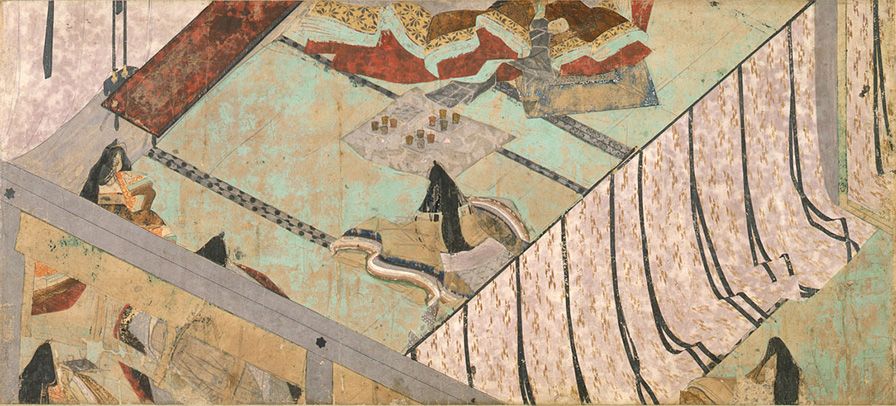
An excerpt from an illustrated copy of the Tales of Ise showing two contestants in a poetry contest, with an incense brazier on between. The lady here serves as the judge of their poetry.
This image comes from an illustrated copy of the classic Japanese text, the Ise Monogatari (Tales of Ise)1 and shows an example of a typical poetry contest. The contestants sit facing one another as a pair, while some contests had multiple pairs facing off.
Presiding over the contest was a judge or hanja (判者) who would provide a topic for the contest. A small incense brazier would burn between the two contestants (方人, kata-udo), who would each come up with one poem to fit the given theme. Each participant would also trash-talk the opponent’s poem while praising their own, or their Allie’s (if multiple sets of participants). Basically, an ancient Japanese rap-battle. Once the winner was declared, the contest could go another round, and each contestant would come up with another poem.
According to the Hyakunin Isshu Daijiten, the longest recorded poetry contest during the classic Heian Period was said to have continued for 500 rounds!
In more formal settings, usually held at the Imperial palace,2 with a director overseeing the contest (a tokushi, 読師), with the poems and their theme recorded by a scribe (kazusashi, 籌刺) who sat off to the side. Musical accompaniments were often added to formal poetry contests, too. Finally, the particularly good poems often ended up later in Imperial Anthologies.
You can see an example of an Imperial uta-awase from a popular manga here:
Every March 3rd in Japan,1 families with daughters celebrate a holiday called Hinamatsuri (ひな祭り) also known as the Doll Festival, or usually in English it is called Girls’ Day.
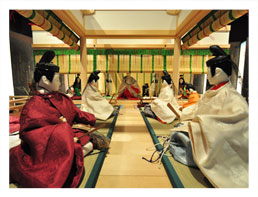
The derives from a kind of doll called hina that are usually on display in the family home starting one month earlier (February 3rd). The displays can be very simple as shown above which we have at home, or, the displays can be very ornate:
A full display at Uwajimaya store in Seattle, Washington. I took this photo years ago, and submitted to Wikimedia Commons here.
This display recreates an Imperial wedding between a prince and his bridge, not unlike those that high-ranking authors of the Hyakunin Isshu probably celebrated back in the day complete with ox-drawn carts of gifts, musicians, ladies-in-waiting, and so on. This tradition is to celebrate daughters, and to wish them a happy wedding in the future. This may seem a bit old-fashioned, but it’s also a great time to wish your daughters prosperity and happiness, regardless of how they choose to live their life.
It’s also fascinating that while the Heian Period culture of Japan is long gone, you can see traces of it today even in modern Japan. When someone like Takako (poem 54) married the powerful Fujiwara no Michinaga, I can’t help but wonder if her wedding looked something like this…
Of all the poets of the Hyakunin Isshu anthology, arguably the most famous, especially overseas is Lady Murasaki (poem 57), who in Japanese is called Murasaki Shikibu (紫式部). She is the author of the Tales of Genji, which epitomized life in Japanese antiquity, and is among the first novels in history. But another work by Lady Murasaki that’s notable here is her eponymous diary, of which an illustrated version appeared centuries later. In English this is simply known as the Diary of Lady Murasaki (murasaki shikibu no nikki, 紫式部の日記).
The diary covers the period from years 1008 to 1010, and provides a first hand account of her life serving the powerful regent, Fujiwara no Michinaga. Michinaga is not featured in the Hyakunin Isshu, but his power as regent was great enough to ruin the lives of a few poets in the anthology:
Michinaga was locked in a power-struggle between his branch of the Fujiwara Clan, and another branch, led by Morechika. Both had daughters married to Emperor Ichijō, and both were fighting to be the regent (kanpaku, 関白) of Ichijō’s heir. In the end, Michinaga’s daughter, Empress Shōshi, gave birth to the future Emperor Go-Ichijō (Ichijō the Latter). With it, Michinaga became the most powerful man in Japan.
At the beginning of the diary, Lady Murasaki describes the events leading up to Empress Shōshi giving birth, and the elaborate ceremonies to protect her and the unborn child from evil spirits. Although it was technically a private ceremony, Michinaga hired an army of priests and shamans to both bless the child, and also to ward off evil spirits. Lady Murasaki, as a member of the household, describes sitting in the crowded audience chamber for hours, listening to the fevered chanting and elaborate rituals.
Then the diary skips ahead to the first weeks of the child’s birth, and further ceremonies. Michinaga spares no expense to protect his grandson (whom he will be the regent of, and thus the true power behind the throne) from diseases, evil spirits and so on. In elaborate rituals, members of the household are selected to read the Confucian Classics to the baby to ensure he will be an august ruler. More priests are called into ward off evil, and so on.
A 13th century illustration of Empress Shōshi and her infant son, with Lady Murasaki in attendance from the Murasaki Shikibu Nikki Emaki (illustrated diary of Lady Murasaki). Tokyo National Museum, Public domain, via Wikimedia Commons
But what about Lady Murasaki?
Lady Murasaki herself comes from a lesser branch of the Fujiwara clan, and since her husband already died some time ago, she describes herself as “washed up”. She held no official appointment in the Imperial Court. And yet, through Michinaga, she becomes a trusted confidant and tutor of the Empress. Michinaga knew talent when he saw it, and wasn’t shy about packing his household with as much as he could get away with.
Lady Murasaki was but one of several famous ladies-in-waiting recruited by Fujiwara no Michinaga to increase the status of his daughter, Empress Shōshi, vis-a-vis the Emperor’s first wife, Teishi (Morechika’s daughter).
Lady Murasaki’s diary implies that life as a lady-in-waiting is a lot of “hurry up, then wait”: periods of great activity and ceremony, followed by long periods of boredom. The period after the child’s birth eventually winds down and leads to a lot of free time, where Lady Murasaki reflects on many things, as well as disparaging some of the other ladies-in-waiting. Here are some examples of her contemporaries who also happen to appear in the Hyakunin Isshu:
Lady Izumi (poem 56) – “She does have a rather unsavory side to her character but has a talent for tossing off letters with ease and seems to make the most banal statement sound special.“
Akazome Emon (poem 59) – “She may not be a genius but she has great poise and does not feel she has to compose a poem on eveyrthing she sees, merely because she is a poet.“
Sei Shonagon (poem 62), part of the rival clique under Empress Teishi – “…was dreadfully conceited. She though herself so clever and littered her writings with Chinese characters; but if you examined them closely, they left a great deal to be desired.“
She also grapples with persistent depression. Her sullen, introverted nature often wins her few friends among other ladies of the Court:
And when I play my koto rather badly to myself in the cool breeze of the evening, I worry lest someone might hear me and recognize how I am just ‘adding to the sadness of it all’; how vain and sad of me. So now both of my instruments, the one with thirteen strings and the one with six, stand in a miserable, sooty little closet still ready-strung.
The diary then jumps forward into a letter written at a later date. The intended recipient is unknown, but is thought to be her daughter Daini no Sanmi (poem 58). Here the diary includes a great deal more self-reflection, and further analysis of the other ladies in waiting, including her grievances with another clique of ladies centered around the high priestess of the Kamo Shrine, Princess Senshi (daughter of Emperor Murakami).
Finally, the diary jumps around a few more times in narrative, and then abruptly stops. Richard Bowring points to theories that other fragments of the diary once existed, possibly some in the Eiga Monagatari, or some possibly in possession by Fujiwara no Teika (poem 97, and compiler of the Hyakunin Isshu), but these are all speculation.
The Diary is pretty short; you can read it cover to cover in a couple of hours. And yet it’s a fascinating blend of historical perspective, and very relatable personal reflection. Loneliness and depression affect people of today as much as it did people of her time, and yet she has to carry on through stodgy court ceremony, pressures of the insular life in the aristocracy, and constant back-biting amongst the ladies-in-waiting.
In one lengthy anecdote, she describes a prank that the other ladies-in-waiting decide to pull on one Lady Sakyō, who apparently had retired from service, then returned to serve another nobleman. The prank was to send a luxurious “gift”, but with a lot of symbolism regarding youth, implying ironically that Lady Sakyō was an old has-been.
The diary lists several incidents where drunken nobles harass attractive servants during dinner, servants who are unable to really do anything about it since they owe their entire livelihood to those nobles. Alternatively, the noblemen, bored themselves, play mean pranks on the ladies, steal their robes, or pull their skirts. Because of the power imbalance (also frequently alluded to in the Gossamer Years), it was just an accepted part of life, and the ladies often had to regularly dodge that minefield.
Middle Counselor Elect Taka’ie, who was leaning against a corner pillar, started pulling at Lady Hyōbu’s robes and singing dreadful songs. His Excellency [Michinaga] said nothing….Realizing that it was bound to [be, sic] a terribly drunken affair this evening, Lady Saishō and I decided to retire once the formal part was over.
trans. by Richard Bowring
Michinaga himself frequently bursts in on Lady Murasaki, sometimes drunk, demanding a quick poem or a verse for particular occasions. Although Michinaga never makes advances on Lady Murasaki, his overbearing demeanor exhausts her, yet she also admires his quick wit and ambition. I can imagine Michinaga in moderns times being a flashy, talented CEO with a dubious reputation :
I felt depressed and went to my room for a while to rest. I had intended to go over later if I felt better, but then Kohyōe and Kohyōbu came in and sat themselves down by the hibachi. ‘It’s so crowded over there, you can hardly see a thing!’ they complained. His Excellency [Michinaga] appeared.
‘What do you think you’re all doing, sitting around like this?’ he said. ‘Come along with me!’
I did not really feel up to it but went at his insistence.
trans. by Richard Bowring
Another frustration that Lady Murasaki describes is the rigid social hierarchy within the aristocracy. Lady Murasaki was from a middle-ranked family, and while not a menial servant herself, she was frequently reminded of her place. This included things like being unable to wear the “forbidden colors“, where she sat during court ceremonies, and whom she was allowed to address directly. Lady Murasaki sums it like so:
The water-music that greeted the Emperor was enchanting. As the procession approach, the bearers — despite being of low rank — hosted the palanquin right up the steps and then had to kneel face down beneath it in considerable distress. ‘Are we really that different?’ I thought to myself as I watched. ‘Even those of us who mix with nobility are bound by rank. How very difficult!’
trans. by Richard Bowring
What she often describes, when reading between the lines, is that for all its pomp, culture and beauty, life in the Heian Period aristocracy was a kind golden sham:2
I returned to the Palace on the twenty-ninth of the twelfth month [after a month absence]. Now I come to think of it, it was on this very night that I first entered service at court. When I remember what a daze I was in then I find my present somewhat blasé attitude quite uncomfortable.
trans. by Richard Bowring
One other thing to note is that her diary alludes to the Tales of Genji frequently. By the time she was recruited by Michinaga, a few drafts of the work had already been in circulation, and this probably helped her reputation. Even the illustrious Fujiwara no Kintō (poem 55) pays her a brief visit in the diary calling her “Murasaki” (e.g. purple) as an allusion to one of her characters in the novel. Richard Bowring implies that this moment might be how Lady Murasaki got her sobriquet.3 We saw this with Nijōin no Sanuki (poem 92) in later generations as well. Sadly, it seems that these copies of the Tales of Genji were sometimes borrowed and never returned, or copied by other people, and since each copy took so long to compose, Richard Bowring implies that it is a miracle that the work survived at all.
In any case, the Diary of Lady Murasaki is probably one of the best descriptions of life in the Imperial Court and its (often oppressive) aristocracy. It was a world of beauty and also of frustration and bitterness.
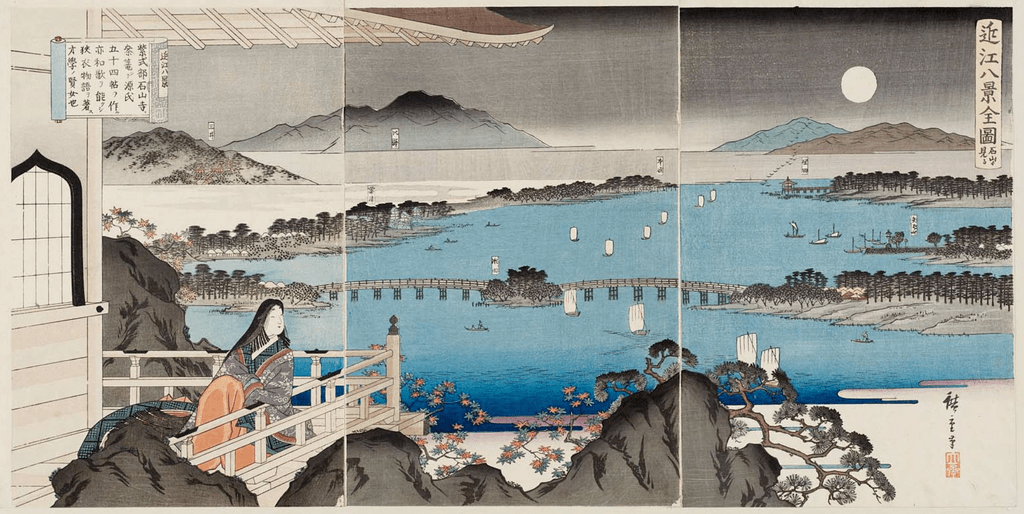
P.S. Photo is a famous woodblock print by Utagawa Hiroshige (Public domain, via Wikimedia Commons), depicting a legend about Murasaki Shikibu at Ishiyama Temple. These are the 3 panels of the nishiki-e: “Eight Views of Omi Province as Seen from Ishiyama” (Ômi hakkei zenzu, Ishiyama yori miru). Notice her purple (murasaki) robes.
1 Sei Shonagon was a lady in waiting for Empress Teishi, who was a daughter of Michinaga’s rival. When Michinaga’s rival is driven out by a scandal, Teishi is relegated to the background, and Sei Shonagon retires in obscurity.
2 Valkyrie in the movie Thor: Ragnarok had said much the same thing about Asgard, too.
3 Her true name is not known, but is thought to be Fujiwara no Kaoriko (藤原香子).
I’ve been making small updates to the blog apart from the poems themselves. The main change is that I’ve added a new “page” that talks about the history of Imperial poetry anthologies. Poetry collections were very popular in the “classical age” of Japanese history, when Court nobles cultivated the finer arts and wrote lots and lots of poetry for social reasons, as well as for career advancement.
The Hyakunin Isshu is an example of a “private” collection in that it was not commissioned by the government. Fujiwara no Teika (poem 97) compiled the Hyakunin Isshu in the later years of his life after his lord, Emperor Gotoba (poem 99), was exiled and the samurai government in Kamakura had won the civil war.
However, many of the poets in the Hyakunin Isshu were also contributors to official anthologies or helped compile them. So, I finally got around to explaining what these anthologies were and why the’re important to this blog.
Also, resources permitting, I may want to try and post poetry from some of those anthologies, starting with the Kokin Wakashū.






 The Hyakunin Isshu

.jpg)
_(CBL_J_1050.2,_ff.11b-12a).jpg)


_4.jpg)
_6.jpg)
