
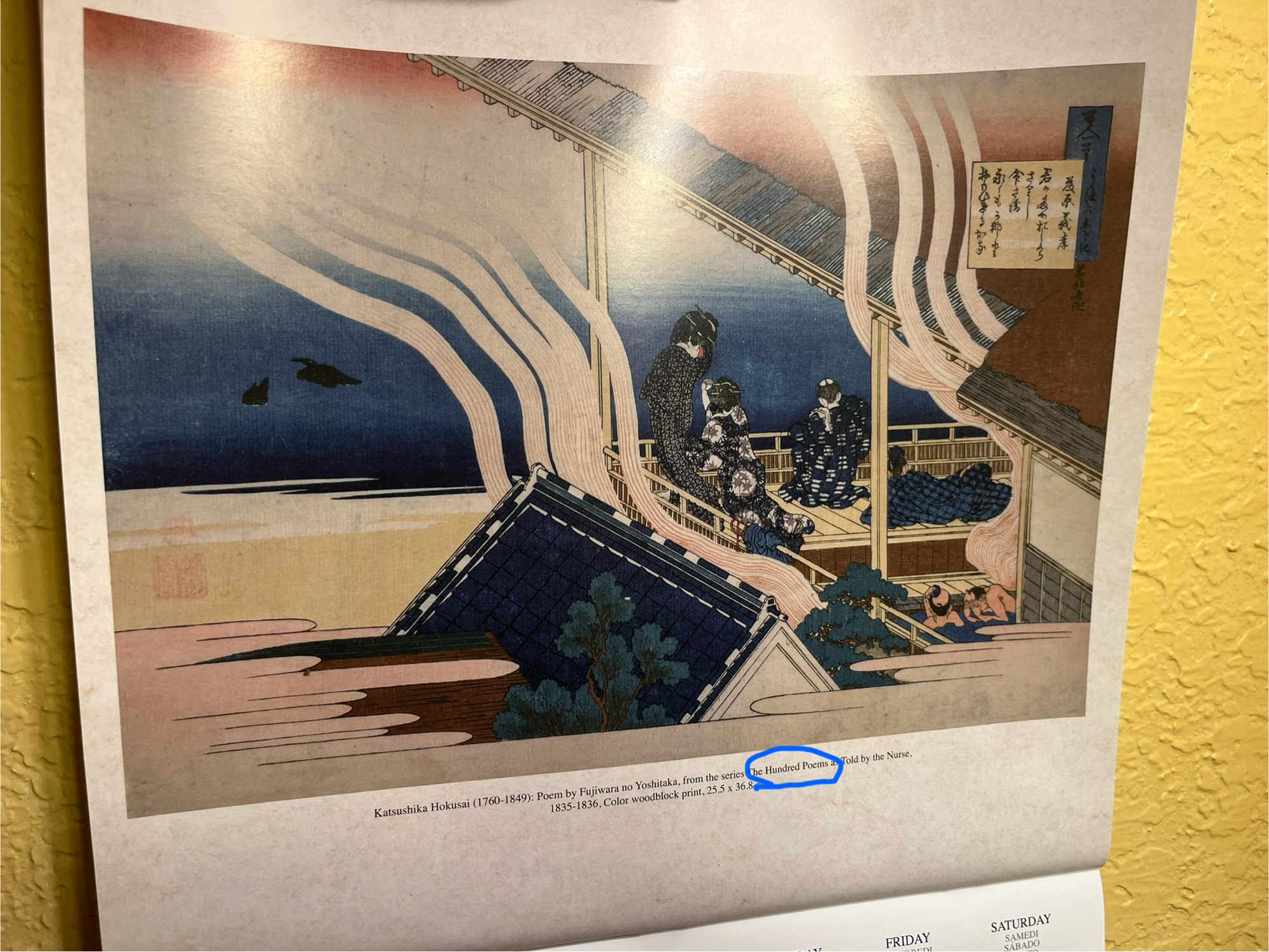
The Hyakunin Isshu anthology, the subject of this blog, is not known for bawdy subjects as Japanese poetry by that time had become increasingly refined and codified in style. By contrast, the much older Manyoshu included a wider variety of poems and topics. This includes drinking poetry.
In fact, the compiler of the Manyoshu, Ōtomo no Yakamochi (大伴家持, 718 – 785) who also composed poem 6 in the Hyakunin Isshu (かさ), was the son of a famous literati and booze-hound: Ōtomo no Tabito (大伴旅人, 665 – 731). Tabito was a contemporary of Hyakunin Isshu poet Hitomaro (poem 3, あし), though not quite as successful.
Tabito was dispatched by the Imperial bureaucracy at the time to serve a term as governor of Daizafu in western Japan, and while there he formed a poetry circle called the Tsukushi Kadan (筑紫歌壇, “Tsukushi Poetry Circle”), where Tsukushi is the name of an old district in Dazaifu. Of Tabito’s 50+ poems in the Manyoshu, 13 of them were contributed by Tabito, known as the Sake wo Homuru Uta Ju-san-shu (酒を讃むる歌13首) or “The Thirteen Poems Praising Saké [rice wine]”.
My book lists two example poems:
| Manyogana | Modern Japanese | Romanization | Rough Translation |
|---|---|---|---|
| 験無 | 験なき | Shirushi naki | I’d rather |
| 物乎不念者 | ものを思はずは | Mono wo omowazu wa | drink a cup of |
| 一坏乃 | 一杯の | Ippai no | “dirty rice wine”1 |
| 濁酒乎 | 濁れる酒を | Nigoreru sake wo | than think about |
| 可飲有良師 | 飲むべくあるらし | Nomu beku aru rashi | useless things. |
| Manyogana | Modern Japanese | Romanization | Rough Translation |
|---|---|---|---|
| 中〻尒 | なかなかに | Naka naka ni | I’d rather be |
| 人跡不有者 | 人とあらずは | Hito to arazu wa | a rice wine cask |
| 酒壷二 | 酒壷に | Saka tsubo ni | and immerse myself |
| 成而師鴨 | 成りにてしかも | Nari te shikamo | in wine, than live a |
| 酒二染甞 | 酒に染みなむ | Sake ni shiminan | half-assed life. |
Although I joke about Tabito’s possible alcoholism, the poems are not necessarily meant to be taken as literal. My book on the Manyoshu points out that these poems may have intended to imitate a famous 3rd century literati group in China called the Seven Sages of the Bamboo Grove, sometimes known as the Seven Sages of the Western Jin [Dynasty]. In Japanese they are called the chikurin-shichiken (竹林七賢). The enduring image of these seven musicians, poets and scholars is a band of bohemian, drunken geniuses, and Tabito and his poetry circle was likely inspired by them. You can see other examples of artistic inspiration in this post from my other blog. Between this collection of poems, and the Zen artwork in my other blog, I had no idea that the Seven Sages were such a popular topic in art.
But I digress.
There is another side to this poetry as well : evidentially on the move from the capital (Kyoto) to Dazaifu to the west, Tabito’s wife apparently fell ill and died. So, my book alludes to the idea that Ōtomo no Tabito took up drinking not just as a literati trend, but also to deal with the grief of losing his wife. Marriages at this time were often political as various noble families vied for position in the tightly stratified hierarchy in the Imperial Court. However, even political marriages could be happy ones at a personal level, so Tabito may have genuinely been grieving for a wife that he loved, plus the isolation from the capital.
Tabito’s poems, celebrating the virtues of rice wine, are technically very good poems, but also cover a subject that is omitted in later anthologies where style and form were pretty much codified by then. So, by the time the Hyakunin Isshu was compiled, 4 centuries later, no one would write such crass poetry about booze and girls (at least not openly). Further, while the Manyoshu lacks the refinement of the Hyakunin Isshu, it does have a raw, visceral tone that’s often missing in later anthologies, and resonates differently with readers. Personally, I love both anthologies, but for different reasons.
P.S. I’m finally back, and have a few upcoming topics. Please enjoy.
1 This kind of rice wine seems to be a style from China, where the fluid is cloudy rather than clear.





 The Hyakunin Isshu


