As I noted in my other blog, I am taking time off the rest of the year to rest, and catch up on nerd projects.
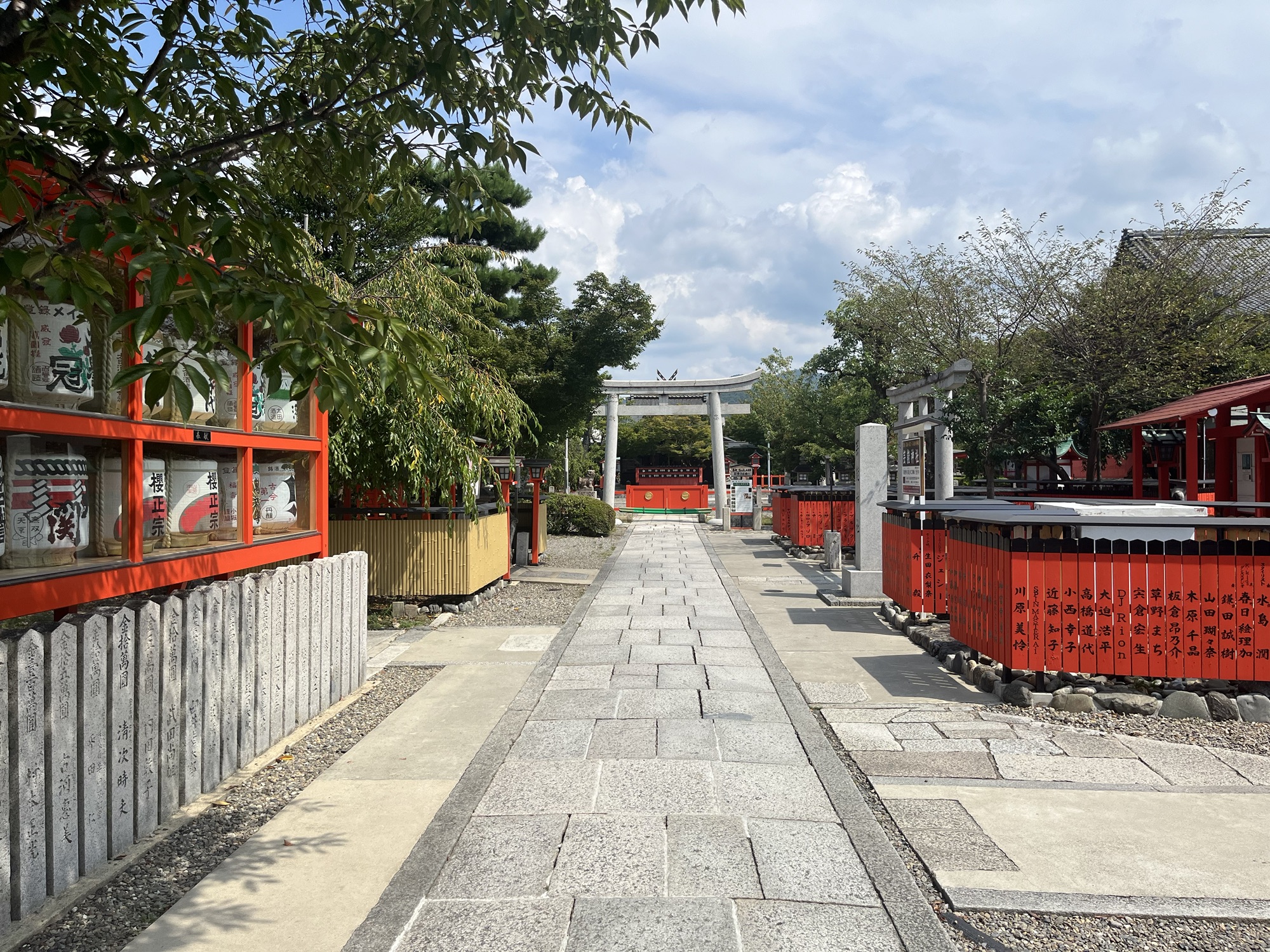
One last post before end of the year: I forgot to share this previously, but during the trip to Japan this summer, and on the same day we both visited the shrine to Sei Shonagon, and the site where the Hyakunin Isshu was compiled, I made one more stop: Nonomiya Shrine. The official website is here (English).
Nonomiya Shrine (nonomiya-jinja, 野宮神社) is a Shinto shrine that has been around since antiquity in west Kyoto within the bamboo forests. You can see it here on Google Maps:
While it is not related to the Hyakunin Isshu, it is related to Lady Murasaki (poem 57, め), whom I wrote about here. You see, one of the most iconic chapters of the Tales of Genji, Lady Murasaki’s famous novel, the “Heartvine” (Aoi, 葵) takes place at Nonomiya Shrine. Here, Genji the protagonist meets Lady Aoi his future wife. So, Nonomiya Shrine is associated with romance and falling in love, or meeting one’s soulmate, and since it was already a fixture in Kyoto culture at the time, Lady Murasaki used it as the backdrop for this romantic encounter.
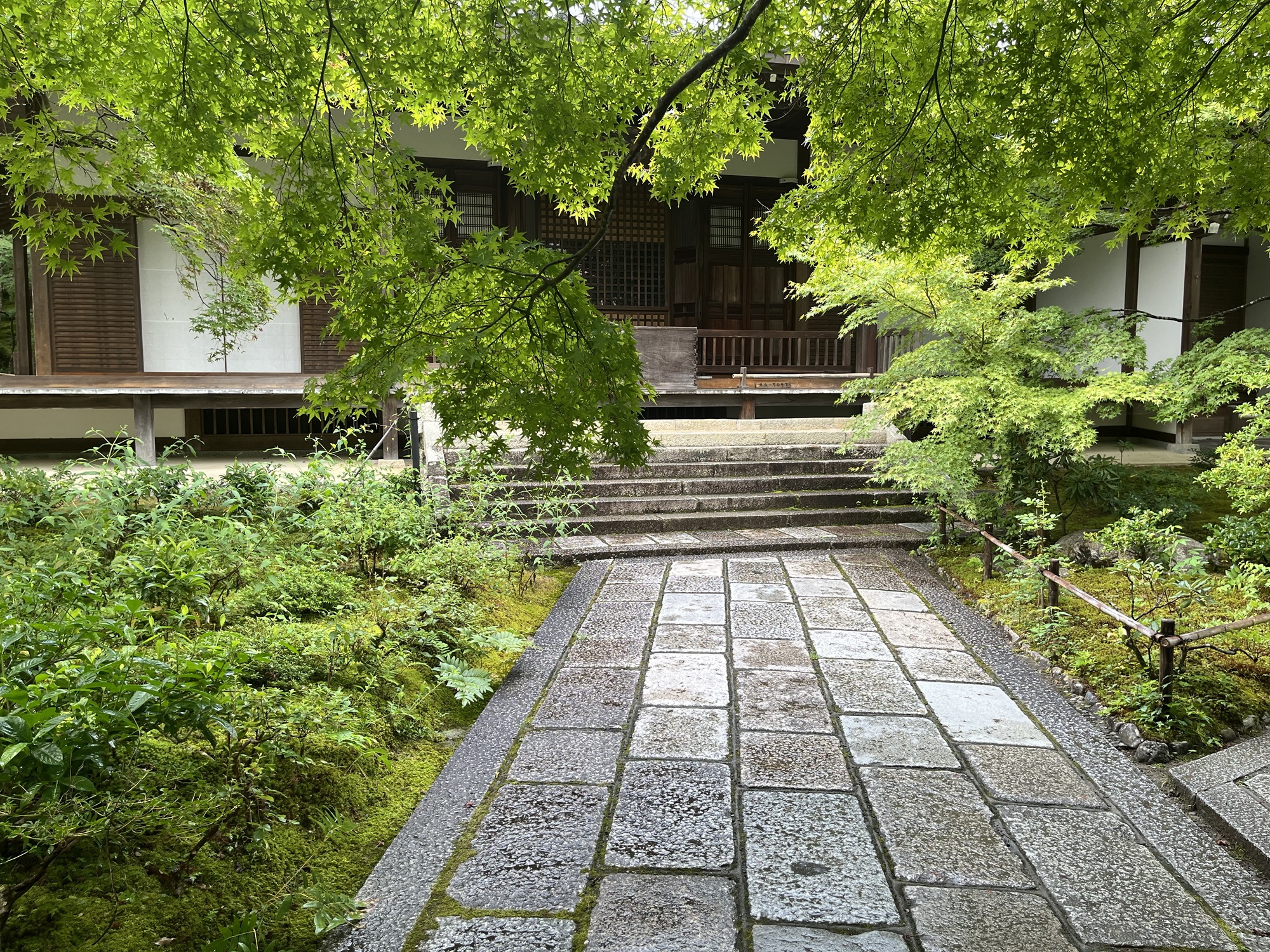
Even now, many people (both Japanese and tourists) come here to pray for love, and many of the omamori charms are focused on romance too. It’s nestled within the famous bamboo forests in the area:
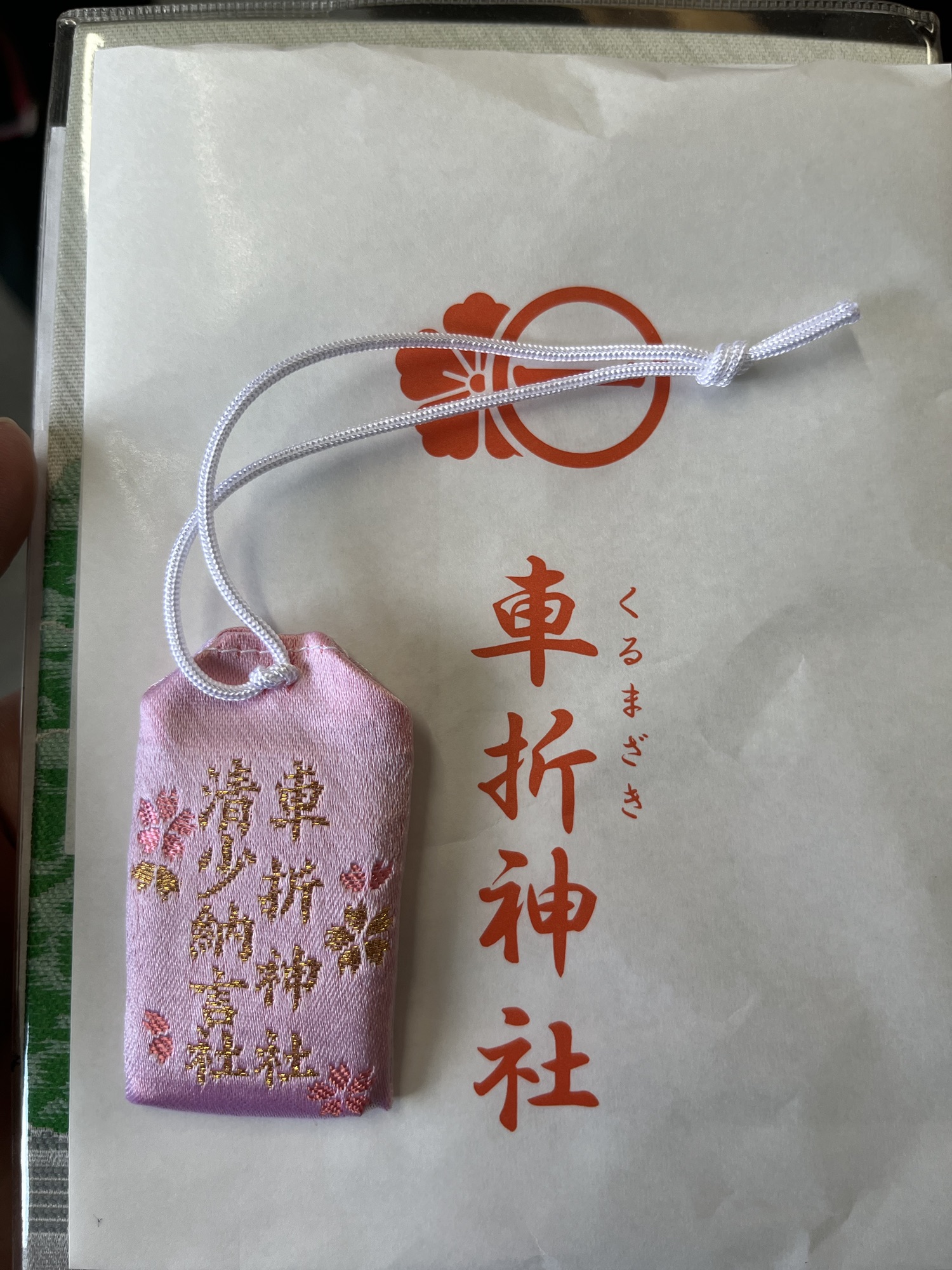
I stumbled upon it by accident after leaving the aforementioned site where the Hyakunin Isshu site was compiled. My family was waiting for me, it was late in the day, and it was very hot and humid, so I didn’t stay very long, but I wanted to at least grab a few photos, and get an omamori charm.1
Anyhow, that’s it for the blog for 2024.
I wanted to end this post by saying thank you to readers. The blog has been been around since 2011 (with some major gaps in content), and with plenty of twists and turns, but I am happy to see that people are still actively reading it, and discovering the Hyakunin Isshu, Heian-period culture, and Japanese poetry overall.
See you all next year!
P.S. Not far away was an exhibit for the historical drama about Lady Murasaki as well.
1 Most of the charms are for en-musubi (縁結び), meaning finding a partner in life, but since I am already happily married, I looked for something general. I picked up a omamori for kai-un (開運), meaning “good luck”, but it showed the famous scene from the Tales of Genji where Genji and Lady Aoi meet at Nonomiya Shrine. I wish I remembered to take a photo sooner, but I already gave it to someone, and have no photos to show. 🤦🏼♂️
You can see it on the website here, the charm on the upper-right corner.
Since I began, this blog has focused on a period of Japanese history which I like to call “Classical Japan”, or “Japanese Antiquity”.1 That’s just a convenient name I call it.
But most researchers and historians tend to divide Japan’s history into “periods” (jidai, 時代) based on where the capitol was at the time. So, precisely speaking, this blog and the Hyakunin Isshu cover a 500-period of history overlapping the Asuka (6th – 8th c.), Nara (8th c.) and Heian Periods (8th – 12th c.), while dipping our toes just a bit into the the early Kamakura Period (12th – 14th c.) for certain poems (poems 93, 99 and 100 for example). For the sake of the Manyoshu we also ventured even further back to somewhat murkier periods of time since some of the very early poets of the Hyakunin Isshu (poems 1, 2, 3 and 4 for example) were also contributors.
But the blog has never really explored anything beyond the early 13th century because that’s when things effectively end. The Hyakunin Isshu was compiled, the aristocracy of the Heian Period were totally sidelined by the new samurai class, and Japan continued on in a new trajectory. The aristocracy still lived until the modern era, and Imperial poetry anthologies were issued from time to time, but the quality and popularity gradually petered out. As poem 100 above alludes to, this era embodied by the Hyakunin Isshu was effectively over.
For the purposes of this blog, why pay attention to anything that comes after?
Well, I attended Professor Mostow’s recent lecture at the University of Washington, and I learned that history of the Hyakunin Isshu kept going. In fact, it was all the rage in the much later Edo Period (17th – 19th c.).
Japan by the Edo Period was pretty different than the earlier Heian Period. By this point, Japan had been effectively ruled by one military government or another for centuries, while the capitol had shifted from Kyoto in central Japan, to a fortified castle town in eastern Japan called Edo (江戸). Edo started as a fishing town, but soon grew into a metropolis thanks to good urban planning and government policies that forced rival warlords to stay there every other year. Edo, later the modern capitol of Tokyo, was one of the largest cities in the world at one point.
After a century of constant warfare throughout Japan, the Edo Period brought unprecedented stability and cultural flourishing. Its isolation from European explorers and rival Asian powers meant that people turned inward and rediscovered Japanese culture that had been forgotten in ages past due to war and instability.
One aspect of this flourishing was the invention of block printing which suddenly allowed the masses to enjoy reading in a way that earlier generations had not. Books became far more affordable, and more available, and suddenly a variety of books about the Hyakunin Isshu were published. There were books about the Hyakunin Isshu as far back as the 15th century, namely the Ōei-shō (応永抄) composed in 1406, but mass-printing made books much more accessible and allowed for a greater variety.
Professor Mostow has collected and aggregated many examples on his website here. Take a look if you can, there are some neat scans of really old documents from the era.
One common usage of the Hyakunin Isshu at the time, according to Professor Mostow, was in the instruction of girls. Books about young women’s education were a popular subject, and such books would work lessons in along with poems of the Hyakunin Isshu. For example, Professor Mostow posted scans from a book called the Hyakunin Isshu Jokun Shō (“A Selection of the Hyakunin Isshu for Women’s Instruction” ?), published in 1849. Another example can be found here.
Men were often taught things like Confucian values and such. And yet, even the boys learned about the Hyakunin Isshu from their mothers who had been raised on it. Also, books that were published for men about the Hyakunin Isshu often did so under the theme of Kokugaku (“national learning”).
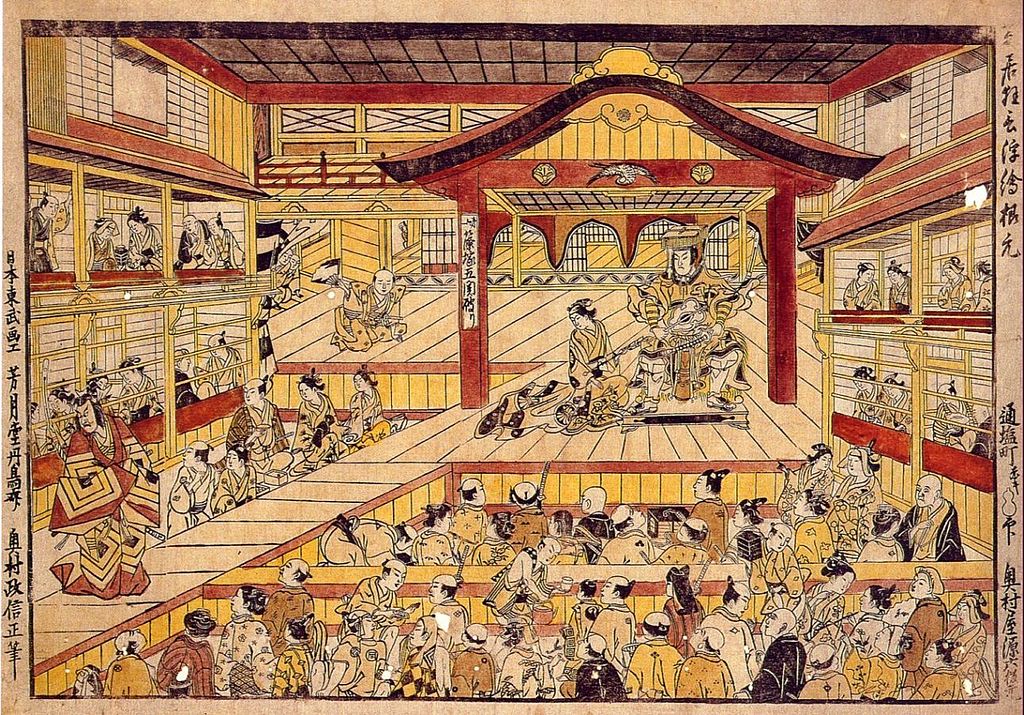
The high point of Edo Period culture, and something that influences Tokyo even today was the Genroku Period (1688 – 1704). Many things people imagine of pre-modern Tokyo, such as Kabuki theater and Ukiyo-e prints, have their origin in this brief period. The Hyakunin Isshu was used in some Ukiyo-e block prints too. Since many of these images were racy or scandalous, publishers would work in poetry of the Hyakunin Isshu to either obfuscate the content from Edo government censors, or to lend a more “classy” air to the image. I found some examples here.
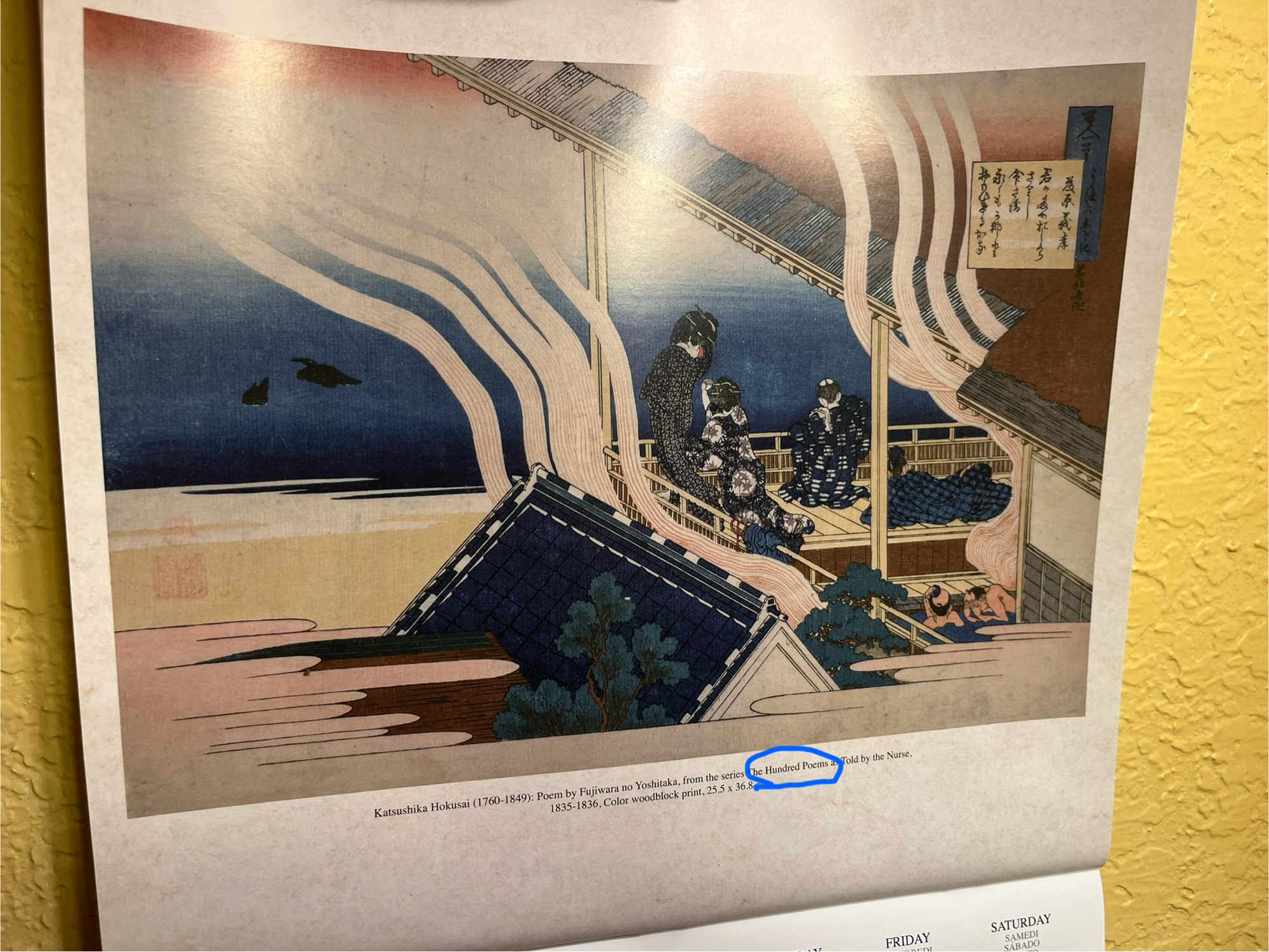
Even the famous artist Hokusai of “Great Wave” fame made block prints that would feature poems of the Hyakunin Isshu. We have a calendar at home and I was surprised to see this Hokusai block print with poem 50 (きみがためお) composed in cursive:
Our wall calendar featuring art by Hokusai. Turns out this page was from the Uba ga Etoki.
In blue, reads Hyakunin Isshu Uba Ga Toki, and in the yellow box poem 50 of the Hyakunin Isshu.
It turns out this is part of a series by Hokusai called theUba ga Etoki (姥がゑとき), or more formally the 百人一首姥がゑとき2, which means something like the “The Illustrated Hyakunin Isshu As Told By a Nurse(maid?)”. You can see more examples of this work here.
Anyhow, it’s fascinating that as literacy among the populace improved during the Edo Period, and access to information via books and printing increased, popular interpretations and illustrations of the Hyakunin Isshu took on a new life. The Hyakunin Isshu was, by that point, already 600 years old, and yet it enjoyed a revival that we benefit from today in the form of anime, karuta, and so on.3
Special thanks to Professor Mostow for his lecture and website! Also, check out Professor Mostow’s new book!4
1 I suppose my reason for doing this is that the end of the Heian Period and the subsequent change in Japan was somewhat similar to the fall of the Western Roman Empire in Europe, and how later generations of feudal lords kept up some of the trappings of the Romans, and yet it was still a different society altogether. But in the end, this is just one history nerd’s interpretation.
2 In modern Japanese 百人一首うばが絵解. See this post for more explanation.
3 Although social media and Internet reveal a pretty ugly side to humanity, it does also lead a similar explosion in cultural and accessibility. Two sides of the same coin, I suppose.
4 This is my associates link on Amazon. I get a small amount of credit for any purchases made through here. Feel free to purchase directly from University of Hawaii press instead though.
If you’re here reading the blog, chances are you like the poetry of the Hyakunin Isshu. Who doesn’t? Maybe you like it so much, you’ve tried to memorize your favorite poems too (I do). But what’s better than memorizing your favorite poems? Reciting them!
When I first learned to play karuta, I realized that poems of the Hyakunin Isshu are recited in a specific style in Japanese. This is necessary for the players to hear clearly, but also reflects a traditional singing method for reciting waka poetry.1 Even on kids shows about Japanese language, when waka or haiku are recited, they’re recited in the same way. Of course, this is not required, but it is cool to learn, and doesn’t take that much effort.
First, let’s look at this Youtube playlist of Hyakunin Isshu poems.2 In particular, let’s look at poem 2:
Poem 2, はるす
All waka poems, including the Hyakunin Isshu have five verses, and are usually written top to bottom, right to left. The poems are further divided by the first three “upper verses” (kami no ku, 上の句) and last two “lower verses” (shimo no ku, 下の句) for structured, reciting, and for games.
It really helps if you can read hiragana script, but even if not, listen to the intonation of the poem, and the way some syllables are drawn out longer (expressed above as vertical “|” lines). That’s how you recite waka poetry.
The syllables that are drawn out are not always in the same place, by the way. Poem 24 of the Hyakunin Isshu does not always match poem 2 especially the fourth verse (fourth column from the right):
Poem 24, この
Or take a look at poem 11 which has a slightly unusual format. This makes the pacing different, and affects where syllables are drawn out:
Poem 11, わたのはらや
Poem 11 is a particularly tricky poem to recite, in my opinion, but also fun because the first two lines sound really neat.
Reciting isn’t just for showing off by the way.
In my book on the Manyoshu, it talks about how many poems come alive when they are recited. This was true during Japanese antiquity, and centuries later when the Hyakunin Isshu was compiled too. There are sounds and expressions that have a nice ring to them and it’s not always apparent if you are just reading the poem in your mind. For example poem 3 of the Hyakunin Isshu uses a lot of “no” (の) sounds that come alive when recited aloud:
Poem 3, あし
Another example is poem 58 which simply has a nice ring to it:
Poem 58, ありま
Anyhow, unless you’re training to be a professional yomité reader in karuta, it’s not necessary to master reciting all 100 poems, or to even sound this nice. However, if you have a handful of poems you like, learning to master the recitation is a great way to bring poems to life. You can use the excellent Youtube list above, or if you are a tactile person (like me), you might consider getting a set of yomite cards like the ones sold by Oishi Tengu-do, direct link here. I purchased mine in Japan this year and enjoy flipping through them and practicing poems I like.
In truth, I am a TERRIBLE singer. I am truly tone-deaf. But, with a bit of practice you get used to the rhythm of a poem and can recite it without much effort. Some poems are easier than others (poem 11 is tough), but with a bit of practice and familiarity anyone can learn to recite their favorite poem.
1 Roughly 99% of the poems I’ve posted in this blog for the past 13 years are all waka poems. These poems almost always have a pattern of 5-7-5-7-7 syllables, as opposed to later haiku poetry that only have 5-7-5 syllables.
2 If you want to search other Youtube examples, search for 百人一首 読み上げ (reading Hyakunin Isshu aloud).
In the past year, I’ve spent a fair amount of time talking about what’s called competitive karuta (kyōgi karuta, 競技カルタ in Japanese) after my first encounters, and subsequentefforts to learn to play the game. The truth is is in that in recent months, for various reasons, I’ve really started to wind down my involvement in the competitive karuta scene. I do enjoy playing karuta games, but frankly just not a very competitive person at heart, and the thought of investing what little time I have to increasingly small, incremental gains in an obscure sport doesn’t really appeal to me. I learned how to play the game, and consider myself decent at it, but the poetic side of the Hyakunin Isshu is still what appeals to me most.
Further, I realized through talking with Japanese people that a lot of people play casual karuta games, not competitive. This mundane side of karuta gaming is not featured in animé such as Chihayafuru. However it is a common past-time for people who enjoy karuta and the Hyakunin Isshu poems,1 but don’t necessarily want to invest countless hours in practice, drills, and so on. So, I wanted to explore the casual side of karuta gaming, and help casual players find ways to enjoy the game without the intense stress of competition.2
Japanese “Karuta”, especially karuta games based on the Hyakunin Isshu, come in many forms. There is a spectrum of very easy games on one end, and competitive karuta on the other. If you think of it like a video game with difficult settings, then games like bozu-mekuri are easy mode. You don’t have to know anything about the cards, it is visual only, and the rules are simple. On the other hand, competitive karuta is hard mode: you are playing against some very good players, the margin of error is very small (in higher ranks), and every bit counts including hand-techniques, card position, mental training, and so on. It’s a tough struggle, with lots of exciting moments, but sometimes also crushing defeats.
So between “easy mode” of bozu-mekuri, and “hard mode” of competitive karuta, isn’t there anything in between? Turns out, yes.
I found good examples of casual karuta games through my Hyakunin Isshu Daijiten book, mentioned here, as well as subsequent information online. Let’s look at the games of chirashi-tori and genpei gassen.
Chirashi-Tori
The game of chirashi-tori (散らし取り), meaning “scatter and take”, can be thought of as a lightweight version of competitive karuta. You don’t have to know the kimariji, but it helps, nor do you have to think about card position. In the same way, penalties don’t exist. You do need to know how to read the hiragana script though, even if slowly.
The game basically works like so:
Take all 100 torifuda cards (the ones that are not illustrated) and spread them around face up. Players sit around the pile, spread out evenly.
Similar to competitive karuta, someone else (not a player) reads a random yomifuda card (the illustrated ones). It’s customary to read the last two verses twice.
You can also use one of several nice karuta reader apps on your mobile phone too.
As the poem is being read, whoever finds it’ll the corresponding card touches it, or takes it. If they are correct, they remove the card from the field and keep it in a stack next to them, face down.
The reader then draws another card and a new round begins until there are no more cards on the field.
Whoever took the most cards by the end of the game wins. 🏆
In terms of difficulty, this is the next step up from bozu-mekuri in that you do have to be able to read hiragana, but it’s a nice first step to getting familiar with the poems with little or no training. Even though knowing the kimariji is not required, knowing some can help you recognize some cards on the field quicker.
Genpei Gassen
The name of this game comes from the climatic war in 12th-century Japanese history: the Genpei War, pitting the Genji (“Gen”) clan versus the Heike (“pei”) clan. Unlike Chirashi-tori where each person plays separately, in Genpei Gassen people divide into even teams. Ostensibly one side plays the Heike clan, and the other the Genji clan.
There are a few other differences to Chirashi-tori:
The two teams sit facing one another, with teammates sitting side by side. Ideally, 5 or 7 people will play. The odd-man-out is the reader (see below).
The 100 torifuda cards (non-illustrated ones) are evenly divided into two groups of 50. Half the cards go to one side (i.e. facing them), and the other 50 go to the other team. Arrange the cards into three rows, roughly equal.
To play the game, a separate person reads a random yomifuda card (the illustrated ones), one at a time. It’s customary to read the last two verses twice.
You can also use one of several nice karuta reader apps on your mobile phone too.
As the poem is being read, players from both sides try to find the corresponding card somewhere on the field. If someone finds the poem, they may touch it, or take it. If they are correct, they remove the card from the field and keep it in a stack, face down.
The first team to get to zero cards on their side wins. 🏆
Similar to competitive karuta, if you take a card from the opponent’s side, you send over a card from your side. This way, their number stays the same, but since you correctly took a card, your side reduces by one.
This games has the advantage of being a gentler version of competitive karuta, but still keeping the look and feel of it. As with Chirashi-tori, you will need to be able to read hiragana script, and knowing the kimariji, even some of them, gives you an advantage, but these are things you’d learn anyway from repeated play. Also, having a team develops some fun and interesting strategies.
Five Color Hyakunin Isshu
Finally, if you still want the look and feel of competitive Karuta, but an easier version, you can look at Five Color Hyakunin Isshu. This way you can play a much smaller set of cards and warm up to the full competitive version. The catch is that it requires a custom set, or you will have to make your own by customizing a standard set.
Non-Hyakunin Isshu Karuta
If, like me, you somehow get a hold of a karuta set not featuring the Hyakunin Isshu poems (there are a surprising number in Japan), the games above will still work. Many karuta sets, regardless of theme, use the same basic format: two sets of cards for reading and taking. They are all meant to be read by someone, with other players finding the correct, corresponding card.
Conclusion
The game of Karuta at heart is just that : a game. It’s a great way to savor the poetry of the Hyakunin Isshu in a fun interactive way, and the more I explore it the more I realize that there are games to suit every player. If you purchase a set, you can try any number of games with friends or even by yourself. The most important thing is HAVE FUN! If poem 96 teaches us anything, it’s that life is short.
P.S. Speaking from experience, playing
1 Fun story, in summer of 2024, I was in Japan again briefly to visit my wife’s family, and found the famous Okuno Karuta store in Tokyo. I didn’t post about it as there wasn’t much to say (I didn’t find what I was looking for, tbh). I did see a tour group of elderly Japanese people come into the store in a single mass, and many of them bought karuta goods in one form or another before leaving again. So, it’s definitely a pasttime, but not quite the way I expected when I first learned about the game.
2 I don’t mean this lightly either. Some people definitely revel in competition, but I find such situations always make me intensely nervous, and uncomfortable, even when I win. Used to feel this way about Magic the Gathering competitions too. I thought maybe it was just me until I spoke to someone Japanese who also felt that way when playing competitive karuta. They just wanted to play casual games. That’s when I started to realize that there were different games for different crowds, but all of them celebrate the Hyakunin Isshu poetry in some way.
Similarly, some people want to play Pokemon TCG or Magic the Gathering at home with friends, rather than big competitions. Other people live for the thrill of competition. There’s enough room in the game for both types of players. I personally prefer Hyakunin Isshu karuta myself.
Ever since I picked up this book which explores the Pillow Book of Sei Shonagon (poem 62 of the Hyakunin Isshu, よを), it’s been fun to learn many of the hidden meanings and cultural allusions of this famous literary work.
It’s also fun to see how the Pillow Book is viewed by Japanese students in Japan. I talked with my wife and her friends about it, and they confirmed that kids in Japan study the Pillow Book in school, but like all students everywhere, they tend to forget most of it.1 My book jokes that most students in Japan only remember the very first line: haru wa akebono.
I bring this up because with the recent changing of the weather, I’ve been thinking a lot about seasons, especially after writing this post. So, I went back and looked at the first chapter of the Pillow Book.
The opening section begins with Sei Shonagon’s analysis of the four seasons, and what’s great about each one. This website posts the original text in Japanese (tl;dr it’s fairly different than modern Japanese) and even has a nice recording. It’s worth a listen, even if archaic Japanese is not your hobby.
Separately, if you want to hear how it was pronounced at the time you can see this video (00:47 onward):
Anyhow, let’s look at how Sei Shonagon describes each of the four seasons, starting with Spring…
Natsu wa yoru. Tsuki no koro wa sarinari. Yami mo nao, hotaru no ooku tobichigaitaru. Mata, tada hitsotsu futatsu nado, honoka ni uchi hikarite iku mo, okashi. Ame nado furu mo, okashi.
“In summer, the night — moonlight nights, of course, but also as the dark of the moon, it’s beautiful when fireflies are dancing everywhere in a mazy flight. And it’s delightful too to see just one or two fly through the darkness, glowing softly. Rain falling on a summer night is also lovely.”
Aki wa yuugure. Yuuhi no sashite, yama no hai to chikau nari taru ni, karasu no nedokoro e ikutote, mitsu, yotsu, futatsu mitsu nado, tobiisogu sae awarenari. Maite, kari nado no tsuranetaru ga, ito chiisaku miyuru wa, itokashi. Hiirihatete, kaze no oto, mushi no ne nado, hata, iiubeki ni arazu.
“In autumn, the evening — the blazing sun has sunk very close to the mountain rim, and now even the crows, in threes and fours or twos and threes, hurrying to their roost, are a moving sight. Still more enchanting is the sight of a string of wild geese in the distant sky, very tiny. And oh how inexpressible, when the sun has sunk, to hear in the growing darkness the wind, and the song of autumn insects.”
Fuyu wa tsutomete. Yuki no furitaru wa, iubeki ni mo arazu. Shimo no ito shiroki mo. Mata sara demo, itso samuki ni, hi nado isogi okoshite, sumi motewataru mo, ito tsukizuki shi. Hiru ni narite, nurukuyurubi moteikeba, hioke no hi mo, shiroki hai ga chininarite, waroshi.
“In winter, the early morning — if snow is falling, of course, it’s unutterably delightful, but it’s perfect too if there’s a pure white frost, or even just when it’s very cold, and they hasten to build up the fires in the braziers and carry fresh charcoal. But it’s unpleasant, as the day draws on and the air grows warmer, how the brazier fire dies down to white ash.”
As someone who likes to “nerd out” about such things, I try to shorten this to the following for easier memorization:
Spring: haru wa akebono (spring daybreak)
Summer: natsu wa yoru (summer nights)
Fall: aki wa yuugure (fall sunsets)
Winter: huyu wa tsutomete (early winter morning)
… and now you too know some authentic Japanese literature from the Heian Period.
1 Despite being a nerd now, I was actually a pretty lazy student in school. I was assigned to read various English classics like Ivanhoe, Treasure Island, etc, but usually didn’t read them, and faked my way through exams and such. My grades were mostly C’s and even some D’s. In high school, I finally took an interest in reading after picking up J.R.R. Tolkein’s Fellowship of the Ring, and have loved reading since. Looking back, I suppose a chaotic home life, and also just lack of structure and inspiration were to blame.
As I wrote previously, I have been spending a lot of time trying find more effective training methods for myself and for new, foreign Karuta players because of the scarcity of resources. One website that has been particularly helpful in Japanese is Karuta Club, managed by the Meijin (master player) Kawase Masayoshi and his wife.
It’s a pretty nice site and has a ton of training and resources, though almost all of it is in Japanese. There is a nice English-language introduction that is worth reading.
But for this post I wanted to focus on one particularly helpful article. This teaches a method of memorization called nakama-waké.
The method seems a bit complicated upfront but really helps in those 15 minutes (or 30 seconds on the app) when you have to memorize the board, and uses knowledge you probably already know: the kimari-ji.
Let’s look at my kimari-ji chart here. You can see how the cards are group by first syllable : “ha” cards, “tsu” cards, “ki” cards, “wa” cards and so on.
Kawase’s article suggests that after you learn the kimari-ji, next invest time memorizing how many are in each group. If you look at the chart, there are only two cards in the “tsu” (つ) group, compared to seven in the “wa” (わ) group, or 16 in the “a” (あ) group. Some groups are very large, some are very small.
Let’s use the examples of the “ha” group. From the chart we can see that there are four cards that start with “ha” (は):
If we remember that the “ha” group has 4 cards total, and when you are memorizing at the start of the match, you can determine which of the four are on the board. The rest can be safely ignored as kara-fuda (“empty cards”).
This separation of similar cards (“friends”) between the ones on the board and the ones that aren’t is why this is called nakama-waké (仲間わけ): “separating friends”.
Using the online karuta app, let’s demonstrate this. Here’s a game I played earlier, using default settings: 8 cards per side, only 30 seconds to memorize. The cards are all laid out, and my opponent (the computer) and I are memorizing.
Of the four “ha” cards, I can see two on the board, highlighted in purple. The two cards are “haruno” (はるの) on my side and “harusu” (はるす) on the opponent’s side. That means the other two in the group “hanano” (はなそ) and “hanasa” (はなさ) can be totally ignored if they are read aloud. That helps me avoid accidentally taking the wrong “ha” card and getting a penalty.
While we’re here, you might notice that both “shi” (し) cards are on the board, highlighted in green: “shira” (しら) and “shino” (しの). Even better they are on my side. That means I can just put group them together and simply listen for “shi” (し). Of course, the danger is that the opponent knows this too. Position matters.
Similarly, both cards of the “tsu” (つ) group are on the board too, highlighted in red. They are on opposite sides of the board though, so I still have to be careful to distinguish which is which when read. But it also means there are no “empty” tsu cards either.
Finally, of the seven unique “one syllable” cards, only one of them is on the board: “sa” (さ) which I’ve highlighted in blue. That means I can totally ignore the other six: “mu” (む), “su” (す), “me” (め), “fu” (ふ), “ho” (ほ) and “se” (せ) if they are read.
This may seem like more work upfront, and it does take time to get used to thinking like this, but it really helps in a couple ways:
Your memorization process is more structured, less haphazard, and so you can memorize a full board of 50 cards more easily.
Less risk of penalties because you’re only paying attention to the cards you know are on the board per group, and disregarding the rest.
If you’re relatively new to karuta and you find this process intimidating, you can focus on smaller, easier groups of cards for now: the one, two, and three card groups. With experience, and familiarity, you can then expand to larger, more difficult groups and even use this trick with the huge “a” group.
As fall is approaching, I wanted to share an interesting anecdote provided by my book on the Manyoshu. It seems that throughout Japanese antiquity, poets frequently debated which is better: spring or fall.
The first example comes from Princess Nukata in the 7th century, whom we discussed here and here, she wrote a lengthy poem (a chōka poem, not the usual tanka poem) in the Manyoshu (poem 16). She discusses the pros and cons of spring and of fall:
Original Manyogana1
Japanese
Romanization
Rough Translation2
冬木成 春去來者
冬ごもり 春さり來れば
Fuyu gomori haru sari kureba
When winter passes and spring comes
不喧有之 鳥毛来鳴奴
鳴かざりし鳥も來鳴きぬ
Nakazarishi tori mo nakinu
Birds that didn’t sing before, now come and sing
不開有之 花毛佐家礼抒 山乎茂
咲かざりし 花も咲けれど 山を茂み
Sakazarishi hana mo sakeredo yama wo shigemi
Flowers that didn’t bloom before now bloom, but because the mountains grass is so thick
入而毛不取 草深 執手母不見
入りても取らず 草深み 取り手も見ず
Irite mo torazu kusabukami torite me mizu
One cannot go and pick flowers, let alone see them.
秋山乃 木葉乎見而者
秋山の 木の葉を見ては
Aki yama no ko no ba wo mite wa
When you look at the leaves in the mountains during fall,
黄葉乎婆 取而曾思努布
黄葉をば 取りてそしのふ
Momiji wo ba torite soshi no fu
collecting the yellow leaves is especially prized.
青乎者 置而曾歎久
青きをば 置きてそ歎く
Aoki wo ba okite so nageku
Leaving the green leaves as they are is regrettable.
曾許之恨之 秋山吾者
そこし恨めし 秋山われは
Sokoshi urameshi akiyama ware wa
In spite of that, autumn in the mountains is spectacular…
a – I am heavily indebted to this site for both the original text. Translation is based in part on that site, but also my Manyoshu book, but probably lots of mistakes. Translating a five-line poem in archaic Japanese is hard enough… 😅
Speaking of the Manyoshu, its compiler Otomo no Yakamochi (poem 6 of the Hyakunin Isshu, かさ) left us some very nice poetry about spring:
Original Manyogana1
Japanese
Romanization
Rough Translation2
春苑
春の苑
Haru no sono
Beneath
紅尓保布
紅にほふ
Kurenai ni hofu
the shining crimson
桃花
桃の花
Momo no hana
orchard of
下照道尓
下照る道に
Shita deru michi ni
peach blossoms
出立オ嬬
出で立つ少女
Idetatsu otome
a young maiden lingers.
Poem 4139, book 19
and about fall:
Original Manyogana1
Japanese
Romanization
Rough Translation2
秋去者
秋さらば
Aki saraba
When fall comes
見乍思跡
見つつ思へと
Mitsutsu shinoe to
think fondly of those
妹之殖之
妹が植ゑし
Imo ga ue shi
pink blossoms
屋前乃石竹
やどのなでしこ
Yado no nadeshiko
of days gone by
開家流香聞
咲きにけるかも
Saki ni keru kamo
and remember me.
Poem 464, book 3
Otomo no Yakamochi wrote both of these poems about his beloved wife, but the second was composed shortly after her parting. The word nadeshiko has special meaning in Japan and has a very feminine, demure3 meaning.
Returning to the debate between spring and fall, Ki no Tsurayuki (poem 35 of the Hyakunin Isshu, ひとは) took up the same topic centuries later. This is poem 509 from an imperial anthology, the Shuishu :
Japanese
Romanization
Rough Translation2
春秋に
Haru aki ni
Spring or Fall?
おもひみたれて
Omoi mitarete
My thoughts are a mess,
わきかねつ
Waki kanetsu
and I cannot decide.
時につけつつ
Toki ni tsuketsutsu
The more time passes,
うつるこころは
Utsuru kokoro wa
the more my heart shifts back and forth.
1 This is a rough translation, all mistakes are my own.
The debate was even cited in the famous 12th century novel Tales of Genji written by Lady Murasaki (poem 57 of the Hyakunin Isshu, め):
“Since antiquity, in the debate about spring versus fall, many people lean toward fall, and yet some very noteworthy people who view the Imperial gardens in spring may yet change their mind, as is the way of the world.”
Princess Nukata all the way back in the Manyoshu seemed to imply that autumn was preferable, and it seems that most of the aristocracy shared this view. In fact if we divide up the poems of the Hyakunin Isshu by season, there are more fall poems than spring:
Note: summer only has 4 poems, winter has 9 (same as spring).
But what do you think? Are you Team Spring, or Team Fall?
Edit: added Hyakunin Isshu poetry chart.
1 If you’re wondering why I post Manyogana for some poems, but not others, it depends on the era. The Manyoshu is the oldest anthology by far, and at that time, there was a brief writing system that took Chinese characters, but used them in a phonetic way for Japanese language (a.k.a. Manyogana). By the time of Ki no Tsurayuki and Lady Murasaki, centuries later, this had been replaced with hiragana script. This blog strives to both be accurate and accessible, so I try to balance both needs.
2 These are all rough translations on my part, and likely have mistakes. Any such mistakes are entirely my own.
3 Not to be confused with the “very demure, very mindful” meme. 😛
During our recent trip to Japan, we visited the city of Kyoto. I talked about this here, but I also wanted to share another site in Kyoto that relates to one of the poets of the Hyakunin Isshu : Kuramazaki Shrine. You can find their official website here, but there is no English and the site is a bit hard to navigate. The shrine itself has a very interesting layout:
The photo above is the main promenade leading to the inner sanctum (toward the back). Apparently, it’s tradition in Japanese culture to walk along the edge of the walkway, not right in the middle, so bear that in mind when visiting a shrine like this.
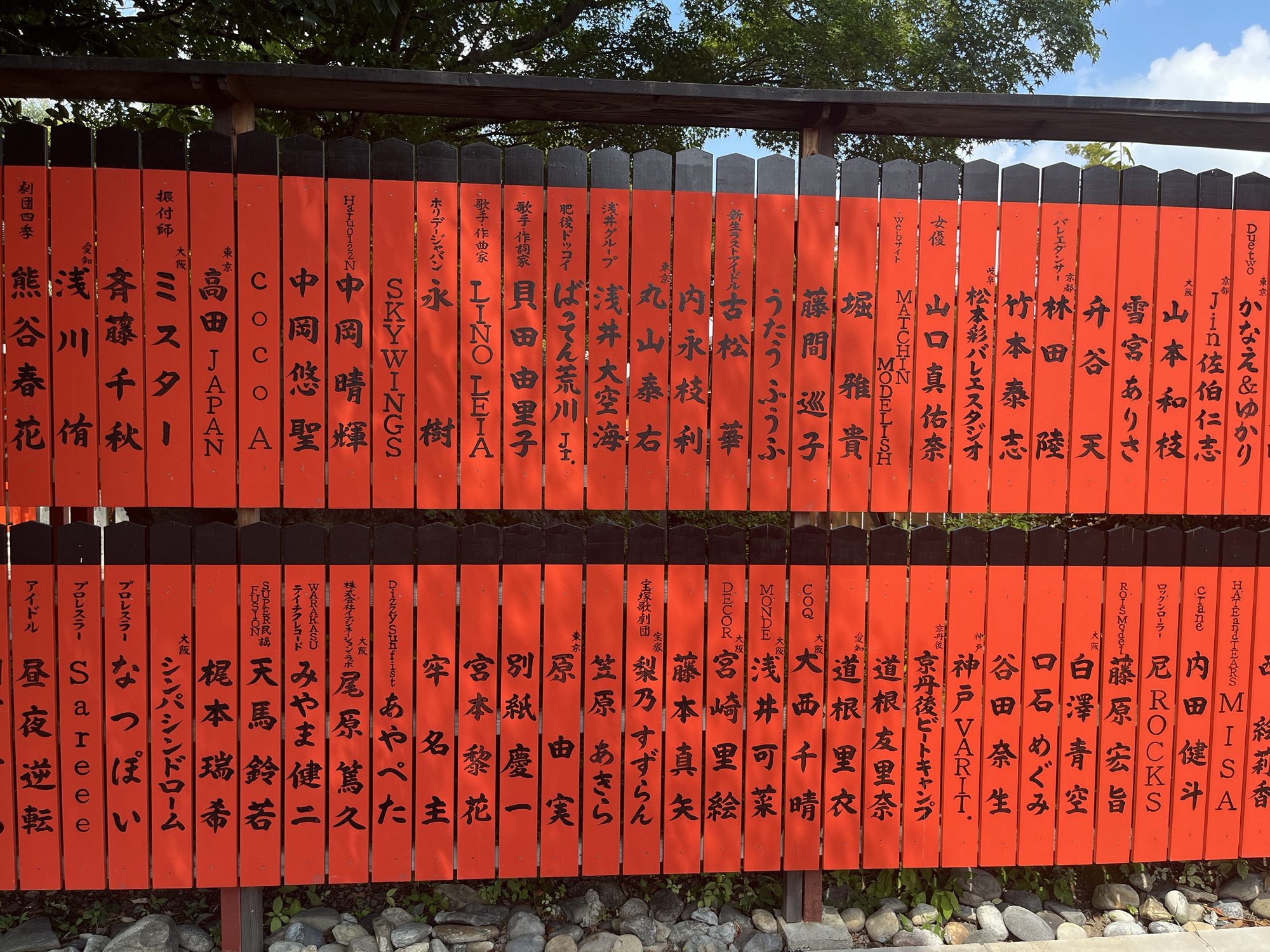
This Shinto shrine is notable for its many visits by celebrities who leave autographed red plaques.
Shinto shrines often serve particular need in society: love, business success, health, etc. In the case of Kurumazaki Shrine, the focus is on show-business, acting, theater, etc.
Why does this matter?
It turns out that Sei Shonagon, author of the Pillow Book and poem 62 (よを) in the Hyakunin Isshu is enshrined here. Not only that, but you can purchase a special omamori charm with her image on it. I learned about this place on social media after seeing the actress First Summer Uika, who played Sei Shonagon in the historical drama, visit the shrine.
Because this site contains many sub-shrines and side passages, it took a bit of effort to find Sei Shonagon’s shrine. It is halfway down the promenade, on the left, and looks like so:
I paid my respects to this esteemed author, and the family and I continued to explore. I found First Summer Uika’s plaque near the inner sanctum:
Incidentally, my wife is a fan of the JPop group Snow Man, and you can see one of their markers just to the left. We both got something out of this trip. 😛
As I alluded to earlier, the shrine complex is deceptively long, with many nooks and hidden shrines and side paths. The site map gives some sense of this. For reference, the Sei Shonagon shrine is number 20 on the map, and you can see there are many other sites here too. I didn’t photograph every shrine here, and most are probably obscure to readers (and obscure to myself). The common theme was both fortune, and also show business. They were some pretty neat shrines though, such as this one showing various theater masks:
At last we came to the gift shop, and I got a Sei Shonagon charm (omamori):
Later, when I got back home and realized that the charm was intended for ladies,1 I was rather embarrassed, yet I didn’t want it to go to waste, so I gave it to my daughter whose preparing for college this year. It seemed fitting, and I am happy to report that she got a good score in her SAT exam the following month, so perhaps the charm worked?
Anyhow, Kurumazaki Shrine is not something tourists usually visit because it’s a little removed from the nearby touristy area of Arashiyama, and like many Shinto shrines, it’s very Japan-centric, but it’s a cool slice-of-life of Japanese popular culture, both past and present.
As for me, I was happy to pay my respects to such a wonderful poet and author directly, someone’s whose creativity and work indirectly helped make this blog what it is today.
P.S. Later that day, I stumbled upon the place where the Hyakunin Isshu was compiled, so I managed to visit two sites in one day. Not too shabby.
1 It’s clearly written on the signs, I just failed to pay attention. I was maybe a bit star-struck perhaps. 😅
Although this blog is primarily about the Hyakunin Isshu, I enjoy when things overlap with other Japanese poetry anthologies, and history.
Let’s talk about two of the poets: Empress Jitō (poem 2, はるす) and Kakinomoto no Hitomaro (poem 3, あし). After Empress Jito ascended to the throne, she was visited by Hitomaro, the revered court poet at the time, who composed the following poem:
Original Manyogana
Modern Japanese
Romanization
Rough Translation1
皇者
大君は
Okimi wa
As my sovereign
神二四座者
神にしませば
Kami ni shimaseba
is a living kami, (see below)
天雲之
天雲の
Amakumo no
she builds a temporary
雷之上尓
雷の上に
Ikazuchi no ue ni
residence atop
廬為流鴨
廬りせるかも
Ioriseru kamo
Ikazuchi Hill.
1 I didn’t like any of the existing translations, so I tried to translate here. Any mistakes are my own.
At first, this poem seems like a simple case of a courtier sucking up to the new boss, but as we’ll see there’s more to it. This poem is very simple in some respects, and surprisingly difficult in others.
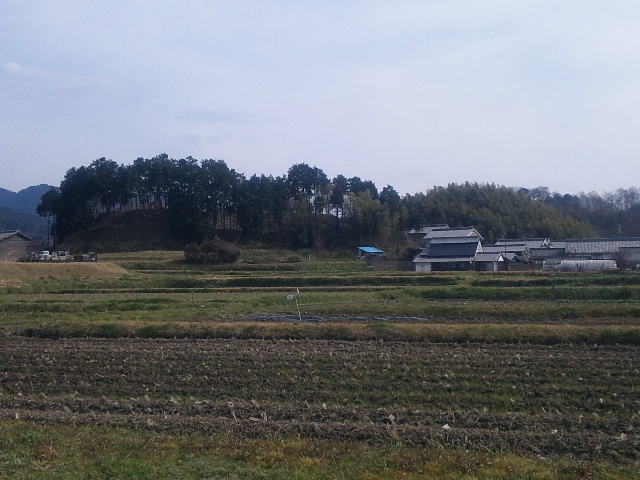
I had to check multiple sources to make sense of it, including my book on the Manyoshu, but the essence of the poem is that Kakinomoto no Hitomaro is describing Empress Jito as a living kami, and that because of her “supernatural abilities”, she can build a residence atop a small hill called Ikazuchi. Ikazuchi Hill, known as Ikazuchi no Oka (雷丘) can be seen in this photo, more information here.
But what the heck is kami? This is surprisingly tough to explain to Western audiences. It is deeply rooted in Shinto religion, and more closely matches something like ancient Greek religion where there were divine spirits both great and small. Small nature spirits would be worshiped as daimon (not to be confused with modern “demon”), and the Olympian gods were venerated too. Even the Olympian gods had “big forms” and small “household forms” worshiped at the hearth. It wasn’t unusual for Zeus, king to the gods, to also be venerated at a home shrine to protect the family assets, or a roadside marker.
In the same way, Shinto has countless kami. It’s not quite right to translate them as “gods” because the meaning is a little different, and “spirits” is not quite right either. But one could include both gods and spirits under the divine label kami. Just like in Greek religion, very talented people could also be venerated as kami after death, such as Hercules. I mention this because Sugawara no Michizane (poem 24 of the Hyakunin Isshu, この) was similarly venerated after death and became something like the Kami (god) of Learning.
This concept of great personages being kami is called arahito-gami (現人神) and that’s basically what Kakinomoto no Hitomaro is describing Empress Jito. Due to the divine ancestry of the Imperial family, this isn’t that surprising, but my book alludes to another reason for this. The turmoil caused by Emperor Tenji (poem 1 of the Hyakunin Isshu, あきの)’s family and his brother Emperor Tenmu’s family for control of the throne meant that Empress Jito (Tenmu’s wife/niece) ascended the throne on shaky ground. Female sovereigns were quite rare in Japanese history, and with the family fighting for control of the throne, Hitomaro was helping her reassert her divine status and legitimacy as the proper ruler of Japan.
The issue of arahito-gami comes up even as recently as 1946, when the reigning Emperor at the time (Emperor Showa, Hirohito), was requested to renounce his divine status after World War II. This declaration used some hair-splitting language about the Emperor’s divinity (or lack thereof), and various interpretations persist today.
…. but that’s something more knowledgeable people could explain better.
As for me, I find it fascinating (and a bit amusing) that these poets I know from the Hyakunin Isshu got embroiled in a succession dispute, but also that Hitomaro helped bolster Empress Jito’s credentials at a time when she was rebuilding the nation again while probably sucking up just a little too.
P.S. the featured photo above is Ikazuchi Hill, photo by Terumasa, CC BY-SA 3.0, via Wikimedia Commons
P.P.S. On a completely unrelated fact, while writing this post I learned that the Chinese characters for 雷丘 also mean “Raichu” as in the Pokemon.
I just returned from another trip to Japan,1 and we got to spend a bit of time in Kyoto. By accident, I also found Mount Ogura, and the place where Hyakunin Isshu was compiled! But first, let’s backup and explain a bit of history first.
Kyoto was the capital of Japan from the 8th century to the 19th century, and so many well-to-do families lived here. This aristocracy wrote countless waka poems that were compiled into official poetry anthologies from time to time,2 but the Hyakunin Isshu was not one of them. It was compiled by Fujiwara no Teika (poem 97) as a favor to his in-laws. Teika had been a compiler of one of the major anthologies, the Shin-Kokin-Wakashu, but was now in retirement after his liege lords (poem 100 and poem 99) were exiled in the upheaval of the Jokyu Rebellion. He resided in a small villa on the west side of Kyoto on the hillside of Mount Ogura, and was tasked with selecting the very best 100 waka poems that his in-laws could decorate their home with. Teika’s excellent poetic taste led to the Hyakunin Isshu we celebrate today.
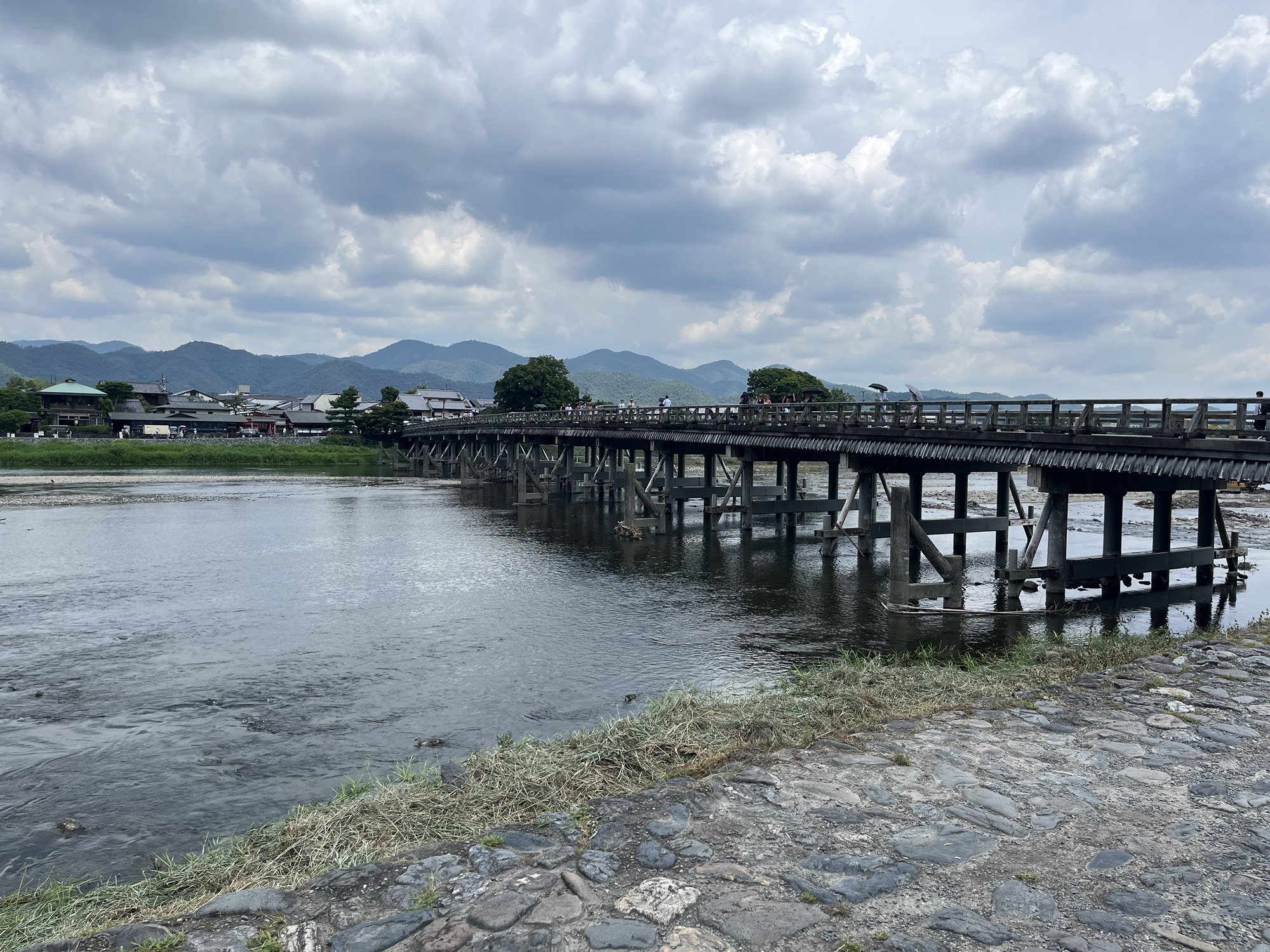
Anyhow, back to present day. I was with the family, and we visited a part of western Kyoto called Arashiyama (嵐山). It’s a very scenic place, with famous bamboo forests, and an iconic bridge named Togetsu-kyō (渡月橋):
Since we visited in the summer, it was extremely hot and muggy, so by lunch time we were exhausted and tired. We went to a local cafe and had lunch. Since we were in Kyoto, I assumed there would be many famous historical places related to the Hyakunin Isshu,3 but I was having trouble finding them on GPS, so I was disappointed.
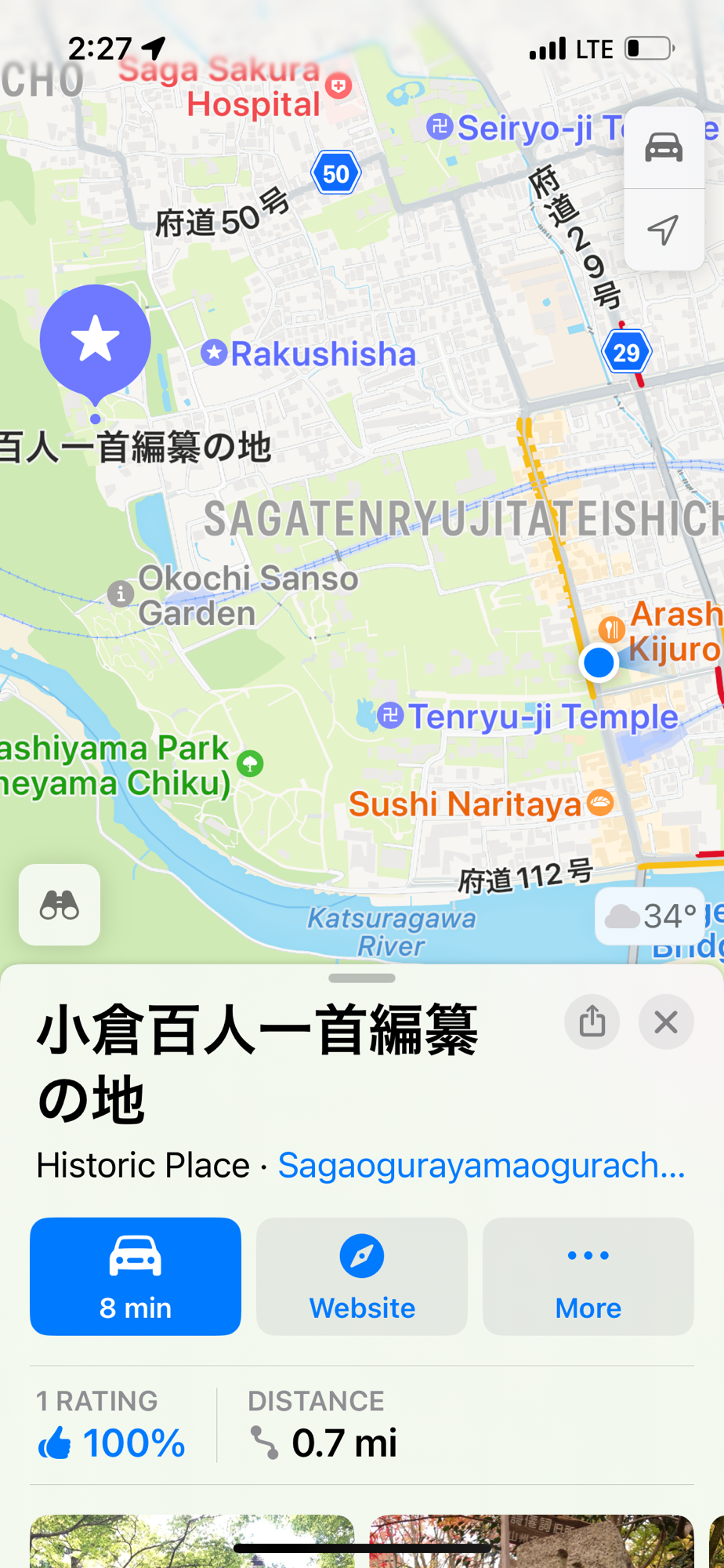
Then I noticed the following spot on my map app:
小倉百人一首編纂の地 (ogura hyakunin isshu hensan no chi) … the place where the Hyakunin Isshu was compiled…? Wow, that’s only 15 minutes by foot from where I was at!
The family was exhausted and sweaty, and were planning to return to our hotel, so I didn’t want to drag them uphill in the heat. I told them I’d be back, and I took off for the place on the map. It turns out that the properly had been converted to a Buddhist temple named Jojakkō-ji (常寂光寺) in the 17th century (a common practice in Kyoto). You can find the official website here.
This is Mount Ogura today.
I followed the map directions and made it safely to Jojakko-ji Temple:
There is a small entry fee, but once I paid that, I got to the second gate here:
The site of the Ogura Hyakunin Isshu is just down the path to the right, before the gate. I made the mistake of going up the stairs instead:
Jojakko-ji Temple is quite scenic actually:
… but it was very late in the day, my family was waiting back at Arashiyama, and I had to hurry. This was my one shot, probably in my lifetime, to find this place, but the temple maps, nor the website show precisely where it was.
Finally, I found it:
The photos from the prefectural website look a lot better than mine (good lighting helps). But there it was, the actual site where the Ogura Hyakunin Isshu was compiled!
The stone marker is pretty small and somewhat eroded, but there was no mistaking it.
Since I was short on time, I paused and said a quick “thank you” to Fujiwara no Teika and then headed back.
If you are fan of the Hyakunin Isshu, and you are in the Arashiyama area of Kyoto don’t miss this small but significant site.
P.S. while at Jojakko-ji, I met a nice Australian couple who had just finished their visit. They told me that at the top of the temple you can see a really view of Kyoto. I didn’t have the time to see it for myself, but if you go, don’t pass up the chance.
P.P.S. I forgot that, ten years ago, I had made a post about Mount Ogura. You can see the Togetsu-Kyo bridge here too.
1 We return every year when possible to visit my wife’s in-laws, and let the kids spend time with their relatives, learn more Japanese, etc.
2 Many earlier poems were also composed at a time when Japan’s capital moved around (Nara, Fujiwara-kyo, Asuka, etc) before settling down in Kyoto. See the Manyoshu for further details.
3 I did actually find one other place we visited earlier in the day, but more on that in an upcoming post.
















 The Hyakunin Isshu


