Shell Matching Game

I learned a neat little cultural facet from watching the historical drama about Lady Murasaki, but also from the anime Onmyoji.1 Since people in Heian-Period Japan did not have the technology to play Super Smash Brothers Ultimate,2 they passed the time in other ways.

One such pasttime, besides poetry contests and court music, was a neat little game originally called Kai-ōi (貝覆い, “Shell hiding”), but came to be more commonly known as Kai-awase (貝合わせ, “Shell matching”). Using shells from the common Meretrix lusoria or “Asiatic hard clam” (hamaguri in Japanese), the insides of the shells were painted so that both halves of the shell had the same picture. Then the shells would be put face down alongside many other similar shells for a matching game. In art, the game seems to be played mostly by women, and in later generations it was used as a wedding gift to upper-class brides.

The designs of shells started out fairly simple in the 11th and 12 centuries (i.e. the late Heian Period which we focus on so much here), but by the Edo Period, the designs were increasingly elaborate, and tended to hark back to the earlier period in history. Here’s a set of shells featuring scenes from Lady Murasaki’s novel The Tales of Genji:

Photo by Sailko, CC BY-SA 4.0, via Wikimedia Commons

This nice blog post below shows kids painting their own shells at the Toy Museum in Hyogo Prefecture:

The idea of a matching game is easy to find in many cultures, but the idea of painting the inside of shells, featuring scenes from a 12th century novel is awfully clever, and shows how the brilliance of the Heian Period culture still shines through even into modern times.

1 Onmyoji was pretty good, but I didn’t get very far. To be honest, I don’t watch anime very much. Even Chihayafuru; I only watched the first season.

2 Who would be the “main” for each poet in SSBU? My guess is:

  • Lady Murasaki – Sephiroth (dark and brooding)
  • Sei Shonagon – Samus
  • Lady Izumi – Bayonetta or Zero-suit Samus
  • Fujiwara no Teika – Metaknight (loyal to Gotoba-in)
  • Ono no Komachi – Peach
  • Ariwara no Narihira – Marth or Link (dashing guy)
  • Gotoba-in – King Dedede
  • Fujiwara no Mototoshi – Bowser (demanding)
  • Kakinomoto no Hitomaro – Kirby
  • Kanké – Dr Mario (scholarly guy)

As for me, I usually play “best dad” Chrom or his daughter Lucina. Byleth is fun to play sometimes, but kind of sluggish in the game.

P.S. I think I spent more time making this SSBU list than writing the rest of the post. 🤦🏼‍♂️

Gagaku Music

Courtly life in the Heian Period of Japanese history wasn’t limited to poetry and love trysts. Music was an important part of the culture too, but Japanese music at the time was considerably different than we might expect. This kind of Court music is called gagaku (雅楽).

You can see a good example of Gagaku music here:

It may not seem obvious at first, but this style preserves many cultural aspects of the Heian Period (which the Hyakunin Isshu was a part of too): the costumes, music, songs of the time, and so on. The music takes a bit of getting used to for modern audiences (it is kind of screechy at times), but it was common then for such music to accompany important dances such as the yearly Go-sechi dance (see poem 12 of the Hyakunin Isshu, あまつ). When Lady Murasaki talks about concerts and dances in her diary or Sei Shonagon in her Pillow Book, this kind of music was played.

Gagaku music still lives on in Japan in traditional theater, and some religious services. It also makes a nice cover for Led Zeppelin’s Stairway to Heaven, too:

Enjoy!

Special thanks to Mr Togi for this awesome video. 東儀さん、ありがとうございます!

P.S. Speaking of Stairway

From Darkness Into Darkness: Lady Izumi’s Final Poem

In a lesser-known Imperial poetry anthology called the Shui Wakashu (拾遺和歌集), poem 1342, is recorded what is believed to be Lady Izumi’s1 final poem:

JapaneseRomanizationTranslation
暗きよりKuraki yoriThe way I must enter
暗き道にぞKuraki michi ni zoleads through darkness to darkness —
入りぬべきIrinu bekiO moon above the mountains’ rim
はるかに照らせHaruka ni teraseplease shine a little further
山の端の月Yama no wa no tsukion my path.
Translation by Jane Hirshfield and Mariko Aratani in “The Ink Dark Moon

This poem was addressed to a Buddhist monk named “Shoku” and includes several Buddhist allusions. The most important is the phrase “darkness to darkness”, which comes from chapter seven of the Lotus Sutra:

….from darkness they [living beings] enter into darkness,
to the end never hearing the Buddha’s name [hear the Dharma].

translation by Burton Watson2

This refers to the Buddhist notion of Samsara, the near-infinite, aimless wandering that living beings undergo lifetime after lifetime, like a cosmic rat race. Such beings, who have yet to hear the Dharma [the teachings] of the Buddha, will continue to wander lifetime after lifetime without rest.

Thus, Lady Izumi is asking Shoku to help shine a light in the darkness for her, so that she may find the way [follow the Buddhist path].

I had trouble deciding which blog to put this in, since it covers both themes, but I decided to post here since the poem was introduced in the new historical drama about Lady Murasaki, Izumi’s contemporary.

Lady Izumi was, to put it mildly, a complex woman. She had incredible talent, and found herself in one scandal3 after another as powerful men fell at her feet, plus she earned scorn from other women such as Lady Murasaki. And yet, she was also very kind, devout and struggled to balance both the religious and worldly aspects of her life, while raising her orphaned granddaughter.

Hirshfield and Aratani note that if this poem is indeed her last, the final word she ever wrote was tsuki (月), “moon”.

1 poem 56 in the Hyakunin Isshu (あらざらん)

2 alternate translation by Murano reads: …they go from darkness to darkness, and do not hear of the names of the Buddhas.

3 this was a conservative, narrow, aristocratic society where men frequently had affairs, but it was much more scandalous if women did. The idea that women could want, and enjoy sex, was not something people really accepted at the time.

Fashion of the Hyakunin Isshu

The fashion of the nobility of the Heian Period of Japanese history is fairly different than later, more familiar styles we often see in Japanese media like anime, manga, etc., because it reflects early Chinese influence, but also increasingly local innovations and culture. Further, as we’ll see, because the aristocracy was socially rigid and had many complex customs and rules, this affected how people dressed as well. Everyone knew their place, and their fashion reflected this too. I have touched on the subject a little bit here and here, but I always wanted to explore in depth. The issue was (until recently) a lack of resources and time. But, here we go.

Some great online resources for fashion during the Heian Period of Japanese history (c. 8th century to 12th century) can be found on this website (Google translated version here), and this site. The second link has some English in it, so even if you can’t read Japanese, it’s a great place to visit and look around.

However, for us Hyakunin Isshu poetry (and karuta) fans, you can see many great examples in the yomifuda cards too.

Women’s Fashion

This card, depicts Daini no Sanmi (poem 58, ありま) of the Hyakunin Isshu. The illustration, part of the Ogata Korin collection, shows her in full formal dress.

Like many women of the Heian Period, during formal occasions, she would wear multiple layers of kimono robes called junihito-é (十二単) which literally translates to “twelve robes”. The women of the court did not actually wear 12 layers, but it was much heavier and bulkier than kimono fashion of later centuries.

Here’s another example: Suō no Naishi (poem 67, はるの):

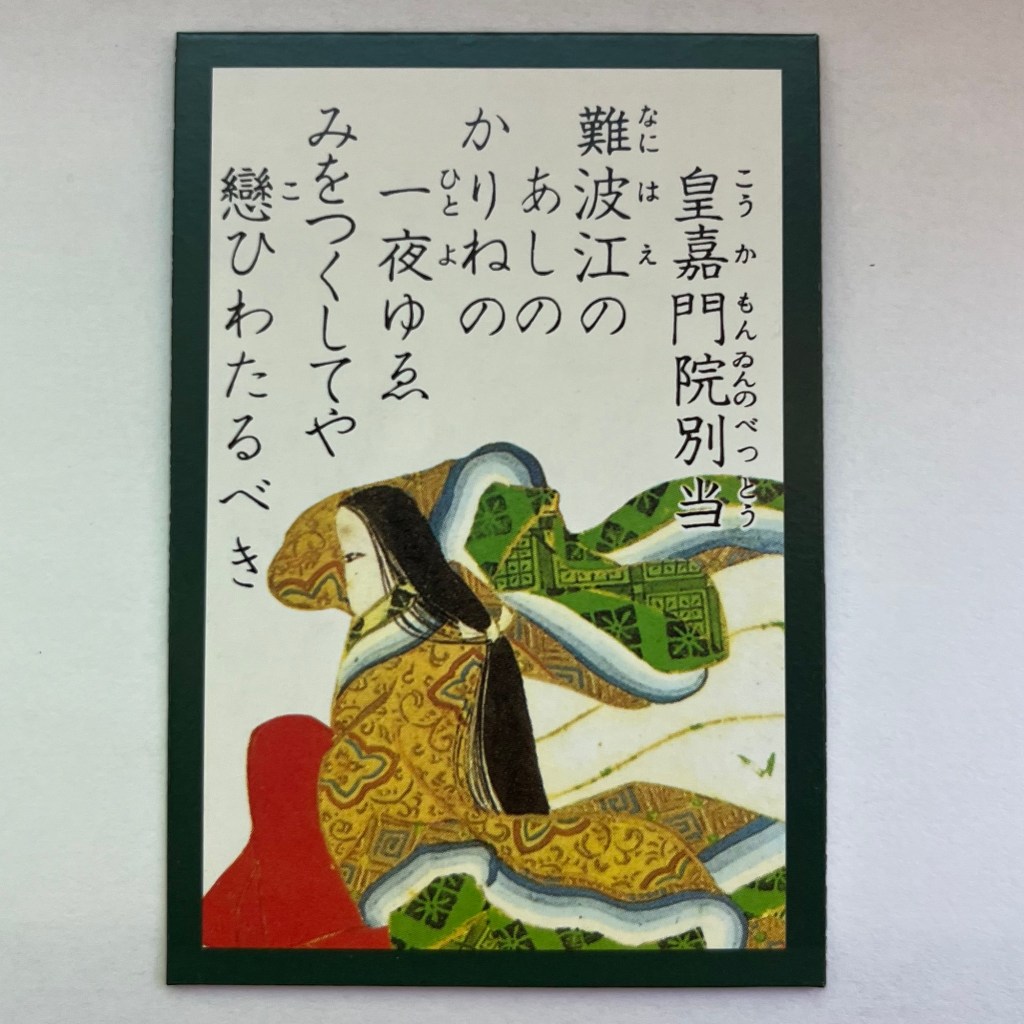
And another: Kōkamonin no Bettō (poem 88, なにはえ):

A few things worth pointing out…

  • The robes (hitoé, 単) were very long and thus hard to walk in.
  • Over the layers of robes, the women would wear a “Chinese jacket” (karaginu, 唐衣).
  • The white train in the back was called a mo (裳), which tied around the waist.
  • The women wore hakama (袴) trousers much like Japanese traditional clothing today.

You can see a really good example of this kind of fashion here. Definitely check out the link.

Men’s Fashion

Men’s formal wear, if you can believe it, was actually more complicated than women’s. Broadly speaking, it could be divided into three categories: civil bureaucrats, warriors (e.g. palace guards), and upper class nobility including the Emperor.

Imperial Advisors

Because the Imperial court of Japan was modeled after the Chinese-Confucian bureaucracy from antiquity, there are some similarities in the fashion of the civil servants (bunkan, 文官): black robes, similar hats, etc. We can see some examples here: Middle Counselor Yakamochi (poem 6, かさ):

and Middle Counselor Yukihira (poem 16, たち):

Some things to point out here:

  • The hat they wore, the sui-ei-kan (垂纓冠) was a black lacquer helmet, but in this case, also had a ribbon hanging down the back too.
  • Black silk overcoat called a ho (枹), based on Chinese-Confucian style.
  • The high collar in the back was called an agekubi (盤領)
  • In formal settings, men would also wield a small, flat wooden scepter called a shaku (笏).
  • The silk pants were a variation of the modern Japanese hakama called an ué-no-hakama (表袴).
  • Finally, the shoes were a kind of black lacquer clogs called asagutsu (浅沓). Similarly to the women’s formal wear, it was hard to walk in.

You can see some great examples of both the summer dress and the winter dress.

One thing to note is that even samurai warlords who ruled the country in later periods (see Sanetomo), when they came to the capital (jōraku 上洛) were expected to wear this kind of court dress befitting whatever rank they had been bestowed. Although the samurai class held true power, they were still technically part of the Imperial court so customs persisted.

Guards

For the palace guards and other military figures, the formal dress was similar to the bureaucrats above, but with some notable differences. A good example from the Hyakunin Isshu is Fujiwara no Michinobu (poem 52, あけ):

Noting the differences here:

  • Guards and military figures were equipped with a sword (ken, 剣), bow (yumi, 弓), and a quiver of arrows (ya, 矢).
  • The crown on their head was shaped in a loop, not a long trailing one. It was called a ken-ei-kan (巻纓冠) instead.
  • The crown also had two fan-like protrusions called oikake (緌).
  • Instead of black-lacquer clogs, the shoes were often pointed-toe boots called kanokutsu (靴).

You can see an example here.

Upper Nobility

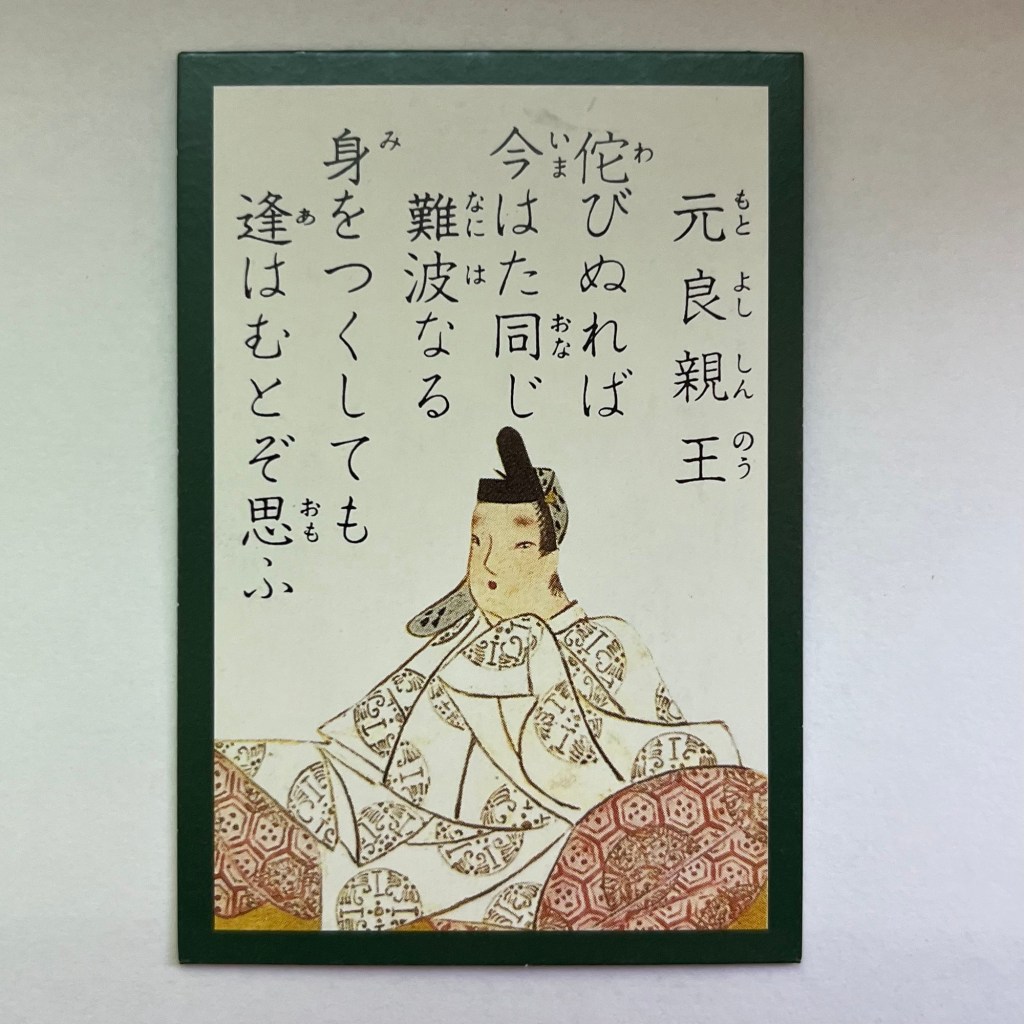
The upper nobility wore clothing that was pretty similar to other members court, but with one major exception: the colors of their robes. Here you can see Prince Motoyoshi (poem 20, わび):

As eluded to in Lady Murasaki’s diary and other sources, there was a strict hierarchy within the Court nobility, which was reinforced by which colors of robes people were permitted to wear. This included colors such as green (shown here), orange (shown here) or white (shown here). The green linked above was, for example, permitted to courtiers of the sixth rank, or palace servants of the fourth rank. Wikipedia has list of forbidden colors, and what ranks were associated with each. The point is is that just by looking at someone’s robes, members of the aristocracy knew each other’s place.

The very upper class nobility, namely those of the Emperor and his family, are often depicted in white robes with red trimming, which is similar to those used by Shinto priests (shown here). It’s probable this was intended to reinforce the Imperial family’s divine lineage, but that’s just a guess on my part.

The fashion used in the yomifuda Karuta cards really tells us a lot about the culture that the poets of the Hyakunin Isshu lived in.

The Pillow Book

Since I spent so much time gushing over First Summer Uika and her portrayal of Sei Shonagon in the Japanese drama Hikaru Kimi É (“Addressed To You, My Radiant One”), this seemed like a good time to talk about the Pillow Book, or Makura no Sōshi (枕草子).

Despite the name “Pillow Book”, the book has no erotic content. Instead, it is a collection of witty musings about life in the Heian Period aristocracy, early 11th century. The image is of a person lying on their pillow, composing thoughts in a diary.

The author, Sei Shonagan (poem 62), was one of the pre-eminent writers of her generation, in a field of many excellent talented women.

I had read the book many years ago, and I felt it was a bit dry at times since it has no narrative. But back then, I also had a much more limited understanding of Heian Period culture, and many of the things mentioned in the Pillow Book are also alluded to in the Hyakunin Isshu, as well as the Diary of Lady Murasaki. So, even if the format is different, all three collections draw from the same “cultural well”.

I thought I had lost my copy of the Pillow Book (the Penguin Classics version, translated by Dr Meredith McKinney) a long time ago, but was amazed to discover that it was just buried behind other books. So, I dusted off the book and have been reading through it again.

Sei Shonagon is a keen observer of life in the Heian Period, and makes lists for all kinds of obscure things:

[23] Occasions that induce half-heartedness — The religious services on days of Buddhist fasting. Preparations for something still far in the future. Long periods of seclusion at a temple.

trans. by Dr Meredith McKinney

or:

[65] Poetic anthologies — The Manyōshū. The Kokinshū.

[66] Topics of poetry — The capital. The kudzu vine. The water burr. Horses. Hail.

trans. by Dr Meredith McKinney

Or she adds things to lists that were probably drawn from personal experience:

[132] Occasions when time drags by — An abstinence that you must observe away from home. A game of sugoroku when you can’t manage to get your pieces off the board. The house of someone who’s failed to get a promotion in the Appointments List. And of course the worst of all is simply a day of heavy rain.

trans. by Dr Meredith McKinney

It’s also clear that Sei Shonagon had a pretty haughty attitude, especially when compared to Lady Murasaki’s (poem 57) withdrawn, melancholy tone or Lady Izumi’s (poem 56) whimsical passion. As they say in modern Japanese: seikaku ga deru (性格が出る, “people’s personalities come out”). In one anecdote, section 94, she grumbles about encountering “worthless peasants”. I wouldn’t be surprised if she was the only one among the nobility at the time who held such views, but it is nonetheless painful to read.

One thing I do particularly enjoy about the Pillow Book though are the anecdotes. While many of the entries are just lists and her opinions, she often reminisces about funny, sad or strange occurrences she witnessed during her 10-year tenure serving the ill-fated Empress Teishi. Some of these anecdotes and observations are quite long, while others are brief. Some happened long ago, and Sei Shonagon’s memory is a bit fuzzy, others are more recent.

For example in one anecdote, number 79, she talks about how her relationship with one Officer of the Left Gate Watch named Norimitsu had soured after an incident where he covered for her. She had gone somewhere and only Norimitsu knew her whereabouts, but the Captain Consultant demanded to know where she had gone and Norimitsu tried to keep his mouth shut. Later when Norimitsu complained, she sent a piece of dried seaweed in reply, and Norimitsu got annoyed. She criticized his lack of sense, and he was frustrated at her for putting him in such a difficult position. Later she muses that they grew more and more distant after that incident until “later, Norimitsu was promoted to Deputy Governor of Tōtōmi Province, and the relationship ended in hostility.”

Sei Shonagon discusses many people of the Court, including other ladies in waiting, but does not mention Lady Murasaki and other famous women of the Hyakunin Isshu. Such women served under the second empress, Shoshi, and thus came a bit later anyway. By the time Emperor Ichijo married a second time, Teishi’s status had greatly declined and her retinue (including Sei Shonagon) were on their way out the door. Teishi herself soon died in childbirth.

The Pillow Book is a really nice “slice of life” look at the court culture of the time: sometimes amusing, sometimes exquisite, and sometimes depressing. Her wit really shows through the ages and even today kids in Japan (and people outside Japan) still read her book.

P.S. Featured photo is a drawing of Sei Shonagon from a 13th-century illustrated copy of the Pillow Book. Courtesy of Wikimedia Commons.

The Gossamer Years

Hi all,

This somewhat different than my usual posts, but I after posting by poem by the Mother of Michitsuna (poem 53), I decided to read her diary, titled the Gossamer Years, or kagerō nikki (蜻蛉日記) in Japanese.

The “Mother of Michitsuna” is never named as per the culture of the Heian Period of Japan. She lived a generation or two before other famous female authors such as Sei Shonagon (poem 62), Lady Murasaki (poem 57), Lady Izumi (poem 56), etc. The translator, Professor Seidensticker, did a masterful job translating this difficult text. In reading the footnotes, you can see he struggled a lot with the vagaries of the text, and with the language, where it’s not always clear from the context who’s talking about whom.

At the time, she was from a lesser branch of the powerful Fujiwara Family, but she married Fujiwara no Kane’ie, who was gradually moving up the ranks of the Heian Court. Fujiwara clan, Kane’ie had to contend with various other members of the court, and even his own clan, to gain the prestigious position of Regent, which he finally accomplished in 986 as regent for Emperor Ichijō. His sons, Michinaga and Michitaka both became regents and the most powerful men in the Heian Court. Lady Murasaki (poem 57) served under Michinaga, by the way, and they are the subject of a Japanese historical drama in 2024.

Suffice to say, Kane’ie was a very ambitious and influential man. As such, he married a few women, as per Heian Period custom, and also carried on various affairs, having yet more children on top of this. One of these children is the author of poem 52.

The Mother of Michitsuna began her diary when Kane’ie first met her, and courted her. Her own father was the governor of a remote province, a mediocre position in the Court, but he gave his blessing and they were married. In the early part of the Diary, she writes about all the passionate love poems they exchanged and such. It seemed like a good relationship early on, but the Mother of Michitsuna wasn’t Kane’ie’s first wife. She was probably his second or third wife (the diary isn’t clear on this), and his time was divided between his wives. When he was not around, she stayed in one of the outer rooms of his mansion and just passed the time with her hand-maidens.

But as the diary shows, Kane’ie’s visits came less and less often. In time she tracked him down to an alleyway where he’d spend the night with some girl, presumably a bastard child of one of the emperors, and rumor has it that she had a son by him as well. The author was not surprisingly furious and jealous, but completely powerless to stop him. She writes about the sound of his carriage driving by the residence, but not even stopping by to say hello, while she spent night after night alone.

Later, in Book 3, she finds about more of his affairs and children, and adopts the daughter of another of his lovers so that she doesn’t have to spend her young life in a monastery. Strangely, Kane’ie’s brother takes an interest in the child (his own niece) and gets very pushy about marrying her which again was not unusual at the time among the nobility. The Mother of Michitsuna expends a lot of effort to delay and make excuses for the girl, and pleads with her husband to help her, with only modest success.

This agonizing loneliness and sense of abandonment is the primary theme of the Gossamer Years. There are times when Kane’ie and the Mother of Michitsuna grow closer briefly, such as when Kane’ie falls gravely ill or when the Mother of Michitsuna loses her own mother to old age, but after a while he forgets her again. Their relationship is quite strained in the diary though, because she is frequently enraged by his insensitivity, but Kane’ie gets frustrated by her “moods” and can’t seem to understand why she is mad at him. Worse, he blames her regularly as to why he doesn’t come anymore.

At one point, the Mother of Michitsuna, now old and a has-been, has had it with Kane’ie and abruptly moves out of the mansion and retreats to a monastery which causes quite a stir at the Court and humiliates Kane’ie. Furious he tries to send messenger after messenger to bring her back, but she refuses for a long time. Finally, after a combination of threats and pleading, she agrees to return home, but they soon fall into the old routine again.

The Mother of Michitsuna only had one child with Kane’ie, Michitsuna of course (who rose to be a minister of the Court, though not as powerful as his half-brothers), and Kane’ie seems to take much pride in his son, but also periodically uses him as a weapon for getting back at his mother.

Thus, the Gossamer Years is a long, and often very depressing diary of a noblewoman in a very unsatisfying marriage who spent many dreary days alone. The diary ends abruptly one day when there’s a knock at her residence, and it appears that she never took up the brush again. Nobody knows why. As for the diary itself, it is full of poems exchanged back and forth. Most of these are mediocre poems, though as you can see, Fujiwara no Teika did include one of them in his famous Hyakunin Isshu anthology. However, these other poems are also waka poems, just like the ones you read here on this blog, and it’s amazing how many poems people exchanged in those days just to express things like “how are you?” or “can you come over?”.

In today’s modern age where text-messages replace letters or poems, we can send messages much quicker now, but it’s amazing how much skill and subtlety it took to get a simple point across to someone back then. Not surprisingly, the kinds of feelings of frustration a broken-hearted woman might have were probably much worse then because they were traditionally very isolated in their homes. It was uncommon for women, especially powerful noblewomen, to go out on their own without permission from their husbands, and their lifestyle and huge robes made it difficult to travel far anyway. Customs and such would also get in the way too. In short, women spent most of their time indoors in their home with nothing to do.

As for the Mother of Michitsuna herself, it’s tempting to make her a tragic, almost saintly figure, but in reality she was prone to faults of her own. When the “woman in the alley” had the misfortune of losing her home to a fire, the author felt a moment of triumph and petty revenge without any remorse. In another, more troubling scene late in book one, she encounters a defeated rival (it’s not clear who) and gloats over her:

At the Hollyhock Festival in the Fourth Month I recognized the carriage of a lady who had once been my rival, and I deliberately had my own carriage stopped beside it. While we were waiting, rather bored, for the procession to go by, I sent over the first line of a poem, attached to an orange and a hollyhock: “The hollyhock should promise a meeting, but the orange tells us we have yet to wait.” After a time she sent back a line to complete the couplet: “Today for the first time I know the perverseness of her who sends this bitter yellow fruit.” “Why just today—she must have had similar feelings for years,” said one of my women. When I told the Prince [Kane’ie] of the incident, he remarked, to our considerable amusement, that the closing line the lady really had in mind was probably more like this: “This fruit you send me, I would like to grind it to bits with my teeth.”

pg. 59, trans. Seidensticker.

Clearly the Mother of Michitsuna was not above petty rivalries or revenge when it suited her.

Anyhow, what makes the Gossamer Years such a significant work of literature is that it was the first and only real diary of the Heian Period to really express how a woman felt in that small, cloistered world. The Heian Period had many great works of literature, both by men and women, but these works were either fiction (e.g. Tales of Genji), poetry (e.g. Tales of Ise) or just dry, stodgy journals about oval events. The Gossamer Years is much more “raw” and unfiltered than other works at the time. The Mother of Michitsuna is not a strong or witty writer like Sei Shonagon or Lady Murasaki, but you can really feel her pain at times, and wonder why she puts up with him. Then again, the customs of the time gave her few options.

But as you see later in Book 3, it was the culture of the time, not unlike the cloistered French Aristocracy centuries later. The marriage laws from the Taika Reform were vague and full of loopholes, so men could marry as often as they could afford, and affairs were pretty rampant as other poetry in the Hyakunin Isshu regularly show. So while I do enjoy the Hyakunin Isshu and the culture of the Heian Period very much, the Gossamer Years was a sobering reminder that there was a serious side to it as well.

P.S. Featured photo is a scene from the Genji Monogatari (“The Tales of Genji)”, Chapter “YADORI GI”( mistletoe ), by Lady Murasaki (poem 57).  Imperial court in Kyoto, Public domain, via Wikimedia Commons

The Hyakunin Isshu as a Rough Historical Tour

As you may have started to notice, the Hyakunin Isshu anthology provides a subtle historical overview of the classical period in Japanese history. This may have been intention on the part of Fujiwara no Teika, or just reflects the sentiment of his time. Either way, it’s an interesting tour of Japan from the 8th to 12th centuries.

The anthology begins with poems in the Nara Period, when Japanese culture, flush with cultural imports from China (e.g. Confucian ethics, Buddhism, technology, administration, poetry, etc). It was an exciting time in Japanese history. And if you look at the poems from this era, you can see that they tend to feature benevolent rulers (poem 1), bright and happy natural scenes (poems 2 and poem 4), or just often dealt with frivolous issues of love (poem 3 and poem 12) or just life in general around the capitol (poem 10).

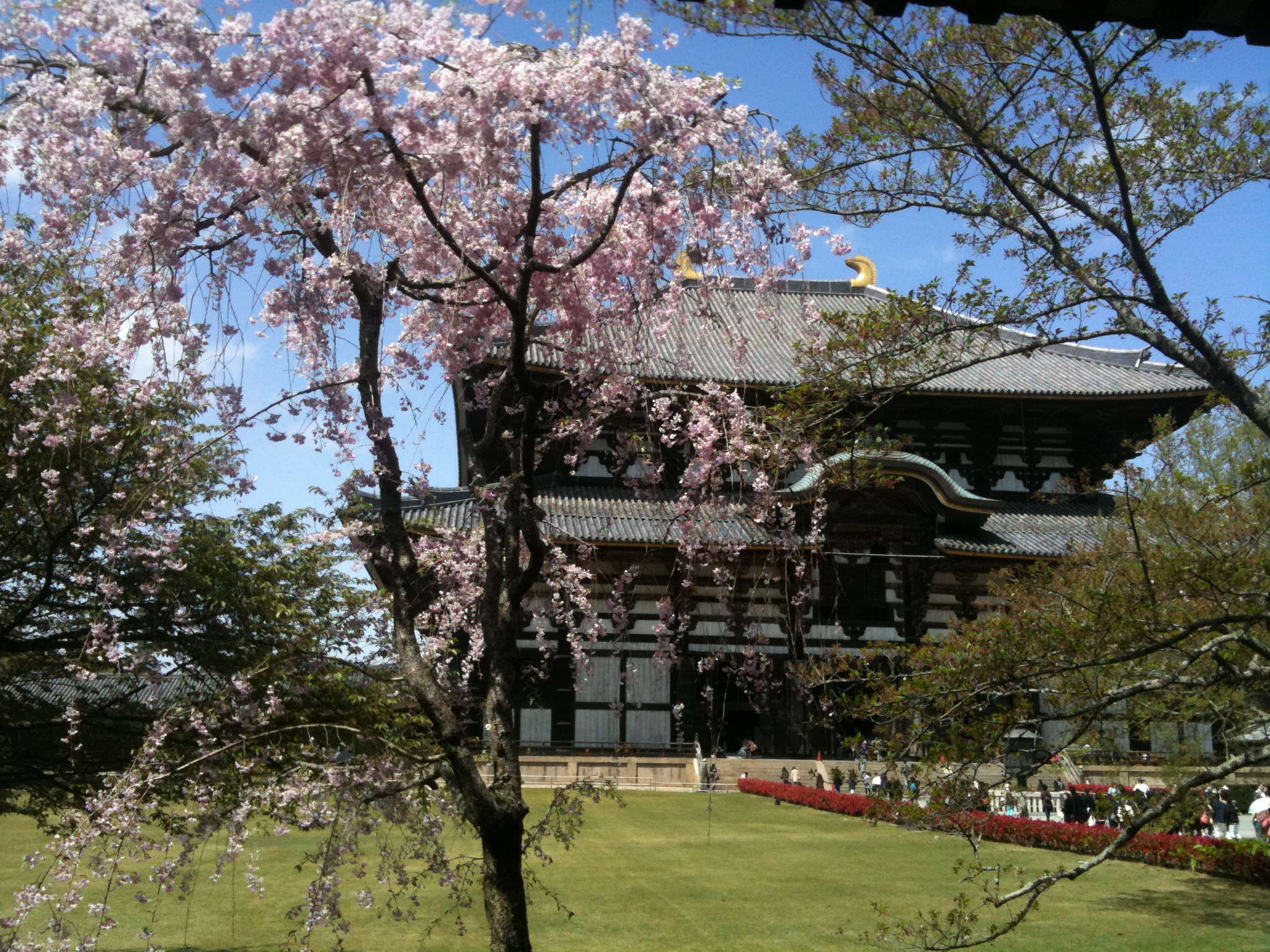
Todaiji Temple in Nara on a warm April day in 2010. Taken by author.

Even when the poems were more melancholy (poem 9, poem 11) they still reflected a more genteel time, and were probably included by Fujiwara no Teika to demonstrate the range of poetic skills of the nobility during that bygone time.

However, the Nara Period eventually gave way to the Heian Period, which was a 400-year flowering of Japanese culture that is still revered today. The transition was slow, and much remained the same generations later, but eventually things started to change:

  • Japan’s contact with China and the Asian mainland eventually stopped, and Japanese culture turned more and more inward for several centuries. Poetry and culture at this time reflected more “native” styles by and by.
  • Politically, the northern-branch of the Fujiwara clan gradually monopolized power around the Emperor through political marriages. In the early period, the nobility included several families who supported the family, but by the 11th century, the Fujiwara controlled every major position in government and most emperors were related to them in one way or another. This is what led in part to Sugawara no Michizan’e exile for example. You’ll notice too how many of the poets have the surname “Fujiwara” in the anthology as well, including Fujiwara no Teika the compiler himself.
  • Toward the end, conflict began to arise again and again, culminating in the famous Genpei War and the fall of the Heike clan. The new samurai class (originally bodyguards to the noble families) clashed with one another for control of Japan and ultimately swept aside the nobility, while still trying to imitate the courtly culture.

As such, if you look at poems toward the very end of the Hyakunin Isshu, they tend to be more dismal in tone. Starting with poem 77 onward, you get an increasing melancholy tone to many poems, culminating at the end when poets often speak of longing for the past (poem 100), complaints about life (poem 83, poem 99) or just expressions of people suffering (poem 95).

Indeed, by this time the flowering culture that started in the Nara Period and flourished in the Heian Period had declined, and war and politics had taken their toll on society. The final few poems begin in the militaristic Kamakura Period, and reflect both nostalgia and unease by people of that era. Small wonder that Fujiwara no Teika, who took tonsure after Emperor Go-Daigo was exiled, decided to compile the Hyakunin Isshu the way he did.

The End of an Era: Poem 100

The very last poem in the anthology goes along with the previous one in our theme on the end of the Heian Court era:

JapaneseRomanizationTranslation
百敷やMomoshiki yaThe hundredfold palace!
古き軒端のFuruki nokiba noeven in the shinobu grass
しのぶにもShinobu ni moon its old eaves
あまりあるNao amari aruI find a past for which
むかしなりけりMukashi narikeriI long yet ever more.
Translation by Dr Joshua Mostow

This poem was composed by Juntoku-in (順徳院. 1197 – 1242), or “Retired Emperor Juntoku”. Emperor Juntoku‘s father, Emperor Go-toba (poem 99), led the disastrous Jōkyū Disturbance in a last-ditch effort to wrest back power from the new samurai military government in 1221. Like his father, Juntoku was exiled after the rebellion was crushed, but he was sent to Sado Island instead, and lived there for 20 years before his death.

This poem, though, was composed in 1216, five years before the war, and recalls the glory days of the Imperial Court before the downfall in the late 12th century. When we look at the lengthy history of the poetry included in the Hyakunin Isshu anthology, spanning 400+ years, you can see how much poems like this one contrast with the upbeat, optimistic ones from earlier generations. By the time that Emperor Juntoku had assumed the throne, the capitol of Kyoto was already a shadow of its former self, and his reign a greatly diminished one.

In fact, in the Hyakunin Isshu Daijiten, the book points out that the Hyakunin Isshu begins with a poem by an Emperor (poem 1) writing on the harvest, a prosperous subject, and ends with another Emperor longing for bygone times. Fujiwara no Teika (poem 97), the compiler of the anthology obviously knew what he was implying.

Also, the phrase momoshiki is an interesting one. According to Professor Mostow, the phrase is borrowed from a much earlier poem in the Manyoshu:

JapaneseRomanizationRough translation
ももしきのMomoshiki noAre the people of the
大宮人はŌmiyabito waHundred Fold Palace
暇あれやItoma areyaso carefree that they
梅をかざしてUme wo kazashitegather plum blossoms
ここにつどへるKoko ni tsudoeruto decorate their hair?
Book 10, poem 1883

This poem colorfully describes how people in the palace are decorating their hair with plum blossoms they’ve collected, and playfully suggests that life at the palace is well and carefree.

So, it’s really interesting to see how Emperor Juntoku revives this ancient phrase in a poem that conveys the opposite meaning. The sun has set on the Imperial Court, and the palace looks tired and worn now. 

Further, Professor Mostow translates momoshiki as the Hundred-fold Palace which is as good a translation as any in English. But the Chinese characters (kanji) are 百敷 or “hundred seats laid out”, but alternatively, momoshiki can be written as 百石城 meaning “100-stones castle”. Both meanings refer to the Imperial Palace or kyūchū (宮中) in Japanese. The first word implies a hundred mats laid out for sitting (i.e. many people attending the court), while the latter means 100 stones, implying a palace with firm foundations.

But it’s a poignant reminder that all things decline some day.

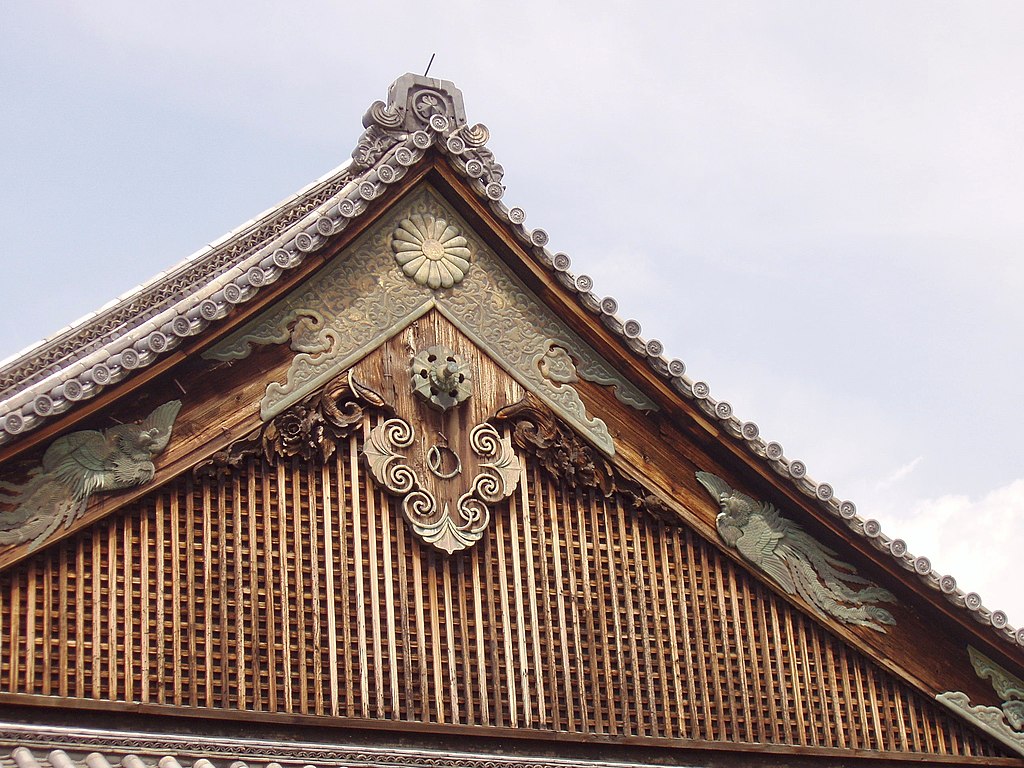
P.S. The featured photo above is the Ninomaru Palace, Kyoto, Japan (photo by Daderot, CC BY-SA 3.0, via Wikimedia Commons).

Brooding: Poem Number 99

Since I touched upon the end of the Court-era in Japanese history, I thought it would be fitting to post this poem:

JapaneseRomanizationTranslation
人もHito mo oshiPeople seem dear and
人もうらめしHito mo urameshipeople also seem hateful
きなくAjiki nakuwhen vainly
世を思Yo wo omou yue niI brood about the world—
もの思身はMono omou mi wathis self who broods about things.
Translation by Dr Joshua Mostow

The author of this poem was Gotoba-in (後鳥羽院, 1180 – 1239), or “Retired Emperor Gotoba”. Emperor Gotoba was one of the most noteworthy Emperors in Japanese antiquity. Gotoba was responsible for a revival in Waka poetry. He commissioned Fujiwara Teika (poem 97), who compiled the Hyakunin Isshu, among others to make a new official anthology after the Kokin Wakashū centuries before, and this new edition became the Shin Kokinshū which is still an important part of Japanese literature.

Gotoba was a bold character, and sought to restore power which had recently been wrested from the Imperial family by the new samurai class based in Kamakura, Japan (cf. poem 93). So, he and his son Emperor Juntoku, poem 100, organized a last-stand rebellion in 1221 called the Jōkyū Disturbance (or Jōkyū War) where he rallied the samurai back to his banner. Unfortunately, most didn’t want to lose their recent gains, and sided with the Kamakura government under the persuasion of Hojo Masako, the famous “Nun Warlord”.

Thus, the Jokyu Disturbance was a disaster and the Emperor’s forces were quickly destroyed. The young firebrand of an Emperor was then exiled to the Oki Islands and lived their for another 18 years.

This poem though, predates the rebellion and exile. According to Professor Mostow, it was composed as part of a series in 1212, which included Fujiwara no Teika, with the topic of “personal grievance”.

As to “who” he was referring to in the poem, that’s tricky. The word hito means “person or persons”, so it’s pretty generic. Mostow suggestions some traditional interpretations, such as those who oppose the Kamakura government, and those who uphold it (whom he detests), or another traditional interpretation was the common folk vs. those who opposed the rebellion (whom he obviously didn’t like).

We will never really know. But certainly after his exile, we can be sure he spent many days brooding.

P.S. Featured photo is another patron of the arts, Victor Hugo, brooding in this photograph from 1853. Photo by Charles Hugo, Public domain, via Wikimedia Commons

Winter Isolation: Poem Number 28

Winter’s always a quiet, lonely time (just ask Sei Shonagon):

JapaneseRomanizationTranslation
山里はYamazato waIn the mountain village,
冬ぞさびしさFuyu zo sabishisait is in winter that my loneliness
まさりけるMasari-keruincreases most,
人めも草もHitome mo kusa mowhen I think how both have dried up,
かれぬと思Karenu to omoebathe grasses and people’s visits.
Translation by Dr Joshua Mostow

According to Mostow, this poem was composed in answer to the question of whether Fall or Winter was the lonelier season. Obviously the author, Minamoto no Muneyuki Ason (源宗于朝臣, ? – 939), “Sir Minamoto no Muneyuki”, favored winter. Minamoto no Muneyuki was the grandson of Emperor Kōkō (poem 15) and had a large portfolio of poems published in official anthologies, and earned himself a place among the Thirty Six Immortals of Poetry as well.

To me at least, the poem reminds me also of nobleman from the Heian Court who were required to do at least one tour of duty in remote provinces as a provincial governor for 4 years. The more remote the province, the more menial and degrading the task. Very well-to-do men could usually get themselves out of this obligation but most middle and lower ranking officials could not. Being cut off from the Heian Court was often a lonely affair as evinced in the writings of men like Sugawara no Michizane and others so imagine the author was also conveying this familiar sense of the time of loneliness officials stuck in a remote mountain village away from the Court in winter and from friends.