Parting Ways: Poem Number 77

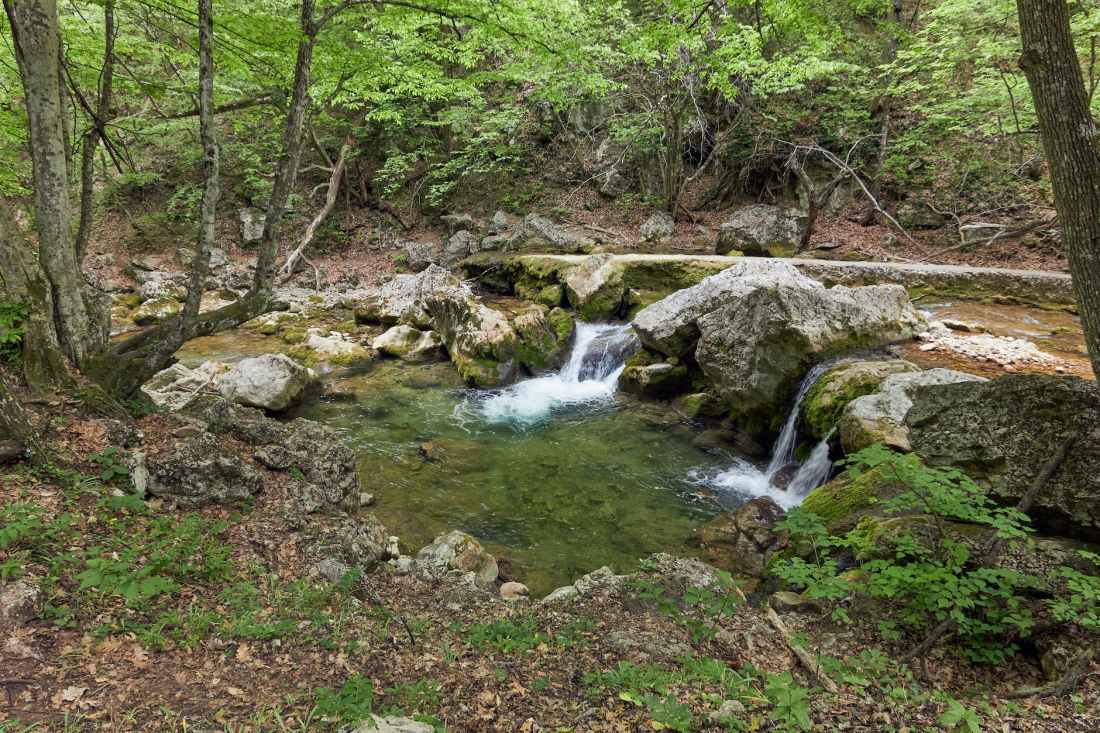
In honor of my wife’s birthday, I thought I’d write about her favorite poem from the Hyakunin Isshu:

JapaneseRomanizationTranslation
瀬をはやみSe wo hayamiBecause the current is swift,
いわにせかるるIwa ni sekarurueven though the rapids,
がわTakigawa noblocked by a boulder,
われてもすWarete mo sue niare divided, like them, in the end,
とぞ思Awan to zo omouwe will surely meet, I know.
Translation by Dr Joshua Mostow

This poem was composed by Sutoku-in (崇徳院, 1119 – 1164), of “Retired Emperor Sutoku“. My new book notes that Sutoku had very tragic fortune in life. Sutoku was the son of Emperor Toba, but there were persistent rumors, and some limited historical evidence that his real father was Toba’s grandfather, Emperor Shirakawa. 😮😮 This strained Sutoku’s relationship with his father Toba, and so Toba did not step down as emperor until 23, despite installing Sutoku as the next emperor at age 5. Though his reign was long, and oversaw many poetry competitions, it ended poorly when he was forced to abdicate, and later exiled.

You see, his father Toba was infatuated with one of his other wive, Fujiwara no Nariko, and designated her son, Konoe as the next Emperor after Sutoku at age 3. Konoe however died at age 17 before ascending, and Nariko believed that a jealous Sutoku had cursed her son. This scandal eventually forced Sutoku off the throne, and his younger brother, Go-Shirakawa was installed next.

After Toba passed away, the bitter Sutoku became embroiled in a succession dispute with the regent Tadamichi (poem 76) that boiled over into the Hōgen Rebellion in 1156. The Rebellion was a disaster, and being on the losing side of the conflict, Sutoku was exiled to Sanuki Province, lived a monastic life until he died in 1164.

Coincidentally, the Hōgen Disturbance marks the beginning of the end of the Heian Court,1 and the rise of the samurai class, so legends existed that Sutoku’s angry spirit helped bring down the Court. A related legend is that while in exile, Sutoku lived a monastic life and sometimes sent poetry back to the Court, but the Court refused them on the grounds that they might be cursed. Evidentially, rumors of his curse from the death of Konoe, plus his ill-will from rebellion and exile, dogged him even later in life.

Sutoku was said to have taken great offense at this:

Vengeful Sutoku in Japanese art
“The Lightning Bolt”, a famous painting depicting Sutoku’s vengeful spirit, by Utagawa Yoshitsuya (same artist with the name Ichieisai Yoshitsuya), Public domain, via Wikimedia Commons

I mention all this because this poem on its own is quite lovely, and because it’s signed as “Retired Emperor Sutoku” it’s quite possible he wrote this while in exile, pining for someone he left behind in the capitol. Was it rejected as the legend says? If so, it’s a tragic waste of great poetry, and fuel for supernatural speculation. But if not, then this poem is still a lovely read and a reminder that old friends and loved ones will reunite again someday.

In any case, Happy Birthday, honey!

1 This is reflected quite a bit in the “mood” of the later poems of the Hyakunin Isshu, especially in the 90’s onward. Some of them have a sense of lost glory as the Heian Period ends, and the Court nobles become utterly powerless to the samurai class.

Heavenly Maidens: Poem Number 12

Speaking of moments that we don’t want to end, I thought this poem was an interesting read, and is also one of the more famous ones:

JapaneseRomanizationTranslation
あまつ風Ama tsu kazeO heavenly breeze,
雲のかよKumo no kayoijiblow so as to block
吹きとFuki toji yotheir path back through
the clouds!
とめの姿Otome no sugataFor I would, if but for a moment,
しばしとどめShibashi todomendetain these maidens’ forms.
Translation by Dr Joshua Mostow

This poem was composed by Sōjō Henjō, (僧正遍昭, 816 – 890), “Bishop Henjo”, who served in the Heian Court until the death of Emperor Nimmyo. It was then that he took tonsure as a Buddhist priest. He is one of the original Six Immortals of Poetry as well as the Thirty-Six Immortals.

The poem was composed during the time that Henjo was in the service of the Emperor (and not yet a priest). The occasion for this was the famous Gosechi Dance or gosechi no mai (五節の舞), more formally known as the toyono akari no sechi-é (豊明の節会), a dance that took place in the Imperial Court during the middle of the eleventh month of the old Japanese calendar (roughly December in modern times) to celebrate the harvest.

During the final months of the year, the Imperial Court held several important events to celebrate the yearly harvest, starting with the niiname no matsuri (新嘗祭) when the Emperor would offer part of the harvest to the gods.1 The following day, the Court would celebrate the Gosechi dance at the Shishinden Palace, and the Emperor would partake of the new harvested rice. According to Richard Bowring, the Gosechi festivities last up to four days.

The Gosechi dance involved 4 “heavenly” maidens called otomé (をとめ) from high-ranking noble families, and is mentioned by several authors from the era, including Sei Shonagon (poem 62) in the Pillow Book:

[87] At the time of the Gosechi Festival somehow everything in the palace, even the people you see every day, becomes simply delightful. There’s the unusual sight of the bits of coloured fabric that the groundswomen wear in their ceremonial hair combs, rather like abstinence tags. When they seat themselves along the arched bridgeway from the Senyōden, the dapple-dye pattern on the ribbons that bind up their hair stands out beautifully, and the whole effect is somehow quite marvelous. It’s perfectly understandable that the serving women and those who attend the dancers should find it all a splendid honour.

trans. Meredith McKinney

And from the eponymous diary of Lady Murasaki (poem 57):

The Gosechi dancers arrived on the twentieth….I knew full well how hard the young dancers had prepared this year in comparison to normal years when things were worse it must have been for them this year, I thought; I was both apprehensive and eager to see them. As they fully stepped forward together I was, for some reason, overcome with emotion and felt dreadfully sorry for them….And with all those young nobles around and the girls not allowed so much as a fan to hide behind in broad daylight, I felt somehow concerned for them, convinced that, although they may have been able to deal with the situation both in terms of rank and intelligence, they must surely have found the pressures of constant rivalry daunting; silly of me, perhaps. (pg. 39-40)

trans. Richard Bowring

Further, even artwork depicts the Gosechi as shown by the featured photo, painted by Hokusai.

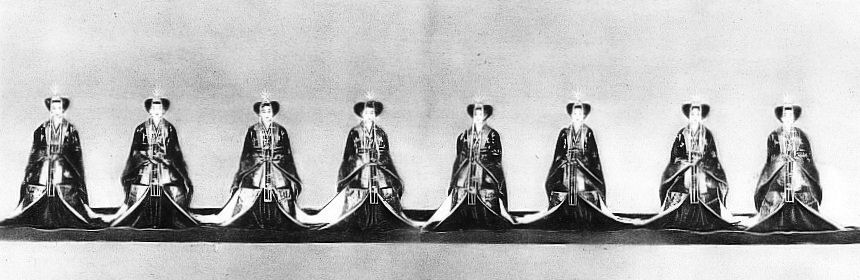
Even now, the Gosechi dance is still performed for the Emperor, at least for special occasions:

Dancers of the Gosechi dance performed in 1928, for the ascension of the Showa Emperor. See page for author, Public domain, via Wikimedia Commons

But I digress, Henjo was so mesmerized by their dance, he compared them with heavenly maidens, and hoped that the breeze would keep them on the earth a bit longer. As Professor Mostow notes, the Gosechi dance had a legendary origin involving Emperor Temmu who beheld heavenly maidens in the sky one night, so Bishop Henjo isn’t just making this up.

However, his playful simile has lasted through the ages.

1 This is still observed today in the form of Labor Day in Japan.

No Refuge In This World: Poem Number 83

This is a well-known poem in the Hyakunin Isshu, and I felt worth posting here:

JapaneseRomanizationTranslation
世の中よYo no naka yoWithin this world
道こそなけれMichi koso nakerethere is, indeed, no path!
入るOmoi iruEven deep in this mountains
山の奥にもYama no oku ni moI have entered, heart set,
鹿ぞ鳴くなるShika zo naku naruI seem to hear the deer cry!
Translation by Dr Joshua Mostow

The author, Kōtai Gōgū no Daibu Toshinari (皇太后宮大夫俊成, 1114 – 1204), or “Master of the Grand Empress’s Palace, Shunzei”. He is also known as Fujiwara no Shunzei, or Fujiwara no Toshinari (俊成 can be read either way), the father of Fujiwara no Teika . Additionally, a surprising number of other poets in the Hyakunin Isshu were associated with (poem 81, 86 and 87), studied under Shunzei (poem 89 and 98), or were directly in opposition to him (poem 79). Shunzei is probably the second most important person in the Hyakunin Isshu after his son of course. 😏

This poem is both moving and technically strong. For example, according to Mostow, the phrase omoi iru is a “pivot word”, meaning that both the words before and after hinge on its double meanings: omoi-iru “to set one’s heart on” and iru “to enter”.

Again, as Mostow explains, the poem generates quite a bit of debate because it’s not clear what concerned him so much. Was it melancholy, a sense of his mortality, or was the state of society at the time (i.e. the decline of the Heian Period)?

Speaking of a deer’s cry, I found this video one of the famous “Nara deer”:

The Nara deer are more domesticated versions of the wild deer in Japan, but it gives you an idea what Shunzei must have heard deep in the woods 900 years ago.

P.S. See poem 5 for something similar.

Contentment: Poem Number 8

An early poem by an obscure and mysterious figure:

JapaneseRomanizationTranslations
わがいWaga io waMy hut is to
都のたつみMiyako no tatsumithe capital’s southeast
しかぞすむShika zo sumuand thus I live. But
世をう山とYo wo ujiyama topeople call it “Uji, hill
人はいなりhito wa iu nariof one weary of the world,” I hear.
Translation by Dr Joshua Mostow

The poem was composed by a Buddhist monk named Kisen Hōshi (喜撰法師, dates unknown), in English lit. “Dharma master Kisen”. Kisen Hōshi lived in the mid-9th century, and this is the only poem known to be his, though others may exist. He is considered one of the original Six Immortals of Poetry and is mentioned in the preface of the official anthology, the kokin wakashū.

The location is a place called ujiyama (宇治山), located on the Tatsumi region southeast of Kyoto, which in turn is named after the twelve animals of the Chinese zodiac. In this context, tatsumi (辰巳) meaning literally “dragon-snake” refers to the direction (southeast) relative to the capitol of Kyoto, then Heian-kyō.

Due to word-play of “uji” meaning either 宇治 (“uji”) or 喜し[つらい] (“ushi[tsurai]”), this place was associated with sorry or grief, so few poeple chose to live here. Since that time, it has been renamed in honor of its resident and is now called kisenzan (喜撰山). Someone did a really nice write-up on their visit to Kisen-zan with photos and a view of what is purported to be Kisen’s original hut. Also, the famous Buddhist temple of Byōdōin also can be found there. It was located south of the capital at the time, Kyoto.

The poem is a tricky one and lends itself to two possible interpretations according to Professor Mostow. One interpretation has been that Kisen came there out of grief and weariness of the world, and made it his home. Mostow provides evidence that instead, Kisen lived there contentedly, and only heard from others that it was called brief mountain.

As there is a Buddhist tradition since the time of the Buddha to withdraw from the entanglement of the world, and find peace of mind. This tradition has led to the Buddhist monastic community that exists today in various parts of the world. Kisen is one of many who sought solace in places like Ujiyama. Question is, did he find only sorrow, or did he find contentedness?

Maybe only Kisen will ever know that.

Summer is Back: Poem Number 81

As spring turns into summer, I thought this poem seemed really appropriate and a great topic for discussion:

JapaneseRomanizationTranslation
ほととぎすHototogisuThe hototogisu:
鳴きつる方をNakitsuru kata wowhen I gaze out towards where
ながむればNagamurebahe was singing,
ただ有明のTada ariake noall that remains is the moon,
月ぞ残れるTsuki zo nokorerupale in the morning sky.
Translation by Dr Joshua Mostow

This poem was composed by Gotokudaiji no Sadaijin (後徳大寺左大臣, 1139 – 1191), the “Later Tokudaiji Minister of the Left Sanesada”. His personal name was Fujiwara no Sanesada, and he was the first cousin of Fujiwara no Teika (poem 97), as well as the nephew of Shunzei (poem 83). He left behind an extensive poetry collection as well as his personal diary.

According to Professor Mostow, the poem was composed on the topic of staying up all night, to hear one cry.

The hototogisu (ホトトギス), is called the “lesser cuckoo” in English, or, is Cuculus poliocephalus. The featured photo was taken by Kunming Institute of Botany. Sun Jiao (Interaccoonale), CC BY 4.0, via Wikimedia Commons.

The hototogisu in Japan is a famous bird known for its early summer call, and is thus an emblematic bird of the season. Compare with the plover in poem 78.

You can see a video of its call below:

According to the Hyakunin Isshu Daijiten, the hototogisu is an elusive bird. It flies from branch to branch often, so by the time you hear its distinctive call, it probably has flown elsewhere. Hence, they are easy to hear, but hard for birdwatchers to observe.

In any case, as Professor Mostow explains, the author is waiting all night to hear the first call of the hototogisu as the first sign of summer.

One other note is the term 有明 (ariake), which is one of many poetic terms for the moon. Specifically it means the moon that remains in the morning, after daybreak. This normally occurs on the 16th day of the lunar cycle according to the old Japanese calendar.

P.S. Like the title, I’m back too. 😉

Wishing This Moment Wouldn’t End: Poem Number 73

Cherry-blossom season doesn’t last long, so while there’s still time, I wanted to post one last poem on the subject:

JapaneseRomanizationTranslation
高砂のTakasago noAbove the lower slopes
の桜Onoe no sakuraof the high mountains,
the cherries
咲きにけりSaki ni kerihave blossomed!
とやまのかすみToyama no kasumiO, mist of the near mountains,
立たずもあらなTatazu mo arananhow I wish you would not rise!
Translation by Dr Joshua Mostow

The author, Gonchūnagon (権中納言匡房, 1041 – 1111) or “Supernumerary Middle Counselor Masafusa”, was a prolific poet both in Japanese and in Chinese-style, and was a close confidant of Emperor Horikawa after retirement. His personal name was Ōe no Masafusa. As Professor Mostow notes, the poem’s meaning is very clear from the headnote, so there’s little if any debate about its meaning (unlike many poems in the Hyakunin Isshu). Masafusa hopes that the mist will not rise and block the view of the blossoms.

This poem brings to mind a time-honored tradition in Japan called hanami (花見) or “cherry-blossom viewing”. 🌸 This is a tradition you can see alive and well in Japan today, and each year there are plenty of websites and helpful guides for Japanese and foreigners to find a good spot for viewing.

However, during the time of the Heian Court and the poets of the Hyakunin Isshu, it was more of an outing for elite members of the court only. Such excursions, just like now, included lots of music, singing and drinking as well as impromptu poetry. The only difference, really, was that back then it was a very isolated affair between good friends and a private spot, whereas now people really have to fight for a good spot in places like Tokyo or Kyoto, and often times involve one’s boss and associates from work. 😏

Still, while some things have changed, it’s nice to see such a tradition live on for so many generations.

P.S. Featured photo is of cherry blossom viewing (hanami) in Oyamazaki, Kyoto Prefecture, Japan. Photo by Oilstreet, CC BY-SA 3.0, via Wikimedia Commons

Cherry Blossoms in Unexpected Places: Poem Number 66

Now that Spring is finally here, and cherry blossoms are blooming in Japan, I thought this poem was especially fitting:

JapaneseRomanizationTranslation
もろともにMorotomo niLet us think of each
れと思Aware to omoeother fondly,
山桜Yama-zakuraO mountain cherries!
花より外にHana yori hoka niFor, outside of your blossoms,
知る人もなしShiru hito mo nashithere’s no one who
knows my feelings.
Translation by Dr Joshua Mostow

The poem was composed by Saki no Daisōjō Gyōson (前大僧正行尊, 1055 – 1135), or “Former Major Archbishop Gyōson”, who according to Mostow, was a famed yamabushi or mountain ascetic, who dwelt on Mount Ōmine near Nara for a long time. He was the great-grandson of Emperor Sanjo (poem 68), and also a very prolific author in his day.

At the age of 10, his father passed away, and by age 12, Gyōson took tonsure at the Buddhist temple of Mii-dera, a major temple of the powerful Tendai sect. According to one episode in my new book, Gyōson had a reputation for being an expert at supplication of the Buddhist deities (lit. kaijikitō 加持祈禱). According to one story, when the newborn baby of Emperor Toba suddenly stopped breathing. Gyōson beseeched the gods, and somehow saved the baby, gaining trust of the Imperial family.

As for the poem, Mostow comments that the poem itself is fairly straightforward, but the poem’s headnote has confused many scholars over time, stating that it was composed “when he saw cherry blossoms unexpectedly at Ōmine.” Was it the time of year, or the location that made it so unexpected? No one really knows for sure.

Also, the term yamazakura (山桜) refers to mountain cherry blossoms. This is a wild variety of cherry blossom that differs from the typical cherry blossoms (somei-yoshino) often seen in gardens. The blossoms are more whitish than pink in color, and bloom at the same time that the leaves do.

Mount Ōmine (大峰山) near Nara was, among places, a popular mountain retreat for yamabushi practitioners. The phrase morotomoni means “you and me”, and implies intimate familiarity.

But, the joy of seeing cherry blossoms at this time of year is hard to deny. 🙂

P.S. Featured photo shows mountain cherry blossoms in Gunma Prefecture, Japan, taken by mahlervv, CC BY 3.0, via Wikimedia Commons

A Lame Excuse: Poem Number 62

As a final poem in March to honor women poets in the Hyakunin Isshu, I wanted to post a humorous, witty poem by Sei Shonagon, author of the Pillow Book:

JapaneseRomanizationTranslations
夜をこめてYo wo kometeAlthough, still wrapped in night,
鳥の空音はTori no sorane wathe cock’s false cry
はかるともHakaru tomosome may deceive,
よにおう坂のYo ni Ōsaka nonever will the Barrier
ゆるさじSeki wa yurusajiof Meeting Hill let you pass.
Translation by Dr Joshua Mostow

Sei Shonagon (清少納言, dates unknown), along with Lady Izumi (poem 56) and Lady Murasaki (poem 57), is one of the most famous female authors of her generation and Japanese history as a whole. She was the daughter of Kiyohara no Motosuke (poem 42). Her name Sei is another way to read the Chinese character “kiyo” (清), while Shonagon refers to a government post (lit. “lesser councilor of state”), but it’s unclear why it’s attached to her.

She’s best known as the author of the Pillow Book. Despite the name, it is mostly just a book of witty observations regarding court life, nature, art, etc. Whereas Lady Izumi was a hopeless romantic, and Lady Murasaki was melancholy, Sei Shonagon’s writings show she had a sharp, often haughty wit:

[151]People who seem enviable — You set about learning to recite a [Buddhist] sutra, stumbling along, going endlessly over the same places and constantly forgetting bits. When you hear the same words tripping smoothly off the tongues of others — not only the priests, but other men and women — you wonder enviously if you’ll ever be able to perform like that.

….You have an urge to go on a pilgrimage to Inari Shrine, and as you’re laboriously gasping your way up the steep mountainside to the middle shrine, you’re filled with admiration to see others who’ve obviously started behind you go climbing straight up without the least effort; when you arrive, there they stand, already at their worship….

The Pillow Book, trans. Dr Meredith McKinney, page 152

Sei had the misfortune of serving Empress Teishi, who fell out of favor after her father died, and the Emperor’s 2nd wife, Empress Shoshi, eclipsed her. Lady Izumi and Lady Murasaki served the latter, and by that time Sei Shonagon was a bit of a has-been. This same power struggle also negatively impacted Fujiwara no Sadayori (poem 64). It is thought that Pillow Book was, among other things, a subtle middle-finger to the Court for abandoning Empress Teishi by painting such a rosy picture of her time.

In any case, this poem demonstrates Sei Shonagon’s wit at her finest though. As with the excerpt above, the back-story for this poem also comes from the Pillow Book:

[129] … One evening, Secretary Controller Yukinari visited the Office of the Empress’s Household [where Sei Shonagon resided as a lady-in-waiting], and stayed talking far into the night. He finally left as dawn was approaching, remarking that he must return by the Hour of the Ox [2 – 4 am] …. the next day he sent a wonderful and very lengthy message on several pieces of official paper from the Chamberlain’s Office, saying “My heart is still full of regrets for yesterday. I thought to stay till dawn speaking with you of things past, but the cock’s crow hastened me early on my way.”

In reply I wrote, “That cock you say you heard so late last night, could it be the false cock of Lord Mengchang?”

“They say,” wrote Yukinari in return, “that Lord Mengchang’s cock opened the Kanko barrier gate and thus allowed his three thousand followers finally to escape — but the barrier gate in my case was the lover’s barrier gate of Osaka.”

So I sent back the following [the poem above]

This exchange has a lot of wit, and some double-entendre (in Japanese too). Clearly, Sei is not convinced by his eloquent excuse and sends this snarky poem back that basically says that no one at Ōsaka Gate (Meeting Hill) would be fooled by it. He has to sleep alone.

Ouch. 👈🏼👈🏼😎

Memories of the Old Capitol: Poem Number 61

Sorry for the lengthy hiatus everyone. Been a long couple of weeks, but I am excited to post this poem in honor of women poets this month, and timely because of the coming of spring:

JapaneseRomanizationTranslation
いにしInishie noThe eight-petalled cherries
奈良の都のNara no miyako nofrom the Nara capital
Yae-zakuraof the ancient past
けふきょうKyo kokonoe nitoday nine layers thick
ほひおいぬるかなNioi nuru kanahave bloomed within your court!
Translation by Dr Joshua Mostow

Isé no Tayū (伊勢大輔, dates unknown), also known in English as “Lady Ise” was another lady in waiting for Empress Shoshi, as was Lady Murasaki (poem 57) and Lady Izumi (poem 56), but was the newbie apparently.

According to Lady Ise’s own diary, she had to present a poem on the fly to the Bishop from the ancient capital of Nara and its Buddhist institutions, who had brought a lovely eight-petaled cherry blossom as a gift. This variety of cherry blossom is known as yae-zakura (八重桜) in Japanese. Further, the capitol of Japan had moved to Kyoto centuries earlier, but people in Kyoto still looked back to Nara at times for nostalgic reasons. Empress Shoshi’s father, Fujiwara no Michinaga (the same one mentioned in Lady Murasaki’s diary) had asked Lady Murasaki to compose the poem, but for reasons not understood, she deferred to Lady Ise because she was new. 

Thankfully, her poem was a success. As Professor Mostow notes, it does a really nice job balancing the “ancient” with the modern, and the eight petals of the blossom with the metaphorical nine-layers of the Imperial court.

No wonder she made the inner-circle of Empress Shoshi. 😌

Happy Spring everyone!

P.S. Nara is a pretty awesome place to visit in Japan, definitely recommend.

P.P.S. Featured photo is of cherry blossoms at the University of Washington in 2022, taken by me

An Awesome Poetic Comeback: Poem Number 60

This is one of my most favorite poems in the Hyakunin Isshu due to its backstory and its clever delivery and was composed by the daughter of Lady Izumi:

JapaneseRomanizationTranslation
おお江山ŌeyamaŌe Mountain and
いく野の道のIkuno no michi nothe road that goes to Ikumo
とおければTō kerebaare far away, and so
まだふみも見ずMada fumi mo mizunot yet have I trod there,
nor letter seen,
天の橋立Ama no Hashidatefrom Ama-no-Hashidate
Translation by Dr Joshua Mostow

This poem was composed by Ko-Shikibu no Naishi (小式部内侍, 1000? – 1025), daughter of Lady Izumi (poem 56). She too was a handmaiden of Empress Shoshi like her mother. The “ko” in her name implies a “junior” lady-in-waiting (shikibu) compared to her mother.

Sadly, she died in her 20’s, leaving her mother behind with a granddaughter to care for, and for such a talented poet, she has only a handful of poems in official anthologies.

According to the backstory of this poem, Lady Izumi was away in the province of Tango with her (current) husband, and there was a poetry contest in the capital. Ko-Shikubu, age 15, was selected to represent her mother. Middle Counselor Sadayori (poem 64) teases her saying:

What will you do about the poems? Have you sent someone off to Tango [to ask your mother for help]? Hasn’t the messenger come back? My, you must be worried.

trans. Joshua Mostow

To which the young and bold Ko-Shikibu pulled at Sadayori’s sleeve and composed this poetic reply off-the-cuff. While less obvious in English, the poem is a master piece because it recites three places in Tango in geographic order, has two puns (iku in Ikuno also means to go 行く, and fumi means both a letter 文 and to step 踏み) and the bridge mentioned, Ama-no-Hashidate, is associated with “stepping” too.

As the story goes, Sadayori was totally speechless and couldn’t come back with a good reply, so he ran off. My new book implies that they evidentially fell in love later like a modern romcom.

Think of this exchange as an 11th century Japanese rap-battle, and Ko-Shikibu trashed her opponent. Well done! 👏🏼👏🏼

P.S. Featured photo is “Travelers on a mountain path along the coast”, by Utagawa Hiroshige, Public domain, via Wikimedia Commons