Feeling Young, Kokinshu Poem 52

While re-reading the Pillow Book lately, one of the people in Sei Shonagon’s anecdotes recites a poem from an Imperial anthology: the Kokin Wakashu (Kokinshu for short).1 When I looked up the poem, it really struck me when I read it. Since I have an English translation of the Kokin Wakashu, and since many of the poems from the Hyakunin Isshu were originally published in the Kokin Wakashu, I figured it would be fun to post other poems from the same anthology.

This poem, poem number 52 of the Kokin Wakashu, reads as follows:

JapaneseRomanizationTranslation
年ふればToshi furebaAs the years stream by
老いぬYowai wa oinumy own life passes from me
しかはあれどShika wa aredostill I am renewed
し見ればHana oshi mirebawhen I but see the blossoms
物思もなしMono omoi mo nashimy heart’s sorrows disappear
Translation by Laurel Rasplica Rodd and Mary Catherine Henkenius

The headline of this poem reads “seeing cherry blossoms in a vase before the Somedono Consort [Empress]“.2

The author of the poem, Fujiwara no Yoshifusa (藤原良房, 804 – 872), was the first member of the Fujiwara clan to assume the post of Regent to the emperor. This was at a time when the Fujiwara were a rising star in the Imperial court, had married into the Imperial family, and Yoshifusa was the grandfather of the young Emperor Seiwa. So, he had much to celebrate. However, even the powerful grow old and die, and Yoshifusa was no exception.

What I really like about this poem is that in spite of his own fears of growing old, he still can enjoy life here and now and feel young again.

I am at the age where I can definitely start to feel my age, and the years ahead of me are likely fewer than the years behind me, and yet I am rarely bothered by it. I often find moments of joy in life, playing with my kids, enjoying nerdy fandom, and savoring poetry like this, so I know how Yoshifusa feels.

1 Nowadays, people quote movies, TV shows and such. I can quote more gags from The Simpsons than I care to admit. Back then, people quoted poetry from earlier generations.

2 Many poems in the Kokin Wakashu included a headline to explain the scene of the poem, or provide some background. These were not carried over when the poems were collected in the Hyakunin Isshu since they were already well-known poems, or possibly just for the sake of brevity.

Omi Shrine

One of most iconic places in the world of Karuta is a placed called Omi Shrine, also called Omi Jingu (近江神宮, おうみじんぐう) in Japanese. It is here that the big championship events are often held, and it is a big part of season one of the anime series Chihayafuru. Not to sound like a cliché, but it is a kind of mecca for the Karuta world and the Hyakunin Isshu.

A scene from Chihayafuru as Chihaya approaches the Rōmon gate.

What is Omi Shrine though?

You see, Japan has essentially two religions that co-exist: the native Shinto religion and imported Buddhist one. We don’t need to go into detail about how they differ; I have an entire blog on the subject. Suffice to say, they differ. Even the place names are different. Buddhist temples are called otera or end with -ji. Shinto shrines are called jinja, jingu or taisha.

Anyhow, Omi is a Shinto shrine located in the city of Ōtsu, in Shiga Prefecture. This area was once the province of Omi, hence the name. The shrine’s constructed began in 1937 and finished by 1940. It is a young shrine, but has a deep connection to the past.

Like all Shinto shrines, Omi Shrine venerates a kami, a divine figure. A kami can be a god (think ancient Greek gods) from Japanese mythology, a local spirit, or even a historical figure. Some shrines venerate more than one kami.

Omi Shrine venerates none other than Emperor Tenji, who wrote poem one of the Hyakunin Isshu (あきの). During his reign, the capitol of Japan was moved to Otsu city and there he reigned until his death. Here, he carried out many essential reforms that provided the foundation for Japanese society for centuries. Because Tenji also wrote the opening poem of the Hyakunin Isshu, the shrine became quickly associated with the anthology and with Karuta.

The shrine website even has a handy catalog of the Hyakunin Isshu poems, not unlike mine. 😉

The English website is pretty limited, but the Japanese site has a lot of great information about the shrine, Karuta and so on.

The shrine is a bit removed from the usual touristy areas, so you might not be able to get there. However if you do go, it’s good etiquette to pay respects to the kami there. Per Shinto tradition (explained here) the process is:

  1. Bow deeply at the waist twice.
  2. In reverence, clap twice.
  3. Bow once more.

You can also use the water font nearby to wash your hands a bit (just watch how other Japanese do it) and your face a bit before facing the kami.

You can also pick up an omamori charm too.

I haven’t been to Omi Shrine myself but it seems like a lovely, scenic location, and I would love to play Karuta there someday even if I get crushed.

P.S. Featured photo is the Rōmon (楼門, “Sakura Gate”), photo by Kenpei, courtesy of Commons Wikimedia.

Progress At Long Last

I started playing Karuta last August with the Seattle Karuta Club, and from time to time I play the computer on the Karuta online app. There’s been a lot of ups and downs in my life, but I’ve tried to stay focused and practice when time allows.

However until today I was never able to beat the hard mode on the Karuta app. At first, I played the easy or solo modes for a long time, afraid to get demolished. I eventually moved up to medium difficulty for a time and got used to it.

But every time I play hard mode, I get destroyed. I get nervous, get penalties, and lose track of where cards are because I am thinking too much about losing.

Finally, I won a match. I made a single penalty (oku vs. ogu) and yet otherwise everything else went surprisingly smooth for me. I even got three of the one-character kimarji cards (se, fu and mu) which I usually struggle with.

It was weird.

For once, I was relaxed and focused on where each card was. My mind was clear. Everything just clicked. In spite of the penalty, I played solid Karuta and won.

I guess practice really does make perfect.

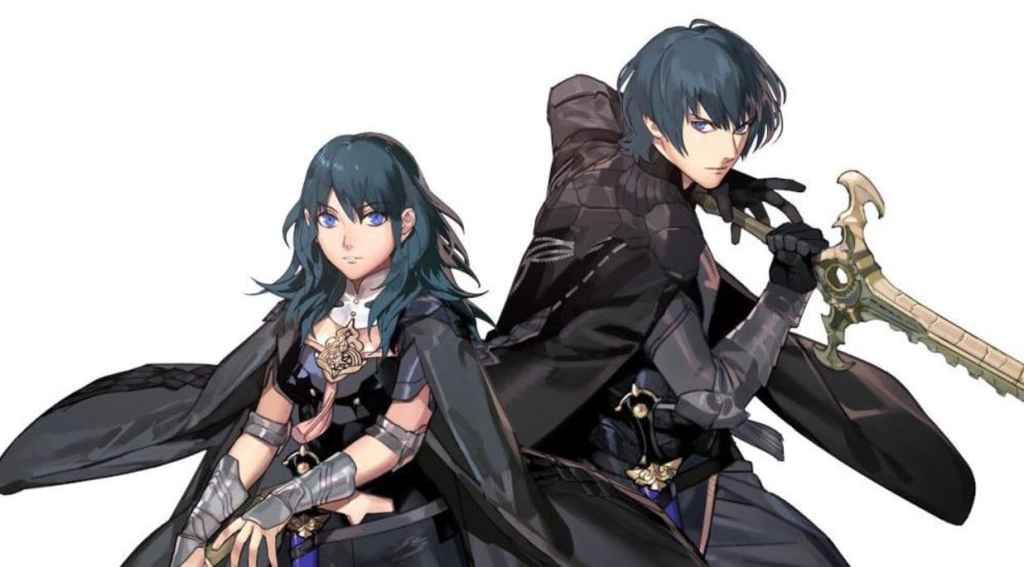
Thank you, Byleth. 😋

Teika’s Handwriting!

In other recent, exciting news, I found this article on the Asahi Shimbun newspaper: the discovery of some of Fujiwara no Teika’s personal notes. This is called the kenchū mikkan (顕注密勘).

Long before Fujiwara no Teika (poem 97) compiled the Hyakunin Isshu, he served as a minister under Emperor Gotoba (poem 99). Among his duties, Teika was commissioned in 1201 to compile a new Imperial poetry anthology, which later became the Shin Kokin Wakashu (新古今和歌集).

Here you can see some of his notes and thought process as he’s compiling the poems together. It’s a fascinating discovery.

You can click here to see more detailed photos of his notes. They are read from right to left, vertically not horizontally.

You can also see another example of his handwriting here, courtesy of Wikipedia, from diary:

Teika himself had a pretty rocky career and after his liege lord was exiled, Teika spent the rest of his days living as a Buddhist monk. Nonetheless, his legacy lives on.

Names in the Hyakunin Isshu

Hello readers,

If you’ve been following this blog for a while, and gotten to know some of the authors of the Hyakunin Isshu, then you may have noticed some patterns with the names of the authors. The authors are rarely listed by their birth name, and instead are listed under a sobriquet, or just their official title in the Imperial Court.

Why was this done?

My book, the Hyakunin Isshu Daijiten, explains that this was because in this period of Japanese history, names were thought to be tied to one’s life. People at this time, both the Nara (8th c.) and increasingly in the Heian (9th – 12th c) periods, were often worried about curses, evil spirits, and such, and went to elaborate lengths to avoid spiritual calamities (see background for poem 24 for example). So, to avoid risk of one’s name (and thus one’s life) being subject to evil magic, people often hesitated to share their personal names with others.

It’s unclear how commoners in the Nara/Heian Period named themselves; there is just not enough information, but for the nobility who all belong to the hierarchical Imperial Court, certain naming conventions developed.

Men

Men with important titles, or positions in the court often used their titles as their sobriquet. Lower-ranking men in the Hyakunin Isshu did not have this privilege.

  • Titles for members of the Imperial FamilyEmperor Tenji, (poem 1), Retired Emperor Go-toba (poem 99), and Prince Motoyoshi (poem 20).
  • Positions in the Imperial CourtSanjō Minister of the Right (poem 25), Major Counselor Fujiwara no Kintō (poem 55), and Master of the Grand Empress’s Palace (poem 83)
  • Clerical namesDharma Master Jakuren (poem 87) and Former Major Archbishop Gyōson (poem 66)
  • Poetic namesSarumaru Dayū (poem 5)

Women

Due to the Confucian, paternalistic culture of the Japan in antiquity, women were not given titles wihtin the Imperial Court (though they did earn rank just as men did), and seldom used their real name. Instead, they used a different naming convention.

  • Male relatives or spouses – Lady Ise (poem 19), whose husband served as governor of Ise Province, Lady Izumi (poem 56) whose tenure as governor of Izumi Province, “The Mother of Michitsuna, Major Captain of the Right” (poem 53), Taiyu of the Household of Princess Ryōshi (poem 90), and Ukon (poem 38) named after her father’s position as Captain of the Guards.
  • Poetic sobriquets – Lady Murasaki (poem 57) named after a character from her own novel the Tales of Genji, Akazome Emon (poem 58).

Because women were more often kept out of sight than men in the Imperial Court, biographical information about women authors of the Hyakunin Isshu is often much thinner than the men (except lower-ranking men). This makes learning about women like Lady Murasaki or Lady Izumi difficult.

In any case, the idea that names are tied to one’s lifespan is a fascinating cultural belief, and it’s likely you would find this in other pre-modern cultures as well.

Interview with Karuta Peru Club: History of the Hyakunin Isshu

Hello readers,

Recently I mentioned an upcoming interview with the Karuta Peru Club via Steph, a fellow karuta player.

I am happy to report that we finished our interview and it is available on YouTube!

Also available on Spotify in podcast form:

In this episode, Steph and I mostly discuss the history of the blog, but then talk about some of my favorite historical figures in the Hyakunin Isshu, such as Sugawara no Michigan’s (poem 24) and Lady Izumi (poem 56), among other things. It was a fun conversation and Steph was a terrific host.

I do sometimes use the word “um” a lot, especially when I am a bit nervous (this was my first interview), but I hope viewers and listeners learn something new, and enjoy the conversation too!

In the next episode, we plan to focus more on our experiences playing kyōgi Karuta (competitive karuta). Stay tuned!

Big thanks to Steph for making all this happen. 🎉

P.S. books cited in the interview (non-Amazon links below):

Love Triangles and Forbidden Fields: Manyoshu Book 1, Poem 20

Now that the year is winding down, I have had time to catch up on some personal projects, and that includes watching the anime Chihayafuru. In season one episode 12, I was surprised to see one of the characters recite a poem, not from the Hyakunin Isshu, but from the Manyoshu, so I wanted to share it here:

Original
Manyogana
1
Modern
Japanese
RomanizationTranslation
茜草指あかねさすAkanesasuThe crimson sunset
武良前野逝紫野行きMurasaki no yukisets these forbidden fields
標野行標野行きShime no yukiaglow.
野守者不見哉野守は見ずやNomori wa mizuyaWave not,
君之袖布流君が袖振るKimi ga sodé furufor the guards might find us.
Translation provided by Chihayafuru

This poem was composed by Princess Nukata (額田王, Nukata no Ōkimi), who was the wife of Emperor Tenji (who composed poem 1 in the Hyakunin Isshu). According to Chihayafuru, Princess Nukata had formerly been married to Tenji’s younger brother, Prince Oama (大海人皇子, Ōama no Miko). Although they had separated, Prince Oama snuck into the Emperor’s lands and waved to her. She was worried that they would be seen, hence the poem.

But, here’s where things get interesting: Princess Nukata recited this poem at a banquet attended by her husband, Tenji, and her ex-husband Prince Oama. What’s going on?

My book on the Manyoshu provides further context. Prince Oama and Emperor Tenji had a …. complicated relationship. Tenji was ambitious and wanted to strengthen his own family lineage, so he pressured Prince Oama to marry his daughter Princess Unonosarara better known as Empress Jito (poem 2 of the Hyakunin Isshu). Tenmu was thus forced to marry his own niece. Further, Tenji designated Prince Oama as his heir until much later when he finally gave birth to a son. Later, after Tenji’s passing, the son was made Emperor briefly, but Prince Oama quickly raised an army and marched on the capitol and became the next Emperor, Tenmu.

Nonetheless, this poem is brilliant because of the visual imagery, but also relatable feeling of unresolved feelings towards someone you still care about.

But as we shall see, the story doesn’t end there… stay tuned.

1 Source: https://art-tags.net/manyo/one/m0020.html and https://tankanokoto.com/2019/04/nukata.html

Upcoming Podcast Interview

Dear Readers,

I am happy to report that I’ll be appearing in a podcast about the Hyakunin Isshu and Karuta coming up in a few weeks! It is exciting to collaborate with a fellow karuta player, “Steph”, who hosts the Karuta Chat podcast.

(Also available on Apple Podcast and many other feeds too)

I’ll have more details soon, but it will be a chance to share my experiences with the Hyakunin Isshu, karuta and more with a wider audience. If you’d like to know, I hope you’ll consider giving the Karuta Chat podcast a listen.

Playing Karuta Solo Has Its Benefits

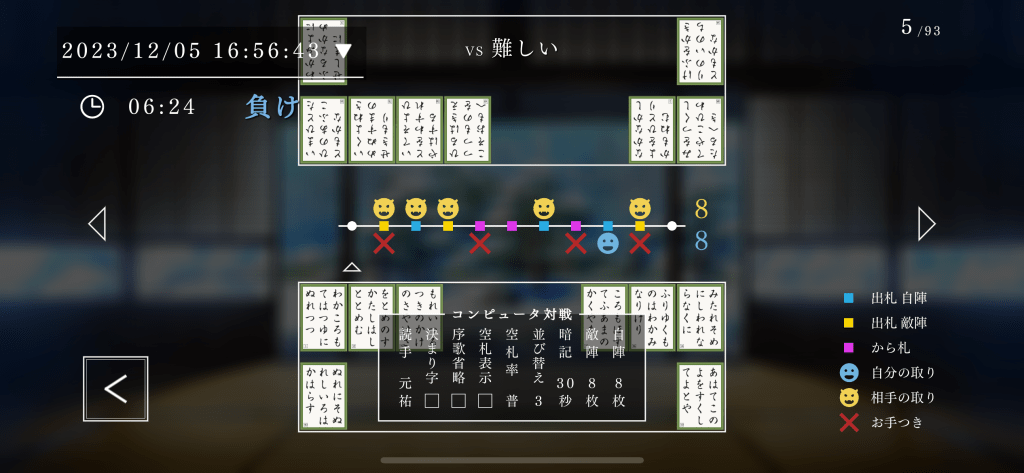
Having played Karuta now for three months and against a variety of opponents, including computer opponents, I realize that I get otetsuki (お手付き, “penalties”) a lot. Like, a lot.

In one in-person game, I was nervous and got eight penalties which is simply painful. Even when playing against the computer on hard mode, I get 2-4 penalties at a time.

I had 4 this particular game (the red X’s shown). 🤦🏼‍♂️

Anyhow, after finishing some other long-term projects recently, I’ve been investing time to practice karuta, and to grow and develop my skills. One of my big goals has been to reduce penalties as much as possible, and so after some introspection, I realized that my biggest issue, besides being nervous and jumpy, is that i don’t pay attention enough to the reader.

As folks who have been following the blog know, the key to playing karuta is to know the kimari-ji syllables, those first, unique syllables each poem has to distinguish from other poems. Until you hear those syllables, you can not be 100% sure which poem is being read, and if you guess wrong, you get a penalty. Sometimes, I got lucky and guessed correctly, obviously though, sometimes I guessed wrong.

Memorizing the kimari-ji is the first step. You also have to recognize them when you hear them, and hopefully faster than your opponent.

I decided this month that I wanted to invest more time in discipline and listening skills, and less on speed, so I have switched to playing “solo mode” on the online karuta app. There are other ways to do this of course, but the point is that I am playing against a “goldfish”.

Why a goldfish?

A “goldfish” is a term in Magic: The Gathering, for when you are practicing against a completely passive opponent. They are there, but do nothing. Like a goldfish. 🐠

If you play solo mode on the online karuta app, you are not pressed for time. You can slow down, pay attention to the reader, and then take the card when you recognize it. It is also a good way to catch your bad habits, test your different card arrangements, etc. It’s a surprisingly handy tool for improving your game.

Also, it’s a great way to analyze your play style. when playing “solo mode” against the computer, I still got jumpy and took a penalty.

Further, as your listening improves, your speed will gradually improve, but it does require a touch of patience, and a willingness to sacrifice speed over accuracy. I need this. My accuracy is poor, and speed cannot fix that. If I don’t play more accurately, I will continue to suffer loss after loss.

Even when I practice fuda-nagashi drills, I realized that I had to slow down a bit, or I would mis-identify cards again. It’s important to recall cards quickly, but if you mis-identify a card, then it’s not worth it. Better to accurately recall the correct kimari-ji, even if slower.

So, if you are learning karuta, and you feel like you are struggling, stop, backtrack, slow down, and focus on playing good karuta, not fast karuta. With a bit of time and patience, it should pay for itself.

P.S. Special thanks to the crew on the Competitive Karuta Discord group (Discord invite link here) for their helpful advice, much of which was incorporated in this blog post. ☺️

Hello, Won’t You Tell Me Your Name? Manyoshu Poem 1

This is the opening poem of the Manyoshu, Japan’s earliest poem anthology, an anthology that a few early Hyakunin Isshu poets also contributed too.

Original
Manyogana1
Modern
Japanese
Romanization
籠毛與籠(こ)もよKo mo yo
美籠母乳み籠(こ)持ちMiko mochi
布久思毛與掘串(ふくし)もよFukushi mo yo
美夫君志持み掘串(ぶくし)持ちMibukushi mochi
此岳尓この丘にKono oka ni
菜採須兒菜摘(なつ)ます児(こ)Natsu masu ko
家吉閑名家聞かなIe kikana
告紗根名告(なの)らさねNanorasane
虚見津そらみつSoramitsu
山跡乃國者大和(やまと)の国はYamato no kuni ha
押奈戸手おしなべてOshinabete
吾許曽居われこそ居(お)れWare koso ore
師吉名倍手しきなべてShiki nabete
吾己曽座われこそ座(ま)せWare koso mase
我許背齒われにこそはWare ni koso wa
告目告(の)らめNorame
家呼毛名雄母家をも名をもIe wo mo na wo mo
1 Manyogana and pronunciation source

Due to length and complexity of poem, plus it’s very old Japanese, I can only offer a rough translation (based on modern Japanese ones) like so:

A basket. The beauty holding the basket. A digging tool (lit. a spatula-like tool). The beauty holding the digging tool. You who are on the hill gathering vegetables, tell me, what family do you come from? Do you not know? I am the sovereign of this land (lit. Yamato, old name for Japan), and that every corner is under my dominion? So, tell me, what is your family’s name and origin?

This poem was composed by Emperor Yūryaku, who reigned in the 5th century, before recorded history. Technically, the title of “Emperor” was not used by ancestors of the Japanese imperial family at this time, and was later implemented by the time of Emperor Tenmu, brother of Tenji (poem 1), but this is a retroactive title. At this time, Yūryaku and others of the lineage were more like great kings (daiō 大王). Interestingly, although this point in Japanese history is pretty murky, Yūryaku is mentioned on a dedication inscribed on an ancient sword, providing historical evidence that he did in fact exist.

Yūryaku was described in early historical documents as a strong ruler, who slew his brothers following the death of the last king/emperor to get to his position. In later years, he helped consolidate power, but also was described as tyrannical as well.

The poor girl whom the poem was addressed to probably wasn’t in any position to say “no”, in any case.

The reason why I posted this poem is two-fold.

First, this poem is noticeably different than the tanka (短歌, “short poem”) style poems of the Hyakunin Isshu. This is a chōka (長歌, “long poem”) style poem. Tanka poems, including all poems of the Hyakunin Isshu, follow the style of 5-7-5-7-7 syllables. Chōka poems were 5-7-5-7-5-7…..5-7-7 syllables, with as many 5-7 syllable verses as needed. The Manyoshu has both formats, but by the time of the Hyakunin Isshu, the chōka format had fallen out of favor, probably because it was simply too long and difficult to fire off verses quickly.

Yūryaku’s poem doesn’t fit the chōka format very closely though, so it’s hard to say how strict poetry was back then. Over the centuries, and by the time we get towards the end of the Hyakunin Isshu, the style poetry had definitely solidified into a very rigid format with many specific rules, customs, and phrases. Yūryaku’s poem reflects an earlier, looser style of poetry. Or, as a powerful sovereign, maybe he just didn’t care. Who’s to say?

Second, the tone of the poem (ignoring the power-imbalance between him and the girl1) is a very lighthearted and romantic tone. Early poems in the Hyakunin Isshu tended to have a similar tone, but gradually the tone tended to get more somber centuries later as the aristocratic culture came to an end. Compare poems 95-100 to poem 1-5 in the Hyakunin Ishsu, and you’ll see what I mean. Yūryaku’s poem definitely belongs to this earlier, more bucolic time.

Anyhow, it’s interesting how poetry reflects history as well.

1 When you look at Lady Murasaki’s diary as well, when Michinaga makes a pass at one of the servant girls, it’s strongly implied a visit later will certainly follow. Again, women back then had less agency, and would have been hard-put to say no to powerful, ambitious men like that.