Learning Karuta For Fun

My journey with the game of Karuta began one August day in 2023 with the kind folks at a local karuta club, and right away I loved the game. However, over time, I realized that the competitive style of karuta, like you see in the anime Chihayafuru, was not for me. The constant pressure to grind out game after game to make incremental improvements, especially as a working parent with little time or energy for such endeavors, made me feel increasingly hopeless about making any real gains.1 Finally, with my children getting older, and one of them graduating, I had to take a long break from karuta. It just wasn’t fun anymore.

Recently, I’ve been playing again with a small informal group where we just mess around a bit, and play shorter Karuta games using the casual format. This is how most Japanese people play in Japan, by the way.

Thus, I wanted to share my experiences lately with readers in hopes that they may find ways to keep enjoying karuta, or help introduce it to people outside of Japan who didn’t learn it in grade school.

For starters, I ordered this 5-color Hyakunin Isshu set online from the good people at Oishi Tengudo last year,2 and after using the set a few times, I finally realized this five-color set is different than the more well-known version sold in Japan. It uses different colors, and divides the cards differently. My karuta reader apps were not set to recite poems according to Oishi Tengudo groupings, so I was really confused at first.

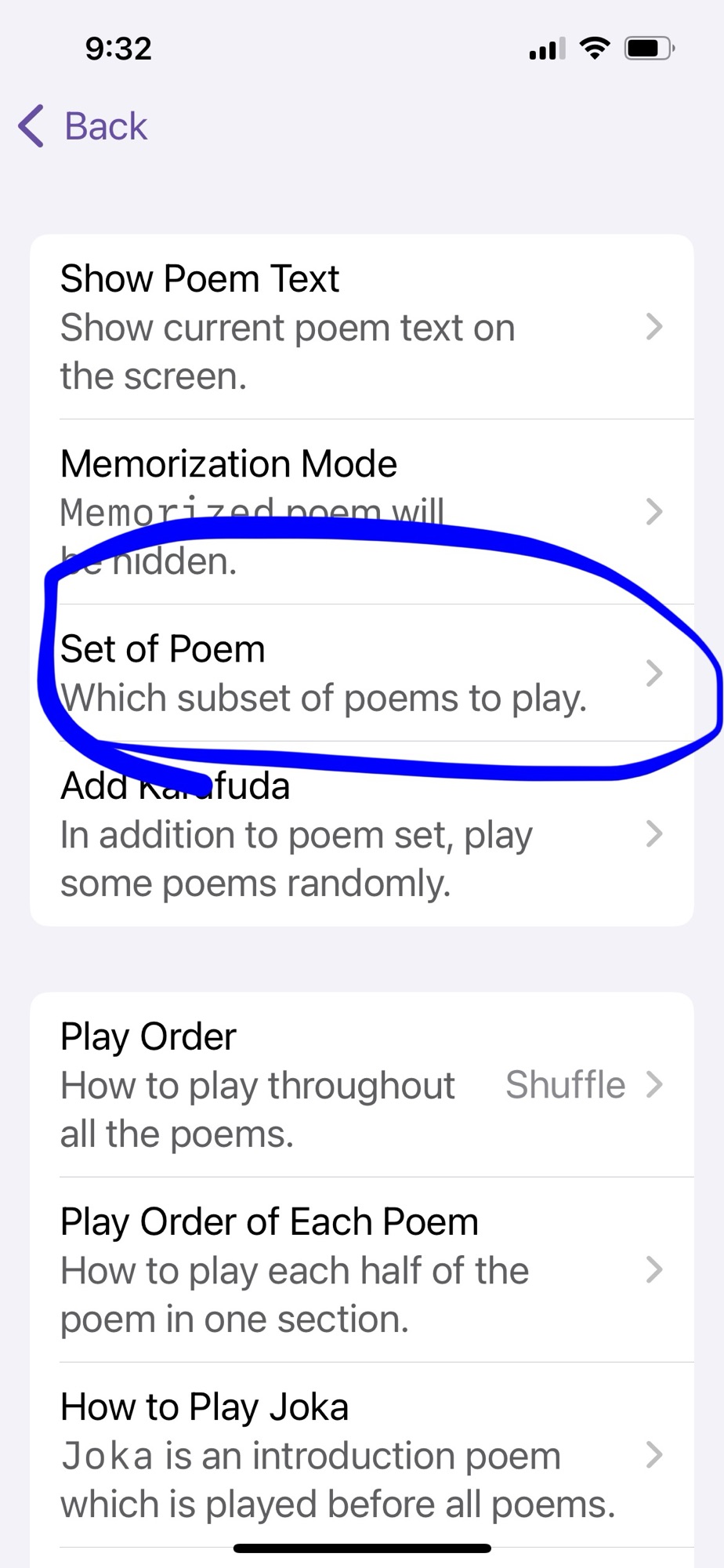
Using my favorite karuta reader app, Wasuramoti (Android and iOS), I decided to make custom lists based on the Oishi Tengudo groupings. You can do this too in Wasuramoti by selecting Advanced Config, then Set of Poem:
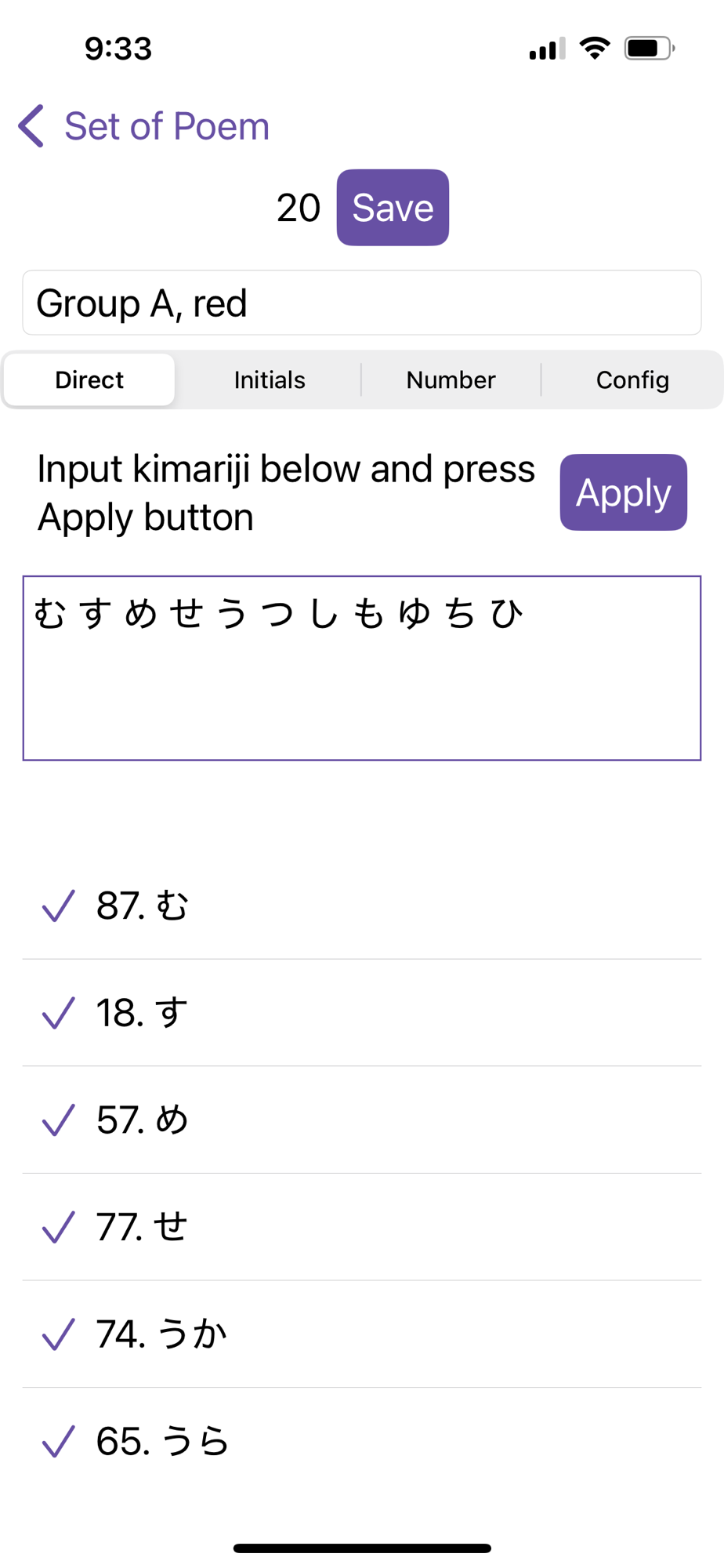
In the Oishi Tengudo set, the “red” group (also called Group A), is comprised of poems whose kimari-ji (starting syllables) start with む (mu), す (su), め (me), せ (se), う (u), つ (tsu), し (shi), も (mo), ゆ (yu), ち (chi), and ひ (hi). These cards have very few or no tomofuda (cards with similar kimari-ji), so they’re distinct and easy to learn first. I created my custom list with 20 cards, just like my physical set.
I made a similar custom list for Group B (“blue”) as well. This group is a bit harder because it includes cards whose kimari-ji have slightly more tomofuda cards (3-4): い (i), み (mi), た (ta), and こ (ko). So, there’s a bit more effort required to distinguish one card from another. Yet it’s still the second easiest group.

… and so on.

When I practice, I just grab the color I want to play (“red”, or Group A in this case) and scatter then on my desk, casual-style.

Then in the Wasuramoti app, I select the group of poems I want (see above), set the app to display the torifuda, same as cards on my desk, and set the reader to “auto” mode so it doesn’t stop with each poem. I just want to see if I can recognize the poem before too late. I don’t care very much about speed.
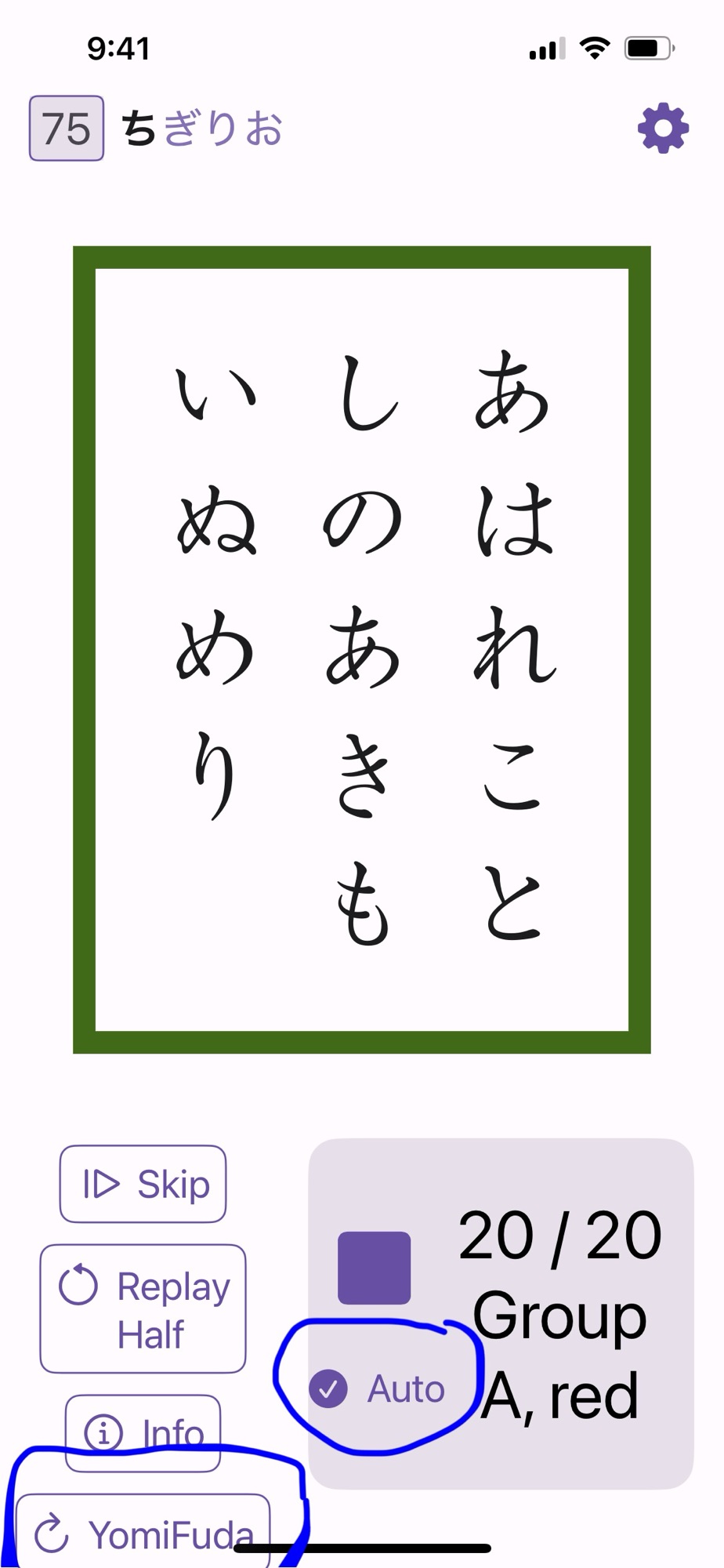
It is fun to play this way. I can finish a game pretty quickly (roughly ten minutes) and it is not very exhausting. Since I chose the easiest set of cards first, I remembered many of them pretty quickly despite the long hiatus, which was gratifying.

This format of playing smaller sets of cards, with optional levels of difficulty, and no threat of penalties, seems to be a great way to introduce to new players as well. I was happy to see that a new player, who had experience with Japanese language, quickly pick up the game, took a few cards of her own, and had a great time. If people aren’t having a great time, why play karuta?

Karuta is super fun, and a great game to enjoy throughout one’s life. However, if you are struggling, don’t blame yourself. Instead, find what you enjoy about karuta, pick a more gentle format, and focus on that, not what the A-rank players are doing.

Happy gaming!

1 The final nail in the coffin was when I joined some online communities which I soon realized were very focused on competition, and very little on actually enjoying the culture of the Hyakunin Isshu. It was just another sport, with physical training regimens, and techniques to edge out your opponent. That is not why I created this blog back in 2011, and not why I continue to enjoy the Hyakunin Isshu now. I had left the world of competitive card games behind when I quit playing Magic the Gathering before the Pandemic, and didn’t want to resume.

2 They only ship in Japan as far as I can tell, and with tariffs making things more expensive, it might be hard to get outside of Japan. Thus, I am adding a new index page for five-color Hyakunin Isshu to help readers make their own sets

Nonomiya Shrine, Charms and Thank You

Happy Holidays, Dear Readers!

As I noted in my other blog, I am taking time off the rest of the year to rest, and catch up on nerd projects.

One last post before end of the year: I forgot to share this previously, but during the trip to Japan this summer, and on the same day we both visited the shrine to Sei Shonagon, and the site where the Hyakunin Isshu was compiled, I made one more stop: Nonomiya Shrine. The official website is here (English).

Nonomiya Shrine (nonomiya-jinja, 野宮神社) is a Shinto shrine that has been around since antiquity in west Kyoto within the bamboo forests. You can see it here on Google Maps:

While it is not related to the Hyakunin Isshu, it is related to Lady Murasaki (poem 57, め), whom I wrote about here. You see, one of the most iconic chapters of the Tales of Genji, Lady Murasaki’s famous novel, the “Heartvine” (Aoi, 葵) takes place at Nonomiya Shrine. Here, Genji the protagonist meets Lady Aoi his future wife. So, Nonomiya Shrine is associated with romance and falling in love, or meeting one’s soulmate, and since it was already a fixture in Kyoto culture at the time, Lady Murasaki used it as the backdrop for this romantic encounter.

Even now, many people (both Japanese and tourists) come here to pray for love, and many of the omamori charms are focused on romance too. It’s nestled within the famous bamboo forests in the area:

I stumbled upon it by accident after leaving the aforementioned site where the Hyakunin Isshu site was compiled. My family was waiting for me, it was late in the day, and it was very hot and humid, so I didn’t stay very long, but I wanted to at least grab a few photos, and get an omamori charm.1
Anyhow, that’s it for the blog for 2024.

I wanted to end this post by saying thank you to readers. The blog has been been around since 2011 (with some major gaps in content), and with plenty of twists and turns, but I am happy to see that people are still actively reading it, and discovering the Hyakunin Isshu, Heian-period culture, and Japanese poetry overall.

See you all next year!

P.S. Not far away was an exhibit for the historical drama about Lady Murasaki as well.

1 Most of the charms are for en-musubi (縁結び), meaning finding a partner in life, but since I am already happily married, I looked for something general. I picked up a omamori for kai-un (開運), meaning “good luck”, but it showed the famous scene from the Tales of Genji where Genji and Lady Aoi meet at Nonomiya Shrine. I wish I remembered to take a photo sooner, but I already gave it to someone, and have no photos to show. 🤦🏼‍♂️

You can see it on the website here, the charm on the upper-right corner.

The Final Days and Legacy of Lady Murasaki

At last, the historical drama about Lady Murasaki has come to an end this week, and sadly I watched the last episode. The drama was slower than other past Taiga Drama on NHK, but it was a lovely tribute to an amazing woman. Lady Murasaki, author of the Tales of Genji, her eponymous diary, and a famous poem in the Hyakunin Isshu left a lasting mark on Japanese culture and world literature.

The final title card for the Japanese historical drama “Hikaru Kimi E”.
The concluding title card for the historical drama: hikaru kimi é (光る君へ, “to you, my radiant one”).

Details of Lady Murasaki’s final years are pretty sketchy, but it seems that she eventually retired from service in Fujiwara no Michinaga’s household, and gradually took up travel. She was born in the year 973, but some scholars believe she may have passed away in 1014 at the age of 41. Others believe she may have lived to the year 1025 (age 52). For the premodern era, this is a pretty typical lifespan for many people, including nobility. Still, as someone who’s older than her, it’s hard to imagine her dying so young.1

Her grave is located in Kita-ku ward of Kyoto:

With her passing, a couple attempts were made to preserve and edit her magnum opus. Fujiwara no Teika (poem 97, こぬ) who compiled the Hyakunin Isshu itself undertook one of these efforts, creating the Aobyōshibon (青表紙本) edition. At this time in Japan, manuscripts had to be hand-copied, and so across several centuries, limited efforts were made to hand-copy works from Lady Murasaki’s time, which helped preserve them across the medieval period, but were inaccessible to general audiences.

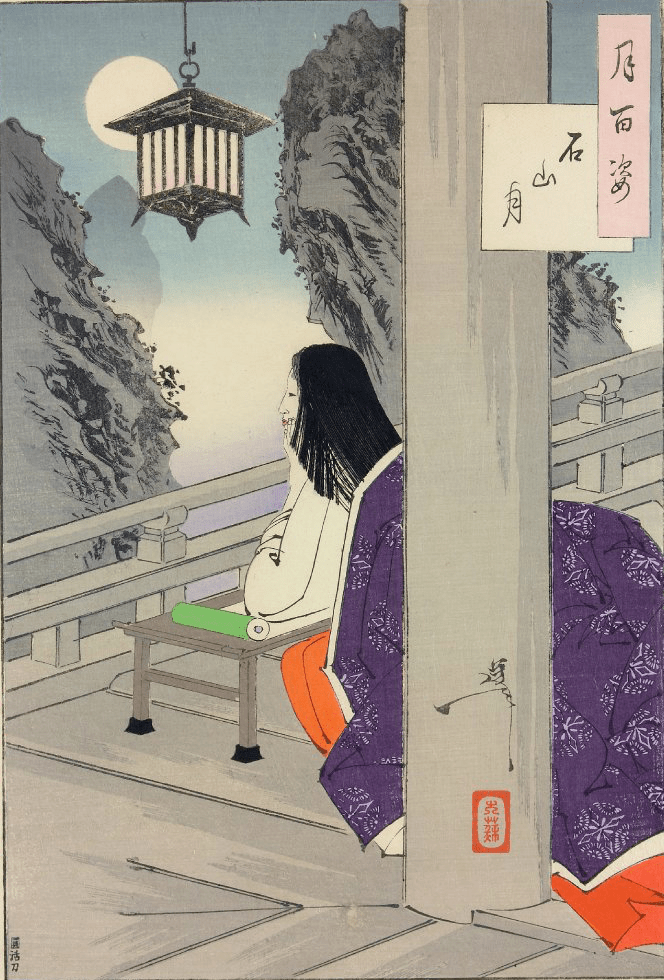
A woodblock print of Lady Murasaki from 1889 made by Yoshitoshi, Public domain, via Wikimedia Commons

By the Edo Period, 17th century, block printing and a flourishing of “book culture” greatly expanded the audience of the Tales of Genji, and Lady Murasaki enjoyed a surge in popularity, rescued from obscurity, and even today is high revered. Lady Murasaki is to Japanese culture what Shakespeare is to the English-speaking world. The historical drama that concluded is arguably an extension of this revival.

Finally, I wanted to explore the relationship between Lady Murasaki and her patron, Fujiwara no Michinaga. In the historical drama, they shared a relationship since childhood (historically improbable), and even had a love child together even though they never married. Political marriages were common among the nobilty at the time, as was infidelity, and so Fujiwara no Michinaga having an official marriage yet carrying a number of romantic trysts would not be surprising. The Hyakunin Isshu poetry is rife with such romances.

And the real, historical relationship between Lady Murasaki and Michinaga is unclear. It’s widely believed that the main character of the Tales of Genji was patterned from Michinaga. Her diary also shows her flirting with Michinaga somewhat. And yet, it’s also implied that she fended off his romantic advances too. The fact that she worked under him, the most powerful political figure in Japan at the time, made their relationship even more complicated. If her daughter, Daini no Sanmi (poem 58 of the Hyakunin Isshu, ありま) was indeed Michinaga’s, as the drama depicts, it may help explain how she was brought into the court inner circle too, alongside her mother. And yet, evidence one way or another is pretty limited, so one can only speculate.

Lady Murasaki herself was woman perpetually out of place in the courtly life of the late Heian Period. Her diary shows her frequently introverted, melancholy, out of place, and exhausted by the back-biting of other women, or the rowdiness of drunk men. Her father had lamented that in spite of her literary talents, her being born a woman in that era meant her talents would go to waste. Such was the period of the time.

One can easily imagine a brilliant woman like Lady Murasaki in modern times sitting in cafe, writing a romance novel, feeling alone, yet observing the world around her in a way that is beautiful and poetic, pouring her heart into her work. What Lady Murasaki conveyed through her writing was something can we can appreciate even today, eleven centuries later.

Out of all the literature of the time, nothing quite epitomizes the sentiments and milieu of the Heian Period, an era now lost to time, yet strangely familiar, quite like Lady Murasaki did.

P.S. The drama definitely took some historical liberties for the sake of drama, but I have to admit that it did a nice job of showing Lady Murasaki as a complex person, and all the different challenges she had to deal with. The last several episodes were really touching and brought tied up things nicely. I might try to purchase the drama next year if I can, but it’s quite expensive ($300-$500 USD), so time will tell.

1 As someone who also spent some time in the ER earlier this year with emergency surgery, I can imagine that I too would have likely died in my 40’s without modern medical care. Modern people often forget how brutal and short life was for the average person before medical science, and how many people never lived past 50, or did so with crippling conditions.

Kurumazaki Shrine

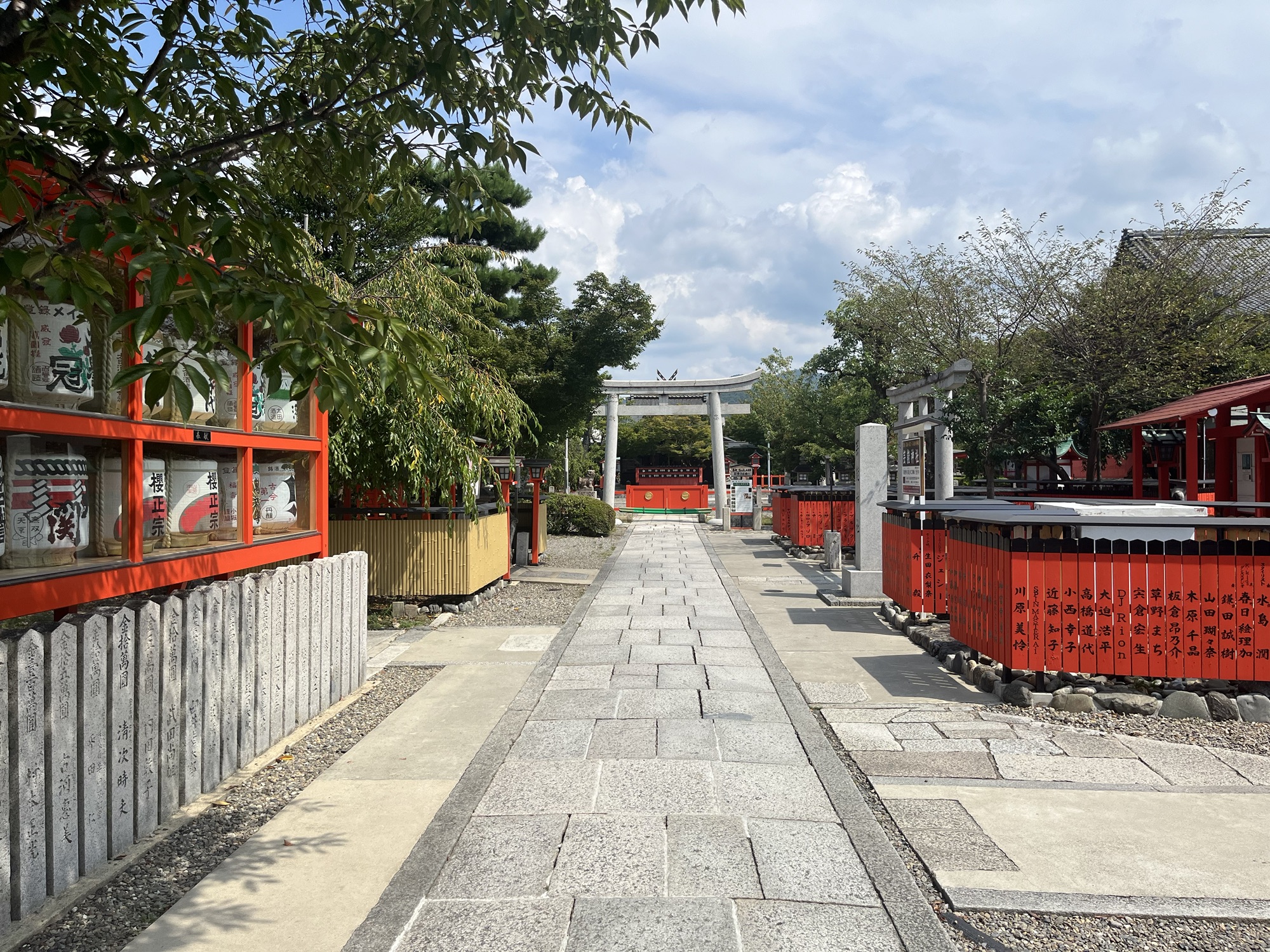
During our recent trip to Japan, we visited the city of Kyoto. I talked about this here, but I also wanted to share another site in Kyoto that relates to one of the poets of the Hyakunin Isshu : Kuramazaki Shrine. You can find their official website here, but there is no English and the site is a bit hard to navigate. The shrine itself has a very interesting layout:

The photo above is the main promenade leading to the inner sanctum (toward the back). Apparently, it’s tradition in Japanese culture to walk along the edge of the walkway, not right in the middle, so bear that in mind when visiting a shrine like this.

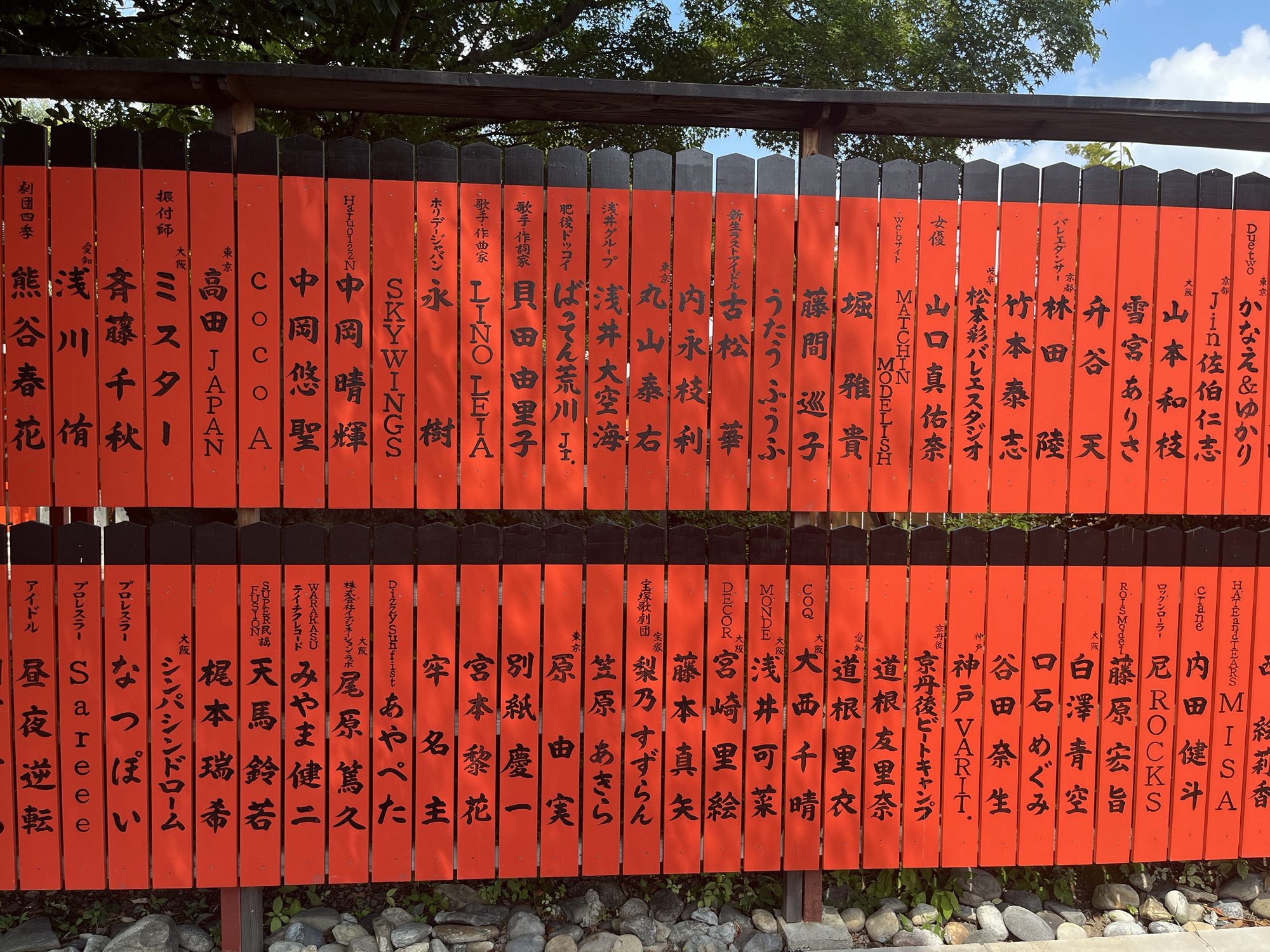
This Shinto shrine is notable for its many visits by celebrities who leave autographed red plaques.

Shinto shrines often serve particular need in society: love, business success, health, etc. In the case of Kurumazaki Shrine, the focus is on show-business, acting, theater, etc.

Why does this matter?

It turns out that Sei Shonagon, author of the Pillow Book and poem 62 (よを) in the Hyakunin Isshu is enshrined here. Not only that, but you can purchase a special omamori charm with her image on it. I learned about this place on social media after seeing the actress First Summer Uika, who played Sei Shonagon in the historical drama, visit the shrine.

Because this site contains many sub-shrines and side passages, it took a bit of effort to find Sei Shonagon’s shrine. It is halfway down the promenade, on the left, and looks like so:

I paid my respects to this esteemed author, and the family and I continued to explore. I found First Summer Uika’s plaque near the inner sanctum:

Incidentally, my wife is a fan of the JPop group Snow Man, and you can see one of their markers just to the left. We both got something out of this trip. 😛

As I alluded to earlier, the shrine complex is deceptively long, with many nooks and hidden shrines and side paths. The site map gives some sense of this. For reference, the Sei Shonagon shrine is number 20 on the map, and you can see there are many other sites here too. I didn’t photograph every shrine here, and most are probably obscure to readers (and obscure to myself). The common theme was both fortune, and also show business. They were some pretty neat shrines though, such as this one showing various theater masks:

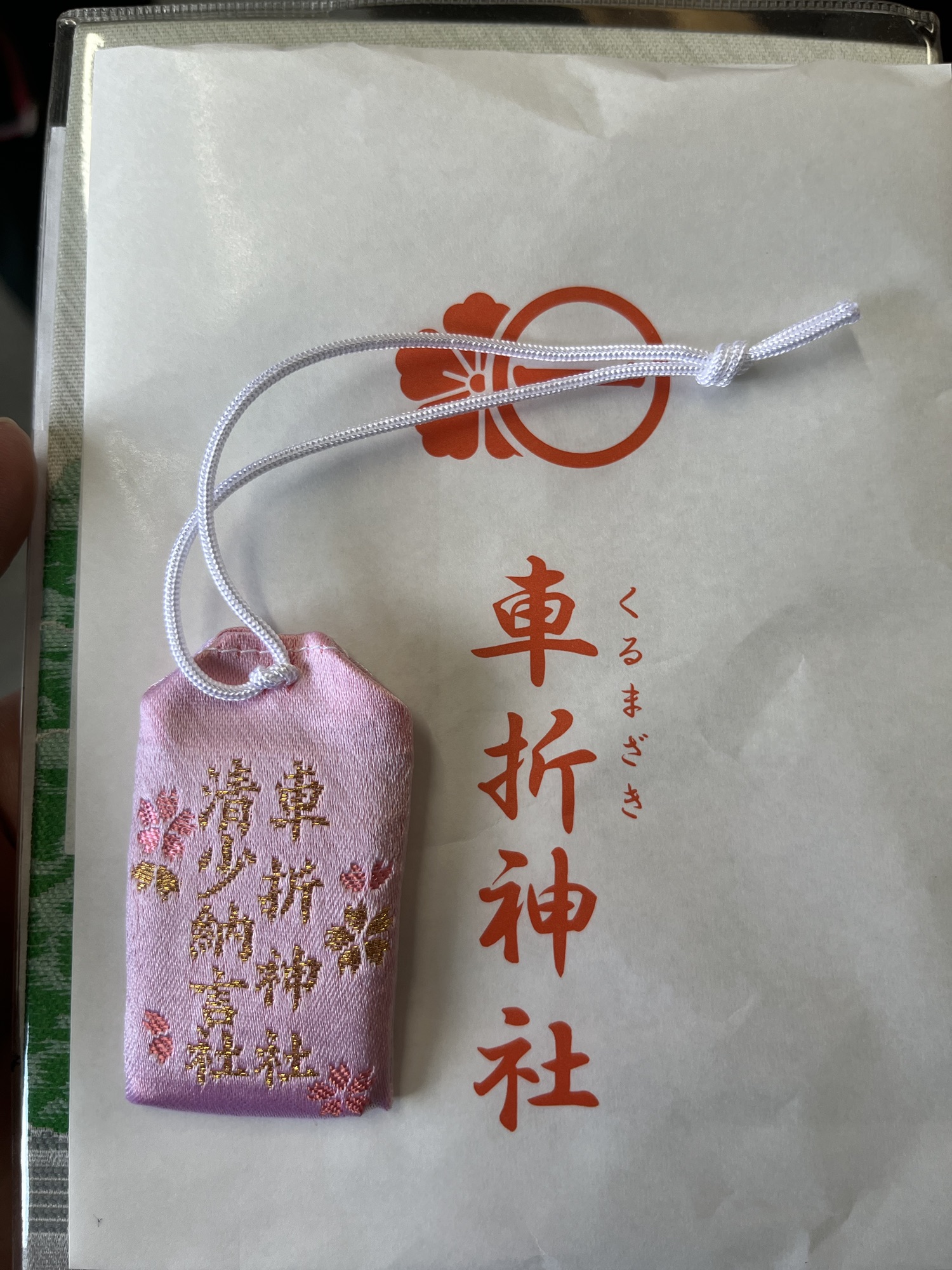
At last we came to the gift shop, and I got a Sei Shonagon charm (omamori):

Later, when I got back home and realized that the charm was intended for ladies,1 I was rather embarrassed, yet I didn’t want it to go to waste, so I gave it to my daughter whose preparing for college this year. It seemed fitting, and I am happy to report that she got a good score in her SAT exam the following month, so perhaps the charm worked?

Anyhow, Kurumazaki Shrine is not something tourists usually visit because it’s a little removed from the nearby touristy area of Arashiyama, and like many Shinto shrines, it’s very Japan-centric, but it’s a cool slice-of-life of Japanese popular culture, both past and present.

As for me, I was happy to pay my respects to such a wonderful poet and author directly, someone’s whose creativity and work indirectly helped make this blog what it is today.

P.S. Later that day, I stumbled upon the place where the Hyakunin Isshu was compiled, so I managed to visit two sites in one day. Not too shabby.

1 It’s clearly written on the signs, I just failed to pay attention. I was maybe a bit star-struck perhaps. 😅

Where It All Began: Mount Ogura

Hello everyone,

I just returned from another trip to Japan,1 and we got to spend a bit of time in Kyoto. By accident, I also found Mount Ogura, and the place where Hyakunin Isshu was compiled! But first, let’s backup and explain a bit of history first.

Kyoto was the capital of Japan from the 8th century to the 19th century, and so many well-to-do families lived here. This aristocracy wrote countless waka poems that were compiled into official poetry anthologies from time to time,2 but the Hyakunin Isshu was not one of them. It was compiled by Fujiwara no Teika (poem 97) as a favor to his in-laws. Teika had been a compiler of one of the major anthologies, the Shin-Kokin-Wakashu, but was now in retirement after his liege lords (poem 100 and poem 99) were exiled in the upheaval of the Jokyu Rebellion. He resided in a small villa on the west side of Kyoto on the hillside of Mount Ogura, and was tasked with selecting the very best 100 waka poems that his in-laws could decorate their home with. Teika’s excellent poetic taste led to the Hyakunin Isshu we celebrate today.

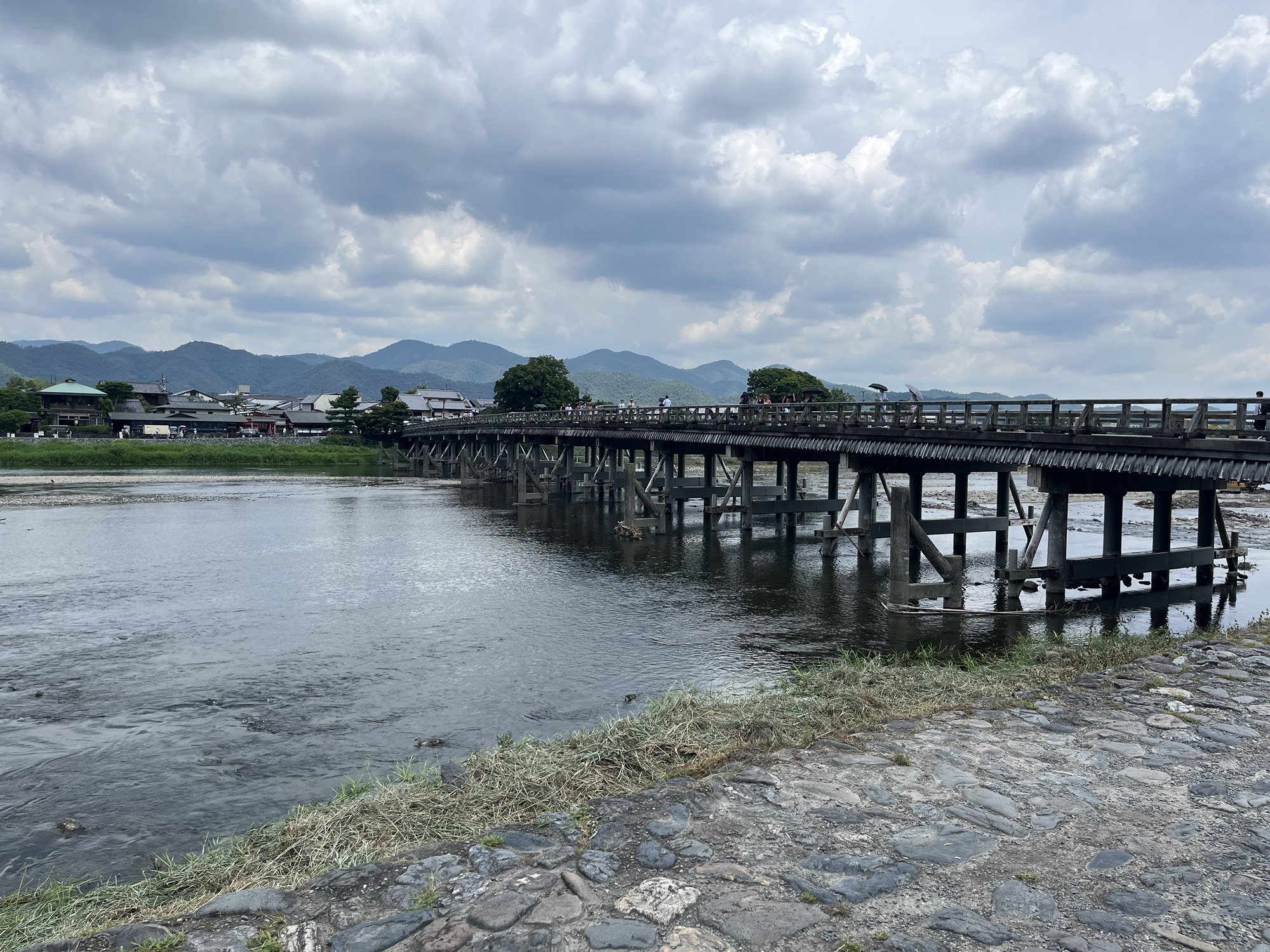
Anyhow, back to present day. I was with the family, and we visited a part of western Kyoto called Arashiyama (嵐山). It’s a very scenic place, with famous bamboo forests, and an iconic bridge named Togetsu-kyō (渡月橋):

Since we visited in the summer, it was extremely hot and muggy, so by lunch time we were exhausted and tired. We went to a local cafe and had lunch. Since we were in Kyoto, I assumed there would be many famous historical places related to the Hyakunin Isshu,3 but I was having trouble finding them on GPS, so I was disappointed.

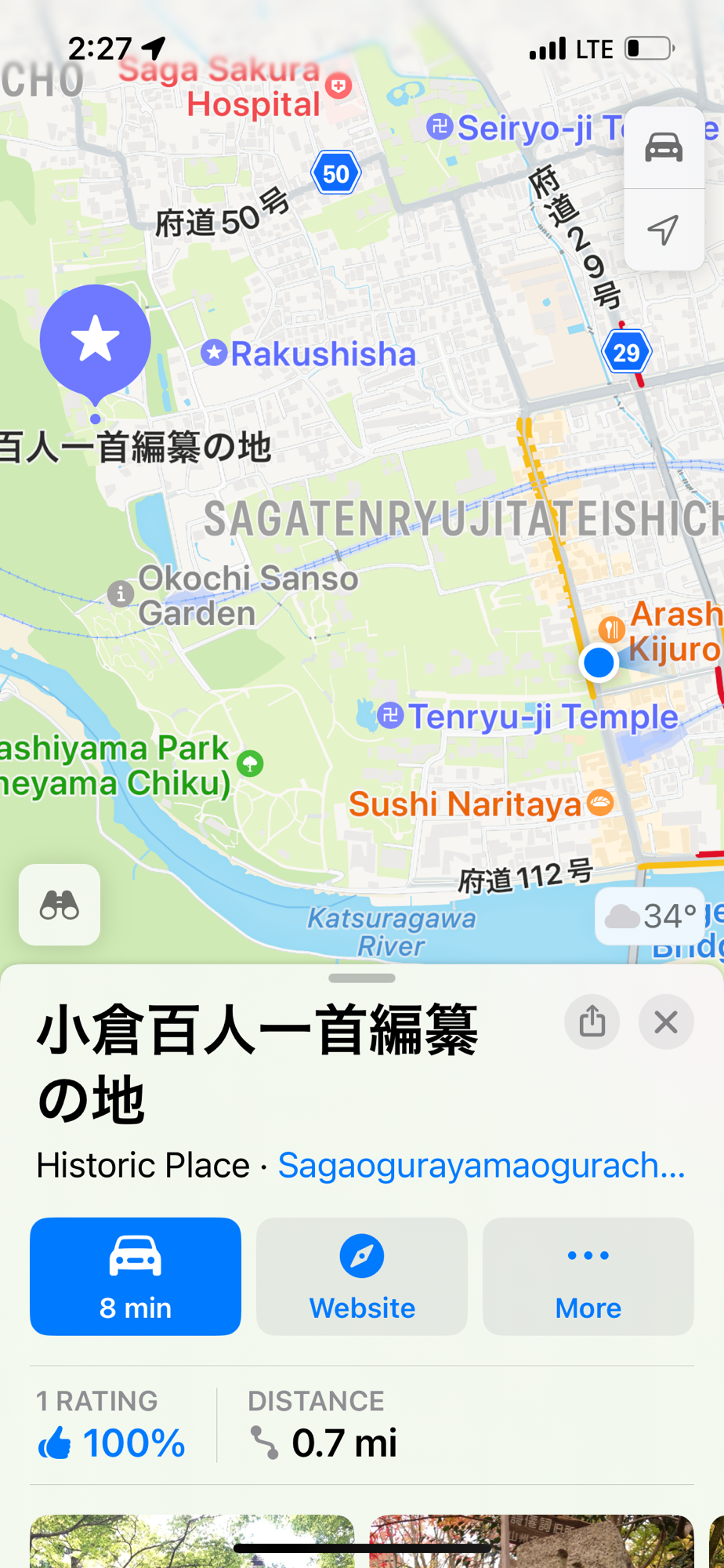
Then I noticed the following spot on my map app:

小倉百人一首編纂の地 (ogura hyakunin isshu hensan no chi) … the place where the Hyakunin Isshu was compiled…? Wow, that’s only 15 minutes by foot from where I was at!

The family was exhausted and sweaty, and were planning to return to our hotel, so I didn’t want to drag them uphill in the heat. I told them I’d be back, and I took off for the place on the map. It turns out that the properly had been converted to a Buddhist temple named Jojakkō-ji (常寂光寺) in the 17th century (a common practice in Kyoto). You can find the official website here.

This is Mount Ogura today.

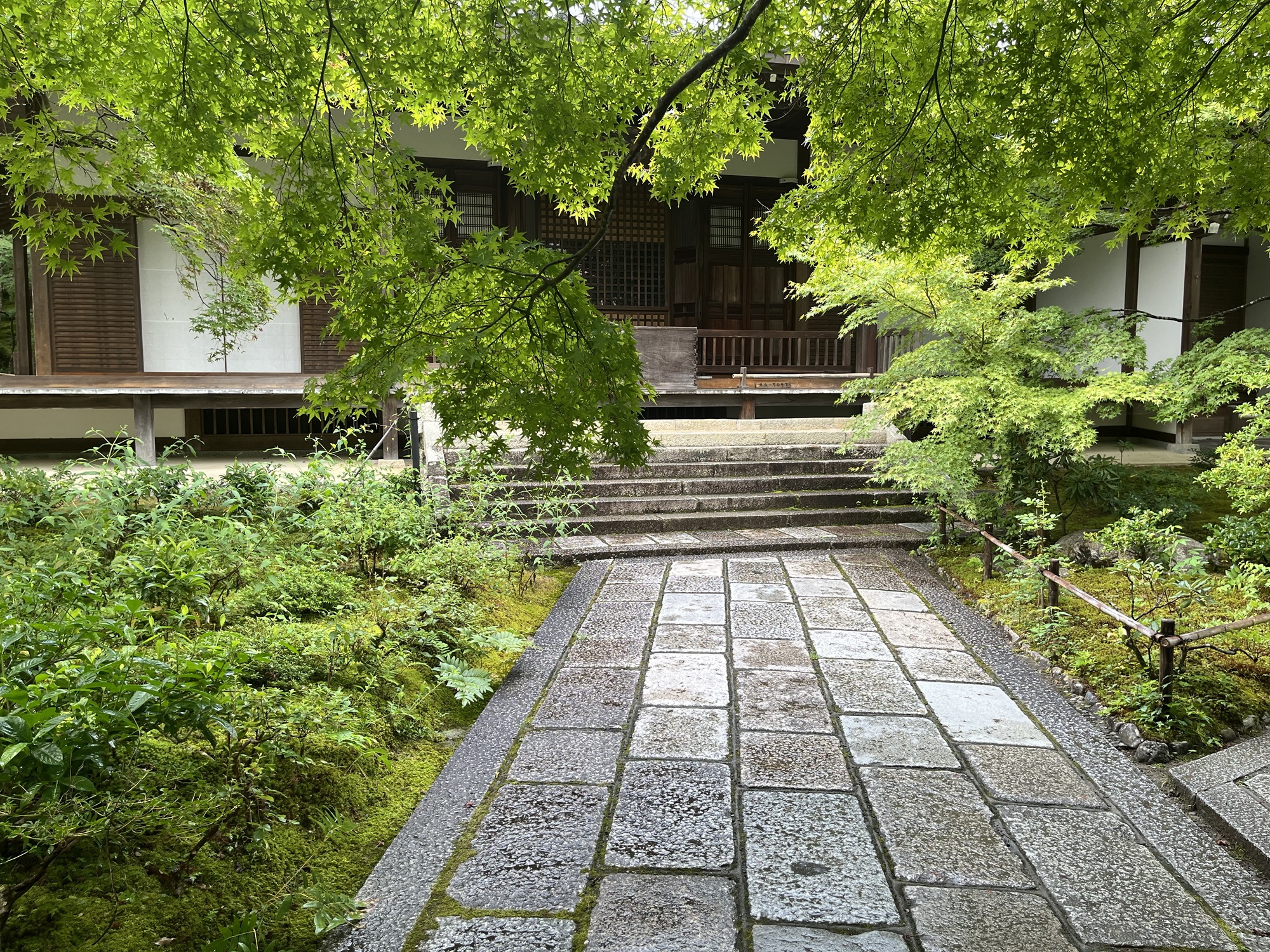
I followed the map directions and made it safely to Jojakko-ji Temple:

There is a small entry fee, but once I paid that, I got to the second gate here:

The site of the Ogura Hyakunin Isshu is just down the path to the right, before the gate. I made the mistake of going up the stairs instead:

Jojakko-ji Temple is quite scenic actually:

… but it was very late in the day, my family was waiting back at Arashiyama, and I had to hurry. This was my one shot, probably in my lifetime, to find this place, but the temple maps, nor the website show precisely where it was.

Finally, I found it:

The photos from the prefectural website look a lot better than mine (good lighting helps). But there it was, the actual site where the Ogura Hyakunin Isshu was compiled!

The stone marker is pretty small and somewhat eroded, but there was no mistaking it.

Since I was short on time, I paused and said a quick “thank you” to Fujiwara no Teika and then headed back.

If you are fan of the Hyakunin Isshu, and you are in the Arashiyama area of Kyoto don’t miss this small but significant site.

P.S. while at Jojakko-ji, I met a nice Australian couple who had just finished their visit. They told me that at the top of the temple you can see a really view of Kyoto. I didn’t have the time to see it for myself, but if you go, don’t pass up the chance.

P.P.S. I forgot that, ten years ago, I had made a post about Mount Ogura. You can see the Togetsu-Kyo bridge here too.

1 We return every year when possible to visit my wife’s in-laws, and let the kids spend time with their relatives, learn more Japanese, etc.

2 Many earlier poems were also composed at a time when Japan’s capital moved around (Nara, Fujiwara-kyo, Asuka, etc) before settling down in Kyoto. See the Manyoshu for further details.

3 I did actually find one other place we visited earlier in the day, but more on that in an upcoming post.

Final Parting

I’ve written before about Empress Teishi, the ill-fated first wife of Emperor Ichijō, and patron of Sei Shonagon who wrote poem 62 of the Hyakunin Isshu (よを). Her family lost a power-struggle to a rival faction of the Fujiwara clan, and under pressure Ichijō took a second wife from the winning faction: Empress Shoshi. Teishi was sidelined, and although she did give birth to an heir, she soon died from illness and presumably humiliation and stress.

While watching the historical drama about Lady Murasaki, it showed Teishi’s untimely death, and revealed that she had left a final deathbed poem to her beloved husband. The poem really exists and is actually recorded in an imperial anthology, the lesser-known Goshūishū (後拾遺), number 536:

JapaneseRomanizationRough Translation
夜もすがらYo mo suguraIf you should remember
契りしことをChigirishi koto wothat vow we made
忘れずはWasurezu wain the deep of night,
恋ひむ涙のKoimu namida nothen I long to see
色ぞゆかしきIro zo yukashikithe color of your tears…

In the drama, Emperor Ichijo and Teishi are portrayed as being sincerely in love, yet ultimately they are a victim of politics and forced apart more and more over time. The vow alluded to here was portrayed in the drama as a promise by Emperor Ichijo to always love Teishi no matter what.

Rokuharamitsu-ji Temple in Kyoto, where Teishi was laid to rest. Photo by 663highland, CC BY-SA 3.0, via Wikimedia Commons

Later, Teishi was buried (not cremated in typical Buddhist fashion) at a temple called Roku-haramitsu-ji, near an area of Kyoto called Toribeno no Misasagi (鳥戸野陵). Legend says that on the night of her funeral it snowed. Emperor Ichijo, who was unable to attend, was said to have stayed up all night mourning for her at the palace. Later he composed a poem for her, preserved in the Eiga Monogatari, which is as follows:

JapaneseRomanizationRough Translation
野辺までにNobe made niMy heart yearns
心ばかりはKokoro bakari wafor you all the way
どもKayoe domoin Toribeno,
わが行幸みゆきともWaga miyuki tomoand yet I worry if
知らずやあるらんShirazuya aruranyou are aware of my coming.

Later, Sei Shonagon who retired from the Court, was said to have taken up residence near Toribeno no Misasagi, particularly near a temple named Sennyu-ji. You can see some photos of these places in the video posted here. It was looking back in her later years that Sei Shonagon wrote the Pillow Book as a subtle memorial to her beloved patron, looking back fondly on happier days together.

Sources used:

Places mentioned:

Lady Murasaki and Marital Strife

Lady Murasaki, one of the most famous women of Heian-period Japan, and the first novelist in Japan, wrote many wonderful romantic scenes through the Tales of Genji, yet her real life marriage was anything but.

The latest episode historical drama on NHK about the life and times of Lady Murasaki (poem 57, め) covers her marriage to her second-cousin Fujiwara no Nobutaka (藤原宣孝, ? – 1001), who was around 20 years her senior. Yes, this was not that unusual for the time, but still gross.

Sadly, the marriage quickly turned sour. Nobutaka slept around a lot, and had other hidden wives and children. Lady Murasaki did not take this lying down and the two of them fought frequently. Nobutaka for his part, enjoyed bragging about his trophy wife.

In the poems preserved in Lady Murasaki’s own private collection is this poem addressed to her husband:

JapaneseRomanizationRough Translation1
言ひ絶えばIi taebaIf you saw you’re going to
さこそは絶えめSa koso wa taemestop writing me, then fine!
なにかそのNanika sonoYou can’t even
らの池をMiwara no ike wostand by the bank
つつみしもせTsutsumi shimo senof Miwara pond properly.
1 Apologies for any mistakes, or for the roughness of this translation

The backstory of this poem is that Nobutaka had taken one of Lady’s Murasaki’s private letters addressed to him, and shown off that letter to friends (apparently bragging about how smart his young bride was). She was justifiably angry and told him to knock it off. Nobutaka was angry with her and threatened to stop writing. Her reply above, was a clever way of saying “fine, don’t bother writing me”. The allusion to Miwara pond was a pair of puns:

  • Miwana pond (mihara) is also a pun for anger.
  • The word tsutsumi is also pun for a bank (as in riverbank), and self-restraint.

Contrary to Lady Murasaki’s reply, Nobutaka was so impressed by the reply that he ended up bragging about it to his friends anyway. 🤦🏼‍♂️

Another letter is as follows:

JapaneseRomanizationRough Translation2
忘るるはWasururu waForgetting others is
うき世のつねとUki yo no tsune toa part of this ephemeral world,
思ふにもOmou ni moEven so,
身をやるかたのMi wo yarukata nobeing forgotten myself,
なきぞわびぬるNaki zo wabinuruI cannot help but cry.
2 Apologies for any mistakes, or for the roughness of this translation

The married nobility of the Heian Period frequently lived in separate estates, and the husband would visit his wife as needed, but not the other way around. It seems by this point, Lady Murasaki was forgotten by her philandering husband, and lamented her unhappy marriage. One can’t help but recall the Gossamer Years generations earlier.

It is sad that such a talented woman was relegated to an unhappy marriage with a faithless, not to mention narcissistic husband, especially in a society where women had little recourse. I also wonder how much this motivated her to write her novel, The Tales of Genji, as a coping mechanism.

P.S. Sources used in this post include:

P.P.S. For folks who are visiting Kyoto, there are many excellent locations associated with the life of Lady Murasaki and the Tales of Genji. The featured photo above is the “Genji Garden”, part of the Buddhist temple of Rozan-ji, courtesy of PlusMinus, CC BY-SA 3.0, via Wikimedia Commons. This blog includes an excellent photo-tour of Rozan-ji.

June Updates and Lazy Izumi Poem

Hi all,

You may have noticed the blog looks a bit different now. I have been struggling since the big blog refresh I started in December 2022 to get the appearance just right. Design isn’t my forte (I am a history nerd), so I’ve struggled with finding the right design for this blog. The original blog template on WordPress was so old (this blog was started in 2011) that it was no longer supported by WordPress, so I had to find something else that works. After dabbling with a few designs this past year, I’ve settled on current blog template as of last week and I am pretty happy with it. I hope you all like the new design. I liked it so much I applied the same template to the other blog.

Next news: I will be off to Japan again this summer … though only briefly. The family and I will visit the ancient capitol of Kyoto, just like last year,1 but the visit overall is much more limited and I probably won’t get to see many things related to this blog. I won’t have time to visit Oishi Tengudo again, or Kitano Tenmangu Shrine, but I do however plan to make a stop at Kurumazaki Shrine (mentioned here) to pick up one of those Sei Shonagon (poem 62, yo wo komete) charms. I may try to work in a few other tourist spots related to the Lady Murasaki drama given that it’s popular right now. I also expect to melt under 35C(95F)-degree weather with 75% humidity again like last year.2

I have a few more posts coming up between now and the trip (late July), and I hope you will find them interesting.

Finally, just as a fun bonus, I wanted to share a one-off poem by Lady Izumi (poem 56, arazan) that I recently heard on a different Japanese historical drama. Lady Izumi is one of my personal favorite figures in the Hyakunin Isshu, and this poem was first recorded in an Imperial anthology, the Goshūi Wakashū (後拾遺和歌集), poem 755:

JapaneseRomanizationTranslation
黒髪のKuro kami noMy black hair’s
みだれもしらずmidarete shirazuin disarray — uncaring
うち臥せばuchi fusebahe lay down, and
まづかきやりしmazu kakiyarishifirst, gently smoothed it:
人ぞ恋しきhito zo koishikimy darling love.
Translation source: http://www.wakapoetry.net/gsis-xiii-755/

It’s not clear from this poem which lover she is referring to, since she had a number of relationships over the years, nonetheless it is a very sincere, romantic poem and expresses her passionate style nicely.

Happy Summer!

P.S. speaking of history nerd, I’ve debated about making a Japan / history podcast (like many other fine podcasts I follow), but have struggled to find a good theme. I might simply do the “history of the hyakunin isshu” podcast someday. It’s a bit commitment though, so we shall see.

1 While we do visit Japan yearly so my kids can spend the summer with their grandparents and extended family, visits to Kyoto are rare because of cost, time, and so on. Our last visit was almost 15 years ago. It just so happens that we could make two trips in two years. After that, who knows when we will visit next?

2 Without going into too many details, the humidity, heat and fluid loss aggravated an old medical issue I have. A reminder to stay hydrated, and avoid junk food. I like getting older in many ways, except at times like this. 😋

Lady Murasaki Drama

Hi folks!

I have been away for a while due to various life circumstances, but I’ve been wanting to share this news with readers.

The Japanese public TV station, NHK, broadcasts a new Taiga Drama (大河ドラマ) every year. These are big productions featuring some aspect of Japanese history, with big name actors and so on. I was very fond of the last one. Usually these cover periods of warfare or conflict, and male historical figures from Japan’s long history, but this year’s drama, titled Hikaru Kimi E (ひかる君へ, “Addressed to You [my dear Radiant One]”), features Lady Murasaki as the main character!

(Image by NHK, all rights reserved)

Lady Murasaki, poem 57 of the Hyakunin Isshu, needs little introduction. She composed the Tales of Genji, as well as her eponymous diary. She was the first female novelist in Japanese history, and has been a subject of interest ever since. The biographical details of her life are somewhat scant, unfortunately, and the drama does embellish quite a bit, including hinting strongly at a romance that probably didn’t happen in real life. My impression is that they are using romantic themes from her novel, the Tales of Genji, as the backdrop for the drama.

Nonetheless, I have been watching this series on Japanese TV1 and I enjoy it. It is somewhat different than past Taiga Drama, since it features a female main character, and this period of history (the late Heian Period), had little warfare, but it does have tons of scandal and intrigue as the Fujiwara clan tighten their grip on the reins of government. This drama is surprisingly risqué in parts, something you usually don’t see in a conservative Japanese drama. However, such scenes remind me more a more subdued Victorian romance than something in modern, American television.

That said, it’s a darn good drama thus far.

The drama frequently shows other people of the Heian period aristrocracy, many of whom were poets of the Hyakunin Isshu. To name a few who have been featured in the drama:

I admit I am particularly fond of the character Sei Shonagon. In historical pop culture, Sei Shonagon and Lady Murasaki are treated as rivals as they were both famous writers of the same generation who belong to rival cliques in the aristocracy, but in reality they probably didn’t interact much. Nonetheless, they frequently talk in the drama, and the actress who plays Sei Shonagon, stage name is “First Summer Uika” (ファーストサマーウイカ), is a talented actress and total babe:

She is on Instragram, too:

First Summer Uika also recently visited a Shinto shrine devoted to Sei Shonagon in Kyoto called Kurumazaki Jinja (車折神社), which even sells Sei Shonagon charms (omamori):2

But I digress.

Because the drama features so many people related to the Hyakunin Isshu, the drama subtly works in many poems from the anthology. It’s been great to suddenly recognize a poem being recited, even if I am a bit slow to recall. The settings, costumes, and cast are all amazing, and even though the historicity is questionable, it’s been a great watch.

I really hope they eventually make an English subtitle version so people outside Japan can watch. The quality of Taiga Dramas are terrific, and they are well worth watching if you can.

Update: while visiting Kyoto in 2024, we found a local NHK display of the drama:

The second photo above is First Summer Uika as Sei Shonagon.

1 Sadly there are not foreign translations, and no subtitles, and it is not always modern Japanese, so I admit I struggle at times to follow the story. At other times, I can follow easily enough.

2 We are going to visit Japan again this year (the last for our teenage daughter), including Kyoto. Visiting this shrine is definitely on the itinerary, even thought it’s pretty small.

A Brief Introduction to Japanese Cherry Blossoms

As spring approaches, people eagerly anticipate when cherry blossoms (sakura in Japanese, 桜), but as I have learned recently in my book, the Hyakunin Isshu Daijiten, there are many types of sakura, some of them even referenced in the Hyakunin Isshu. Let’s explore a few and learn how to spot one versus another.

If you’re curious about how to even spot a cherry tree, my alma mater has a nice video introduction from the Pandemic era on spotting various trees in your own neighborhood:

A Brief History Lesson of Cherry Blossoms

Cherry blossoms have been a part of Japanese culture for a very long time, but were not always revered as they are now. In antiquity, the plum blossom, imported from China, were more highly revered as one can see in the Manyoshu, but over the centuries the roles reversed. The tradition of outings to view cherry blossoms is credited to Empress Jitō (poem 2). Nowadays, this tradition continues as ohanami (お花見), and can be a fun outing with friends and family or co-workers. In places like Ueno Park in Tokyo, the grounds are crowded with picnic blankets, visitors, and plenty of food and saké to go around.

The most famous, most iconic poem about cherry blossoms was composed by Ariwara no Narihara (who also wrote poem 17):

JapaneseRomanizationTranslation
世の中にYo no naka niIf in all the world
絶えて桜のTaete sakura nothere were of cherry blossoms
なかりせばKanarisebano trace anywhere
春の心はHaru no kokoro waah, how truly peaceful then
のどけからましNodokekaramashispring would be for everyone!
Translation by Dr Josha Mostow and Dr Royall Tyler from the Ise Stories, the poem is also number 53 in the Kokin Wakashū.

Varieties of Cherry Blossoms

Big thanks to this site for providing additional references. I also relied on some details from the Hyakunin Isshu Daijiten book I’ve used for the blog.

Yoshino Cherry

The most common, most well-known type are the Somei Yoshino (ソメイヨシノ) or “Yoshino Cherry” in English:

(Photo by Tak1701d, Public domain, via Wikimedia Commons)

This is a relatively recent variety that was bred for gardening, then gained popularity abroad. It is named after the famous village of Yoshino. For many, this is the classic “cherry blossom” and the one you’re most likely to see outside of Japan.

Yae-Zakura Cherry

Another famous example is the Yae-Zakura (ヤエザクラ):

(Photo by Raita Futo from Tokyo, Japan, CC BY 2.0, via Wikimedia Commons)

The term yae (八重) means something like “eight layers” or “eight levels”, which helps describe it’s thicker, multi-layered blossoms. It is also the subject of poem 61.

To be honest, yae-zakura are my personal favorite.

Kanzan Cherry

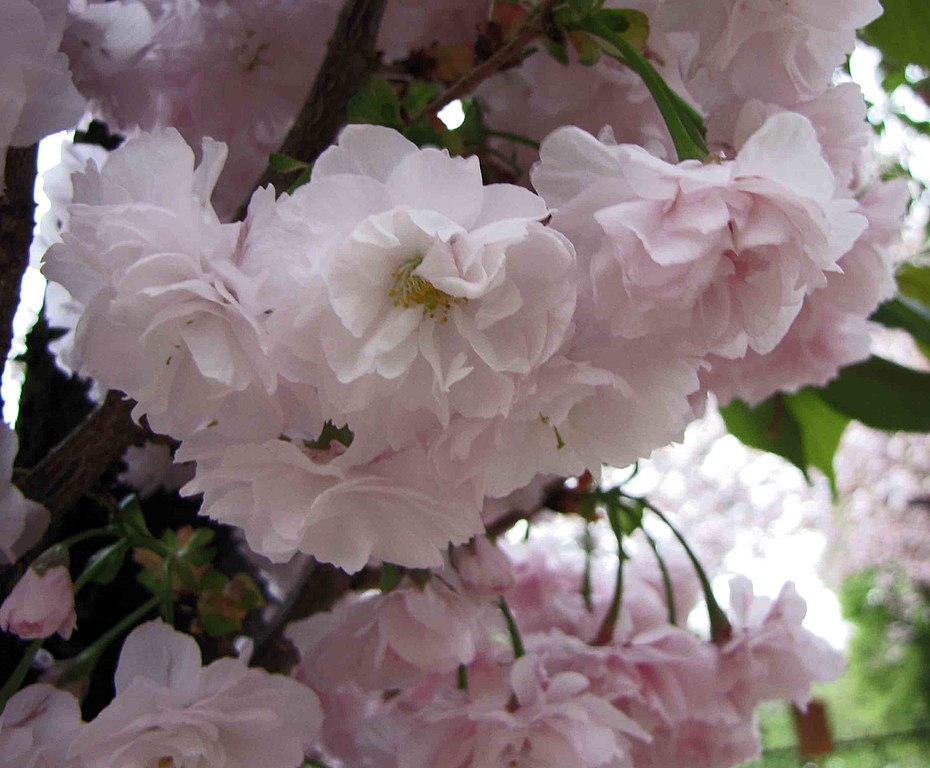
A popular variety that I only learned about recently is a hybrid variety called the kanzan (カンザン, sometimes archaically spelled Kwanzan). I didn’t find this one online at first, but was able to take a photo during a recent visit to the University of Washington.

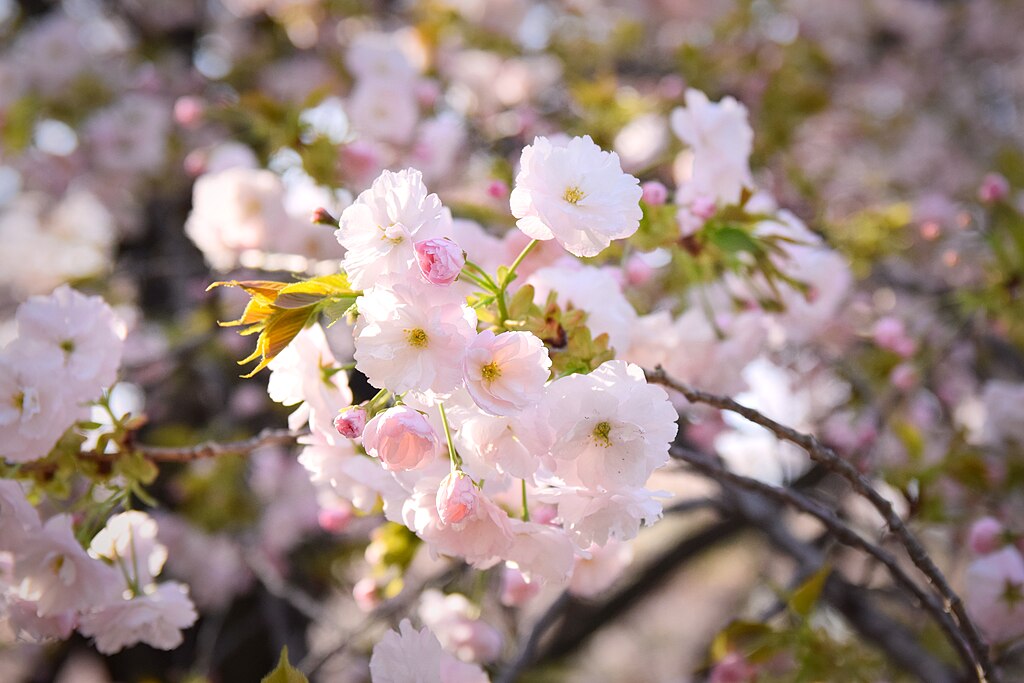
This variety was, similar to the Yoshino, a relatively recent variety, and a result of hybrid breeding with Ōshima cherry. What makes this one interesting is the both the rich pink color, and the multiple layers of blossoms (similar to the Kasumi cherry below).

Mountain Cherry

Another example of cherry blossoms, that’s lesser-known in the West are the wild cherry trees, or yama-zakura (ヤマザクラ) also known as the “Mountain Cherry”:

(Photo by 阿橋 HQ, CC BY-SA 2.0, via Wikimedia Commons)

If you compare the Yama-zakura to the classic Yoshino Cherry, you can see the color is a little more faded, kind of whitish in comparison. I think I have also read somewhere that the leaves and blossoms of a mountain cherry sprout at the same time, compared to a Yoshino Cherry where the blossoms comes first.

In antiquity, when the nobility of the capitol would go on a cherry blossom viewing, these are the trees they would most likely go to see. They are the subject of poem 66 as well.

Shidaré-zakura Cherry

Another iconic variety of cherry blossoms are the shidaré-zakura (シダレザクラ), or Hanging Cherry:

(Photo by Sakaori, CC BY-SA 3.0, via Wikimedia Commons)

You often see these grown in very scenic places, as well as on the grounds of Buddhist temples or Shinto shrines. The way the hanging branches sway in the wind is a sight to behold.

Kasumi-Zakura

One interesting variety that I was unaware of, until researching for this blog was the kasumi-zakura (カスミザクラ):

The word kasumi is a poetic term for haze or mist, especially a spring mist. You can see how the blossoms hang down somewhat, and are particularly large compared to other cherry blossoms varieties. They also seem to have a two-tone quality, where the edges are deeper color than the middle.

Fuyu-Zakura

Another example I wanted to share is an unusual variety that blooms in spring, and in winter, called the fuyu-zakura (フユザクラ):

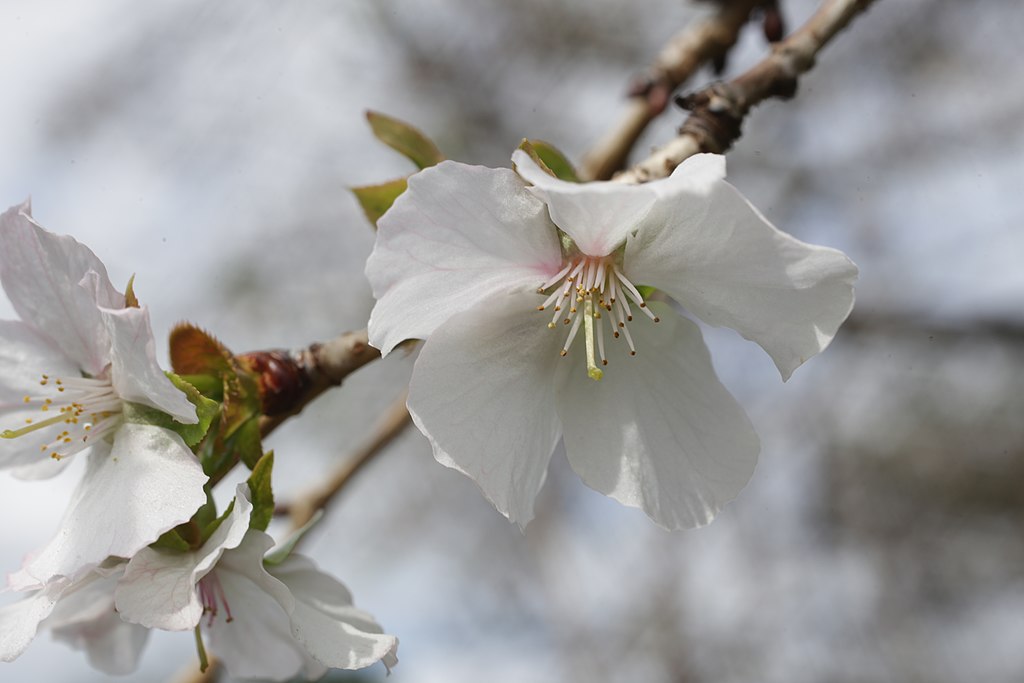
This cherry variety, also known as a gobazakura (コバザクラ) has white blossoms and blooms both in April, and also in December.

Kanhi-zakura

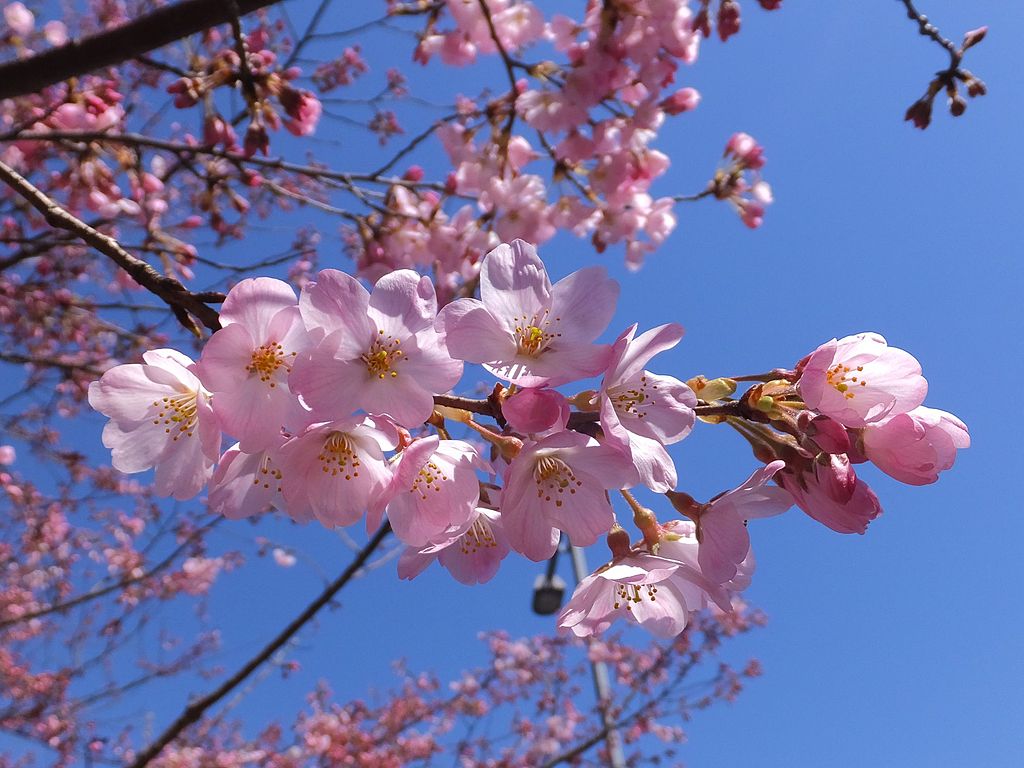
Taken by me at University of Washington in April 2025

While visiting the University of Washington in 2025, I found another variety I hadn’t noticed before. This variety is listed on UW maps as “Hisakura”, but in digging around in Japanese I found that a more common name is Kanhi-zakura (カンヒザクラ), also called Taiwan-zakura (タイワンザクラ) after the island of Taiwan. The name Hizakura (ヒザクラ) is also used. As the name implies (and according to Wikipedia), this variety is found all over East Asia, including Taiwan, and blooms somewhat early. Based on my visit to the UW I can confirm this as an amateur cherry blossom nerd.

Amanogawa Cherry

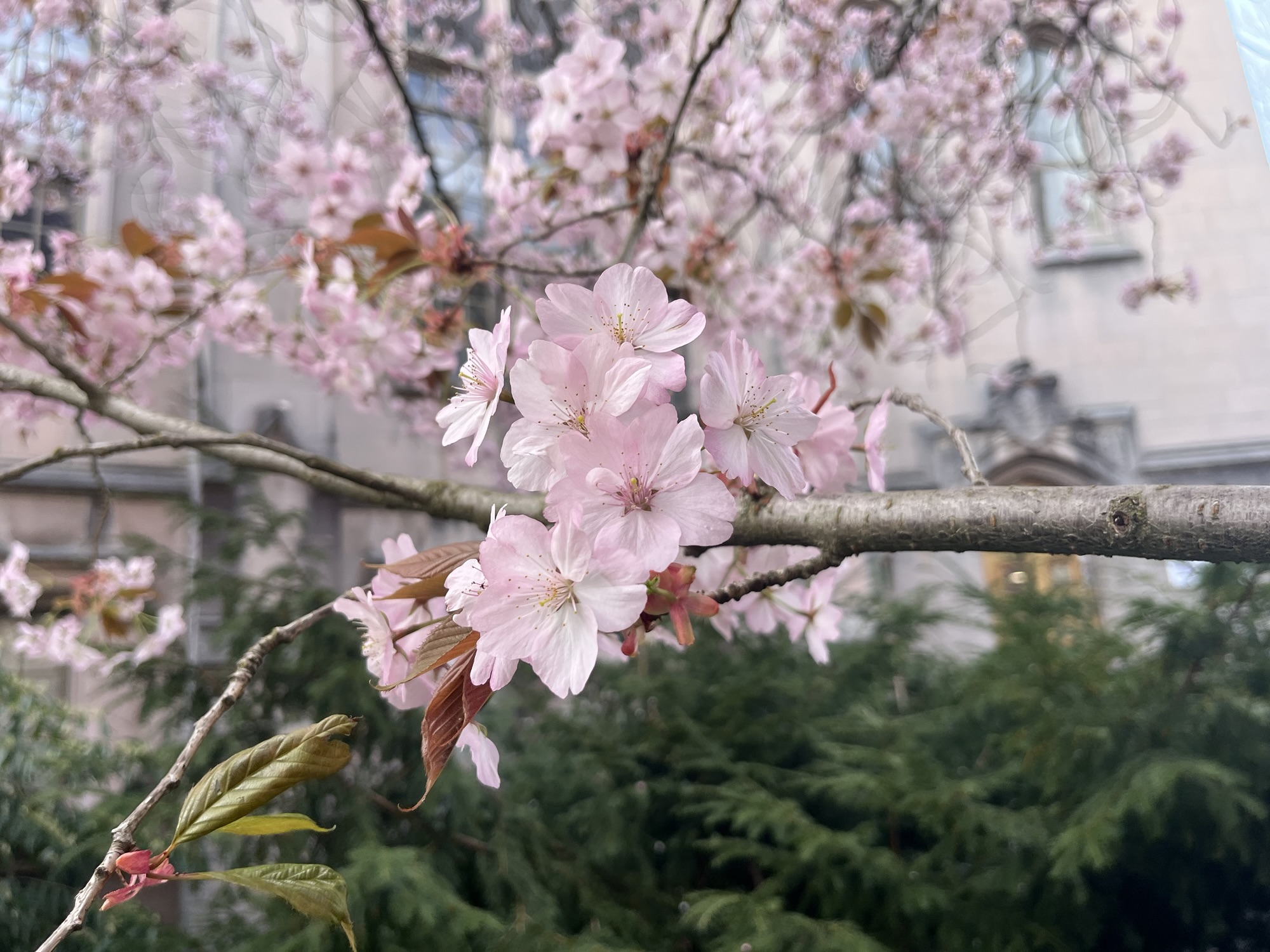
Taken by me in my neighborhood, April of 2025

Yet another variety I stumbled upon recently in 2025 is the Amanogawa (アマノガワ, “Milky Way”) variety. You can see an extra layer of petals in this one, similar to the Kanzan variety, but a lighter, softer color. I couldn’t find much detail about this variety but it appears to be a form of sato-zakura plants also known as the Ōshima cherry, similar to the Kansan variety.

Conclusion

There are many more varieties of cherry blossoms than listed here, but many are obscure or only known to botanists and experts. Also, it’s important to point out that Korea also has a venerable cherry blossom tradition, though I confess I don’t have much information.

In any case, when spring comes, see if you can identify the different cherry blossoms you see. You may be pleasant surprised.