The author, Mibu no Tadamine (壬生忠岑, dates unknown), is one of the Thirty-Six Immortals of Poetry and was the father of Tadami (poem 41). He was also one of the official compilers of the official anthology, the Kokinshū, along with Ōshikōchi no Mitsune (poem 29).
By all accounts, this appears to be another famous “morning after poem”, similar to the one seen in poem 50. The term, ariake (有明) is a poetic term for the last-rising moon, in the last-half of the lunar cycle, which you can still see in the morning.1 On the other hand, as Professor Mostow points out, the fact that the moon was heartless could also imply lover who spent all night waiting to see his lover but was never received and finally went home at dawn.
The poem’s author, Motoyoshi Shinnō (元良親王, 890 – 943), the Crown Prince Motoyoshi, was the eldest son of the mad Emperor Yozei (poem 13), who was forced to abdicate prematurely. This likely affected Motoyoshi’s chances of assuming the throne, and before long Emperor Koko (poem 15) was enthroned instead. As an Imperial prince with nothing to do, Motoyoshi turned all his energy to women. My new book points out that the poetry collection that Motoyoshi left behind is almost entirely about women and sex.
According to commentaries, this poem was real and not part of a themed poetry contest. Motoyoshi, apparently, was in love with one of the hand-maidens of the retired Emperor Uda. The maiden, daughter of the powerful Fujiwara no Tokihira, had already given birth to 3 sons for Emperor Uda and was highly favored by him, but Motoyoshi persisted in his love, even if it cost him his reputation. Bear in mind that this was the same Fujiwara no Tokihira who was instrumental in getting Uda’s favorite advisor, Sugawara no Michizane (poem 24), exiled.
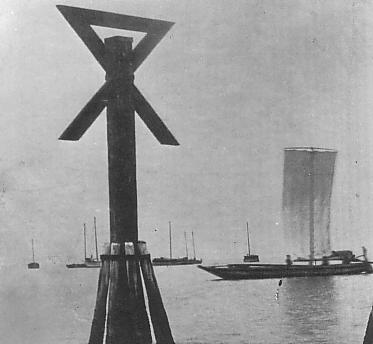
The main “pivot word” here is the phrase mi wo tsukushitemo, where miotsukushi (澪標) are famous water-markers in Japanese culture as pictured above, photograph taken during the Meiji era (Unknown author, Public domain, via Wikimedia Commons). But the poem can also be read as 身を尽くしても meaning “even if it exhausts my life”. So, rather than the subtle romantic allusions your normally see in poetry from this era, Motoyoshi is going all-out and making a big gamble.
This poem was composed by Fujiwara no Toshiyuki Ason (藤原敏行朝臣, ? – 901) who was one of the Thirty-Six Immortals of Poetry, and was an active participant of poetry contests in his day and noted for his excellent calligraphy. His calligraphy was so good, he was often compared with the talented Buddhist monk and founder of the Shingon sect, Kukai.1 Coupled with his long life-span, he has a great presence in poetry and calligraphy during his era. My new book mentions that both he and one Ariwara no Norihira were both infamous playboys, and ended up marrying sisters. Needless to say his wild episodes were recorded in certain tales at the time.
In fact, this poem is part of a poetry contest held in 953, presumably under the theme of forbidden or another similar topic. The poem uses a clever pun for yoru. The first yoru in the poem refers to the waves visiting (寄る in modern day Japanese) the shore of Sumi-no-e Bay (modern day Osaka Bay, specifically Sumiyoshi).
The second yoru means night (夜). The author’s submission to the poetry contents laments that public scrutiny in the small, tightly-knit aristocracy of the Heian Period was so intense that his lover couldn’t even visit him even in his dreams. Professor Mostow points out that the poem can also be interpreted that he could not visit his lover in his dreams, as well.
Because it was such a closed and stratified society, gossip was rampant, and an embarrassing situation could destroy one’s career and family reputation. Forbidden love was something many in the Heian Court faced, and no doubt Toshiyuki’s poem resonated with such people.
1 Kukai (a.k.a. “Kōbō Daishi” posthumously) was so famous for his calligraphy, a phrase exists even to this day in Japanese:
The author, Kawara no Sadaijin (河原左大臣, 822 – 895), “Riverbank Minister of the Left”. His personal name was Minamoto no Toru, renowned for his courtly elegance, and Professor Mostow thinks he may have served as a partial role-model for the famous hero of the Tale of Genji.
The poem is thought to be Toru’s defense to his wife or lover about his faithfulness, but he uses some interesting imagery to convey how upset he is that his faithfulness is questioned. Mostow points out that the poem is a subject of debate because it’s also been interpreted as an expression of secret love to someone else (i.e. “why did you make me feel this way”?).
The place referenced, Shinobu in Michinoku, is the old name for what is now the city of Fukushima in Fukushima Prefecture. Although it is now known for last year’s earthquake and nuclear disaster, the area was originally a frontier area during the time of the Nara and Heian periods, and as evinced in the poem above, famous for it’s patterned cloth called shinobu mojizuri.
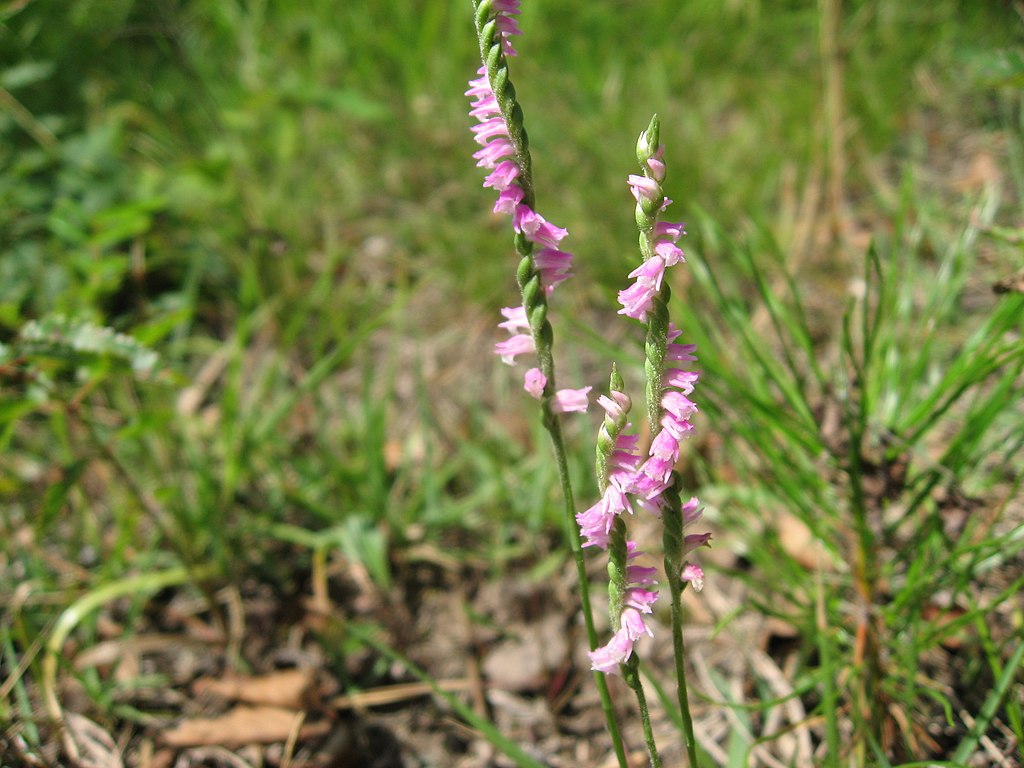
The term mojizuri refers to a type of plant, Spiranthes sinensis var. amoena pictured above (photo by Qwert1234, CC BY-SA 4.0, via Wikimedia Commons), a variety of orchid found in east Asia. It’s also called nejibana in modern Japanese. However, mojizuri also refers to a kind of dyed-cloth pattern made from the plant. The method involves pressing a cloth between the plant and a rock, forming dyed patterns like the ones shown here. This the context that Minamoto no Toru is using in the poem.
This poem was composed by one Fujiwara no Yoshitaka (藤原義孝, 954 – 974), the third son of Fujiwara Koremasa (poem 45). It was composed and sent after spending the night with his lover. These kind of “morning after” poems are very common at the time because lovers could not meet openly during the day, so they often met at night and slept together. The term for this kind of poem is kinuginu no uta (後朝の歌), and were often a way of sharing feelings after the two have parted company.
As Mostow also explains, it’s not clear why he valued his life so little, but the main interpretation is that he loved her so much, he was willing to throw his life away just to meet her. Other interpretations are, among other things, that he would have thrown away his life for her sake if he could.
What really makes this poem extra tragic though, is that Yoshitaka died at the age of twenty (he lived from 954 to 974), from smallpox. We don’t know what happened between him and his lover, but at least his words live on.
Anyhow, we’re at the halfway-point of this blog, and I wanted to thank everyone for your support. The biggest thanks go to Professor Mostow who graciously allowed me to use his translations for this blog (if you like to study the Hyakunin Isshu more in depth, I recommend his book).
This poem was composed by one Semimaru (蝉丸, dates unknown) who is reputedly a blind man who built a hut near Osaka Barrier and was famous for playing the biwa, but the authenticity of this story is questionable, and as Mostow points out, it’s not even certain he existed at all. The story about his life has also changed throughout the generations, so in some cases he’s the servant of the son of an Emperor, and in others he’s the son of an Emperor, abandoned by his blindness.
According to one account in my new book, a high-ranking official named Minamoto no Hiromasa (源博雅) once heard a rumor of a talented blind man with a biwa lute who lived near the Osaka Barrier (see below). He wanted to hear this man’s music, and sought him out for three years until he finally found him on the evening of 15th day of the 8th month (old lunar calendar), and from this man, Hiromasa learned to play the songs that he had been squirreling away. Songs titled such as 流泉 (ryūsen, “flowing spring”) and 啄木 (takuboku, “woodpecker”).
The place in question, Osaka Barrier, is a popular subject of poetry from this era. Poems 62 and 25 also mention the same place because it was a popular meeting spot for people coming and going from the capitol (modern-day Kyoto) eastward. Note that this Osaka has no relation to the modern city of Osaka, which was called Naniwa during that era. In fact the name of Osaka Barrier is also a pun. The Chinese characters are 逢坂, which means “meeting hill”, but is also the place-name.
Anyway, these kinds of check-points, or sekisho (関所) existed in Japan across major roads going in and out of the capitol, but were also popular meeting places for friends and lovers too, as well as having inns nearby for weary travelers. The featured photo above is an example of “sekisho” checkpoint, photo by 663highland, CC BY-SA 3.0, via Wikimedia Commons
The Osaka Barrier in particular was the first check-point leaving eastward from the capitol, so many people probably parted company here, or met old friends at this particular gate more than others. It’s fun to imagine what Osaka Barrier was like in those days. As Mostow points out, this poem probably was originally just a poem about Osaka Barrier, but by the medieval era, it took on an increasingly Buddhist tone in symbolizing the coming and going of all phenomena. Even modern Japanese books on the Hyakunin Isshu tend to reflect this sentiment. Pretty interesting metaphor I think.
One other interesting thing about this poem is its rhythm. If you read this one out loud, the rhythm is very easy to follow, and this is probably one of the easier poems to memorize if you’re looking for a place to start (poem 3 is another good choice in my opinion 😉).
Finally, one random note about Semimaru himself.
His artistic depiction in karuta cards, such as the yomifuda card above based on the famous Korin Karuta collection, leads to frequent confusion by people who play bozu mekuri: is he a monk or a nobleman? Even my new book mentions this conundrum among Japanese players. His lack of verified biographical information makes this question even more mysterious. The book jokes that the author’s house-rule is that if anyone pulls the Semimaru card, then everyone loses what their stack of cards. Feel free to make your own house-rule. 😊
This poem was composed by Gotokudaiji no Sadaijin (後徳大寺左大臣, 1139 – 1191), the “Later Tokudaiji Minister of the Left Sanesada”. His personal name was Fujiwara no Sanesada, and he was the first cousin of Fujiwara no Teika (poem 97), as well as the nephew of Shunzei (poem 83). He left behind an extensive poetry collection as well as his personal diary.
According to Professor Mostow, the poem was composed on the topic of staying up all night, to hear one cry.
The hototogisu (ホトトギス), is called the “lesser cuckoo” in English, or, is Cuculus poliocephalus. The featured photo was taken by Kunming Institute of Botany. Sun Jiao (Interaccoonale), CC BY 4.0, via Wikimedia Commons.
The hototogisu in Japan is a famous bird known for its early summer call, and is thus an emblematic bird of the season. Compare with the plover in poem 78.
You can see a video of its call below:
According to the Hyakunin Isshu Daijiten, the hototogisu is an elusive bird. It flies from branch to branch often, so by the time you hear its distinctive call, it probably has flown elsewhere. Hence, they are easy to hear, but hard for birdwatchers to observe.
In any case, as Professor Mostow explains, the author is waiting all night to hear the first call of the hototogisu as the first sign of summer.
One other note is the term 有明 (ariake), which is one of many poetic terms for the moon. Specifically it means the moon that remains in the morning, after daybreak. This normally occurs on the 16th day of the lunar cycle according to the old Japanese calendar.
The author, Akazome Emon (赤染衛門, 958? – 1041?), was another court lady in waiting for Empress Shoshi, along with Lady Murasaki (poem 57) and Lady Izumi (poem 56). Although her father is officially Akazome no Tokimochi, it is theorized that her father was actually Taira no Kanemori (poem 40) due to an affair by her mother.
Akazome Emon has an impressive 93 poems in the Shūishū Imperial anthology, and composed at least part of the Eiga Monogatari another classic from the era.
While Lady Murasaki had harsh words for some of her associates, according to Mostow, she describes Akazome Emon as having “great poise” and takes her poetry seriously, without composing verses just for the fun of it. Indeed, Lady Murasaki states she is “most accomplished”.
My new book also mentions that Akazome Emon was liked by the other ladies in waiting, and even by rival cliques including Sei Shonagon (poem 62) whom she corresponded with. It is even said she was happily married to her husband Oe no Masahira (大江匡衡), a rare thing in a world of political marriages.
The poem above itself is a bit of a mystery though. The headnote to the poem is explained as Akazome Emon writing a poem on behalf of her sister who waited all night for her lover, Middle Regent Michitaka, but was stood up. Michitaka was an extremely powerful and charming man in his day and likely had multiple lovers even as he maintained his legitimate marriage to Takashina no Takako (aka Gidōsanshi no Haha, poem 54). Akazome writing this poetic complaint on behalf of her jilted sister was an increasingly common practice at the time.
As explained before, women lived sheltered lives in his era, and men rarely could see them except by secret arranged meetings, and yet sometimes a women might wait all night without her lover ever coming. This is a frequent topic in the Hyakunin Isshu anthology as well, both real and fictional.
However what makes this poem standout is that Akazome Emon complained to Michitaka in a sweet, unaccusing way, when she obviously meant the opposite. “Oh, it’s no big deal I stayed up all night waiting for you, I saw the full moon tonight. No big deal.”
There is some research that suggests that maybe Akazome didn’t author the poem, though it’s unclear who did. Nevertheless, whoever was stood up that night, I hope Michitaka apologised the next day. 😏
Izumi Shikibu (和泉式部, 978 – ?), known in the West as “Lady Izumi” was a very talented and passionate poet, but she also faced much tragedy and heartache as well. Apart from her skills with poetry, she was very famous for her public affairs with various men of the Court. Due to her unhappy marriage with Tachibana no Michisada, she left him and met Prince Tametaka, third son of Emperor Reizei. The ensuing affair was such a scandal that her husband divorced her for good and her father disowned her. Further, her daughter, Koshikibu no Naishi (poem 60) was in the custody of her ex-husband, and they remained separated for many years.
Sadly, Tametaka died soon after due to a plague, and Lady Izumi was devastated. She was later the subject of interest by Tametaka’s half-brother, Prince Atsumichi who was already married and slightly younger than her. Their affair was soon discovered, and Atsumichi’s wife was furious and left him. Undaunted, Izumi and Atsumichi moved in together and had a public relationship until Atsumichi died at the age of 27. This relationship is explained in 3rd person by Lady Izumi in her eponymous diary, izumi shikibu nikki (和泉式部日記, “Diary of Lady Izumi”).
At this time, Lady Izumi joined the inner circle of Empress Shoshi, and worked alongside other great women of her time including Lady Murasaki (poem 57) author of the Tales of Genji and Akazome Emon (poem 59). However, as Lady Murasaki’s writings show, the two definitely did not get along:
Izumi Shikibu is an amusing letter-writer; but there is something not very satisfactory about her. She has a gift for dashing off informal compositions in a careless running-hand; but in poetry she needs either an interesting subject or some classic model to imitate. Indeed it does not seem to me that in herself she is really a poet at all. — trans. Waley, “Diary of Lady Murasaki“
I wrote a much more detailed biography of Lazy Izumi on my other blog, but suffice to say Lady Izumi’s passion was her greatest strength and her greatest detriment. For all this and more, she’s been admired and remembered throughout the ages, and can be seen in young women’s comics in Japan eventoday:
Lady Izumi as depicted in a young women’s manga of love stories from the past.
Nevertheless, she eventually settled down and reuinted with her daughter, Koshikibu no Naishi, who shared her tremendous talent for verses (poem 60), though Lady Izumi likely outlived her. Once again, Lady Izumi could not escape death around her.
This poem reflects the end of her life and her desire to see someone one last time. According to Professor Mostow, commentators disagree as to whether she wrote this to a dear friend she wanted to see once more, her husband, or a lover. My new book strongly implies that due to the language used, it’s a plea a lover that she misses for one last intimate moment together. The word au/ou (逢う) ostensibly means “to meet”, but not in the generic sense as modern Japanese au (会う). As we also see in poem 25, the term 逢う meant to spend the night together romantically.
Nevertheless, to me the poem is also a sobering reminder that all good things must come to and end.
The author, Ukon (右近, dates unknown), takes her sobriquet after her father’s position in the Court as Lesser Captain of the Right Bodyguards, or ukon-e no shōshō (右近衛少将). She served as a lady in waiting to Empress Onshi. Apparently she was a busy woman. Like her father, she is said to have had a number of romantic liaisons, including Atsutada (poem 43), Asatada (poem 44), and Prince Motoyoshi (poem 20) among others. Her tryst with Atsutada is mentioned in a later text called the Tales of Yamato. Ukon also actively participated in poetry contests.
Professor Mostow explains that there are historically two interpretations to this poem. One interpretation is that she wrote the letter to her cold lover, conveying a mean, sarcastic tone. My new book favors this theory, and implies that the lover who spurned her was none other than Fujiwara no Atsutada mentioned above.
The other explanation is more of a private letter to herself. This second meaning then sounds less harsh in tone, and more tragic.






 The Hyakunin Isshu


