Thepoem from the Manyoshu feels like an ancient Japanese dad-joke. Read it out loud and you’ll see what I mean:
Manyogana
Modern Japanese
Romanization
Rough Translation
淑人乃
よき人の
Yoki hito no
Men of old
良跡吉見而
よしとよく見て
Yoshito yoku mite
came to Yoshino
好常言師
よしと言ひし
Yoshito ii shi
and declared it a good place,
芳野吉見与
吉野よく見よ
Yoshino yoku miyo
So, good sons, go
良人四来三
よき人よく見
Yoki hito yoku mi
and take in the view!
The author of the poem is Emperor Tenmu whom we saw here and here. He is the younger brother of Emperor Tenji of Hyakunin Isshu fame (poem 1, あきの), and husband/uncle to Empress Jito (poem 2, はるす).
Yo, yo, yo, this poem has lots of “yo” words.
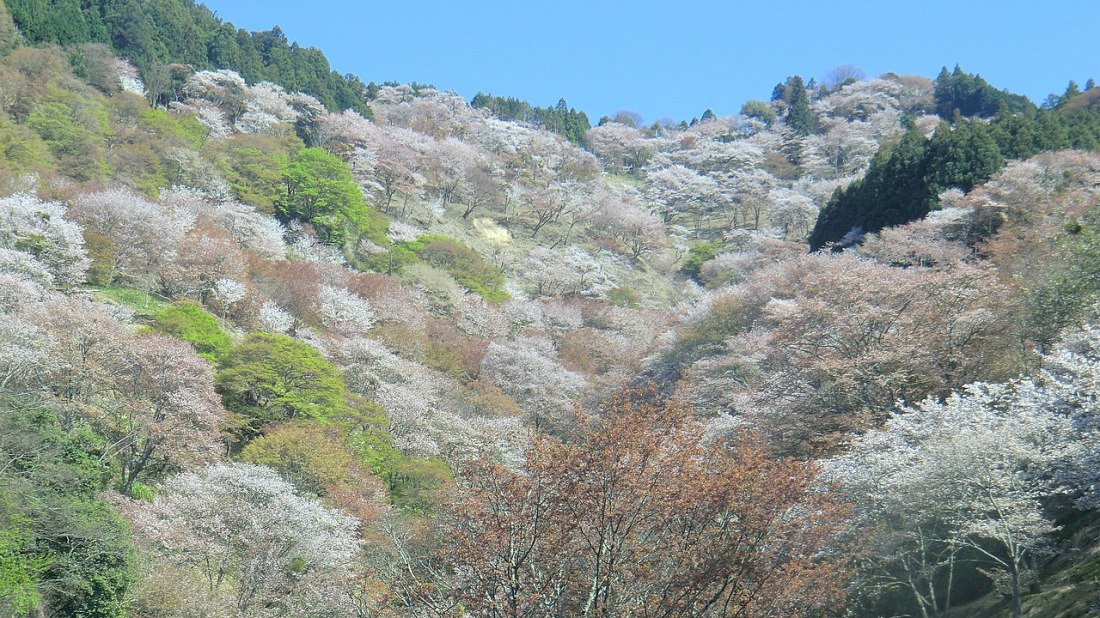
The poem was, evidentially, a suggestion by Emperor Tenmu to his sons to visit the beautiful village of Yoshino, near the old capital of Nara, famed for its otherworldly beauty in Spring. The featured image shows Yoshino and its famous cherry trees.
It was also an attempt to foster good relations between Tenmu and his sons through a combination of humor and providing some fatherly advice. Given how complicated family relations were at the time (see links above), and since Tenmu had defeated his own nephew in combat to assume the throne, he had reason to worry.
Sadly, it didn’t work.
After Tenmu’s passing, one son, Prince Ōtsu (ōtsu no miko, 大津皇子), started a rebellion and was later given the death penalty at the age of 24. Wikipedia implies that the rebellion may be a false charge though brought by Empress Jito so that her own son could ascend the throne. My book on the Manyoshu delves into this at length and comes to the same conclusion.
Still, you can’t blame Emperor Tenmu for trying to heal family divisions, yo.
The fashion of the nobility of the Heian Period of Japanese history is fairly different than later, more familiar styles we often see in Japanese media like anime, manga, etc., because it reflects early Chinese influence, but also increasingly local innovations and culture. Further, as we’ll see, because the aristocracy was socially rigid and had many complex customs and rules, this affected how people dressed as well. Everyone knew their place, and their fashion reflected this too. I have touched on the subject a little bit here and here, but I always wanted to explore in depth. The issue was (until recently) a lack of resources and time. But, here we go.
Some great online resources for fashion during the Heian Period of Japanese history (c. 8th century to 12th century) can be found on this website (Google translated version here), and this site. The second link has some English in it, so even if you can’t read Japanese, it’s a great place to visit and look around.
However, for us Hyakunin Isshu poetry (and karuta) fans, you can see many great examples in the yomifuda cards too.
Women’s Fashion
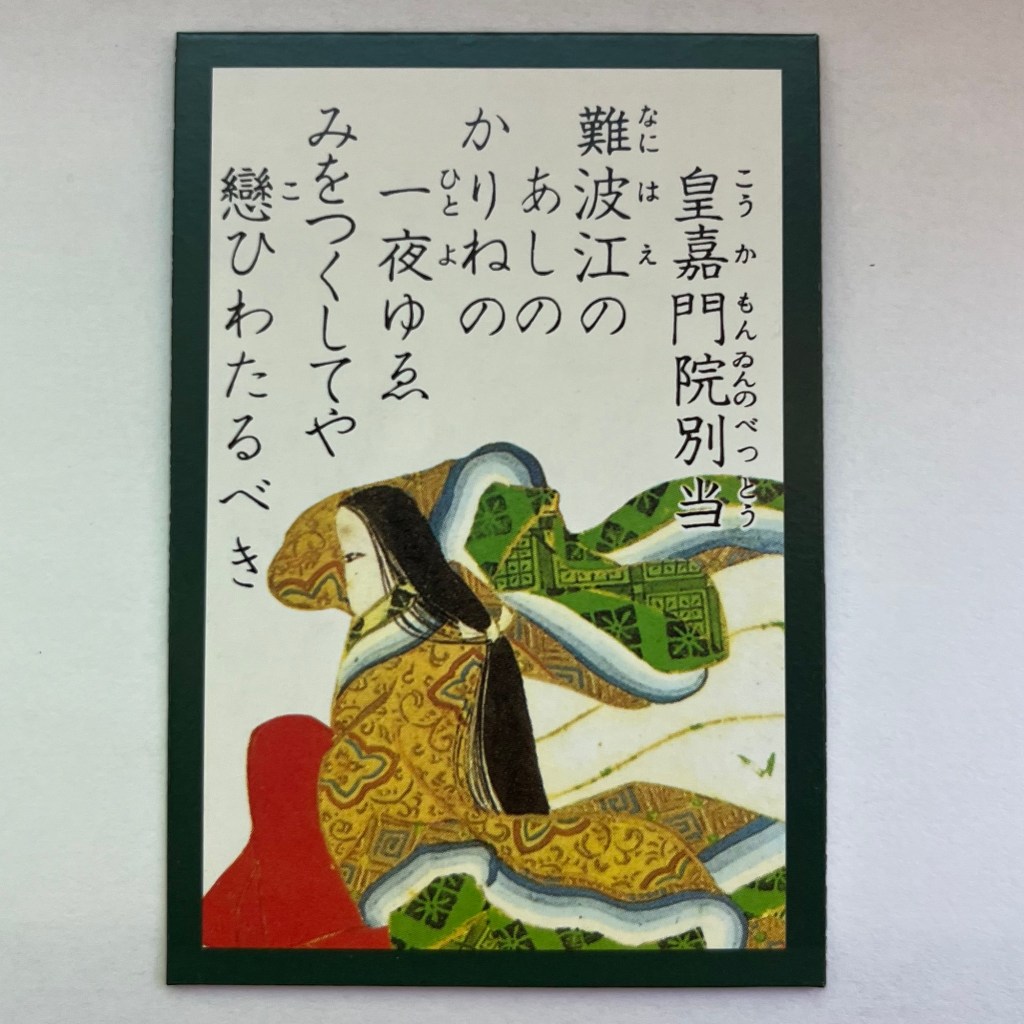
This card, depicts Daini no Sanmi (poem 58, ありま) of the Hyakunin Isshu. The illustration, part of the Ogata Korin collection, shows her in full formal dress.
Like many women of the Heian Period, during formal occasions, she would wear multiple layers of kimono robes called junihito-é (十二単) which literally translates to “twelve robes”. The women of the court did not actually wear 12 layers, but it was much heavier and bulkier than kimono fashion of later centuries.
Here’s another example: Suō no Naishi (poem 67, はるの):
The robes (hitoé, 単) were very long and thus hard to walk in.
Over the layers of robes, the women would wear a “Chinese jacket” (karaginu, 唐衣).
The white train in the back was called a mo (裳), which tied around the waist.
The women wore hakama (袴) trousers much like Japanese traditional clothing today.
You can see a really good example of this kind of fashion here. Definitely check out the link.
Men’s Fashion
Men’s formal wear, if you can believe it, was actually more complicated than women’s. Broadly speaking, it could be divided into three categories: civil bureaucrats, warriors (e.g. palace guards), and upper class nobility including the Emperor.
Imperial Advisors
Because the Imperial court of Japan was modeled after the Chinese-Confucian bureaucracy from antiquity, there are some similarities in the fashion of the civil servants (bunkan, 文官): black robes, similar hats, etc. We can see some examples here: Middle Counselor Yakamochi (poem 6, かさ):
One thing to note is that even samurai warlords who ruled the country in later periods (see Sanetomo), when they came to the capital (jōraku 上洛) were expected to wear this kind of court dress befitting whatever rank they had been bestowed. Although the samurai class held true power, they were still technically part of the Imperial court so customs persisted.
Guards
For the palace guards and other military figures, the formal dress was similar to the bureaucrats above, but with some notable differences. A good example from the Hyakunin Isshu is Fujiwara no Michinobu (poem 52, あけ):
Noting the differences here:
Guards and military figures were equipped with a sword (ken, 剣), bow (yumi, 弓), and a quiver of arrows (ya, 矢).
The crown on their head was shaped in a loop, not a long trailing one. It was called a ken-ei-kan (巻纓冠) instead.
The crown also had two fan-like protrusions called oikake (緌).
Instead of black-lacquer clogs, the shoes were often pointed-toe boots called kanokutsu (靴).
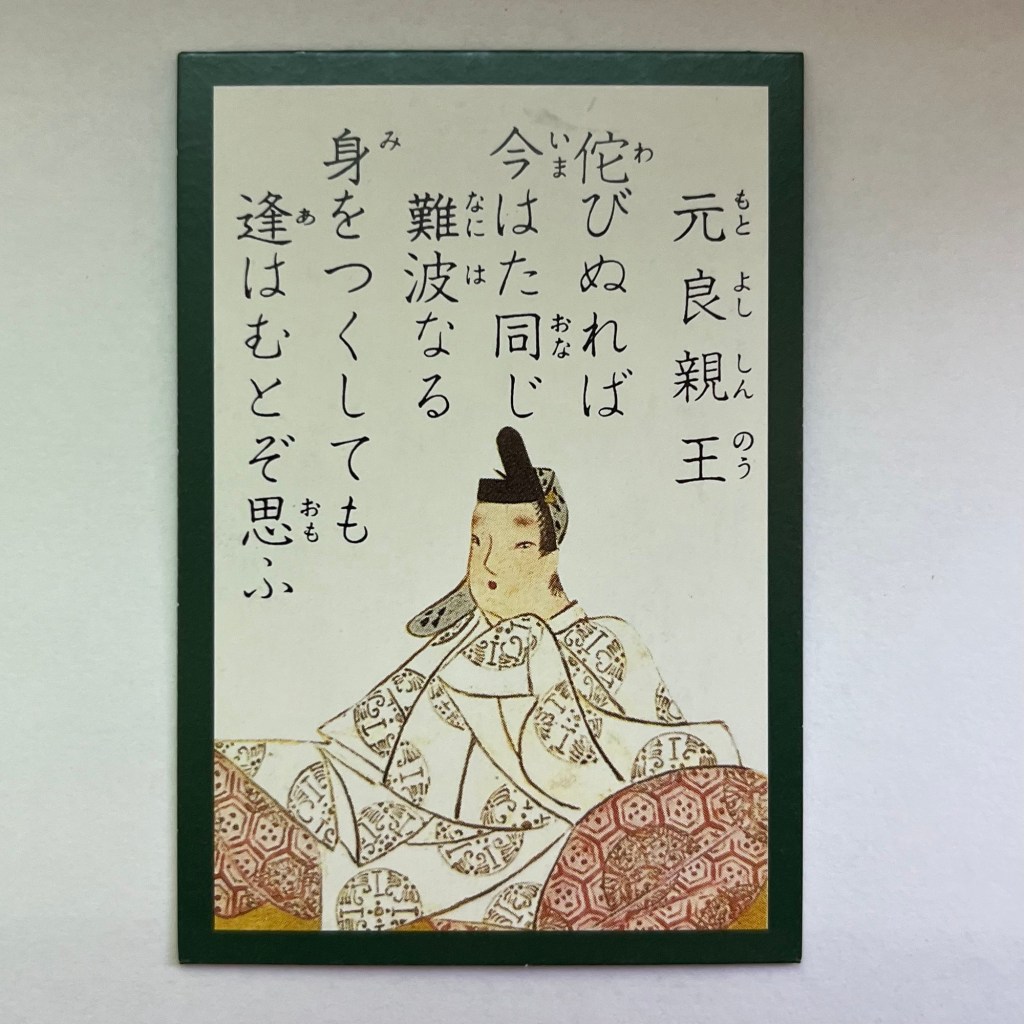
The upper nobility wore clothing that was pretty similar to other members court, but with one major exception: the colors of their robes. Here you can see Prince Motoyoshi (poem 20, わび):
As eluded to in Lady Murasaki’s diary and other sources, there was a strict hierarchy within the Court nobility, which was reinforced by which colors of robes people were permitted to wear. This included colors such as green (shown here), orange (shown here) or white (shown here). The green linked above was, for example, permitted to courtiers of the sixth rank, or palace servants of the fourth rank. Wikipedia has list of forbidden colors, and what ranks were associated with each. The point is is that just by looking at someone’s robes, members of the aristocracy knew each other’s place.
The very upper class nobility, namely those of the Emperor and his family, are often depicted in white robes with red trimming, which is similar to those used by Shinto priests (shown here). It’s probable this was intended to reinforce the Imperial family’s divine lineage, but that’s just a guess on my part.
The fashion used in the yomifuda Karuta cards really tells us a lot about the culture that the poets of the Hyakunin Isshu lived in.
Waka poetry, including the Hyakunin Isshu has a lot of conventions and symbols used to express certain seasons or sentiments. This is not so unusual. For example, if someone in the US writes a poem about the smell of cinnamon, it definitely brings to mind late autumn or winter.
One common example in the Hyakunin Isshu of poetic symbolism are birds. Birds have distinctive calls, and different species tend to be prominent at different times of year, among other things. For this post, I included a lot of poetry from the Imperial anthology, the Kokin Wakashu, which is much larger than the 100 poems of the Hyakunin Isshu, and thus easier to find examples.
Spring
The most prominent bird in Spring is the uguisu, the Japanese Bush Warbler, also called the Japanese Mountain Thrush:
The uguisu’s distinctive bird call is very emblematic of the season.
The bird call of the uguisu sounds like ho-ho-ke-kyo, which to Japanese people sounds similar to a famous Buddhist text called the Lotus Sutra (hokekyo in Japanese). I’ve written much about the Lotus Sutra in my other blog, so I do not need to repeat here. Needless to say, when Spring comes, people in Japan inevitably hear this lovely sound, even in urban areas.
Oddly, there are no poems in the Hyakunin Isshu about the uguisu, however, I found many poems in the official anthology, the Kokin Wakashu. Here are a few of my favorites thus far. This first one is poem 4 by Fujiwara no Takako (藤原高子; 842–910) later Nijo-kisaki (二条后, “Nijō Consort”):
Apparently, the bird was highly praised during the aristocratic court culture of the Heian Period, and Sei Shonagon (poem 62) mentions an expedition in her Pillow Book:
[94] …it had been overcast and tending to rain since the first day of the [fifth] month. Some of us were sitting about at a loose end, when I came up with the suggestion that it would be fun to go off on an expedition to hear the hototogisu….
[ later ] … and as for the hototogisu, they were indeed calling back and forth, so loudly in fact that they made almost too much of a din for comfort.
Translation by Dr Meredith McKinney
The anecdote is quite long, but Sei Shonagon and the other ladies-in-waiting do encounter the hototogisu, and meant to write poetry about them, but then through a series of interactions forgot the poetry entirely and came back to the Empress empty handed, followed by various witty comments back and forth.
Autumn
Unlike the Spring, where the call of the bird is highly praised in poetry, in the Autumn, theHyakunin Isshu Daijiten lists a few birds that were revered in poetry. For example, migratory birds, such as the Wild Goose (kari):
I had some trouble finding poems for the fall birds listed in either the Hyakunin Isshu or the Kokin Wakashuanthology, but there seems to be a lot in the later Shin-Kokin Wakashu anthology. I don’t have a reliable translation of the Shin-Kokin Wakashu, so I may update later.
I did find this poem under the section “Miscellany 2” in the Kokin Wakashu, poem 497 by an anonymous poet:
The birds associated with winter, were birds whose cries were melancholy and said. First and foremost is the plover, which we saw in poem 78 (あわじ) of the Hyakunin Isshu:
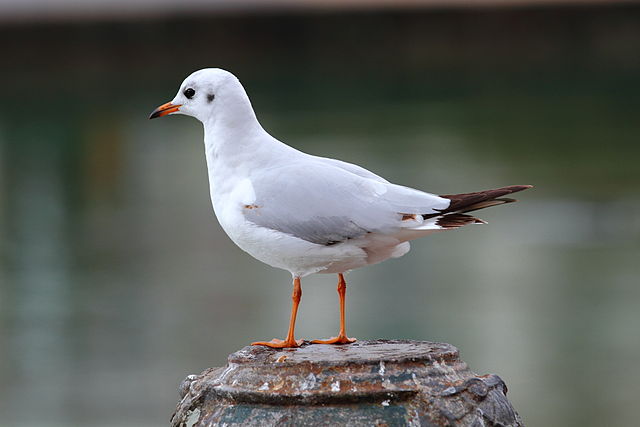
Or the Black-headed Gull (miyako-dori, meaning “bird of the capital”):
The miyakodori in particular stood out due to its unusual name. The Hyakunin Isshu Daijiten lists a poem from the official Kokin Wakashu anthology of note, poem 411 under the section “Travel Poems”:
The headline for this poem explaining the backstory is unusually long, but basically the poet, Ariwara no Narihira (who also wrote poem 17, ちはやふる, in the Hyakunin Isshu) was away in eastern Japan with some companions, and longing for home in the capital, they saw a miyako-dori bird (lit. “capital bird”) and recited this poem.
The Mallard in particular had dual-association with romance and with the melancholy of winter. This poem in the Kokin Wakashu, number 533, by an anonymous author illustrates this:
Certain birds were also used in Japanese poetry for symbolic purposes, but not necessarily for seasonal expression.
We’ve talked about birds associated with seasons thus far, but there’s a couple worth calling out that are an important part of Japanese poetry, but not related to seasons. The first is the Copper Pheasant, called yamadori, which we saw in poem 3 of the Hyakunin Isshu (あしびきの).
In antiquity, it was thought that Copper Pheasants mated for life (true), but slept in separate nests at night. Thus, the poet Kakinomoto no Hitomaro likened himself to a Copper Pheasant sleeping alone at night part from his lover.
And finally we come to the magpie. In poem 6 of the Hyakunin Isshu (かさ), the poet Chūnagon Yakamochi describes frost growing under moonlight on the so-called Magpie Bridge of the Imperial Palace. The magpie (kasasagi) was associated with a Chinese myth that evolved into the Qīxī Festival (七夕), celebrated as Tanabata in Japan.
In this tale, two star-crossed lovers, a celestial princess and a cowherd, were forcibly separated in the heavens by her father the Jade Emperor, but allowed to reunite one night a year. It was said they would reunite by crossing a bridge made of magpie birds who put their outstretched wings together. Thus, the magpie was always associated with this famous tale.
You may have noticed the blog looks a bit different now. I have been struggling since the big blog refresh I started in December 2022 to get the appearance just right. Design isn’t my forte (I am a history nerd), so I’ve struggled with finding the right design for this blog. The original blog template on WordPress was so old (this blog was started in 2011) that it was no longer supported by WordPress, so I had to find something else that works. After dabbling with a few designs this past year, I’ve settled on current blog template as of last week and I am pretty happy with it. I hope you all like the new design. I liked it so much I applied the same template to the other blog.
Next news: I will be off to Japan again this summer … though only briefly. The family and I will visit the ancient capitol of Kyoto, just like last year,1 but the visit overall is much more limited and I probably won’t get to see many things related to this blog. I won’t have time to visit Oishi Tengudo again, or Kitano Tenmangu Shrine, but I do however plan to make a stop at Kurumazaki Shrine (mentioned here) to pick up one of those Sei Shonagon (poem 62, yo wo komete) charms. I may try to work in a few other tourist spots related to the Lady Murasaki drama given that it’s popular right now. I also expect to melt under 35C(95F)-degree weather with 75% humidity again like last year.2
I have a few more posts coming up between now and the trip (late July), and I hope you will find them interesting.
Finally, just as a fun bonus, I wanted to share a one-off poem by Lady Izumi (poem 56, arazan) that I recently heard on a different Japanese historical drama. Lady Izumi is one of my personal favorite figures in the Hyakunin Isshu, and this poem was first recorded in an Imperial anthology, the Goshūi Wakashū (後拾遺和歌集), poem 755:
It’s not clear from this poem which lover she is referring to, since she had a number of relationships over the years, nonetheless it is a very sincere, romantic poem and expresses her passionate style nicely.
Happy Summer!
P.S. speaking of history nerd, I’ve debated about making a Japan / history podcast (like many other fine podcasts I follow), but have struggled to find a good theme. I might simply do the “history of the hyakunin isshu” podcast someday. It’s a bit commitment though, so we shall see.
1 While we do visit Japan yearly so my kids can spend the summer with their grandparents and extended family, visits to Kyoto are rare because of cost, time, and so on. Our last visit was almost 15 years ago. It just so happens that we could make two trips in two years. After that, who knows when we will visit next?
2 Without going into too many details, the humidity, heat and fluid loss aggravated an old medical issue I have. A reminder to stay hydrated, and avoid junk food. I like getting older in many ways, except at times like this. 😋
Since I spent so much time gushing over First Summer Uika and her portrayal of Sei Shonagon in the Japanese drama Hikaru Kimi É (“Addressed To You, My Radiant One”), this seemed like a good time to talk about the Pillow Book, or Makura no Sōshi (枕草子).
Despite the name “Pillow Book”, the book has no erotic content. Instead, it is a collection of witty musings about life in the Heian Period aristocracy, early 11th century. The image is of a person lying on their pillow, composing thoughts in a diary.
The author, Sei Shonagan (poem 62), was one of the pre-eminent writers of her generation, in a field of many excellenttalentedwomen.
I had read the book many years ago, and I felt it was a bit dry at times since it has no narrative. But back then, I also had a much more limited understanding of Heian Period culture, and many of the things mentioned in the Pillow Book are also alluded to in the Hyakunin Isshu, as well as the Diary of Lady Murasaki. So, even if the format is different, all three collections draw from the same “cultural well”.
I thought I had lost my copy of the Pillow Book (the Penguin Classics version, translated by Dr Meredith McKinney) a long time ago, but was amazed to discover that it was just buried behind other books. So, I dusted off the book and have been reading through it again.
Sei Shonagon is a keen observer of life in the Heian Period, and makes lists for all kinds of obscure things:
[23] Occasions that induce half-heartedness — The religious services on days of Buddhist fasting. Preparations for something still far in the future. Long periods of seclusion at a temple.
Or she adds things to lists that were probably drawn from personal experience:
[132] Occasions when time drags by — An abstinence that you must observe away from home. A game of sugoroku when you can’t manage to get your pieces off the board. The house of someone who’s failed to get a promotion in the Appointments List. And of course the worst of all is simply a day of heavy rain.
It’s also clear that Sei Shonagon had a pretty haughty attitude, especially when compared to Lady Murasaki’s (poem 57) withdrawn, melancholy tone or Lady Izumi’s (poem 56) whimsical passion. As they say in modern Japanese: seikaku ga deru (性格が出る, “people’s personalities come out”). In one anecdote, section 94, she grumbles about encountering “worthless peasants”. I wouldn’t be surprised if she was the only one among the nobility at the time who held such views, but it is nonetheless painful to read.
One thing I do particularly enjoy about the Pillow Book though are the anecdotes. While many of the entries are just lists and her opinions, she often reminisces about funny, sad or strange occurrences she witnessed during her 10-year tenure serving the ill-fated Empress Teishi. Some of these anecdotes and observations are quite long, while others are brief. Some happened long ago, and Sei Shonagon’s memory is a bit fuzzy, others are more recent.
For example in one anecdote, number 79, she talks about how her relationship with one Officer of the Left Gate Watch named Norimitsu had soured after an incident where he covered for her. She had gone somewhere and only Norimitsu knew her whereabouts, but the Captain Consultant demanded to know where she had gone and Norimitsu tried to keep his mouth shut. Later when Norimitsu complained, she sent a piece of dried seaweed in reply, and Norimitsu got annoyed. She criticized his lack of sense, and he was frustrated at her for putting him in such a difficult position. Later she muses that they grew more and more distant after that incident until “later, Norimitsu was promoted to Deputy Governor of Tōtōmi Province, and the relationship ended in hostility.”
Sei Shonagon discusses many people of the Court, including other ladies in waiting, but does not mention Lady Murasaki and other famous women of the Hyakunin Isshu. Such women served under the second empress, Shoshi, and thus came a bit later anyway. By the time Emperor Ichijo married a second time, Teishi’s status had greatly declined and her retinue (including Sei Shonagon) were on their way out the door. Teishi herself soon died in childbirth.
The Pillow Book is a really nice “slice of life” look at the court culture of the time: sometimes amusing, sometimes exquisite, and sometimes depressing. Her wit really shows through the ages and even today kids in Japan (and people outside Japan) still read her book.
P.S. Featured photo is a drawing of Sei Shonagon from a 13th-century illustrated copy of the Pillow Book. Courtesy of Wikimedia Commons.
The author of this poem is Ju-ni-i Ietaka (従二位家隆, 1158 – 1237), or “Ietaka of Junior Second Rank”. His personal name was Fujiwara no Ietaka, and that he was the son-in-law of Jakuren (poem 87), and studied poetry under Fujiwara no Shunzei (poem 83). In fact he was so talented that he became the tutor for a young Emperor Gotoba (poem 99). After the Emperor’s exile following the Jokyu War, Ietaka and Gotoba still corresponded and shared poems.
My new book suggests that this might be why Teika (poem 97), compiler of the Hyakunin Isshu, put them next to one another (poems 98 and 99) numerically.
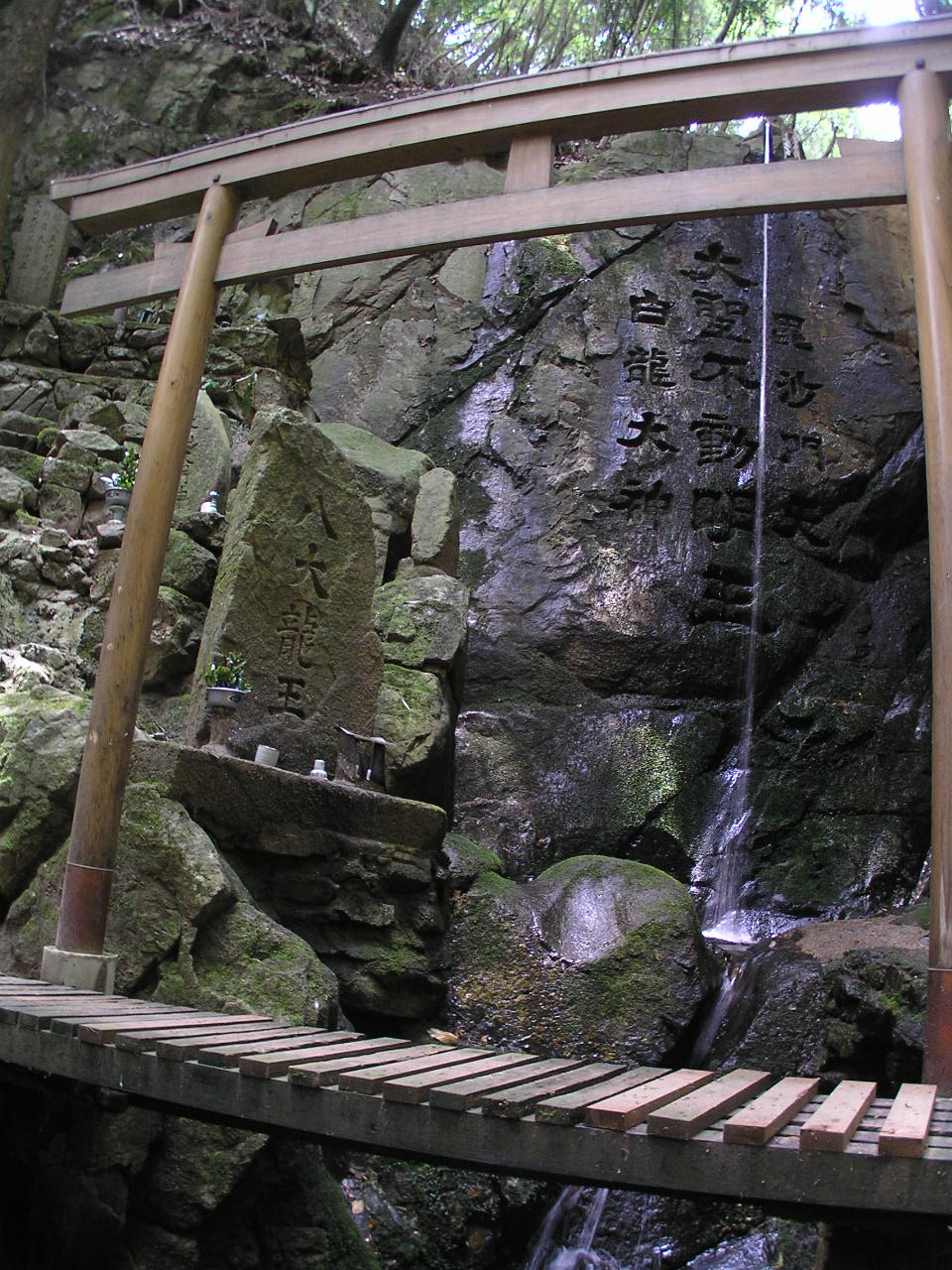
The notion of ablution or misogi (禊ぎ) is a Shinto ritual involving purification through cold water, prayer, etc. The practice is still alive and well today, and is often done in the summer months, but it varies depending on the particular Shinto shrine. In Shinto, people accumulate impurities through bad actions or traumatic events, and have to expunge them through ritual to balance their lives. As Professor Mostow explains, it was also popular in the author’s time as a well of making up for carrying on illicit affairs too. 😉
According to the Hyakunin Isshu Daijiten, the second verse of the poem is a good example of a kakekotoba ( 掛詞) wordplay, in that it has two meanings. First, nara can mean an oak tree (楢), especially Quercus serrata trees. The second meaning, nara no ogawa, refers to the font at the upper Kamo Shrine also called the Kamigamo Shrine (kamigamo-jinja, 上賀茂神社). The homepage can be found here.
The nara-no-ogawa next to the Kamigamo Shrine. Photo courtesy of 663highland, CC BY-SA 3.0, via Wikimedia Commons
Another concept in late summer is the notion of zansho (残暑) which is the long, hot, humid summer that comes after the monsoon season in June-July. Speaking from first-hand experience, it’s stifling hot, but here the poem implies that the summer is nearly over, and only the ablutions remain.
P.S. Featured photo is of Iyagatani (伊屋ヶ谷) waterfall, of Ryujuin (龍樹院) Temple. Photo by 松岡明芳, CC BY-SA 3.0, via Wikimedia Commons
The author of the poem, Kiyohara no Fukayabu (清原深養父, dates unknown), was a relatively well-known poet in his time, but it also turns out that he is the grandfather of Motosuke (poem 42) and great-grandfather of the famous author, Sei Shonagon (poem 62), so it seems poetry and literature run in the family. 😁
Anyhow, as Mostow explains, this poem was highly regarded at the time, but for readers in the 21st century, it has so many hidden cultural allusions, that it’s hard to see the significance at first.
As he summarizes, summer nights are short, and Fukayabu is saying that he is surprised that the moon is already dawning in the western sky. Since it’s cloudy, he asks where the moon might be lodging since it’s hard to imagine that it is already setting. It’s a clever, light-hearted poem exploring brief summer, moonlit nights in other words.
Interestingly, Mostow points out that despite the praise on this poem from antiquity, Fukayabu was not included among the Thirty Six Immortals of Poetry and his reputation suffered a major blow that didn’t recover until it was included in later anthologies.
It’s pretty amazing to think how a poem can really make or break a person in that era. We saw this in reverse for poem 92.
This poem was composed by Gotokudaiji no Sadaijin (後徳大寺左大臣, 1139 – 1191), the “Later Tokudaiji Minister of the Left Sanesada”. His personal name was Fujiwara no Sanesada, and he was the first cousin of Fujiwara no Teika (poem 97), as well as the nephew of Shunzei (poem 83). He left behind an extensive poetry collection as well as his personal diary.
According to Professor Mostow, the poem was composed on the topic of staying up all night, to hear one cry.
The hototogisu (ホトトギス), is called the “lesser cuckoo” in English, or, is Cuculus poliocephalus. The featured photo was taken by Kunming Institute of Botany. Sun Jiao (Interaccoonale), CC BY 4.0, via Wikimedia Commons.
The hototogisu in Japan is a famous bird known for its early summer call, and is thus an emblematic bird of the season. Compare with the plover in poem 78.
You can see a video of its call below:
According to the Hyakunin Isshu Daijiten, the hototogisu is an elusive bird. It flies from branch to branch often, so by the time you hear its distinctive call, it probably has flown elsewhere. Hence, they are easy to hear, but hard for birdwatchers to observe.
In any case, as Professor Mostow explains, the author is waiting all night to hear the first call of the hototogisu as the first sign of summer.
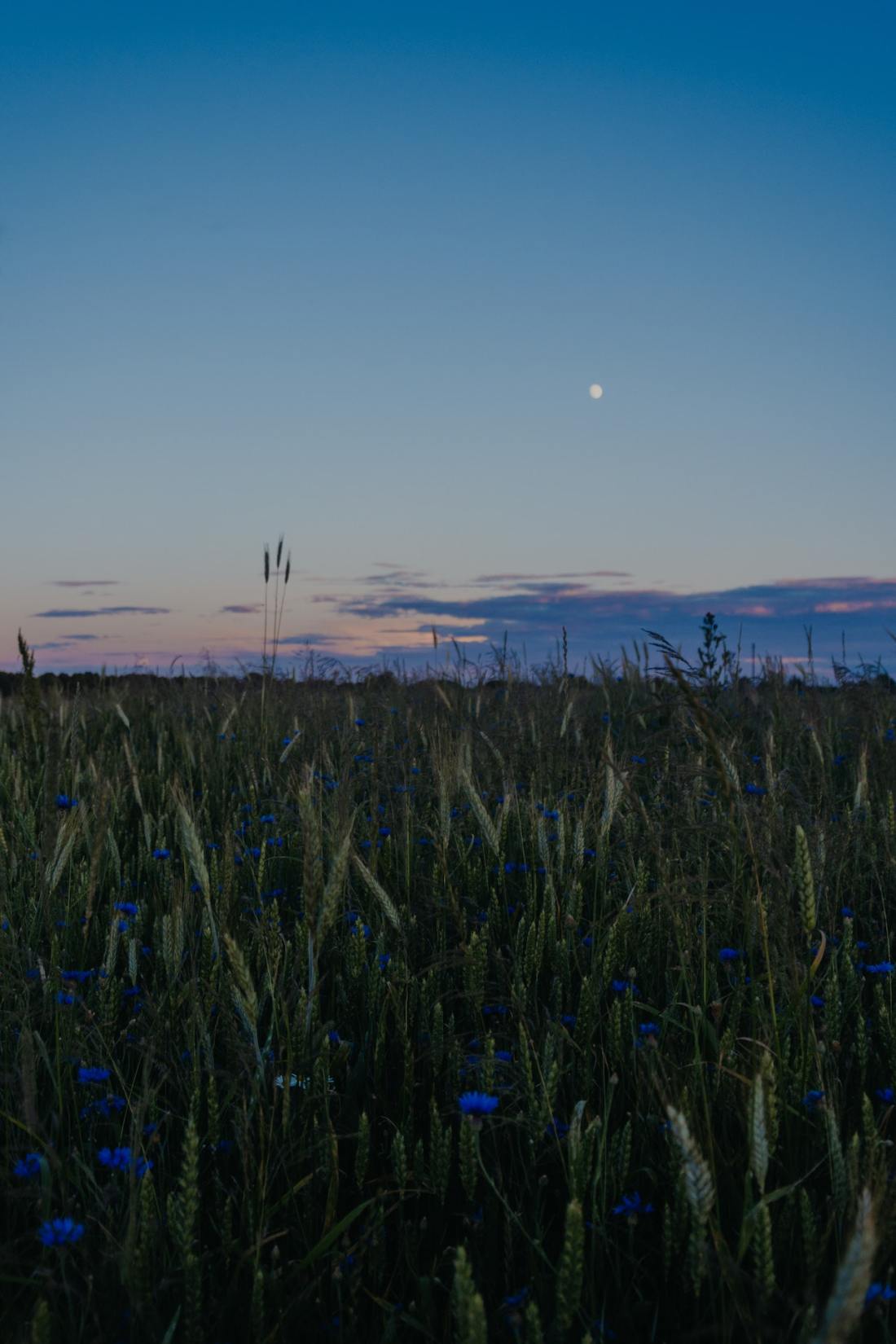
One other note is the term 有明 (ariake), which is one of many poetic terms for the moon. Specifically it means the moon that remains in the morning, after daybreak. This normally occurs on the 16th day of the lunar cycle according to the old Japanese calendar.
The Moon is not surprisingly one of the most powerful images in the Hyakunin Isshu anthology, but the myriad ways it is used as imagery shows a remarkable variety and depth. There are 43 poems in the Hyakunin Isshu that cover topics of love and romance, but only 12 that pertain to the Moon.
However, within those twelve poems, and in Japanese waka poetry as a whole, the moon itself is a very popular subject and expressed in many ways. As one book on the subject points out, the Moon expresses different themes depending on the situation:
Print #98 from the One Hundred Aspects of the Moon by Yoshitoshi. This picture features Semimaru from the Hyakunin Isshu (poem 10, これ)
This is only for the Hyakunin Isshu of course. For larger anthologies like the Kokinshū and the vast corpus of Chinese poetry, the Moon is a persistent symbol of so many aspects of human emotion.
But also in Japanese language, many poetic terms for the moon and its phases have arisen over time:
ariake (有明) – moon visible during sunrise, appears in the latter half of the lunar cycle
misokazuki (晦日月) – the night before the new moon, the moon is a barely visible crescent.
shingetsu (新月) – new moon
tsugomori (つごもり) – last day of the moon (i.e. new moon)
mochizuki (望月) – full moon, 15th day of the old lunar calendar.
izayoizuki (十六夜月) – moon on the 16th day, just after full moon.
tachimachizuki (立待月) – moon on the 16th day of the cycle.
fukemachizuki (更待月), also called hatsukazuki (二十日月) – the three-quarters waning moon. The implication of the first word is that the moon rises late in the evening.
fushimachizuki (臥待月) – waning half-moon
nemachizuki (寝待月) – another term for waning half-moon
A lot of these terms are pretty obscure (some I couldn’t find in a common dictionary), while a few like mangetsu and mikazuki are used in standard Japanese.
The author of this iconic poem was Jitō Tennō (持統天皇, 645 – 702) known in English as Empress Jitō. Originally Princess Unonosarara, she was the daughter of Emperor Tenji (poem 1), and later his sister-in-law after Tenji forced her to marry his brother (later Emperor Tenmu). In any case, she became the Empress after her husband Tenmu died, and reigned for 11 years. Female emperors were quite rare in Japanese history, by the way, so her reign was pretty noteworthy. Empress Jito proved to be a powerful and effective empress, a patron of the arts who promoted cherry-blossom viewing, completed the new capital of Fujiwara-kyō, but also ruthless toward potential political rivals as well as in the case of her step-son/nephew Prince Otsu.
This poem in general causes a lot of headaches for commentators and translators over generations because of the confusing relation between certain lines. Further, a second slightly different version of the poem exists in the Manyoshu poetry anthology (book 1, poem 28), with differences highlighted:
Original Manyogana
Japanese
Romanization
Translation adapted from Dr Mostow’s1
春過而
春過ぎて
Haru sugite
Spring has passed, and
夏来良之
夏来るらし
Natsu kitaru rashi
summer is coming, it seems
白妙能
白たへの
Shirotae no
Heavenly Mount Kagu
衣乾有
衣干したり
Koromo hoshitari
where, it is said, they are drying robes
天之香来山
天の香具山
Ame no kaguyama
of the whitest mulberry!
1 Special thanks to “Cameron” for helpful insights in making sense of the alternate version. Also, any translation mistakes are my own, not Dr Mostow’s.
According to Mostow, there’s a lot of uncertainty about what’s being dried, what does it stand for, and whether the scene is directly observed or not. One further note about the pillow word shirotae (白妙) in the third line, Mostow explains that the word tahe/tae refers to a kind of Paper Mulberry plant. So this is not just paper, but gleaming white paper.
Also, where is this famous Mount Kagu? Mount Kagu, more formally known as Amanokagu in Japanese,2 is one of three peaks called the Yamato Sanzan (大和三山, Three Peaks of [old] Yamato) or the Sanrinzan (三輪山) which are pictured here. These mountains are:
畝傍山, Unebi-yama
耳成山, Miminashi-yama
天香具山, Ama-no-kaguyama (e.g. Mount Kagu)
Yamato is among the oldest parts of Japan as we know it, so these mountains, while small by standards of Mt. Fuji, have held important cultural significance since the beginning. Since antiquity, it was believed that all three mountains were inhabited by Shinto kami,3 and thus sacred spaces. Miminashi-yama and Ama-no-kaguyama were said to be inhabited by male kami, who competed for the affection of Unebi-yama, a female kami.
Ama-no-kaguyama with purple Cosmos flowers in the foreground. The remnants of the ancient capital of Fujiwara-kyo can also be seen to the right. Photograph by Ajax, CC BY-SA 4.0, via Wikimedia Commons
The ancient imagery of such a venerable old mountain, couple with such vivid imagery of a sunny, warm summer day are among the reasons why I like this poem so much. 🙂
2 The Manyoshu version of the poem alternatively spells it as ame-no-kaguyama, which is an obscure though valid way to read 天. I am not sure why both versions of the poem are read slightly differently.
3 Although kami is usually translated as a “god” in English, it helps to think of them more like ancient Greek gods, than the modern concept. Ancient Greek religion had gods both large and small, so the English word “divinity” might be more accurate?














 The Hyakunin Isshu
.JPG)

.jpg)


_W_IMG_0104.jpg)


