Waves Beating Against The Shore: Poem Number 48

I decided to post this one after Valentine’s Day for all those whose plans didn’t go well. You’re not alone, as we shall see.

JapaneseRomanizationTranslation
風をいたみKaze wo itamiWaves that beat against the rocks,
うつ波のIwa utsu nami nofanned by a fierce wind—
おのれのみOnore nomiit is I alone
くだけて物をKudakete mono wowho breaks, those times
おも頃かなOmou koro kanawhen I think of her!
Translation by Dr Joshua Mostow

The author, Minamoto no Shigeyuki (源重之, ? – 1001) was a well-associated poet who knew Kanemori (poem 40) and Sanekata (poem 51) according to Mostow. He is the last of the Thirty Six Immortals of Poetry featured in the blog (not all 36 are in the Hyakunin Isshu).

The poem, like poem 45 and poem 19, features the popular theme of a cold lover. For some reason, I had a difficult time understanding the analogy of this poem the first time, but Shigeyuki is comparing himself to the waves that crash on the shore. His lover is like the rocks that are unmoved by the waves.

It turns out though that this poem was actually composed for a poetry game involving a hundred-poem sequence “when Retired Emperor Reizei was still called the crown prince” according to Mostow. Such poetry games were popular in the late Heian Period, and influenced people like Fujiwara no Teika and the Hyakunin Isshu anthology.

The Cold Morning: Poem Number 52

For our final poem for Valentine’s Day, I thought this was another good choice:

JapaneseRomanizationTranslation
明けぬればAkenurebaBecause it has dawned,
暮るるものとはKururu mono to wait will become night again—
知りながらShiri nagarathis I know, and yet,
うらめしきNao urameshikiah, how hateful it is—
あさぼらけかなAsaborake kanathe first cold light of morning!
Translation by Dr Joshua Mostow

The author of the poem, Fujiwara no Michinobu Ason (藤原道信朝臣, 972-994), was the adopted son of the powerful Fujiwara no Kane’ie, husband of the mother of Michitsuna (poem 53) and subject of the Gossamer Years. His birth mother was the daughter of Fujiwara no Koretada (poem 45). Michinobu for his part, benefitted from his adoptive father’s influence, and rose to the Court rank of 4th-upper, and a position as part of the Imperial Guard (sakon no chūjō, 左近中将).

However, Michinobu seemed more interested in Waka poetry than in politics. He was close with Fujiwara no Sanekata (poem 51) and Fujiwara no Kinto (poem 55), and would often gather with them for poetry sessions. Further, Michinobu had a secret relationship with one of the court ladies under Emperor Kazan, named Enshi Jo-ō (婉子女王), but eventually he lost her to a political marriage with the powerful Fujiwara no Sanesuke. Sadly, Michinobu later died from due smallpox, which took his life at the age of 23.

This is another classic “Morning After” poem, which we’ve featured here, here and here.

Lord Michinobu dreads the rising sun because it means he has to sneak back to his own residence, away from his lover. Judging by his reaction, it must have been a night well-spent together. 😏

Happy Valentine’s Day!

Lost Without An Oar: Poem Number 46

Hello,

Continuing our theme for Valentine’s Day, this poem is quite fitting and another example of a “love poem” from the 40’s section of the Hyakunin Isshu:

JapaneseRomanizationTranslation
由良の門をYura no to woLike a boatman, crossing
わたる舟人Wataru funabitothe Strait of Yura,
をたえKaji wo taewhose oar-cord has snapped,
ゆくもしらぬYukue mo shiranuI’m lost and know not my way
こいの道かなKoi no michi kanaon the road of love!
Translation by Dr Joshua Mostow

The author, Sone no Yoshitada (曾禰好忠, dates unknown), lived toward the end of the 11th century, but as Mostow writes, very little else is known about him. Apparently he was a prolific poet and had his own collection, which was common among the aristocracy of day, but his style was considered unconventional and unappreciated until the time of Fujiwara no Teika (poem 97), who compiled the Hyakunin Isshu.

The poem is somewhat confusing, Mostow explains, for two reasons. The first is that the location of “Yura” isn’t know, but exists in both Kii and Tango provinces. Since Yoshitada was a secretary in the province Tango, perhaps he meant that Yura, but it’s only speculation on my part. The second is the phrase kaji wo tae (かぢをたえ), the third line. It can either be read as kaji wo tae (to lose an oar), or kaji-o tae (the oar cord snaps). Mostow makes a convincing argument for the latter.

But in any case, I think we all know that feeling when we were young and experienced love for the first time how happy, yet lost we were. Things haven’t changed in 900 years it seems. 🥰

A Cold Shoulder: Poem Number 45

This is another poem in our series leading up to Valentine’s Day. This one is perhaps a bit more unrequited, than the last poem I posted here:

JapaneseRomanizationTranslation
れともAwaré to moNot one person who would
べき人はIu beki hito wacall my plight pathetic
えでOmoedécomes at all to mind,
身のいたらにMi no itazura niand so, uselessly,
なりぬべきかなNarinu beki kanaI must surely die!
Translation by Dr Joshua Mostow

This poem was composed by Kentokukō (謙徳公, 924-972) also known as “Lord Kentoku”, or simply Fujiwara no Koremasa. Koremasa served as regent to the Emperor from 970 onward, and was frequently involved in compiling (and writing poems for) the second Imperial anthology of the time, the Gosenshō.

The poem, simply put, is Koremasa’s efforts to gain a girl’s attention, even after she spurned him previously. Mostow explains that according to the original sources, this poem was composed by Koremasa thinking “I will not be defeated!” and sent this poem as a last-ditch effort.

Nowadays, we might call such people stalkers, but at the time, this kind of persistent, dramatic effort wasn’t unusual. Men of the Court might try months if not years to gain a girl’s attention, and if she spurned him a few times, he might have chosen to persist, or possibly find a new lover.

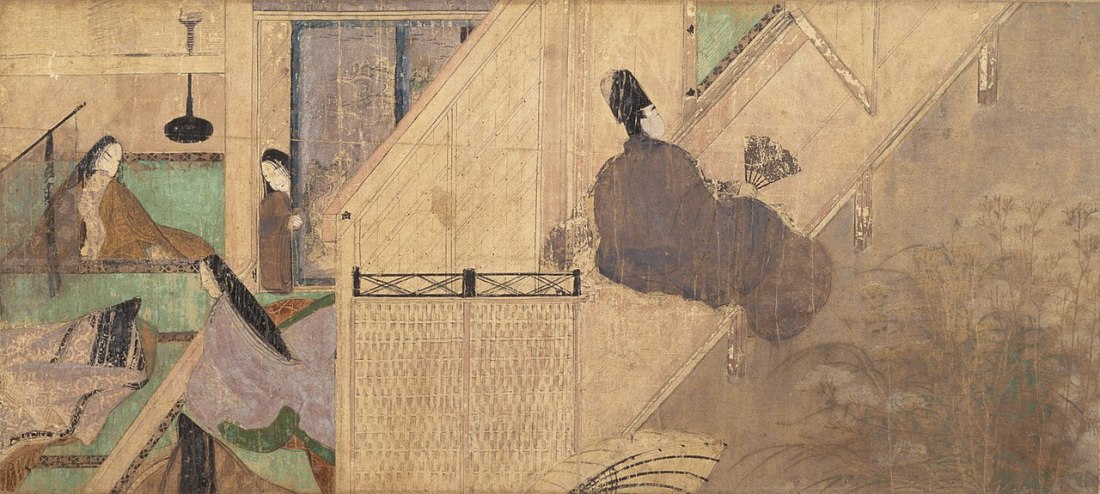
P.S. Featured photo is a scene of the Chapter “TAKEKAWA “(Bamboo River) of Illustrated handscroll of Tale of Genji (written by MURASAKI SHIKIBU(11th cent.)., Unknown author, Public domain, via Wikimedia Commons

Changed One’s Life: Poem Number 43

I can’t believe it’s been a year since my last series of love poems for Valentine’s Day. But, here we are again! This poem is the first in a series I’ll be posting before Valentine’s Day:

JapaneseRomanizationTranslation
見てのAi mite noWhen compared to
後の心にNochi no kokoro nithe feelings in my heart
くらぶればKuraburebaafter we’d met and loved,
むかしは物をMukashi wa mono woI realize that in the past
ざりけりOmowazari keriI had no cares at all.
Translation by Dr Joshua Mostow

The poet, Supernumerary Middle Counselor Atsutada (権中納言敦忠, 906-943), also known as Fujiwara no Atsutada, was among the sons of the power minister Fujiwara no Tokihira (the same man who had Sugawara no Michizane exiled, poem 24), and was one of the Thirty-Six Immortals of Poetry, as well as an accomplished poet all-around. Sadly, like his father Tokihira, Atsutada, according to my new book, died young in his 30’s and rumors swirled at the time that this was Michizane’s vengeful ghost. Such rumors help provide the impetus for Michizane’s later deification as a means of pacifying him.

The book also states that Atsutada was quite a playboy in his time. No sooner had he got into a relationship with Ukon (poem 38), then he dumped her, prompting her to write a bitter poem about it. On the other hand, Atsutada kept up a long, passionate correspondence with the daughter of Emperor Daigo, Masako, until she was sent away to be the high priestess of Ise Shrine. It was a heartbreaking separation we are told.

This is a classic “morning-after” poem (kinuginu no uta, 後朝の歌) which we’ve talked about in Poem 50 and Poem 30. The author’s love and longing have only increased, not decreased since their first meeting together.

As written before, meeting one’s lover was a huge ordeal among the aristocrats of the Heian Court in Japan. It wasn’t like meeting someone online today, or just going to have coffee together. Men and women were constantly separated from one another, and one would be lucky to catch sight of a woman’s sleeve back then, let alone her face. So, a first meeting required a long, drawn out courtship of exchanging poetry, and somehow arranging a way to meet that wouldn’t catch the public eye. Worse, if the meeting didn’t go well, then it was kind of a wasted effort and breaking up would be awkward as well. Or, if word got out, it could cause a scandal. Discretion was essential.

But, when things hit it off so well like this, it’s a cause to celebrate. 🙂

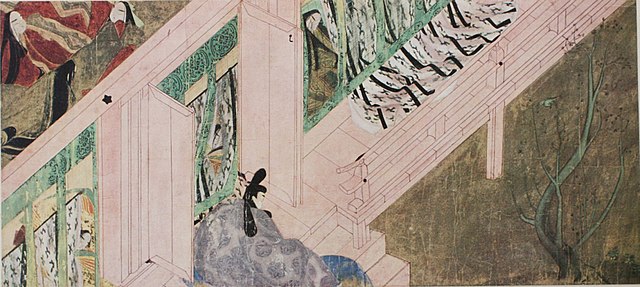
P.S. Featured photo is a scene (AZUMA YA: East Wing) from the Illustrated scroll of the Tale of Genji (written by MURASAKI SHIKIBU (11th cent.) Courtesy of Wikipedia

Once Was Enough: Poem Number 44

Although I have been posting love poetry from the Hyakunin Isshu all week in celebration of Valentine’s Day, I felt like posting this poem for all those who don’t like Valentine’s Day, or had a lousy time:

JapaneseRomanizationTranslation
あふおうことのAu(Ou)1 koto noIf there were no such things
絶えてしなくはTaete shi nakuwaas ever having met her, then,
中々にNakanaka nicontrary to all expectations,
人をも身をもHito wo mo mi wo moneither her coldness nor
my pain
恨みざらましUrami zaramashiwould I have to resent!
Translation by Dr Joshua Mostow

The author, Middle Counselor Asatada (中納言朝忠, 910 – 966), also known as Fujiwara no Asatada, was the fifth son of Fujiwara no Sadataka (poem 25) and one of the Thirty-Six Immortals of Poetry. I happen to consider this one of my favorite poems in the entire anthology, so I think it’s a fair ranking. 🙂

According to commentators, this poem was part of the same poetry contest as poems 40 and 41 and implies frustration that a woman has not consented to a visit by her presumed lover. Life would have been easier if they simply hadn’t bothered to try and meet.

However, Mostow also points out that the interpretation by Fujiwara no Teika (poem 97, who compiled the Hyakunin Isshu), was different, and implied that they had met, and she wouldn’t meet him again. It didn’t end well, in other words, and the lover is bitter over it.

P.S. Featured photo is a woodblock print of the Tale of Genji by Toyokuni Utagawa, Utagawa Kunisada, Public domain, via Wikimedia Commons

1 A good example of unusual spellings in the Hyakunin Isshu.

Hello, I Love You: Poem Number 51

This is the final poem in our series dedicated to Valentine’s Day:

JapanaeseRomanizationTranslation
かくとだにKaku to daniCan I even say
えやはいぶきのEyawa ibuki no“I love you this much”?—No, and so
さしも草Sashimogusayou do not know of it
さしも知らじなSashimo shiraji naanymore than of the sashimo grasses of Ibuki,
もゆる思Moyuru omoi womy burning love for you!
Translation by Dr Joshua Mostow

Fujiwara no Sanekata Ason (藤原実方), the poem’s author, was the grandson of Fujiwara no Tadahira (poem 26). True to his heritage, Sanetaka had an impressive record as a poet as well, and his poetry was frequently included in official anthologies such as the Shūishū among others. He was thought to also be friends with Sei Shonagon (poem 62) and Fujiwara no Michinobu (poem 52).

Sanekata apparently was quite full of himself too, and he later paid for this. According to my new book, Sanekata was a darling in his youth and frequently socialized with Emperors Enyu and Kazan. According to one story, when the Imperial procession went flower-viewing, Sanekata accompanied them, but then a heavy rain started. Everyone started to scatter, but Sanekata supposedly said “if I am going to get wet, might as well do it under the blossoms”, and he thus stood under a flowering tree. One Fujiwara no Yukinari later commented “that’s fine in poetry, but Sanetaka is a fool”. Sanetaka and Yukinari apparently had a prolonged and bitter hatred of one another, and in one incident Sanetaka took Yukinari’s headdress and angrily threw it into the garden. Emperor Ichijo, who caught sight of this, rebuked Sanetaka’s crass behavior, demoted him in rank, and sent him to the remote province of Mutsu as punishment. Yukinari, for his part, was later promoted head of the Imperial Archives.

According to Mostow, this poem was sent to a woman he was first starting to court, so the poem is an introduction of sorts to her, since she probably didn’t know who he was. The poem is as technically strong as it is bold, as Professor Mostow explains in detail. The reference to “Ibuki” is probably to a famous mountain in Japan called Mount Ibuki which has a variety of wildlife, including a kind of grass called sashimogusa or mogusa and is part of the Mugwort family. Mugwort was used in moxibustion, so it was burned, and this poem uses this as a symbol of his burning love.

According to Mostow, there is further word-play in the poem as sashimo can be read as sa shimo meaning “that much”, while the words mogusa and omohi reinforce each other to emphasize the passion of his burning love.

If Sanetaka wanted to introduce himself to a lady, he sure did a fine job of it!

P.S. Another poem about mugwort.

P.P.S. Featured photo is of a Japanese Mugwort (yomogi, ヨモギ) by Qwert1234 / CC BY-SA 3.0, courtesy of Wikipedia

The Joys and Pains of Marriage: Poem Number 54

This is the fifth poem in our series dedicated to Valentine’s Day:

JapaneseRomanizationTranslation
忘れじのWasureji noBecause that future, until which,
行くすまではYukusue made wayou say, you will “never forget,”
難ければKatakerebais hard to rely on,
けうきょうを限りのKyo wo kagiri nooh, if only today could be
命ともがなInochi to mo ganathe last day of my life!
Translation by Dr Joshua Mostow

This poem was composed by Gidō Sanshi no Haha (儀同三司母, ? – 996), or “Kishi” or short. Her personal name was Takashina no Takako, and she was the wife of the powerful regent, Fujiwara no Michitaka. She is listed in the Hyakunin Isshu as “Mother of the Supernumerary Grand Minister” due to the tremendous power wielded by her son, Fujiwara no Korechika for a time, as well as Princess Teishi whom Sei Shonagon (poem 62) served under.

Takako herself was from an elite family, and had considerable talent in Chinese poetry, which allowed her to win competitions over many learned gentleman. No doubt this helped her catch the eye of the ambitious and rising star that was Fujiwara no Michitaka. This poem was, according to Mostow, composed shortly after their wedding, with all the joy and excitement about the future that comes with marriage.

However, as you can see, there is a bitter undertone to this poem. Noblemen at the time often married multiple wives, and such women were often living apart from their husbands. Further, Michitaka was known to carry on many side affairs, including Akazomé Emon’s sister (poem 59).

As we saw with the Gossamer Years, this can lead to many years of isolation and loneliness if the husband neglects her. So, the poem expressed a sense of unease about the future and how long this excitement might last.

Later, when Michitaka later passed away, Takako took tonsure as a Buddhist nun and left behind few other poems.

Speaking as one who’s happily married myself, I can definitely understand her excitement that day, even a thousand years later, but also the joys of staying with it for many years. One wife is enough, and I am glad to have invested the care and devotion to make it work.

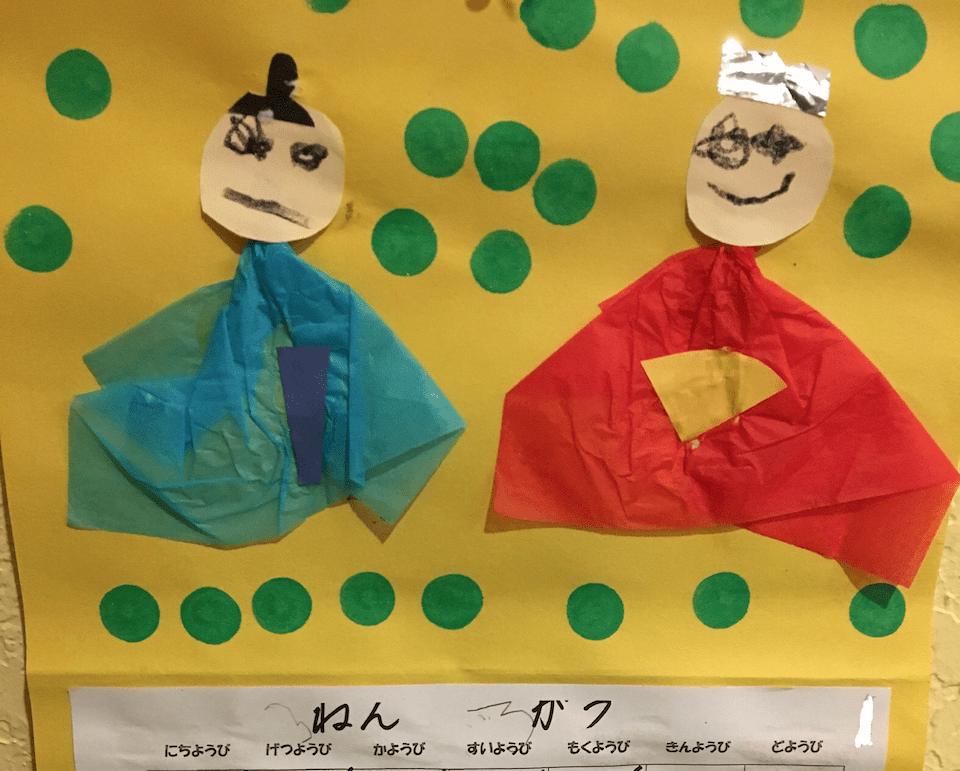
The photo above was taken by me of the doll set we keep at home for Girl’s Day, a holiday celebrated in early March. It symbolizes the happy marriage of the Emperor and Empress, and the aspirations of young women everywhere for a happy life with the man of their dreams.

P.S. Featured image is a calendar my son made in Japanese preschool, depicting Girl’s Day.

A Broken Thread: Poem Number 89

For our fourth poem in honor of Valentine’s Day, I thought this was an excellent choice:

JapaneseRomanizationTranslation
玉のTama no o yoO, jeweled thread of life!
絶えなば絶えねTaenaba taeneif you are to break, then break now!
ながらNagaraebaFor, if I live on,
しのぶることのShinoburu koto nomy ability to hide my love
よはりもぞするYowari mo zo suruwill most surely weaken!
Translation by Dr Joshua Mostow

The author of this poem, Shokushi Naishinnō (式子内親王) was the daughter of Emperor Go-Shirakawa and was high priestess, or saiin (斎院), of the Kamo Shrine near Kyoto (office website, Japanese only). Because the Kamo Shrine was so central to the spiritual protection of the capitol, the high-priestess could only be the daughter of an emperor, and was expected to be a vestal virgin. She would serve as the high-priestess until such time as a new emperor was enthroned.

The daughter of Emperor Go-Shirakawa received a world-class education in poetry from none other than Fujiwara no Shunzei (poem 83), and later by his son, Fujiwara no Teika (poem 97), the compiler of the Hyakunin Isshu. The Hyakunin Isshu Daijiten also alludes to rumors that Teika and Shokushi Naishinnō later had a romantic relationship. Further, researchers have noted that Teika frequently mentions her in his journal.

However, if the two had a romantic relationship, they never married. Shokushi Naishinnō became the high priestess and led a celibate life. According to one story, after Shokushi Naishinnō passed away, it is said that Teika’s strong feelings of longing for her eventually led to the sprouting of teikakazura flowers (Asiatic Jasmine, Trachelospermum asiaticum) around her grave.

Shokushi Naishinnō, in addition to being the high priestess, also left a considerable poetry collection in her own right. This poem belonged to another anthology under the subject of “hidden love”, according to Mostow. This was a popular subject of poetry contests and similar poems can be found in the Hyakunin Isshu as well.

One other note here is the imagery of strings of jewelry symbolizing one’s life, as in the first verse of the poem above. It seems to have been a frequent metaphor and there are example poems dating all the way to the Manyoshu that use similar imagery.

Reel Her In: Poem Number 25

This is the third poem in the series dedicated to Valentine’s Day:

JapaneseRomanzationTranslation
名にしおNa ni shi owabaIf they bear such names:
おう坂山のOsakayama nothe “come-sleep vine” of
さねかSanekazura“Meeting-Slope Hill” —
人にしられでHito ni shiraredehow I wish there was a way to come to you,
くるよしもがなKuru yoshi mo ganaas if pulling in a vine, unknown to others.
Translation by Dr Joshua Mostow

The poem was composed by Sanjō Udaijin (三条右大臣, 873-932), or “Sanjō Minister of the Right”. He was also known as Fujiwara no Sadakata, the father of Fujiwara no Asatada (poem 44) and cousin of Kanesuke (poem 27). His sobriquet comes from his residence in the Sanjō district of the capitol of Kyoto (formerly Heian-kyō).

While successful politically, he was a minor poet in the day, whose poetry only appeared in a few collections. However, he was also the sponsor of a poetry circle centered around Kanesuke above, Ki no Tsurayuki (poem 35), and Ōshikōchi no Mitsune (poem 29) during the reign of Emperor Daigo.

Kadsura japonica (sanekazura), bearing fruit

In the days of the Heian Court, men and women frequently lived apart and meeting one another was very difficult. Also, traditionally, if they were going to meet, it was the man’s role to meet the woman. Thus poetry was a very useful means of expressing one’s love, arranging meetings, etc.

Here Sadakata uses the image of a vine pulling his lover to him (rather than him visiting her), but also a lot of clever word-play. The name of the place, Ōsaka (逢坂), no relation to the modern city, can mean “meeting place-hill”. Here, the verb for meeting, au/ou (逢う), is not the same as the generic, modern Japanese verb au (会う). The meeting in this context is an overtly romantic one. We see this again in Lady Izumi’s poem (poem 56). The name of the vine, sanekazura (Kadsura japonica), has the words sa ne (サ、寝), in there, meaning “come, sleep!” according to Professor Mostow. Lastly, the word kuru can mean either “come” or to “reel in”.