Poetry about war is not something you will ever find in the Hyakunin Isshu, or other Imperial anthologies. So, I was quite surprised to find this poem in the Manyoshu.
Manyogana
Japanese
Romanization
Translation1
熟田津尓
熟田津に
Nikitatsu ni
I was going to wait for
船乗世武登
船乗りせむと
Funanorisen to
the moon to rise before
月待者
月待てば
Tsuki mateba
embarking from Nikita bay,
潮毛可奈比沼
潮もかなひぬ
Shio mo kanainu
but the tide is up:
今者許藝乞菜
今は漕ぎ出でな
Ima wa kogi-idé na
go, row out now!
1 Translation by Kudō Rikio, Ōtani Masao, Satake Akihiro, Yamada Hideo, Yamazaki Yoshiyuki, ed. SNKBT: Man’yōshū, 4 vols. Iwanami, 1999–2003, originally found here.
This poem was recited by none other than Princess Nukata (Nukata no Okimi, 額田王, 7th century), whom we saw in these twopoems. She wasn’t just a woman sought after by two emperors, but also played a small part in the effort to restore the Korean kingdom of Baekje.
A map of Korea in the 4th century showing the three kingdoms. Baekje is at the height of power at this time. Map by Historiographer at English Wikipedia, Public domain, via Wikimedia Commons
For centuries, the Korean Peninsula was divided into three kingdoms: Goguryeo, Silla and Baekje who constantly vied for control. Baekje, called Kudara (百済) in Japanese, was the country most closely allied with Japan in antiquity and helped bring much continental culture to the fledging Japanese court. They had a long-standing alliance.
But in 660, Baekje was crushed by the combined forces of Silla and their ally, Tang-Dynasty China (aka “Great Tang” as they called themselves). The remnants of the Baekje court fled to Japan and sought help to restore their kingdom.
With Japanese and Korean restoration forces mustered at beaches of Nikita (熟田) Bay in modern day Ehime Prefecture, Princess Nukata, writing on behalf of the Baekje sovereign, Prince Buyeo Pung, recited this poem to fire up the troops.
Sadly, the restoration effort gradually failed. The forces landed in former Baekje and made initial gains, but gradually lost steam, and then were crushed in 663 at the Battle of Baekgang. This was also the last time that Japan sent troops to the Korean Peninsula until the 16th century under Toyotomi Hideyoshi’s invasion of Korea.
As I wrote before, the Manyoshu, while technically Japan’s first poetry anthology, is a somewhat different beast than later anthologies and collections. The poetry techniques are less refined, but the Manyoshu is often revered for its more visceral nature, its breadth, and its small peeks into antiquity.
P.S. Korean history is fascinating too, and makes for some pretty nice K-Dramas which you can easily find on streaming media such as Netflix. If you’re not already a K-Drama fan, maybe look up a few and enjoy.
P.P.S. Before I found a proper translation, I was translating the final line as “Let’s row” in the same way that Optimus Prime from the Transformers would say “Roll out!”. Maybe less accurate but it sounds cool, especially coming from Princess Nukata. 😎
Author’s note: this draft was nearly complete before I had to go to the hospital in February. I decided to post as-is even if it is a bit late.
At a recent meeting of the Seattle Karuta Club, I tried my hand at being the yomité (読み手), the card reader.
The game of Karuta traditionally requires three people to play: two opponents and one person, the yomité, to read the full poem cards, the yomifuda.
Reading the cards is not just a matter of reading aloud, there’s a certain style and method to it. Plus you need to be able to read hiragana smoothly, including the weird spellings. Further you have to be clear enough that players know precisely which card to take.
Usually, Karuta players overseas just use one of several reader apps, but in Japan, Karuta matches usually have a yomité when possible. It’s a handy skill to learn if possible, even if you are musically tone-deaf like me.
This featured photo is me starting the match. I was quite nervous since it was my first time, and have a terrible singing voice. I don’t say that to be modest; I am genuinely a bad singer.
Right away, I found I could read the text easily enough, but I didn’t project my voice, or enunciate the kimari-jiproperly. Halfway through the match I “found my groove” and my reading improved but I still needed practice.
Learning to read Karuta cards does not take long to learn, but learning to read well takes time.
This page in Japanese focuses on learning to read Karuta cards. It even includes a video (Japanese only)
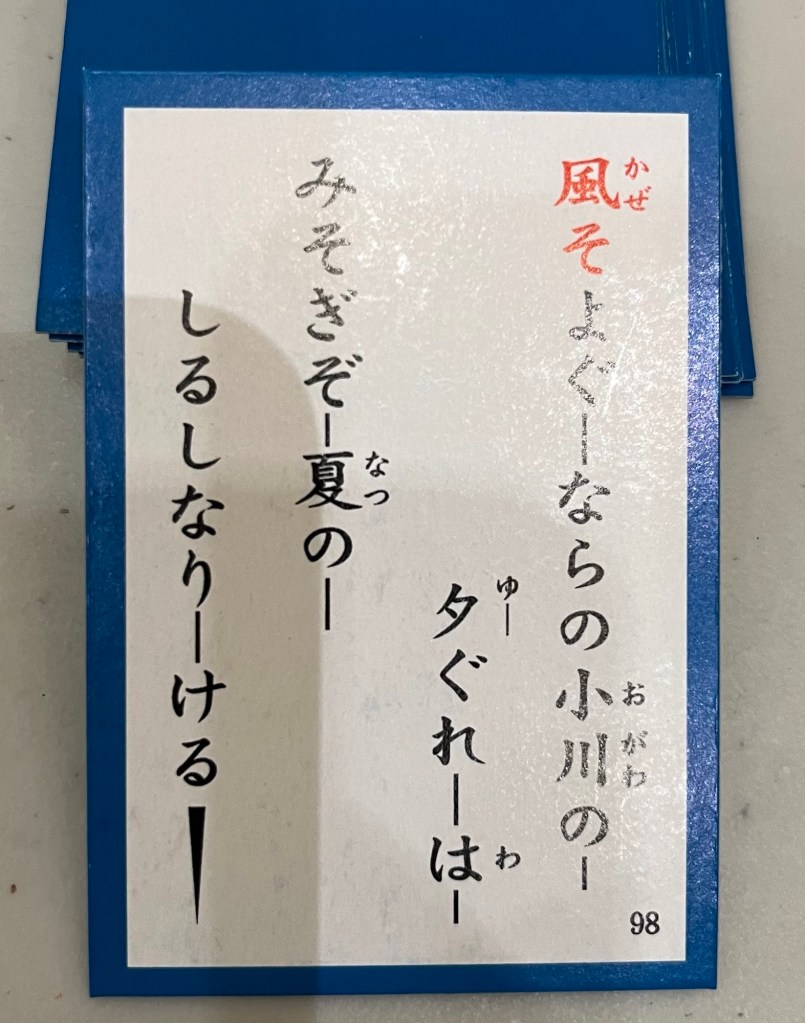
In red, the kimari-ji is shown, and the text of the poem includes rhythm clues (the lines and arrows) where you should elongate the syllable, for example. Each poem has a slightly different rhythm. It’s not the same pattern with every poem. So, you definitely have to practice each poem and how to recite them.
In the end, taking turns as the yomité is a nice way to share responsibility, and even Japanese is not your first language, you can pick it up with a bit of time and effort.
Being able to recite your favorite poem the traditional way is also a neat skill to learn anyway.
In other recent, exciting news, I found this article on the Asahi Shimbun newspaper: the discovery of some of Fujiwara no Teika’s personal notes. This is called the kenchū mikkan (顕注密勘).
Long before Fujiwara no Teika (poem 97) compiled the Hyakunin Isshu, he served as a minister under Emperor Gotoba (poem 99). Among his duties, Teika was commissioned in 1201 to compile a new Imperial poetry anthology, which later became the Shin Kokin Wakashu (新古今和歌集).
Here you can see some of his notes and thought process as he’s compiling the poems together. It’s a fascinating discovery.
You can click here to see more detailed photos of his notes. They are read from right to left, vertically not horizontally.
You can also see another example of his handwriting here, courtesy of Wikipedia, from diary:
Teika himself had a pretty rocky career and after his liege lord was exiled, Teika spent the rest of his days living as a Buddhist monk. Nonetheless, his legacy lives on.
I have been away for a while due to variouslifecircumstances, but I’ve been wanting to share this news with readers.
The Japanese public TV station, NHK, broadcasts a new Taiga Drama (大河ドラマ) every year. These are big productions featuring some aspect of Japanese history, with big name actors and so on. I was very fond of the last one. Usually these cover periods of warfare or conflict, and male historical figures from Japan’s long history, but this year’s drama, titled Hikaru Kimi E (ひかる君へ, “Addressed to You [my dear Radiant One]”), features Lady Murasaki as the main character!
(Image by NHK, all rights reserved)
Lady Murasaki, poem 57 of the Hyakunin Isshu, needs little introduction. She composed the Tales of Genji, as well as her eponymous diary. She was the first female novelist in Japanese history, and has been a subject of interest ever since. The biographical details of her life are somewhat scant, unfortunately, and the drama does embellish quite a bit, including hinting strongly at a romance that probably didn’t happen in real life. My impression is that they are using romantic themes from her novel, the Tales of Genji, as the backdrop for the drama.
Nonetheless, I have been watching this series on Japanese TV1 and I enjoy it. It is somewhat different than past Taiga Drama, since it features a female main character, and this period of history (the late Heian Period), had little warfare, but it does have tons of scandal and intrigue as the Fujiwara clan tighten their grip on the reins of government. This drama is surprisingly risqué in parts, something you usually don’t see in a conservative Japanese drama. However, such scenes remind me more a more subdued Victorian romance than something in modern, American television.
That said, it’s a darn good drama thus far.
The drama frequently shows other people of the Heian period aristrocracy, many of whom were poets of the Hyakunin Isshu. To name a few who have been featured in the drama:
I admit I am particularly fond of the character Sei Shonagon. In historical pop culture, Sei Shonagon and Lady Murasaki are treated as rivals as they were both famous writers of the same generation who belong to rival cliques in the aristocracy, but in reality they probably didn’t interact much. Nonetheless, they frequently talk in the drama, and the actress who plays Sei Shonagon, stage name is “First Summer Uika” (ファーストサマーウイカ), is a talented actress and total babe:
First Summer Uika also recently visited a Shinto shrine devoted to Sei Shonagon in Kyoto called Kurumazaki Jinja (車折神社), which even sells Sei Shonagon charms (omamori):2
Because the drama features so many people related to the Hyakunin Isshu, the drama subtly works in many poems from the anthology. It’s been great to suddenly recognize a poem being recited, even if I am a bit slow to recall. The settings, costumes, and cast are all amazing, and even though the historicity is questionable, it’s been a great watch.
I really hope they eventually make an English subtitle version so people outside Japan can watch. The quality of Taiga Dramas are terrific, and they are well worth watching if you can.
Update: while visitingKyoto in 2024, we found a local NHK display of the drama:
The second photo above is First Summer Uika as Sei Shonagon.
1 Sadly there are not foreign translations, and no subtitles, and it is not always modern Japanese, so I admit I struggle at times to follow the story. At other times, I can follow easily enough.
2 We are going to visit Japan again this year (the last for our teenage daughter), including Kyoto. Visiting this shrine is definitely on the itinerary, even thought it’s pretty small.
Centuries before the Hyakunin Isshu was compiled and before official Imperial anthologies such as the Kokin Wakashū were promulgated there was the Manyoshu (万葉集) or “collection of ten thousand leaves”.
The Manyoshu is the oldest extant poetry collection, completed in 759 CE for the pious Emperor Shomu, and has much that resembles the Hyakunin Isshu, but also much that differs. I have been reading all about it in a fun book, which is in the same series as this one.
The Manyoshu was purportedly compiled by one Ōtomo no Yakamochi (大伴家持, 718-785), author of poem 6 (かささぎの) in the Hyakunin Isshu, but it’s also likely that he only compiled the collection toward the end, and that others were involved too.
Sadly, English translations are very few in number and usually quite expensive. Translating the Hyakunin Isshu hard enough, and this is even more true with a larger, more obscure volume like the Manyoshu.
Format
The Manyoshu is a collection of poems from a diverse set of sources, including members of the Imperial family and the aristocracy, but also from many provinces across the country and people from many walks of life. In fact, 40% of the poems in the collection are anonymous, with sources unknown. It also includes a few different styles of poetry:
265 chōka (長歌), long poems that have 5-7 syllable format over and over (e.g. 5-7-5-7-5-7…etc), until they end with a 5-7-7 syllable ending. These are often read aloud during public functions. Kakinomoto no Hitomaro (柿本 人麻呂, 653–655, or 707–710?), who wrote poem 3 in the Hyakunin Isshu, was considered the foremost poet of this format, but the longest was composed by one Takechi no Miko (高市皇子) at 149 verses.
4,207 tanka(短歌), short poems as opposed to the long poems above. The “tanka” style poems are usually 5-7-5-7-7 syllables long, and are what we see in later anthologies such as the Hyakunin Isshu. At the time, they were often included as prologues to long poems above. The Hyakunin Isshu is entirely tanka poetry, by the way.
One bussokusekika (a poem in the form 5-7-5-7-7-7; named for the poems inscribed on the Buddha’s footprints at Yakushi-ji temple in Nara),
Four kanshi (漢詩), Chinese-style poems often popular with male aristocrats that contrasted with more Japanese-style poetry.
22 Chinese prose passages.
Additionally, these poems were often grouped by certain subjects:
Sōmonka (相聞歌) – Originally poems to enquire how someone was doing, but gradually involved into couples expressing romantic feelings for one another.
Banka (挽歌) – Funerary poems honoring the deceased.
Zōka (雑歌) – Miscellaneous poems about many topics. Basically everything else that is not included into the other two topics.
Manyogana
One of the interesting aspects of the Manyoshu compared to the later Hyakunin Isshu, and other related anthologies, is the written script used. When people think of karuta or Hyakunin Isshu, they think of the hiragana script, but the hiragana script didn’t exist in the 8th century when texts such as the Manyoshu, the Kojiki or Nihon Shoki were composed. Such texts were composed purely using Chinese characters, but in a phonetic style native to Japanese later called Manyogana. Confusing? Let’s take a look.
The book above explains that in Manyogana, Chinese characters such as 安 and 以 are read phonetically in the Manyoshu as “a” and “i” respectively. Even modern Japanese people can easily intuit this.
Then you get more difficult examples such as 相 (saga) and 鴨 (kamo) in Manyogana. These are more obscure, but still possible for native Japanese speakers to understand them.
Then you get much harder examples such as 慍 (ikari) and 炊 (kashiki).
And finally you get even more difficult examples such as 五十 (also read as “i“) and 可愛 (just “e“). My wife, who has an extensive background in Japanese calligraphy, struggled with these.
In any case, words in the Manyoshu were all spelled out using Chinese characters like this, with no phonetic guide. You just had to know how to read or spell them, and as you can imagine this was a clunky system that only well-educated members of the aristocracy could make sense of. However in spite of its issues, this system of phonetic Chinese characters is how the later hiragana script gradually evolved.
Technique
When we compare the Manyoshu with the Hyakunin Isshu, there are many similarities. Both have tanka poetry (5-7-5-7-7 syllables), and cover a variety of topics. Further, both collections make good use of pillow words. In fact the same pillow words you see in the Hyakunin Isshu, such as hisakata no (poems 33 and 76), also show up centuries earlier in the Manyoshu:
Original Manyogana
Modern Japanese
Romanization
Rough Translation1
和何則能尓
我が園に
Waga sono ni
Perhaps
宇米能波奈知流
梅の花散る
Ume no hana chiru
the plum blossoms will
比佐可多能
ひさかたの
Hisakata no
scatter in my garden
阿米欲里由吉能
天より雪の
Ama yori yuki no
like falling snow
那何久流加母
流れ来るかも
Nagarekuru kamo
from the gleaming heavens
1 Amateur translation, apologies for any mistakes
This poem, incidentally was composed by Yakamochi’s father, Ōtomo no Tabito, when he organized a flower viewing party at his villa (book 5, poem 822).
Another commonality, the book explains, is the use of preface verses or jo-kotoba (序詞) where the first verses are just one long-winded comparison to whatever comes after. Poem 39 in the Hyakunin Isshu is a great example of this since the first 3 verses describe various grasses in order to make a point: that love is hard to hide.
The Manyoshu used this technique as well:
Original Manyogana
Modern Japanese
Romanization
Rough Translation
千鳥鳴
千鳥鳴く
Chidori naku
Just as the plovers’ cries
佐保乃河瀬之
佐保の川瀬の
Sabo no kawase no
along the wavelets
小浪
さざれ波
Sazare nami
of the Sabo river
止時毛無
やむ時もなし
Yamu toki mo nashi
never end,
吾戀者
我が恋ふらくは
A ga ko furaku wa
so too are my feelings of love.
Author: Ōtomo no Saka no Ue no Iratsume (大伴坂上郎女), book 4, poem 526
Historicity
Similar to the Hyakunin Isshu, the Manyoshu covers a fairly broad span of history, but much of it is now pretty obscure to historians. Even so, the poems in the Mayonshu can be grouped somewhat reliably into 4 specific eras:
first half of 5th century to 672 CE, starting with the reign of Emperor Nintoku onward.
672 to 710 CE
710 to 733 CE
733 to 759 CE
These periods mostly coincide with certain authors who contributed poetry, but also appear to have breaks due to historical events such as conflicts, temporary political upheavals, etc.
Differences with the Hyakunin Isshu
Although there are many commonalities between the Hyakunin Isshu and the Manyoshu, there are also differences. The most obvious is that the Manyoshu is a mixed-format collection, so it includes poetry other than Tanka style. Another difference is its broad sources for poetry, not just contributions by the elite aristocracy.
However, the book above notes that on a technical level there are other differences.
For example, the use of “pivot words” frequently used in the Hyakunin Isshu ( poems 16, 20, 27, and 88 for example) is a technique that is almost absent in the Manyoshu. Similarly, puns are also rarely used.
Legacy
As the largest and earliest extant poetry collection, it set the standard for Japanese poetry that people were still studying and emulating centuries later. Poems such as 22, 64, and 88 are all examples that use themes or poetic styles that closely resemble poems in the Manyoshu.
Further, compared to more polished anthologies that came later, the Manyoshu’s bucolic and unvarnished content has often been revered by later generations (including Japanese nationalists and Shinto revivalists in the 19th century) for getting to the “heart of Japanese culture”.
The book has been a great read, with amazing illustrations, and it helps show how the roots of the Hyakunin Isshu, including a few of its early authors, lay centuries earlier in the Manyoshu.
While watching competitivekaruta online, and in person, I noticed that there is a certain poem that is read at the outset of a match, but what’s interesting is that this is a poem that is not actually part of the Hyakunin Isshu.
This poem is called the joka (序歌), or preliminary poem, and reads:
What’s interesting from a historical standpoint is that this poem was composed by a 3rd century immigrant to Japan named Wani (王仁), who came from the Korean kingdom of Baekje1 and is credited with introducing the Analects of Confucius and the Thousand-Character Classic to Japan at a time when it was actively trying to import knowledge and culture from the mainland. I’ve talked about Japan and Baekje here as well.
The poem by Wani was so highly-praised it was felt in antiquity that if you were going to know any Waka poem, you had to at least know this one. Hence over time it became the opening poem for karuta competitions. Like many poems of the Hyakunin Isshu, it was originally preserved in the official Imperial anthology, the Kokinshū.
In karuta matches, the poem is always read before the match begins. My guess is that reciting this poem helps to calibrate or warm-up the players before the match actually begins. Apparently, the last two verses, the shimo no ku (下の句) in karuta, are repeated twice. Once it’s read twice, the match begins.
It’s fascinating to note that this poem has been in existence for 1,700 years, and is still going strong!
1 A time when the Korean peninsula was divided into three warring kingdoms. Baekje probably had the closest relationship with the early Yamato Court of Japan due to proximity and mutually beneficial relations.
Throughout this blog, I’ve alluded many times to poetry contests, called uta-awase (歌合), as the origin of many of the poems of the Hyakunin Isshu. These contests were a popular past-time among the nobility of Nara and Heian periods of Japanese history, and onward. The first such contest was recorded as far back as 885, and became a staple of nobility since.
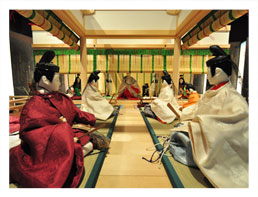
The poetry contest was a ritualized affair, and worth exploring here.
An excerpt from an illustrated copy of the Tales of Ise showing two contestants in a poetry contest, with an incense brazier on between. The lady here serves as the judge of their poetry.
This image comes from an illustrated copy of the classic Japanese text, the Ise Monogatari (Tales of Ise)1 and shows an example of a typical poetry contest. The contestants sit facing one another as a pair, while some contests had multiple pairs facing off.
Presiding over the contest was a judge or hanja (判者) who would provide a topic for the contest. A small incense brazier would burn between the two contestants (方人, kata-udo), who would each come up with one poem to fit the given theme. Each participant would also trash-talk the opponent’s poem while praising their own, or their Allie’s (if multiple sets of participants). Basically, an ancient Japanese rap-battle. Once the winner was declared, the contest could go another round, and each contestant would come up with another poem.
According to the Hyakunin Isshu Daijiten, the longest recorded poetry contest during the classic Heian Period was said to have continued for 500 rounds!
In more formal settings, usually held at the Imperial palace,2 with a director overseeing the contest (a tokushi, 読師), with the poems and their theme recorded by a scribe (kazusashi, 籌刺) who sat off to the side. Musical accompaniments were often added to formal poetry contests, too. Finally, the particularly good poems often ended up later in Imperial Anthologies.
You can see an example of an Imperial uta-awase from a popular manga here:
This poem was composed by Supernumerary Middle Counselor Sada’ie (権中納言定家, 1162-1241), better known as Fujiwara no Teika, or alternatively Fujiwara no Sadaie.1 He is considered one of the greatest poets in all of Japanese history. Teika was the compiler of this Hyakunin Isshu anthology and was also one of the major compilers of the officialShin Kokin Wakashū anthology. He was also the tutor for Shokushi Naishinno (poem 89), and it is thought that they had a romantic relationship too, though eventually they would be separated for good. In any case, his talent and his family’s influence were so great that the family virtually monopolized the Court poetry for centuries to come. But we’ll talk more about that shortly.
Fujiwara no Teika composed many of his own poems in his lifetime, and yet in compiling the Hyakunin Isshu, why did he select this particular poem for inclusion?
Like many of the later poems in the anthology (poem 90, 91 and 94), this poem alludes to a much older one. In Teika’s case, his poem alludes all the way back to the original anthology in Japan, the Manyoshu. Unlike later anthologies, the Manyoshu was a loose connection of poems, compiled 400+ years before Teika, and the particular poem he alludes to was written from the perspective of a man whose love was burning for a woman like the boiling of seaweed at Matsuo Bay. As you can see, Teika reversed the perspective to be that of a woman, while still alluding to the original. Additionally, Teika gives his poem a sadder tone than the poem from the Manyoshu, which came to be a hallmark of Teika’s style.
Incidentally, Matsuo Bay (written as Matsuho 松帆 here) is on the very northern tip of the famous Awaji Island in the Inland Sea. It is a scenic part of Awaji Island, and even has its own homepage. Awaji Island is also the scene for poem 78. The technique of extracting salt by boiling seaweed, or moshio (藻塩) is a time-honored tradition in Japan, and the seaweed gives the salt a special flavor. There’s a really good article about it here.
Fujiwara no Teika was a master of expressing yūgen (幽玄) or subtle, profound beauty in his poetry. This kind of subtle beauty centuries later came to influence other arts in time in Japan including Noh theater, tea-ceremony, etc.
But who was Fujiwara no Teika?
Teika, alternatively read as Sada’ie, was born from an illustrious family of poets though a minor branch of the powerful Fujiwara clan. His grandfather was Fujiwara no Toshitada and his father was Shunzei (poem 83). As a youth, Teika was a sickly boy but as the eldest son, he was obligated to carry on the family legacy. Unfortunately due to complex court politics, Teika was overlooked for much of his early life. However after a fortunate turn of events, he was noticed by Emperor Go-Toba (poem 99) who eventually commissioned him to compile two new anthologies, including the Shin Kokin Wakashū.
Over time though, Teika and Emperor Gotoba disagreed over poetry and compiling the anthology, leading to an increasingly distant and cold relationship. Teika found Gotoba overbearing, while Gotoba didn’t care for Teika’s free-wheeling style. At times, Teika and Gotoba openly criticized one another through poetry, or in their diary entries, and Gotoba even banished Teika for a year from the capitol. Teika meanwhile grew closer to Gotoba’s son who later became Emperor Juntoku (poem 100), while Gotoba became increasingly occupied with the martial arts, and with wresting power back from the samurai rulers in Kamakura (cf. poem 93)
Unfortunately for Emperor Gotoba, his meager forces were utterly routed by the Kamakura army in the short-lived Jōkyū War, and Gotoba was sent into exile (since it was sacrilege to kill the Emperor). Teika was not involved in the war, so he remained in Kyoto, and even reached the Imperial post of Middle Counselor. During this time, he also completed another Imperial anthology, the Shin Chokusen Wakashū, which shows more of his down-to-earth later style.
Finally though, his health declined from old age and from the famine at the time, so he retired and took Buddhist tonsure. It was during his final years in a Buddhist monastery that he was invited by his son’s father-in-law, Lord Utsunomiya no Yoritsuna, to his villa at Mount Ogura near Kyoto.
This stone marker at Jojakko-ji Temple in west Kyoto, near Arashiyama, marks where Teika had compiled the Hyakunin Isshu. More on that in this post. Photo taken in August 2024.
Lord Utsunomiya asked Teika to compile 100 poems in his own hand, so that they could be adorned on the silk screens of his villa, and these 100 eventually became the collection that we know today.
After Teika died at the age of 80, he was interred at Shokoku-ji Temple in Kyoto. The featured photo above shows his grave marker (Photo courtesy of Wikimedia Commons.). His grandchildren formed into three rival schools of Waka poetry that dominated the poetry scene for centuries:
Nijō School (nijō-ha 二条派) – the conservative and dominant school at first. Over time, a series of misfortunes eventually caused the school to decline and fade by the medieval period in Japanese history.
Reizei School (reizei-ke 冷泉家) – the more liberal branch, but a few generations later became the dominant branch. By the middle of the Muromachi Period, two branches had formed: the upper Reizei school (kamireizei 上冷泉家) and the lower Reizei school (shimoreizei 下冷泉家), which the upper school prevailing in the long-run. This school still maintains a large compound in Kyoto to this day.
Kyōgoku School (kyōgoku-ha 京極派) – this school died out in only a couple generations.
But more importantly, the legacy of Fujiwara no Teika is in his celebrated poetry anthologies, particularly this one. Even today, many kids in Japan enjoy playinguta-garuta in school competitions, and there are even Japanese anime about the Hyakunin Isshu. All of this is due to Teika’s talent and taste for selecting good poetry.
And now, this anthology is enjoyed by international readers like yourself. This blog was a originally a little experiment of mine, but I have enjoyed your readership, your comments, and of course your support. Thank you everyone from the bottom of my heart.
As this is the 100th and final poem of the Hyakunin Isshu, that is all I have to offer on this blog. I may take it up again sometime in the future and cover other anthologies like the Kokinshu and the Shinkokinshu, but for now, I decided that I prefer to leave it as it is.
1 The Chinese characters (kanji) for his given name (定家) have multiple readings possible, and both are seemingly correct. However, based on a cursory glance in Japanese, it seems that “Teika” is the more common reading.
The author, Nyūdō Saki no Daijōdaijin (入道前太政大臣, 1171 – 1244), or “Buddhist novice and former Chancellor of the Realm”. His personal name was Fujiwara no Kintsune. He was a powerful member of the elite Fujiwara clan and extended his support to the Hyakunin Isshu’s compiler, Fujiwara no Teika (poem 97), after Teika married Kintsune’s older sister. He was also well-liked by members of the old Imperial Court and the new military government at Kamakura.
According to Mostow, Kintsune married a niece of Minamoto no Yoritomo, the first shogun of the new military government. After Yoritomo’s son Sanetomo (poem 93) died a tragic death with no heir, Kintsune pushed to make his grandson Kujō Yoritsune, a distant relation to Sanetomo, the next shogun. My new book states that his reputation worsens in his later years as he kept manipulating the power of shoguns from behind the throne.
It also implies that Kintsune may have helped tip off the new military government about Emperor Gotoba’s (poem 99) plans to wrest back control, helping to contribute to the demise of the Emperor and his son (poem 100).
Ah, times had changed since the earlier generations of the Hyakunin Isshu mostly worried about poetry contests and marriage arrangements.
But I digress.
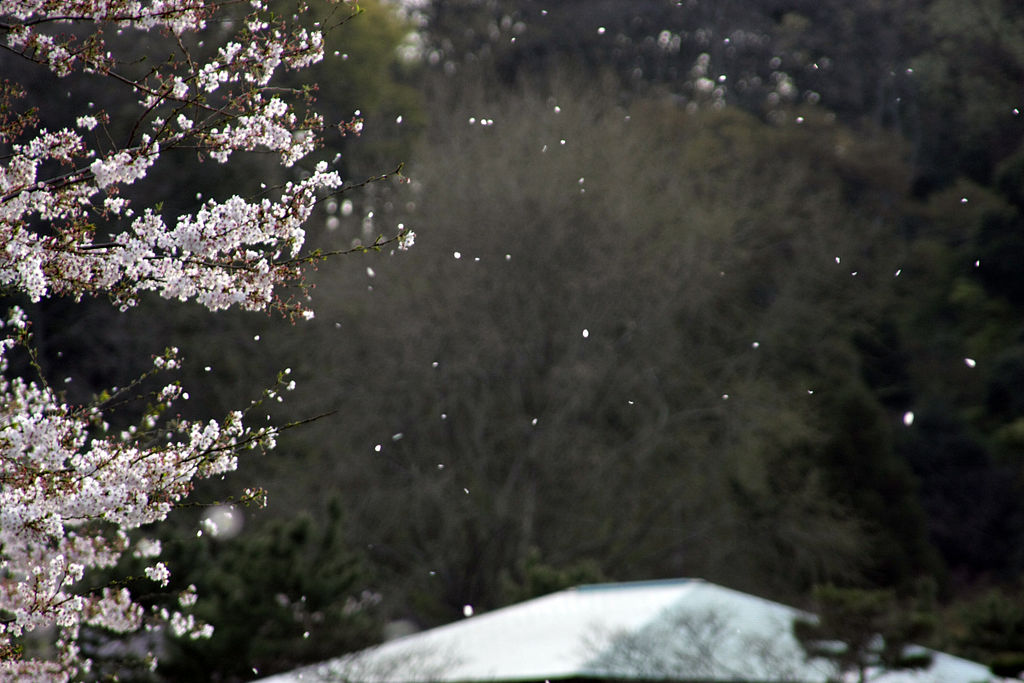
This poem, unlike other poems recently posted which were more clear-cut in meaning, often was the subject of much interpretation. The contrast between the aging man and the scattering of flowers in the wind, called hana fubuki (花吹雪) led to many interpretations by later commentators particularly about the man growing old, according to Professor Mostow. Perhaps he won’t be back next year?
The image of hana fubuki also is noteworthy, because it isn’t a small scattering of flowers. It refers to great scattering of blossoms in the wind, just like a snowfall. Thus Kintsune is witnessing this great scattering even as he contemplates his own decline even after so many years in power.
Pretty awesome poem, really, for a man who lived a noteworthy life.
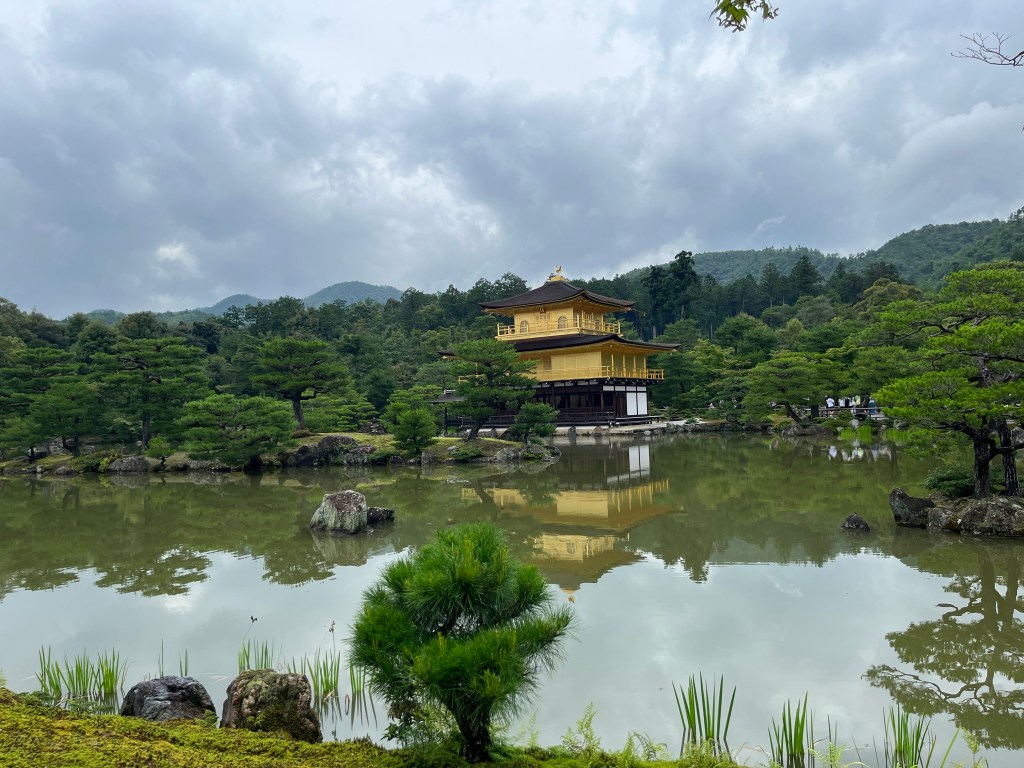
Speaking of scenic views, Kintsune’s residence of Saionji (西園寺), which was also established as his clan’s new name (Saionji), later became the famous Golden Pavilion.
Taken by me in July 2023
Indeed Kintsune’s contribution to Japanese culture and history, dubious as it may be, can be felt even today.
The author, Sangi Masatsune (参議雅経, “Counselor Masatsune”, 1170-1221), also as known as Fujiwara no Masatsune, was another editor of the Shin Kokin Wakashū like Yoshitsune (poem 91) and went on to found the poetic house of Asukai (also famous for calligraphy). He also studied under Shunzei (poem 83) earlier in his career.
I had to look up what fulling cloth meant, but apparently it’s the process of beating cloth, especially wool, to improve the texture, or in the case of Japan, give the cloth a nice glossy sheen. You can see an example of this above, in a painting made in the 1800’s, almost 700 years later. I can’t imagine the process changed much within that time. The process was to place the cloth on a wood or stone surface and pound it with a wooden mallet. In Japanese, the process called koromo utsu (衣打つ) just as it is mentioned in this poem.
Also, this poem, like other poems we’ve looked at recently (poem 90 and poem 91), alludes to a much older poem by Korenori (poem 31), which also mentions snow in the village of Yoshino (yoshino-chō, 吉野町), near the old capitol of Nara.
Interestingly, the “former capitol” is referred to by the poetic phrase furusato, which in modern Japanese means one’s hometown. Nara was the capitol of Japan during the early Nara Period, and personally my most favorite place to visit in Japan. The culture at that time was an interesting fusion of early Japanese culture, Chinese art and culture, and Indian Buddhism (via Silk Road). Even after the capitol was moved to Kyoto (another great place), there existed many euphemisms to the “former capitol” by later poets and authors (poem 61, for example) as a kind of nostalgia or the “good ol’ days”. Hence the use of the term furusato I believe.
P.S. Featured photo is Surimono, Woman Fulling Cloth in the Moonlight, by Shigenobu, Brooklyn Museum, No restrictions, via Wikimedia Commons






 The Hyakunin Isshu


.jpg)
_(CBL_J_1050.2,_ff.11b-12a).jpg)

