
As I’ve written before, the Hyakunin Isshu poetry anthology is a rough slice of history of Japan’s “classical age” which spans the Asuka, Nara, Heian, and early Kamakura periods of history: roughly six centuries.
The early poems, numerically, were often written by people living in and around the area of Nara (奈良), a very old city in Japan, and also the capitol for a time.1 The city itself isn’t the only famous landmark, though. Many of the geographic features around Nara have become part of the poetry that we enjoy today.
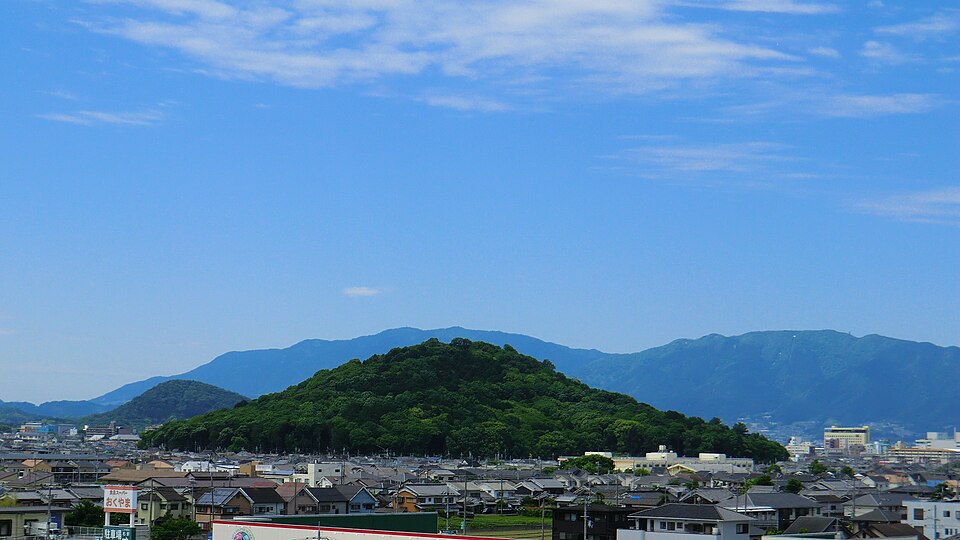
Poem two of the Hyakunin Isshu (はるす) introduces a mountain named Kagu-yama, but nowadays is known as Amano-kaguyama (天香久山) in Japanese. Mount Amanokagu is actually one of three mountains that surround Nara, called the Three Mountains of Yamato: yamato-sanzan (大和三山). These mountains are:
- Mount Amanokagu (天香久山, amanokagu-yama)
- Mount Unebi (畝傍山, unebi-yama), and
- Mount Miminashi (耳成山. miminashi-yama)


When you look at these mountains, they’re not very big,2 nothing like Mount Fuji which was also a subject of the Hyakunin Isshu (poem 4, たご). So….. what’s so special about the Three Mountains of Nara?
You can find clues to this in the Manyoshu anthology,3 including this choka (“long form”) poem from book one, poem 17:
| Manyogana | Modern Japanese | Romanization |
|---|---|---|
| 味酒 三輪乃山 青丹吉 奈良能山乃 山際 伊隠萬代 道隈 伊積流萬代尓 委曲毛 見管行武雄 數々毛 見放武八萬雄 情無 雲乃 隠障倍之也 | 味酒 三輪の山 あをによし 奈良の山の 山の際に い隠るまで 道の隈 い積もるまでに つばらにも 見つつ行かむを しばしばも 見放けむ山を 心なく 雲の 隠さふべしや | Umasake miwa no yama Aoniyoshi nara no yama no Yama no ma ni ikakuru made Michi no kuma itsumoru made ni Tsubara ni mo mitsutsu ikan wo Shibashiba mo misakemu yama wo Kokoro naku kumo no kakusafubeshi ya |
A rough translation is as follows (alternate translation here):
Oh, how I wish to take in the sights of the Three Sacred Mountains, the mountains of Nara of the blue-green dyes, until they are far from view. Yet, at every step of way, you hinder me, O heartless clouds!
But something’s lost in this, admittedly very crude, translation: the pillow word umasake. This is a pillow word (actually this poem has two pillow words, aoniyoshi is the other) specifically used for the sacred mountains of Nara, but uses the Chinese characters 味酒 for “delicious sake”. Sake rice wine has since antiquity been an offering to the Shinto gods (kami), so there’s a touch of the divine as well. Think of the Greek god Dionysus, and you get an idea of the nuance.
The three mountains were each thought to be the home of a sacred kami, two male one female (Unebi, I think), and as Nara was surrounded by them, the whole scene must have felt ethereal to Japanese at the time. In the same way, Mount Olympus in Greece really isn’t that big, but it has an aura to it that has fascinated people since ancient times.
1 Speaking from personal experience, Nara is a fun place to visit because it’s a small, laid-back city but also has so much early history there. Compared to Kyoto which is wonderful, but very crowded, Nara is slower and quieter, and well worth a visit.
2 The prefectural website also has some nice photos. Well worth visiting.
3 Many of the early (numerically early) poets in the Hyakunin Isshu also contributed poetry to the Manyoshu. Otomo no Yakamochi (poem 6, かさ), compiled the Manyoshu. So, there’s quite a bit of overlap. Teika’s (poem 97, こぬ) genius in compiling the Hyakunin Isshu was selecting the very best of the best, and organizing it in a simple, accessible collection.
Discover more from The Hyakunin Isshu
Subscribe to get the latest posts sent to your email.

