

This blog, since 2011 (!), has been devoted to the famous poetry collection, the Hyakunin Isshu, and the greater tradition of Waka poetry. Waka poetry began far back in Japanese history. We can see this progression in the Manyoshu anthology of the 7th century, followed by various Imperial anthologies promulgated every few generations (some more successful than others). The Hyakunin Isshu collection is a product of early 13th century. By the 15th century, when the last imperial anthology (the Shinshokukokin Wakashū) was published in 1439, poetry in Japan mostly shifted away from Waka poetry to newer Haiku, Renga, and other forms. Waka was essentially a dead poetry form.
And yet, there was still one poet in Kyoto who fully immersed himself in the tradition, despite not coming from an aristocratic background: Shōtetsu (正徹, 1381–1459).
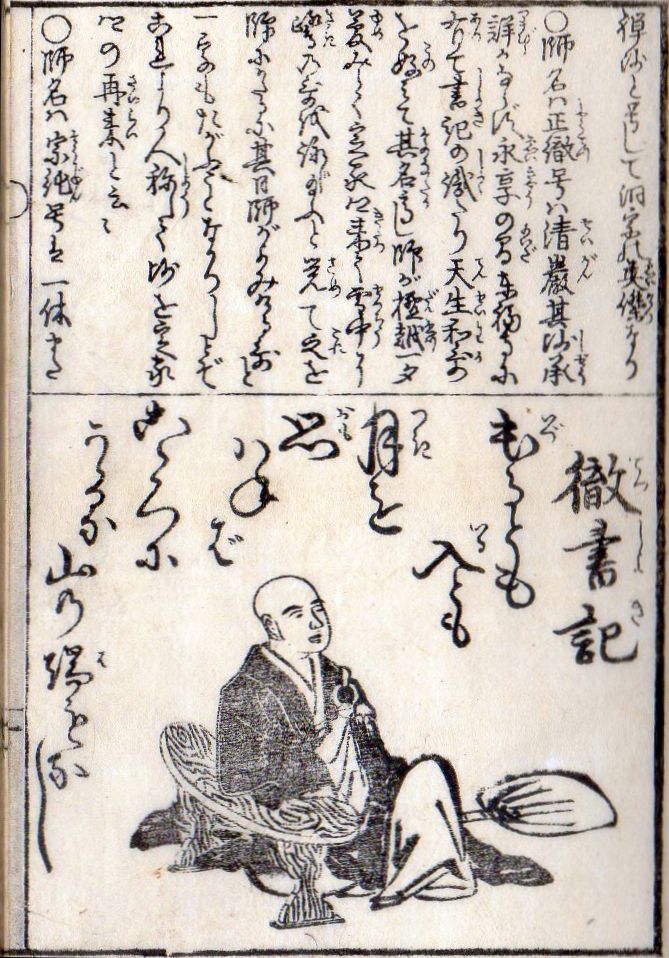
Shotetsu was a great admirer of Teika. In one anecdote he said, “Sometimes on awaking from sleep I happen to think of one of Teika’s poems and feel as if I were about to lose my mind.” Like many of his time, he sought any scrap of calligraphy or poetry from him. He was said to hang up a photo of Teika in his home too.
Shotetsu was a Buddhist monk, ordained since the age of 15 (not unusual in medieval times). By age twenty, Shotetsu sought out a famous poetry teacher named Imagawa Ryōshun, and later Reizei no Tamemasa to learn the “way of poetry”. Reizei no Tamemasa was a member of the Reizei family whose ancestor was none other than Fujiwara no Teika, compiler of the Hyakunin Isshu (poem 97 こぬ). Over the centuries, the Reizei family had developed info rival families and factions, but Shotetsu tried to stay out of the family politics and go back to the source: Teika himself.
In one example poem from 1432, which I found here among his collection, he writes:
| Japanese | Romanization | Rough Translation |
|---|---|---|
| 春来ては まづ咲く花の 都ぞと 思ひなしにも 空ぞのどけき | Haru kite wa Mazu saku hana no Miyako zo to Omoi nashi ni mo Sora zo no dodeki | Just as spring arrives, behold this capitol blooming with flowers. Even the sky seems like it’s gleaming! |
Apparently this poem is a variation of a poem all the way back from the Manyoshu (700 years before) by Yama-no-ue Okura, poem 818, book 5:
| Manyogana | Modern Japanese | Romanization | Rough Translation |
|---|---|---|---|
| 波流佐礼婆 麻豆佐久耶登能烏 梅能波奈 比等利美都〻夜 波流比久良佐武 | 春されば まづ咲く宿の 梅の花 ひとり見つつや 春日暮らさむ | Haru sareba Mazu saku yado no Ume no hana Hitori mitsutsu ya Haru hikurasan | Spring has arrived, and my plum trees have blossomed first, why am I spending the day enjoying this all alone? |
You can see how they’re similar, but different.
Anyhow, if you stop to think about it, what Shotetsu did is something like a modern English speaker going back to the time of Chaucer, and producing poetry that matches the style, but is original and good quality. It can be done, but it takes considerable dedication, time and effort. Further, Shotetsu lacked the pedigree typical of many poets of the Court (including the Reizei family), including the necessary training and education, so he was largely self-taught (with help from Ryoshun and Tamemasa).
He left behind many poems and musing in his Shōtetsu Monogatari (正徹物語, “Conversations with Shotetsu”) around 1450:
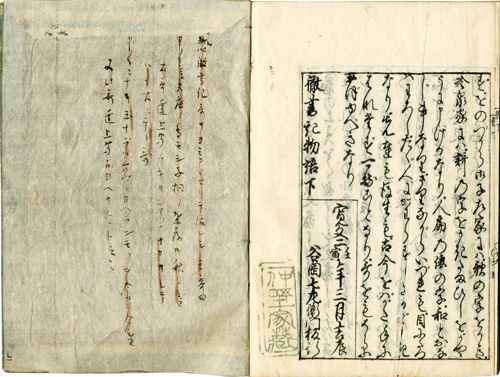
Sadly, Shotetu’s life had many ups and downs. His house had burned down in 1432, and by his own description, tens of thousands his poems were lost. He became caught up in the Reizei family squabbles, and was punished by the reigning Shogun, Ashikaga Yoshinori, losing all of his property. As further salt in the wound, Shotetsu was excluded from the last imperial anthology, the aforementioned Shinshokukokin Wakashū. Shotetsu would thus leave behind no official legacy.
In time, the tempestuous Shogun was assassinated, and Shotetsu eventually got his lands back. However by this time, he was probably the last waka poet in the Imperial Court. Times had changed, and the Ashikaga Shogunate was crumbling, sliding Japan into a prolonged period of warfare. No one had much time for poetry anymore.
Thus, when Shotetsu was awake one night, thinking about Fujiwara no Teika’s poetry, he was longing for a more glamorous age that was little more than a faded memory in his time.
I suppose we readers feel the same way…

