The author, Sakanoue no Korenori (坂上是則, dates unknown), is one of the Thirty-Six Immortals of Poetry, but otherwise nothing much is known about him.
This poem, as Professor Mostow explains, is similar to poem 29, and is part of a theme on “elegant confusion” which is a hallmark of Chinese poetry. Early poetry in Japan was still greatly indebted to Chinese poetry and many of the imagery, and idioms used in the Hyakunin Isshu anthology are not exception.
I happen to like this poem also because it has a lot of obscure, but cool Japanese poetic terms. We’ve seen ariaké discussed in poem 30. However, this poem also uses the term asaboraké (朝ぼらけ) which as we say in poem 64 means that period of time in the dawn, in either winter or autumn, when things are hazy. It’s a kind of slow, late dawn that you only find in that time of year. Compare with akatsuki (暁), which Professor Mostow explains can mean “dawn” any time of the year. Since asaboraké is used in two poems in the Hyakunin Isshu, it makes the kimari-ji for each poem particularly tricky.
The village of Yoshino that this poem refers to, is none other than the iconic village of Yoshino in Nara Prefecture.
The author, Mibu no Tadamine (壬生忠岑, dates unknown), is one of the Thirty-Six Immortals of Poetry and was the father of Tadami (poem 41). He was also one of the official compilers of the official anthology, the Kokinshū, along with Ōshikōchi no Mitsune (poem 29).
By all accounts, this appears to be another famous “morning after poem”, similar to the one seen in poem 50. The term, ariake (有明) is a poetic term for the last-rising moon, in the last-half of the lunar cycle, which you can still see in the morning.1 On the other hand, as Professor Mostow points out, the fact that the moon was heartless could also imply lover who spent all night waiting to see his lover but was never received and finally went home at dawn.
As you may have started to notice, the Hyakunin Isshu anthology provides a subtle historical overview of the classical period in Japanese history. This may have been intention on the part of Fujiwara no Teika, or just reflects the sentiment of his time. Either way, it’s an interesting tour of Japan from the 8th to 12th centuries.
The anthology begins with poems in the Nara Period, when Japanese culture, flush with cultural imports from China (e.g. Confucian ethics, Buddhism, technology, administration, poetry, etc). It was an exciting time in Japanese history. And if you look at the poems from this era, you can see that they tend to feature benevolent rulers (poem 1), bright and happy natural scenes (poems 2 and poem 4), or just often dealt with frivolous issues of love (poem 3 and poem 12) or just life in general around the capitol (poem 10).
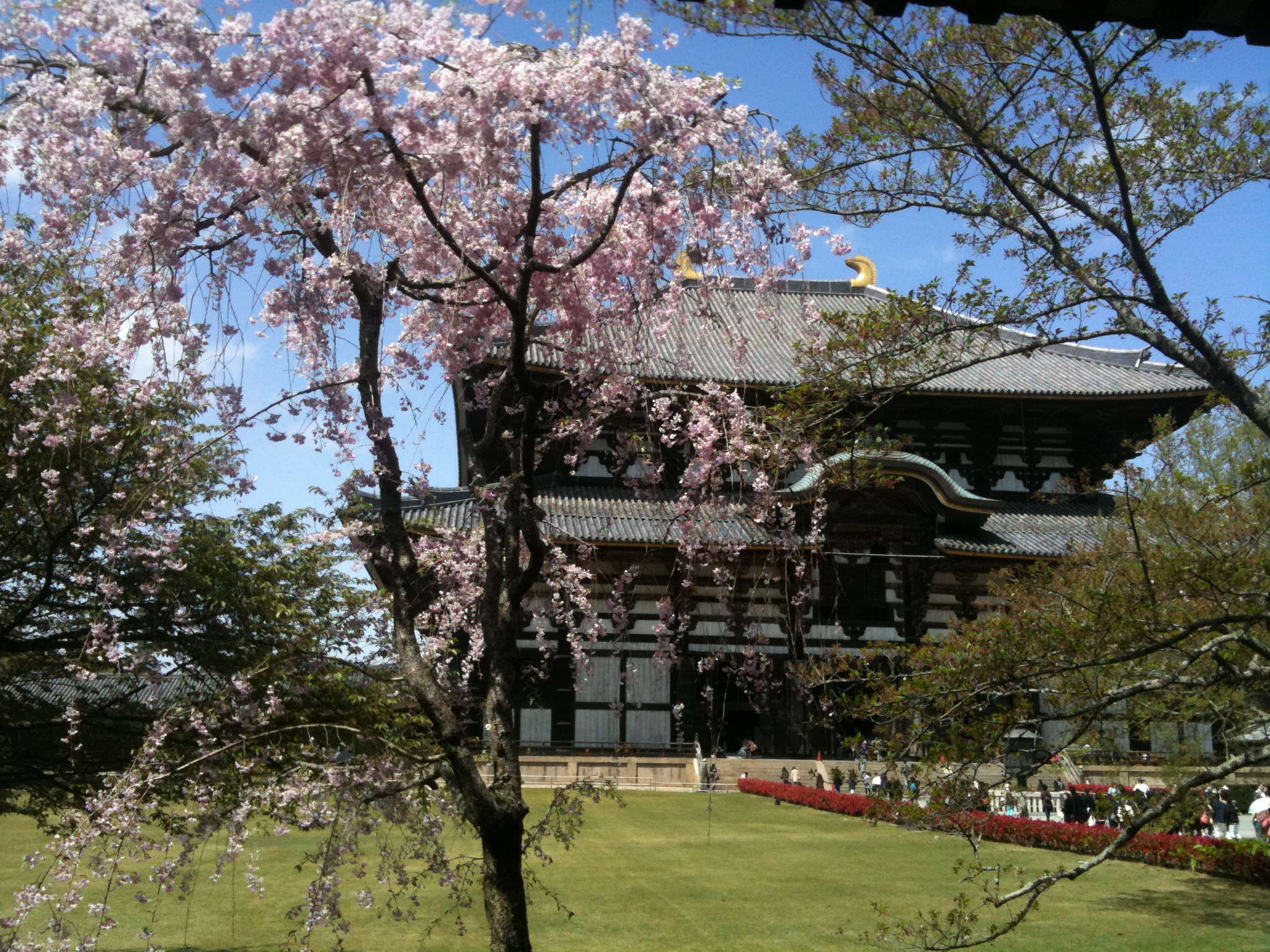
Todaiji Temple in Nara on a warm April day in 2010. Taken by author.
Even when the poems were more melancholy (poem 9, poem 11) they still reflected a more genteel time, and were probably included by Fujiwara no Teika to demonstrate the range of poetic skills of the nobility during that bygone time.
However, the Nara Period eventually gave way to the Heian Period, which was a 400-year flowering of Japanese culture that is still revered today. The transition was slow, and much remained the same generations later, but eventually things started to change:
Japan’s contact with China and the Asian mainland eventually stopped, and Japanese culture turned more and more inward for several centuries. Poetry and culture at this time reflected more “native” styles by and by.
Politically, the northern-branch of the Fujiwara clan gradually monopolized power around the Emperor through political marriages. In the early period, the nobility included several families who supported the family, but by the 11th century, the Fujiwara controlled every major position in government and most emperors were related to them in one way or another. This is what led in part to Sugawara no Michizan’e exile for example. You’ll notice too how many of the poets have the surname “Fujiwara” in the anthology as well, including Fujiwara no Teika the compiler himself.
Toward the end, conflict began to arise again and again, culminating in the famous Genpei War and the fall of the Heike clan. The new samurai class (originally bodyguards to the noble families) clashed with one another for control of Japan and ultimately swept aside the nobility, while still trying to imitate the courtly culture.
As such, if you look at poems toward the very end of the Hyakunin Isshu, they tend to be more dismal in tone. Starting with poem 77 onward, you get an increasing melancholy tone to many poems, culminating at the end when poets often speak of longing for the past (poem 100), complaints about life (poem 83, poem 99) or just expressions of people suffering (poem 95).
Indeed, by this time the flowering culture that started in the Nara Period and flourished in the Heian Period had declined, and war and politics had taken their toll on society. The final few poems begin in the militaristic Kamakura Period, and reflect both nostalgia and unease by people of that era. Small wonder that Fujiwara no Teika, who took tonsure after Emperor Go-Daigo was exiled, decided to compile the Hyakunin Isshu the way he did.
This poem was composed not by a woman as one would expect, but by a Buddhist priest named Sosei Hōshi (素性法師, dates unknown), or “Dharma Master Sosei”. He was the son of Henjō (poem 12, あまつ) before Henjō took tonsure. In fact, when Henjō did become a monk, Sosei was obligated to do the same.
Nonetheless, Sosei kept busy. He worked in the Imperial Court and was a priest, and a prolific and popular poet. He kept a salon of fellow poets including Ki no Tsurayuki (poem 35, ひさ) and Oshikochi no Mitsune (poem 29, こころあ). Both men were tasked with compiling the imperial anthology, the Kokin Wakashū, and Mostow points out Sosei is heavily represented in there. Coincidence? My new book suggests not. To his credit, Sosei is also one of the Thirty-Six Immortals of Poetry.
As we’ve seen with other poems from this earlier era, it was common to write about poetry themes, and to write from a role outside one’s own. So, for a monastic to be writing from the perspective of a lonely woman wasn’t unusual.
This poem is interesting because it seems to happen in one night, or a long period of time. It is a mystery. Mostow explains the contradiction in this poem between the “one long night” and “months” as being an issue of interpretation. Though most people assumed it was a long Autumn night, Fujiwara no Teika (poem 97, こぬ), the compiler of the Hyakunin Isshu anthology, felt it was more like a long passage of time.
P.S. Photo above is a Japanese calendar we have a home. More on that in a related post in my other blog.
The author of the poem is by a priest of the Tendai sect of Buddhism named Saki no Daisōjō Jien (先の大僧正慈円, 1155-1225), or “Former Archbishop Jien”. He was the son of the powerful Fujiwara no Tadamichi (poem 76) and nephew of fellow poet Yoshitsune (poem 91) as well as Fujiwara no Teika (poem 97) himself. Although he was from an elite family, he was the 10th son of Tadamichi, and thus extraneous. Like many powerful medieval families in both Europe and Asia, the extraneous kid was sent to a monastery. In this case, the prestigious monastery of Mount Hiei (homepage here), one of two powerful centers of the Tendai sect.
Interestingly, Professor Mostow suspects the poem may actually be an allusion to Emperor Daigo, who was said to have taken off his robe one winter night to suffer the same cold as the people did.
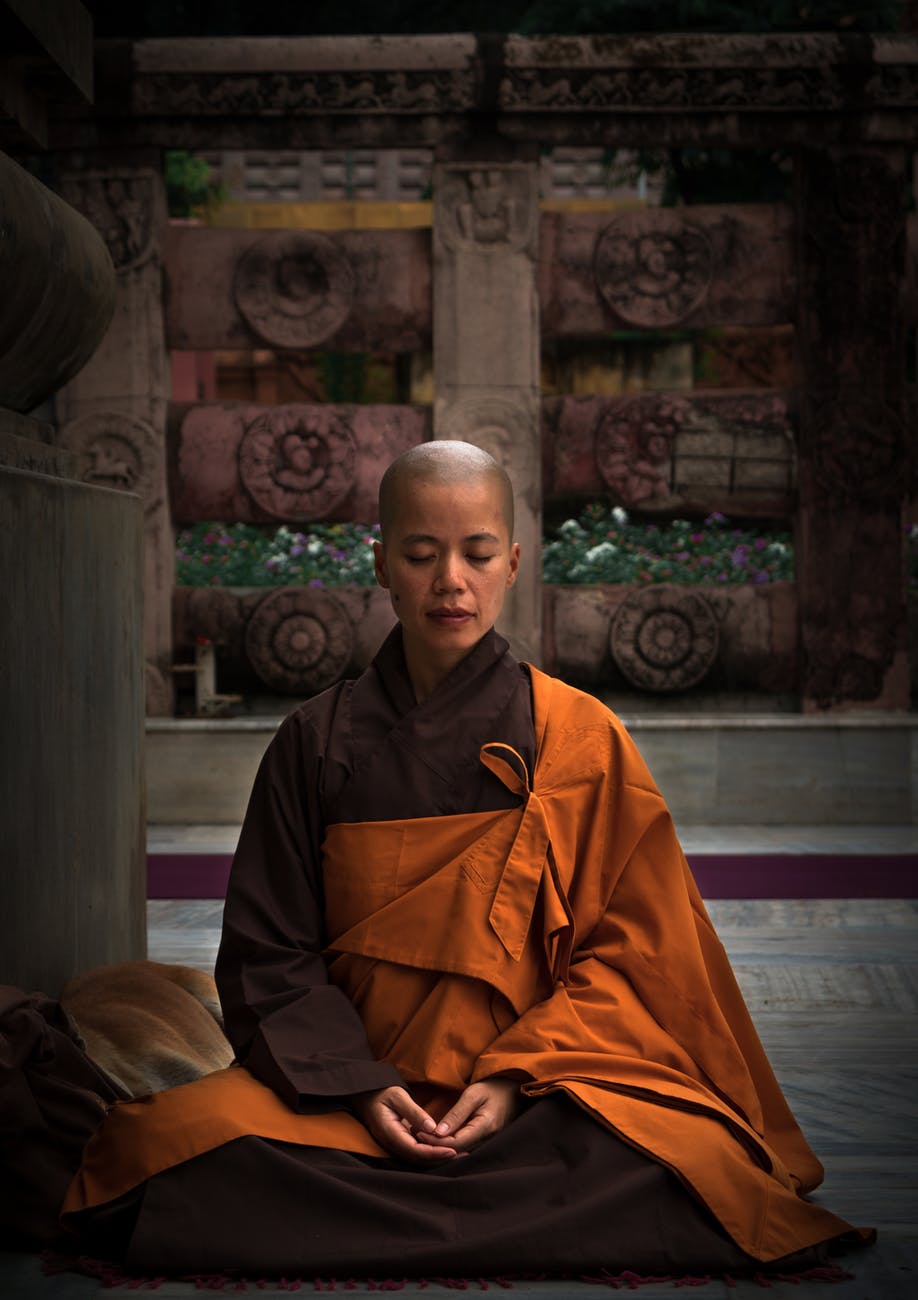
In any case, the last line of the poem is noteworthy because it is a direct quote from the founder of Tendai Buddhism in Japan, Saichō who lived centuries before. So, for many, this has been interpreted as Jien’s vow as a monk to carry on this tradition of compassion for all beings in a world that is transient and marked by suffering. Here, the “ink-black” or sumizome no sodé (墨染の袖) literally means “ink-black sleeves” (sumi is Japanese ink), and is the traditional color that Buddhist priests in East Asia wear. Compare the black sleeves with the orange-ochre robes in Southeast Asia, or red robes in Tibet.
This notion of compassion for all beings is exemplified by the Buddhist notion of a bodhisattva who is a being who is highly advanced on the Buddhist path and has turned outward to help and teach all beings before becoming a Buddha (i.e. enlightened) themselves. An example is a bodhisattva named Kannon (Avalokiteshvara), “who hears the cries of the world”.
Kannon, symbolized here with 1,000 arms, providing aid to all who seek it. Photo taken by me in 2013 at a local Vietnamese temple.
Tendai Buddhism, in particular, reveres the Bodhisattva ideal and practices, and not surprisingly the poem reflects this. In any case, the notion of goodwill and compassion for others is something I hope others find inspiring.
The poem’s author, Motoyoshi Shinnō (元良親王, 890 – 943), the Crown Prince Motoyoshi, was the eldest son of the mad Emperor Yozei (poem 13), who was forced to abdicate prematurely. This likely affected Motoyoshi’s chances of assuming the throne, and before long Emperor Koko (poem 15) was enthroned instead. As an Imperial prince with nothing to do, Motoyoshi turned all his energy to women. My new book points out that the poetry collection that Motoyoshi left behind is almost entirely about women and sex.
According to commentaries, this poem was real and not part of a themed poetry contest. Motoyoshi, apparently, was in love with one of the hand-maidens of the retired Emperor Uda. The maiden, daughter of the powerful Fujiwara no Tokihira, had already given birth to 3 sons for Emperor Uda and was highly favored by him, but Motoyoshi persisted in his love, even if it cost him his reputation. Bear in mind that this was the same Fujiwara no Tokihira who was instrumental in getting Uda’s favorite advisor, Sugawara no Michizane (poem 24), exiled.
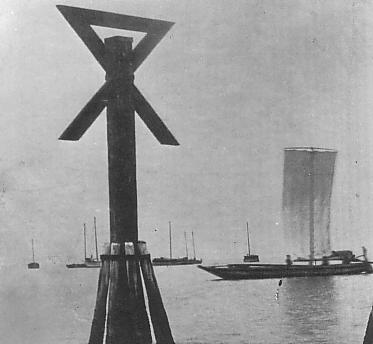
The main “pivot word” here is the phrase mi wo tsukushitemo, where miotsukushi (澪標) are famous water-markers in Japanese culture as pictured above, photograph taken during the Meiji era (Unknown author, Public domain, via Wikimedia Commons). But the poem can also be read as 身を尽くしても meaning “even if it exhausts my life”. So, rather than the subtle romantic allusions your normally see in poetry from this era, Motoyoshi is going all-out and making a big gamble.
The poem is signed as Kanké (菅家, 845 – 903), which is the Sinified (Chinese) way to read the Sugawara Family name (lit. “House of Sugawara”). You see similar names used for the Taira Clan (e.g. Heike 平家) and Minamoto Clan (e.g. Genji 源氏) in later times. Anyhow, the author is none other than the famous poet/scholar Sugawara no Michizane who in later generations was deified as a sort of god of learning named “Tenjin” after he was wrongfully exiled through political intrigue.
The term nusa (幣) means a special wand used in Shinto religious ceremonies. The photo above is an example of a nusa, more formally a gohei (御幣) “wand” used in Shinto religious ceremonies, with the paper streamers used for purification (photo by nnh, Public domain, via Wikimedia Commons). At this time in history, according to the Hyakunin Isshu Daijiten, small nusa were often made from thin strips of paper and cloth and offered to the gods for a safe journey.
The poem was composed by Michizane after going on an excursion with his patron, Emperor Uda. Compare with another outing made years later by (then retired) Emperor Uda later in poem 26. In this case, Michizane had little time to prepare, and couldn’t make a proper offering to the gods for a safe trip. However, admiring the beautiful autumn scene on Mount Tamuke, he hopes that this will make a suitable offering instead. Sadly Michizane would be disgraced and exiled only a short time later.
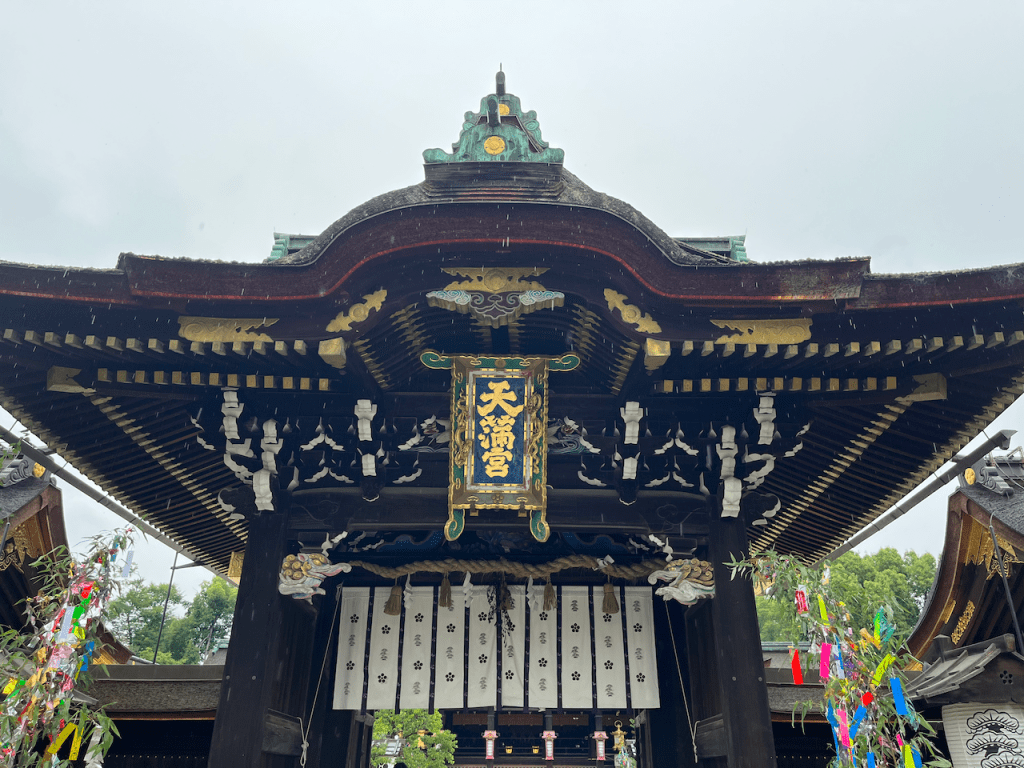
My interest in Sugawara no Michizane mostly comes because I admire him as a fellow scholar. I visited one of his shrines in Tokyo a couple times over the years, and usually try to pay respects. In July 2023, I visited the home shrine of Kitano Tenmangu as well.
Kitano Tenmangu shrine in Kyoto, Japan. Taken in July 2023.
The real life Michizane was no god of learning, but his real-life contributions to poetry and Chinese literature in Japan helped the culture flourish at that time, and earned his place as a trusted adviser to the Emperor, despite his more humble background. This also helped explain his status centuries later as a god of learning. Every year in Japan in April, students pay respects hoping that they can pass entrance exams, and it’s nice to see his legacy carry on so many years later.
The author of this poem is a monk named Ryōzen Hōshi (良暹法師, dates unknown) or “Dharma Master Ryōzen”, who supposedly composed it while doing austerities in a remote hut outside the capitol. Unfortunately, we have little about Ryōzen Hōshi’s personal history, even in my new book. He had some infamy over a poem he composed during a poetry contest, by inadvertently copying one in the Kokin Wakashu, causing him to be a laughing stock. However, other scant records show he was still respected by the nobility overall.
The notion of “Autumn sunset” appears a lot in Japanese poetry, but apparently its meaning differs depending on the time and place. Ryōzen Hoshi gives a more melancholy, almost Buddhist, tone implying that the world around him is declining into winter and possibly, metaphorically declining in a general Buddhist sense. However, Sei Shonagon (poem 62) also wrote about Autumn Sunset in her PillowBook, but used it to describe crows and wild-geese flying
An Autumn sunset means a lot of different things to a lot of different people, but it still is significant one way or another. For me, I tend to like Ryōzen’s imagery the best, and it’s the one I imagine whenever I read this poem.
The author, Fun’ya no Asayasu (文屋朝康, dates unknown), is the son of Fun’ya no Yasuhidé (poem 22), but is otherwise unknown. My new book states that, like his father, he achieved only middling rank (junior sixth rank) in the Imperial bureaucracy, but unlike his father, he did not achieve much fame through poetry either. There have been persistent rumors, though, across the ages that some of Yasuhidé’s poems were in fact composed by his son, Asayasu. However, evidence is sketchy.
The poem is something of an oddity in the Hyakunin Isshu because, as Mostow explains, it seems to be a relatively common poem. It uses a popular motif of dew as gems, comparing them to pearls or jewels, and you can find similar imagery in other poems of the time. So, why did the compiler of the Hyakunin Isshu, Fujiwara no Teika (poem 97), select this poem for this anthology?
Mostow points out that this poem is featured in other anthologies as well, so for some unknown reason, it was highly prized, even though the significance is lost now.
Still, there is something beautiful about the idea of gems scattering in the Autumn wind in particular and perhaps that is what sets this poem apart from others from the same era.
The poet, Egyō Hōshi (恵慶法師, dates unknown) also known by his title “Dharma Master Egyō”, was a Buddhist monk active during the last half of the tenth century. He was the bishop (kōsō 高僧) of a major temple in old Harima Province and often gave lectures. As Professor Mostow explains, he was closely associated with other poets who frequently met at the Kawara Villa on the banks of the Kamo River. According to Mostow, these included Yoshinobu (poem 49) and Motosuke (poem 42) among others. He was also friends with Kanemori (poem 40).
The poem was given as an entry to a poetry contest about the coming of autumn to a ‘dilapidated house’ according to Mostow, but he points out that the “house” in question was probably referring to the Kawara Villa, itself previously owned generations earlier by Minamoto no Toru (poem 14). The juxtaposition between people (who don’t visit) and autumn (which does) makes this poem highly prized.
Given that Egyō is a Buddhist monk, and well-versed in the Buddhist teachings of the effervescence of life, it seems reasonable that he used the house and the seasons to give the poem a bit of a Buddhist theme. Spring gives way to Summer, Summer to Fall, Fall to Winter and so on. In the same way, things rise and fall, and Egyō perhaps wanted to remind his audience that “Autumn” comes sooner or later.