The poem’s author, Motoyoshi Shinnō (元良親王, 890 – 943), the Crown Prince Motoyoshi, was the eldest son of the mad Emperor Yozei (poem 13), who was forced to abdicate prematurely. This likely affected Motoyoshi’s chances of assuming the throne, and before long Emperor Koko (poem 15) was enthroned instead. As an Imperial prince with nothing to do, Motoyoshi turned all his energy to women. My new book points out that the poetry collection that Motoyoshi left behind is almost entirely about women and sex.
According to commentaries, this poem was real and not part of a themed poetry contest. Motoyoshi, apparently, was in love with one of the hand-maidens of the retired Emperor Uda. The maiden, daughter of the powerful Fujiwara no Tokihira, had already given birth to 3 sons for Emperor Uda and was highly favored by him, but Motoyoshi persisted in his love, even if it cost him his reputation. Bear in mind that this was the same Fujiwara no Tokihira who was instrumental in getting Uda’s favorite advisor, Sugawara no Michizane (poem 24), exiled.
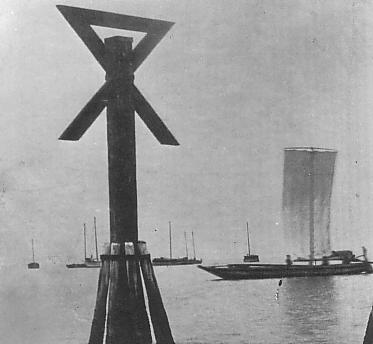
The main “pivot word” here is the phrase mi wo tsukushitemo, where miotsukushi (澪標) are famous water-markers in Japanese culture as pictured above, photograph taken during the Meiji era (Unknown author, Public domain, via Wikimedia Commons). But the poem can also be read as 身を尽くしても meaning “even if it exhausts my life”. So, rather than the subtle romantic allusions your normally see in poetry from this era, Motoyoshi is going all-out and making a big gamble.
This poem was composed by Fujiwara no Toshiyuki Ason (藤原敏行朝臣, ? – 901) who was one of the Thirty-Six Immortals of Poetry, and was an active participant of poetry contests in his day and noted for his excellent calligraphy. His calligraphy was so good, he was often compared with the talented Buddhist monk and founder of the Shingon sect, Kukai.1 Coupled with his long life-span, he has a great presence in poetry and calligraphy during his era. My new book mentions that both he and one Ariwara no Norihira were both infamous playboys, and ended up marrying sisters. Needless to say his wild episodes were recorded in certain tales at the time.
In fact, this poem is part of a poetry contest held in 953, presumably under the theme of forbidden or another similar topic. The poem uses a clever pun for yoru. The first yoru in the poem refers to the waves visiting (寄る in modern day Japanese) the shore of Sumi-no-e Bay (modern day Osaka Bay, specifically Sumiyoshi).
The second yoru means night (夜). The author’s submission to the poetry contents laments that public scrutiny in the small, tightly-knit aristocracy of the Heian Period was so intense that his lover couldn’t even visit him even in his dreams. Professor Mostow points out that the poem can also be interpreted that he could not visit his lover in his dreams, as well.
Because it was such a closed and stratified society, gossip was rampant, and an embarrassing situation could destroy one’s career and family reputation. Forbidden love was something many in the Heian Court faced, and no doubt Toshiyuki’s poem resonated with such people.
1 Kukai (a.k.a. “Kōbō Daishi” posthumously) was so famous for his calligraphy, a phrase exists even to this day in Japanese:
This poem was composed by one Fujiwara no Yoshitaka (藤原義孝, 954 – 974), the third son of Fujiwara Koremasa (poem 45). It was composed and sent after spending the night with his lover. These kind of “morning after” poems are very common at the time because lovers could not meet openly during the day, so they often met at night and slept together. The term for this kind of poem is kinuginu no uta (後朝の歌), and were often a way of sharing feelings after the two have parted company.
As Mostow also explains, it’s not clear why he valued his life so little, but the main interpretation is that he loved her so much, he was willing to throw his life away just to meet her. Other interpretations are, among other things, that he would have thrown away his life for her sake if he could.
What really makes this poem extra tragic though, is that Yoshitaka died at the age of twenty (he lived from 954 to 974), from smallpox. We don’t know what happened between him and his lover, but at least his words live on.
Anyhow, we’re at the halfway-point of this blog, and I wanted to thank everyone for your support. The biggest thanks go to Professor Mostow who graciously allowed me to use his translations for this blog (if you like to study the Hyakunin Isshu more in depth, I recommend his book).
This poem was composed by Sōjō Henjō, (僧正遍昭, 816 – 890), “Bishop Henjo”, who served in the Heian Court until the death of Emperor Nimmyo. It was then that he took tonsure as a Buddhist priest. He is one of the original Six Immortals of Poetry as well as the Thirty-Six Immortals.
The poem was composed during the time that Henjo was in the service of the Emperor (and not yet a priest). The occasion for this was the famous Gosechi Dance or gosechi no mai (五節の舞), more formally known as the toyono akari no sechi-é (豊明の節会), a dance that took place in the Imperial Court during the middle of the eleventh month of the old Japanese calendar (roughly December in modern times) to celebrate the harvest.
During the final months of the year, the Imperial Court held several important events to celebrate the yearly harvest, starting with the niiname no matsuri (新嘗祭) when the Emperor would offer part of the harvest to the gods.1 The following day, the Court would celebrate the Gosechi dance at the Shishinden Palace, and the Emperor would partake of the new harvested rice. According to Richard Bowring, the Gosechi festivities last up to four days.
The Gosechi dance involved 4 “heavenly” maidens called otomé (をとめ) from high-ranking noble families, and is mentioned by several authors from the era, including Sei Shonagon (poem 62) in the Pillow Book:
[87] At the time of the Gosechi Festival somehow everything in the palace, even the people you see every day, becomes simply delightful. There’s the unusual sight of the bits of coloured fabric that the groundswomen wear in their ceremonial hair combs, rather like abstinence tags. When they seat themselves along the arched bridgeway from the Senyōden, the dapple-dye pattern on the ribbons that bind up their hair stands out beautifully, and the whole effect is somehow quite marvelous. It’s perfectly understandable that the serving women and those who attend the dancers should find it all a splendid honour.
The Gosechi dancers arrived on the twentieth….I knew full well how hard the young dancers had prepared this year in comparison to normal years when things were worse it must have been for them this year, I thought; I was both apprehensive and eager to see them. As they fully stepped forward together I was, for some reason, overcome with emotion and felt dreadfully sorry for them….And with all those young nobles around and the girls not allowed so much as a fan to hide behind in broad daylight, I felt somehow concerned for them, convinced that, although they may have been able to deal with the situation both in terms of rank and intelligence, they must surely have found the pressures of constant rivalry daunting; silly of me, perhaps. (pg. 39-40)
trans. Richard Bowring
Further, even artwork depicts the Gosechi as shown by the featured photo, painted by Hokusai.
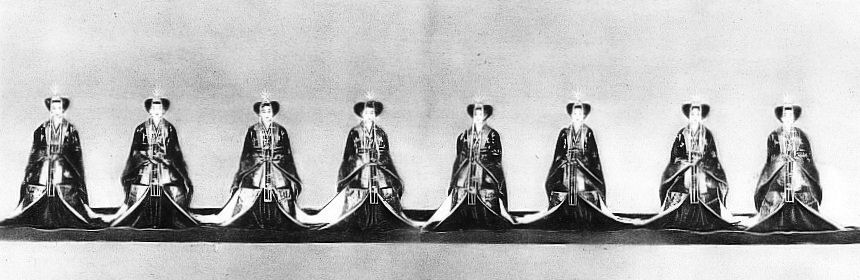
Even now, the Gosechi dance is still performed for the Emperor, at least for special occasions:
Dancers of the Gosechi dance performed in 1928, for the ascension of the Showa Emperor. See page for author, Public domain, via Wikimedia Commons
But I digress, Henjo was so mesmerized by their dance, he compared them with heavenly maidens, and hoped that the breeze would keep them on the earth a bit longer. As Professor Mostow notes, the Gosechi dance had a legendary origin involving Emperor Temmu who beheld heavenly maidens in the sky one night, so Bishop Henjo isn’t just making this up.
However, his playful simile has lasted through the ages.
1 This is still observed today in the form of Labor Day in Japan.
This poem was composed by Gotokudaiji no Sadaijin (後徳大寺左大臣, 1139 – 1191), the “Later Tokudaiji Minister of the Left Sanesada”. His personal name was Fujiwara no Sanesada, and he was the first cousin of Fujiwara no Teika (poem 97), as well as the nephew of Shunzei (poem 83). He left behind an extensive poetry collection as well as his personal diary.
According to Professor Mostow, the poem was composed on the topic of staying up all night, to hear one cry.
The hototogisu (ホトトギス), is called the “lesser cuckoo” in English, or, is Cuculus poliocephalus. The featured photo was taken by Kunming Institute of Botany. Sun Jiao (Interaccoonale), CC BY 4.0, via Wikimedia Commons.
The hototogisu in Japan is a famous bird known for its early summer call, and is thus an emblematic bird of the season. Compare with the plover in poem 78.
You can see a video of its call below:
According to the Hyakunin Isshu Daijiten, the hototogisu is an elusive bird. It flies from branch to branch often, so by the time you hear its distinctive call, it probably has flown elsewhere. Hence, they are easy to hear, but hard for birdwatchers to observe.
In any case, as Professor Mostow explains, the author is waiting all night to hear the first call of the hototogisu as the first sign of summer.
One other note is the term 有明 (ariake), which is one of many poetic terms for the moon. Specifically it means the moon that remains in the morning, after daybreak. This normally occurs on the 16th day of the lunar cycle according to the old Japanese calendar.
Sei Shonagon (清少納言, dates unknown), along with Lady Izumi (poem 56) and Lady Murasaki (poem 57), is one of the most famous female authors of her generation and Japanese history as a whole. She was the daughter of Kiyohara no Motosuke (poem 42). Her name Sei is another way to read the Chinese character “kiyo” (清), while Shonagon refers to a government post (lit. “lesser councilor of state”), but it’s unclear why it’s attached to her.
She’s best known as the author of the Pillow Book. Despite the name, it is mostly just a book of witty observations regarding court life, nature, art, etc. Whereas Lady Izumi was a hopeless romantic, and Lady Murasaki was melancholy, Sei Shonagon’s writings show she had a sharp, often haughty wit:
[151]People who seem enviable — You set about learning to recite a [Buddhist] sutra, stumbling along, going endlessly over the same places and constantly forgetting bits. When you hear the same words tripping smoothly off the tongues of others — not only the priests, but other men and women — you wonder enviously if you’ll ever be able to perform like that.
….You have an urge to go on a pilgrimage to Inari Shrine, and as you’re laboriously gasping your way up the steep mountainside to the middle shrine, you’re filled with admiration to see others who’ve obviously started behind you go climbing straight up without the least effort; when you arrive, there they stand, already at their worship….
The Pillow Book, trans. Dr Meredith McKinney, page 152
Sei had the misfortune of serving Empress Teishi, who fell out of favor after her father died, and the Emperor’s 2nd wife, Empress Shoshi, eclipsed her. Lady Izumi and Lady Murasaki served the latter, and by that time Sei Shonagon was a bit of a has-been. This same power struggle also negatively impacted Fujiwara no Sadayori (poem 64). It is thought that Pillow Book was, among other things, a subtle middle-finger to the Court for abandoning Empress Teishi by painting such a rosy picture of her time.
In any case, this poem demonstrates Sei Shonagon’s wit at her finest though. As with the excerpt above, the back-story for this poem also comes from the Pillow Book:
[129] … One evening, Secretary Controller Yukinari visited the Office of the Empress’s Household [where Sei Shonagon resided as a lady-in-waiting], and stayed talking far into the night. He finally left as dawn was approaching, remarking that he must return by the Hour of the Ox [2 – 4 am] …. the next day he sent a wonderful and very lengthy message on several pieces of official paper from the Chamberlain’s Office, saying “My heart is still full of regrets for yesterday. I thought to stay till dawn speaking with you of things past, but the cock’s crow hastened me early on my way.”
In reply I wrote, “That cock you say you heard so late last night, could it be the false cock of Lord Mengchang?”
“They say,” wrote Yukinari in return, “that Lord Mengchang’s cock opened the Kanko barrier gate and thus allowed his three thousand followers finally to escape — but the barrier gate in my case was the lover’s barrier gate of Osaka.”
So I sent back the following [the poem above]
This exchange has a lot of wit, and some double-entendre (in Japanese too). Clearly, Sei is not convinced by his eloquent excuse and sends this snarky poem back that basically says that no one at Ōsaka Gate (Meeting Hill) would be fooled by it. He has to sleep alone.
The author, Akazome Emon (赤染衛門, 958? – 1041?), was another court lady in waiting for Empress Shoshi, along with Lady Murasaki (poem 57) and Lady Izumi (poem 56). Although her father is officially Akazome no Tokimochi, it is theorized that her father was actually Taira no Kanemori (poem 40) due to an affair by her mother.
Akazome Emon has an impressive 93 poems in the Shūishū Imperial anthology, and composed at least part of the Eiga Monogatari another classic from the era.
While Lady Murasaki had harsh words for some of her associates, according to Mostow, she describes Akazome Emon as having “great poise” and takes her poetry seriously, without composing verses just for the fun of it. Indeed, Lady Murasaki states she is “most accomplished”.
My new book also mentions that Akazome Emon was liked by the other ladies in waiting, and even by rival cliques including Sei Shonagon (poem 62) whom she corresponded with. It is even said she was happily married to her husband Oe no Masahira (大江匡衡), a rare thing in a world of political marriages.
The poem above itself is a bit of a mystery though. The headnote to the poem is explained as Akazome Emon writing a poem on behalf of her sister who waited all night for her lover, Middle Regent Michitaka, but was stood up. Michitaka was an extremely powerful and charming man in his day and likely had multiple lovers even as he maintained his legitimate marriage to Takashina no Takako (aka Gidōsanshi no Haha, poem 54). Akazome writing this poetic complaint on behalf of her jilted sister was an increasingly common practice at the time.
As explained before, women lived sheltered lives in his era, and men rarely could see them except by secret arranged meetings, and yet sometimes a women might wait all night without her lover ever coming. This is a frequent topic in the Hyakunin Isshu anthology as well, both real and fictional.
However what makes this poem standout is that Akazome Emon complained to Michitaka in a sweet, unaccusing way, when she obviously meant the opposite. “Oh, it’s no big deal I stayed up all night waiting for you, I saw the full moon tonight. No big deal.”
There is some research that suggests that maybe Akazome didn’t author the poem, though it’s unclear who did. Nevertheless, whoever was stood up that night, I hope Michitaka apologised the next day. 😏
Daini no Sanmi (大弐三位, dates unknown), was the daughter of Lady Murasaki (poem 57) and was an accomplished poet as well. Her name in the Hyakunin Isshu is a sobriquet and comes from her husband’s position as Assistant Governor-general of Dazaifu province (daini). She served as the wet-nurse for Emperor Go-Reizei, she achieved the prestigious Third Rank in the Court hence “sanmi”.
This poem seems simple at first, which Professor Mostow explains as a poem composed about a man who had grown distant toward Daini no Sanmi, and that he was uneasy because he believed her feelings for him had changed. However, the poem contains some clever word-play too. The first three lines lead up to the word soyo which is an otomatopeoia for the sound of rustling grass, but also means “so it is!”. Professor Mostow explains that this is meant to convey to the man that she was the one was uneasy (because he was uneasy?). In other words, she was worried about his feelings because she cared about him. It’s amazing how one word can make all the difference like that when the context is just right.
Also, as a bit of reference, Arima Mountain, or arimayama (有馬山) is in the northern part of the city of Kobe, and boasts one of the most famous and oldest hot-spring resorts in all of Japan called Arima Onsen (有馬温泉). The Hyakunin Isshu Daijiten states that the combination of bamboo grasses at Ina (猪名) and Mount Arima was a popular setting used by many poets in antiquity.
One interesting aspect about the Hyakunin Isshu as a collection of poems is its tendency to have poets related to other poets in the anthology. The poems are not necessarily close to one another numerically, but quite a few poets in the anthology are related to another poet either as the child, parent, siblings, etc. You can see it through the women poets, but also through many of the male poets as well: Kiyohara no Motosuke (poem 42) is the father of Sei Shonagon (poem 62) and grandson of Kiyohara no Fukayabu (poem 36).
The name of the author is unknown. She is only known as Udaishō Michitsuna no Haha (右大将道綱母, c. 937-995), or “The Mother of Michitsuna, Major Captain of the Right” both in the Hyakunin Isshu and in the Gossamer Years. Her son, Michitsuna, went on to be a Court official who held the prestigious post of Major Captain of the Right.
The Mother of Michitsuna, was the second wife of the powerful and ambitious Fujiwara no Kane’ie, and her diary, like this poem, reflects her pain and frustration as her husband slowly slips away from her and into the arms of other women. As the modern Japanese proverb goes: eiyū iro wo konomu (英雄色を好む), meaning “great men prefer color”. In other words, after Kane’ie had snagged his beautiful new bride, the mother of Michitsuna, he was off on his next conquest, and this pattern would continue throughout their marriage. His trophy wife was thus abandoned except when he needed her for some reason.
According to her diary, at times the couple reconciled somewhat, but over time they became more and more estranged, and the author thus felt more depressed and abandoned as the years wore on.
This poem actually comes from the Gossamer Years, book one, when her husband Kane’ie is spending his nights in a back-alley with a low-class woman in a short-lived affair (Kane’ie soon abandoned that woman even after she bore him a son). As she writes:
Two or three days later I was awakened toward dawn by a pounding on the gate. It was he, I knew, but I could not bring myself to let him in, and presently he went off, no doubt to the alley [and the mistress] that interested him so.
I felt that I could not let things stand as they were. Early the next morning I sent, attached to a withered chrysanthemum, a poem written with more care than usual.
What’s important to understand is that this poem wasn’t something she composed for a poetry contest (i.e. poems 40 and 41), she was genuinely expressing her frustration and rage at being abandoned by her husband Kane’ie. Fujiwara no Teika, no doubt impressed with the poem and the story behind it, included it in the Hyakunin Isshu generations later.
The author, Ukon (右近, dates unknown), takes her sobriquet after her father’s position in the Court as Lesser Captain of the Right Bodyguards, or ukon-e no shōshō (右近衛少将). She served as a lady in waiting to Empress Onshi. Apparently she was a busy woman. Like her father, she is said to have had a number of romantic liaisons, including Atsutada (poem 43), Asatada (poem 44), and Prince Motoyoshi (poem 20) among others. Her tryst with Atsutada is mentioned in a later text called the Tales of Yamato. Ukon also actively participated in poetry contests.
Professor Mostow explains that there are historically two interpretations to this poem. One interpretation is that she wrote the letter to her cold lover, conveying a mean, sarcastic tone. My new book favors this theory, and implies that the lover who spurned her was none other than Fujiwara no Atsutada mentioned above.
The other explanation is more of a private letter to herself. This second meaning then sounds less harsh in tone, and more tragic.





 The Hyakunin Isshu


