Every March 3rd in Japan,1 families with daughters celebrate a holiday called Hinamatsuri (ひな祭り) also known as the Doll Festival, or usually in English it is called Girls’ Day.
The derives from a kind of doll called hina that are usually on display in the family home starting one month earlier (February 3rd). The displays can be very simple as shown above which we have at home, or, the displays can be very ornate:
A full display at Uwajimaya store in Seattle, Washington. I took this photo years ago, and submitted to Wikimedia Commons here.
This display recreates an Imperial wedding between a prince and his bridge, not unlike those that high-ranking authors of the Hyakunin Isshu probably celebrated back in the day complete with ox-drawn carts of gifts, musicians, ladies-in-waiting, and so on. This tradition is to celebrate daughters, and to wish them a happy wedding in the future. This may seem a bit old-fashioned, but it’s also a great time to wish your daughters prosperity and happiness, regardless of how they choose to live their life.
It’s also fascinating that while the Heian Period culture of Japan is long gone, you can see traces of it today even in modern Japan. When someone like Takako (poem 54) married the powerful Fujiwara no Michinaga, I can’t help but wonder if her wedding looked something like this…
The good news is that I cross the halfway point in late March and memorized 50 of the poems! 🎉 When I started in January, I wasn’t I’d get very far before life got in the way. It has gotten in the way since returning to the US, but I have been able to manage learning the Hyakunin Isshu amidst the chaos.
The bad news is is that I stopped to review the 50 cards that I learned so far, and discovered that even those that I knew well are already starting to fade from memory! 😮
This has reinforced for me that periodic review is required for weeks, maybe months on old cards. Even if I feel I have “nailed it”, my mind gets rusty pretty quick. So, I had to go back and start reviewing old cards again, which takes away from learning the remaining 50.
Thus, I am experimenting with a hybrid method whereby I review a small number of cards per day (3-5 max), with a mix of old and new. I found that powering through more cards per day was exhausting and not always feasible with my schedule, and one card per day wasn’t quite enough. So, I settled on 3-5, and keep it on my desk at work so that i can review for a minute or two. Small, frequent reviews seem to work better than “power sessions”.
By mixing old and new, I hope I can also trim down the cards that I need to review, but also keep the momentum going in learning the remaining poems.
One nice thing to consider is that once I’ve memorized all 100, then it’s just review for the rest of my life. No need to learn more poems (unless I delve into Imperial anthologies or other works). So, part of me just wants to hurry up and power through the last 50, but until we get closer to the end, I think it’s essential to keep an even pace of learning a few poems at a time, while also reviewing old ones bit by bit.
Time will tell.
P.S. Thanks to everyone who’s been submitting ideas, suggestions, translations and so on for the Hyakunin Isshu. I am not always able to respond, but I do read and appreciate them. 🙂
P.P.S I am posting this at the end of March, despite the title. I just assume that as April is imminent, people won’t always read this post right away.
My progress in memorizing the Hyakunin Isshu poems, for the sake of learning to playkaruta, continues, but since returning to the US, it has taken some twists and turns.
When I got back home, it became clear how busy my day to day life is compared to Japan, where I didn’t have to worry about work commitments, and had fewer natural distractions from hobbies, projects, etc. So, my original strategy of learning one poem a day quickly unraveled.
Further, as the number of cards I memorized has grown (38 out of 100 as of writing), the effort to review them all has grown too. As the number grows even larger, it gets harder and harder to review all of them daily.
So, I started switching to a spaced-repetition style of learning to help manage the load. This means I focus more on the cards I still need to improve on, and focus less on the ones I know well, while still reviewing periodically. To accomplish this, I needed a way to not only organize my cards, but also manage the progress of each one.
I brushed off one of my old Legion brand deck boxes from when I used to actively play Magic the Gathering (yes, I am a giant nerd).
Inside, I used a few card dividers (some borrowed from other deck boxes) into sections. The section in the back represents cards that I know well and can recite with little or no effort. The section in the middle represents cards I am still struggling with. The section in the front is the “new” queue: cards I have yet to learn but have lined up next.
I mostly focus on the middle queue, since I am actively learning them, but not comfortable enough yet to move them to the “back” queue. I also review the back queue from time to time, and occasionally have to move cards from there to the middle queue in situations where I feel a poem needs a bit more active review. I also try to add a new card from the “front” queue every 1-2 days.
This process took some trial and error to get right, and it may not work for everyone, but it has helped me regain my pace in memorizing the Hyakunin Isshu after some interruptions after coming back to the States.
My original goal was to finish by end of April, and this is still possible, but I have lost some time and now I am hopeful I can memorize all one hundred poems by June.
Of all the poets of the Hyakunin Isshu anthology, arguably the most famous, especially overseas is Lady Murasaki (poem 57), who in Japanese is called Murasaki Shikibu (紫式部). She is the author of the Tales of Genji, which epitomized life in Japanese antiquity, and is among the first novels in history. But another work by Lady Murasaki that’s notable here is her eponymous diary, of which an illustrated version appeared centuries later. In English this is simply known as the Diary of Lady Murasaki (murasaki shikibu no nikki, 紫式部の日記).
The diary covers the period from years 1008 to 1010, and provides a first hand account of her life serving the powerful regent, Fujiwara no Michinaga. Michinaga is not featured in the Hyakunin Isshu, but his power as regent was great enough to ruin the lives of a few poets in the anthology:
Michinaga was locked in a power-struggle between his branch of the Fujiwara Clan, and another branch, led by Morechika. Both had daughters married to Emperor Ichijō, and both were fighting to be the regent (kanpaku, 関白) of Ichijō’s heir. In the end, Michinaga’s daughter, Empress Shōshi, gave birth to the future Emperor Go-Ichijō (Ichijō the Latter). With it, Michinaga became the most powerful man in Japan.
At the beginning of the diary, Lady Murasaki describes the events leading up to Empress Shōshi giving birth, and the elaborate ceremonies to protect her and the unborn child from evil spirits. Although it was technically a private ceremony, Michinaga hired an army of priests and shamans to both bless the child, and also to ward off evil spirits. Lady Murasaki, as a member of the household, describes sitting in the crowded audience chamber for hours, listening to the fevered chanting and elaborate rituals.
Then the diary skips ahead to the first weeks of the child’s birth, and further ceremonies. Michinaga spares no expense to protect his grandson (whom he will be the regent of, and thus the true power behind the throne) from diseases, evil spirits and so on. In elaborate rituals, members of the household are selected to read the Confucian Classics to the baby to ensure he will be an august ruler. More priests are called into ward off evil, and so on.
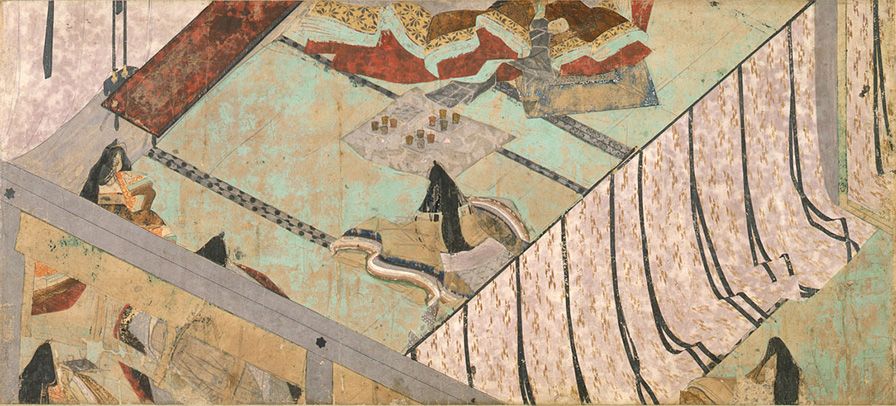
A 13th century illustration of Empress Shōshi and her infant son, with Lady Murasaki in attendance from the Murasaki Shikibu Nikki Emaki (illustrated diary of Lady Murasaki). Tokyo National Museum, Public domain, via Wikimedia Commons
But what about Lady Murasaki?
Lady Murasaki herself comes from a lesser branch of the Fujiwara clan, and since her husband already died some time ago, she describes herself as “washed up”. She held no official appointment in the Imperial Court. And yet, through Michinaga, she becomes a trusted confidant and tutor of the Empress. Michinaga knew talent when he saw it, and wasn’t shy about packing his household with as much as he could get away with.
Lady Murasaki was but one of several famous ladies-in-waiting recruited by Fujiwara no Michinaga to increase the status of his daughter, Empress Shōshi, vis-a-vis the Emperor’s first wife, Teishi (Morechika’s daughter).
Lady Murasaki’s diary implies that life as a lady-in-waiting is a lot of “hurry up, then wait”: periods of great activity and ceremony, followed by long periods of boredom. The period after the child’s birth eventually winds down and leads to a lot of free time, where Lady Murasaki reflects on many things, as well as disparaging some of the other ladies-in-waiting. Here are some examples of her contemporaries who also happen to appear in the Hyakunin Isshu:
Lady Izumi (poem 56) – “She does have a rather unsavory side to her character but has a talent for tossing off letters with ease and seems to make the most banal statement sound special.“
Akazome Emon (poem 59) – “She may not be a genius but she has great poise and does not feel she has to compose a poem on eveyrthing she sees, merely because she is a poet.“
Sei Shonagon (poem 62), part of the rival clique under Empress Teishi – “…was dreadfully conceited. She though herself so clever and littered her writings with Chinese characters; but if you examined them closely, they left a great deal to be desired.“
She also grapples with persistent depression. Her sullen, introverted nature often wins her few friends among other ladies of the Court:
And when I play my koto rather badly to myself in the cool breeze of the evening, I worry lest someone might hear me and recognize how I am just ‘adding to the sadness of it all’; how vain and sad of me. So now both of my instruments, the one with thirteen strings and the one with six, stand in a miserable, sooty little closet still ready-strung.
The diary then jumps forward into a letter written at a later date. The intended recipient is unknown, but is thought to be her daughter Daini no Sanmi (poem 58). Here the diary includes a great deal more self-reflection, and further analysis of the other ladies in waiting, including her grievances with another clique of ladies centered around the high priestess of the Kamo Shrine, Princess Senshi (daughter of Emperor Murakami).
Finally, the diary jumps around a few more times in narrative, and then abruptly stops. Richard Bowring points to theories that other fragments of the diary once existed, possibly some in the Eiga Monagatari, or some possibly in possession by Fujiwara no Teika (poem 97, and compiler of the Hyakunin Isshu), but these are all speculation.
The Diary is pretty short; you can read it cover to cover in a couple of hours. And yet it’s a fascinating blend of historical perspective, and very relatable personal reflection. Loneliness and depression affect people of today as much as it did people of her time, and yet she has to carry on through stodgy court ceremony, pressures of the insular life in the aristocracy, and constant back-biting amongst the ladies-in-waiting.
In one lengthy anecdote, she describes a prank that the other ladies-in-waiting decide to pull on one Lady Sakyō, who apparently had retired from service, then returned to serve another nobleman. The prank was to send a luxurious “gift”, but with a lot of symbolism regarding youth, implying ironically that Lady Sakyō was an old has-been.
The diary lists several incidents where drunken nobles harass attractive servants during dinner, servants who are unable to really do anything about it since they owe their entire livelihood to those nobles. Alternatively, the noblemen, bored themselves, play mean pranks on the ladies, steal their robes, or pull their skirts. Because of the power imbalance (also frequently alluded to in the Gossamer Years), it was just an accepted part of life, and the ladies often had to regularly dodge that minefield.
Middle Counselor Elect Taka’ie, who was leaning against a corner pillar, started pulling at Lady Hyōbu’s robes and singing dreadful songs. His Excellency [Michinaga] said nothing….Realizing that it was bound to [be, sic] a terribly drunken affair this evening, Lady Saishō and I decided to retire once the formal part was over.
trans. by Richard Bowring
Michinaga himself frequently bursts in on Lady Murasaki, sometimes drunk, demanding a quick poem or a verse for particular occasions. Although Michinaga never makes advances on Lady Murasaki, his overbearing demeanor exhausts her, yet she also admires his quick wit and ambition. I can imagine Michinaga in moderns times being a flashy, talented CEO with a dubious reputation :
I felt depressed and went to my room for a while to rest. I had intended to go over later if I felt better, but then Kohyōe and Kohyōbu came in and sat themselves down by the hibachi. ‘It’s so crowded over there, you can hardly see a thing!’ they complained. His Excellency [Michinaga] appeared.
‘What do you think you’re all doing, sitting around like this?’ he said. ‘Come along with me!’
I did not really feel up to it but went at his insistence.
trans. by Richard Bowring
Another frustration that Lady Murasaki describes is the rigid social hierarchy within the aristocracy. Lady Murasaki was from a middle-ranked family, and while not a menial servant herself, she was frequently reminded of her place. This included things like being unable to wear the “forbidden colors“, where she sat during court ceremonies, and whom she was allowed to address directly. Lady Murasaki sums it like so:
The water-music that greeted the Emperor was enchanting. As the procession approach, the bearers — despite being of low rank — hosted the palanquin right up the steps and then had to kneel face down beneath it in considerable distress. ‘Are we really that different?’ I thought to myself as I watched. ‘Even those of us who mix with nobility are bound by rank. How very difficult!’
trans. by Richard Bowring
What she often describes, when reading between the lines, is that for all its pomp, culture and beauty, life in the Heian Period aristocracy was a kind golden sham:2
I returned to the Palace on the twenty-ninth of the twelfth month [after a month absence]. Now I come to think of it, it was on this very night that I first entered service at court. When I remember what a daze I was in then I find my present somewhat blasé attitude quite uncomfortable.
trans. by Richard Bowring
One other thing to note is that her diary alludes to the Tales of Genji frequently. By the time she was recruited by Michinaga, a few drafts of the work had already been in circulation, and this probably helped her reputation. Even the illustrious Fujiwara no Kintō (poem 55) pays her a brief visit in the diary calling her “Murasaki” (e.g. purple) as an allusion to one of her characters in the novel. Richard Bowring implies that this moment might be how Lady Murasaki got her sobriquet.3 We saw this with Nijōin no Sanuki (poem 92) in later generations as well. Sadly, it seems that these copies of the Tales of Genji were sometimes borrowed and never returned, or copied by other people, and since each copy took so long to compose, Richard Bowring implies that it is a miracle that the work survived at all.
In any case, the Diary of Lady Murasaki is probably one of the best descriptions of life in the Imperial Court and its (often oppressive) aristocracy. It was a world of beauty and also of frustration and bitterness.
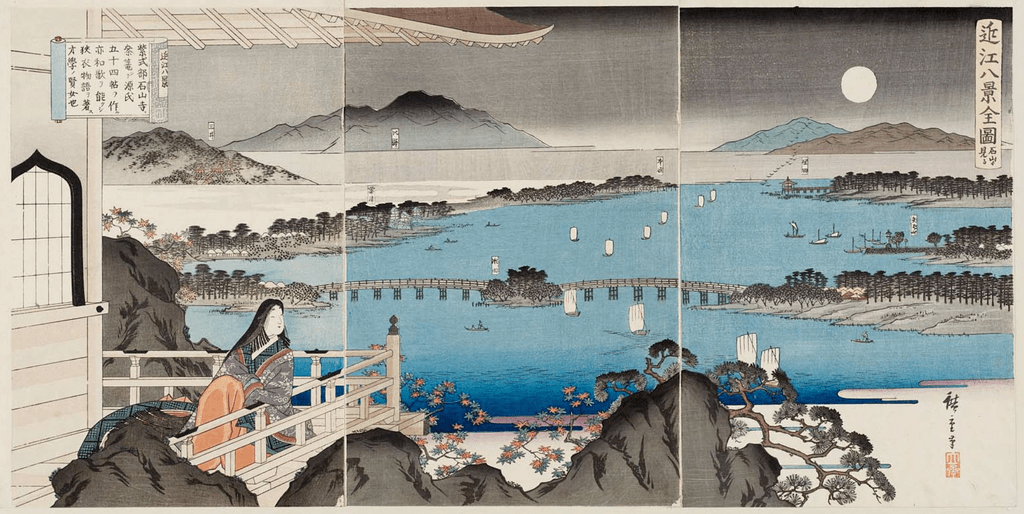
P.S. Photo is a famous woodblock print by Utagawa Hiroshige (Public domain, via Wikimedia Commons), depicting a legend about Murasaki Shikibu at Ishiyama Temple. These are the 3 panels of the nishiki-e: “Eight Views of Omi Province as Seen from Ishiyama” (Ômi hakkei zenzu, Ishiyama yori miru). Notice her purple (murasaki) robes.
1 Sei Shonagon was a lady in waiting for Empress Teishi, who was a daughter of Michinaga’s rival. When Michinaga’s rival is driven out by a scandal, Teishi is relegated to the background, and Sei Shonagon retires in obscurity.
2 Valkyrie in the movie Thor: Ragnarok had said much the same thing about Asgard, too.
3 Her true name is not known, but is thought to be Fujiwara no Kaoriko (藤原香子).
Edit: since writing this post, I took up the game of karuta, which requires learning only certain verses of each poem. This post is not for playing karuta, but for learning the poems for aesthetic reasons. You can always do both, but I learned the hard way that knowing the full poem still won’t help with karuta due to speed required.
I started this blog in 2011, and after a long lull, I have picked it up again and added a lot more to it. One thing I never did though was memorize the Hyakunin Isshu anthology. I had a poem or two (poems 24 and 33) that I kind of remembered, but never really put in much effort beyond that. It seemed daunting, and yet as I have learned, many kids in Japan do it as part of high school competitions and other things [correction: they learned the kimari-ji for playing karuta]. My wife used to learn it in school too.
Further, after a long stay in my room due to Covid, I had a lot of time to revisit various hobbies, and I realized that I truly enjoyed the Hyakunin Isshu above many other things. Between this, and visiting Japan in December 2022, I finally decided it to make the effort.
You might be asking yourself why someone who’s not Japanese would go to the trouble of memorizing 100 poems, especially if they’re not written in modern, standard Japanese. But recently I’ve come to appreciate a few things:
Translations are just translations. Even the really excellent translations by Joshua Mostow don’t quite convey things the way the original author intended. It’s not because of bad translations; it’s just the reality of language.
I discovered that reciting the poems in Japanese out loud sometimes reveals things that simply reading them cannot. It’s hard to explain, but for example Lady Izumi’s poem (poem 56) sounds a lot nicer to me when recited as-is even in my badly accented Japanese. Same with Emperor Koko’s poem (poem 15).
Memorizing the poems is helpful for the karutacard game. At the very least, when you learn to play karuta, you need to learn the kimari-ji for each poem. However, if you learn the poems as whole, and not just the first syllables, you gain a deeper understanding of the poem, and it brings the game to life.
Finally, to my surprise, I’ve discovered that if you do know even some Japanese, the poems are still understandable to a modern (let alone a foreign) audience. It’s amazing how much of the language has carried over across the centuries.1
So, how does one memorize the Hyakunin Isshu? Here’s some tips:
Learn Hiragana, Optional
First, while not required, it is really useful to learn Hiragana script in Japanese especially if you want to play the karuta game. Kanji (Chinese characters) are also nice to know, but not strictly required. You can rely on Romanized Japanese (rōmaji), but you’ll often hit limitations. If you’re interested in Japanese culture anyway, hiragana opens a lot of doors, and makes learning the Hyakunin Isshu a lot more fun. If you’d like to learn more about hiragana script, check out my other blog here and here.
Keep in mind that spelling of words has changed over time, so modern omou (おもう) was often spelled as omofu (おもふ) in pre-modern times even if the pronuncation was the same. There are not many spelling differences, and they are predictable, but just be aware that they exist. The good news is that modern pronunciations are usually provided beside the poem.
Get a Karuta Set, Optional
This is another optional suggestion, but I find it really helpful for using spaced repetition: purchase a karuta set. If you are not able to get a hold of one, 3×5 cards can work too.
In either case, I like having something tactile that I can use to learn something. However, your learning style may be different.
Use Spaced-Repetition
The notion of spaced repetition is a technique for memorizing a lot of content by dividing it up into small chunks (hence the need for 3×5 cards or a karuta set) and then gradually sorting out the ones that are easy to learn vs. the ones that aren’t.
I started only learning 1-2 poems a day, randomly selected from my karuta set, and then reviewing everything I had learned up to this point. Some cards naturally floated to the top as “easy” cards (the poems were just easier to memorize) and get sorted into the easier pile. Other cards have more tricky poems, and I sort these into a harder pile, and focus on memorizing that harder pile until they all go into the easy pile.
Sometimes you’ll still forget an “easy” poem. This is natural. In such cases, you just move it to the hard pile for that day and re-learn it.
Memorize As A Song
Many experts and educators will tell you that learning new information through verses, songs or rhymes is often a handy method to easily memorize the content, and the poems of the Hyakunin Isshu have in fact been recited out loud across the ages. This is often true of haiku as well: the poems come to life when recited out loud in a sing-song style.
Japanese people often recite the poems in a style like that shown below:
Notice how the first three verses are recited, then after a pause the final two verses are recited. This is the same style used for playingkaruta, by the way. Even if you are tone-deaf, like me, you can still pick up this style of recitation easily enough to help you practice the poems out loud.
Find A Sustainable Pattern
Finally, unless you are Vulcan or an Android, it is quite difficult to take in all the poems at one time. I found it better to focus on a poem or two at a time, and keep reviewing old ones. Eventually, the review pile grows longer and longer, but as of writing I’ve memorized 15 poems in about 3 weeks. Maybe some people can do it faster, others might be slower.
It’s important to find a sustainable pace so it doesn’t become a source of stress (then you’re more likely to give up), but still gives a consistent sense of progress and reward. Since you have a fixed goal, each poem you learn reduces the number you have to learn by that much.
Good luck and happy memorizing!
1 Compare with English, which has undergone many radical transformations and now Old English is barely readable to a modern audience without sufficient training.
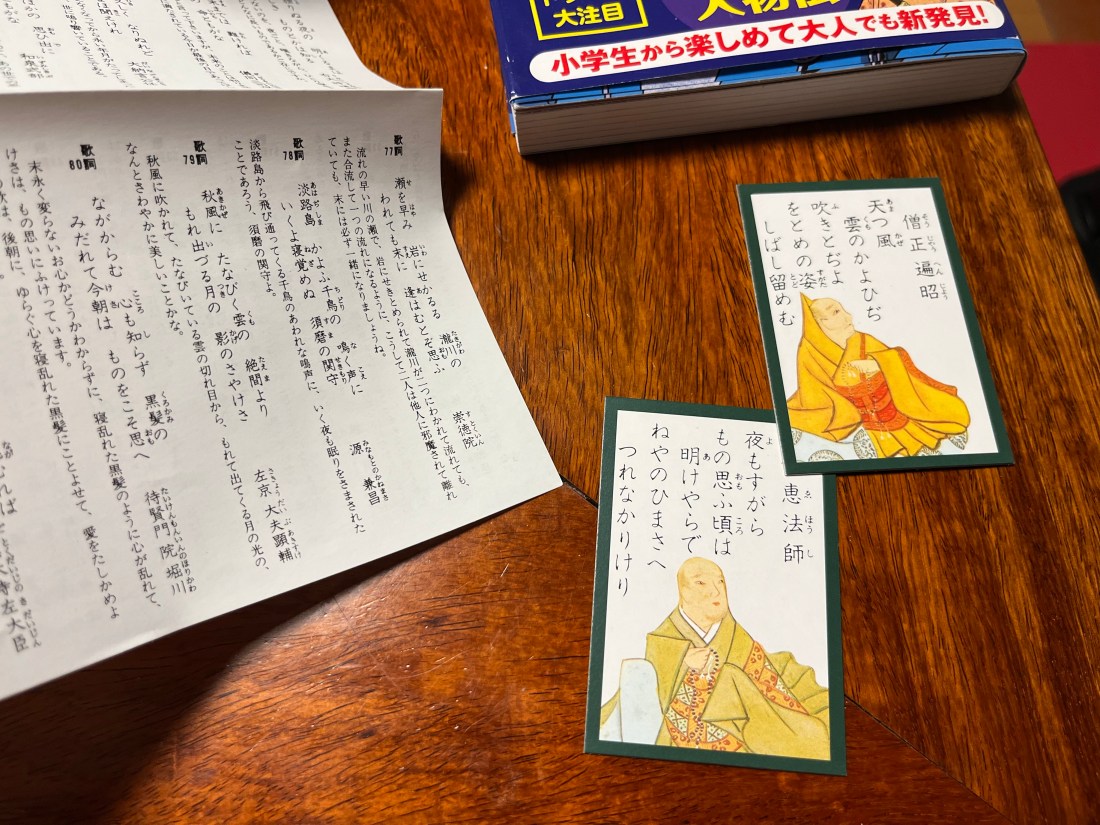
While here in Japan for a couple weeks, I picked up my first karuta set of the Hyakunin Isshu at the local bookstore when I realized that getting to the more famous store was harder than I expected, and I just won’t be here long enough for local delivery.
However, my interest in the Hyakunin Isshu was not sated with a single set, and so, when the family I went to a local Kinokuniya bookstore (we have them in the US too), I found another set that I liked, shown above.
This set, by Silverback, linked here, is another set of karuta cards, but this one includes a CD of someone reciting the poems (読み手, yomité) just like in a karuta game. As you can see from the linked product description, this set has the cards color-coded. The illustrated cards (yomifuda) have a beige background, while the verses cards (torifuda) are blank white for easy searching.
When I got back home, I imported the CD into my iTunes playlist, so I can shuffle the album. That allows me to practice the karuta game since the next card read out loud will be random.
I can’t decide with of the two sets I like better. The artistic detail on the Kyoto set (the first purchase) is really quite amazing, while the character illustration on the Silverback set is more what I am familiar with. The CD the Silverback set is quite handy (and sounds very nice), while the box and presentation on the Kyoto set is more sturdy.
I suspect I will probably continue collecting sets over time. Each one is a work of art by itself. I also learned alot how and where to purchase karuta sets and will be updating my blog post about it as a result.
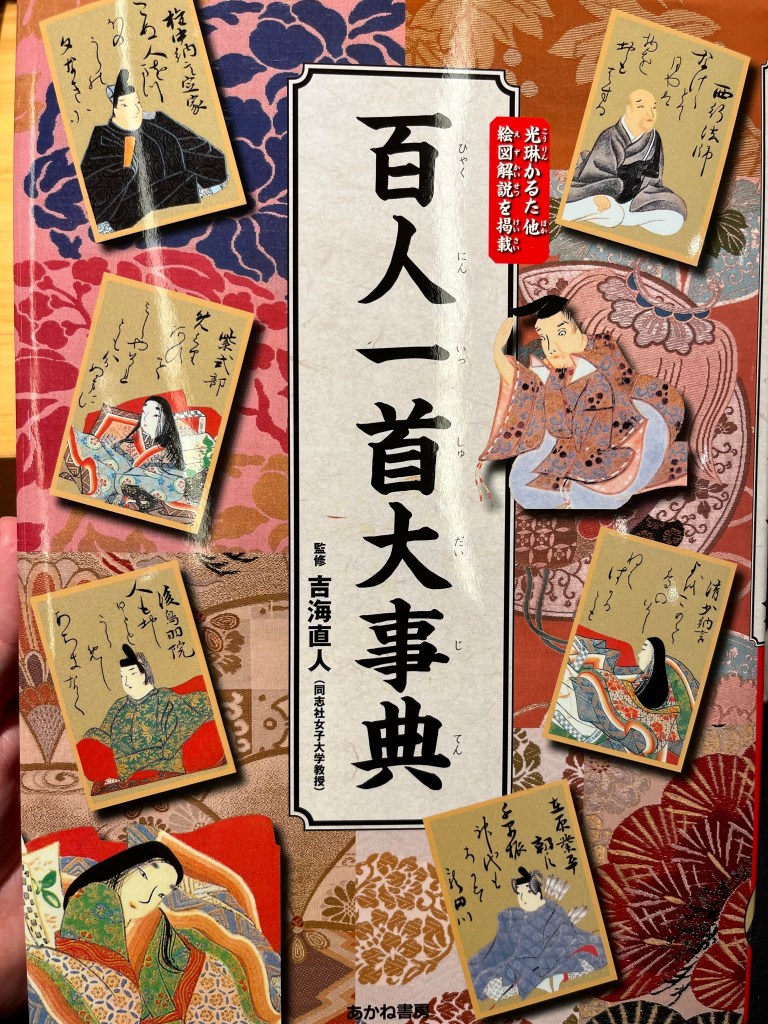
Separately, while at Kinokuniya though, my wife noticed this fascinating book (publisher’s link):
This is a comprehensive book (大辞典, daijiten) all about the Hyakunin Isshu. I like this book because it’s geared for younger audiences, so it’s easier to read, but it’s very comprehensive in detail about each poem, old vocabulary, famous places mentioned in the anthology and so on. I will likely be drawing on this book in the future.
One other interesting note about the book is that it does not present the poems in the usual numerical order, instead it sorts by topic (love, spring, autumn, etc) which is (coincidentially?) closer to how Waka poems were organized in official Imperial anthologies.
Anyhow, it’s been a very lucrative haul, and gives me plenty to admire and practice with. I have been busy memorizing poems of the Hyakunin Isshu over the past few weeks and will write more about how to accomplish that.
I finally did it! I got my very own karuta set of the hyakunin isshu.
Since we came to Japan earlier this week (just ahead of snowy weather, no less), my original plan was to go to the famous karuta shop in Tokyo: Okuno Karuta.
However, since we are here primarily for family matters, we are here for a narrow window of time, and because it’s fairly deep in Tokyo (and thus far removed from my in-laws home), getting there is probably not feasible. Plans might change, but I don’t think I will be able to visit this time around.
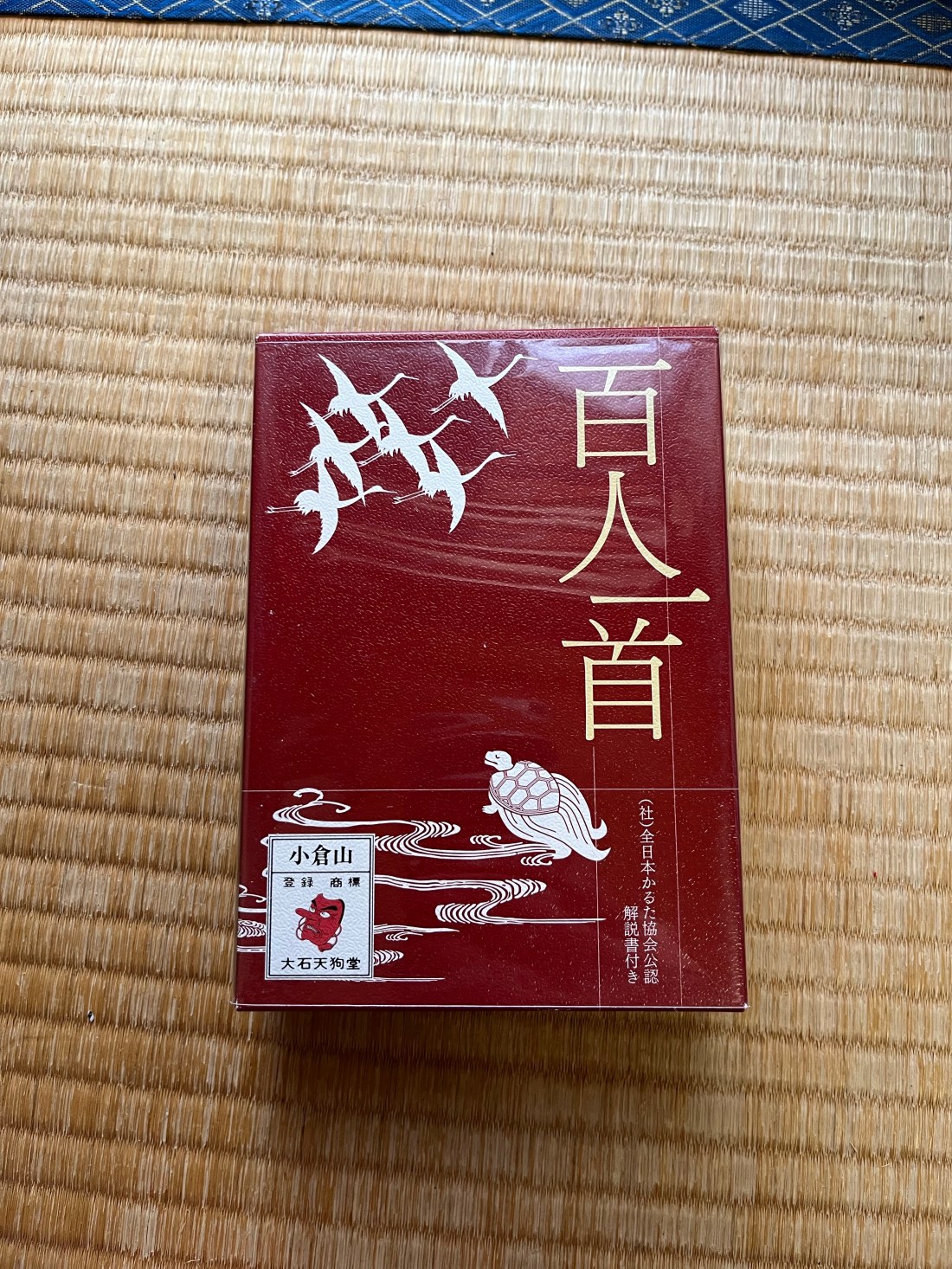
On the other hand, at a local bookstore I found a really nice, affordable set!
This set is made by Kyoto Tengu-dō, another famous karuta company. I love the box design. Inside, you can see the full set of yomifuda and torifuda cards:
As the product link shows, this set was designed for beginners to karuta games, and the torifuda cards (the ones without pictures) are written in a very legible font, so they’re easier to newcomers to find cards on the fly.
The illustrations are different than what I normally see on karuta cards, but I found out later that this is more typical of handicrafts from Kyoto, versus more Tokyo-style art. Also, the more I look at them, the more I appreciate the amazing detail, such as the clothing patterns, curtains, etc. It’s really fun just to flip through the cards and look.
This set cost me ¥1700, so about $12-15 (depending on exchange rate), which as a gorgeous starter set is quite good deal in my opinion.
Also, I suspect that this won’t be the last set I collect either. 😜
P.S. I had also thought about ordering from Okuno Karuta, but I can’t be sure it would arrive at my in-laws house in time due to holidays and our short schedule. Like I said, I am in no rush and will visit another time.
If you’re following on this blog, which I started way back in 2011, I am happy to report that the updates I made are now done. I made several updates and fixes, including:
Fixing broken links. There were quite a few (such is the ephemeral nature of the Internet).
Converting poem text into HTML tables for easier comparison.
Replaced some photos with updated photos from Wikimedia or Pexels where appropriate, proper citations added.
Consistent formatting updates to each poem page. When I first wrote them, there was some drift between how certain pages looked vs. other, newer pages.
Fixed or replaced, a few non-poem posts that were just really outdated.
Behind the scenes, fixed markup code in WordPress. The code I
used predated the current design, and led to some weird behavior.
Edited and rewrote some historical descriptions for clarity, or expanded on some details.
Anyhow, thanks all for patience, and please continue to enjoy!
P.S. I will be heading to Japan in a few days with the family (first time since pandemic), and hope to provide some updates for this blog, along with the other blog.
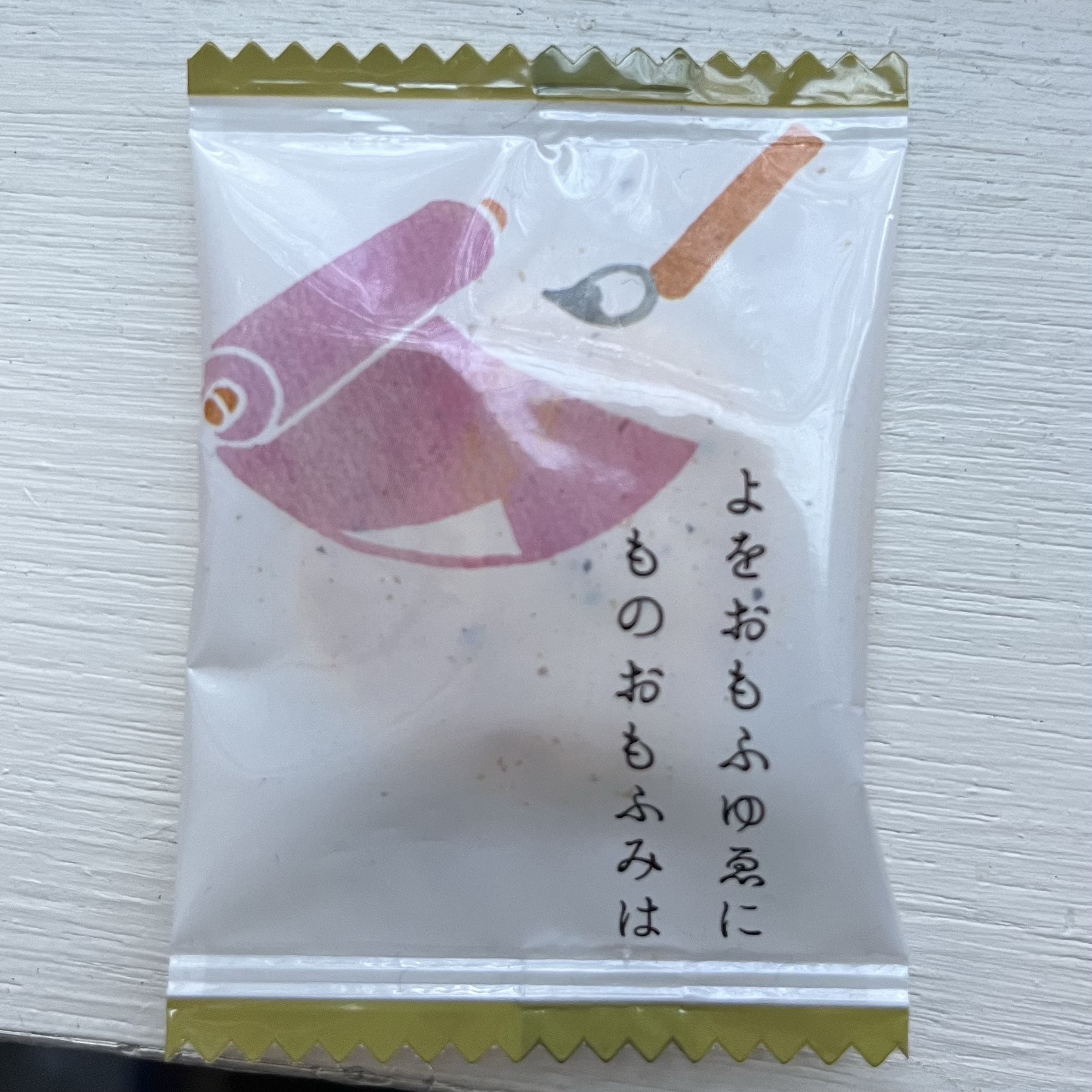
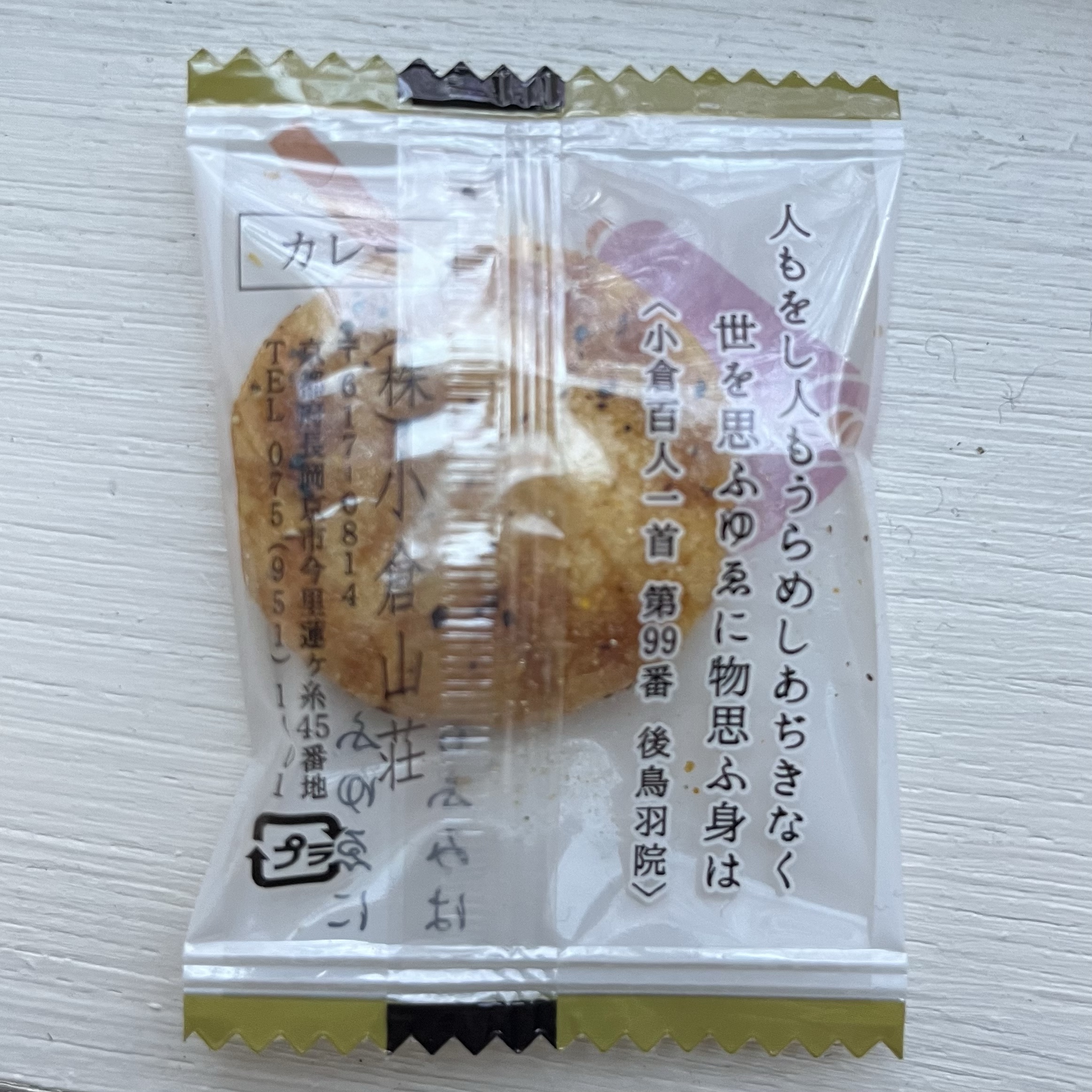
In Japan, gift-giving (omiyagé お土産) among friends and relatives is a common tradition, and recently a friend returned from Japan and gave us some special crackers (senbei) featuring poems from the Hyakunin Isshu. The crackers come in different flavors, and the wrapper each has a random poem.
I got a curry-flavored one:
The first two verses of the poem, poem 99, are written on the front. On the back are the remaining verses:
Hyakunin Isshu-themed crackers are sold here and there, and I’ve posted about it in the past, but it’s still nice to get them from time to time.
P.S. This vendor sells Hyakunin Isshu themed senbei crackers as well (it was the vendor featured in the original post).
Since initially making this blog way back in 2011, I have learned that you can now find karuta competitions (競技かるた kyōgi karuta) online on the official Youtube channel!
Here’s a recent high school playoff competition in 2022 for men:
and ladies playoff competition:
As you can see, it’s a very formal, elegant affair, with traditional clothing, customs, etc. Good manners and sportsmanship are emphasized.
Hyakunin Isshu karuta sets, such as those used in games and competitions, are always divided by two sets of cards:
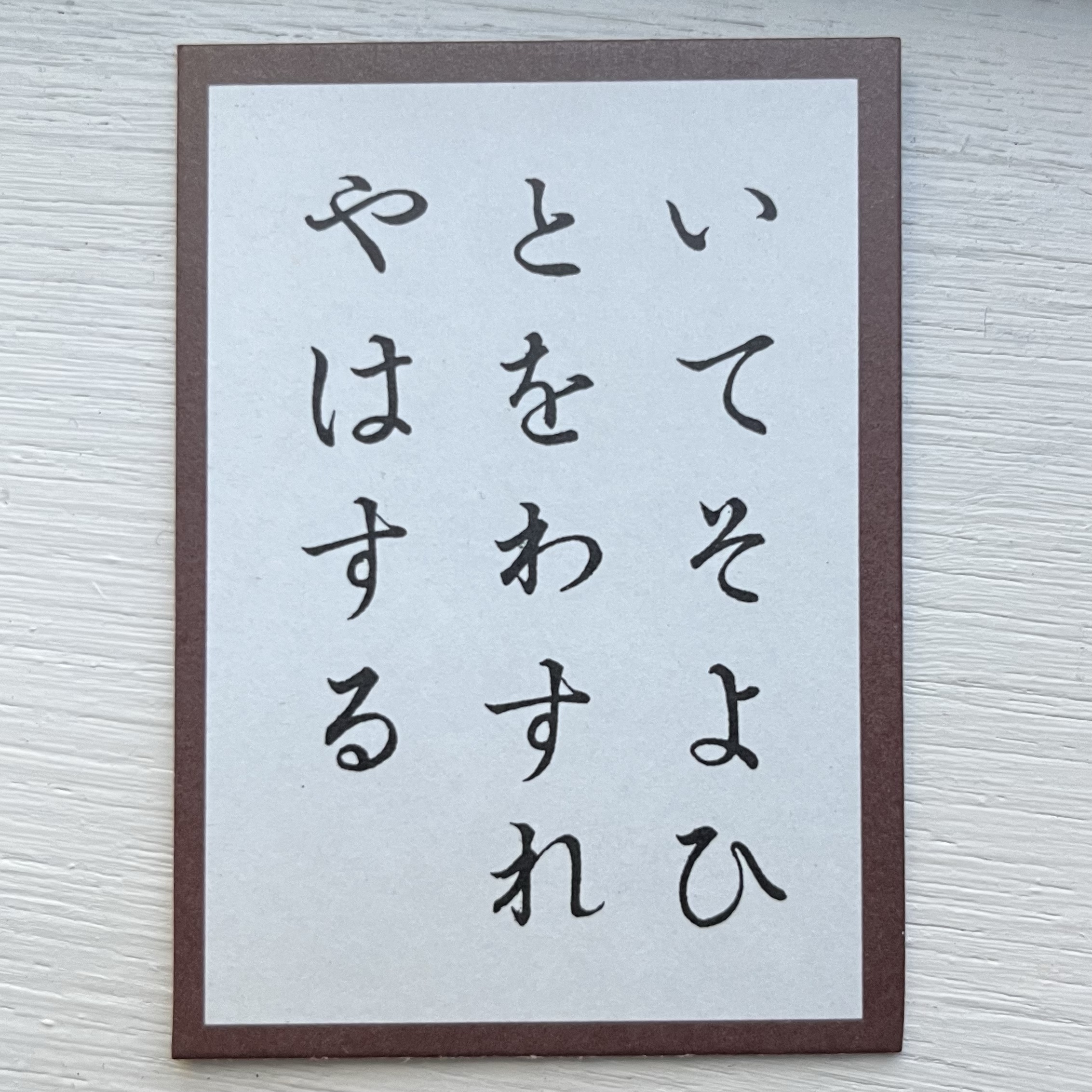
yomifuda (読み札) cards, illustrated cards with entire poem on them, and
torifuda (取り札) cards that only contain the last only the last 2 verses. Illustrations below.
The yomifuda card for poem 58, with the last two verses circled in blue. These correspond to the matching torifuda card on the right.
The matching torifuda card with the last two verses. Torifuda cards are always written in simple hiragana script for easy reading.
I admit that I am still learning the rules, but the gist is that 50 of the 100 total torifuda cards are laid out in a set pattern of cards on the floor, half (25) of them on one player’s side, the other half (25) with the other player.
A diagram of the play field that I made using LibreOffice
The yomité (読手, “reciter”) reads a randomly select poem in full using the illustrated yomifuda cards above.
The yomifuda card for poem 58, from my wife’s karuta set.
The players have to wait until the first 3 verses are completed, then if the matching torifuda cards on the field (i.e. the last 2 verses of the poem), the players can try to take that card. Whoever touches it first wins that round, and the card is taken off the field. Usually, players will swat the card aside because it’s just faster and keeps the other player from touching it.
If the card had been on the opponent’s side (相手陣, aitejin), then not only is the card taken off the field, but you also select a card from your side (自陣, jijin), and send it over to their side. Usually the players will raise their hand to pause the match while they decide which card to send over. The end result is that the cards on your side are reduced by 1, the opponent’s remain unchanged. If the card you took was on your side, then your side is reduced by 1 anyway. No transfer needed. When watching the videos, the player will the lower number of cards is winning.
Side note, if the matching torifuda card was not on the board anyway, then it’s considered karafuda (空札, “empty card”), and the game moves onto the next round.
The player who removes all cards from their side is the winner.
Anyhow, it’s pretty interesting to watch, even if the competitions can take an hour or more. You can see how explosively fast the players are.
Finally, I’d like to give a shout out to groups such as the Boston Karuta Club and Seattle Karuta Club. They have plenty of helpful links in English on getting started with karuta, rules and training resources, among many other great resources!











 The Hyakunin Isshu


_4.jpg)
_6.jpg)
