I can’t believe this thing has kept going for so long. When I made my first post (here is the first poem I posted), I never imagined that fifteen years later I would still be fascinated by the Hyakunin Isshu, or that I would have so many wonderful readers from around the world, including some in my own backyard. ❤️
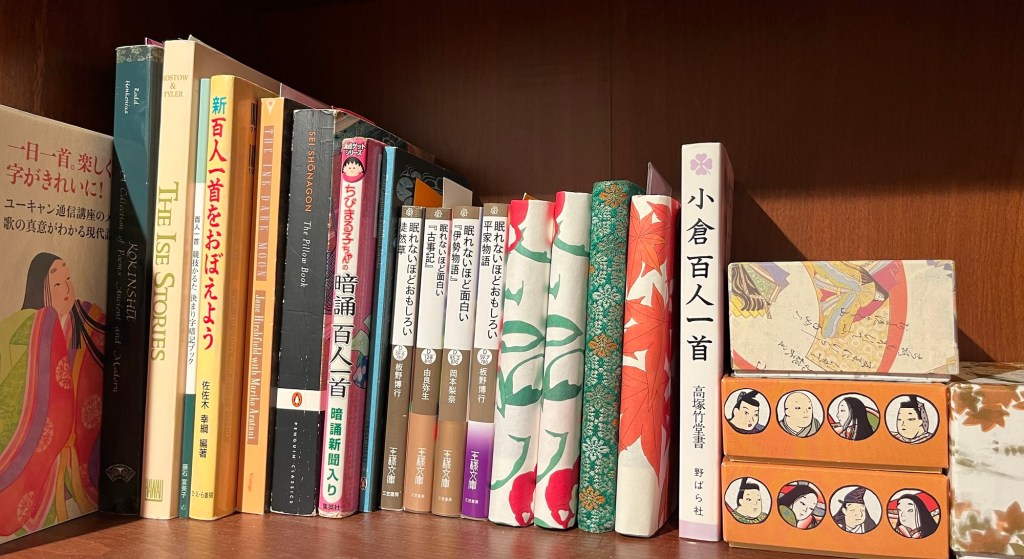
My bookshelf collection, minus a few items too large to fit. The book in yellow on the left belonged to my late mother-in-law (RIP). A few books are wrapped in book covers too.
Thank you all for your support and interest over the years. 🥰 With luck, this blog will hopefully stay around for a long time to come.
This summer my family went back to Japan to visit relatives while I stayed home, and one of the souvenirs they brought back was this wonderful book (publisher’s link here):
This book was sold at a local Kinokuniya bookstore in Japan, and each page of the book features a poem from the 100 poems of the Hyakunin Isshu, in traditional numerical order. Within that page, you can practice your own handwriting by writing out the poem, first on the right-hand side, and again on the left.
Here’s a close-up of one of the pages, depicting poem 41 (こい), one of two poems from a famous poetry contest (poem 40 is the other). You can see the poem is written out in traditional style: right to left, vertically. There is a special handwriting guide on the left-side of this page with tips to help with certain difficult Chinese characters. You can also trace the poem on the right side of the page to practice your penmanship.
On the following page, there are some historical details about the poem. In this case, it is a lineage chart of the Imperial family at the time, and focuses on the reigning Emperor Murakami who succeeded the throne after the death of Emperor Daigo. On the bottom right is a glossary of terms, since the poem is composed in old Japanese, and thus the spellings and vocabulary are not clear to modern speakers.
This is a pretty neat book, and I am hesitant to practice my handwriting on it, since it is pretty poor. But I love the idea, and it’s a lot of fun to look through. It also seems like a nice relaxing exercise if you go slow, and take in each poem one by one.
If you are ever in Japan, and happen to be browsing a local bookstore, keep an eye out for books like this. The Hyakunin Isshu continues to be a populartopic, and you’ll find many such excellent books and many ways to savor and enjoy this wonderful anthology.
Lately, I’ve been having some fun conversations with coworkers introducing them to the Hyakunin Isshu, and while describing the poems, I realized that learning the kimari-ji of each poem is a handy way to keep track of which poem is which. When I first learned the Hyakunin Isshu way back in the early days of this blog, I tried to learn the poems by number. They are listed in numerical order in many publications, so this made sense.
However, many publications in Japan also list the poems by their kimari-ji too.
But if you’re not playing karuta (casual or competitive) why bother? Think Michael Jackson.
The album cover for Michael’s Jacksons Thriller, courtesy of Wikipedia.
Michael Jackson’s songs are tremendously famous. As soon as I say out loud, “Eddie are you OK?”, or “Billie Jean”, anyone listening beyond a certain age range will know how to finish the next lyric. It’s not necessary to know the whole song, simply knowing a key lyric triggers the rest of the song, or at least recognition of the song.
Think of kimari-ji the same way. Since the Hyakunin Isshu was meant to be a compilation of the very 100 best waka poems in Japanese antiquity (as chosen by Fujiwara no Teika), you can think of them as a “Best of Michael Jackson” album collection.
Thus, rather than remembering poem 29 it may be easier to remember it as the ko-ko-ro-a poem since the first line starts with that verse (kokoro até ni), and that’s enough to distinguish itself from other poems.
At last, the historical drama about Lady Murasaki has come to an end this week, and sadly I watched the last episode. The drama was slower than other past Taiga Drama on NHK, but it was a lovely tribute to an amazing woman. Lady Murasaki, author of the Tales of Genji, her eponymous diary, and a famous poem in the Hyakunin Isshu left a lasting mark on Japanese culture and world literature.
The concluding title card for the historical drama: hikaru kimi é (光る君へ, “to you, my radiant one”).
Details of Lady Murasaki’s final years are pretty sketchy, but it seems that she eventually retired from service in Fujiwara no Michinaga’s household, and gradually took up travel. She was born in the year 973, but some scholars believe she may have passed away in 1014 at the age of 41. Others believe she may have lived to the year 1025 (age 52). For the premodern era, this is a pretty typical lifespan for many people, including nobility. Still, as someone who’s older than her, it’s hard to imagine her dying so young.1
With her passing, a couple attempts were made to preserve and edit her magnum opus. Fujiwara no Teika (poem 97, こぬ) who compiled the Hyakunin Isshu itself undertook one of these efforts, creating the Aobyōshibon (青表紙本) edition. At this time in Japan, manuscripts had to be hand-copied, and so across several centuries, limited efforts were made to hand-copy works from Lady Murasaki’s time, which helped preserve them across the medieval period, but were inaccessible to general audiences.
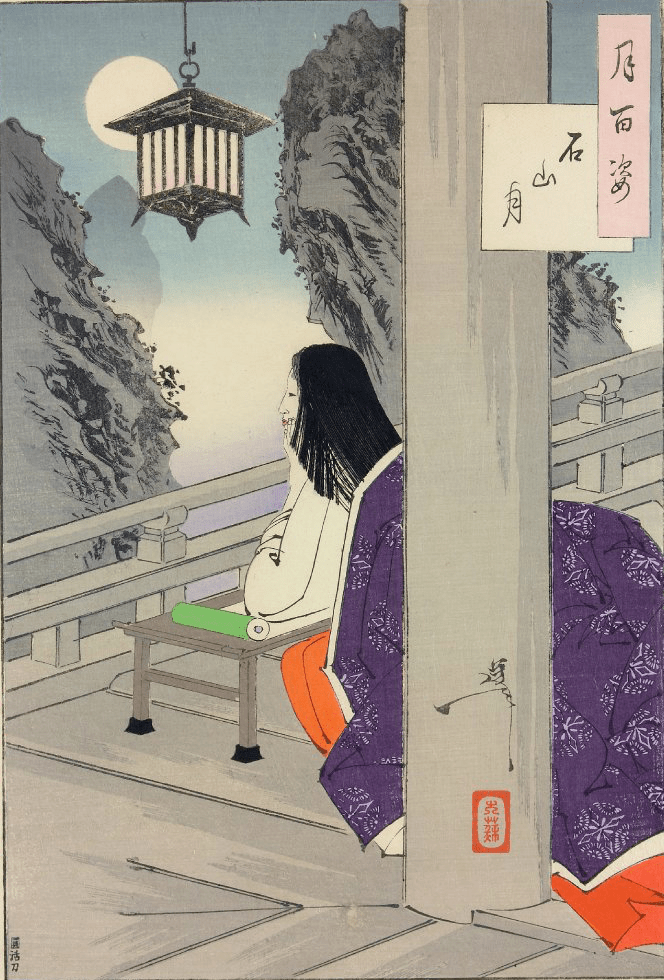
A woodblock print of Lady Murasaki from 1889 made by Yoshitoshi, Public domain, via Wikimedia Commons
By the Edo Period, 17th century, block printing and a flourishing of “book culture” greatly expanded the audience of the Tales of Genji, and Lady Murasaki enjoyed a surge in popularity, rescued from obscurity, and even today is high revered. Lady Murasaki is to Japanese culture what Shakespeare is to the English-speaking world. The historical drama that concluded is arguably an extension of this revival.
Finally, I wanted to explore the relationship between Lady Murasaki and her patron, Fujiwara no Michinaga. In the historical drama, they shared a relationship since childhood (historically improbable), and even had a love child together even though they never married. Political marriages were common among the nobilty at the time, as was infidelity, and so Fujiwara no Michinaga having an official marriage yet carrying a number of romantic trysts would not be surprising. The Hyakunin Isshu poetry is rife with such romances.
And the real, historical relationship between Lady Murasaki and Michinaga is unclear. It’s widely believed that the main character of the Tales of Genji was patterned from Michinaga. Her diary also shows her flirting with Michinaga somewhat. And yet, it’s also implied that she fended off his romantic advances too. The fact that she worked under him, the most powerful political figure in Japan at the time, made their relationship even more complicated. If her daughter, Daini no Sanmi (poem 58 of the Hyakunin Isshu, ありま) was indeed Michinaga’s, as the drama depicts, it may help explain how she was brought into the court inner circle too, alongside her mother. And yet, evidence one way or another is pretty limited, so one can only speculate.
Lady Murasaki herself was woman perpetually out of place in the courtly life of the late Heian Period. Her diary shows her frequently introverted, melancholy, out of place, and exhausted by the back-biting of other women, or the rowdiness of drunk men. Her father had lamented that in spite of her literary talents, her being born a woman in that era meant her talents would go to waste. Such was the period of the time.
One can easily imagine a brilliant woman like Lady Murasaki in modern times sitting in cafe, writing a romance novel, feeling alone, yet observing the world around her in a way that is beautiful and poetic, pouring her heart into her work. What Lady Murasaki conveyed through her writing was something can we can appreciate even today, eleven centuries later.
Out of all the literature of the time, nothing quite epitomizes the sentiments and milieu of the Heian Period, an era now lost to time, yet strangely familiar, quite like Lady Murasaki did.
P.S. The drama definitely took some historical liberties for the sake of drama, but I have to admit that it did a nice job of showing Lady Murasaki as a complex person, and all the different challenges she had to deal with. The last several episodes were really touching and brought tied up things nicely. I might try to purchase the drama next year if I can, but it’s quite expensive ($300-$500 USD), so time will tell.
1 As someone who also spent some time in the ER earlier this year with emergency surgery, I can imagine that I too would have likely died in my 40’s without modern medical care. Modern people often forget how brutal and short life was for the average person before medical science, and how many people never lived past 50, or did so with crippling conditions.
Since I began, this blog has focused on a period of Japanese history which I like to call “Classical Japan”, or “Japanese Antiquity”.1 That’s just a convenient name I call it.
But most researchers and historians tend to divide Japan’s history into “periods” (jidai, 時代) based on where the capitol was at the time. So, precisely speaking, this blog and the Hyakunin Isshu cover a 500-period of history overlapping the Asuka (6th – 8th c.), Nara (8th c.) and Heian Periods (8th – 12th c.), while dipping our toes just a bit into the the early Kamakura Period (12th – 14th c.) for certain poems (poems 93, 99 and 100 for example). For the sake of the Manyoshu we also ventured even further back to somewhat murkier periods of time since some of the very early poets of the Hyakunin Isshu (poems 1, 2, 3 and 4 for example) were also contributors.
But the blog has never really explored anything beyond the early 13th century because that’s when things effectively end. The Hyakunin Isshu was compiled, the aristocracy of the Heian Period were totally sidelined by the new samurai class, and Japan continued on in a new trajectory. The aristocracy still lived until the modern era, and Imperial poetry anthologies were issued from time to time, but the quality and popularity gradually petered out. As poem 100 above alludes to, this era embodied by the Hyakunin Isshu was effectively over.
For the purposes of this blog, why pay attention to anything that comes after?
Well, I attended Professor Mostow’s recent lecture at the University of Washington, and I learned that history of the Hyakunin Isshu kept going. In fact, it was all the rage in the much later Edo Period (17th – 19th c.).
Japan by the Edo Period was pretty different than the earlier Heian Period. By this point, Japan had been effectively ruled by one military government or another for centuries, while the capitol had shifted from Kyoto in central Japan, to a fortified castle town in eastern Japan called Edo (江戸). Edo started as a fishing town, but soon grew into a metropolis thanks to good urban planning and government policies that forced rival warlords to stay there every other year. Edo, later the modern capitol of Tokyo, was one of the largest cities in the world at one point.
After a century of constant warfare throughout Japan, the Edo Period brought unprecedented stability and cultural flourishing. Its isolation from European explorers and rival Asian powers meant that people turned inward and rediscovered Japanese culture that had been forgotten in ages past due to war and instability.
One aspect of this flourishing was the invention of block printing which suddenly allowed the masses to enjoy reading in a way that earlier generations had not. Books became far more affordable, and more available, and suddenly a variety of books about the Hyakunin Isshu were published. There were books about the Hyakunin Isshu as far back as the 15th century, namely the Ōei-shō (応永抄) composed in 1406, but mass-printing made books much more accessible and allowed for a greater variety.
Professor Mostow has collected and aggregated many examples on his website here. Take a look if you can, there are some neat scans of really old documents from the era.
One common usage of the Hyakunin Isshu at the time, according to Professor Mostow, was in the instruction of girls. Books about young women’s education were a popular subject, and such books would work lessons in along with poems of the Hyakunin Isshu. For example, Professor Mostow posted scans from a book called the Hyakunin Isshu Jokun Shō (“A Selection of the Hyakunin Isshu for Women’s Instruction” ?), published in 1849. Another example can be found here.
Men were often taught things like Confucian values and such. And yet, even the boys learned about the Hyakunin Isshu from their mothers who had been raised on it. Also, books that were published for men about the Hyakunin Isshu often did so under the theme of Kokugaku (“national learning”).
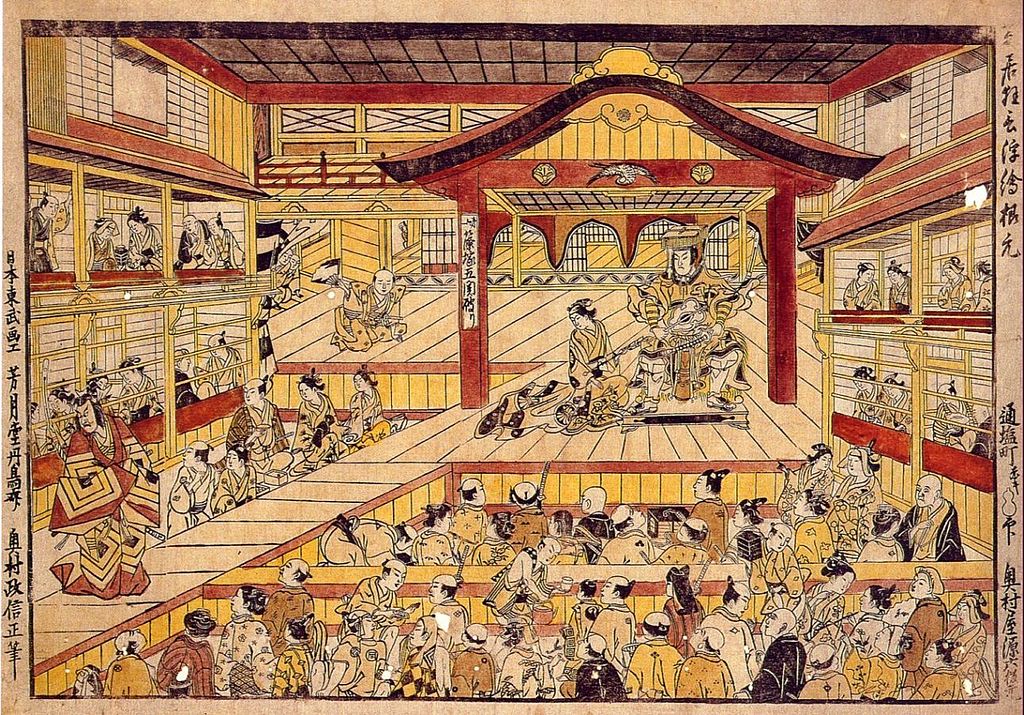
The high point of Edo Period culture, and something that influences Tokyo even today was the Genroku Period (1688 – 1704). Many things people imagine of pre-modern Tokyo, such as Kabuki theater and Ukiyo-e prints, have their origin in this brief period. The Hyakunin Isshu was used in some Ukiyo-e block prints too. Since many of these images were racy or scandalous, publishers would work in poetry of the Hyakunin Isshu to either obfuscate the content from Edo government censors, or to lend a more “classy” air to the image. I found some examples here.
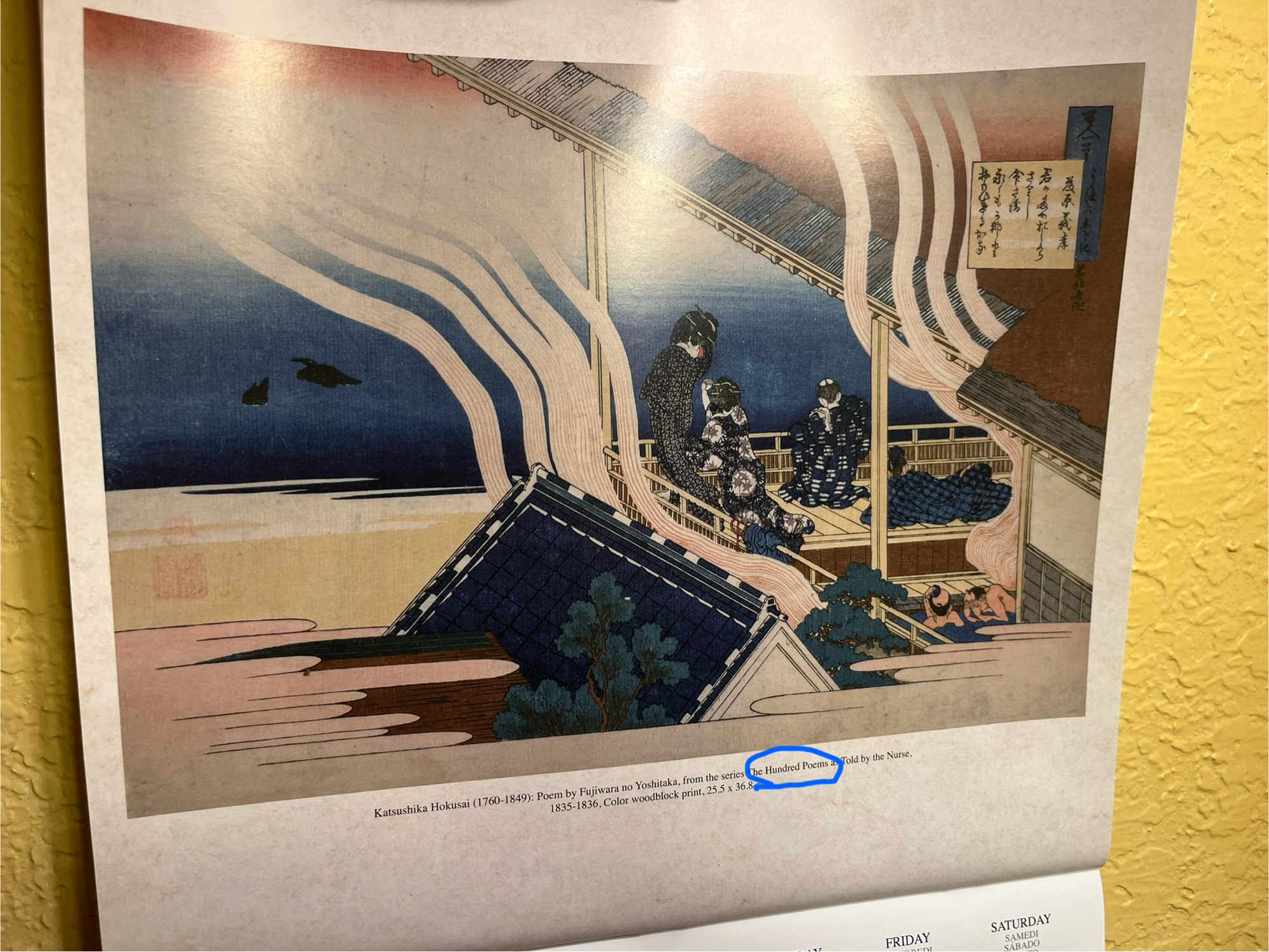
Even the famous artist Hokusai of “Great Wave” fame made block prints that would feature poems of the Hyakunin Isshu. We have a calendar at home and I was surprised to see this Hokusai block print with poem 50 (きみがためお) composed in cursive:
Our wall calendar featuring art by Hokusai. Turns out this page was from the Uba ga Etoki.
In blue, reads Hyakunin Isshu Uba Ga Toki, and in the yellow box poem 50 of the Hyakunin Isshu.
It turns out this is part of a series by Hokusai called theUba ga Etoki (姥がゑとき), or more formally the 百人一首姥がゑとき2, which means something like the “The Illustrated Hyakunin Isshu As Told By a Nurse(maid?)”. You can see more examples of this work here.
Anyhow, it’s fascinating that as literacy among the populace improved during the Edo Period, and access to information via books and printing increased, popular interpretations and illustrations of the Hyakunin Isshu took on a new life. The Hyakunin Isshu was, by that point, already 600 years old, and yet it enjoyed a revival that we benefit from today in the form of anime, karuta, and so on.3
Special thanks to Professor Mostow for his lecture and website! Also, check out Professor Mostow’s new book!4
1 I suppose my reason for doing this is that the end of the Heian Period and the subsequent change in Japan was somewhat similar to the fall of the Western Roman Empire in Europe, and how later generations of feudal lords kept up some of the trappings of the Romans, and yet it was still a different society altogether. But in the end, this is just one history nerd’s interpretation.
2 In modern Japanese 百人一首うばが絵解. See this post for more explanation.
3 Although social media and Internet reveal a pretty ugly side to humanity, it does also lead a similar explosion in cultural and accessibility. Two sides of the same coin, I suppose.
4 This is my associates link on Amazon. I get a small amount of credit for any purchases made through here. Feel free to purchase directly from University of Hawaii press instead though.
In the past year, I’ve spent a fair amount of time talking about what’s called competitive karuta (kyōgi karuta, 競技カルタ in Japanese) after my first encounters, and subsequentefforts to learn to play the game. The truth is is in that in recent months, for various reasons, I’ve really started to wind down my involvement in the competitive karuta scene. I do enjoy playing karuta games, but frankly just not a very competitive person at heart, and the thought of investing what little time I have to increasingly small, incremental gains in an obscure sport doesn’t really appeal to me. I learned how to play the game, and consider myself decent at it, but the poetic side of the Hyakunin Isshu is still what appeals to me most.
Further, I realized through talking with Japanese people that a lot of people play casual karuta games, not competitive. This mundane side of karuta gaming is not featured in animé such as Chihayafuru. However it is a common past-time for people who enjoy karuta and the Hyakunin Isshu poems,1 but don’t necessarily want to invest countless hours in practice, drills, and so on. So, I wanted to explore the casual side of karuta gaming, and help casual players find ways to enjoy the game without the intense stress of competition.2
Japanese “Karuta”, especially karuta games based on the Hyakunin Isshu, come in many forms. There is a spectrum of very easy games on one end, and competitive karuta on the other. If you think of it like a video game with difficult settings, then games like bozu-mekuri are easy mode. You don’t have to know anything about the cards, it is visual only, and the rules are simple. On the other hand, competitive karuta is hard mode: you are playing against some very good players, the margin of error is very small (in higher ranks), and every bit counts including hand-techniques, card position, mental training, and so on. It’s a tough struggle, with lots of exciting moments, but sometimes also crushing defeats.
So between “easy mode” of bozu-mekuri, and “hard mode” of competitive karuta, isn’t there anything in between? Turns out, yes.
I found good examples of casual karuta games through my Hyakunin Isshu Daijiten book, mentioned here, as well as subsequent information online. Let’s look at the games of chirashi-tori and genpei gassen.
Chirashi-Tori
The game of chirashi-tori (散らし取り), meaning “scatter and take”, can be thought of as a lightweight version of competitive karuta. You don’t have to know the kimariji, but it helps, nor do you have to think about card position. In the same way, penalties don’t exist. You do need to know how to read the hiragana script though, even if slowly.
The game basically works like so:
Take all 100 torifuda cards (the ones that are not illustrated) and spread them around face up. Players sit around the pile, spread out evenly.
Similar to competitive karuta, someone else (not a player) reads a random yomifuda card (the illustrated ones). It’s customary to read the last two verses twice.
You can also use one of several nice karuta reader apps on your mobile phone too.
As the poem is being read, whoever finds it’ll the corresponding card touches it, or takes it. If they are correct, they remove the card from the field and keep it in a stack next to them, face down.
The reader then draws another card and a new round begins until there are no more cards on the field.
Whoever took the most cards by the end of the game wins. 🏆
In terms of difficulty, this is the next step up from bozu-mekuri in that you do have to be able to read hiragana, but it’s a nice first step to getting familiar with the poems with little or no training. Even though knowing the kimariji is not required, knowing some can help you recognize some cards on the field quicker.
Genpei Gassen
The name of this game comes from the climatic war in 12th-century Japanese history: the Genpei War, pitting the Genji (“Gen”) clan versus the Heike (“pei”) clan. Unlike Chirashi-tori where each person plays separately, in Genpei Gassen people divide into even teams. Ostensibly one side plays the Heike clan, and the other the Genji clan.
There are a few other differences to Chirashi-tori:
The two teams sit facing one another, with teammates sitting side by side. Ideally, 5 or 7 people will play. The odd-man-out is the reader (see below).
The 100 torifuda cards (non-illustrated ones) are evenly divided into two groups of 50. Half the cards go to one side (i.e. facing them), and the other 50 go to the other team. Arrange the cards into three rows, roughly equal.
To play the game, a separate person reads a random yomifuda card (the illustrated ones), one at a time. It’s customary to read the last two verses twice.
You can also use one of several nice karuta reader apps on your mobile phone too.
As the poem is being read, players from both sides try to find the corresponding card somewhere on the field. If someone finds the poem, they may touch it, or take it. If they are correct, they remove the card from the field and keep it in a stack, face down.
The first team to get to zero cards on their side wins. 🏆
Similar to competitive karuta, if you take a card from the opponent’s side, you send over a card from your side. This way, their number stays the same, but since you correctly took a card, your side reduces by one.
This games has the advantage of being a gentler version of competitive karuta, but still keeping the look and feel of it. As with Chirashi-tori, you will need to be able to read hiragana script, and knowing the kimariji, even some of them, gives you an advantage, but these are things you’d learn anyway from repeated play. Also, having a team develops some fun and interesting strategies.
Five Color Hyakunin Isshu
Finally, if you still want the look and feel of competitive Karuta, but an easier version, you can look at Five Color Hyakunin Isshu. This way you can play a much smaller set of cards and warm up to the full competitive version. The catch is that it requires a custom set, or you will have to make your own by customizing a standard set.
Non-Hyakunin Isshu Karuta
If, like me, you somehow get a hold of a karuta set not featuring the Hyakunin Isshu poems (there are a surprising number in Japan), the games above will still work. Many karuta sets, regardless of theme, use the same basic format: two sets of cards for reading and taking. They are all meant to be read by someone, with other players finding the correct, corresponding card.
Conclusion
The game of Karuta at heart is just that : a game. It’s a great way to savor the poetry of the Hyakunin Isshu in a fun interactive way, and the more I explore it the more I realize that there are games to suit every player. If you purchase a set, you can try any number of games with friends or even by yourself. The most important thing is HAVE FUN! If poem 96 teaches us anything, it’s that life is short.
P.S. Speaking from experience, playing
1 Fun story, in summer of 2024, I was in Japan again briefly to visit my wife’s family, and found the famous Okuno Karuta store in Tokyo. I didn’t post about it as there wasn’t much to say (I didn’t find what I was looking for, tbh). I did see a tour group of elderly Japanese people come into the store in a single mass, and many of them bought karuta goods in one form or another before leaving again. So, it’s definitely a pasttime, but not quite the way I expected when I first learned about the game.
2 I don’t mean this lightly either. Some people definitely revel in competition, but I find such situations always make me intensely nervous, and uncomfortable, even when I win. Used to feel this way about Magic the Gathering competitions too. I thought maybe it was just me until I spoke to someone Japanese who also felt that way when playing competitive karuta. They just wanted to play casual games. That’s when I started to realize that there were different games for different crowds, but all of them celebrate the Hyakunin Isshu poetry in some way.
Similarly, some people want to play Pokemon TCG or Magic the Gathering at home with friends, rather than big competitions. Other people live for the thrill of competition. There’s enough room in the game for both types of players. I personally prefer Hyakunin Isshu karuta myself.
I wanted to share an exciting opportunity for readers. The University of Washington, my alma mater, is hosting a lecture in-person and online by none other than Professor Joshua Mostow!
Years ago, Dr Mostow graciously allowed me to use his translations of the HyakuninIsshu for this blog, and readers have hopefully enjoyed his translations over the years. We poet-enthusiasts have all benefitted from Dr Mostow’s hard work and enthusiasm for the field. Let’s show our support, and enjoy a fascinating lecture on the Hyakunin Isshu and how it impacted Japanese history in later times.
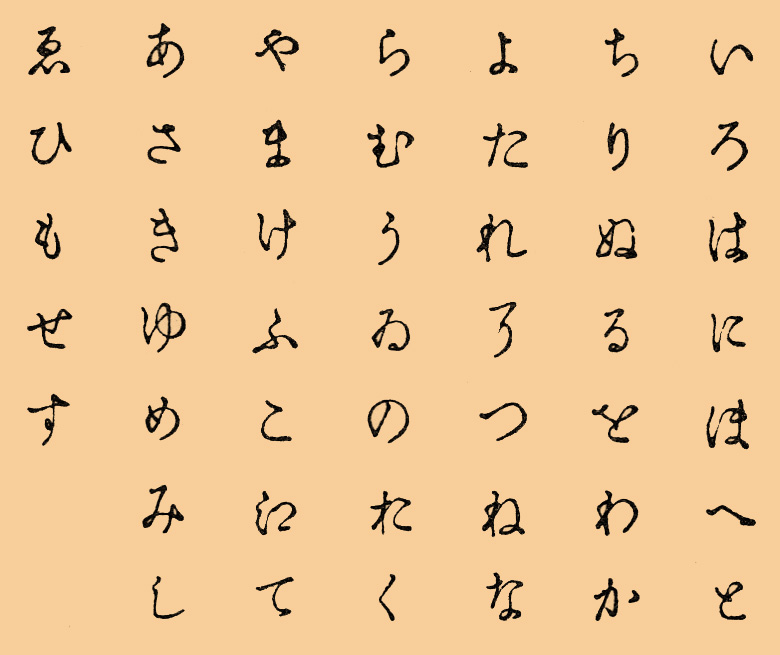
One of the most famous waka poems across Japanese history and even contemporary culture is a poem called the Iroha. The name “iroha” comes from the first three letters of the poem “i”, “ro” and “ha”. What makes this poem famous is that it uses each hiragana syllable exactly once, and still makes an intelligible, not to mention lovely, poem.
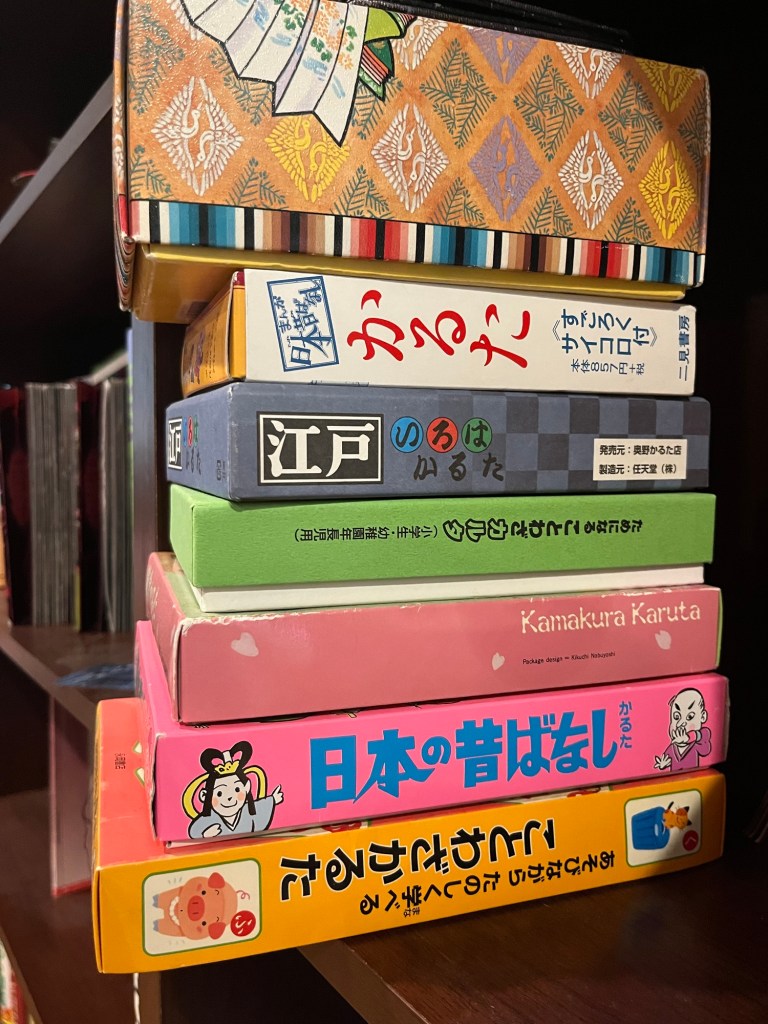
Because of this, it was often used in pre-industrial Japan as a way to organize things. Theater rows would be organized by the order in the Iroha letters, and so were firefighter brigades in pre-modern Tokyo (a.k.a. Edo). Even modern karuta sets are organized by iroha order. I don’t mean the Hyakunin Isshu karuta that I often discuss in the blog, but more informal karuta games that kids often play. We have a few sets here at home, given to us by my in-laws for the grandkids. You can see a nice selection of Iroha karuta sets on the Okuno Karuta online store, too.a
Various karuta sets my in-laws in Japan sent us. The top one is my wife’s original Hyakunin Isshu she had from grade-school.
But I digress.
The Iroha poem’s author is unknown (more on that later), but it was originally composed in old Manyogana script, like other poems of the early Manyoshu anthology, then later in hiragana. It includes many old spellings, so it’s a bit hard to render in modern Japanese.
The poem is as follows:
Manyogana
Modern Japanese
Romanization
Translation1
以呂波耳本部止
いろはにほへと
I ro ha ni ho he to
Even the blossoming flowers
千利奴流乎和加
ちりぬるをわか
chi ri nu ru o wa ka
will eventually scatter
餘多連曽津祢那
よたれそつねな
yo ta re so tsu ne na
Who in this world shall
良牟有為能於久
らむうゐのおく
ra mu u i no o ku
remain unchanged? Let us today2
耶万計不己衣天
やまけふこえて
ya ma kyo (ke fu) ko e te
cross the mountains of impermanence
阿佐伎喩女美之
あさきゆめみし
a sa ki yu me mi shi
and no longer have superficial
恵比毛勢須
ゑひもせす
e hi mo se su
dreams, nor be deluded
1 adapted translation from Wikipedia, plus a few modifications of my own 2 有為 (u i) meaning “viccisitudes of life” or the impermanence of all phenomena
This poem has strong Buddhist allusions to such concepts as samsara (“the aimless wandering lifetime after lifetime”), the delusions that bindus to this existence, awakening to these delusions (e.g. “enlightenment”), and finally nirvana (“unbinding”). The poem itself shows considerable familiarity with earlier Buddhist texts such as the Perfection of Wisdom sutras, including the Heart Sutra, as well.
But I digress. Again. 😅
There are some really interesting aspects of this poem that are worth sharing. First, authorship. Given the strongly Buddhist undertones of the poem, it’s often been attributed to a famous Buddhist monk named Kukai (a.k.a. Kobo Daishi) who was a talented poet and calligrapher. Another theory states that this poem may attributed to none other than the famous court poet Kakinomoto no Hitomaro, who composed poem 3 in the Hyakunin Isshu (あしびきの).
But things get even more interesting.
Scholars have noted that if you take the last syllable of each line (highlighted above for convenience) it spells another sentence: toka (ga) nakute shisu (咎[が]無くて死す) meaning “he/she died without fault or blemish”. Another theory, mentioned in my new book, points out that the 5th column spells out ho(n) wo tsu no ko me (本を津の小女), which could mean “deliver this book to my wife in the town of Tsu”, which if taken together with the 7th column implies that “I will die without blemish, please deliver this poem to my wife”.
So, is the poem a tribute to someone else? Perhaps Kukai or Hitomaro? If so, then who wrote it, and why? Was the poem a coded message to someone who was executed for political reasons? Or was the poem simply an attempt at word-play?
We will never know, but the impact of the Iroha on Japanese poem can still be easily seen today.
a Although things like Chihayafuru and this blog tend to emphasize the competitive karuta of the Hyakunin Isshu, in reality that’s only a small subset of karuta gaming culture. Most of it is much more informal stuff you play at home with family, much like board games in Western culture, and often times doesn’t even relate to the Hyakunin Isshu. Maybe I’ll post about it some time, but thanks to grandparents in Japan, we have 4-5 sets here ranging from such subjects as places in the city of Kamakura, old folks-sayings, Japanese fairy-tales, and just really basic words in Japanese. Most of these list the cards using iroha-order, and are not related to the Hyakunin Isshu. We’ve played them with our kids from time to time, and they’re much easier than competitive karuta, though it’s still assumed you know at least some basic Japanese.
As fall is approaching, I wanted to share an interesting anecdote provided by my book on the Manyoshu. It seems that throughout Japanese antiquity, poets frequently debated which is better: spring or fall.
The first example comes from Princess Nukata in the 7th century, whom we discussed here and here, she wrote a lengthy poem (a chōka poem, not the usual tanka poem) in the Manyoshu (poem 16). She discusses the pros and cons of spring and of fall:
Original Manyogana1
Japanese
Romanization
Rough Translation2
冬木成 春去來者
冬ごもり 春さり來れば
Fuyu gomori haru sari kureba
When winter passes and spring comes
不喧有之 鳥毛来鳴奴
鳴かざりし鳥も來鳴きぬ
Nakazarishi tori mo nakinu
Birds that didn’t sing before, now come and sing
不開有之 花毛佐家礼抒 山乎茂
咲かざりし 花も咲けれど 山を茂み
Sakazarishi hana mo sakeredo yama wo shigemi
Flowers that didn’t bloom before now bloom, but because the mountains grass is so thick
入而毛不取 草深 執手母不見
入りても取らず 草深み 取り手も見ず
Irite mo torazu kusabukami torite me mizu
One cannot go and pick flowers, let alone see them.
秋山乃 木葉乎見而者
秋山の 木の葉を見ては
Aki yama no ko no ba wo mite wa
When you look at the leaves in the mountains during fall,
黄葉乎婆 取而曾思努布
黄葉をば 取りてそしのふ
Momiji wo ba torite soshi no fu
collecting the yellow leaves is especially prized.
青乎者 置而曾歎久
青きをば 置きてそ歎く
Aoki wo ba okite so nageku
Leaving the green leaves as they are is regrettable.
曾許之恨之 秋山吾者
そこし恨めし 秋山われは
Sokoshi urameshi akiyama ware wa
In spite of that, autumn in the mountains is spectacular…
a – I am heavily indebted to this site for both the original text. Translation is based in part on that site, but also my Manyoshu book, but probably lots of mistakes. Translating a five-line poem in archaic Japanese is hard enough… 😅
Speaking of the Manyoshu, its compiler Otomo no Yakamochi (poem 6 of the Hyakunin Isshu, かさ) left us some very nice poetry about spring:
Original Manyogana1
Japanese
Romanization
Rough Translation2
春苑
春の苑
Haru no sono
Beneath
紅尓保布
紅にほふ
Kurenai ni hofu
the shining crimson
桃花
桃の花
Momo no hana
orchard of
下照道尓
下照る道に
Shita deru michi ni
peach blossoms
出立オ嬬
出で立つ少女
Idetatsu otome
a young maiden lingers.
Poem 4139, book 19
and about fall:
Original Manyogana1
Japanese
Romanization
Rough Translation2
秋去者
秋さらば
Aki saraba
When fall comes
見乍思跡
見つつ思へと
Mitsutsu shinoe to
think fondly of those
妹之殖之
妹が植ゑし
Imo ga ue shi
pink blossoms
屋前乃石竹
やどのなでしこ
Yado no nadeshiko
of days gone by
開家流香聞
咲きにけるかも
Saki ni keru kamo
and remember me.
Poem 464, book 3
Otomo no Yakamochi wrote both of these poems about his beloved wife, but the second was composed shortly after her parting. The word nadeshiko has special meaning in Japan and has a very feminine, demure3 meaning.
Returning to the debate between spring and fall, Ki no Tsurayuki (poem 35 of the Hyakunin Isshu, ひとは) took up the same topic centuries later. This is poem 509 from an imperial anthology, the Shuishu :
Japanese
Romanization
Rough Translation2
春秋に
Haru aki ni
Spring or Fall?
おもひみたれて
Omoi mitarete
My thoughts are a mess,
わきかねつ
Waki kanetsu
and I cannot decide.
時につけつつ
Toki ni tsuketsutsu
The more time passes,
うつるこころは
Utsuru kokoro wa
the more my heart shifts back and forth.
1 This is a rough translation, all mistakes are my own.
The debate was even cited in the famous 12th century novel Tales of Genji written by Lady Murasaki (poem 57 of the Hyakunin Isshu, め):
“Since antiquity, in the debate about spring versus fall, many people lean toward fall, and yet some very noteworthy people who view the Imperial gardens in spring may yet change their mind, as is the way of the world.”
Princess Nukata all the way back in the Manyoshu seemed to imply that autumn was preferable, and it seems that most of the aristocracy shared this view. In fact if we divide up the poems of the Hyakunin Isshu by season, there are more fall poems than spring:
Note: summer only has 4 poems, winter has 9 (same as spring).
But what do you think? Are you Team Spring, or Team Fall?
Edit: added Hyakunin Isshu poetry chart.
1 If you’re wondering why I post Manyogana for some poems, but not others, it depends on the era. The Manyoshu is the oldest anthology by far, and at that time, there was a brief writing system that took Chinese characters, but used them in a phonetic way for Japanese language (a.k.a. Manyogana). By the time of Ki no Tsurayuki and Lady Murasaki, centuries later, this had been replaced with hiragana script. This blog strives to both be accurate and accessible, so I try to balance both needs.
2 These are all rough translations on my part, and likely have mistakes. Any such mistakes are entirely my own.
3 Not to be confused with the “very demure, very mindful” meme. 😛
I just returned from another trip to Japan,1 and we got to spend a bit of time in Kyoto. By accident, I also found Mount Ogura, and the place where Hyakunin Isshu was compiled! But first, let’s backup and explain a bit of history first.
Kyoto was the capital of Japan from the 8th century to the 19th century, and so many well-to-do families lived here. This aristocracy wrote countless waka poems that were compiled into official poetry anthologies from time to time,2 but the Hyakunin Isshu was not one of them. It was compiled by Fujiwara no Teika (poem 97) as a favor to his in-laws. Teika had been a compiler of one of the major anthologies, the Shin-Kokin-Wakashu, but was now in retirement after his liege lords (poem 100 and poem 99) were exiled in the upheaval of the Jokyu Rebellion. He resided in a small villa on the west side of Kyoto on the hillside of Mount Ogura, and was tasked with selecting the very best 100 waka poems that his in-laws could decorate their home with. Teika’s excellent poetic taste led to the Hyakunin Isshu we celebrate today.
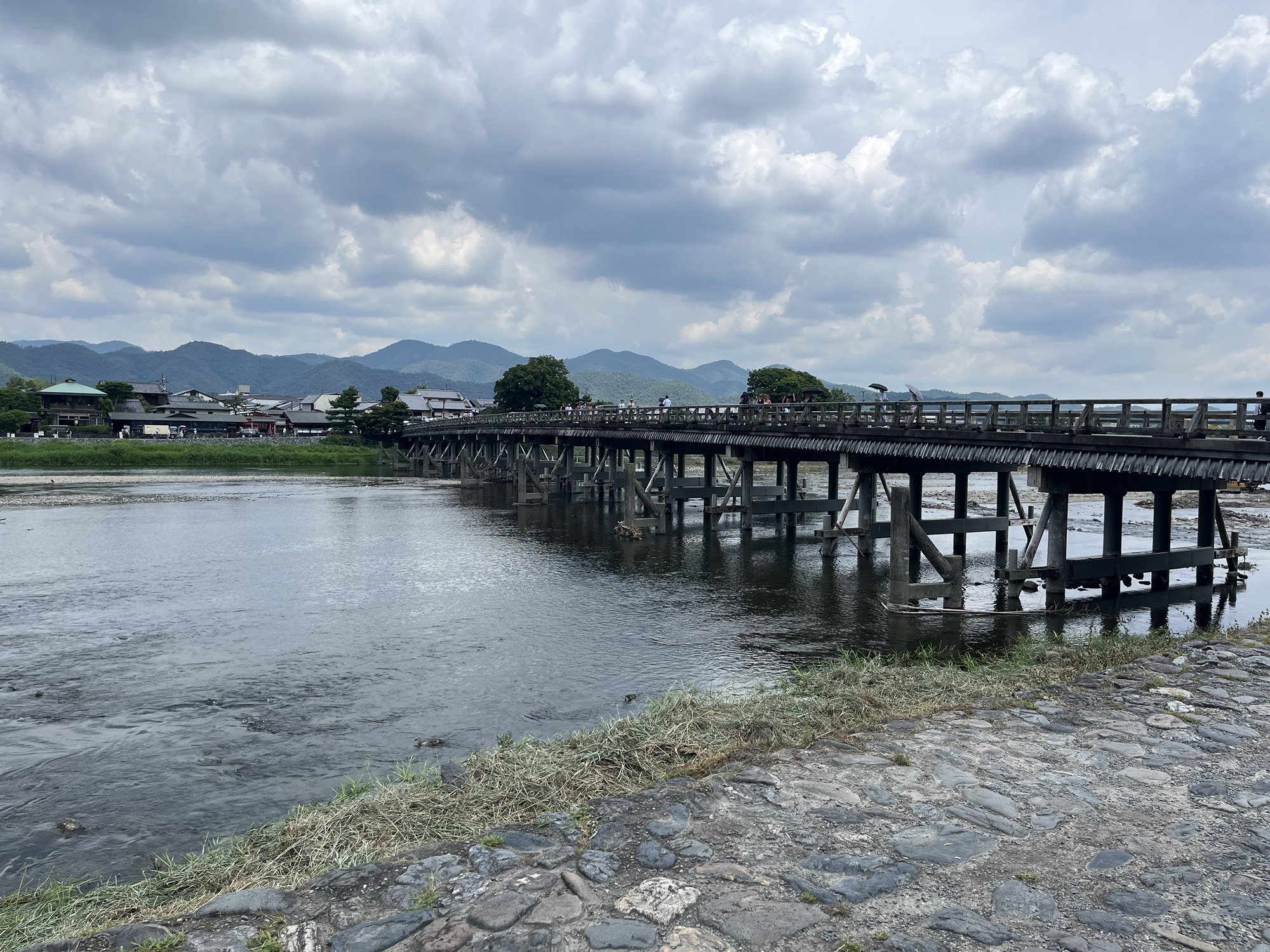
Anyhow, back to present day. I was with the family, and we visited a part of western Kyoto called Arashiyama (嵐山). It’s a very scenic place, with famous bamboo forests, and an iconic bridge named Togetsu-kyō (渡月橋):
Since we visited in the summer, it was extremely hot and muggy, so by lunch time we were exhausted and tired. We went to a local cafe and had lunch. Since we were in Kyoto, I assumed there would be many famous historical places related to the Hyakunin Isshu,3 but I was having trouble finding them on GPS, so I was disappointed.
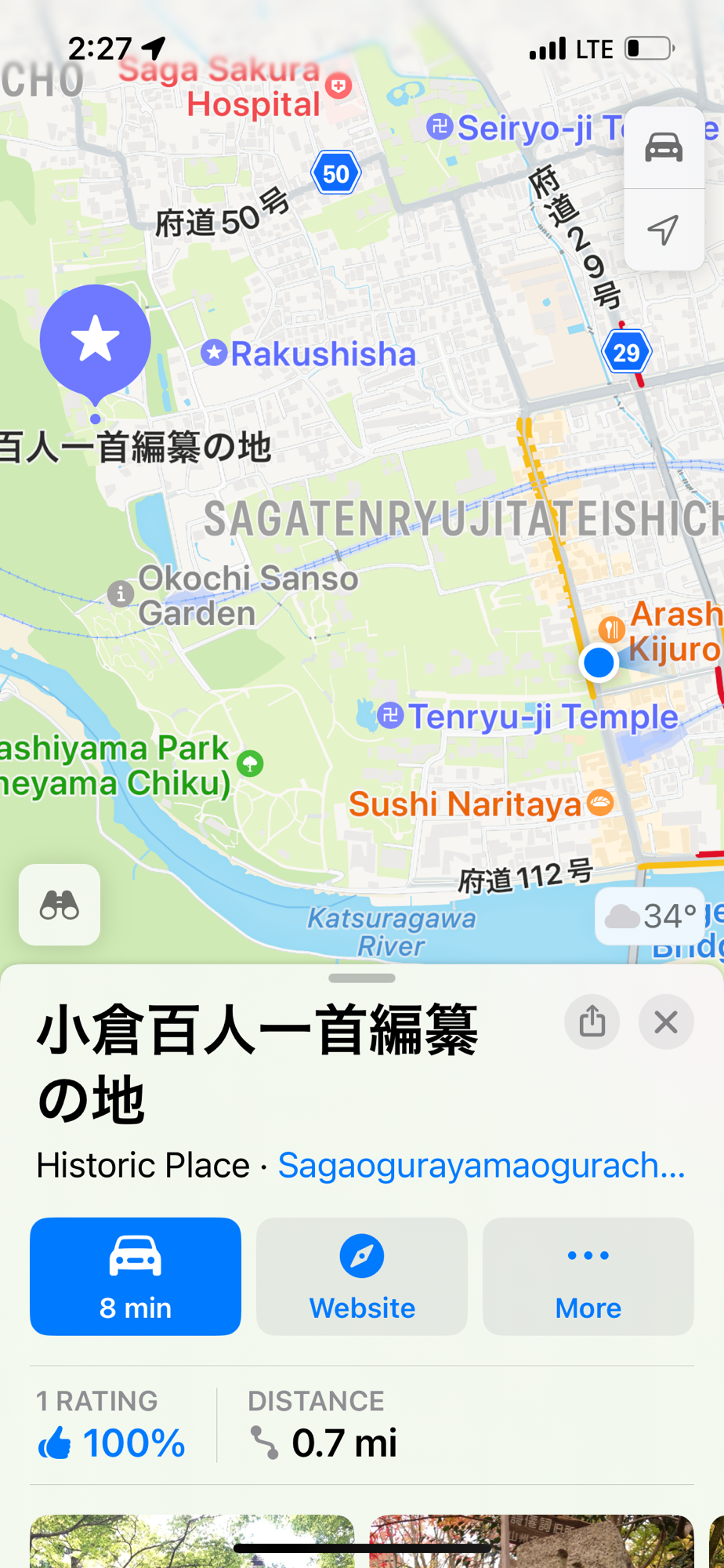
Then I noticed the following spot on my map app:
小倉百人一首編纂の地 (ogura hyakunin isshu hensan no chi) … the place where the Hyakunin Isshu was compiled…? Wow, that’s only 15 minutes by foot from where I was at!
The family was exhausted and sweaty, and were planning to return to our hotel, so I didn’t want to drag them uphill in the heat. I told them I’d be back, and I took off for the place on the map. It turns out that the properly had been converted to a Buddhist temple named Jojakkō-ji (常寂光寺) in the 17th century (a common practice in Kyoto). You can find the official website here.
This is Mount Ogura today.
I followed the map directions and made it safely to Jojakko-ji Temple:
There is a small entry fee, but once I paid that, I got to the second gate here:
The site of the Ogura Hyakunin Isshu is just down the path to the right, before the gate. I made the mistake of going up the stairs instead:
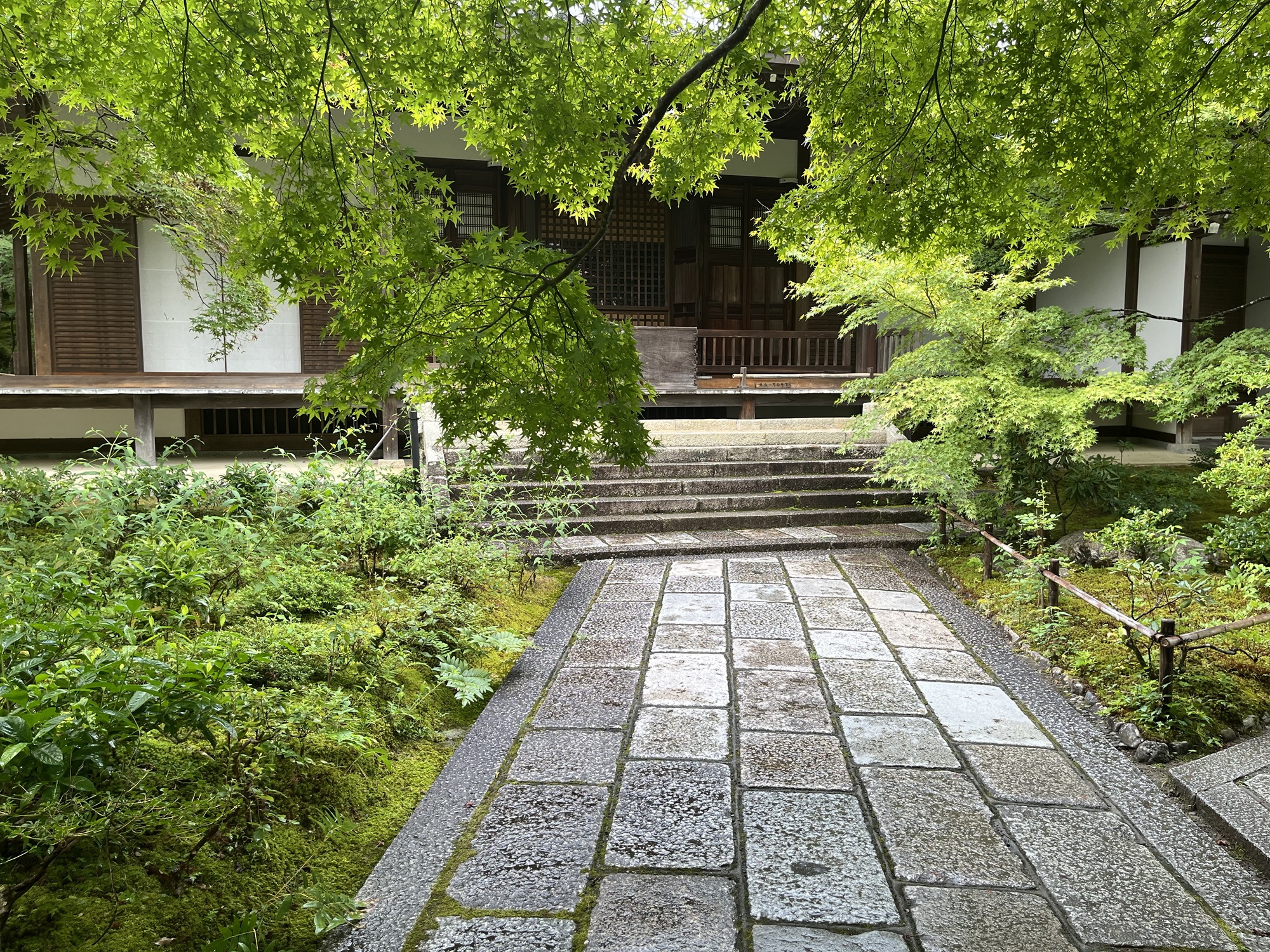
Jojakko-ji Temple is quite scenic actually:
… but it was very late in the day, my family was waiting back at Arashiyama, and I had to hurry. This was my one shot, probably in my lifetime, to find this place, but the temple maps, nor the website show precisely where it was.
Finally, I found it:
The photos from the prefectural website look a lot better than mine (good lighting helps). But there it was, the actual site where the Ogura Hyakunin Isshu was compiled!
The stone marker is pretty small and somewhat eroded, but there was no mistaking it.
Since I was short on time, I paused and said a quick “thank you” to Fujiwara no Teika and then headed back.
If you are fan of the Hyakunin Isshu, and you are in the Arashiyama area of Kyoto don’t miss this small but significant site.
P.S. while at Jojakko-ji, I met a nice Australian couple who had just finished their visit. They told me that at the top of the temple you can see a really view of Kyoto. I didn’t have the time to see it for myself, but if you go, don’t pass up the chance.
P.P.S. I forgot that, ten years ago, I had made a post about Mount Ogura. You can see the Togetsu-Kyo bridge here too.
1 We return every year when possible to visit my wife’s in-laws, and let the kids spend time with their relatives, learn more Japanese, etc.
2 Many earlier poems were also composed at a time when Japan’s capital moved around (Nara, Fujiwara-kyo, Asuka, etc) before settling down in Kyoto. See the Manyoshu for further details.
3 I did actually find one other place we visited earlier in the day, but more on that in an upcoming post.













 The Hyakunin Isshu


.jpg)