If you are learning to play karuta there are plenty of resources in Japanese language, but outside of that, there’s almost nothing. This is understandable since karuta has only very recently become known outside of Japan, but it still challenging for foreign players to develop good foundations. So, although I am a casual novice myself, I try to share what I find.
One training method used in Japan, especially for children learning to play in school, is the Five Color (go-shiki, 五色) Hyakunin Isshu method. This is a way of color-coding the 100 poems of the Hyakunin Isshu into five groups of 20, based on relative difficulty to learn. I have posted about it before but didn’t have a set to try out and demonstrate.
Since I was in Japan earlier this year with the family (visiting in-laws), I decided to get a boxed set for myself. They are hard to obtain outside of Japan, and I had to order directly from the Oishi Tengudo. My package soon arrived at my in-laws house,1 and later I brought them home and opened up the box.
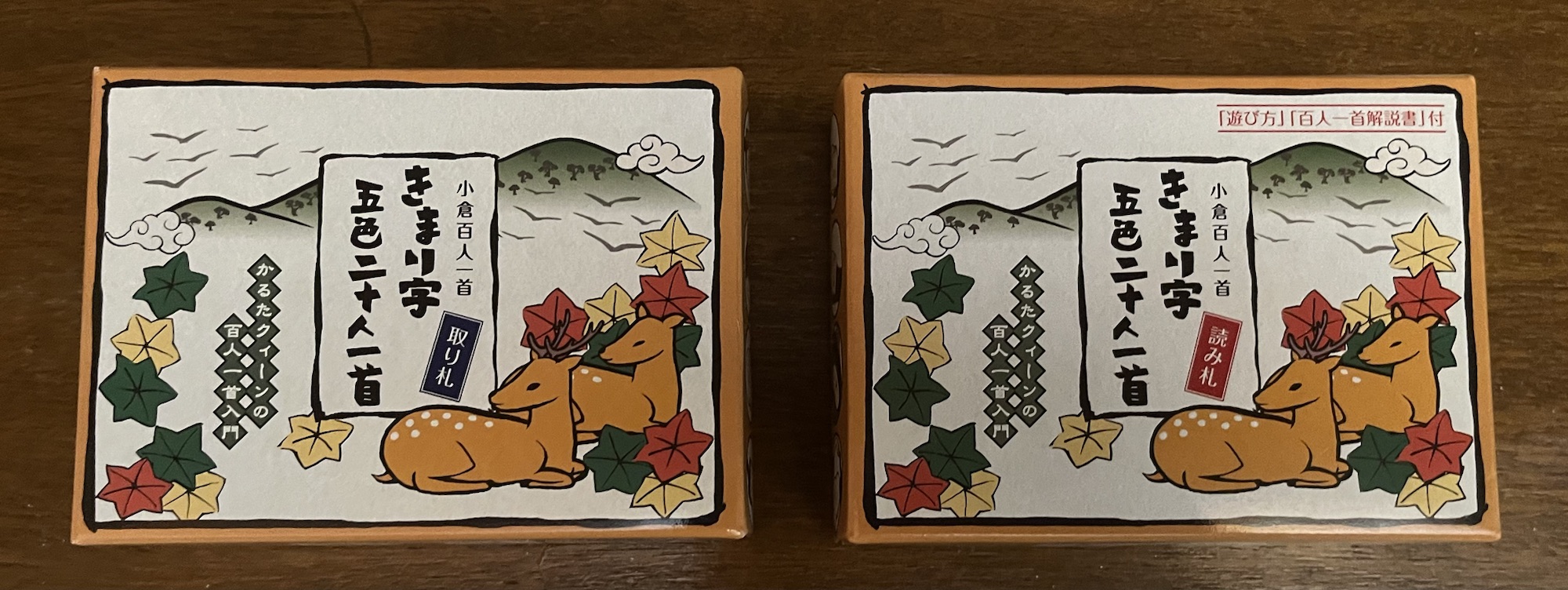
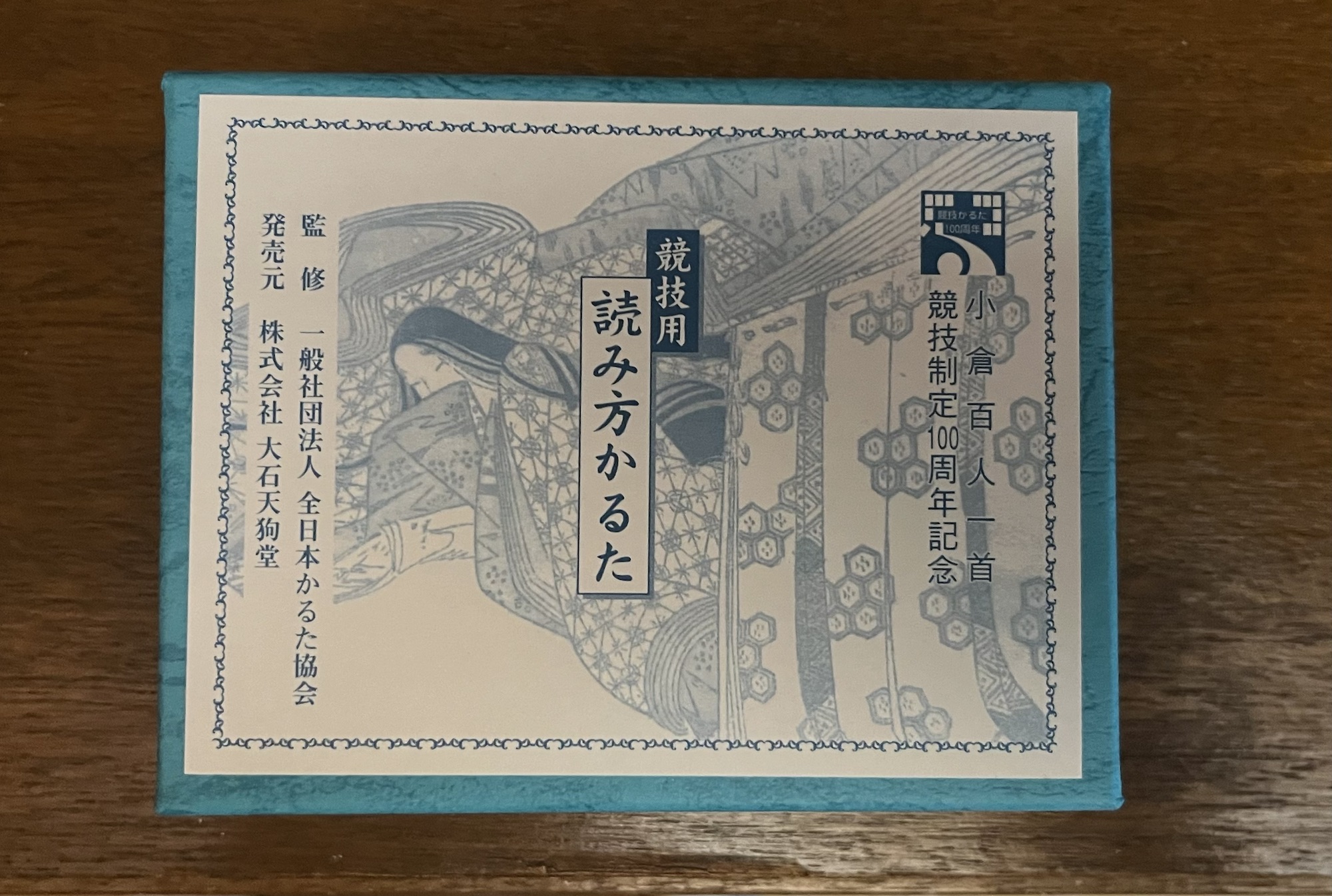
The set is very nicely put together. It comes in separate boxes for the reading cards, yomifuda, and corresponding the cards you take, torifuda.
Torifuda cards on the left, and yomifuda cards on the right.
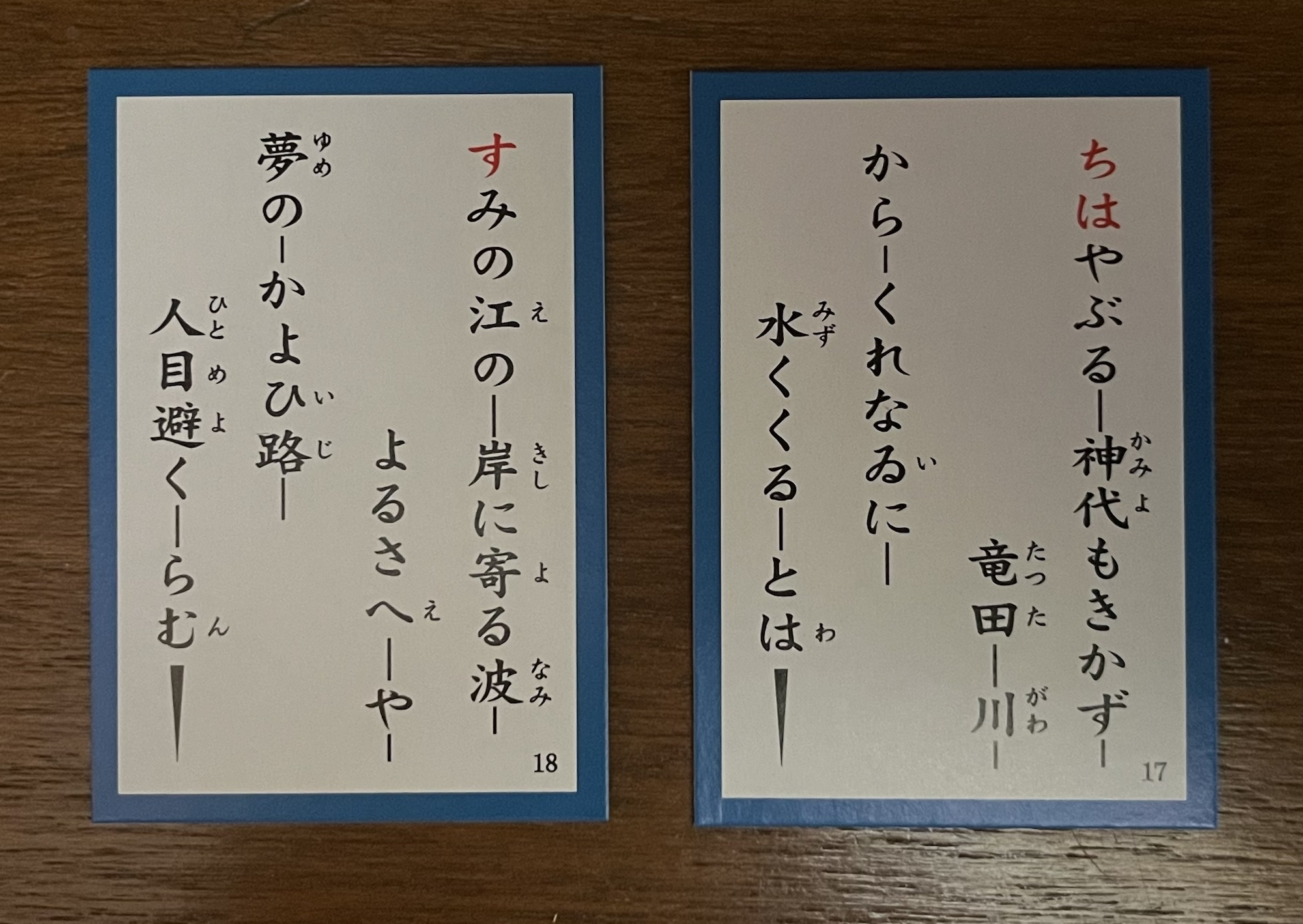
Because the Five Color Hyakunin Isshu is mostly geared for children (and not nerdy middle-aged foreigners 😅), the illustrations have a cute, cartooinish quality, and the hiragana script uses a very readable font. Notice that the card borders have colors too: yellow and red in the pictures above.
Something that surprised me was that the back of the torifuda cards, which are usually not seen during play, also show the first half of the Hyakunin Isshu poems, with the kimari-ji emphasized. This saves new players the hassle of having to go and look up what the kimari-ji are.
Poem 15 shown in yellow on the left, and poem 65 in red on the right.
Also, if you get a set like this, and you use a Karuta reader app to read only that color. Many reader apps have readings sets specifically for the Five Color Hyakunin Isshu, however, the Oishi Tengudo set divides its cards differently, and so the sets in karuta apps are not the same. You have to make your own custom sets like I did here.
So, does it work as a training method? Is it worth foreign players going to the effort to getting one of these sets?
I haven’t had a chance to field-test yet, especially with new karuta players, so I don’t know. Some foreign players online have derided the five-color method, and instead advocated other learning methods (more on those in later posts), but unfortunately I don’t have enough data to say which works. Since I have already self-learned karuta (more or less), I can’t really use myself as a test.
That said, the resources above are really nice, and since they’re geared for children, they provide a nice, gentle introduction to playing karuta. You do need to read hiragana script, but if you’re intending to play karuta, you need to know hiragana anyway. It is also one way to start with learning a smaller subnet of the 100 poems, with increasing difficulty as you move between colors.
I am eager to try this out the next time I meet with the local karuta club.
1 I also ordered a yomite card set for reading purposes. I’ve written about that in a previous post.
I just returned from another trip to Japan,1 and we got to spend a bit of time in Kyoto. By accident, I also found Mount Ogura, and the place where Hyakunin Isshu was compiled! But first, let’s backup and explain a bit of history first.
Kyoto was the capital of Japan from the 8th century to the 19th century, and so many well-to-do families lived here. This aristocracy wrote countless waka poems that were compiled into official poetry anthologies from time to time,2 but the Hyakunin Isshu was not one of them. It was compiled by Fujiwara no Teika (poem 97) as a favor to his in-laws. Teika had been a compiler of one of the major anthologies, the Shin-Kokin-Wakashu, but was now in retirement after his liege lords (poem 100 and poem 99) were exiled in the upheaval of the Jokyu Rebellion. He resided in a small villa on the west side of Kyoto on the hillside of Mount Ogura, and was tasked with selecting the very best 100 waka poems that his in-laws could decorate their home with. Teika’s excellent poetic taste led to the Hyakunin Isshu we celebrate today.
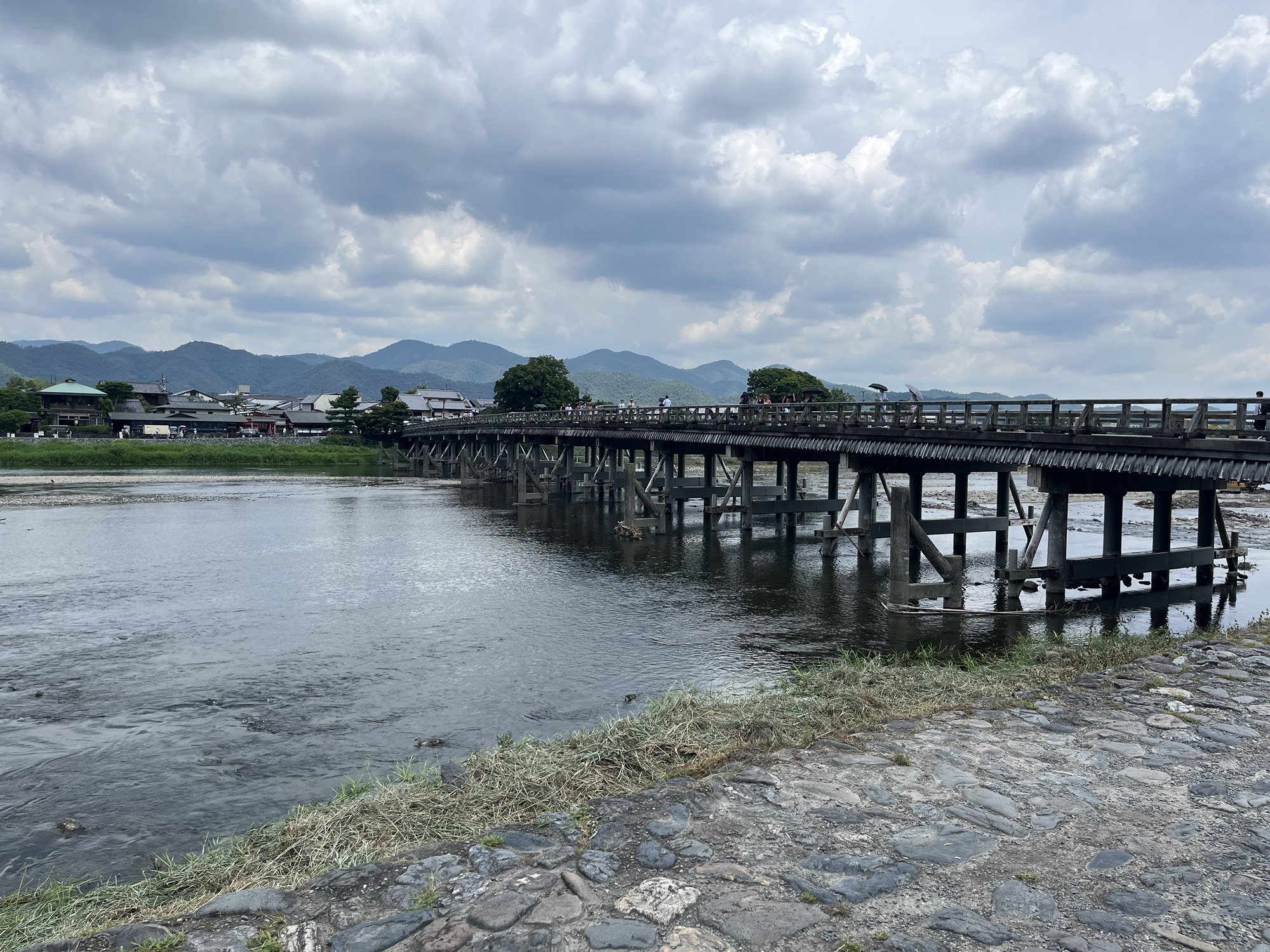
Anyhow, back to present day. I was with the family, and we visited a part of western Kyoto called Arashiyama (嵐山). It’s a very scenic place, with famous bamboo forests, and an iconic bridge named Togetsu-kyō (渡月橋):
Since we visited in the summer, it was extremely hot and muggy, so by lunch time we were exhausted and tired. We went to a local cafe and had lunch. Since we were in Kyoto, I assumed there would be many famous historical places related to the Hyakunin Isshu,3 but I was having trouble finding them on GPS, so I was disappointed.
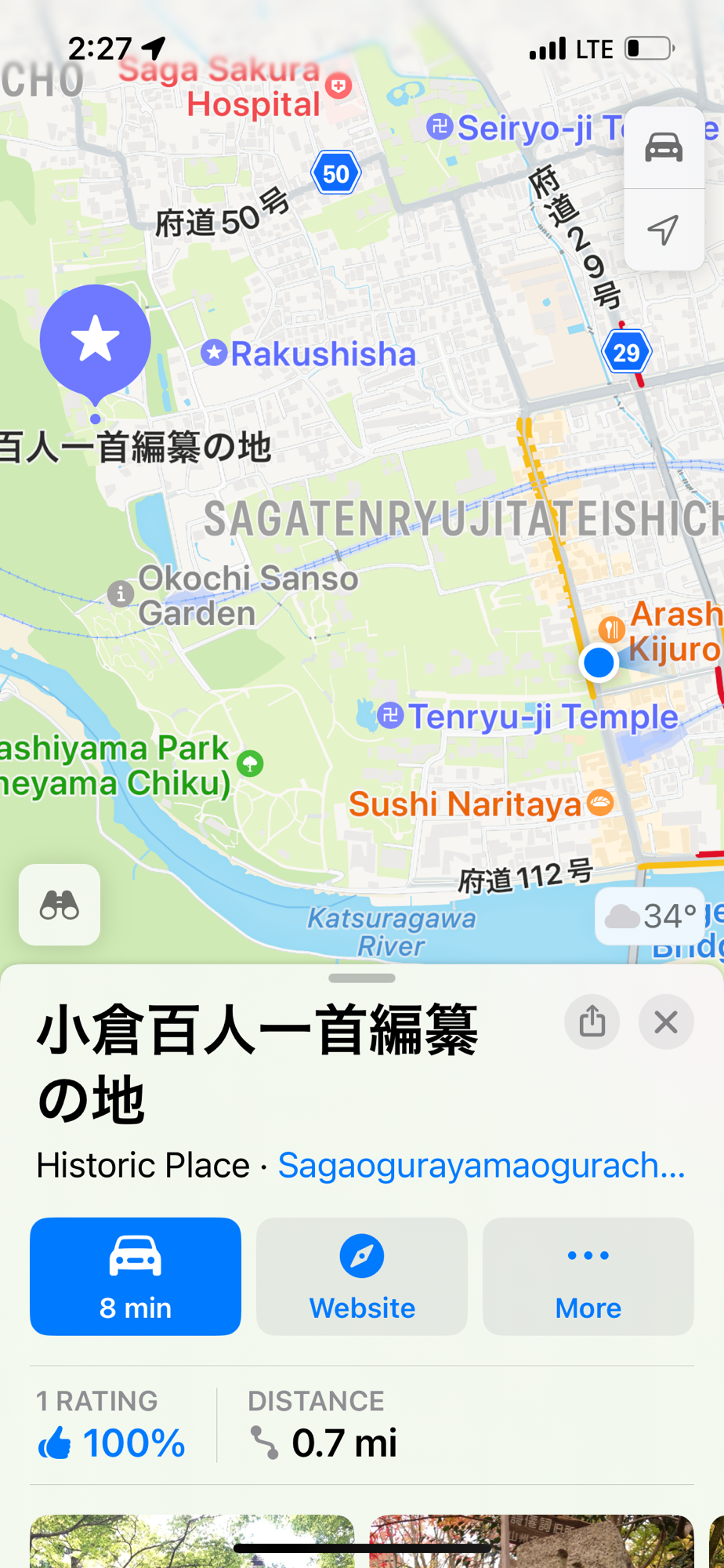
Then I noticed the following spot on my map app:
小倉百人一首編纂の地 (ogura hyakunin isshu hensan no chi) … the place where the Hyakunin Isshu was compiled…? Wow, that’s only 15 minutes by foot from where I was at!
The family was exhausted and sweaty, and were planning to return to our hotel, so I didn’t want to drag them uphill in the heat. I told them I’d be back, and I took off for the place on the map. It turns out that the properly had been converted to a Buddhist temple named Jojakkō-ji (常寂光寺) in the 17th century (a common practice in Kyoto). You can find the official website here.
This is Mount Ogura today.
I followed the map directions and made it safely to Jojakko-ji Temple:
There is a small entry fee, but once I paid that, I got to the second gate here:
The site of the Ogura Hyakunin Isshu is just down the path to the right, before the gate. I made the mistake of going up the stairs instead:
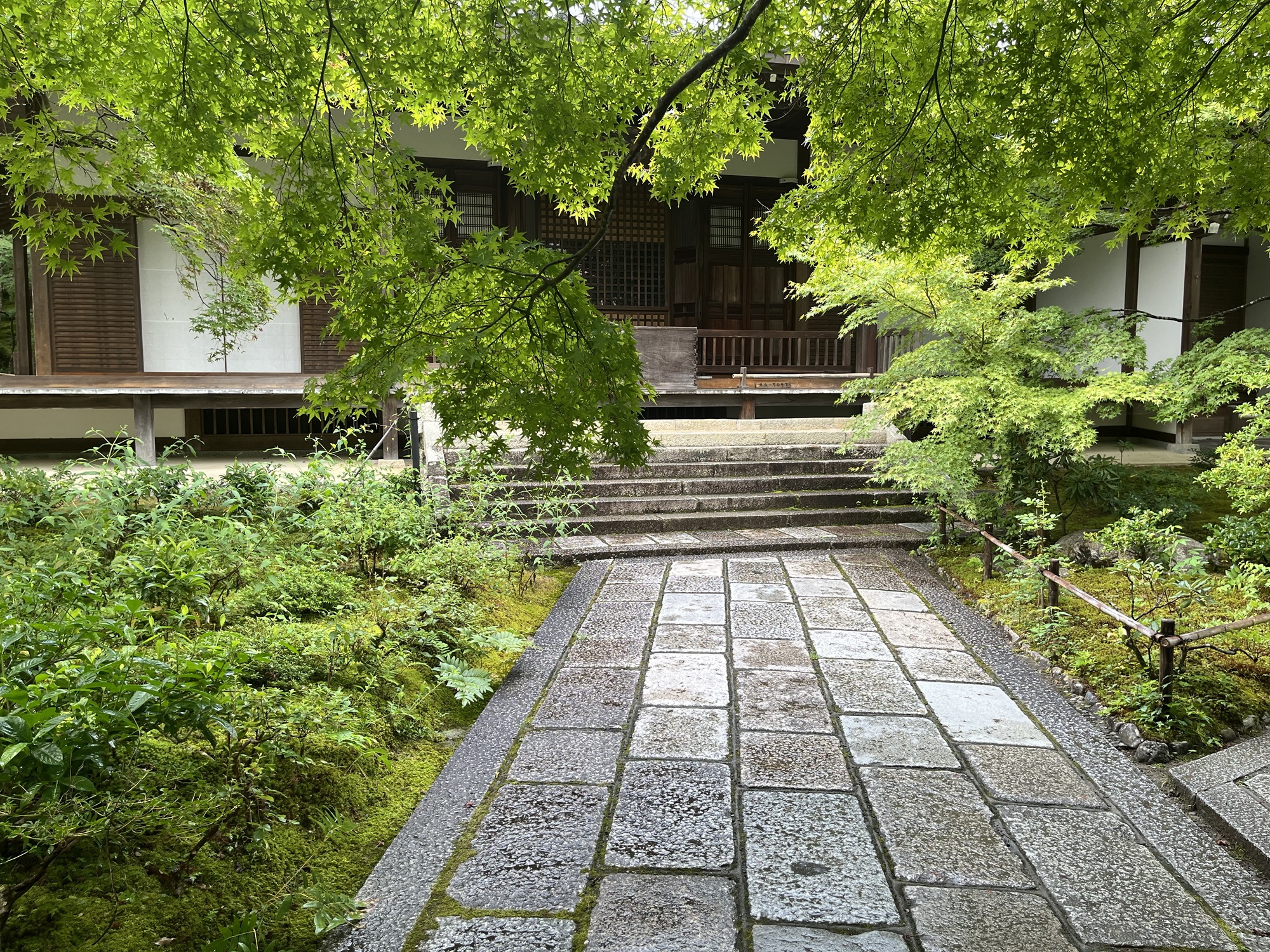
Jojakko-ji Temple is quite scenic actually:
… but it was very late in the day, my family was waiting back at Arashiyama, and I had to hurry. This was my one shot, probably in my lifetime, to find this place, but the temple maps, nor the website show precisely where it was.
Finally, I found it:
The photos from the prefectural website look a lot better than mine (good lighting helps). But there it was, the actual site where the Ogura Hyakunin Isshu was compiled!
The stone marker is pretty small and somewhat eroded, but there was no mistaking it.
Since I was short on time, I paused and said a quick “thank you” to Fujiwara no Teika and then headed back.
If you are fan of the Hyakunin Isshu, and you are in the Arashiyama area of Kyoto don’t miss this small but significant site.
P.S. while at Jojakko-ji, I met a nice Australian couple who had just finished their visit. They told me that at the top of the temple you can see a really view of Kyoto. I didn’t have the time to see it for myself, but if you go, don’t pass up the chance.
P.P.S. I forgot that, ten years ago, I had made a post about Mount Ogura. You can see the Togetsu-Kyo bridge here too.
1 We return every year when possible to visit my wife’s in-laws, and let the kids spend time with their relatives, learn more Japanese, etc.
2 Many earlier poems were also composed at a time when Japan’s capital moved around (Nara, Fujiwara-kyo, Asuka, etc) before settling down in Kyoto. See the Manyoshu for further details.
3 I did actually find one other place we visited earlier in the day, but more on that in an upcoming post.
I am writing this post while staying with my in-laws house in Japan. We will be doing a bit of traveling later, but are mostly fighting jet lag and record heat + humidity for now.
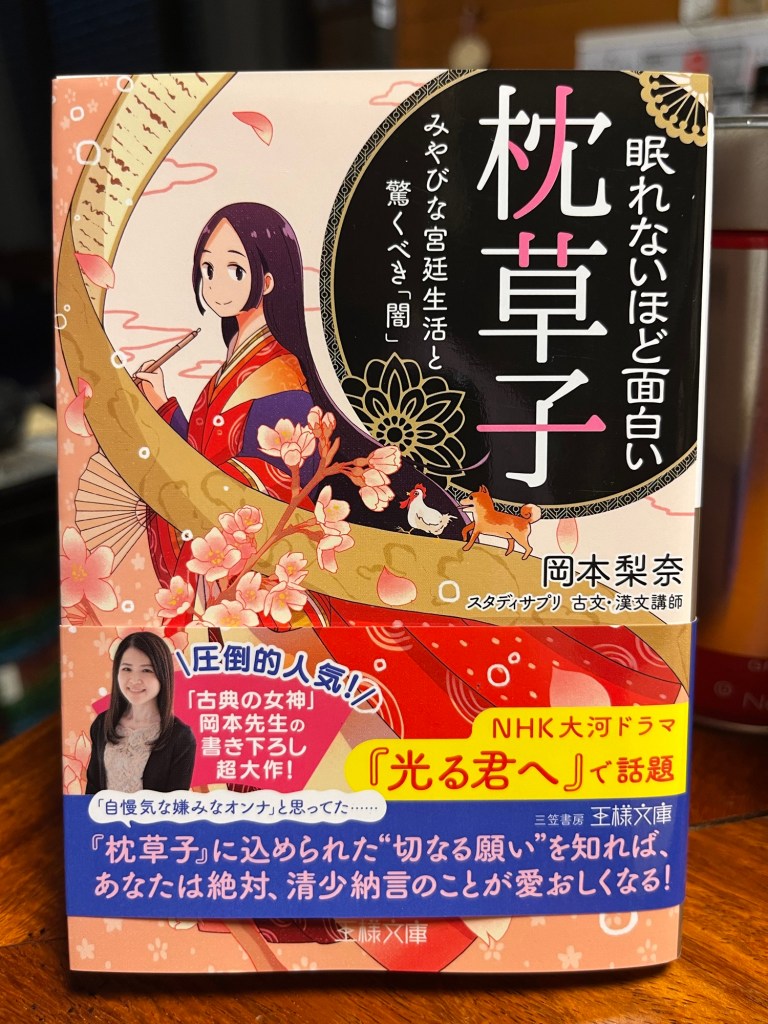
In the meantime I am excited to share some items I picked up, including these new books:
The first book explores the Pillow Book by Sei Shonagon, the second Lady Murasaki’s diary. These texts are both pivotal to appreciating the life and culture of people back then, the same people who composed the poetry of the Hyakunin Isshu. It’s a window to a world that simply doesn’t exist anymore.
Further, this book series, 眠れないほど面白い (nemurenai hodo omoshiroi, “so interesting you can’t sleep!”) has been a hugeboon for the blog. It’s provided a lot of fun, historical information about the Heian Period, the Hyakunin Isshu, the Manyoshu, etc., that is simply not available in English. The Japanese is sometimes difficult to read at my level, but it’s been a labor of love, so I enjoy the challenge and have been learning a lot. So I am excited to delve into these two books as well.
Also, it’s noteworthy that both books above mention the current drama series 「光る君へ」as a tie-in.
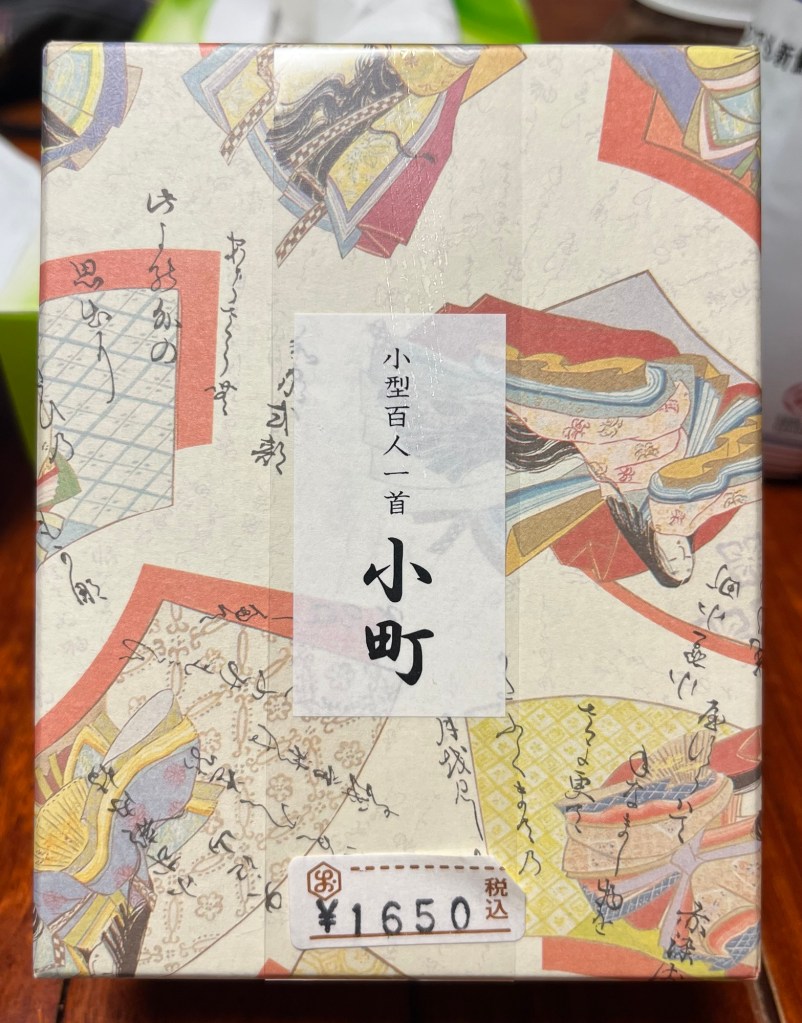
Yesterday, on a day trip to Tokyo I visited the Karuta shop Okuno Karuta (奥野かるた店). It was very easy to find from the Jinbocho train station (just head left and walk down a few blocks). The store was larger than the Tengu-do and includes lots of neat card sets not related to Karuta. I was on a budget so I tried not to spend too much. I did pick up a mini Karuta set though:
This set looks just like the first set I got, both Tengu-dō brand, but roughly half the size. It’s not suitable for competitive karuta but it’s cute and fun to own.
Anyhow, the staff at Okuno Karuta were very nice and helpful. While I was perusing, a tour group of elderly Japanese came through for a while, and the staff had to handle the rush of customers, before things quieted down again.
Hopefully I can post more updates soon.
P.S. also picked up an obscure Fire Emblem game too:
The fashion of the nobility of the Heian Period of Japanese history is fairly different than later, more familiar styles we often see in Japanese media like anime, manga, etc., because it reflects early Chinese influence, but also increasingly local innovations and culture. Further, as we’ll see, because the aristocracy was socially rigid and had many complex customs and rules, this affected how people dressed as well. Everyone knew their place, and their fashion reflected this too. I have touched on the subject a little bit here and here, but I always wanted to explore in depth. The issue was (until recently) a lack of resources and time. But, here we go.
Some great online resources for fashion during the Heian Period of Japanese history (c. 8th century to 12th century) can be found on this website (Google translated version here), and this site. The second link has some English in it, so even if you can’t read Japanese, it’s a great place to visit and look around.
However, for us Hyakunin Isshu poetry (and karuta) fans, you can see many great examples in the yomifuda cards too.
Women’s Fashion
This card, depicts Daini no Sanmi (poem 58, ありま) of the Hyakunin Isshu. The illustration, part of the Ogata Korin collection, shows her in full formal dress.
Like many women of the Heian Period, during formal occasions, she would wear multiple layers of kimono robes called junihito-é (十二単) which literally translates to “twelve robes”. The women of the court did not actually wear 12 layers, but it was much heavier and bulkier than kimono fashion of later centuries.
Here’s another example: Suō no Naishi (poem 67, はるの):
The robes (hitoé, 単) were very long and thus hard to walk in.
Over the layers of robes, the women would wear a “Chinese jacket” (karaginu, 唐衣).
The white train in the back was called a mo (裳), which tied around the waist.
The women wore hakama (袴) trousers much like Japanese traditional clothing today.
You can see a really good example of this kind of fashion here. Definitely check out the link.
Men’s Fashion
Men’s formal wear, if you can believe it, was actually more complicated than women’s. Broadly speaking, it could be divided into three categories: civil bureaucrats, warriors (e.g. palace guards), and upper class nobility including the Emperor.
Imperial Advisors
Because the Imperial court of Japan was modeled after the Chinese-Confucian bureaucracy from antiquity, there are some similarities in the fashion of the civil servants (bunkan, 文官): black robes, similar hats, etc. We can see some examples here: Middle Counselor Yakamochi (poem 6, かさ):
One thing to note is that even samurai warlords who ruled the country in later periods (see Sanetomo), when they came to the capital (jōraku 上洛) were expected to wear this kind of court dress befitting whatever rank they had been bestowed. Although the samurai class held true power, they were still technically part of the Imperial court so customs persisted.
Guards
For the palace guards and other military figures, the formal dress was similar to the bureaucrats above, but with some notable differences. A good example from the Hyakunin Isshu is Fujiwara no Michinobu (poem 52, あけ):
Noting the differences here:
Guards and military figures were equipped with a sword (ken, 剣), bow (yumi, 弓), and a quiver of arrows (ya, 矢).
The crown on their head was shaped in a loop, not a long trailing one. It was called a ken-ei-kan (巻纓冠) instead.
The crown also had two fan-like protrusions called oikake (緌).
Instead of black-lacquer clogs, the shoes were often pointed-toe boots called kanokutsu (靴).
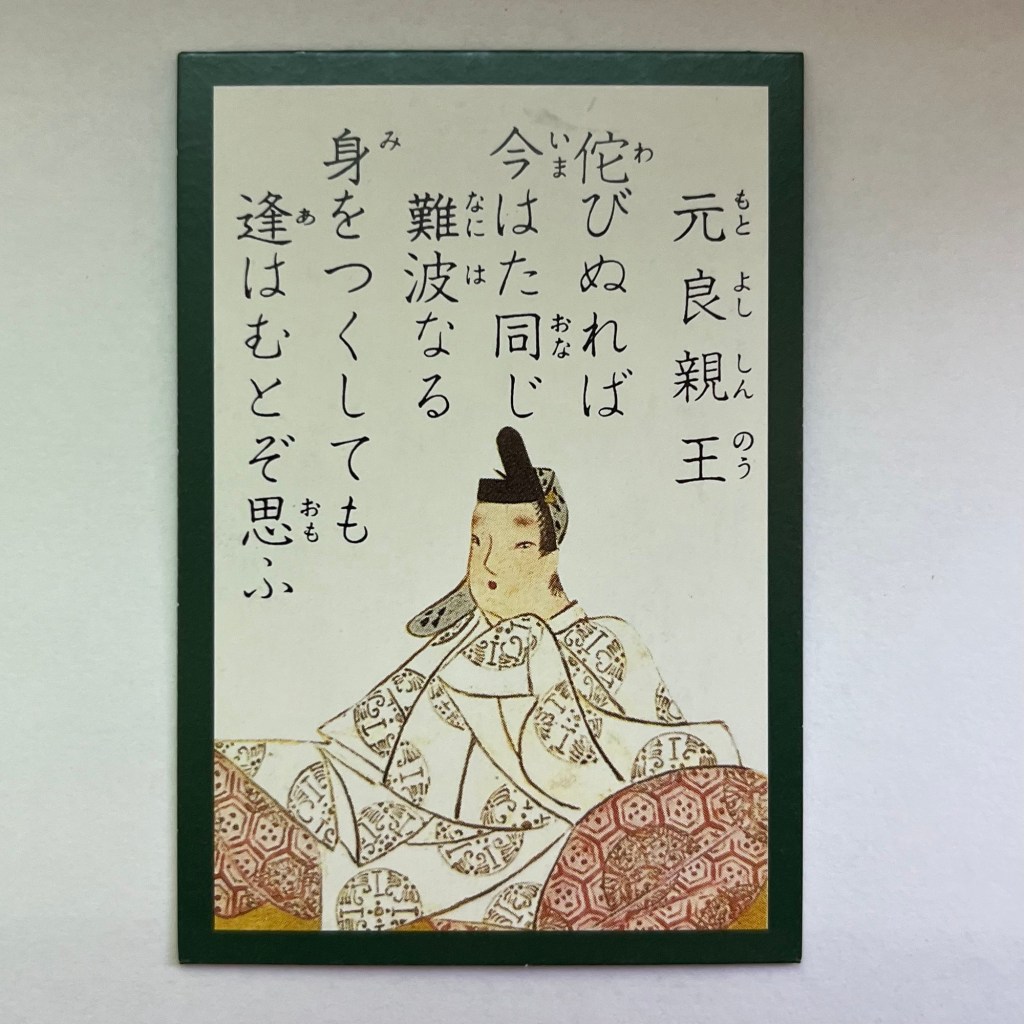
The upper nobility wore clothing that was pretty similar to other members court, but with one major exception: the colors of their robes. Here you can see Prince Motoyoshi (poem 20, わび):
As eluded to in Lady Murasaki’s diary and other sources, there was a strict hierarchy within the Court nobility, which was reinforced by which colors of robes people were permitted to wear. This included colors such as green (shown here), orange (shown here) or white (shown here). The green linked above was, for example, permitted to courtiers of the sixth rank, or palace servants of the fourth rank. Wikipedia has list of forbidden colors, and what ranks were associated with each. The point is is that just by looking at someone’s robes, members of the aristocracy knew each other’s place.
The very upper class nobility, namely those of the Emperor and his family, are often depicted in white robes with red trimming, which is similar to those used by Shinto priests (shown here). It’s probable this was intended to reinforce the Imperial family’s divine lineage, but that’s just a guess on my part.
The fashion used in the yomifuda Karuta cards really tells us a lot about the culture that the poets of the Hyakunin Isshu lived in.
You may have noticed the blog looks a bit different now. I have been struggling since the big blog refresh I started in December 2022 to get the appearance just right. Design isn’t my forte (I am a history nerd), so I’ve struggled with finding the right design for this blog. The original blog template on WordPress was so old (this blog was started in 2011) that it was no longer supported by WordPress, so I had to find something else that works. After dabbling with a few designs this past year, I’ve settled on current blog template as of last week and I am pretty happy with it. I hope you all like the new design. I liked it so much I applied the same template to the other blog.
Next news: I will be off to Japan again this summer … though only briefly. The family and I will visit the ancient capitol of Kyoto, just like last year,1 but the visit overall is much more limited and I probably won’t get to see many things related to this blog. I won’t have time to visit Oishi Tengudo again, or Kitano Tenmangu Shrine, but I do however plan to make a stop at Kurumazaki Shrine (mentioned here) to pick up one of those Sei Shonagon (poem 62, yo wo komete) charms. I may try to work in a few other tourist spots related to the Lady Murasaki drama given that it’s popular right now. I also expect to melt under 35C(95F)-degree weather with 75% humidity again like last year.2
I have a few more posts coming up between now and the trip (late July), and I hope you will find them interesting.
Finally, just as a fun bonus, I wanted to share a one-off poem by Lady Izumi (poem 56, arazan) that I recently heard on a different Japanese historical drama. Lady Izumi is one of my personal favorite figures in the Hyakunin Isshu, and this poem was first recorded in an Imperial anthology, the Goshūi Wakashū (後拾遺和歌集), poem 755:
It’s not clear from this poem which lover she is referring to, since she had a number of relationships over the years, nonetheless it is a very sincere, romantic poem and expresses her passionate style nicely.
Happy Summer!
P.S. speaking of history nerd, I’ve debated about making a Japan / history podcast (like many other fine podcasts I follow), but have struggled to find a good theme. I might simply do the “history of the hyakunin isshu” podcast someday. It’s a bit commitment though, so we shall see.
1 While we do visit Japan yearly so my kids can spend the summer with their grandparents and extended family, visits to Kyoto are rare because of cost, time, and so on. Our last visit was almost 15 years ago. It just so happens that we could make two trips in two years. After that, who knows when we will visit next?
2 Without going into too many details, the humidity, heat and fluid loss aggravated an old medical issue I have. A reminder to stay hydrated, and avoid junk food. I like getting older in many ways, except at times like this. 😋
One of most iconic places in the world of Karuta is a placed called Omi Shrine, also called Omi Jingu (近江神宮, おうみじんぐう) in Japanese. It is here that the big championship events are often held, and it is a big part of season one of the anime series Chihayafuru. Not to sound like a cliché, but it is a kind of mecca for the Karuta world and the Hyakunin Isshu.
A scene from Chihayafuru as Chihaya approaches the Rōmon gate.
What is Omi Shrine though?
You see, Japan has essentially two religions that co-exist: the native Shinto religion and imported Buddhist one. We don’t need to go into detail about how they differ; I have an entire blog on the subject. Suffice to say, they differ. Even the place names are different. Buddhist temples are called otera or end with -ji. Shinto shrines are called jinja, jingu or taisha.
Anyhow, Omi is a Shinto shrine located in the city of Ōtsu, in Shiga Prefecture. This area was once the province of Omi, hence the name. The shrine’s constructed began in 1937 and finished by 1940. It is a young shrine, but has a deep connection to the past.
Like all Shinto shrines, Omi Shrine venerates a kami, a divine figure. A kami can be a god (think ancient Greek gods) from Japanese mythology, a local spirit, or even a historical figure. Some shrines venerate more than one kami.
Omi Shrine venerates none other than Emperor Tenji, who wrote poem one of the Hyakunin Isshu (あきの). During his reign, the capitol of Japan was moved to Otsu city and there he reigned until his death. Here, he carried out many essential reforms that provided the foundation for Japanese society for centuries. Because Tenji also wrote the opening poem of the Hyakunin Isshu, the shrine became quickly associated with the anthology and with Karuta.
The shrine website even has a handy catalog of the Hyakunin Isshu poems, not unlike mine. 😉
The English website is pretty limited, but the Japanese site has a lot of great information about the shrine, Karuta and so on.
The shrine is a bit removed from the usual touristy areas, so you might not be able to get there. However if you do go, it’s good etiquette to pay respects to the kami there. Per Shinto tradition (explained here) the process is:
Bow deeply at the waist twice.
In reverence, clap twice.
Bow once more.
You can also use the water font nearby to wash your hands a bit (just watch how other Japanese do it) and your face a bit before facing the kami.
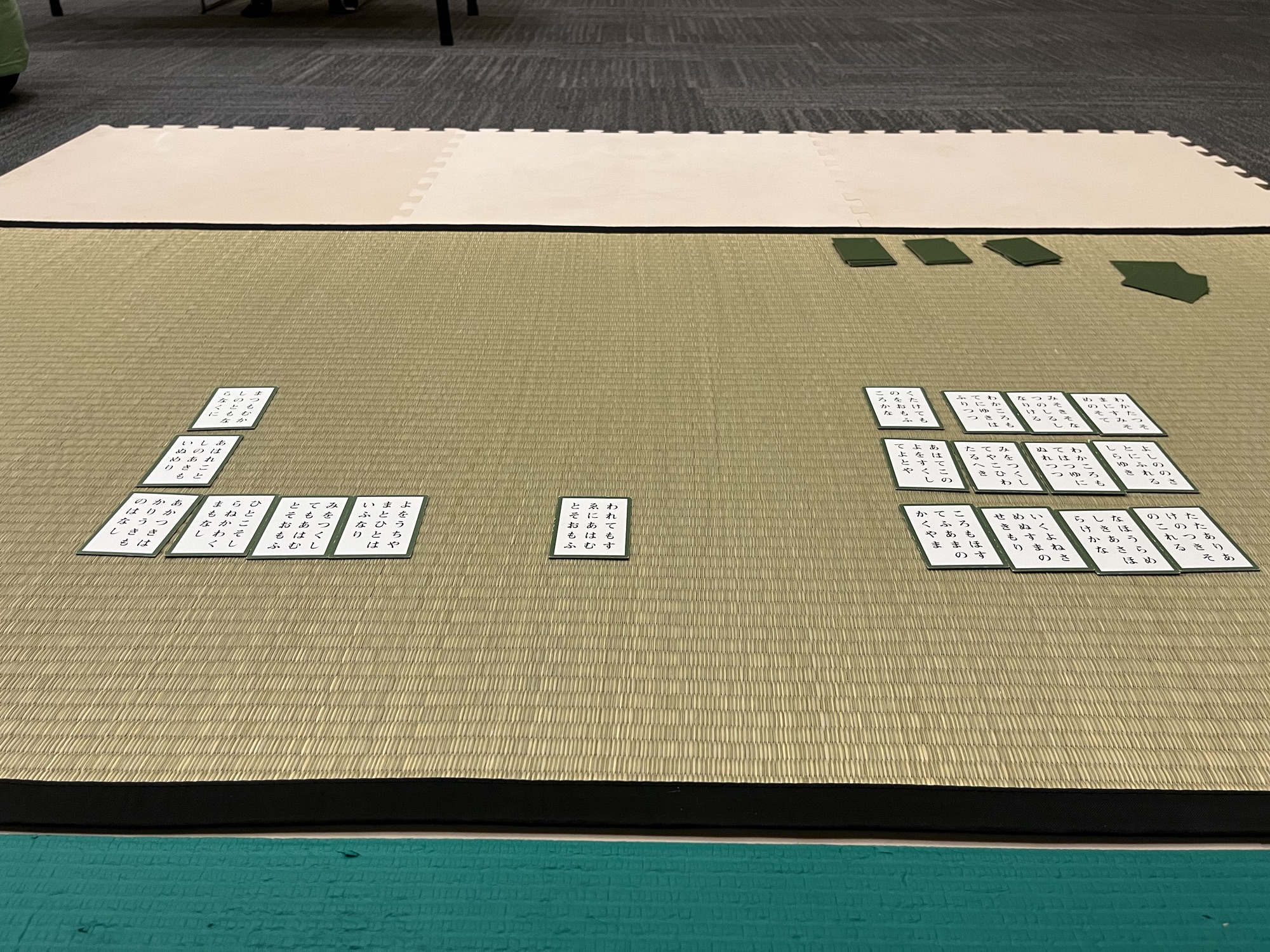
One of the first challenges when you start a game of karuta is to figure out where to put your cards. You’ve been dealt 25 torifuda cards out of 100 total (or 8 if you’re playing online) and they need to be arranged somehow in 3 rows (2 online) such that you can remember where they are, and hopefully make it harder for your opponent to take your cards.
An arrangement of cards, might look something like the picture above: 3 horizontal rows, 1cm between them, and cards arranged across these three rows usually clumped into corners.
Sounds easy … right?
Nope.
The concept of card position or tei-ichi (定位置) has plenty of strategy, and also plenty of personal habits. The first time I ever played, I didn’t know any of this and so my tei-ichi made no sense. I called it the “chaos strategy” as a joke:
It wasn’t even using the correct arrangement or spacing, but I lost 25-0 so I guess it didn’t matter. In time, my arrangement got somewhat better:
In any case, along as you adhere to the basic dimensions of the game layout, you can arrange your cards anyway you like. But also keep in mind that you have constantly remember the current board state (i.e. where every card is) because they often move around as the game progresses. This takes considerable concentration and good mastery of the kimari-ji.
During the start of the match, a lot of people, myself included, like to place their favorite cards in certain areas, or arrange them in a certain way to help relieve the pressure of memorizing so many card positions. I am told by much better players that if you play an opponent enough times you’ll start to figure out where they usually put their cards and can anticipate this (making it easier to remember board state). I have yet to reach this state.
If you watch the anime Chihayafuru1 you may recall that the chubby kid Nishida2 explains some basic tips for good tei-ichi:
Keep the one-syllable kimari-ji cards on the row closest to you. SInce they are taken very quickly, that little extra bit of distance may help you.
Keep the tomofuda (友札) cards, the ones with similar kimari-ji, separate from each other. We’ll get to that in a moment.
These are merely suggestions though. Some players seem to prefer to a more offensive style of play, where they focus more on getting their opponent’s cards and less on their own card arrangement. Other players prefer a more defensive style where they focus on taking their own cards first, and making it as difficult for the opponent as possible.
A very common strategy I see for new and veteran players is to keep your tomofuda together (despite Nishida saying not to). For example, if I have the two cards starting with kono (poem 24) and konu (poem 97) as their kimari-ji, I might go ahead and keep them together. That way, I know where all my “ko” cards are. If I also have koi, then I might put all 3 together.
On the one hand, it’s easier for me to remember. On the other hand, your opponent will likely notice this too, and it makes their job easier.
You can also do as Nishida suggests and intentionally keep them separate. More work for you, but also more work for them.
Notice too that people often keep their cards towards the left and right edges. As with the single-syllable kimari-ji, that extra bit of distance makes it harder for your opponent to reach over and take the card before you do. In close games every bit counts.3
By the way, it is possible, within certain rules and customs, to rearrange cards into new positions during the match. People often do this in the late game when they have only 3-4 cards left and just want to clump them into a single spot, but this is a personal choice. I am told that moving your cards too often is frowned upon. However, if a card in between others was taken, it’s quite alright to shuffle the remaining cards on the row to the edges to take its place (keeping everything neat and tidy).
Since I am kind of a lousy player, I am not adverse to sharing my strategy here, but keep in mind that it is neither expert strategy, nor is it static. It changes and evolves as I gain more experience.
Because of my experience with Japanese language, I like to arrange mine based on columns of the hiragana syllabary, not so much tomofuda:
For example, if I have cards that start with “a” or “i” kimari-ji, for example, I’ll lump them together since they’re in the same column of the hiragana chart. I often group “yo”, “ya” and “yu” together similarly. Of course, I often have tomofuda among them, but that’s not always the case. I have areas where I almost always lump the “a”-row cards, the “ya”, “wa”, and “mi” cards, the “o” cards and so on. It can vary quite a bit depending on which cards I get at the start of the game, but I’ve definitely evolved some habits, for better or worse.
If I have too many cards like this, then I might break them up into two groups so they don’t clump too much. If I get seven “a”-row cards, it’s a bit silly to keep “all my eggs in one basket”.
I do follow Nishida’s advice and keep my one-syllable cards in the corners, but that’s almost a universal strategy, I’ve noticed. Even if you’re reflexes aren’t great, that extra little bit of distance away from your opponent can help.
Further, sometimes, if there’s a card that I am pretty comfortable with, such as the ooe card (poem 60), wasura (Poem 38), or shira (poem 37), I like to isolate it in the middle of the back row. It’s very easy for me to grab, and its unique position is easy for me to remember. Sometimes I do that with the iconic chiha card (poem 17) as well, though it rarely works for me. Of course, this strategy sometimes backfires too.
Thus far, we’ve talked a lot about starting positions. Let’s talk about things moving around.
As cards move around either due to penalties, or because a card from the opponent’s side was taken, things will move around. This can make things hard to remember when you’ve barely got a grasp on where the cards were previously, and that can lead to penalties. One advice I found in Japanese was to send cards to your opponent that have lots of impact (i.e. easy to remember), so you have an easier time remembering the new board state. You can also send tomofuda cards to your opponent so that they are forced to keep them together, or keep them separate. You can also break up your own tomofuda this way.
In any case, as gameplay continues, I try to scan and rescan the board state over and over again to refresh the current card positions. I even close my eyes and try to remember the board state in my mind without any visual distractions. I found closing my eyes to be especially helpful. I think in Chihayafuru, the kids even played a game where the cards were face-down, so the entire game was done from memory. I haven’t tried this yet, but might try it with a smaller set of cards someday.
Based on limited experience, I have noticed that if I stay focused and keep re-scanning the board state over and over, while paying close attention to what the reader is reciting, I tend to play better. When I lose focus, everything goes off the rails.
So, initial card position is something important to consider, but even more important is updating that “mental map”, and of course good listening skills.
Good luck!
P.S. This is pretty amateur advice, so take this with a grain of salt.
1 To be honest, I never finished season one of Chihayafuru. I watch plenty of Japanese TV, but I just don’t watch anime very much. I don’t really watch Ghibli movies either. However, in a feat of hypocrisy, I loveFire Emblem: Three Houses.
2 I forget his English nickname, but his Japanese nickname is Nikuman-kun where nikuman are just the Japanese version of Chinese hum-bao. Anyhow, you probably know the guy, right? Right? 😅
3 If you’re playing against me though, you’re probably going to win. I think my win rate is about 2-3% thus far.
I started playing Karuta last August with the Seattle Karuta Club, and from time to time I play the computer on the Karuta online app. There’s been a lot of ups and downs in my life, but I’ve tried to stay focused and practice when time allows.
However until today I was never able to beat the hard mode on the Karuta app. At first, I played the easy or solo modes for a long time, afraid to get demolished. I eventually moved up to medium difficulty for a time and got used to it.
But every time I play hard mode, I get destroyed. I get nervous, get penalties, and lose track of where cards are because I am thinking too much about losing.
Finally, I won a match. I made a single penalty (oku vs. ogu) and yet otherwise everything else went surprisingly smooth for me. I even got three of the one-character kimarji cards (se, fu and mu) which I usually struggle with.
It was weird.
For once, I was relaxed and focused on where each card was. My mind was clear. Everything just clicked. In spite of the penalty, I played solid Karuta and won.
Author’s note: this draft was nearly complete before I had to go to the hospital in February. I decided to post as-is even if it is a bit late.
At a recent meeting of the Seattle Karuta Club, I tried my hand at being the yomité (読み手), the card reader.
The game of Karuta traditionally requires three people to play: two opponents and one person, the yomité, to read the full poem cards, the yomifuda.
Reading the cards is not just a matter of reading aloud, there’s a certain style and method to it. Plus you need to be able to read hiragana smoothly, including the weird spellings. Further you have to be clear enough that players know precisely which card to take.
Usually, Karuta players overseas just use one of several reader apps, but in Japan, Karuta matches usually have a yomité when possible. It’s a handy skill to learn if possible, even if you are musically tone-deaf like me.
This featured photo is me starting the match. I was quite nervous since it was my first time, and have a terrible singing voice. I don’t say that to be modest; I am genuinely a bad singer.
Right away, I found I could read the text easily enough, but I didn’t project my voice, or enunciate the kimari-jiproperly. Halfway through the match I “found my groove” and my reading improved but I still needed practice.
Learning to read Karuta cards does not take long to learn, but learning to read well takes time.
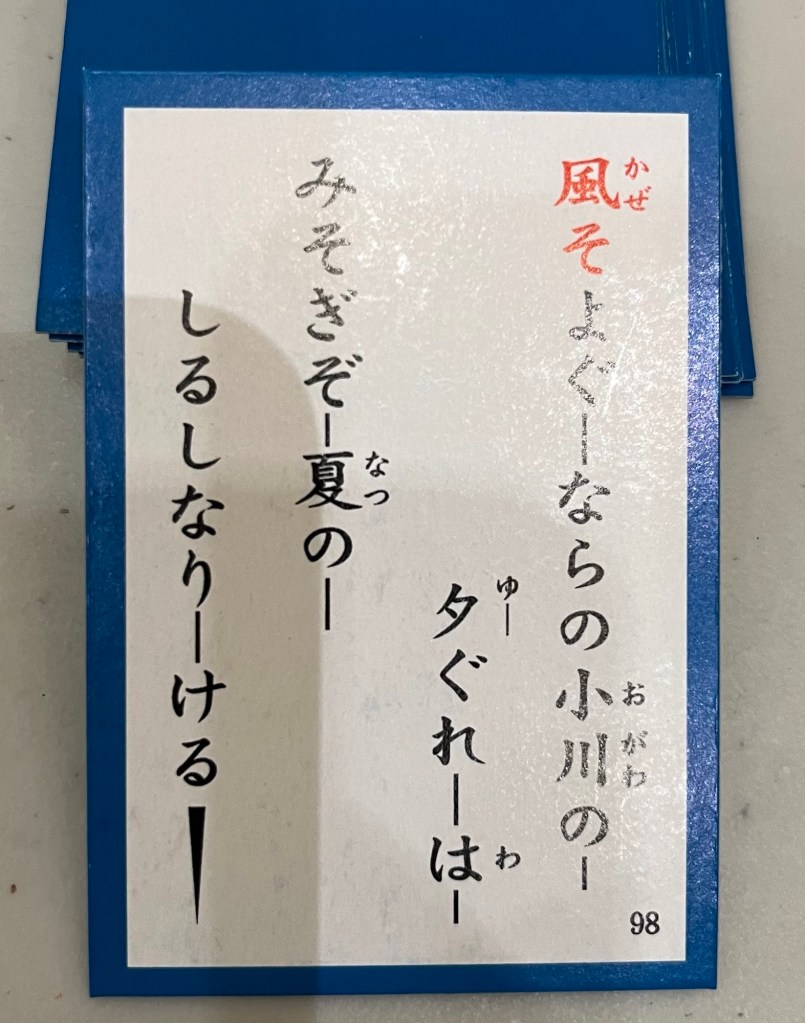
This page in Japanese focuses on learning to read Karuta cards. It even includes a video (Japanese only)
In red, the kimari-ji is shown, and the text of the poem includes rhythm clues (the lines and arrows) where you should elongate the syllable, for example. Each poem has a slightly different rhythm. It’s not the same pattern with every poem. So, you definitely have to practice each poem and how to recite them.
In the end, taking turns as the yomité is a nice way to share responsibility, and even Japanese is not your first language, you can pick it up with a bit of time and effort.
Being able to recite your favorite poem the traditional way is also a neat skill to learn anyway.
One of my biggest challenges with learning to playkaruta are penalties (otetsuki, お手付き). A penalty happens in one of there scenarios:
The correct card is on the opponents side, but you touch a card on your side for any reason.
The correct card is on your side, but for any reason you touch a card on the opponent’s side.
The card is not on the board (karafuda, から札), but for any reason you touch a card on the board.
In all three cases the result is the same: your opponent is allowed to send a card over to you. Their card count is reduced by one (advantage), and your card count also increases by one (disadvantage).
If you think about it, a penalty is more costly than simply letting your opponent take the card. In the rare case of a double penalty, it is extremely costly because your opponent will send over two cards.
However, the pressure to correctly identify and then take the correct card before your opponent makes penalties possible, even for pro players. However, the more you prevent penalties the better your gameplay overall.
In my case, I get penalties often under pressure. In some games, I get as many as 8-9 penalties which is disastrous. The featured photo is a game I lost recently where I had 6 penalties. I would have still lost but the margin was much bigger due to penalties and panic (i.e. “tilting”).
If I calm down and focus, I can reduce this far fewer. Sometimes when I panic, I have to remind myself that it is better to be slow, than to be wrong.
For the past month, I have been striving to reduce my penalty rate and found a great article in Japanese. It identifies a few different patterns of penalties people tend to do, and how to counteract each. I won’t explain the article word for word, but some of the more common patterns are:
Forgetting (or mis-remembering) the position of cards on the board. This requires a grasp of the kimariji for quick recognition, and focus to maintain a “mental map” in your head. Personally, I find it helpful to focus on an empty spot on the board as a meditation “focal point”, so I can visualize without looking.
Hitting cards on both sides of the board on accident. This requires physically practicing how you move your hand and being quick, but more precise.
Listening incorrectly (or jumping the gun) and taking the wrong card. This is very common and a good habit to break quickly.
One method I have used and wrote about before is playing solo and reducing the pressure while focusing on being correct, not fast.
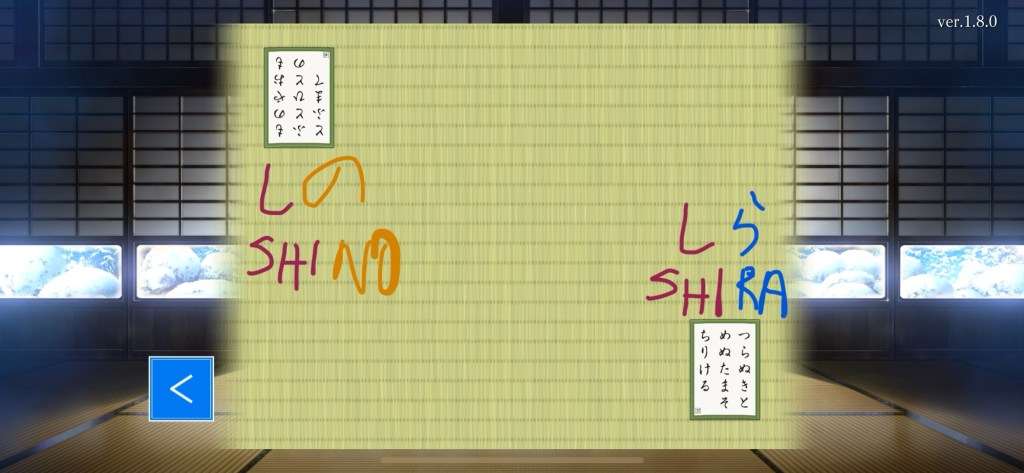
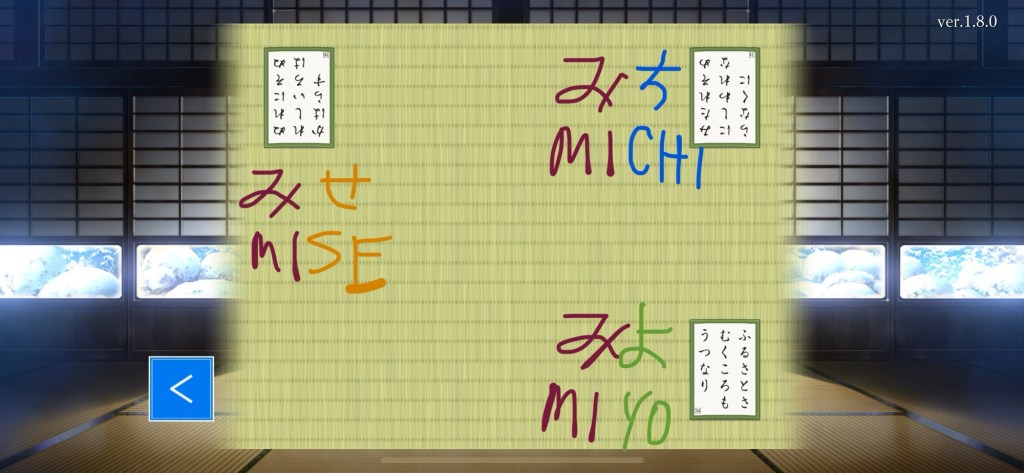
Another, general method for reducing penalties is practicing kikiwaké (聞き分け): “separating sounds”. This is a form of teaming and a mini-game in the online karuta app called “Branching Cards” in English. The Japanese kikiwake means to listen and differentiate.
“Branching Card” in English
In each round you will be presented with 2-3 tomofuda (友札), or cards with similar kimariji. Your job is to listen and take the correct one. There are no empty cards; the correct one is always on the board somewhere.
As the article explains above, you should focus on the last syllable of each kimariji so that you can more easily differentiate which is being read.
In the example below, there are two cards with kimariji of しの (shino) and しら (shira). The の and ら are what differentiate the two.
In a more challenging example, there are cards with kimariji of みせ (mise), みち (michi) and みよ (miyo). The せ, ち, and よ are what differentiate the three.
At first this is surprisingly tough to do. You have to recognize the cards quickly, and then listen for the important syllable. I made many mistakes at first, but after a couple weeks, I’ve gotten better about waiting until the correct syllable is read.
As always keep practicing fudawake, but also strive to improve your listening and self-discipline too.























 The Hyakunin Isshu

