I wanted to share an exciting opportunity for readers. The University of Washington, my alma mater, is hosting a lecture in-person and online by none other than Professor Joshua Mostow!
Years ago, Dr Mostow graciously allowed me to use his translations of the HyakuninIsshu for this blog, and readers have hopefully enjoyed his translations over the years. We poet-enthusiasts have all benefitted from Dr Mostow’s hard work and enthusiasm for the field. Let’s show our support, and enjoy a fascinating lecture on the Hyakunin Isshu and how it impacted Japanese history in later times.
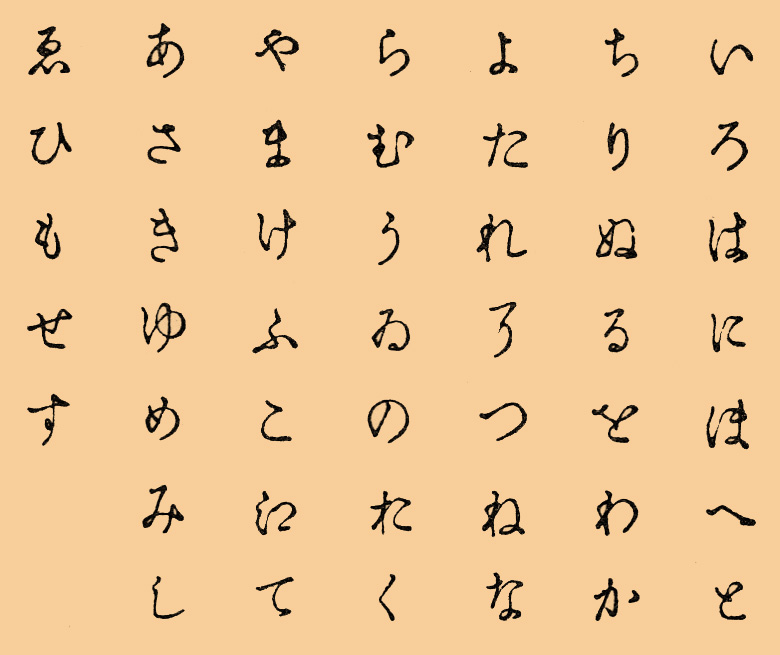
One of the most famous waka poems across Japanese history and even contemporary culture is a poem called the Iroha. The name “iroha” comes from the first three letters of the poem “i”, “ro” and “ha”. What makes this poem famous is that it uses each hiragana syllable exactly once, and still makes an intelligible, not to mention lovely, poem.
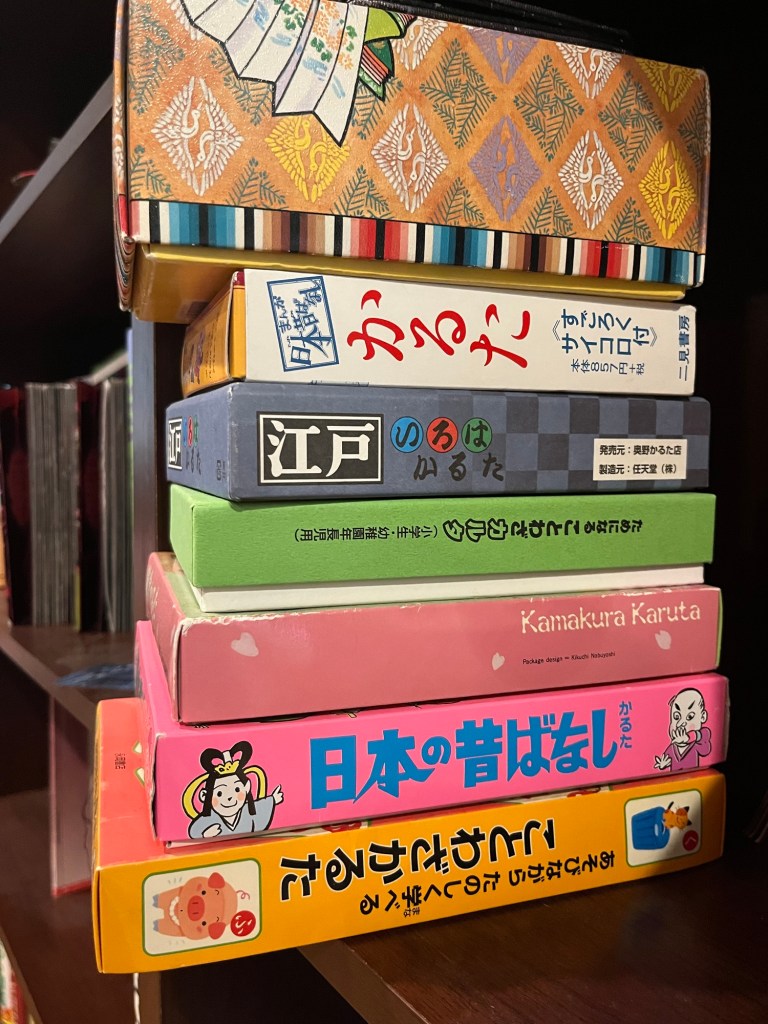
Because of this, it was often used in pre-industrial Japan as a way to organize things. Theater rows would be organized by the order in the Iroha letters, and so were firefighter brigades in pre-modern Tokyo (a.k.a. Edo). Even modern karuta sets are organized by iroha order. I don’t mean the Hyakunin Isshu karuta that I often discuss in the blog, but more informal karuta games that kids often play. We have a few sets here at home, given to us by my in-laws for the grandkids. You can see a nice selection of Iroha karuta sets on the Okuno Karuta online store, too.a
Various karuta sets my in-laws in Japan sent us. The top one is my wife’s original Hyakunin Isshu she had from grade-school.
But I digress.
The Iroha poem’s author is unknown (more on that later), but it was originally composed in old Manyogana script, like other poems of the early Manyoshu anthology, then later in hiragana. It includes many old spellings, so it’s a bit hard to render in modern Japanese.
The poem is as follows:
Manyogana
Modern Japanese
Romanization
Translation1
以呂波耳本部止
いろはにほへと
I ro ha ni ho he to
Even the blossoming flowers
千利奴流乎和加
ちりぬるをわか
chi ri nu ru o wa ka
will eventually scatter
餘多連曽津祢那
よたれそつねな
yo ta re so tsu ne na
Who in this world shall
良牟有為能於久
らむうゐのおく
ra mu u i no o ku
remain unchanged? Let us today2
耶万計不己衣天
やまけふこえて
ya ma kyo (ke fu) ko e te
cross the mountains of impermanence
阿佐伎喩女美之
あさきゆめみし
a sa ki yu me mi shi
and no longer have superficial
恵比毛勢須
ゑひもせす
e hi mo se su
dreams, nor be deluded
1 adapted translation from Wikipedia, plus a few modifications of my own 2 有為 (u i) meaning “viccisitudes of life” or the impermanence of all phenomena
This poem has strong Buddhist allusions to such concepts as samsara (“the aimless wandering lifetime after lifetime”), the delusions that bindus to this existence, awakening to these delusions (e.g. “enlightenment”), and finally nirvana (“unbinding”). The poem itself shows considerable familiarity with earlier Buddhist texts such as the Perfection of Wisdom sutras, including the Heart Sutra, as well.
But I digress. Again. 😅
There are some really interesting aspects of this poem that are worth sharing. First, authorship. Given the strongly Buddhist undertones of the poem, it’s often been attributed to a famous Buddhist monk named Kukai (a.k.a. Kobo Daishi) who was a talented poet and calligrapher. Another theory states that this poem may attributed to none other than the famous court poet Kakinomoto no Hitomaro, who composed poem 3 in the Hyakunin Isshu (あしびきの).
But things get even more interesting.
Scholars have noted that if you take the last syllable of each line (highlighted above for convenience) it spells another sentence: toka (ga) nakute shisu (咎[が]無くて死す) meaning “he/she died without fault or blemish”. Another theory, mentioned in my new book, points out that the 5th column spells out ho(n) wo tsu no ko me (本を津の小女), which could mean “deliver this book to my wife in the town of Tsu”, which if taken together with the 7th column implies that “I will die without blemish, please deliver this poem to my wife”.
So, is the poem a tribute to someone else? Perhaps Kukai or Hitomaro? If so, then who wrote it, and why? Was the poem a coded message to someone who was executed for political reasons? Or was the poem simply an attempt at word-play?
We will never know, but the impact of the Iroha on Japanese poem can still be easily seen today.
a Although things like Chihayafuru and this blog tend to emphasize the competitive karuta of the Hyakunin Isshu, in reality that’s only a small subset of karuta gaming culture. Most of it is much more informal stuff you play at home with family, much like board games in Western culture, and often times doesn’t even relate to the Hyakunin Isshu. Maybe I’ll post about it some time, but thanks to grandparents in Japan, we have 4-5 sets here ranging from such subjects as places in the city of Kamakura, old folks-sayings, Japanese fairy-tales, and just really basic words in Japanese. Most of these list the cards using iroha-order, and are not related to the Hyakunin Isshu. We’ve played them with our kids from time to time, and they’re much easier than competitive karuta, though it’s still assumed you know at least some basic Japanese.
Ever since I picked up this book which explores the Pillow Book of Sei Shonagon (poem 62 of the Hyakunin Isshu, よを), it’s been fun to learn many of the hidden meanings and cultural allusions of this famous literary work.
It’s also fun to see how the Pillow Book is viewed by Japanese students in Japan. I talked with my wife and her friends about it, and they confirmed that kids in Japan study the Pillow Book in school, but like all students everywhere, they tend to forget most of it.1 My book jokes that most students in Japan only remember the very first line: haru wa akebono.
I bring this up because with the recent changing of the weather, I’ve been thinking a lot about seasons, especially after writing this post. So, I went back and looked at the first chapter of the Pillow Book.
The opening section begins with Sei Shonagon’s analysis of the four seasons, and what’s great about each one. This website posts the original text in Japanese (tl;dr it’s fairly different than modern Japanese) and even has a nice recording. It’s worth a listen, even if archaic Japanese is not your hobby.
Separately, if you want to hear how it was pronounced at the time you can see this video (00:47 onward):
Anyhow, let’s look at how Sei Shonagon describes each of the four seasons, starting with Spring…
Natsu wa yoru. Tsuki no koro wa sarinari. Yami mo nao, hotaru no ooku tobichigaitaru. Mata, tada hitsotsu futatsu nado, honoka ni uchi hikarite iku mo, okashi. Ame nado furu mo, okashi.
“In summer, the night — moonlight nights, of course, but also as the dark of the moon, it’s beautiful when fireflies are dancing everywhere in a mazy flight. And it’s delightful too to see just one or two fly through the darkness, glowing softly. Rain falling on a summer night is also lovely.”
Aki wa yuugure. Yuuhi no sashite, yama no hai to chikau nari taru ni, karasu no nedokoro e ikutote, mitsu, yotsu, futatsu mitsu nado, tobiisogu sae awarenari. Maite, kari nado no tsuranetaru ga, ito chiisaku miyuru wa, itokashi. Hiirihatete, kaze no oto, mushi no ne nado, hata, iiubeki ni arazu.
“In autumn, the evening — the blazing sun has sunk very close to the mountain rim, and now even the crows, in threes and fours or twos and threes, hurrying to their roost, are a moving sight. Still more enchanting is the sight of a string of wild geese in the distant sky, very tiny. And oh how inexpressible, when the sun has sunk, to hear in the growing darkness the wind, and the song of autumn insects.”
Fuyu wa tsutomete. Yuki no furitaru wa, iubeki ni mo arazu. Shimo no ito shiroki mo. Mata sara demo, itso samuki ni, hi nado isogi okoshite, sumi motewataru mo, ito tsukizuki shi. Hiru ni narite, nurukuyurubi moteikeba, hioke no hi mo, shiroki hai ga chininarite, waroshi.
“In winter, the early morning — if snow is falling, of course, it’s unutterably delightful, but it’s perfect too if there’s a pure white frost, or even just when it’s very cold, and they hasten to build up the fires in the braziers and carry fresh charcoal. But it’s unpleasant, as the day draws on and the air grows warmer, how the brazier fire dies down to white ash.”
As someone who likes to “nerd out” about such things, I try to shorten this to the following for easier memorization:
Spring: haru wa akebono (spring daybreak)
Summer: natsu wa yoru (summer nights)
Fall: aki wa yuugure (fall sunsets)
Winter: huyu wa tsutomete (early winter morning)
… and now you too know some authentic Japanese literature from the Heian Period.
1 Despite being a nerd now, I was actually a pretty lazy student in school. I was assigned to read various English classics like Ivanhoe, Treasure Island, etc, but usually didn’t read them, and faked my way through exams and such. My grades were mostly C’s and even some D’s. In high school, I finally took an interest in reading after picking up J.R.R. Tolkein’s Fellowship of the Ring, and have loved reading since. Looking back, I suppose a chaotic home life, and also just lack of structure and inspiration were to blame.
As I wrote previously, I have been spending a lot of time trying find more effective training methods for myself and for new, foreign Karuta players because of the scarcity of resources. One website that has been particularly helpful in Japanese is Karuta Club, managed by the Meijin (master player) Kawase Masayoshi and his wife.
It’s a pretty nice site and has a ton of training and resources, though almost all of it is in Japanese. There is a nice English-language introduction that is worth reading.
But for this post I wanted to focus on one particularly helpful article. This teaches a method of memorization called nakama-waké.
The method seems a bit complicated upfront but really helps in those 15 minutes (or 30 seconds on the app) when you have to memorize the board, and uses knowledge you probably already know: the kimari-ji.
Let’s look at my kimari-ji chart here. You can see how the cards are group by first syllable : “ha” cards, “tsu” cards, “ki” cards, “wa” cards and so on.
Kawase’s article suggests that after you learn the kimari-ji, next invest time memorizing how many are in each group. If you look at the chart, there are only two cards in the “tsu” (つ) group, compared to seven in the “wa” (わ) group, or 16 in the “a” (あ) group. Some groups are very large, some are very small.
Let’s use the examples of the “ha” group. From the chart we can see that there are four cards that start with “ha” (は):
If we remember that the “ha” group has 4 cards total, and when you are memorizing at the start of the match, you can determine which of the four are on the board. The rest can be safely ignored as kara-fuda (“empty cards”).
This separation of similar cards (“friends”) between the ones on the board and the ones that aren’t is why this is called nakama-waké (仲間わけ): “separating friends”.
Using the online karuta app, let’s demonstrate this. Here’s a game I played earlier, using default settings: 8 cards per side, only 30 seconds to memorize. The cards are all laid out, and my opponent (the computer) and I are memorizing.
Of the four “ha” cards, I can see two on the board, highlighted in purple. The two cards are “haruno” (はるの) on my side and “harusu” (はるす) on the opponent’s side. That means the other two in the group “hanano” (はなそ) and “hanasa” (はなさ) can be totally ignored if they are read aloud. That helps me avoid accidentally taking the wrong “ha” card and getting a penalty.
While we’re here, you might notice that both “shi” (し) cards are on the board, highlighted in green: “shira” (しら) and “shino” (しの). Even better they are on my side. That means I can just put group them together and simply listen for “shi” (し). Of course, the danger is that the opponent knows this too. Position matters.
Similarly, both cards of the “tsu” (つ) group are on the board too, highlighted in red. They are on opposite sides of the board though, so I still have to be careful to distinguish which is which when read. But it also means there are no “empty” tsu cards either.
Finally, of the seven unique “one syllable” cards, only one of them is on the board: “sa” (さ) which I’ve highlighted in blue. That means I can totally ignore the other six: “mu” (む), “su” (す), “me” (め), “fu” (ふ), “ho” (ほ) and “se” (せ) if they are read.
This may seem like more work upfront, and it does take time to get used to thinking like this, but it really helps in a couple ways:
Your memorization process is more structured, less haphazard, and so you can memorize a full board of 50 cards more easily.
Less risk of penalties because you’re only paying attention to the cards you know are on the board per group, and disregarding the rest.
If you’re relatively new to karuta and you find this process intimidating, you can focus on smaller, easier groups of cards for now: the one, two, and three card groups. With experience, and familiarity, you can then expand to larger, more difficult groups and even use this trick with the huge “a” group.
As fall is approaching, I wanted to share an interesting anecdote provided by my book on the Manyoshu. It seems that throughout Japanese antiquity, poets frequently debated which is better: spring or fall.
The first example comes from Princess Nukata in the 7th century, whom we discussed here and here, she wrote a lengthy poem (a chōka poem, not the usual tanka poem) in the Manyoshu (poem 16). She discusses the pros and cons of spring and of fall:
Original Manyogana1
Japanese
Romanization
Rough Translation2
冬木成 春去來者
冬ごもり 春さり來れば
Fuyu gomori haru sari kureba
When winter passes and spring comes
不喧有之 鳥毛来鳴奴
鳴かざりし鳥も來鳴きぬ
Nakazarishi tori mo nakinu
Birds that didn’t sing before, now come and sing
不開有之 花毛佐家礼抒 山乎茂
咲かざりし 花も咲けれど 山を茂み
Sakazarishi hana mo sakeredo yama wo shigemi
Flowers that didn’t bloom before now bloom, but because the mountains grass is so thick
入而毛不取 草深 執手母不見
入りても取らず 草深み 取り手も見ず
Irite mo torazu kusabukami torite me mizu
One cannot go and pick flowers, let alone see them.
秋山乃 木葉乎見而者
秋山の 木の葉を見ては
Aki yama no ko no ba wo mite wa
When you look at the leaves in the mountains during fall,
黄葉乎婆 取而曾思努布
黄葉をば 取りてそしのふ
Momiji wo ba torite soshi no fu
collecting the yellow leaves is especially prized.
青乎者 置而曾歎久
青きをば 置きてそ歎く
Aoki wo ba okite so nageku
Leaving the green leaves as they are is regrettable.
曾許之恨之 秋山吾者
そこし恨めし 秋山われは
Sokoshi urameshi akiyama ware wa
In spite of that, autumn in the mountains is spectacular…
a – I am heavily indebted to this site for both the original text. Translation is based in part on that site, but also my Manyoshu book, but probably lots of mistakes. Translating a five-line poem in archaic Japanese is hard enough… 😅
Speaking of the Manyoshu, its compiler Otomo no Yakamochi (poem 6 of the Hyakunin Isshu, かさ) left us some very nice poetry about spring:
Original Manyogana1
Japanese
Romanization
Rough Translation2
春苑
春の苑
Haru no sono
Beneath
紅尓保布
紅にほふ
Kurenai ni hofu
the shining crimson
桃花
桃の花
Momo no hana
orchard of
下照道尓
下照る道に
Shita deru michi ni
peach blossoms
出立オ嬬
出で立つ少女
Idetatsu otome
a young maiden lingers.
Poem 4139, book 19
and about fall:
Original Manyogana1
Japanese
Romanization
Rough Translation2
秋去者
秋さらば
Aki saraba
When fall comes
見乍思跡
見つつ思へと
Mitsutsu shinoe to
think fondly of those
妹之殖之
妹が植ゑし
Imo ga ue shi
pink blossoms
屋前乃石竹
やどのなでしこ
Yado no nadeshiko
of days gone by
開家流香聞
咲きにけるかも
Saki ni keru kamo
and remember me.
Poem 464, book 3
Otomo no Yakamochi wrote both of these poems about his beloved wife, but the second was composed shortly after her parting. The word nadeshiko has special meaning in Japan and has a very feminine, demure3 meaning.
Returning to the debate between spring and fall, Ki no Tsurayuki (poem 35 of the Hyakunin Isshu, ひとは) took up the same topic centuries later. This is poem 509 from an imperial anthology, the Shuishu :
Japanese
Romanization
Rough Translation2
春秋に
Haru aki ni
Spring or Fall?
おもひみたれて
Omoi mitarete
My thoughts are a mess,
わきかねつ
Waki kanetsu
and I cannot decide.
時につけつつ
Toki ni tsuketsutsu
The more time passes,
うつるこころは
Utsuru kokoro wa
the more my heart shifts back and forth.
1 This is a rough translation, all mistakes are my own.
The debate was even cited in the famous 12th century novel Tales of Genji written by Lady Murasaki (poem 57 of the Hyakunin Isshu, め):
“Since antiquity, in the debate about spring versus fall, many people lean toward fall, and yet some very noteworthy people who view the Imperial gardens in spring may yet change their mind, as is the way of the world.”
Princess Nukata all the way back in the Manyoshu seemed to imply that autumn was preferable, and it seems that most of the aristocracy shared this view. In fact if we divide up the poems of the Hyakunin Isshu by season, there are more fall poems than spring:
Note: summer only has 4 poems, winter has 9 (same as spring).
But what do you think? Are you Team Spring, or Team Fall?
Edit: added Hyakunin Isshu poetry chart.
1 If you’re wondering why I post Manyogana for some poems, but not others, it depends on the era. The Manyoshu is the oldest anthology by far, and at that time, there was a brief writing system that took Chinese characters, but used them in a phonetic way for Japanese language (a.k.a. Manyogana). By the time of Ki no Tsurayuki and Lady Murasaki, centuries later, this had been replaced with hiragana script. This blog strives to both be accurate and accessible, so I try to balance both needs.
2 These are all rough translations on my part, and likely have mistakes. Any such mistakes are entirely my own.
3 Not to be confused with the “very demure, very mindful” meme. 😛
If you are learning to play karuta there are plenty of resources in Japanese language, but outside of that, there’s almost nothing. This is understandable since karuta has only very recently become known outside of Japan, but it still challenging for foreign players to develop good foundations. So, although I am a casual novice myself, I try to share what I find.
One training method used in Japan, especially for children learning to play in school, is the Five Color (go-shiki, 五色) Hyakunin Isshu method. This is a way of color-coding the 100 poems of the Hyakunin Isshu into five groups of 20, based on relative difficulty to learn. I have posted about it before but didn’t have a set to try out and demonstrate.
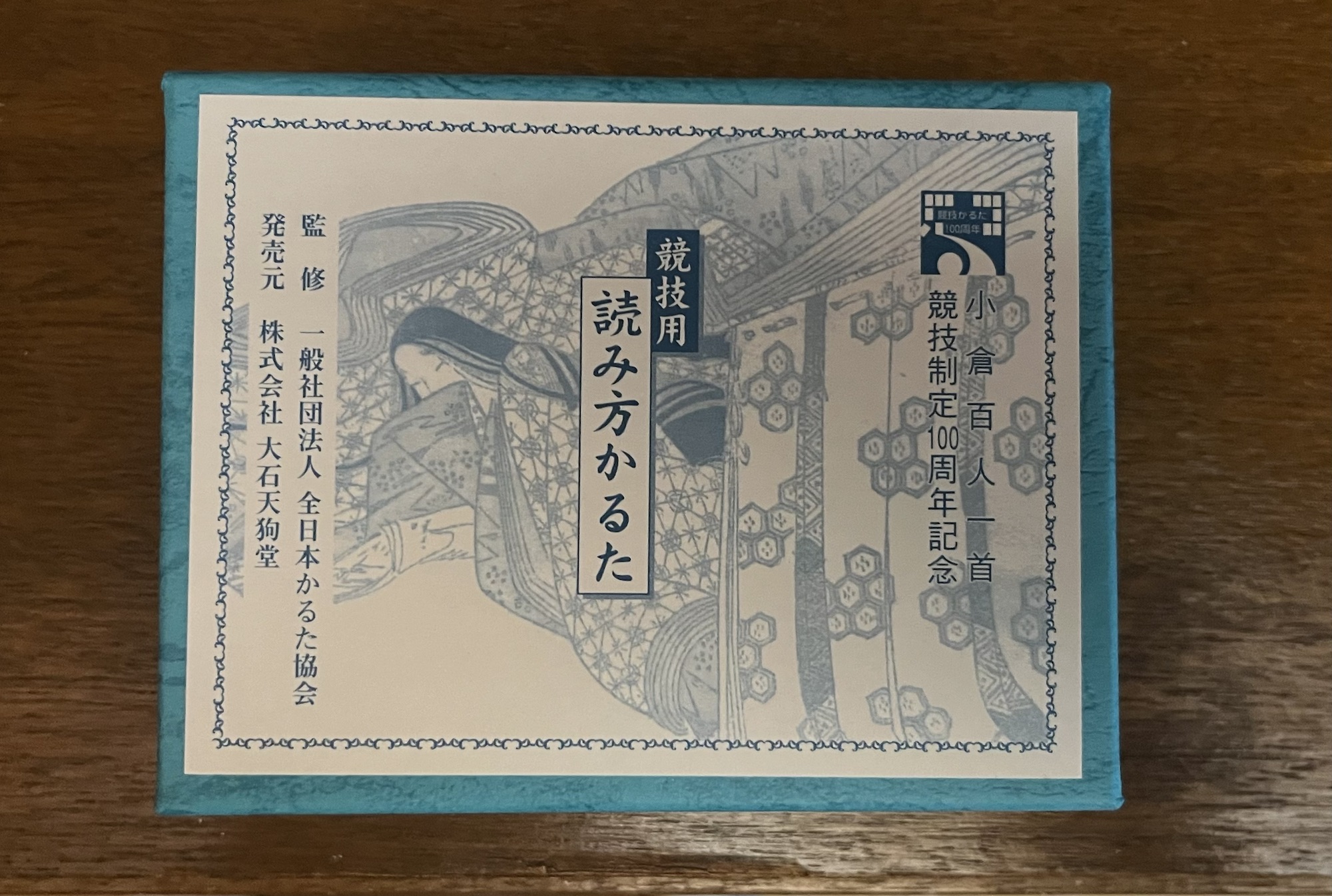
Since I was in Japan earlier this year with the family (visiting in-laws), I decided to get a boxed set for myself. They are hard to obtain outside of Japan, and I had to order directly from the Oishi Tengudo. My package soon arrived at my in-laws house,1 and later I brought them home and opened up the box.
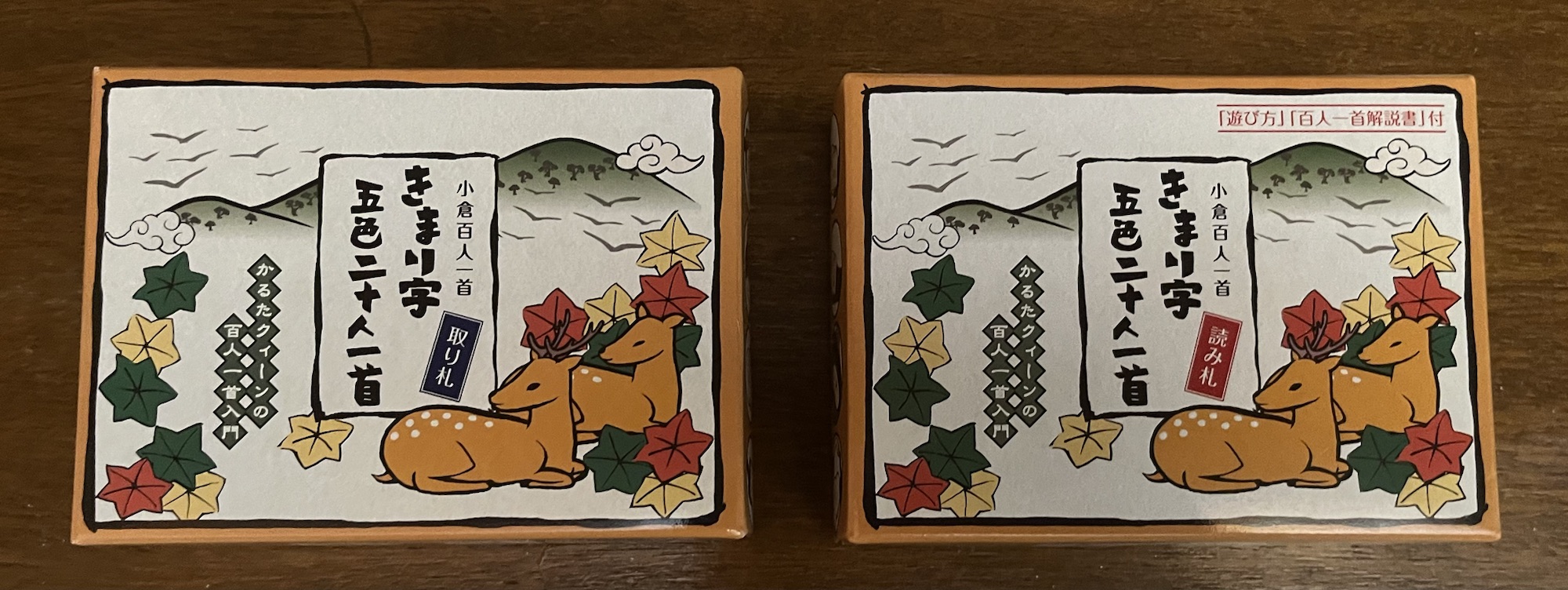
The set is very nicely put together. It comes in separate boxes for the reading cards, yomifuda, and corresponding the cards you take, torifuda.
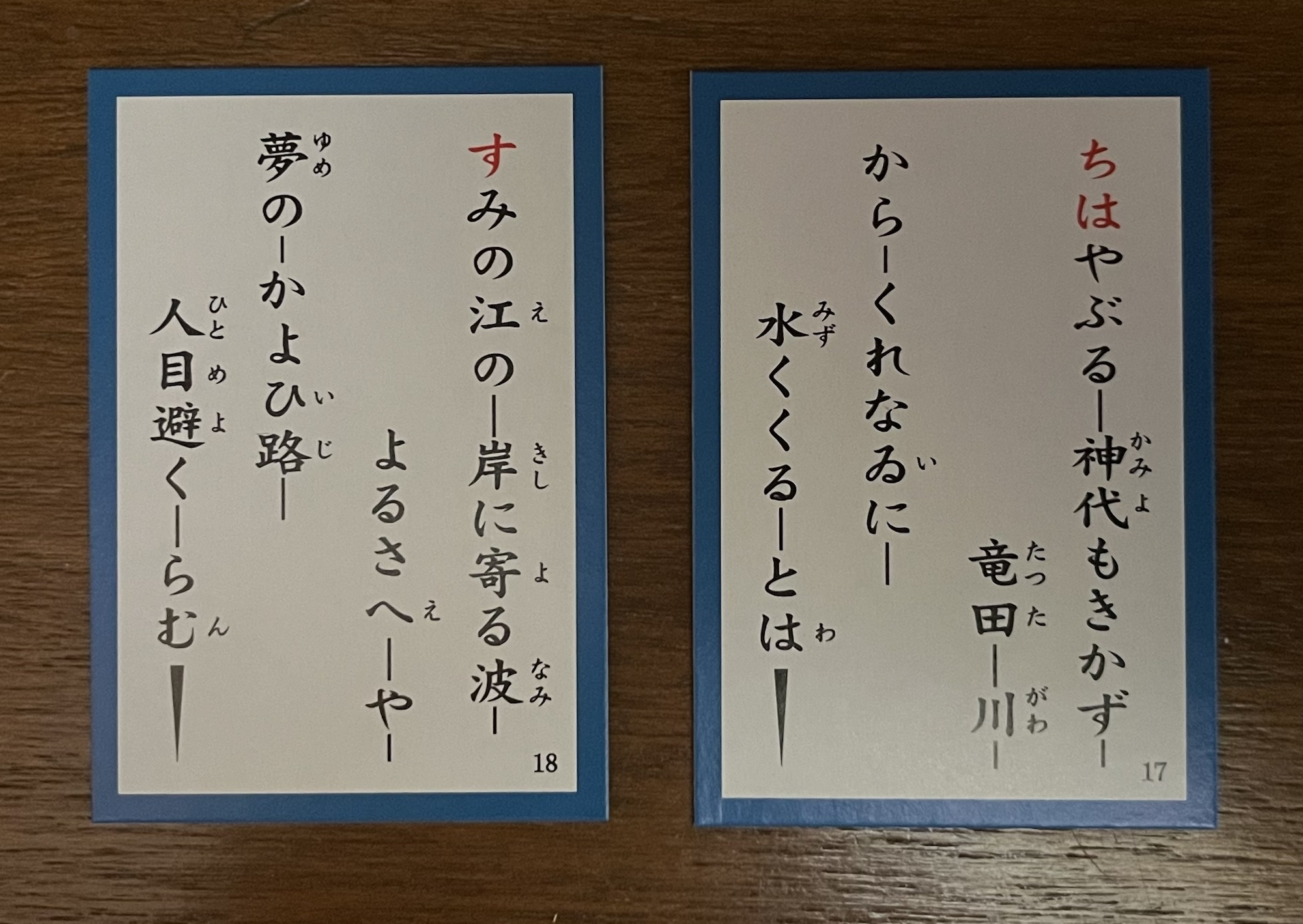
Torifuda cards on the left, and yomifuda cards on the right.
Because the Five Color Hyakunin Isshu is mostly geared for children (and not nerdy middle-aged foreigners 😅), the illustrations have a cute, cartooinish quality, and the hiragana script uses a very readable font. Notice that the card borders have colors too: yellow and red in the pictures above.
Something that surprised me was that the back of the torifuda cards, which are usually not seen during play, also show the first half of the Hyakunin Isshu poems, with the kimari-ji emphasized. This saves new players the hassle of having to go and look up what the kimari-ji are.
Poem 15 shown in yellow on the left, and poem 65 in red on the right.
Also, if you get a set like this, and you use a Karuta reader app to read only that color. Many reader apps have readings sets specifically for the Five Color Hyakunin Isshu, however, the Oishi Tengudo set divides its cards differently, and so the sets in karuta apps are not the same. You have to make your own custom sets like I did here.
So, does it work as a training method? Is it worth foreign players going to the effort to getting one of these sets?
I haven’t had a chance to field-test yet, especially with new karuta players, so I don’t know. Some foreign players online have derided the five-color method, and instead advocated other learning methods (more on those in later posts), but unfortunately I don’t have enough data to say which works. Since I have already self-learned karuta (more or less), I can’t really use myself as a test.
That said, the resources above are really nice, and since they’re geared for children, they provide a nice, gentle introduction to playing karuta. You do need to read hiragana script, but if you’re intending to play karuta, you need to know hiragana anyway. It is also one way to start with learning a smaller subnet of the 100 poems, with increasing difficulty as you move between colors.
I am eager to try this out the next time I meet with the local karuta club.
1 I also ordered a yomite card set for reading purposes. I’ve written about that in a previous post.
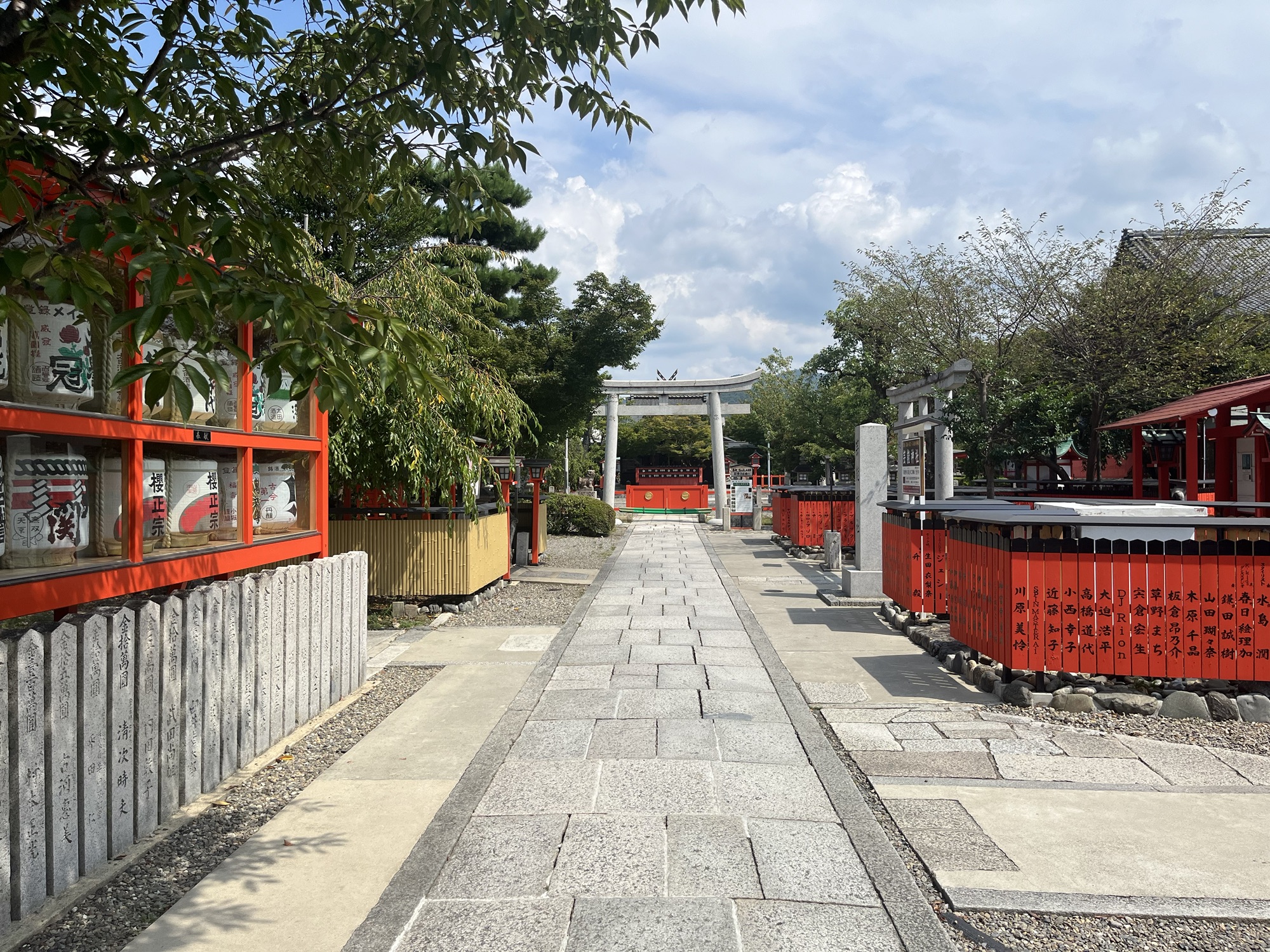
During our recent trip to Japan, we visited the city of Kyoto. I talked about this here, but I also wanted to share another site in Kyoto that relates to one of the poets of the Hyakunin Isshu : Kuramazaki Shrine. You can find their official website here, but there is no English and the site is a bit hard to navigate. The shrine itself has a very interesting layout:
The photo above is the main promenade leading to the inner sanctum (toward the back). Apparently, it’s tradition in Japanese culture to walk along the edge of the walkway, not right in the middle, so bear that in mind when visiting a shrine like this.
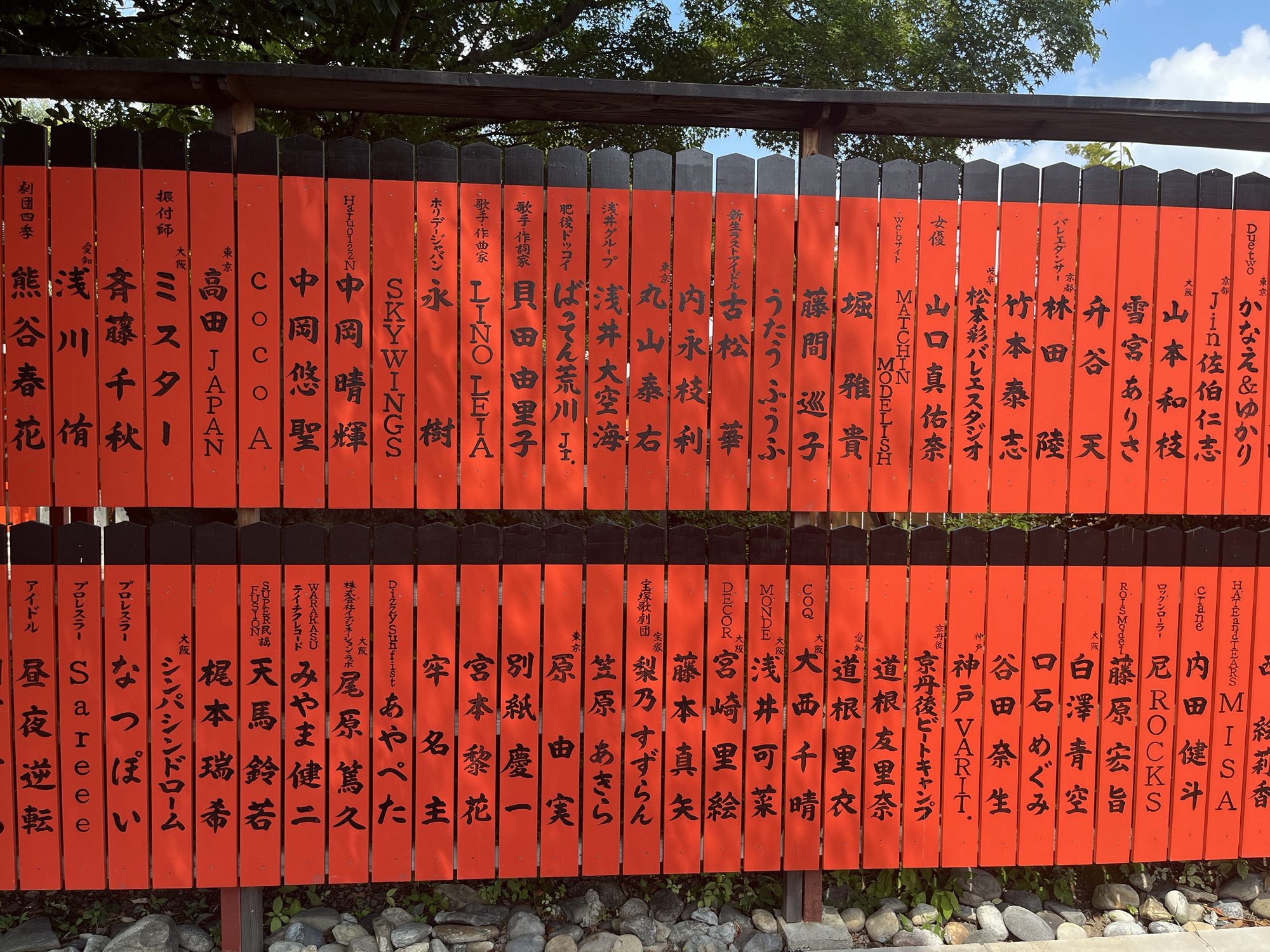
This Shinto shrine is notable for its many visits by celebrities who leave autographed red plaques.
Shinto shrines often serve particular need in society: love, business success, health, etc. In the case of Kurumazaki Shrine, the focus is on show-business, acting, theater, etc.
Why does this matter?
It turns out that Sei Shonagon, author of the Pillow Book and poem 62 (よを) in the Hyakunin Isshu is enshrined here. Not only that, but you can purchase a special omamori charm with her image on it. I learned about this place on social media after seeing the actress First Summer Uika, who played Sei Shonagon in the historical drama, visit the shrine.
Because this site contains many sub-shrines and side passages, it took a bit of effort to find Sei Shonagon’s shrine. It is halfway down the promenade, on the left, and looks like so:
I paid my respects to this esteemed author, and the family and I continued to explore. I found First Summer Uika’s plaque near the inner sanctum:
Incidentally, my wife is a fan of the JPop group Snow Man, and you can see one of their markers just to the left. We both got something out of this trip. 😛
As I alluded to earlier, the shrine complex is deceptively long, with many nooks and hidden shrines and side paths. The site map gives some sense of this. For reference, the Sei Shonagon shrine is number 20 on the map, and you can see there are many other sites here too. I didn’t photograph every shrine here, and most are probably obscure to readers (and obscure to myself). The common theme was both fortune, and also show business. They were some pretty neat shrines though, such as this one showing various theater masks:
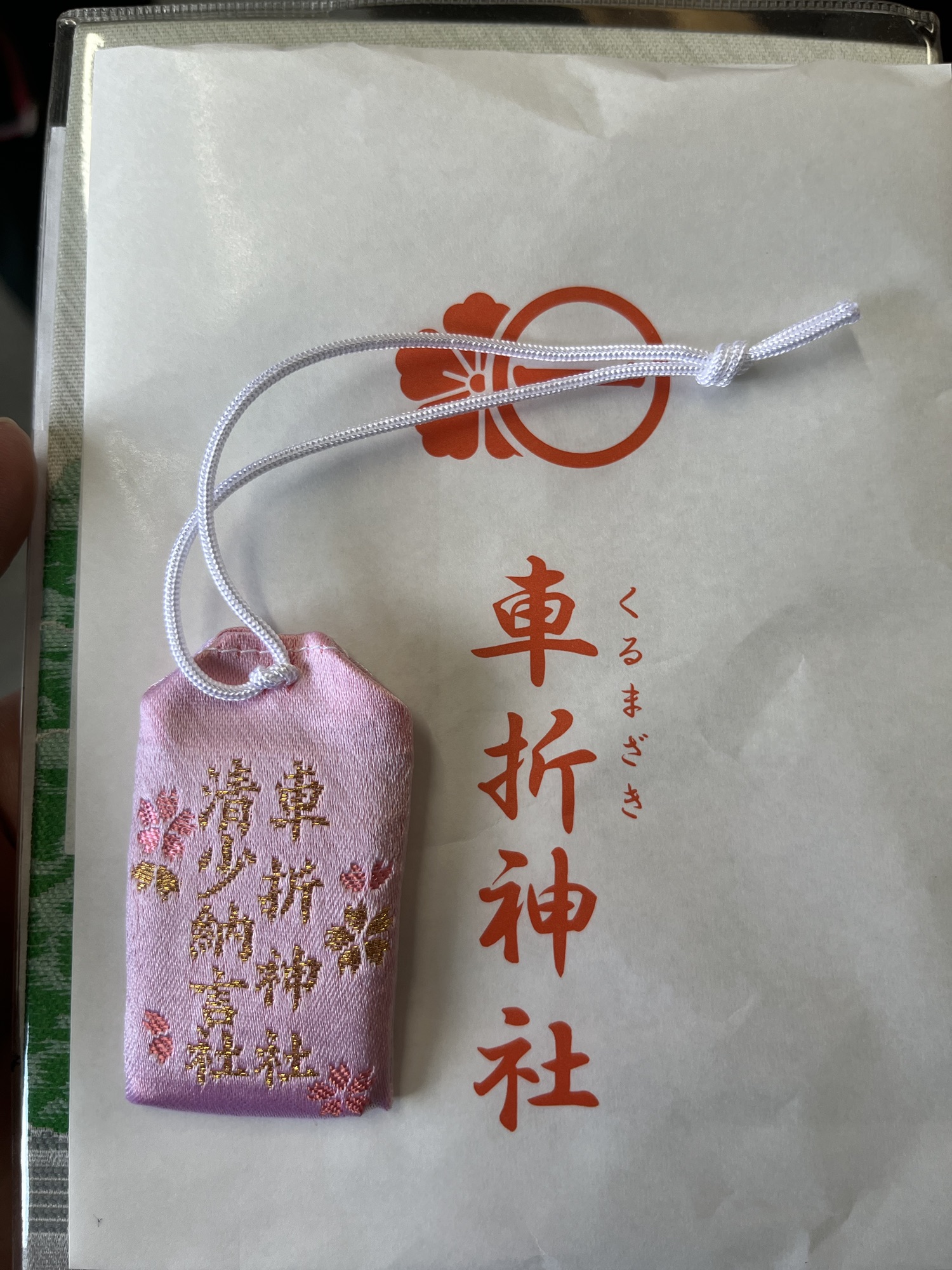
At last we came to the gift shop, and I got a Sei Shonagon charm (omamori):
Later, when I got back home and realized that the charm was intended for ladies,1 I was rather embarrassed, yet I didn’t want it to go to waste, so I gave it to my daughter whose preparing for college this year. It seemed fitting, and I am happy to report that she got a good score in her SAT exam the following month, so perhaps the charm worked?
Anyhow, Kurumazaki Shrine is not something tourists usually visit because it’s a little removed from the nearby touristy area of Arashiyama, and like many Shinto shrines, it’s very Japan-centric, but it’s a cool slice-of-life of Japanese popular culture, both past and present.
As for me, I was happy to pay my respects to such a wonderful poet and author directly, someone’s whose creativity and work indirectly helped make this blog what it is today.
P.S. Later that day, I stumbled upon the place where the Hyakunin Isshu was compiled, so I managed to visit two sites in one day. Not too shabby.
1 It’s clearly written on the signs, I just failed to pay attention. I was maybe a bit star-struck perhaps. 😅












 The Hyakunin Isshu
.jpg)
