Playing Karuta Solo Has Its Benefits

Having played Karuta now for three months and against a variety of opponents, including computer opponents, I realize that I get otetsuki (お手付き, “penalties”) a lot. Like, a lot.

In one in-person game, I was nervous and got eight penalties which is simply painful. Even when playing against the computer on hard mode, I get 2-4 penalties at a time.
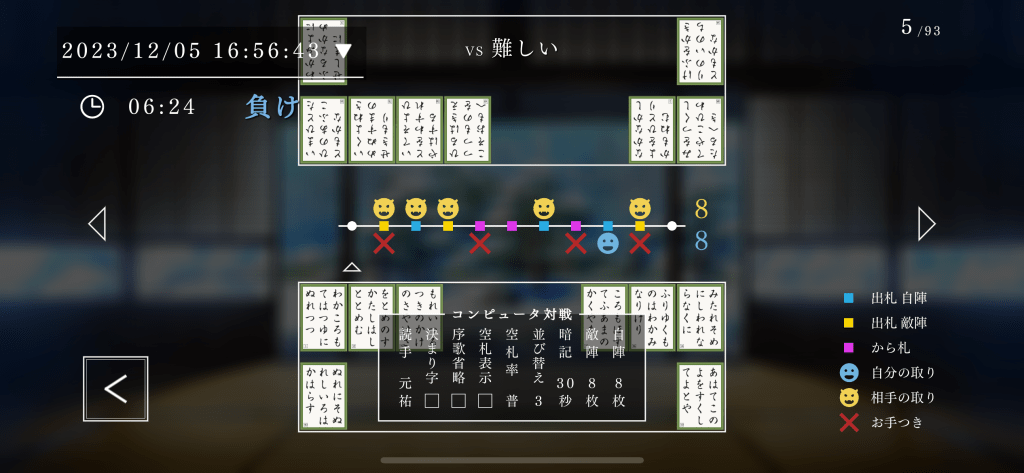
I had 4 this particular game (the red X’s shown). 🤦🏼‍♂️

Anyhow, after finishing some other long-term projects recently, I’ve been investing time to practice karuta, and to grow and develop my skills. One of my big goals has been to reduce penalties as much as possible, and so after some introspection, I realized that my biggest issue, besides being nervous and jumpy, is that i don’t pay attention enough to the reader.

As folks who have been following the blog know, the key to playing karuta is to know the kimari-ji syllables, those first, unique syllables each poem has to distinguish from other poems. Until you hear those syllables, you can not be 100% sure which poem is being read, and if you guess wrong, you get a penalty. Sometimes, I got lucky and guessed correctly, obviously though, sometimes I guessed wrong.

Memorizing the kimari-ji is the first step. You also have to recognize them when you hear them, and hopefully faster than your opponent.

I decided this month that I wanted to invest more time in discipline and listening skills, and less on speed, so I have switched to playing “solo mode” on the online karuta app. There are other ways to do this of course, but the point is that I am playing against a “goldfish”.

Why a goldfish?

A “goldfish” is a term in Magic: The Gathering, for when you are practicing against a completely passive opponent. They are there, but do nothing. Like a goldfish. 🐠

If you play solo mode on the online karuta app, you are not pressed for time. You can slow down, pay attention to the reader, and then take the card when you recognize it. It is also a good way to catch your bad habits, test your different card arrangements, etc. It’s a surprisingly handy tool for improving your game.

Also, it’s a great way to analyze your play style. when playing “solo mode” against the computer, I still got jumpy and took a penalty.

Further, as your listening improves, your speed will gradually improve, but it does require a touch of patience, and a willingness to sacrifice speed over accuracy. I need this. My accuracy is poor, and speed cannot fix that. If I don’t play more accurately, I will continue to suffer loss after loss.

Even when I practice fuda-nagashi drills, I realized that I had to slow down a bit, or I would mis-identify cards again. It’s important to recall cards quickly, but if you mis-identify a card, then it’s not worth it. Better to accurately recall the correct kimari-ji, even if slower.

So, if you are learning karuta, and you feel like you are struggling, stop, backtrack, slow down, and focus on playing good karuta, not fast karuta. With a bit of time and patience, it should pay for itself.

P.S. Special thanks to the crew on the Competitive Karuta Discord group (Discord invite link here) for their helpful advice, much of which was incorporated in this blog post. ☺️

The Kōrin Karuta Collection

On a quiet Saturday afternoon, the first in a long time, I caught up on some reading and continued to read through my book about the Hyakunin Isshu (mentioned here): the Hyakunin Isshu Daijiten.

In one chapter, the book discussed a special artistic collection of the Hyakunin Isshu called the Kōrin Karuta collection (kōrin karuta, 光琳カルタ) which was painted by the famous artist Ogata Kōrin (尾形光琳, 1658-1716). The featured image above is one of his famous paintings depicting irises in a field (Public domain, via Wikimedia Commons).

I had a hard time finding available images of the Ogata Kōrin collection of cards, but you can see an example at the Tengu-do homepage. There’s a few things that make this collection noteworthy among the long history of the Hyakunin Isshu….

First, the cards use a gold background, instead of white or off-color white. If you look at Ogata’s other paintings, this is a common technique that he used, so it makes sense.

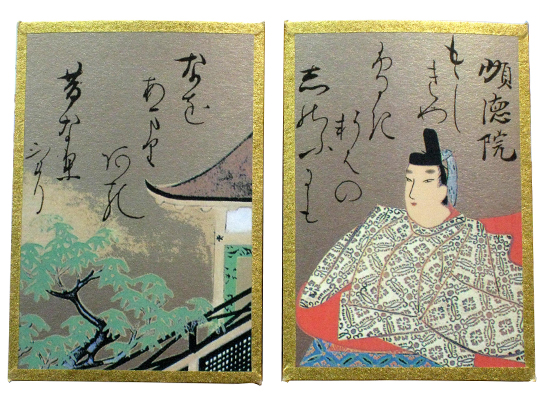
Second, and more significantly, the torifuda cards are painted as well. Whereas the yomifuda cards have portraits of the poets (with some subtle details we’ll talk about below), modern torifuda cards only have the text on them. Ogata decorated the torifuda cards using scenes that matched the poem.

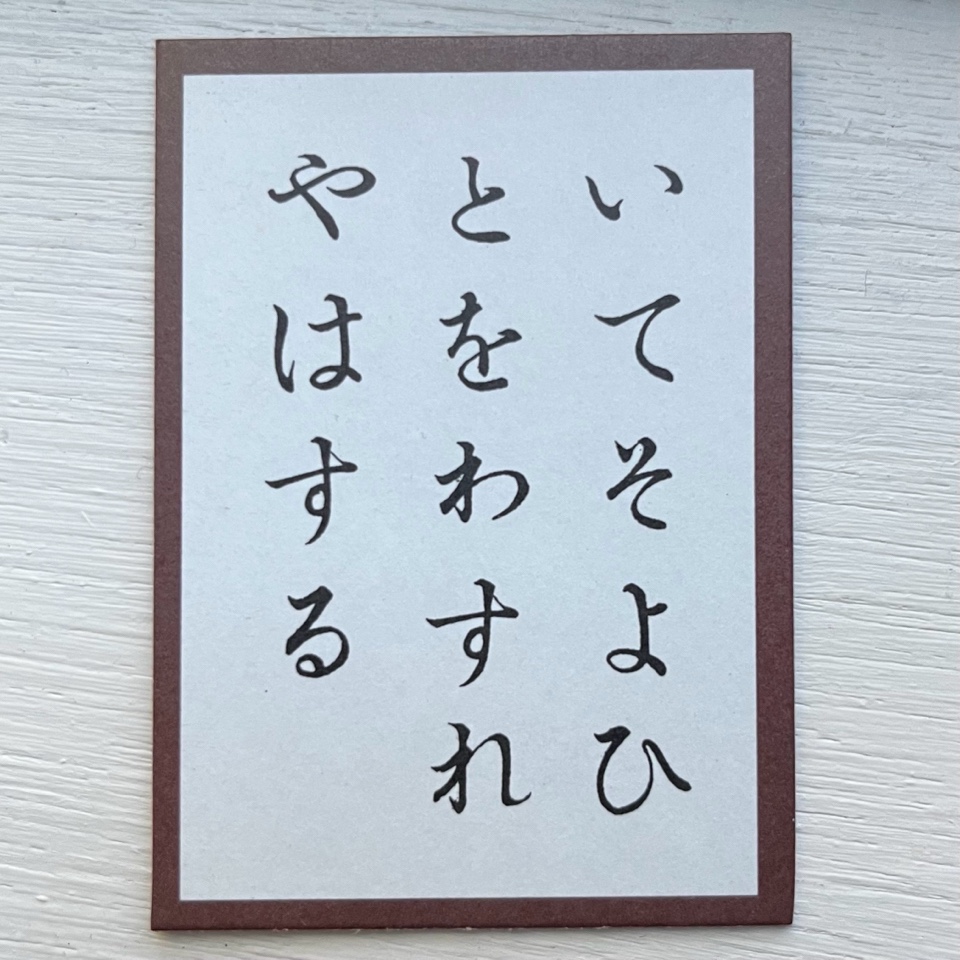
For example, poem 100 (ももしきや) is shown here on the Tengu-do website. The corresponding torifuda card shows the eaves of a palace since the poem is about the declining condition of the Imperial palace amidst political strife. Poem 35 (ひとはいさ) is shown here. Since the poem is about the first cherry blossoms in spring, the torifuda card depicts cherry blossoms. And so on.

Third, the cards were larger in size than a standard karuta card used today. Perhaps the cards were not meant for playing, but as a medium of art.

Also, I realized that the illustrations of the poets looked awfully familiar. My first karuta set uses the same Ogata illustrations, even though the torifuda are not illustrated, and the card background is plain white versus the original gold color.

Even the paintings of the authors has some pretty interesting qualities to them. Using my own set, let’s take a look at a few notable quirks.

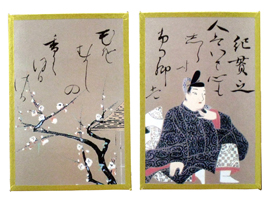
First, the “emperor” cards (cards where the poet was a reigning or retired emperor) have them seated on a straw mat with a brocade edge, a sign of authority. None of the other poets have this, even if the poet was a high ranking officials in the court. Here are the cards for Kōkō Tennō (“Emperor Koko”, poem 15) and Juntoku-in (“Retired Emperor Juntoku”, poem 100):

Second, while most poets’ faces are visible, the card for Shokushi Naishinnyo (“Imperial Princess Shokushi”, poem 89) completely hides her face. Why is that?

Evidentially, Princess Shokushi was quite beautiful, and Ogata didn’t want to leave her open to criticism or scrutiny, so he hid her face to protect. In some versions of the Kōrin Karuta set, Ono no Komachi’s (poem 9) face is also hidden.

The Kōrin Karuta collection isn’t the only famous illustration of the Hyakunin Isshu, and in time I hope to highlight others.

Personal Growth

After playing some recent matches with the good folks at the Competitive Karuta Club (Discord invite link here), and also in person with the Seattle Karuta Club, I realized that, as of writing, I’ve been learning to play for 11 weeks. It felt longer somehow. I even double-checked the calendar and, sure enough, it has only been eleven weeks from my very first karuta experience.

In that time I have managed to memorize all 100 kimari-ji. It wasn’t always easy, and I recall some of them faster than others, but practicing fuda-nagashi does help.

Further, I haven’t won a single match yet (online or in person), but I feel like more confident than before, am more aware of my opponents card arrangement (tei’ichi 定位置), sometimes able to keep track of cards that have already been read, and even take a few cards now and then. My rate of penalties is still higher than I like, but that’s still a work in progress.

In short, I have grown as a Karuta player. Not a lot, but it’s nice to look back and actually see progress.

Using the analogy Fire Emblem: Three Houses again, if I may,* there is a part of the story where your students have the option to face the dreaded Death Knight. Unless your student’s name is Lysithea, very few characters can defeat the Death Knight without considerable luck and strategy. It’s not that the characters are weak, they’re just not ready. So the game encourages you to know your limits, and just skip if you’re not prepared. Much later in the game, when your characters are much stronger, you will encounter the Death Knight again and have a much better chance to emerge victorious.

In the same way, battling an advanced player in Karuta probably won’t result in victory, but those little incremental wins, each card taken, each penalty avoided, is still a sign of growth.

As a game, karuta is more difficult to learn upfront compared to things like Magic: the Gathering, Pokemon TCG, etc. However, once you pass that hurdle, it becomes a game you can carry with you the rest of your life. You don’t have to keep buying new sets of cards, dealing with “power creep” with new card sets, etc. The 100 poems of the Hyakunin Isshu have been around for centuries and will continue to be around for many more. The more you play, the more your skills refine. There’s no rush, come as you are, enjoy the poems, learn a little bit each time.

Finding a community of players isn’t always easy, but the budding international community continues to grow and we are always welcoming new people.

If you’re unsure, feel free to take the plunge anyway. Hopefully, you’ll be glad you did. I was.

P.S. featured photo taken at Ryonaji temple in Kyoto, Japan, in summer of 2023.

* the best part of owning your own blog is that you can write whatever silly stuff you want. 😋 Also, if you own a Switch, please try FE:3H. It’s a pretty neat game.

Hello, Won’t You Tell Me Your Name? Manyoshu Poem 1

This is the opening poem of the Manyoshu, Japan’s earliest poem anthology, an anthology that a few early Hyakunin Isshu poets also contributed too.

Original
Manyogana1
Modern
Japanese
Romanization
籠毛與籠(こ)もよKo mo yo
美籠母乳み籠(こ)持ちMiko mochi
布久思毛與掘串(ふくし)もよFukushi mo yo
美夫君志持み掘串(ぶくし)持ちMibukushi mochi
此岳尓この丘にKono oka ni
菜採須兒菜摘(なつ)ます児(こ)Natsu masu ko
家吉閑名家聞かなIe kikana
告紗根名告(なの)らさねNanorasane
虚見津そらみつSoramitsu
山跡乃國者大和(やまと)の国はYamato no kuni ha
押奈戸手おしなべてOshinabete
吾許曽居われこそ居(お)れWare koso ore
師吉名倍手しきなべてShiki nabete
吾己曽座われこそ座(ま)せWare koso mase
我許背齒われにこそはWare ni koso wa
告目告(の)らめNorame
家呼毛名雄母家をも名をもIe wo mo na wo mo
1 Manyogana and pronunciation source

Due to length and complexity of poem, plus it’s very old Japanese, I can only offer a rough translation (based on modern Japanese ones) like so:

A basket. The beauty holding the basket. A digging tool (lit. a spatula-like tool). The beauty holding the digging tool. You who are on the hill gathering vegetables, tell me, what family do you come from? Do you not know? I am the sovereign of this land (lit. Yamato, old name for Japan), and that every corner is under my dominion? So, tell me, what is your family’s name and origin?

This poem was composed by Emperor Yūryaku, who reigned in the 5th century, before recorded history. Technically, the title of “Emperor” was not used by ancestors of the Japanese imperial family at this time, and was later implemented by the time of Emperor Tenmu, brother of Tenji (poem 1), but this is a retroactive title. At this time, Yūryaku and others of the lineage were more like great kings (daiō 大王). Interestingly, although this point in Japanese history is pretty murky, Yūryaku is mentioned on a dedication inscribed on an ancient sword, providing historical evidence that he did in fact exist.

Yūryaku was described in early historical documents as a strong ruler, who slew his brothers following the death of the last king/emperor to get to his position. In later years, he helped consolidate power, but also was described as tyrannical as well.

The poor girl whom the poem was addressed to probably wasn’t in any position to say “no”, in any case.

The reason why I posted this poem is two-fold.

First, this poem is noticeably different than the tanka (短歌, “short poem”) style poems of the Hyakunin Isshu. This is a chōka (長歌, “long poem”) style poem. Tanka poems, including all poems of the Hyakunin Isshu, follow the style of 5-7-5-7-7 syllables. Chōka poems were 5-7-5-7-5-7…..5-7-7 syllables, with as many 5-7 syllable verses as needed. The Manyoshu has both formats, but by the time of the Hyakunin Isshu, the chōka format had fallen out of favor, probably because it was simply too long and difficult to fire off verses quickly.

Yūryaku’s poem doesn’t fit the chōka format very closely though, so it’s hard to say how strict poetry was back then. Over the centuries, and by the time we get towards the end of the Hyakunin Isshu, the style poetry had definitely solidified into a very rigid format with many specific rules, customs, and phrases. Yūryaku’s poem reflects an earlier, looser style of poetry. Or, as a powerful sovereign, maybe he just didn’t care. Who’s to say?

Second, the tone of the poem (ignoring the power-imbalance between him and the girl1) is a very lighthearted and romantic tone. Early poems in the Hyakunin Isshu tended to have a similar tone, but gradually the tone tended to get more somber centuries later as the aristocratic culture came to an end. Compare poems 95-100 to poem 1-5 in the Hyakunin Ishsu, and you’ll see what I mean. Yūryaku’s poem definitely belongs to this earlier, more bucolic time.

Anyhow, it’s interesting how poetry reflects history as well.

1 When you look at Lady Murasaki’s diary as well, when Michinaga makes a pass at one of the servant girls, it’s strongly implied a visit later will certainly follow. Again, women back then had less agency, and would have been hard-put to say no to powerful, ambitious men like that.

Karuta Practice: Fuda-waké

As part of my efforts to improve my practice routine and make small, incremental gains, I got some helpful advice from the Seattle Karuta Club, and was pointed toward this website. This Karuta Club, the Akita Kohohana Karuta Club, in Akita Prefecture demonstrates how to practice Karuta using a method called fuda-waké (札分け), meaning “distributing cards” or “dividing up cards”, etc.

This technique takes a bit of setup at first but is a great way to both reinforce kimari-ji and also positioning your cards (tei’ichi 定位置).

First, you need to make a chart large enough to place your cards on a 7×4 grid, like so:


Then fill in the Japanese hiragana like so. I’ve added both romaji (Roman alphabet) and kiriji (Cyrillic alphabet) for convenience.

や ya яみ mi миは ha хаた ta таさ sa саか ka каあ a a
ゆ yu юむ mu муひ hi хиち chi тиし shi сиき ki киい i и/й
よ yo ёめ me мэふ fu фуつ tsu цуす su суう u у
わ wa ваも mo моほ ho хоな na наせ se сэこ ko коお o o

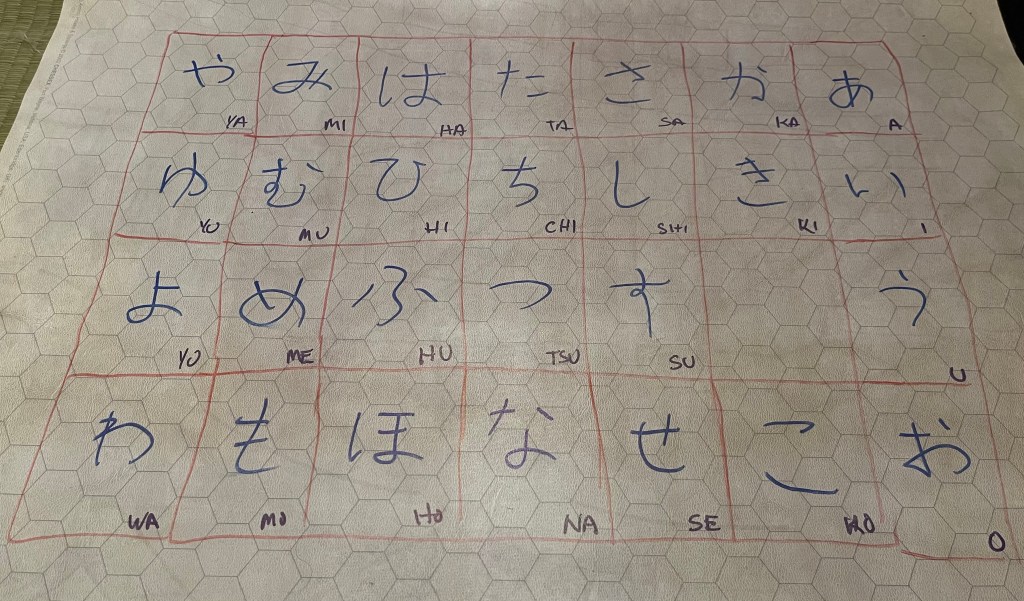
I wanted to try out this method, so I used my old battle-map from Dungeons and Dragons, and drew the same chart on there:

My handwriting is terrible, but hopefully legible. You can see a close-up here:

To be honest, I made my grid a bit too small, so as I piled cards, I couldn’t see which space was which. If you make something similar, make sure the squares are extra big.

Anyhow, the method for fudawaké is to pile up your torifuda cards to the side, then time yourself:

  • Grab a handful (doesn’t matter how many)
  • One by one, put them in the right square based on the first letter of their kimari-ji.
  • Grab more cards as needed.
  • When you place all 100 cards, stop the timer.

According to the Akita Konohana Karuta Club website, their team standard is 1:40, which is quite fast. You can see that some members finish in less than one minute!

When I tried it the first time, it took me 8:05, and then on my second try, it took 6:07. Not even close to their standard, but it was a fun exercise. It is more challenging than fuda-nagashi, but still teaches many of the same skills. It also helps with the initial board setup too, because you can correctly remember where to group your cards based on common kimari-ji.

Try it out and let me know what you think!

Five Color Hyakunin Isshu

Recently I learned about the concept of go-shoku Hyakunin Isshu (五色百人一首), or five color Hyakunin Isshu.

During my recent trips to Japan, while shopping for Karuta sets, I did see some advertised as “five color sets” but didn’t understand the significance, and there is no information in English.

According to this helpful website, it’s a kind of teaching aid for grade school kids to learn Karuta by diving the cards into 5 sets of 20, color-coded: Blue, Pink, Yellow, Green and Orange. The website above has a comprehensive chart for each color, and which poems belong to each.

The cards are grouped this way to ease the memorization of the kimari-ji for playing karuta by organizing easier versus more difficult cards into different groups. The website above suggests the following game to help (my rough translation below):

  1. This is a 1v1 game
  2. Of the five color groups, select one at random (or however you want to decide).
  3. Shuffle the 20 cards and then divide into two piles. Using rock-paper-scissors to decide, the winner can pick their preferred pile.
  4. Each player will lay out their cards in two rows of 5 cards each. Lay your cards out so that you can read them.
  5. The tops of your cards on the top row will touch the top of your opponent’s cards on their top row. Your cards do not have to be touching each other.
  6. You have one minute to memorize your cards.
  7. The reader will reader the upper verses of the poem, then the lower verses, one time each.
  8. When you are going to take the card, yell hai!
  9. If both players touch the card at the same time, you can decide the winner using rock-paper-scissors.
  10. If one player’s hand is on top of another, the player who’s hand is at the bottom is the winner.
  11. When the reader is not reading cards, you are allowed to flip the cards over to see the upper verses. (Me: I guess the official five color cards print on both sides?)
  12. When 17 cards have been read, the match is over.
  13. Whoever took the most cards wins.

There is a helpful instructional video too (sorry, no English):

It also points out some penalties: touching the wrong card (even if you touch the correct one later) and such. Most of this is geared towards grade school kids, so adults would not likely make such mistakes.

Also, some groups seem easier than others. Based on reviews in the website above, yellow and blue seemed easiest, while orange and green were the hardest.

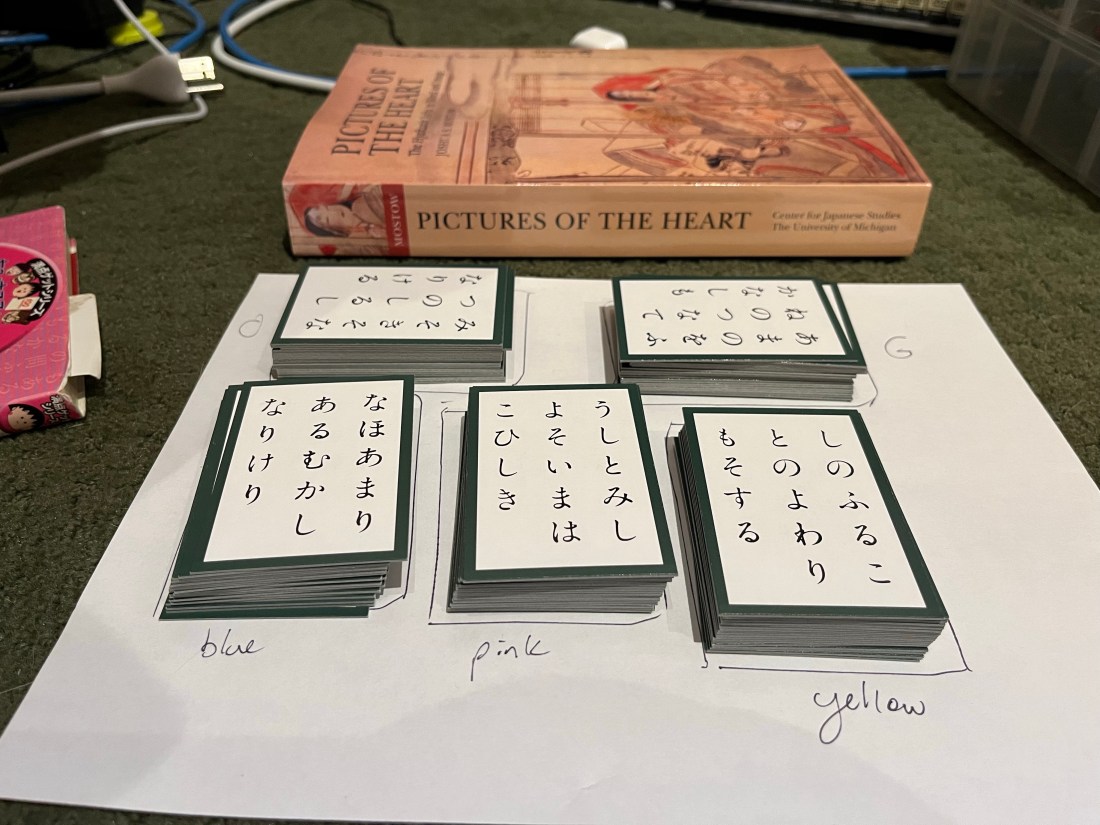
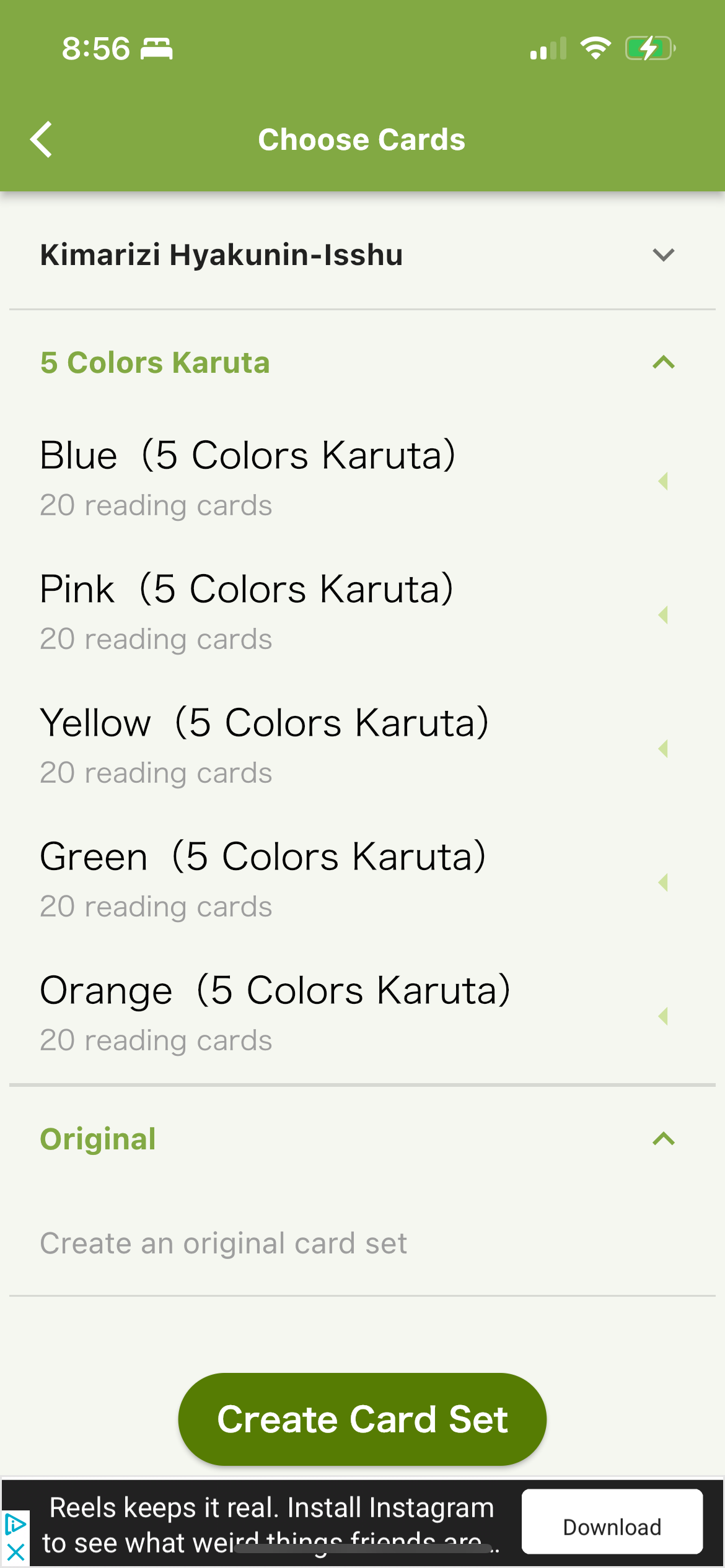
Since I don’t own an official five-color set (yet), I decided to make my own set by using one of my non-competitive sets, and dividing it up into the five color groups. You can see my efforts above in the featured photo. Also, please buy Dr Mostow’s book on the Hyakunin Isshu. This blog is graciously his debt. 😌

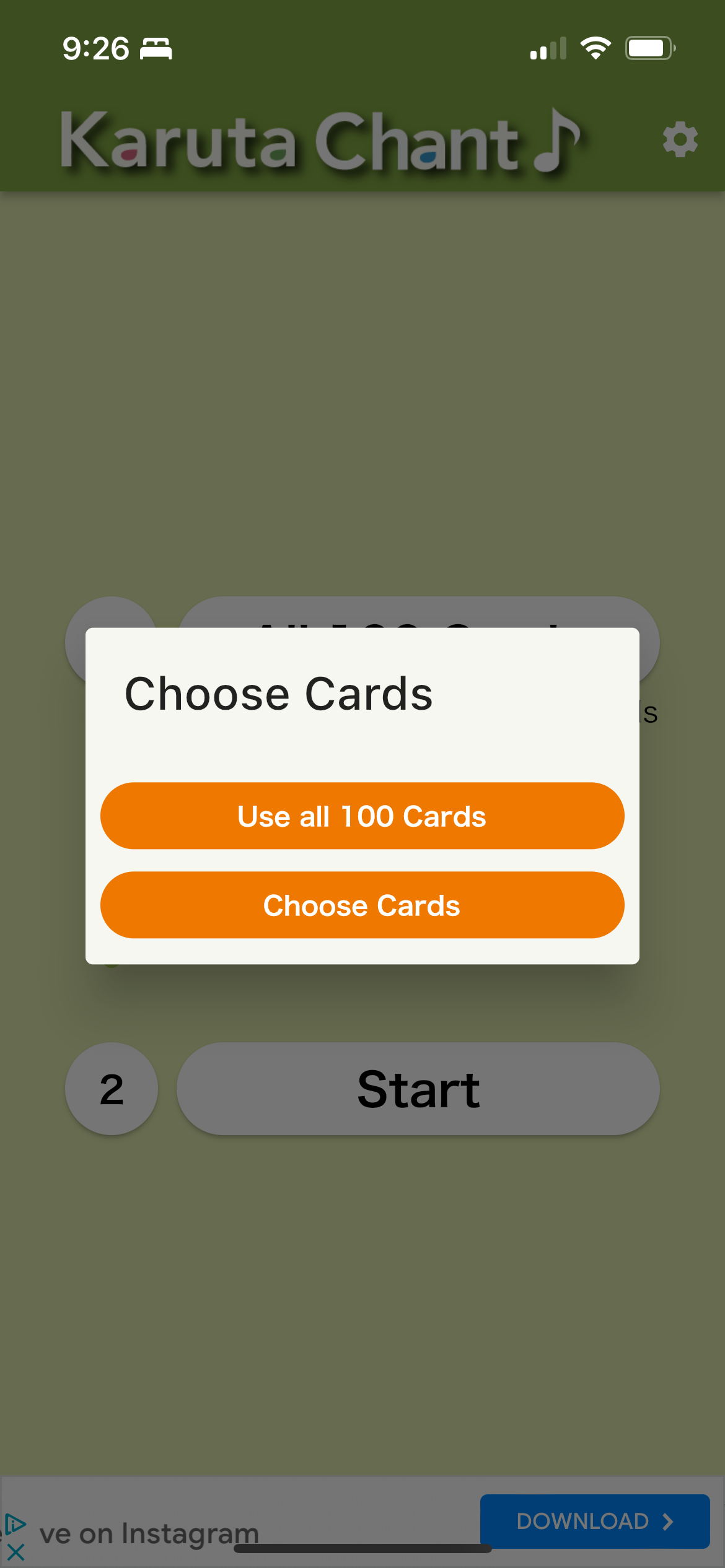
Even if you don’t play the five color Hyakunin Isshu game, you can still use an online reader app like Karuta Chant (iOS and Android). The app even has options for reading only the specified color group:

This established method of dividing up the cards into five colored groups is a very handy way to divide and conquer in your efforts to learn the karuta cards.

Try it out and let me know what you think in the comments!

October 2023 Updates

Hello dear readers and karuta players! Just a few updates:

  • I added a new page with charts to learn the kimari-ji for playing Karuta. This is a work in progress so feel free to leave a comment or suggestion for improvement.
  • If you noticed the blog appearance changed you are not wrong. For many years I relied on the same old template, but when I overhauled the blog last year I tried a newer, supported template. It was difficult to manage, so I am try out other templates now. I hope you like the new look.
  • Finally the blog is now 13 years old, according to WordPress! When I started this as a small side project in 2011 I had no idea how things would turn out. I wasn’t even sure I could finish all 100 poems amidst parenting and work. But here we are. Thank you readers and maybe we’ll make 20 years some day! ☺️

Happy October, everyone!

Karuta Practice: Fuda-nagashi

One of the most essential skills in playing karuta is to quickly and accurately recall the Kimari-ji for each card. Speaking from experience, if you recall the cards too slow, your opponent takes them first. If you are not accurate you take otetsuki penalties which are painful. As a new player, I tend to do both. 🤦🏼‍♂️

An example torifuda card. The kimari-ji is ありま, by the way.

The trick is looking at the torifuda card, the last two verses of the poem, and from that recall what the kimari-ji is. This is not easy to do with 100 cards possible, but with practice it is possible to get good at this. With even more practice you can do this both accurately and quickly. Since there are only 100 cards possible, it is a finite set of information to learn.

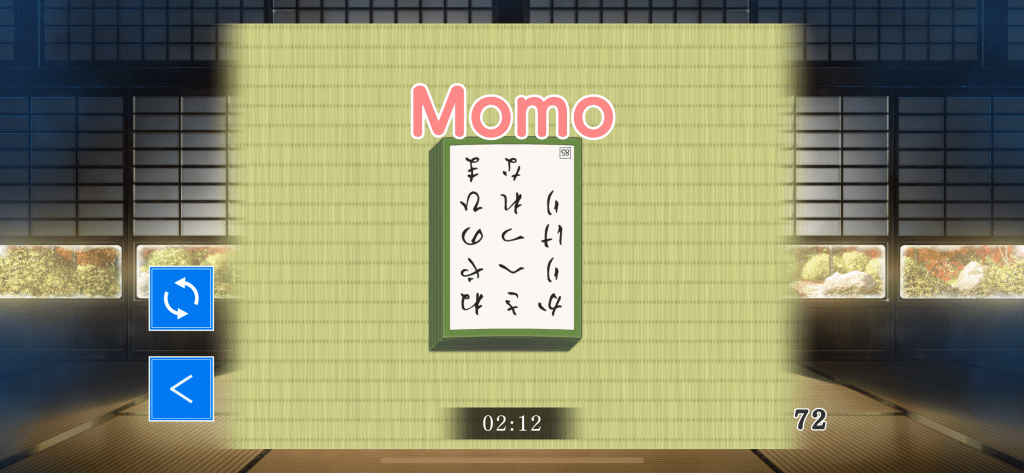
The online app provides a handy mini game called “Flashcard” that’s lets you practice this. In Japanese, this method is called fudanagashi (札流し, “flow of cards”). This means to quickly sift through flash cards and correctly guessing the kimari-ji.

The app will let you practice this easily, and posts the correct answer in red. It also randomly shows the cards upside down (since half the cards on the board would be upside down anyway):

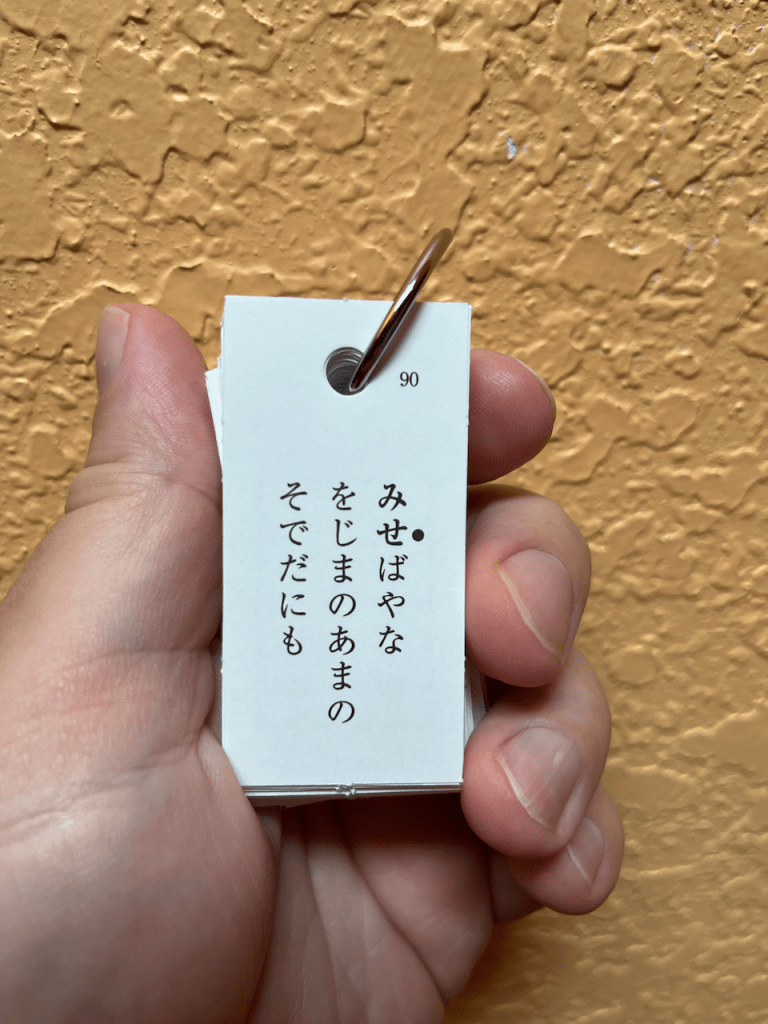
But you can also do this using flash cards. In Japan they often sell cards like this. I bought this ring of flashcards at the Tengu-dō store in Kyoto (product link here):

On the other side is the kimari-ji:

Sometimes I take this with me when walking around the neighborhood and just practice a few cards here and there.

As for the flashcard game on the online app, my first run-through I finished in 7:33 (7 minutes, 33 seconds), but also made several mistakes. Within two days, I narrowed the time down to 4:23 and fewer mistakes. After that, I decided to be more strict about mistakes (as they are costly in the game) and would reset the stack even if I made one mistake.

That was difficult at first, but I learned each time I mess up, even when I made the same mistake more than once. I probably had to reset 12-15 times but eventually I finished without errors and with a time of 4:21. Yay.

Finally, you can do this while blasting your favorite Fire Emblem: Three Houses song to keep you motivated:

The point is, is that fuda-nagashi is an essential skill for any karuta player, and there’s many ways to approach it. Find what works, and make it fun. If you do, you’ll be surprised how quick you can improve.

Edit: after writing this post, got to 04:18.

Edit #2: as of December 2023, I am down to 3:14.

Each Battle, A Chance to Grow

Dedicated to “Rachel” and “Lore”, and to blog reader . Thank you all for the encouragement!

In my last post, I talked about taking stock after a bad loss in karuta and focusing on small, incremental improvements rather than “shooting for the moon”. I used the Nintendo Switch game Fire Emblem: Three Houses as a source of inspiration.

The blog post title comes from the main character Byleth, who sometimes says this after combat. In the game, if your students defeat a foe in combat, they gain experience points making them grow stronger. If they are attacked by an enemy, they still gain experience. If they dodge an attack, do something supportive or other things non-combat related they also gain experience.

In other words, the characters get stronger not just from defeating foes, but from many other things too.

In the same way, I realized that Karuta isn’t just winning battles. It’s lots of small things you do and get gradually better at.

If you use the flash card “minigame” on the karuta app, how long did it take you to finish all 100 cards? Did you beat your time? If so, experience gained. If not, experience still gained.

If you tried a new way to arrange your cards on the board (tei’ichi 定位置), did it work better or worse? Experience gained either way.

If you practice listening and distinguishing tomofuda cards (cards with very similar kimari-ji), did you succeed? Even if not, experience gained.

If you listen to audio readings of the Hyakunin Isshu is it starting to sink in? Experience gained.

And so on.

Like Byleth says, each encounter or task is a chance to grow. It may not seem like it, but given a few weeks or months, you’ll begin to see the difference.

If you’re feeling down or discouraged, keep looking toward the skies and take it one step at a time.

Good luck and happy karuta’ing!

P.S. Fire Emblem: Three Houses is a criminally underrated game. Definitely check it out if you can. Also, image source above is from Nintendo.

Stay Focused, Keep Trying

After taking up karuta with the local community, I was soon introduced to the international Karuta Discord group (Discord invite link here). The international karuta community is great, and you get to meet people from places like Brazil, Russia, Germany, etc. If you are even casually interested in karuta, or the hyakunin isshu, it’s a nice community and worth joining.

Further, the community has been organizing periodic tournaments using the online Karuta app. I started learning karuta 2-3 months ago, and finally got to the point where I know (more or less), the 100 kimari-ji. So, I decided to throw my hat into the ring and register for the October competition.

Right away, I realized that I might be in over my head.

I lost a couple matches, both very decisively, and felt pretty of embarrassed. At the end of that day, I played poorly. In addition to slow reaction time to take cards, I tilted (in Magic: the Gathering speak) and fell apart under pressure.

I was pretty disheartened by this and I wondered if maybe I am just hopeless. Since I am starting karuta pretty late in life, I feared that maybe I am just getting too old for the game.

But, then I got to thinking. In my spare time, I’ve been playing a game called Fire Emblem: Three Houses (mentioned in my other blog here, among other places). The game, at its core, is about taking a team of amateur students and gradually turning them into an elite force through training, trial, etc. The instructor and main character, Byleth (catchphrase: “stay focused”), develops their individual talents, addressing weaknesses, taking them on training missions, etc.

I kind of felt inspired by this (and frankly, it’s an awesome game), so I got to thinking: I really do want to improve. However, if I want to improve at karuta, I need to get back to basics, stay focused, and work towards small improvements at a time:

  • Get back to basics – practice memorizing kimariji. I sometimes recalled the cards too slowly, or incorrectly. Also, card placement at the beginning of the match (tei’ichi 定位置) is important.
  • Stay focused – learning to stay calm, no matter what situation, and just pay attention to where each card is on the board. When I do get flustered, take a moment to calm myself and re-focus.
  • Work towards small improvements – I can’t expect to win tournaments overnight. But if I focus on making small, incremental improvements, inevitably my game play will improve. Things such as:
    • Better card placement on the board for easier recall / taking.
    • Cutting down on penalties
    • Small improvements to taking cards faster.
    • Getting better acquainted with rules and etiquette. The online app handles most of that, but it’s still essential to learn.

So, if you’re playing karuta, or any competitive game, and you’ve been crushed in defeat, take heart. Given enough time and dedication you will definitely improve. Don’t worry how well other people play, focus on how well you’re playing now.

Edit: if you are a fellow Three Houses fan, I challenge you to boldly declare “I am Ferdinand von Aegir” during your next Karuta match and swipe half the cards from the board Chihayafuru style.

Either you’ll make a new friend (since they are a fan), or they’ll think you’re nutty.

P.S. Featured image source is from Nintendo, and depicts both genders of Byleth (you can play either one, which is neat).