In the book Hyakunin Isshu Daijiten, which I mentioned here, it explains that the fourth verse, karakurenai (唐紅), is in fact a traditional color word in Japanese. The Chinese characters read something like “Chinese (lit. Tang Dynasty China) scarlet or vermillion”. There is no one-to-one equivalent in English.1
You can see an example of what karakurenai looks like on this amazing website, among other tradition colors. You can also see a list of colors on Wikipedia as well. Both sites also include the HTML codes (a # sign, followed by 6 alpha-numeric characters) if you want to reproduce yourself. For example using the HTML hex code #C91F37 I get:
karakurenai
In truth, many of these colors would be obscure to modern audiences, except in some literary circles, but some, such as yamabuki-iro (山吹色, “golden yellow”) are still used in common vernacular. Further, as is common with other Asian languages, colors green and blue are often conflated (e.g. 信号は青, shingō wa ao, “the traffic light is blue/green”).
In any case, try it out the website above, and see what other colors you might find!
Update: I decided to update the blog appearance and apply a new background color based on the HTML codes above. For the blog background color, I am using Haizakura (灰桜, code #d7c4bb).
1 Similarly, I bet some English tradition colors would have no translation in Japanese. Such is the way with language and cultures.
A blog reader recently left a comment about this, and I realized that this would make a good topic for discussion, especially if are you are trying to memorize the Hyakunin Isshu, or learnkaruta. If you know even a little modern Japanese, you may soon start to notice that the hiragana spellings for some words aren’t always what you expect. For example, the fourth verse of poem 2 reads:
ころもほすてふ
But it reads as:
koromo hosu chou (not te-fu)
Another verse that threw me off recently was poem 44:
逢うことの
In modern Japanese, this would read as au koto no, but in the Hyakunin Isshu it is read as ou koto no.
Then there are other examples throughout, too many to list. The issue is that Japanese language, like any language, changes over time. People don’t speak or pronounce things the same as they did 1,000+ years ago.1 English language, for example, has undergone some dramatic sound-changes in the last 500 years, and yet the spelling was never updated. Hence, English spelling is confusing now.
Japanese underwent a similar change. Hiragana script at the time when it was first adopted was probably phonetic and intuitive to native speakers. However, fast-forward 1,000 years and it has long since diverged from the way people pronounce it.
This was finally fixed after World War II when the modern Hiragana spelling system was used, but old literature such as the Hyakunin Isshu remained as is. Hence, spelling of words in the Hyakunin Isshu differs from the modern Japanese equivalents.
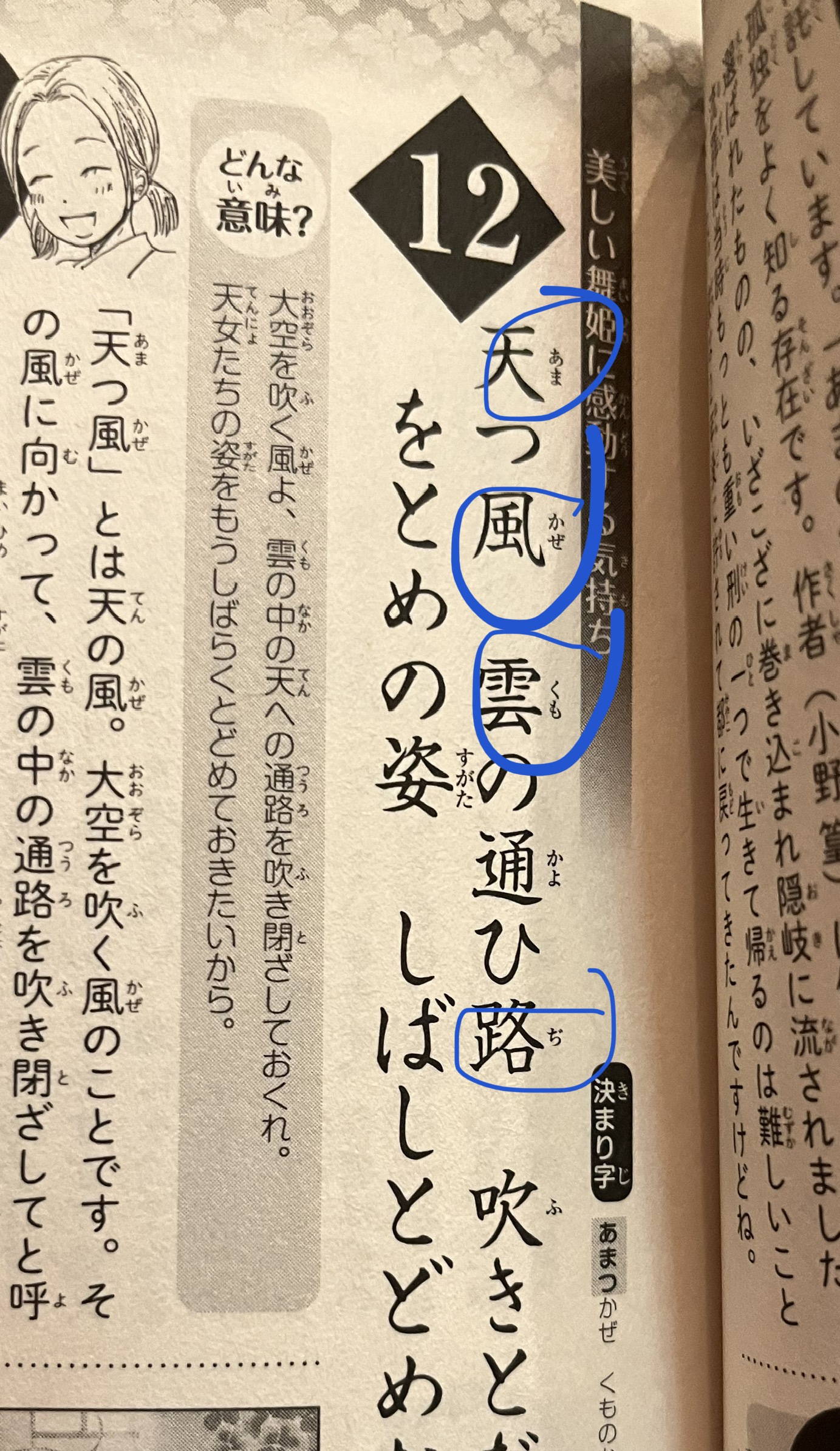
For this reason, Japanese students of the Hyakunin Isshu often rely on furigana pronunciation guides when reading about the Hyakunin Isshu. For example, this excerpt from a Chihayafuru manga my daughter has shows examples of furigana usage:
From the manga ちはやと覚える百人一首 (“Remember the Hyakunin Isshu with Chihaya”)
Further, some hiragana themselves are pronounced differently:
ひ (modern “hi”) is pronounced like い (“i”), see poem 12.
The aforementioned てふ (modern “te-fu”) is pronounced like ちょう (“cho-u”), see poem 2.
Similarly, けふ (modern “ke-fu”) is pronounced like きょう (“kyo-u”), see poem 54 and poem 61.
ぢ is pronounced the same as じ (“ji”), see poem 12.
おもふ (modern “o-mo-fu”) is pronounced as おもう (“o-mo-u”), see poem 85.
Archaic hiragana ゑ (“weh”) and ゐ (“wi”) are pronounced as え (“eh”) and い (“i”), see poem 5 or poem 14.
を (“wo”) is pronounced the same as お (“o”), see poem 12.
む (modern “mu”) is often pronounced as ん (“n”), but only if it’s at the end of a word, see poem 3.
And so on. If unsure, just listen to audio readings of the Hyakunin Isshu and you’ll often get a feel for how it’s pronounced anyway. Or, note the furigana text above the letter, as this provides a visual cue for native Japanese speakers. Whatever the furigana says is correct. Just be aware that the spellings differ from modern, standard Japanese, and that this is a common feature of pre-modern Japanese literature. There are patterns to this, and once you get used to it, you don’t even think about it anymore.
P.S. if you think the history of hiragana script is confusing, the history of romaji (Roman alphabet for Japanese) is even nuttier.
1 I always find it mildly amusing (or annoying) when time-travel movies have everyone speaking perfect English, often British-accented English. I get that it’s hard to work in another language, especially finding actors who can pronounce it reliably, but still….
Karuta is a game of memory and speed. You’re trying to take a specific poem card before your opponent does, and you can’t know which card it is until the reader starts reading the selected poem. So, players have to use clues called kimari-ji (決まり字), or “deciding letter (or character)” to determine which poem is being read as quickly as possible.
I had heard of the concept before, but in my quest to learn all 100 poems of the Hyakunin Isshu, I didn’t pay attention to kimari-ji, and thus during my first competition I struggled a lot. Learning an entire poem, and learning its kimari-ji are two separate skills. Over the long run, a person can do both, but if you want to play karuta you should invest in memorizing the kimari-ji for as many poems as you can.
A torifuda card (取り札) containing only the last two verses. The last two verses are also known as shimo no ku (下の句) or “lower verses”. This particular poem is poem 58.
What are kimari-ji though? These are the first letters (or characters, I’ll explain shortly) of poetic verse, that tell you which poem is being read. Since the cards on the floor, the torifuda cards, only contain the last two out of five verses of a poem, it’s not immediately obvious which is which. The reader has the full poem using the corresponding yomifuda card.
Anyhow, both the torifuda and yomifuda cards are written using Japanese hiragana script. Hiragana is not an alphabet. It’s a syllabary. Each letter/character is a self-contained syllable or ji (字) in Japanese. Like many languages, English uses an alphabet so it takes 2 letters to spell the syllable “go”, but in Japanese this would require a single character: ご.1
If you’d like to learn more about hiragana script, check out my other blog here and here. Learning hiragana is worthwhile not only because it will unlock the Japanese language, it will help you play karuta a lot more effectively. It takes effort to learn upfront, but the good news is that it’s a learn-once-use-often skill.
When first learning to play karuta, and memorizing the poems, you soon realize that cards often fall into common patterns just based on the first few hiragana syllables. Others stand out from the others and are thus easier to recognize during play.
Let’s look at an easy example, poem 77 (my wife’s favorite).
This poem begins with the first verse:
せをはやみ
se wo hayami
The “se” (せ) in “se wo hayami” is unique among the Hyakunin Isshu anthology in that there are no other poems that start with “se”. So, as soon as the reader says “se”, highlighted below in blue, a seasoned player knows the poem being read is number 77, and that its fourth verse starts with われても, shown in red below.
This is an example of a one-character (一字, ichiji) kimari-ji poem, also called a ichiji-kimari (一字決まり). Poems that can be recognized by the first two characters are niji-kimari (二字決まり), three-character poems are sanji-kimari (三字決まり), four are yojikimari (四字決まり), and so on.
At other extreme end are six-characterkimari-ji poems, also commonly called ōyama-fuda (大山札, “big mountain cards”). Here’s an example below.
The yomifuda cards above are poem 64 (left) and poem 31 (right). Both start with the same 5-character verse, shown in green: asaboraké. It’s not until the sixth character (blue) that they differ. In this case, the sixth for poem 64 is “u” (う), and the sixth character for poem 31 is “ah” (あ). So, if you are listening to the poem, you have to wait all the way until the start of the sixth character to know which poem is being read. If you jump the gun and pick the wrong one, you get a foul (otetsuki, お手つき). Speaking from experience, I have done this. 🤦🏻♂️ It sucks.
In any case, vast majority of poems out there usually fall between these two extremes. The more you practice playing karuta, or memorizing them, the more you internalize them. This is important as kimari-ji work like a trigger: if you’ve memorize the “board state” (i.e. where everything is on the board), as soon as you hear the right syllables, BOOM, you take the card before your opponent does.
If you’ve been training for a while, this motion is almost unconscious. It’s a great feeling when it happens.
Shifting Kimari-ji and Late Game
As the game progresses, or depending on which cards are on the board, even a “six-kimariji” card can become a one-kimariji card. How? This is called kimariji-henka (決まり字変化, “shifting kimariji”).
“Rachel” from the Seattle Karuta Club kindly provided the following chart for the blog:
This chart shows a breakdown of all 100 poems with their kimari-ji, sorted by the initial hiragana character on downward. This is important because if the cards start with naniwa-e (poem 88) and naniwa-ga (poem 19) are both on the board, you have to wait until the fourth syllable (e vs. ga) to determine which card to take. Because of their initial similarity, they are grouped together as tomofuda (友札, “friend cards”).
However, if one of the poems above has already been read, and another card with the kimari-jinanishi (poem 25) has not, then you only need to determine which one to take based on naniwa vs. nanishi. You don’t have to wait until the fourth character. If there is only one card on the entire board that starts with “na” (usually very late in the game), you can just trigger off that.
As the cards on the board reduce in number, this comes up more and more. This is a slightly more advanced topic, but as you gain more experience, you’ll start to notice this too.
So…. How do you memorize them all?
There are many approaches to learning the kimari-ji, so you should find a method that works for you, and not be afraid to adjust that method if it’s not really working. I have created a chart to help listed out the kimari-ji and also group them by tomofuda for easier memorization.
Since my last karuta competition, I’ve shifted methods a few times. But there are some popular methods worth mentioning.
First of all, the 1-character kimari-ji can be remembered using this simple rhyme:
む す め ふ さ ほ せ
mu su me fu sa ho se
Which actually spells a mnemonic sentence in Japanese:
娘房干せ
“Daughter, dry the bunches [of flowers, grapes, whatever]
However, for learning all 100 poems, the Seattle Karuta Club pointed me to some helpful resources online:
This site divides the kimari-ji by initial letters, and has good visuals.
There are mobile apps too, though many have advertisement banners and such. You can search for “hyakunin isshu” in your favorite app store.
There are a lot of helpfulcharts and explanations in various Japanese sources (this is a great example), since it’s a popular pastime, but if you’re still learning hiragana and not familiar with Japanese language, you may need to stick with English-sources for now.
For my part, I started trying out some things at home. Since I don’t have a goza mat yet, I just grabbed one of my battle-map playmats I use for Dungeons and Dragons, and used that as a play area:
I started practicing with batches of 5-10 karuta cards at a time, starting with the 1-character and 7-character kimari-ji, since they are both fewest in number.
But then I started sprinkling poems in that I just happened to like. Since I spent so much effort memorizing poems previously, I picked out another 10-15 that I liked, and mixed them in anyway.
Then, I started making my own flash cards using Anki SRS using a format similar to this site:
As you can imagine, there’s many ways to learn the kimari-ji. The sky’s the limit as they say. Find something that works for, or keep experimenting until you master all 1️⃣0️⃣0️⃣ poems! Once you’ve done that, the game really starts to open up.
Anyhow, my goal is to try to learn at least half of the cards reliably before the next meeting of the Karuta Club in September. It won’t win me any matches, but it will build a foundation for (hopefully) future wins.
Good luck, and happy Karuta play!
1 There are a few exceptions to this in the Japanese, mostly in the revised modern spelling, but not worth calling out here.
Hello from Japan! The family and I are here visiting family, but we are also using the time to visit some sites my youngest son hasn’t seen before (Pandemic ruined past travel plans).
Anyhow, yesterday my wife and I stumbled upon a fascinating book at the local bookstore titled Nemurenai Hodo Omoshiroi Hyakunin Isshu (眠れないおもしろい百人一首), meaning “[Facts about the] Hyakunin Isshu that are so interesting, you can’t sleep”. The publisher’s product link is here.
The book groups the 100 poems in a different order and seeks to get inside the mind of Fujiwara no Teika (poem 97), the compiler of the anthology, in order to determine why he selected these poems above thousands of others. The book tends to favor more salacious aspects of the authors and theories about why they composed the poems they did, but much of it lines up with Professor Mostow’s book too.
For example, I am currently memorizing poem 61, and the book explains some of the backstory of why the Ise no Tayu, and not someone more senior like Lady Murasaki (poem 57) got the privilege of reciting the poem for that occasion.
The illustrations in the book are amazing. The fantastic artwork really brings the stories of the authors to life.
Anyhow, as I read more, and as I come across more stuff related to the Hyakunin Isshu, I’ll be sure to post here, and update existing poem entries with more backstory details.
Every March 3rd in Japan,1 families with daughters celebrate a holiday called Hinamatsuri (ひな祭り) also known as the Doll Festival, or usually in English it is called Girls’ Day.
The derives from a kind of doll called hina that are usually on display in the family home starting one month earlier (February 3rd). The displays can be very simple as shown above which we have at home, or, the displays can be very ornate:
A full display at Uwajimaya store in Seattle, Washington. I took this photo years ago, and submitted to Wikimedia Commons here.
This display recreates an Imperial wedding between a prince and his bridge, not unlike those that high-ranking authors of the Hyakunin Isshu probably celebrated back in the day complete with ox-drawn carts of gifts, musicians, ladies-in-waiting, and so on. This tradition is to celebrate daughters, and to wish them a happy wedding in the future. This may seem a bit old-fashioned, but it’s also a great time to wish your daughters prosperity and happiness, regardless of how they choose to live their life.
It’s also fascinating that while the Heian Period culture of Japan is long gone, you can see traces of it today even in modern Japan. When someone like Takako (poem 54) married the powerful Fujiwara no Michinaga, I can’t help but wonder if her wedding looked something like this…
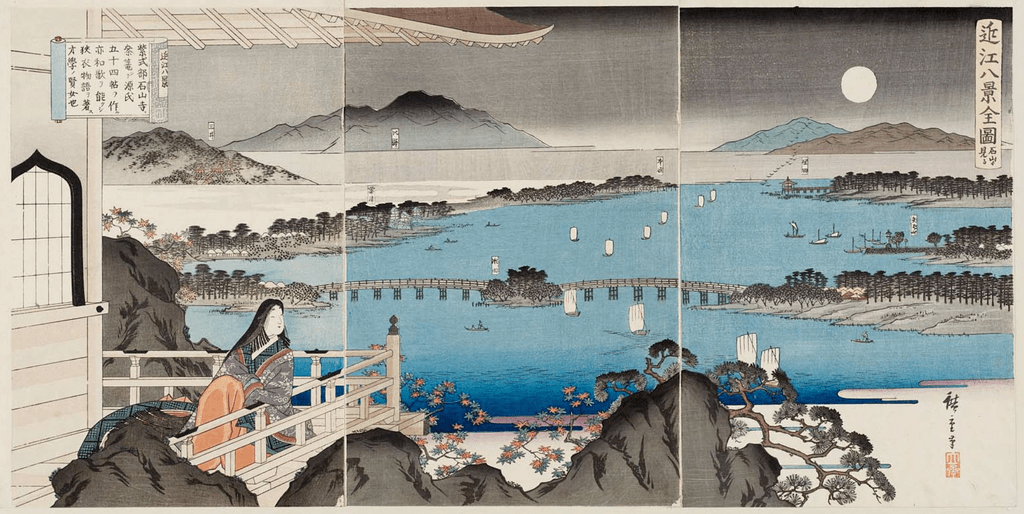
Of all the poets of the Hyakunin Isshu anthology, arguably the most famous, especially overseas is Lady Murasaki (poem 57), who in Japanese is called Murasaki Shikibu (紫式部). She is the author of the Tales of Genji, which epitomized life in Japanese antiquity, and is among the first novels in history. But another work by Lady Murasaki that’s notable here is her eponymous diary, of which an illustrated version appeared centuries later. In English this is simply known as the Diary of Lady Murasaki (murasaki shikibu no nikki, 紫式部の日記).
The diary covers the period from years 1008 to 1010, and provides a first hand account of her life serving the powerful regent, Fujiwara no Michinaga. Michinaga is not featured in the Hyakunin Isshu, but his power as regent was great enough to ruin the lives of a few poets in the anthology:
Michinaga was locked in a power-struggle between his branch of the Fujiwara Clan, and another branch, led by Morechika. Both had daughters married to Emperor Ichijō, and both were fighting to be the regent (kanpaku, 関白) of Ichijō’s heir. In the end, Michinaga’s daughter, Empress Shōshi, gave birth to the future Emperor Go-Ichijō (Ichijō the Latter). With it, Michinaga became the most powerful man in Japan.
At the beginning of the diary, Lady Murasaki describes the events leading up to Empress Shōshi giving birth, and the elaborate ceremonies to protect her and the unborn child from evil spirits. Although it was technically a private ceremony, Michinaga hired an army of priests and shamans to both bless the child, and also to ward off evil spirits. Lady Murasaki, as a member of the household, describes sitting in the crowded audience chamber for hours, listening to the fevered chanting and elaborate rituals.
Then the diary skips ahead to the first weeks of the child’s birth, and further ceremonies. Michinaga spares no expense to protect his grandson (whom he will be the regent of, and thus the true power behind the throne) from diseases, evil spirits and so on. In elaborate rituals, members of the household are selected to read the Confucian Classics to the baby to ensure he will be an august ruler. More priests are called into ward off evil, and so on.
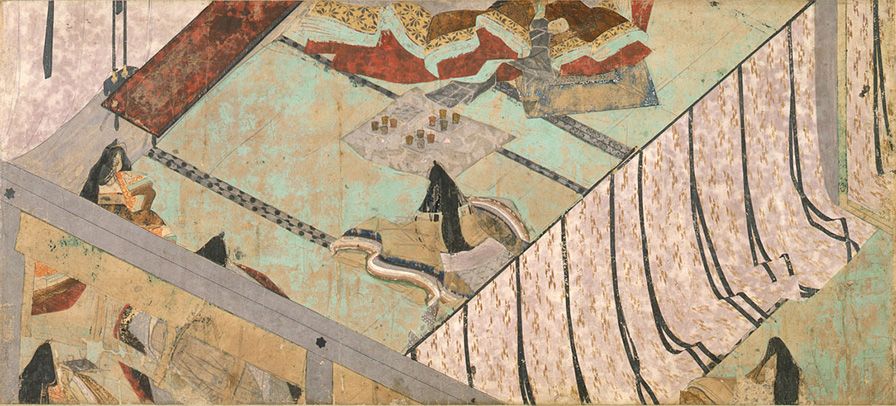
A 13th century illustration of Empress Shōshi and her infant son, with Lady Murasaki in attendance from the Murasaki Shikibu Nikki Emaki (illustrated diary of Lady Murasaki). Tokyo National Museum, Public domain, via Wikimedia Commons
But what about Lady Murasaki?
Lady Murasaki herself comes from a lesser branch of the Fujiwara clan, and since her husband already died some time ago, she describes herself as “washed up”. She held no official appointment in the Imperial Court. And yet, through Michinaga, she becomes a trusted confidant and tutor of the Empress. Michinaga knew talent when he saw it, and wasn’t shy about packing his household with as much as he could get away with.
Lady Murasaki was but one of several famous ladies-in-waiting recruited by Fujiwara no Michinaga to increase the status of his daughter, Empress Shōshi, vis-a-vis the Emperor’s first wife, Teishi (Morechika’s daughter).
Lady Murasaki’s diary implies that life as a lady-in-waiting is a lot of “hurry up, then wait”: periods of great activity and ceremony, followed by long periods of boredom. The period after the child’s birth eventually winds down and leads to a lot of free time, where Lady Murasaki reflects on many things, as well as disparaging some of the other ladies-in-waiting. Here are some examples of her contemporaries who also happen to appear in the Hyakunin Isshu:
Lady Izumi (poem 56) – “She does have a rather unsavory side to her character but has a talent for tossing off letters with ease and seems to make the most banal statement sound special.“
Akazome Emon (poem 59) – “She may not be a genius but she has great poise and does not feel she has to compose a poem on eveyrthing she sees, merely because she is a poet.“
Sei Shonagon (poem 62), part of the rival clique under Empress Teishi – “…was dreadfully conceited. She though herself so clever and littered her writings with Chinese characters; but if you examined them closely, they left a great deal to be desired.“
She also grapples with persistent depression. Her sullen, introverted nature often wins her few friends among other ladies of the Court:
And when I play my koto rather badly to myself in the cool breeze of the evening, I worry lest someone might hear me and recognize how I am just ‘adding to the sadness of it all’; how vain and sad of me. So now both of my instruments, the one with thirteen strings and the one with six, stand in a miserable, sooty little closet still ready-strung.
The diary then jumps forward into a letter written at a later date. The intended recipient is unknown, but is thought to be her daughter Daini no Sanmi (poem 58). Here the diary includes a great deal more self-reflection, and further analysis of the other ladies in waiting, including her grievances with another clique of ladies centered around the high priestess of the Kamo Shrine, Princess Senshi (daughter of Emperor Murakami).
Finally, the diary jumps around a few more times in narrative, and then abruptly stops. Richard Bowring points to theories that other fragments of the diary once existed, possibly some in the Eiga Monagatari, or some possibly in possession by Fujiwara no Teika (poem 97, and compiler of the Hyakunin Isshu), but these are all speculation.
The Diary is pretty short; you can read it cover to cover in a couple of hours. And yet it’s a fascinating blend of historical perspective, and very relatable personal reflection. Loneliness and depression affect people of today as much as it did people of her time, and yet she has to carry on through stodgy court ceremony, pressures of the insular life in the aristocracy, and constant back-biting amongst the ladies-in-waiting.
In one lengthy anecdote, she describes a prank that the other ladies-in-waiting decide to pull on one Lady Sakyō, who apparently had retired from service, then returned to serve another nobleman. The prank was to send a luxurious “gift”, but with a lot of symbolism regarding youth, implying ironically that Lady Sakyō was an old has-been.
The diary lists several incidents where drunken nobles harass attractive servants during dinner, servants who are unable to really do anything about it since they owe their entire livelihood to those nobles. Alternatively, the noblemen, bored themselves, play mean pranks on the ladies, steal their robes, or pull their skirts. Because of the power imbalance (also frequently alluded to in the Gossamer Years), it was just an accepted part of life, and the ladies often had to regularly dodge that minefield.
Middle Counselor Elect Taka’ie, who was leaning against a corner pillar, started pulling at Lady Hyōbu’s robes and singing dreadful songs. His Excellency [Michinaga] said nothing….Realizing that it was bound to [be, sic] a terribly drunken affair this evening, Lady Saishō and I decided to retire once the formal part was over.
trans. by Richard Bowring
Michinaga himself frequently bursts in on Lady Murasaki, sometimes drunk, demanding a quick poem or a verse for particular occasions. Although Michinaga never makes advances on Lady Murasaki, his overbearing demeanor exhausts her, yet she also admires his quick wit and ambition. I can imagine Michinaga in moderns times being a flashy, talented CEO with a dubious reputation :
I felt depressed and went to my room for a while to rest. I had intended to go over later if I felt better, but then Kohyōe and Kohyōbu came in and sat themselves down by the hibachi. ‘It’s so crowded over there, you can hardly see a thing!’ they complained. His Excellency [Michinaga] appeared.
‘What do you think you’re all doing, sitting around like this?’ he said. ‘Come along with me!’
I did not really feel up to it but went at his insistence.
trans. by Richard Bowring
Another frustration that Lady Murasaki describes is the rigid social hierarchy within the aristocracy. Lady Murasaki was from a middle-ranked family, and while not a menial servant herself, she was frequently reminded of her place. This included things like being unable to wear the “forbidden colors“, where she sat during court ceremonies, and whom she was allowed to address directly. Lady Murasaki sums it like so:
The water-music that greeted the Emperor was enchanting. As the procession approach, the bearers — despite being of low rank — hosted the palanquin right up the steps and then had to kneel face down beneath it in considerable distress. ‘Are we really that different?’ I thought to myself as I watched. ‘Even those of us who mix with nobility are bound by rank. How very difficult!’
trans. by Richard Bowring
What she often describes, when reading between the lines, is that for all its pomp, culture and beauty, life in the Heian Period aristocracy was a kind golden sham:2
I returned to the Palace on the twenty-ninth of the twelfth month [after a month absence]. Now I come to think of it, it was on this very night that I first entered service at court. When I remember what a daze I was in then I find my present somewhat blasé attitude quite uncomfortable.
trans. by Richard Bowring
One other thing to note is that her diary alludes to the Tales of Genji frequently. By the time she was recruited by Michinaga, a few drafts of the work had already been in circulation, and this probably helped her reputation. Even the illustrious Fujiwara no Kintō (poem 55) pays her a brief visit in the diary calling her “Murasaki” (e.g. purple) as an allusion to one of her characters in the novel. Richard Bowring implies that this moment might be how Lady Murasaki got her sobriquet.3 We saw this with Nijōin no Sanuki (poem 92) in later generations as well. Sadly, it seems that these copies of the Tales of Genji were sometimes borrowed and never returned, or copied by other people, and since each copy took so long to compose, Richard Bowring implies that it is a miracle that the work survived at all.
In any case, the Diary of Lady Murasaki is probably one of the best descriptions of life in the Imperial Court and its (often oppressive) aristocracy. It was a world of beauty and also of frustration and bitterness.
P.S. Photo is a famous woodblock print by Utagawa Hiroshige (Public domain, via Wikimedia Commons), depicting a legend about Murasaki Shikibu at Ishiyama Temple. These are the 3 panels of the nishiki-e: “Eight Views of Omi Province as Seen from Ishiyama” (Ômi hakkei zenzu, Ishiyama yori miru). Notice her purple (murasaki) robes.
1 Sei Shonagon was a lady in waiting for Empress Teishi, who was a daughter of Michinaga’s rival. When Michinaga’s rival is driven out by a scandal, Teishi is relegated to the background, and Sei Shonagon retires in obscurity.
2 Valkyrie in the movie Thor: Ragnarok had said much the same thing about Asgard, too.
3 Her true name is not known, but is thought to be Fujiwara no Kaoriko (藤原香子).
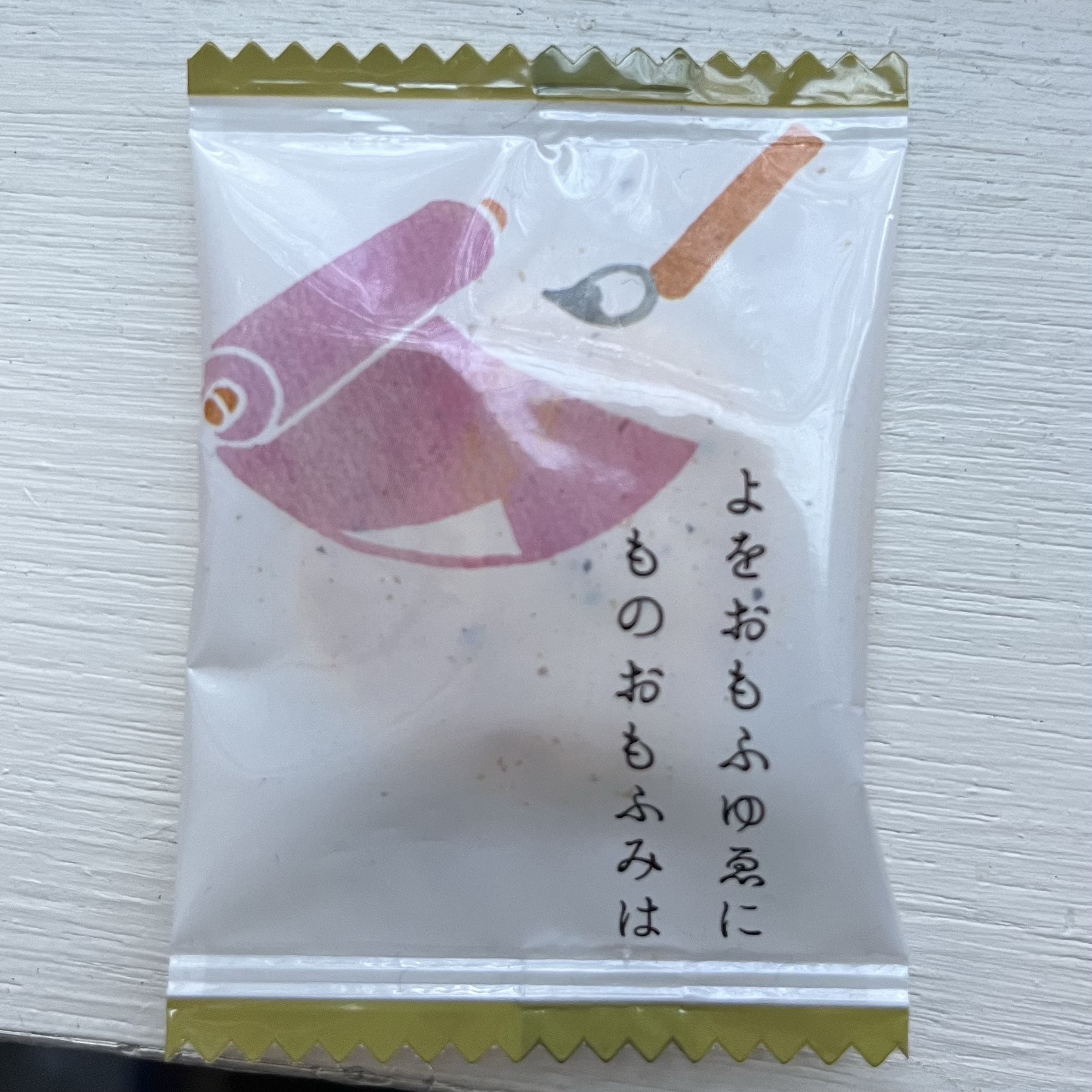
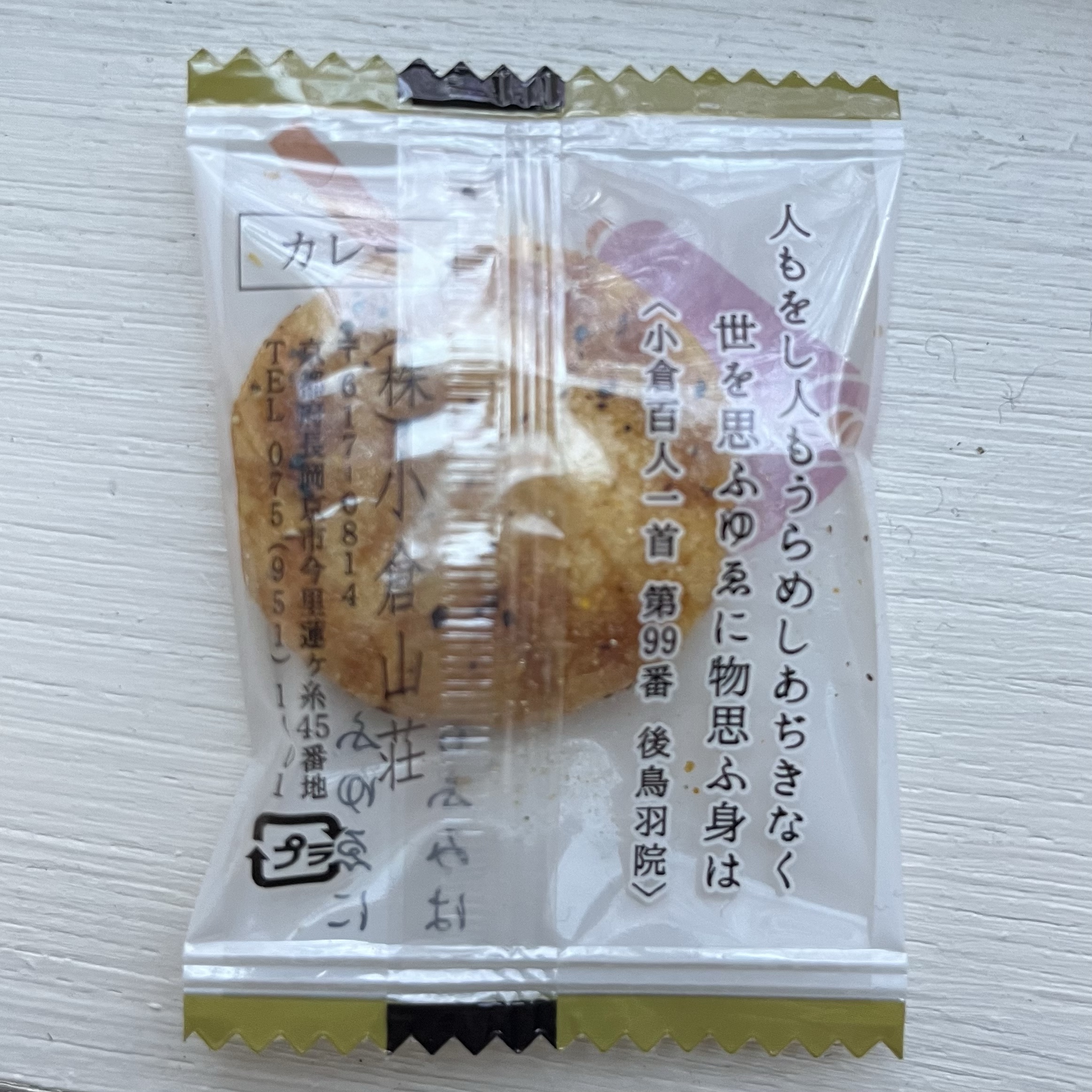
In Japan, gift-giving (omiyagé お土産) among friends and relatives is a common tradition, and recently a friend returned from Japan and gave us some special crackers (senbei) featuring poems from the Hyakunin Isshu. The crackers come in different flavors, and the wrapper each has a random poem.
I got a curry-flavored one:
The first two verses of the poem, poem 99, are written on the front. On the back are the remaining verses:
Hyakunin Isshu-themed crackers are sold here and there, and I’ve posted about it in the past, but it’s still nice to get them from time to time.
P.S. This vendor sells Hyakunin Isshu themed senbei crackers as well (it was the vendor featured in the original post).
Since initially making this blog way back in 2011, I have learned that you can now find karuta competitions (競技かるた kyōgi karuta) online on the official Youtube channel!
Here’s a recent high school playoff competition in 2022 for men:
and ladies playoff competition:
As you can see, it’s a very formal, elegant affair, with traditional clothing, customs, etc. Good manners and sportsmanship are emphasized.
Hyakunin Isshu karuta sets, such as those used in games and competitions, are always divided by two sets of cards:
yomifuda (読み札) cards, illustrated cards with entire poem on them, and
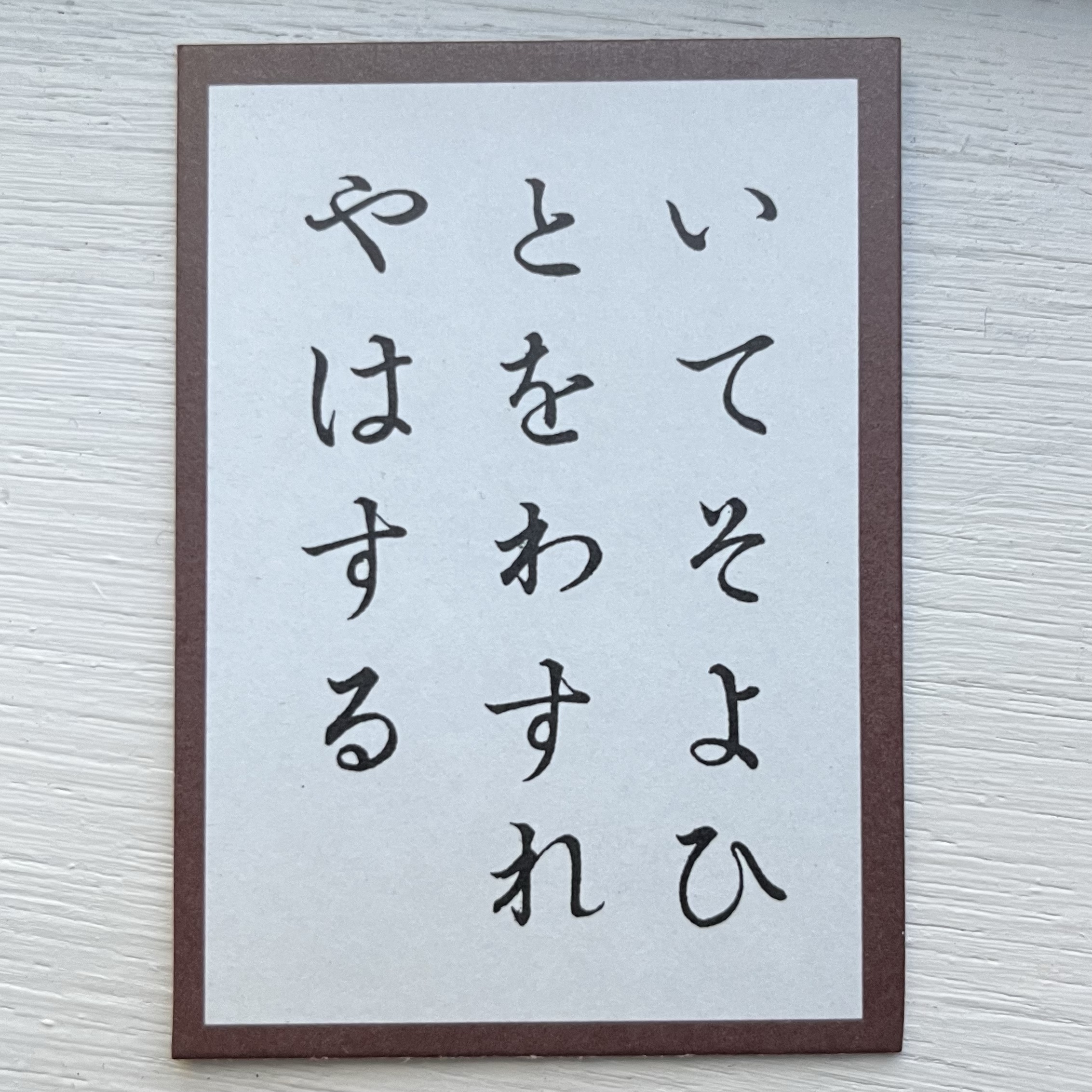
torifuda (取り札) cards that only contain the last only the last 2 verses. Illustrations below.
The yomifuda card for poem 58, with the last two verses circled in blue. These correspond to the matching torifuda card on the right.
The matching torifuda card with the last two verses. Torifuda cards are always written in simple hiragana script for easy reading.
I admit that I am still learning the rules, but the gist is that 50 of the 100 total torifuda cards are laid out in a set pattern of cards on the floor, half (25) of them on one player’s side, the other half (25) with the other player.
A diagram of the play field that I made using LibreOffice
The yomité (読手, “reciter”) reads a randomly select poem in full using the illustrated yomifuda cards above.
The yomifuda card for poem 58, from my wife’s karuta set.
The players have to wait until the first 3 verses are completed, then if the matching torifuda cards on the field (i.e. the last 2 verses of the poem), the players can try to take that card. Whoever touches it first wins that round, and the card is taken off the field. Usually, players will swat the card aside because it’s just faster and keeps the other player from touching it.
If the card had been on the opponent’s side (相手陣, aitejin), then not only is the card taken off the field, but you also select a card from your side (自陣, jijin), and send it over to their side. Usually the players will raise their hand to pause the match while they decide which card to send over. The end result is that the cards on your side are reduced by 1, the opponent’s remain unchanged. If the card you took was on your side, then your side is reduced by 1 anyway. No transfer needed. When watching the videos, the player will the lower number of cards is winning.
Side note, if the matching torifuda card was not on the board anyway, then it’s considered karafuda (空札, “empty card”), and the game moves onto the next round.
The player who removes all cards from their side is the winner.
Anyhow, it’s pretty interesting to watch, even if the competitions can take an hour or more. You can see how explosively fast the players are.
Finally, I’d like to give a shout out to groups such as the Boston Karuta Club and Seattle Karuta Club. They have plenty of helpful links in English on getting started with karuta, rules and training resources, among many other great resources!
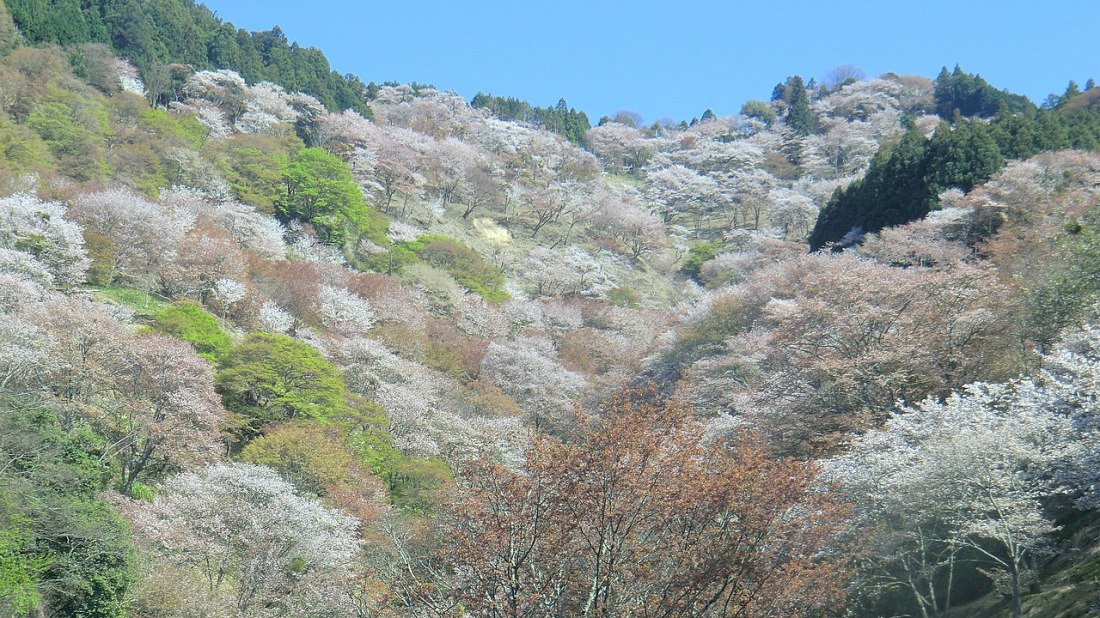
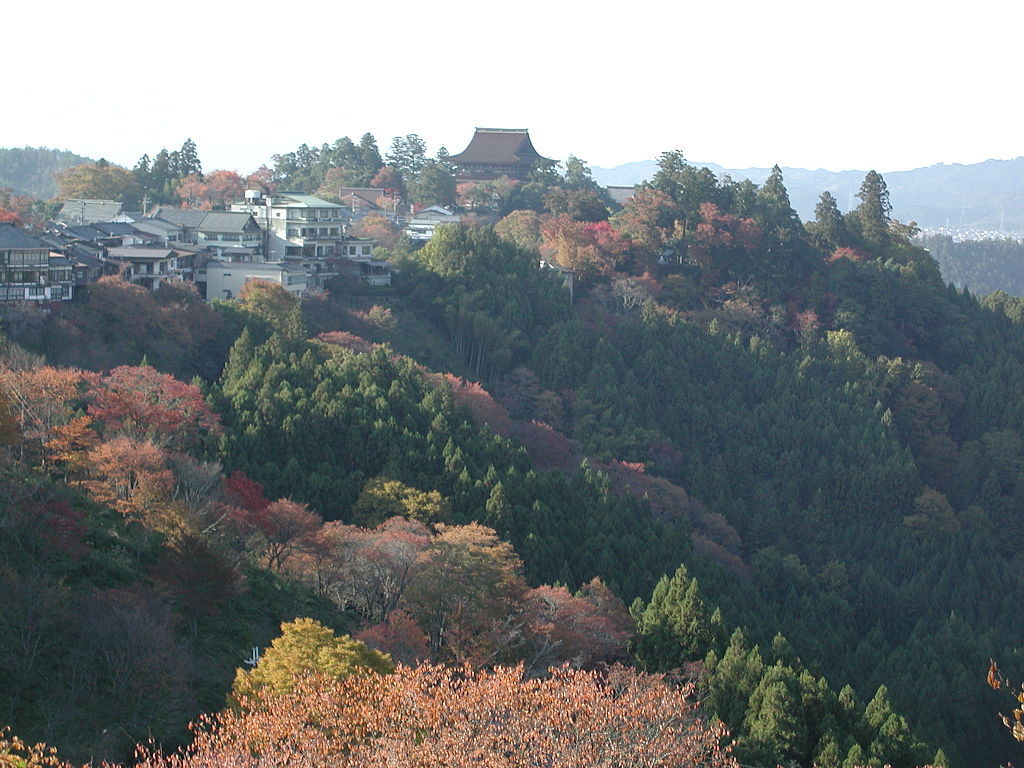
The small town of Yoshino (吉野, official site), near the old capitol of Nara, was a popular spot since ancient times and was often the subject of poetry in the Hyakunin Isshu anthology, for example poem 31 and poem 94. Further, according to the old Japanese historical account, the Nihon Shoki, visits to Yoshino to view the cherry blossoms went as far back as Empress Jitō (poem 2) and became a tradition ever since.
There is also a famous love story that takes place between the celebrated 12th century warrior Minamoto no Yoshitsune, and his mistress Shizuka Gozen. It was said that winter, while fleeing his jealous older brother, on the way to Oshu province in the north, they had to separate for her safety. In the snows of Yoshino, they parted, and Shizuka was sad to watch her beloved disappear in the snow.
Last spring, the Yasaka Taxi company in Japan posted a terrific photo of Yoshino (original link on Twitter):
Even to this day, cherry blossom viewing at Yoshino is a major tourism destination, and from what I hear, it’s pretty amazing.
Wow, it’s been a while. Recently, while playing with my wife and kids a game of karuta with our Hyakunin Isshu set, I learned about a simple, introductory way to enjoy the game without spending a lot of time learning the poems or mastering the rules of the competition. This simple game is called bōzu-mekuri (坊主めくり).
A recent game (Jan 2023) of bozu mekuri my family and I played on a Saturday night. We use the two-pile yamafuda setup (almost depleted now). The discarded cards are in the middle, with the remaining yamafuda on either side. My cards are in the foreground.
The rules are nicely explained here in Japanese, but goes like this:
Two or more people sit around in a circle.
Shuffle all 100 of the picture cards (yomifuda), then make a stack face-down. This stack is called the yamafuda (lit. “card mountain”).
Alternatively, you can split the stack into two stacks, three stacks, or even a ring of cards. My family plays with two stacks as shown above.
No matter how you deal the cards, they need to be face down.
Players take turns drawing one card from any yamafuda stack.
Depending on what kind of card a person gets, one of three things will happen:
If the card is a picture of a nobleman (tono), simply add it to your personal pile.
If the card is a picture of a Buddhist monk (bōzu), you lose all your cards. Put your cards into a pile somewhere in the middle, near the original yamafuda stack, but face up. If there are cards already there, just add to the pile.
If the card is a court lady (himé) then you get all the cards from the face-up pile.
Once done, pass the turn to the next player.
When all the yamafuda cards are exhausted, whoever has the most cards at the end wins the game.
One quick note: the poet Semimaru (poem 10) looks like a monk card, but the poet wasn’t a monk. This leads to a frequent confusion by players: does Semimaru count as a monk, or as a nobleman, or … something else? This actually did come up in a recent game I played with friends: we couldn’t figure how if he was tono or bōzu and apparently many Japanese people have been stumped by this.
The Hyakunin Isshu Daijiiten, which I mentioned here, considers Semimaru a bōzu (monk) for the purposes of the game, even though he wasn’t actually an ordained monk.
However, my other new book jokes that the author has a house-rule whereby if anyone draws the Semimaru card, then everyone loses their cards.
You can treat Semimaru the way you treat a Joker in poker cards: decide ahead of time what it means, and play accordingly.
Anyhow, once you get a set of hyakunin isshu karuta cards, try it out with your friends some time! I found the game very easy to learn, and fun to play with 3-4 people. More people the better. There are lots of house-rules possible in bozu-mekuri, so feel free to choose rules that you and the other players enjoy.












 The Hyakunin Isshu


_4.jpg)
_6.jpg)


