After taking up karuta with the local community, I was soon introduced to the international Karuta Discord group (Discord invite link here). The international karuta community is great, and you get to meet people from places like Brazil, Russia, Germany, etc. If you are even casually interested in karuta, or the hyakunin isshu, it’s a nice community and worth joining.
Further, the community has been organizing periodic tournaments using the online Karuta app. I started learning karuta 2-3 months ago, and finally got to the point where I know (more or less), the 100 kimari-ji. So, I decided to throw my hat into the ring and register for the October competition.
Right away, I realized that I might be in over my head.
I lost a couple matches, both very decisively, and felt pretty of embarrassed. At the end of that day, I played poorly. In addition to slow reaction time to take cards, I tilted (in Magic: the Gathering speak) and fell apart under pressure.
I was pretty disheartened by this and I wondered if maybe I am just hopeless. Since I am starting karuta pretty late in life, I feared that maybe I am just getting too old for the game.
But, then I got to thinking. In my spare time, I’ve been playing a game called Fire Emblem: Three Houses (mentioned in my other blog here, among other places). The game, at its core, is about taking a team of amateur students and gradually turning them into an elite force through training, trial, etc. The instructor and main character, Byleth (catchphrase: “stay focused”), develops their individual talents, addressing weaknesses, taking them on training missions, etc.
I kind of felt inspired by this (and frankly, it’s an awesome game), so I got to thinking: I really do want to improve. However, if I want to improve at karuta, I need to get back to basics, stay focused, and work towards small improvements at a time:
Get back to basics – practice memorizing kimariji. I sometimes recalled the cards too slowly, or incorrectly. Also, card placement at the beginning of the match (tei’ichi 定位置) is important.
Stay focused – learning to stay calm, no matter what situation, and just pay attention to where each card is on the board. When I do get flustered, take a moment to calm myself and re-focus.
Work towards small improvements – I can’t expect to win tournaments overnight. But if I focus on making small, incremental improvements, inevitably my game play will improve. Things such as:
Better card placement on the board for easier recall / taking.
Cutting down on penalties
Small improvements to taking cards faster.
Getting better acquainted with rules and etiquette. The online app handles most of that, but it’s still essential to learn.
So, if you’re playing karuta, or any competitive game, and you’ve been crushed in defeat, take heart. Given enough time and dedication you will definitely improve. Don’t worry how well other people play, focus on how well you’re playing now.
Edit: if you are a fellow Three Houses fan, I challenge you to boldly declare “I am Ferdinand von Aegir” during your next Karuta match and swipe half the cards from the board Chihayafuru style.
Either you’ll make a new friend (since they are a fan), or they’ll think you’re nutty.
P.S. Featured image source is from Nintendo, and depicts both genders of Byleth (you can play either one, which is neat).
Centuries before the Hyakunin Isshu was compiled and before official Imperial anthologies such as the Kokin Wakashū were promulgated there was the Manyoshu (万葉集) or “collection of ten thousand leaves”.
The Manyoshu is the oldest extant poetry collection, completed in 759 CE for the pious Emperor Shomu, and has much that resembles the Hyakunin Isshu, but also much that differs. I have been reading all about it in a fun book, which is in the same series as this one.
The Manyoshu was purportedly compiled by one Ōtomo no Yakamochi (大伴家持, 718-785), author of poem 6 (かささぎの) in the Hyakunin Isshu, but it’s also likely that he only compiled the collection toward the end, and that others were involved too.
Sadly, English translations are very few in number and usually quite expensive. Translating the Hyakunin Isshu hard enough, and this is even more true with a larger, more obscure volume like the Manyoshu.
Format
The Manyoshu is a collection of poems from a diverse set of sources, including members of the Imperial family and the aristocracy, but also from many provinces across the country and people from many walks of life. In fact, 40% of the poems in the collection are anonymous, with sources unknown. It also includes a few different styles of poetry:
265 chōka (長歌), long poems that have 5-7 syllable format over and over (e.g. 5-7-5-7-5-7…etc), until they end with a 5-7-7 syllable ending. These are often read aloud during public functions. Kakinomoto no Hitomaro (柿本 人麻呂, 653–655, or 707–710?), who wrote poem 3 in the Hyakunin Isshu, was considered the foremost poet of this format, but the longest was composed by one Takechi no Miko (高市皇子) at 149 verses.
4,207 tanka(短歌), short poems as opposed to the long poems above. The “tanka” style poems are usually 5-7-5-7-7 syllables long, and are what we see in later anthologies such as the Hyakunin Isshu. At the time, they were often included as prologues to long poems above. The Hyakunin Isshu is entirely tanka poetry, by the way.
One bussokusekika (a poem in the form 5-7-5-7-7-7; named for the poems inscribed on the Buddha’s footprints at Yakushi-ji temple in Nara),
Four kanshi (漢詩), Chinese-style poems often popular with male aristocrats that contrasted with more Japanese-style poetry.
22 Chinese prose passages.
Additionally, these poems were often grouped by certain subjects:
Sōmonka (相聞歌) – Originally poems to enquire how someone was doing, but gradually involved into couples expressing romantic feelings for one another.
Banka (挽歌) – Funerary poems honoring the deceased.
Zōka (雑歌) – Miscellaneous poems about many topics. Basically everything else that is not included into the other two topics.
Manyogana
One of the interesting aspects of the Manyoshu compared to the later Hyakunin Isshu, and other related anthologies, is the written script used. When people think of karuta or Hyakunin Isshu, they think of the hiragana script, but the hiragana script didn’t exist in the 8th century when texts such as the Manyoshu, the Kojiki or Nihon Shoki were composed. Such texts were composed purely using Chinese characters, but in a phonetic style native to Japanese later called Manyogana. Confusing? Let’s take a look.
The book above explains that in Manyogana, Chinese characters such as 安 and 以 are read phonetically in the Manyoshu as “a” and “i” respectively. Even modern Japanese people can easily intuit this.
Then you get more difficult examples such as 相 (saga) and 鴨 (kamo) in Manyogana. These are more obscure, but still possible for native Japanese speakers to understand them.
Then you get much harder examples such as 慍 (ikari) and 炊 (kashiki).
And finally you get even more difficult examples such as 五十 (also read as “i“) and 可愛 (just “e“). My wife, who has an extensive background in Japanese calligraphy, struggled with these.
In any case, words in the Manyoshu were all spelled out using Chinese characters like this, with no phonetic guide. You just had to know how to read or spell them, and as you can imagine this was a clunky system that only well-educated members of the aristocracy could make sense of. However in spite of its issues, this system of phonetic Chinese characters is how the later hiragana script gradually evolved.
Technique
When we compare the Manyoshu with the Hyakunin Isshu, there are many similarities. Both have tanka poetry (5-7-5-7-7 syllables), and cover a variety of topics. Further, both collections make good use of pillow words. In fact the same pillow words you see in the Hyakunin Isshu, such as hisakata no (poems 33 and 76), also show up centuries earlier in the Manyoshu:
Original Manyogana
Modern Japanese
Romanization
Rough Translation1
和何則能尓
我が園に
Waga sono ni
Perhaps
宇米能波奈知流
梅の花散る
Ume no hana chiru
the plum blossoms will
比佐可多能
ひさかたの
Hisakata no
scatter in my garden
阿米欲里由吉能
天より雪の
Ama yori yuki no
like falling snow
那何久流加母
流れ来るかも
Nagarekuru kamo
from the gleaming heavens
1 Amateur translation, apologies for any mistakes
This poem, incidentally was composed by Yakamochi’s father, Ōtomo no Tabito, when he organized a flower viewing party at his villa (book 5, poem 822).
Another commonality, the book explains, is the use of preface verses or jo-kotoba (序詞) where the first verses are just one long-winded comparison to whatever comes after. Poem 39 in the Hyakunin Isshu is a great example of this since the first 3 verses describe various grasses in order to make a point: that love is hard to hide.
The Manyoshu used this technique as well:
Original Manyogana
Modern Japanese
Romanization
Rough Translation
千鳥鳴
千鳥鳴く
Chidori naku
Just as the plovers’ cries
佐保乃河瀬之
佐保の川瀬の
Sabo no kawase no
along the wavelets
小浪
さざれ波
Sazare nami
of the Sabo river
止時毛無
やむ時もなし
Yamu toki mo nashi
never end,
吾戀者
我が恋ふらくは
A ga ko furaku wa
so too are my feelings of love.
Author: Ōtomo no Saka no Ue no Iratsume (大伴坂上郎女), book 4, poem 526
Historicity
Similar to the Hyakunin Isshu, the Manyoshu covers a fairly broad span of history, but much of it is now pretty obscure to historians. Even so, the poems in the Mayonshu can be grouped somewhat reliably into 4 specific eras:
first half of 5th century to 672 CE, starting with the reign of Emperor Nintoku onward.
672 to 710 CE
710 to 733 CE
733 to 759 CE
These periods mostly coincide with certain authors who contributed poetry, but also appear to have breaks due to historical events such as conflicts, temporary political upheavals, etc.
Differences with the Hyakunin Isshu
Although there are many commonalities between the Hyakunin Isshu and the Manyoshu, there are also differences. The most obvious is that the Manyoshu is a mixed-format collection, so it includes poetry other than Tanka style. Another difference is its broad sources for poetry, not just contributions by the elite aristocracy.
However, the book above notes that on a technical level there are other differences.
For example, the use of “pivot words” frequently used in the Hyakunin Isshu ( poems 16, 20, 27, and 88 for example) is a technique that is almost absent in the Manyoshu. Similarly, puns are also rarely used.
Legacy
As the largest and earliest extant poetry collection, it set the standard for Japanese poetry that people were still studying and emulating centuries later. Poems such as 22, 64, and 88 are all examples that use themes or poetic styles that closely resemble poems in the Manyoshu.
Further, compared to more polished anthologies that came later, the Manyoshu’s bucolic and unvarnished content has often been revered by later generations (including Japanese nationalists and Shinto revivalists in the 19th century) for getting to the “heart of Japanese culture”.
The book has been a great read, with amazing illustrations, and it helps show how the roots of the Hyakunin Isshu, including a few of its early authors, lay centuries earlier in the Manyoshu.
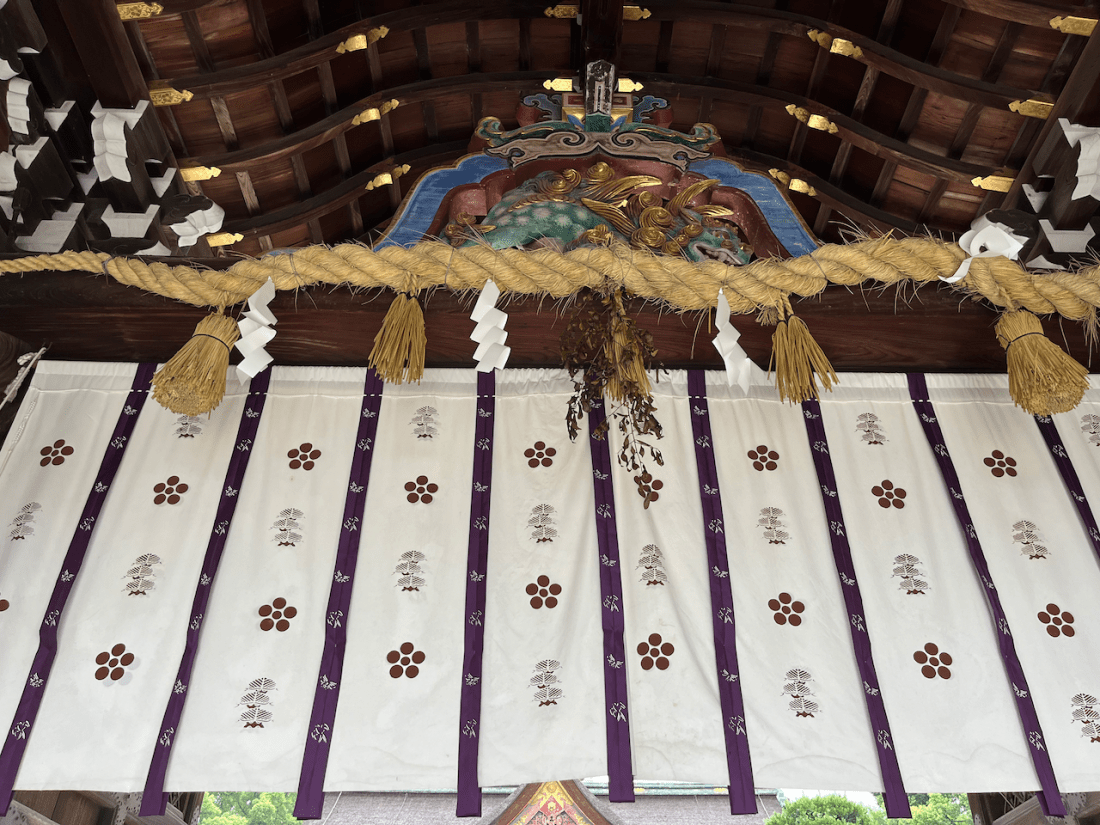
I’ve been writing in my other blog several articles about my family’s visit to Kyoto and Nara in July 2023, but for this particular article, I wanted to write it on this blog instead. You’ll see why shortly. While in Kyoto, we made an unexpected stop at a Shinto shrine called the Kitano-Tenmangu Shrine (北野天満宮) right in the middle of the city.
Kitano-Tenmangu Shrine (English / Japanese homepages) is devoted to a Shinto kami named Tenjin, who’s essentially the God of Learning. Each year, thousands of kids trying to pass their entrance exams visit local shrines, and pray for success. I’ve prayed at the Yushima Tenmangu Shrine in Tokyo myself years ago when trying to pass a Japanese-language certification test (I passed). The one in Kyoto, though, Kitano Tenmangu, is the original shrine.
But what’s the big deal?
The kami Tenjin is a deified form of the poet and scholar, Sugawara no Michizane, who composed poem 24 in the Hyakunin Isshu. When he was ousted by the powerful rival Fujiwara no Tokihira (father of Atsutada, poem 43), and died in exile, people worried that his vengeful spirit had returned to plague the capitol. The untimely deaths Tokihira and Atsutada certainly didn’t help this. Michizane was posthumously re-instated to the Imperial Court bureaucracy, elevated to a high rank, and venerated as a Shinto kami1 to appease him.
Anyhow, Kitano Tenmangu is the original shrine devoted to Michizane and has since grown into a large network of shrines across Japan.
The Shrine itself is relatively small, since it’s inside the city, but it has lots of neat things in it. When you first come in, there is a walkway like so leading to the inner sanctum:
To the right, is a plum tree, though not blossomging in July:
Plum blossoms (umé 梅) are associated with Michizane due to a famous poem he wrote in exile:
Japanese
Romanization
Translation
東風吹かば
Kochi fukaba
When the east wind blows,
にほひをこせよ
Nioi okose yo
let it send your fragrance,
梅の花
Ume no hana
oh plum blossoms.
主なしとて
Aruji nashi tote
Although your master is gone,
春を忘るな
Haru o wasuru na
do not forget the spring.
Sugawara no Michizané (845 – 903), translation by Robert Borgen
Anyhow, if you continue you get to the gate to the inner sanctum:
The inner sanctum is here (I prayed for my Japanese-language exam this year as well… we’ll see if I pass again 😄):
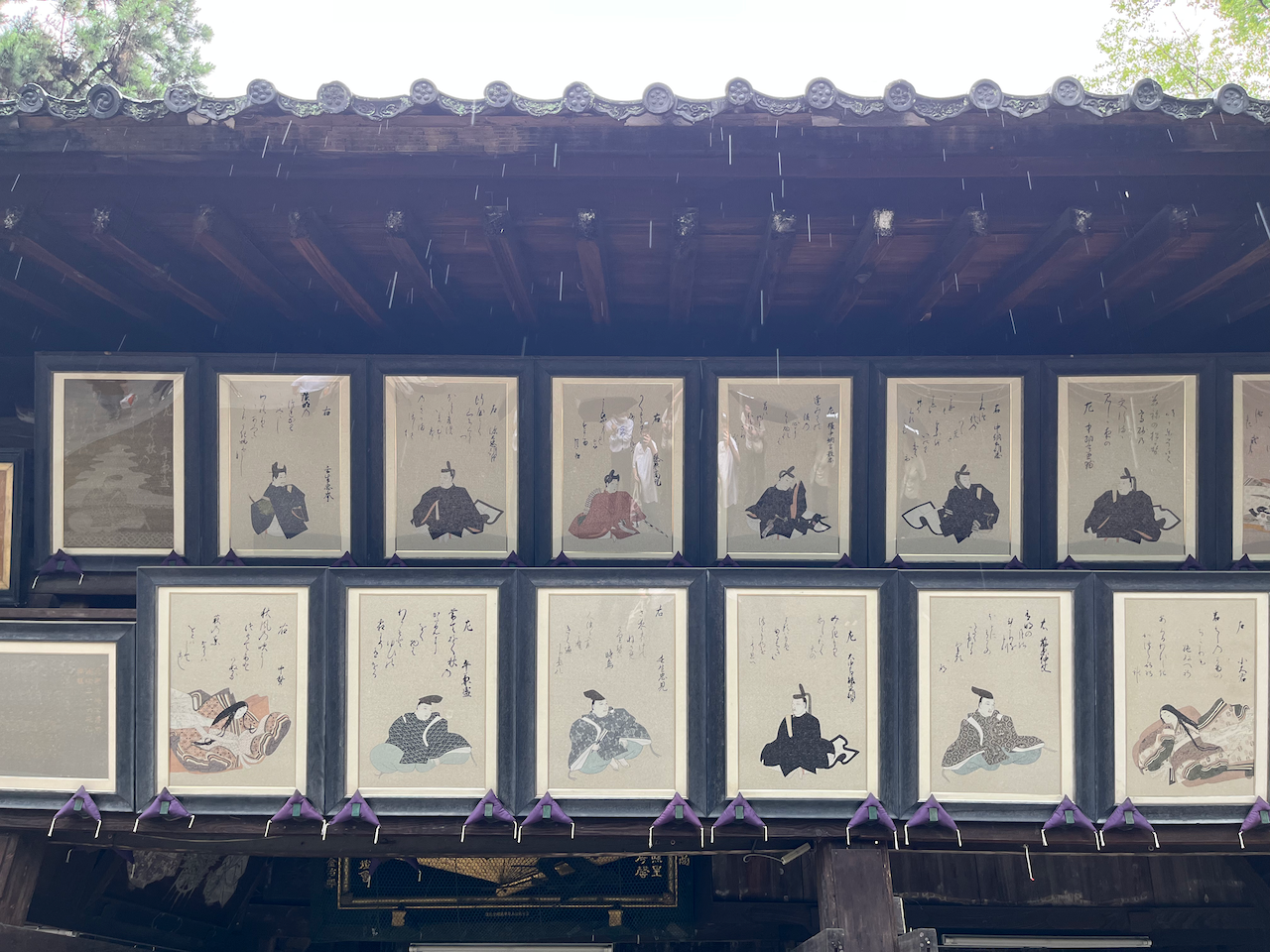
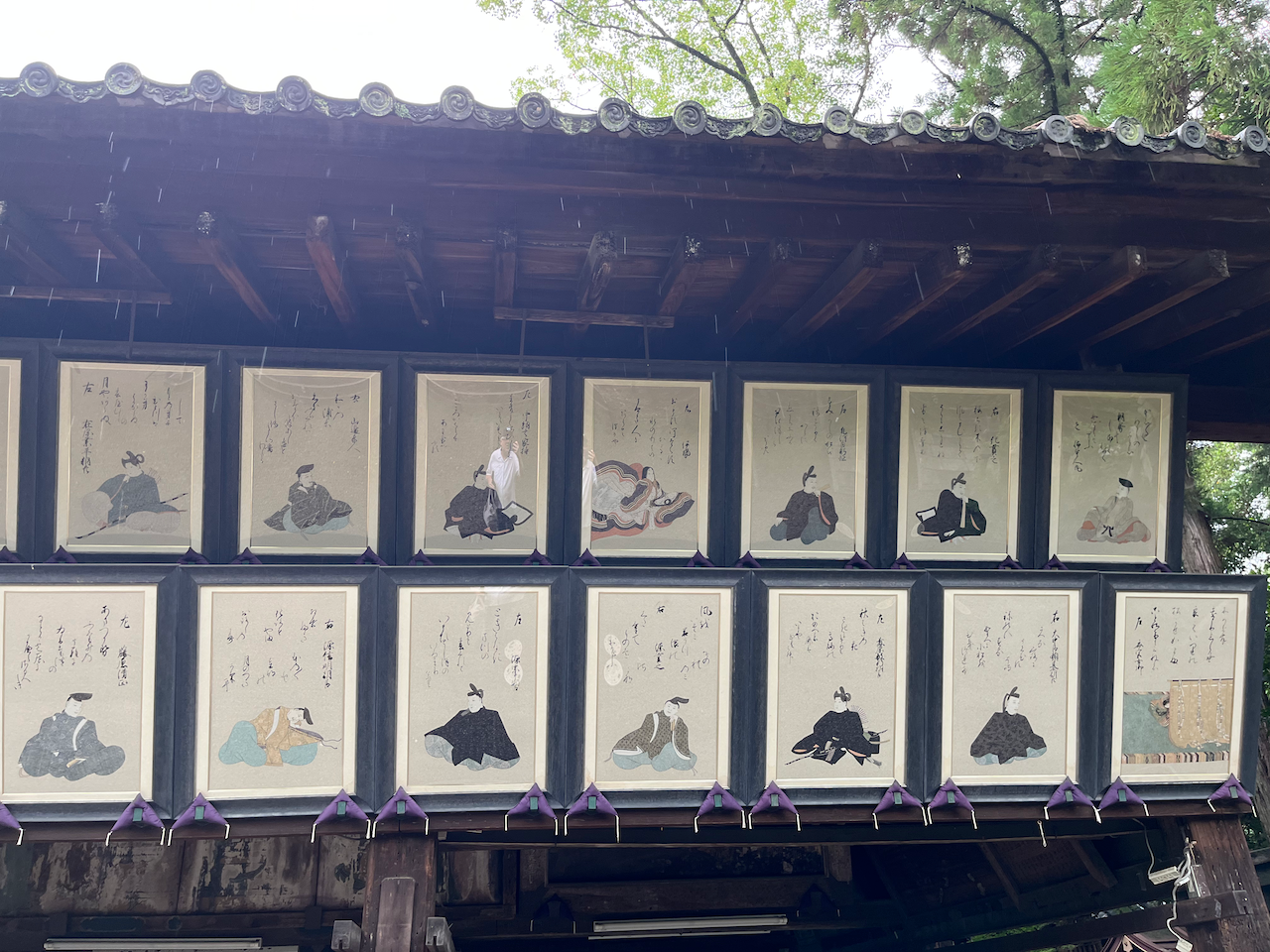
What’s really neat is that if you loop back around toward the main entrance, you’ll see this:
The pavilion near the front entrance had displays of various poems from the Hyakunin Isshu in the form of yomifuda karuta cards! If you look at the photos, you might even see my reflection, too. ;-p
The inside room of the pavilion was interesting too, with lots of really old pictures and paintings affixed:
I also picked up an omamori charm as well:
I keep this in my wallet.
Kitano Tenmangu is a great place to visit while you are in Kyoto, and its tribute to both the famous scholar, and to the Hyakunin Isshu really warmed my heart.
1 This isn’t that unusual in Shinto since the notion of a kami is very broad, and includes not just gods, but also nature spirits, great historical figures, and “anything else that inspires awe” according to one writer.
Edit: after publishing this article, a kind reader “Kiri”, pointed out that an English-language option exists, so I re-wrote much of this post to focus on that. Thanks Kiri!
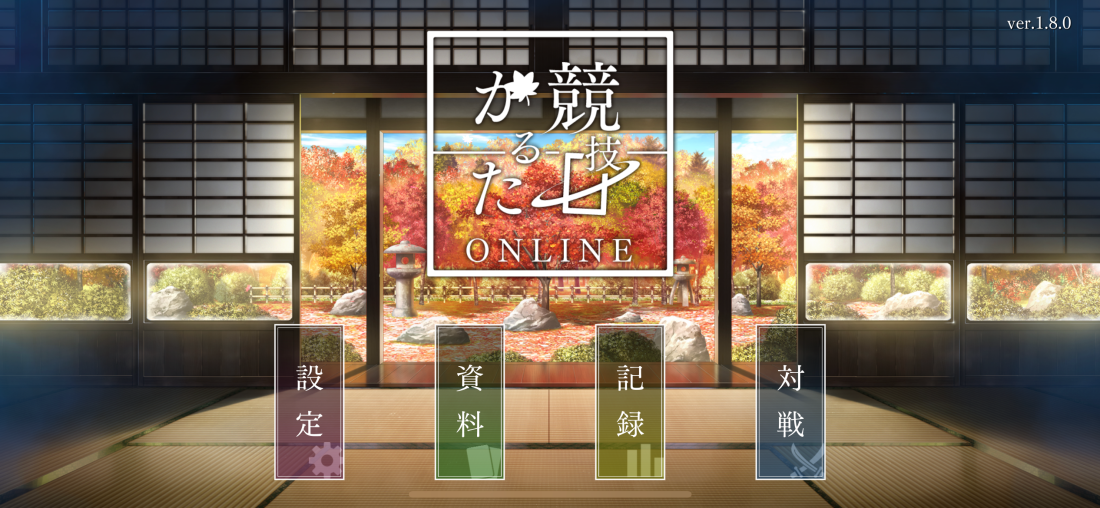
If you are interested in learning how to playkaruta, and especially if you live outside of Japan, it can be hard to find ways to practice, and learn the basics of karuta. The good news is that there is a great smartphone app for this. The Kyōgi Karuta Online (homepage), is available for both IOS and Google Android, and is a well-developed that lets you either play against a computer (great for training) or against opponents online (usually in Japanese time zones).
If you want to switch to English from Japanese, you can just follow this sequence of options (among other possible methods):
Battling
Battling of course is the point of the game, and there are two options available. The computer (CPU) option allows you to play anytime, anywhere without finding an opponent. I also find it very useful for training purposes.
Playing online of course is a more realistic experience, but requires finding opponents, and sometimes the skill levels do not always match.
Let’s look at each…
Computer Play
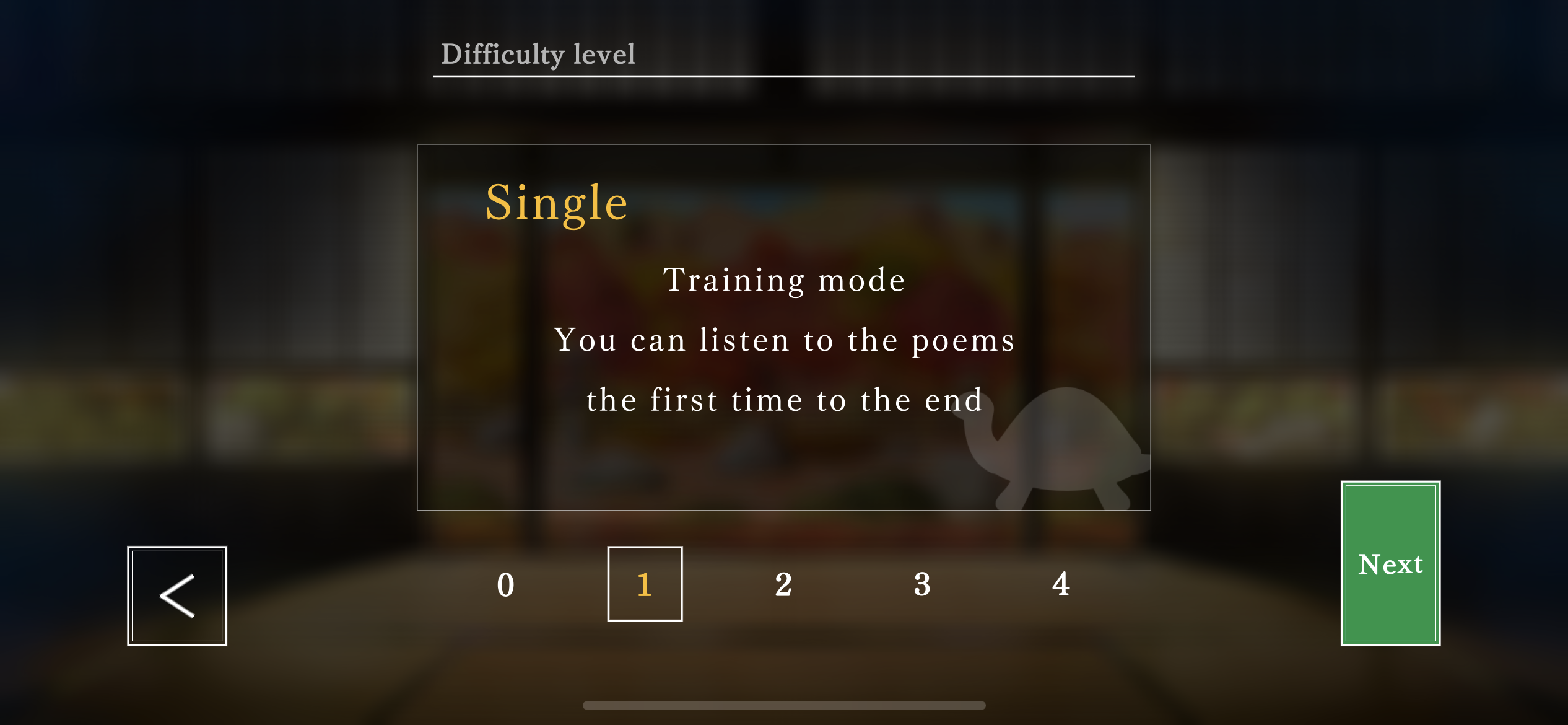
The computer play offers five modes, from left to right:
0 – short for tutorial
1 – single, this is basically a “goldfish” opponent, an opponent who is entirely passive allowing you to play at your own pace.
2 – easy
3 – normal
4 – hard
Even if you are somewhat familiar with the game of karuta, the tutorial is great and provides helpful tips and explanations of the rules of the game, plus you still get to play a match at the end.
I found, at first, that playing oneself (i.e the “goldfish” option) is a great, safe way to play and get the feel for the game before moving into easy mode.
Playing Online
At some point you will want to try online.
The vast majority of karuta players are in Japan and so Japanese daylight hours, especially weekends, are the best time to find an opponent. On the upper-right corner of the screenshot above you can change your gamer tag from “guest” to whatever you want. As of writing, my tag is SpockHere (not shown above), so maybe you might find me online.
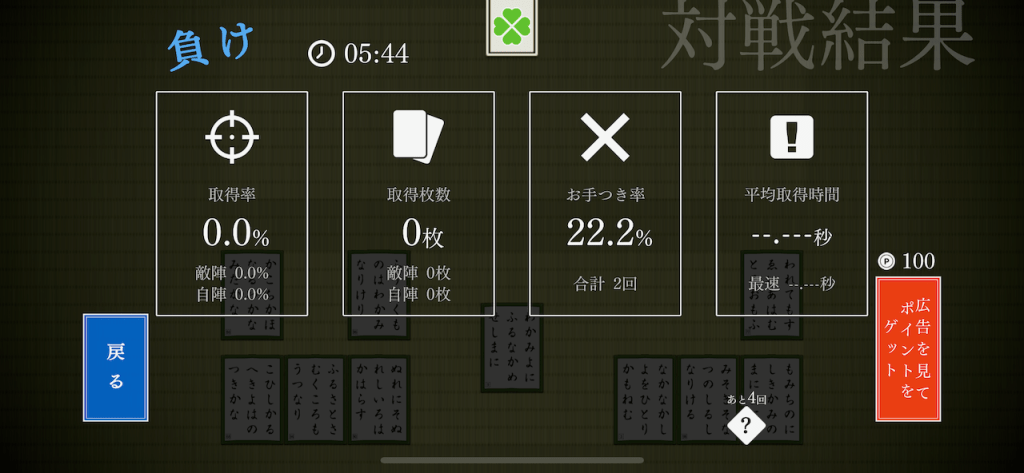
My first match online with a Japanese player was a complete disaster:
(I’ve been playing in Japanese partly to help with my reading, partly because I didn’t know the English-language option even existed until recently 🤦🏽♂️)
I took 0 cards and had 22.2% penalties because I was panicking. My opponent was so fast and aggressive that I failed miserably.
My second opponent was less experienced, but I still did poorly:
Here I did get 1 card, but still got 14.3% penalties.
That said, experience is the best teacher, so if you’re willing to take a few lumps early on, you can gain valuable experience that will help in the competitive scene. Eventually, the more you play, the better prepared you will be.
Mini Games
Note: special thanks to “Kiri” and “Lore” for pointing me to this feature. I totally overlooked it.
In the battle section, the game also includes some mini games which you can find here:
These games are a handy method for building basic skills.
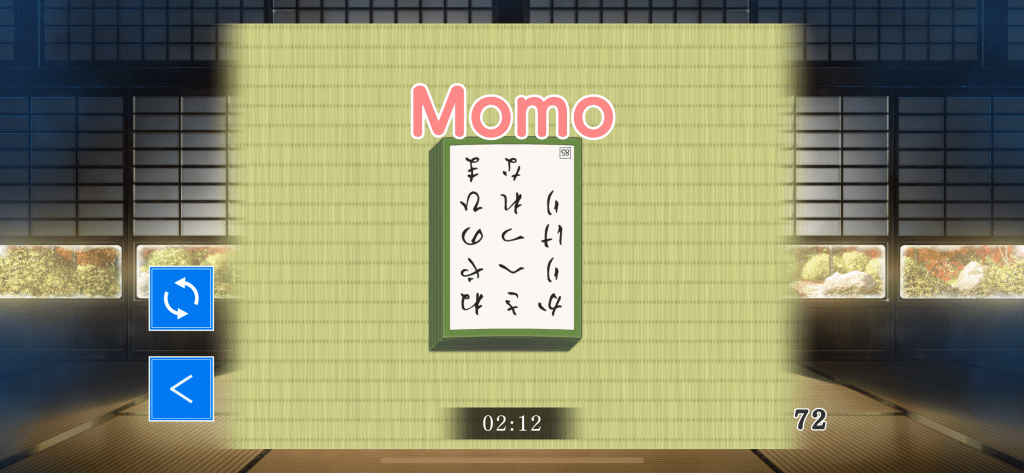
The “FlashCards” game (fudanagashi, 札流し in Japanese) will take you through all 100 torifuda cards and you guess the kimari-ji :
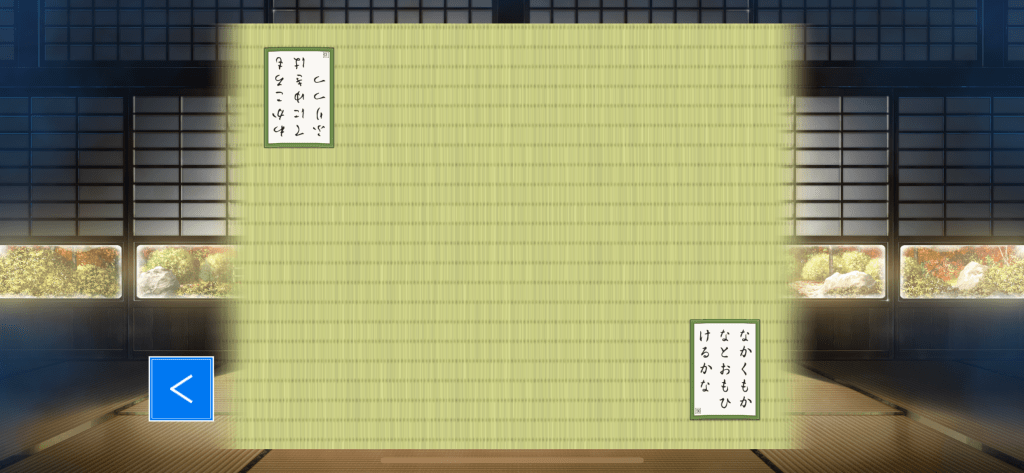
Sometimes the cards appear upside-down, just like in a real game.
The other game, Branching Cards (kikiwake, 聞き分け), helps you distinguish cards with similar sounding kimari-ji. This is important in avoiding painful penalties.
One of these cards has a kimari-ji of きみがためは and the other has きみがためお. You have to listen carefully and take the correct one.
Conclusion
Karuta Online is a great app for easing into playing karuta without having to make a big commitment upfront, but also a way for experienced players to hone their skills too. Non-Japanese players, who are otherwise scattered around the globe, use it to organize tournaments too.
A blog reader recently left a comment about this, and I realized that this would make a good topic for discussion, especially if are you are trying to memorize the Hyakunin Isshu, or learnkaruta. If you know even a little modern Japanese, you may soon start to notice that the hiragana spellings for some words aren’t always what you expect. For example, the fourth verse of poem 2 reads:
ころもほすてふ
But it reads as:
koromo hosu chou (not te-fu)
Another verse that threw me off recently was poem 44:
逢うことの
In modern Japanese, this would read as au koto no, but in the Hyakunin Isshu it is read as ou koto no.
Then there are other examples throughout, too many to list. The issue is that Japanese language, like any language, changes over time. People don’t speak or pronounce things the same as they did 1,000+ years ago.1 English language, for example, has undergone some dramatic sound-changes in the last 500 years, and yet the spelling was never updated. Hence, English spelling is confusing now.
Japanese underwent a similar change. Hiragana script at the time when it was first adopted was probably phonetic and intuitive to native speakers. However, fast-forward 1,000 years and it has long since diverged from the way people pronounce it.
This was finally fixed after World War II when the modern Hiragana spelling system was used, but old literature such as the Hyakunin Isshu remained as is. Hence, spelling of words in the Hyakunin Isshu differs from the modern Japanese equivalents.
For this reason, Japanese students of the Hyakunin Isshu often rely on furigana pronunciation guides when reading about the Hyakunin Isshu. For example, this excerpt from a Chihayafuru manga my daughter has shows examples of furigana usage:
From the manga ちはやと覚える百人一首 (“Remember the Hyakunin Isshu with Chihaya”)
Further, some hiragana themselves are pronounced differently:
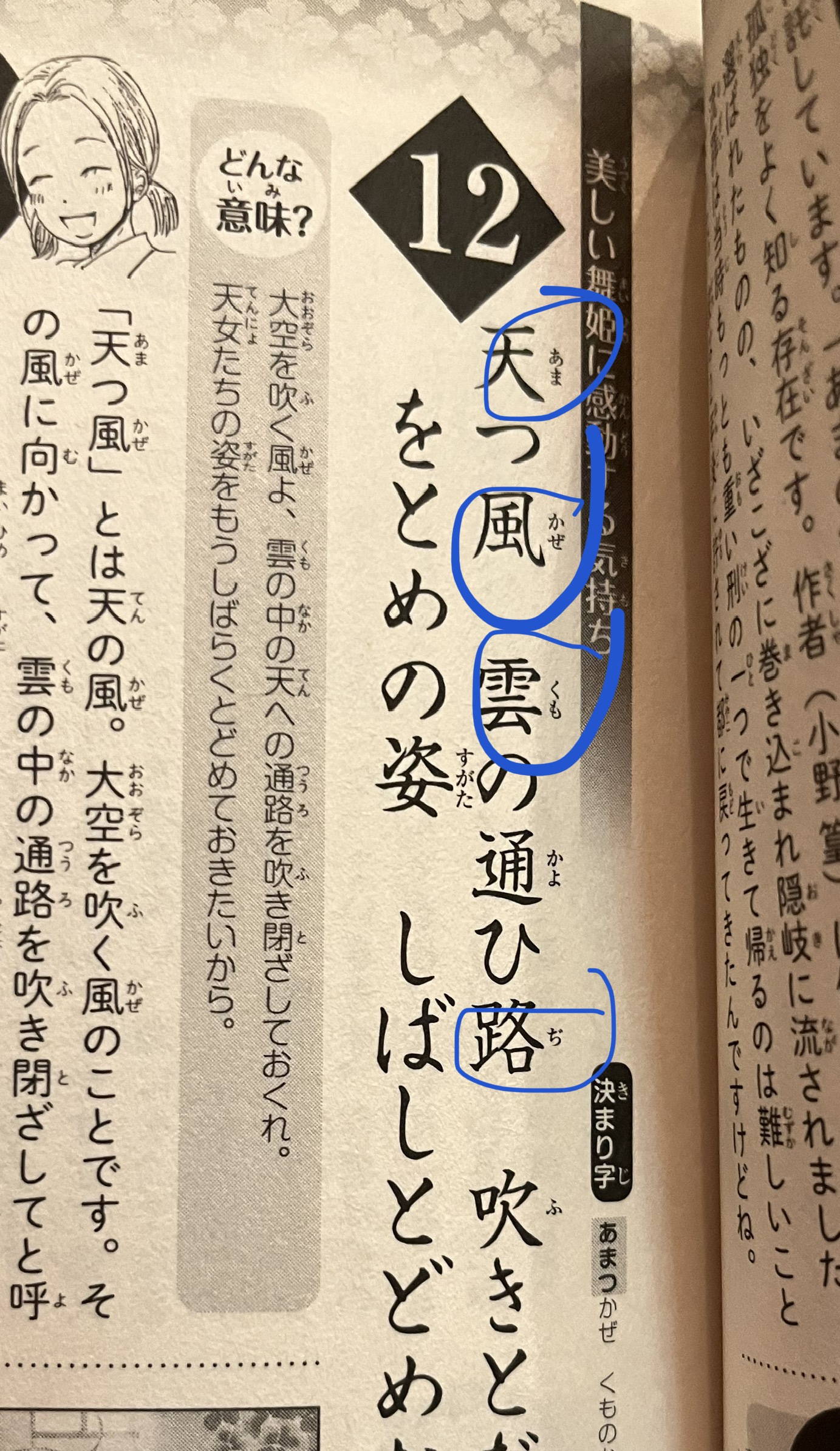
ひ (modern “hi”) is pronounced like い (“i”), see poem 12.
The aforementioned てふ (modern “te-fu”) is pronounced like ちょう (“cho-u”), see poem 2.
Similarly, けふ (modern “ke-fu”) is pronounced like きょう (“kyo-u”), see poem 54 and poem 61.
ぢ is pronounced the same as じ (“ji”), see poem 12.
おもふ (modern “o-mo-fu”) is pronounced as おもう (“o-mo-u”), see poem 85.
Archaic hiragana ゑ (“weh”) and ゐ (“wi”) are pronounced as え (“eh”) and い (“i”), see poem 5 or poem 14.
を (“wo”) is pronounced the same as お (“o”), see poem 12.
む (modern “mu”) is often pronounced as ん (“n”), but only if it’s at the end of a word, see poem 3.
And so on. If unsure, just listen to audio readings of the Hyakunin Isshu and you’ll often get a feel for how it’s pronounced anyway. Or, note the furigana text above the letter, as this provides a visual cue for native Japanese speakers. Whatever the furigana says is correct. Just be aware that the spellings differ from modern, standard Japanese, and that this is a common feature of pre-modern Japanese literature. There are patterns to this, and once you get used to it, you don’t even think about it anymore.
P.S. if you think the history of hiragana script is confusing, the history of romaji (Roman alphabet for Japanese) is even nuttier.
1 I always find it mildly amusing (or annoying) when time-travel movies have everyone speaking perfect English, often British-accented English. I get that it’s hard to work in another language, especially finding actors who can pronounce it reliably, but still….
Karuta is a game of memory and speed. You’re trying to take a specific poem card before your opponent does, and you can’t know which card it is until the reader starts reading the selected poem. So, players have to use clues called kimari-ji (決まり字), or “deciding letter (or character)” to determine which poem is being read as quickly as possible.
I had heard of the concept before, but in my quest to learn all 100 poems of the Hyakunin Isshu, I didn’t pay attention to kimari-ji, and thus during my first competition I struggled a lot. Learning an entire poem, and learning its kimari-ji are two separate skills. Over the long run, a person can do both, but if you want to play karuta you should invest in memorizing the kimari-ji for as many poems as you can.
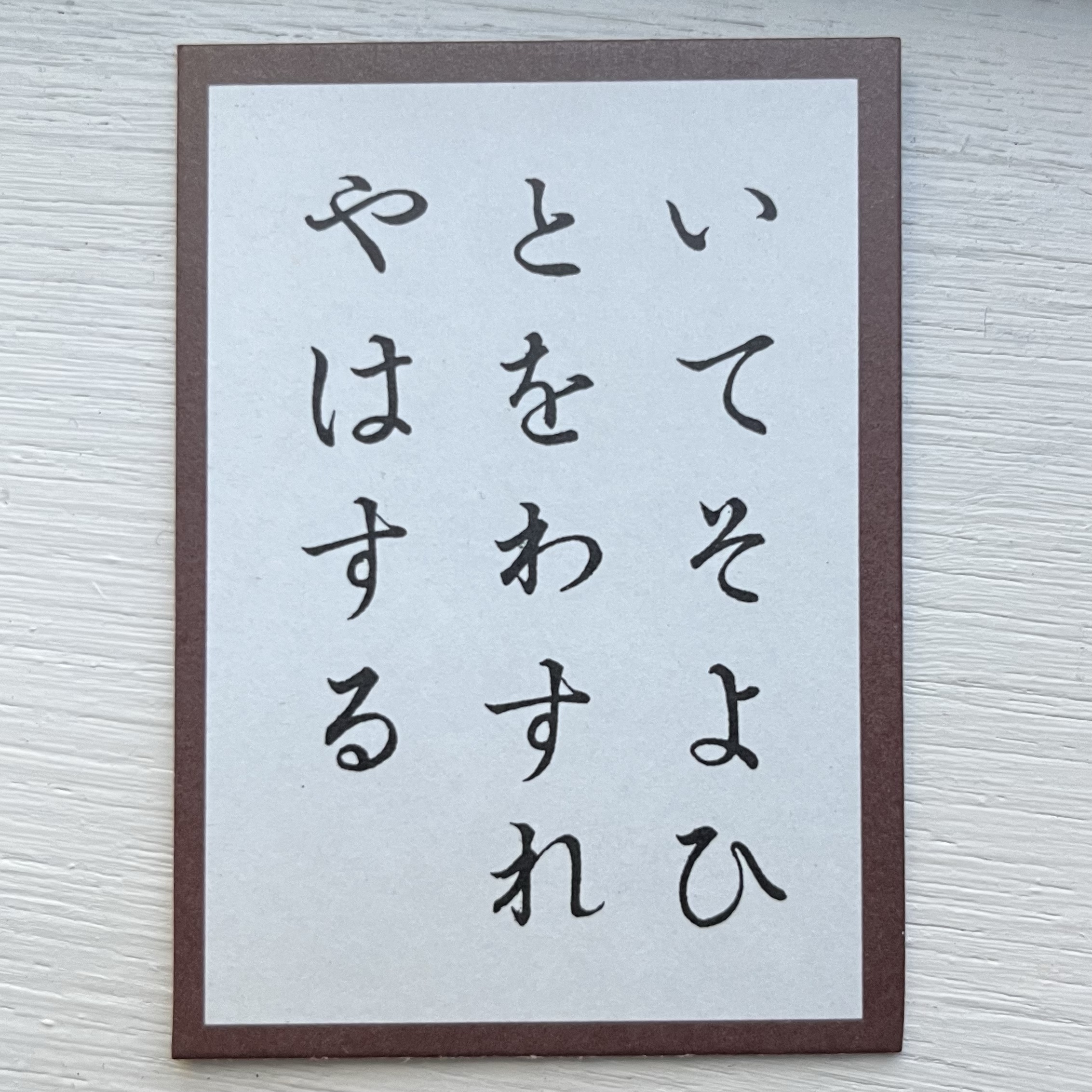
A torifuda card (取り札) containing only the last two verses. The last two verses are also known as shimo no ku (下の句) or “lower verses”. This particular poem is poem 58.
What are kimari-ji though? These are the first letters (or characters, I’ll explain shortly) of poetic verse, that tell you which poem is being read. Since the cards on the floor, the torifuda cards, only contain the last two out of five verses of a poem, it’s not immediately obvious which is which. The reader has the full poem using the corresponding yomifuda card.
Anyhow, both the torifuda and yomifuda cards are written using Japanese hiragana script. Hiragana is not an alphabet. It’s a syllabary. Each letter/character is a self-contained syllable or ji (字) in Japanese. Like many languages, English uses an alphabet so it takes 2 letters to spell the syllable “go”, but in Japanese this would require a single character: ご.1
If you’d like to learn more about hiragana script, check out my other blog here and here. Learning hiragana is worthwhile not only because it will unlock the Japanese language, it will help you play karuta a lot more effectively. It takes effort to learn upfront, but the good news is that it’s a learn-once-use-often skill.
When first learning to play karuta, and memorizing the poems, you soon realize that cards often fall into common patterns just based on the first few hiragana syllables. Others stand out from the others and are thus easier to recognize during play.
Let’s look at an easy example, poem 77 (my wife’s favorite).
This poem begins with the first verse:
せをはやみ
se wo hayami
The “se” (せ) in “se wo hayami” is unique among the Hyakunin Isshu anthology in that there are no other poems that start with “se”. So, as soon as the reader says “se”, highlighted below in blue, a seasoned player knows the poem being read is number 77, and that its fourth verse starts with われても, shown in red below.
This is an example of a one-character (一字, ichiji) kimari-ji poem, also called a ichiji-kimari (一字決まり). Poems that can be recognized by the first two characters are niji-kimari (二字決まり), three-character poems are sanji-kimari (三字決まり), four are yojikimari (四字決まり), and so on.
At other extreme end are six-characterkimari-ji poems, also commonly called ōyama-fuda (大山札, “big mountain cards”). Here’s an example below.
The yomifuda cards above are poem 64 (left) and poem 31 (right). Both start with the same 5-character verse, shown in green: asaboraké. It’s not until the sixth character (blue) that they differ. In this case, the sixth for poem 64 is “u” (う), and the sixth character for poem 31 is “ah” (あ). So, if you are listening to the poem, you have to wait all the way until the start of the sixth character to know which poem is being read. If you jump the gun and pick the wrong one, you get a foul (otetsuki, お手つき). Speaking from experience, I have done this. 🤦🏻♂️ It sucks.
In any case, vast majority of poems out there usually fall between these two extremes. The more you practice playing karuta, or memorizing them, the more you internalize them. This is important as kimari-ji work like a trigger: if you’ve memorize the “board state” (i.e. where everything is on the board), as soon as you hear the right syllables, BOOM, you take the card before your opponent does.
If you’ve been training for a while, this motion is almost unconscious. It’s a great feeling when it happens.
Shifting Kimari-ji and Late Game
As the game progresses, or depending on which cards are on the board, even a “six-kimariji” card can become a one-kimariji card. How? This is called kimariji-henka (決まり字変化, “shifting kimariji”).
“Rachel” from the Seattle Karuta Club kindly provided the following chart for the blog:
This chart shows a breakdown of all 100 poems with their kimari-ji, sorted by the initial hiragana character on downward. This is important because if the cards start with naniwa-e (poem 88) and naniwa-ga (poem 19) are both on the board, you have to wait until the fourth syllable (e vs. ga) to determine which card to take. Because of their initial similarity, they are grouped together as tomofuda (友札, “friend cards”).
However, if one of the poems above has already been read, and another card with the kimari-jinanishi (poem 25) has not, then you only need to determine which one to take based on naniwa vs. nanishi. You don’t have to wait until the fourth character. If there is only one card on the entire board that starts with “na” (usually very late in the game), you can just trigger off that.
As the cards on the board reduce in number, this comes up more and more. This is a slightly more advanced topic, but as you gain more experience, you’ll start to notice this too.
So…. How do you memorize them all?
There are many approaches to learning the kimari-ji, so you should find a method that works for you, and not be afraid to adjust that method if it’s not really working. I have created a chart to help listed out the kimari-ji and also group them by tomofuda for easier memorization.
Since my last karuta competition, I’ve shifted methods a few times. But there are some popular methods worth mentioning.
First of all, the 1-character kimari-ji can be remembered using this simple rhyme:
む す め ふ さ ほ せ
mu su me fu sa ho se
Which actually spells a mnemonic sentence in Japanese:
娘房干せ
“Daughter, dry the bunches [of flowers, grapes, whatever]
However, for learning all 100 poems, the Seattle Karuta Club pointed me to some helpful resources online:
This site divides the kimari-ji by initial letters, and has good visuals.
There are mobile apps too, though many have advertisement banners and such. You can search for “hyakunin isshu” in your favorite app store.
There are a lot of helpfulcharts and explanations in various Japanese sources (this is a great example), since it’s a popular pastime, but if you’re still learning hiragana and not familiar with Japanese language, you may need to stick with English-sources for now.
For my part, I started trying out some things at home. Since I don’t have a goza mat yet, I just grabbed one of my battle-map playmats I use for Dungeons and Dragons, and used that as a play area:
I started practicing with batches of 5-10 karuta cards at a time, starting with the 1-character and 7-character kimari-ji, since they are both fewest in number.
But then I started sprinkling poems in that I just happened to like. Since I spent so much effort memorizing poems previously, I picked out another 10-15 that I liked, and mixed them in anyway.
Then, I started making my own flash cards using Anki SRS using a format similar to this site:
As you can imagine, there’s many ways to learn the kimari-ji. The sky’s the limit as they say. Find something that works for, or keep experimenting until you master all 1️⃣0️⃣0️⃣ poems! Once you’ve done that, the game really starts to open up.
Anyhow, my goal is to try to learn at least half of the cards reliably before the next meeting of the Karuta Club in September. It won’t win me any matches, but it will build a foundation for (hopefully) future wins.
Good luck, and happy Karuta play!
1 There are a few exceptions to this in the Japanese, mostly in the revised modern spelling, but not worth calling out here.
While watching competitivekaruta online, and in person, I noticed that there is a certain poem that is read at the outset of a match, but what’s interesting is that this is a poem that is not actually part of the Hyakunin Isshu.
This poem is called the joka (序歌), or preliminary poem, and reads:
What’s interesting from a historical standpoint is that this poem was composed by a 3rd century immigrant to Japan named Wani (王仁), who came from the Korean kingdom of Baekje1 and is credited with introducing the Analects of Confucius and the Thousand-Character Classic to Japan at a time when it was actively trying to import knowledge and culture from the mainland. I’ve talked about Japan and Baekje here as well.
The poem by Wani was so highly-praised it was felt in antiquity that if you were going to know any Waka poem, you had to at least know this one. Hence over time it became the opening poem for karuta competitions. Like many poems of the Hyakunin Isshu, it was originally preserved in the official Imperial anthology, the Kokinshū.
In karuta matches, the poem is always read before the match begins. My guess is that reciting this poem helps to calibrate or warm-up the players before the match actually begins. Apparently, the last two verses, the shimo no ku (下の句) in karuta, are repeated twice. Once it’s read twice, the match begins.
It’s fascinating to note that this poem has been in existence for 1,700 years, and is still going strong!
1 A time when the Korean peninsula was divided into three warring kingdoms. Baekje probably had the closest relationship with the early Yamato Court of Japan due to proximity and mutually beneficial relations.
I’ve been running this blog since 2011, but until very recently I had no idea other non-Japanese people around me even knew about the Hyakunin Isshu, let alone play the competitive version. I honestly thought I was the only one around.
Enter the local karuta club called the Seattle Karuta Club (homepage).
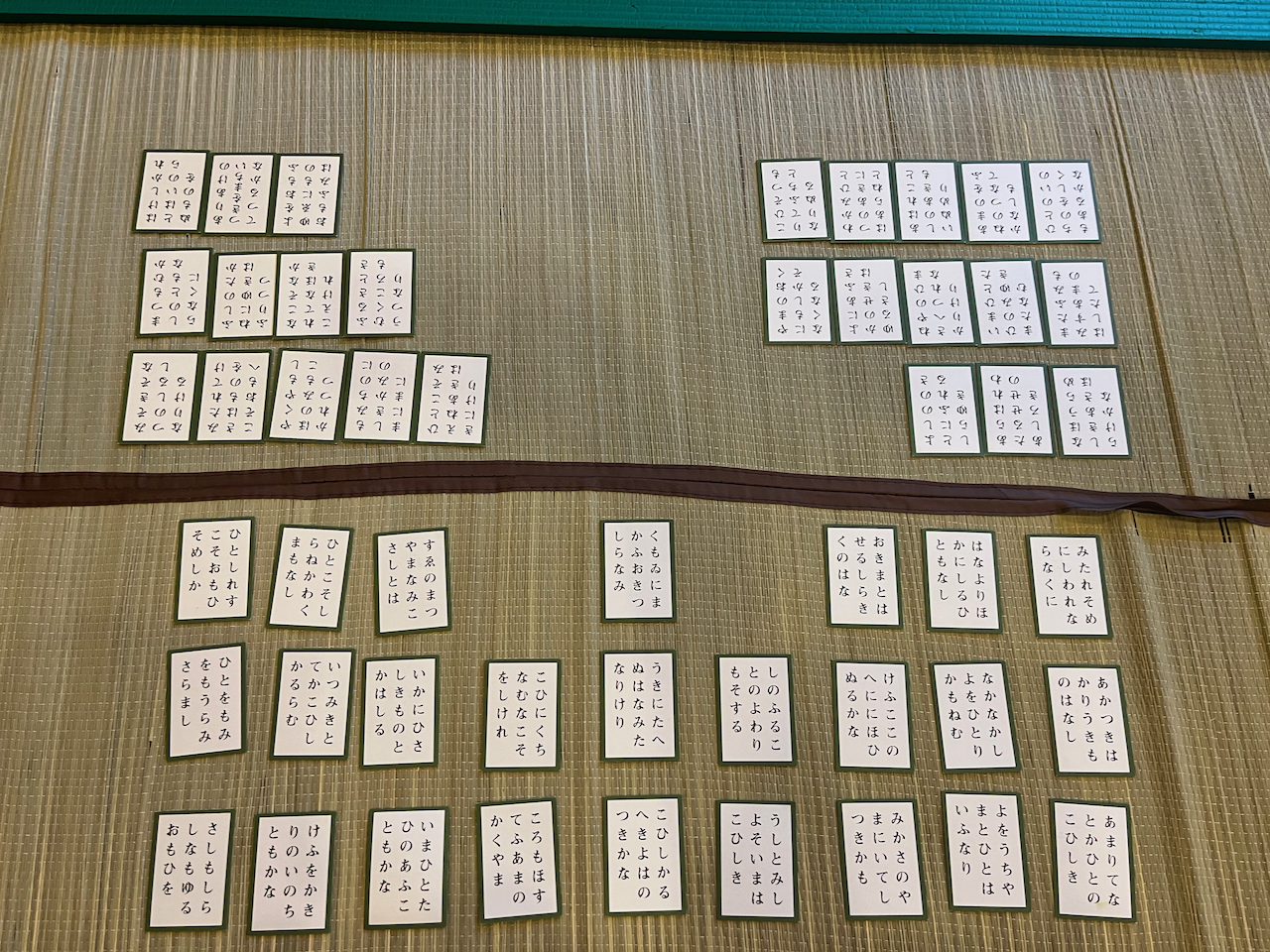
I stumbled upon their website last month, and being intrigued, came to a recent session. The people at Seattle Karuta Club were super nice and helped me get acquainted with my first game. My first opponent was Lore, one of the founding members. Above, you can see a view of my side of the board as we were setting up. I call this arrangement the “chaos strategy” because I had noooo idea what I was doing. 😅
Another view of me overlooking my cards and trying to make sense of them.
One of the things that immediately struck me was that the torifuda (取り札), that is the cards you take, have no marks to distinguish hiragana て versus で, or ち versus ぢ, etc. I presume this is by design, and yet after all this time I had simply never noticed before. 😅 In any case, my brain struggled to make sense of my board for the first few minutes until I started to pick out verses I knew. But it was too little, too late.
The card on the right, the yomifuda (読み札) uses normal Japanese syntax. The card on the left, the torifuda (取り札) is very streamlined for visual simplicity.
Further, I realized quickly that knowing a poem, and being able to listen to a poem are two different skills. If your ears aren’t tuned to the reading, you’ll totally miss a poem you might otherwise know. For example, poem 24 is near and dear to my heart, but when it did come up in a match, my brain registered it much too slow.
So, in the end, I lost 25-0. Lore was amazing. They really knew their stuff, and not only helped me through etiquette and good arrangement strategy, but also some pointers about what to listen for, mnemonics, etc.
Afterwards, the club members and I had a fun chat about all things related to the Hyakunin Isshu, how folks met, and so on. I was surprised by how many people were inspired but the Japanese anime Chihayafuru (which embarrassingly, I never watched 😅), and how useful that anime is for learning strategy.
Then, abruptly, we had to relocate venues due to shutting down from inclement heat, and club member Rachel gave us all a ride. Thanks Rachel!
For my second match, I played again Kiri, another founding member. As with Lore, Kiri was another sharp player and super nice. Kiri also drew amazing illustrations on the back of their cards. This is recommended by the club to help keep track of one’s own deck versus others, but Kiri definitely went the extra mile. 😊
My match with Kiri was similarly 25-0, but this time around, my brain had adjusted somewhat to the rhythm of poetry recitation, and I could pick out a cards I could now recognize. Further, I started to develop a crude strategy for arranging my cards. I haven’t covered the concept of kimari-ji in this post but have one coming up soon. That’s a topic worth its own blog post (or three).
I knew going into this I’d be poorly prepared, but I also really wanted the experience, because I knew reading about and watching YouTube videos just wasn’t enough. Even if I got clobbered, I’d learn a lot and the Seattle Karuta Club did not disappoint. I genuinely had a great time and was fired up about learning Karuta for next time.
After I got home, I busted out my decks from Japan and starting practicing a few things, including listening, kimari-ji and so on. Also, my daughter had some old copies of the manga Chihayafuru in Japanese which I am borrowing.
Issue 1 of the Chihayafuru manga, Japanese versionA special edition of the manga, devoted toward learning to play Karuta.
All in all, competitive karuta was super fun. Compared to my days playing Magic the Gathering where it was all about money, and competitive dude-bros, “grifters”, “grinders”, etc, the karuta scene, by contrast, was much more about fun.
Rachel, Kiri and Lore were all solid, no-nonsense players, but they knew how to have fun and make people feel welcome too. I can’t tell you the last time I was at something like this that didn’t make you feel dumb or awkward. Everyone is learning together.
Further, compared to a hobby like Magic, Karuta has more cost upfront (for a deck, goza mat, etc) plus memorizing the kimari-ji, but then that’s it. It becomes something you just enjoy and perfect over a lifetime. Further, the deeper you go, the more you get out of it.
So, I am already thinking ahead toward the next meeting, and practicing for my next game.
I recently came back from a family trip to Japan (mentioned here), and while there we took the kids to see the old capitol of Kyoto, where many of the poets of the Hyakunin Isshu lived,1 and where many events took place. But one thing on my bucket-list was to see was the Oishi Tengu-do karuta shop. Last year, I bought a karuta set at a local bookstore in Japan, and of the sets I bought the Tengu-do set was my favorite. And since we wanted to go to Kyoto anyway, it was a great opportunity to visit the home shop fo Tengu-do.
The Tengo-do shop is in the southeast part of Kyoto. If you get to Fushimi-Momoyama station, you can easily walk south 2-3 blocks to get there.
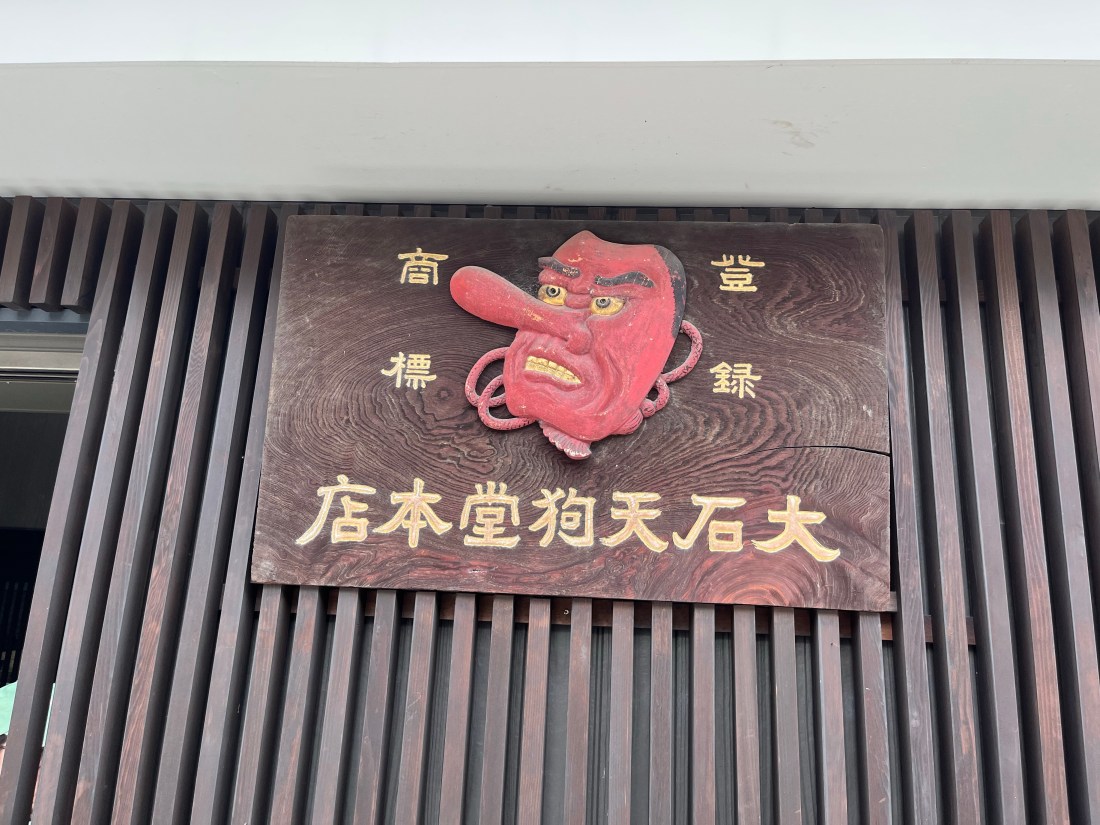
The shop is in a residential neighborhood, but if you look carefully, you can find the sign like so:
The inside of the shop is a single room, just enough room for myself and family, and I didn’t get a chance to take a photo, but I found some good photos online. The elderly lady minding the shop was very kind. We perused for a bit, and I found a few items that I wanted to get. The most important was this set:
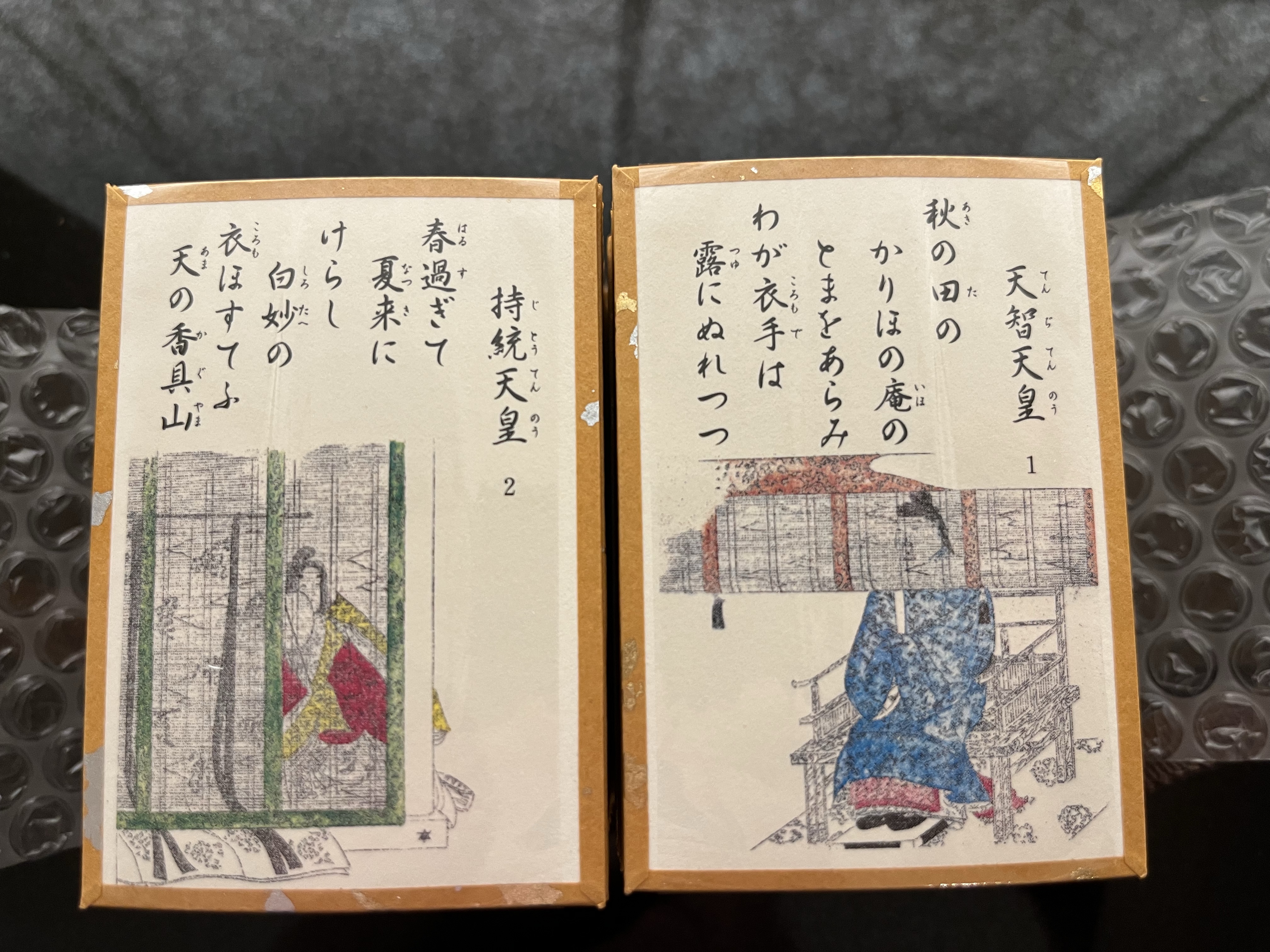
This was one of more expensive sets, but I knew that I probably wouldn’t visit Kyoto again for another 10-15 years, so I figured I’d better go big or go broke.
The detail on the cards, especially the border is simply amazing. The yomifuda cards below are for poems 1 and 2:
I also picked up a couple other odds and ends, but this was the real treasure. It was great to visit the home shop of Tengu-do, and to patronize a business like this. If you happen to be in Kyoto, and have an interest in the Hyakunin Isshu and/or karuta, definitely stop by!
1 Prior to Kyoto, the capitol of Japan was a city called Nara. Some of the earliest poets and figures of the Hyakunin Isshu lived when Nara was still the capitol, but I’d estimate at the remaining three-fourths lived in and around Kyoto until you get to the very last few poets who lived in the new capitol of Kamakura. That’s how much history the anthology spans.
The good news is that I cross the halfway point in late March and memorized 50 of the poems! 🎉 When I started in January, I wasn’t I’d get very far before life got in the way. It has gotten in the way since returning to the US, but I have been able to manage learning the Hyakunin Isshu amidst the chaos.
The bad news is is that I stopped to review the 50 cards that I learned so far, and discovered that even those that I knew well are already starting to fade from memory! 😮
This has reinforced for me that periodic review is required for weeks, maybe months on old cards. Even if I feel I have “nailed it”, my mind gets rusty pretty quick. So, I had to go back and start reviewing old cards again, which takes away from learning the remaining 50.
Thus, I am experimenting with a hybrid method whereby I review a small number of cards per day (3-5 max), with a mix of old and new. I found that powering through more cards per day was exhausting and not always feasible with my schedule, and one card per day wasn’t quite enough. So, I settled on 3-5, and keep it on my desk at work so that i can review for a minute or two. Small, frequent reviews seem to work better than “power sessions”.
By mixing old and new, I hope I can also trim down the cards that I need to review, but also keep the momentum going in learning the remaining poems.
One nice thing to consider is that once I’ve memorized all 100, then it’s just review for the rest of my life. No need to learn more poems (unless I delve into Imperial anthologies or other works). So, part of me just wants to hurry up and power through the last 50, but until we get closer to the end, I think it’s essential to keep an even pace of learning a few poems at a time, while also reviewing old ones bit by bit.
Time will tell.
P.S. Thanks to everyone who’s been submitting ideas, suggestions, translations and so on for the Hyakunin Isshu. I am not always able to respond, but I do read and appreciate them. 🙂
P.P.S I am posting this at the end of March, despite the title. I just assume that as April is imminent, people won’t always read this post right away.


















 The Hyakunin Isshu
