Spring or Fall: Which is Better?

As fall is approaching, I wanted to share an interesting anecdote provided by my book on the Manyoshu. It seems that throughout Japanese antiquity, poets frequently debated which is better: spring or fall.

The first example comes from Princess Nukata in the 7th century, whom we discussed here and here, she wrote a lengthy poem (a chōka poem, not the usual tanka poem) in the Manyoshu (poem 16). She discusses the pros and cons of spring and of fall:

Original Manyogana1JapaneseRomanizationRough Translation2
冬木成 春去來者 冬ごもり 春さり來れば Fuyu gomori haru sari kurebaWhen winter passes and spring comes
不喧有之 鳥毛来鳴奴鳴かざりし鳥も來鳴きぬNakazarishi tori mo nakinuBirds that didn’t sing before, now come and sing
不開有之 花毛佐家礼抒 山乎茂咲かざりし 花も咲けれど 山を茂みSakazarishi hana mo sakeredo yama wo shigemiFlowers that didn’t bloom before now bloom, but because the mountains grass is so thick
入而毛不取 草深 執手母不見入りても取らず 草深み 取り手も見ずIrite mo torazu kusabukami torite me mizuOne cannot go and pick flowers, let alone see them.
秋山乃 木葉乎見而者 秋山の 木の葉を見ては Aki yama no ko no ba wo mite waWhen you look at the leaves in the mountains during fall,
黄葉乎婆 取而曾思努布黄葉をば 取りてそしのふMomiji wo ba torite soshi no fucollecting the yellow leaves is especially prized.
青乎者 置而曾歎久青きをば 置きてそ歎くAoki wo ba okite so nagekuLeaving the green leaves as they are is regrettable.
曾許之恨之 秋山吾者そこし恨めし 秋山われはSokoshi urameshi akiyama ware waIn spite of that, autumn in the mountains is spectacular…
a – I am heavily indebted to this site for both the original text. Translation is based in part on that site, but also my Manyoshu book, but probably lots of mistakes. Translating a five-line poem in archaic Japanese is hard enough… 😅

Speaking of the Manyoshu, its compiler Otomo no Yakamochi (poem 6 of the Hyakunin Isshu, かさ) left us some very nice poetry about spring:

Original Manyogana1JapaneseRomanizationRough Translation2
春苑春の苑Haru no sonoBeneath
紅尓保布紅にほふKurenai ni hofuthe shining crimson
桃花桃の花Momo no hanaorchard of
下照道尓下照る道にShita deru michi nipeach blossoms
出立オ嬬出で立つ少女Idetatsu otomea young maiden lingers.
Poem 4139, book 19

and about fall:

Original Manyogana1JapaneseRomanizationRough Translation2
秋去者秋さらばAki sarabaWhen fall comes
見乍思跡見つつ思Mitsutsu shinoe tothink fondly of those
妹之殖之妹が植Imo ga ue shipink blossoms
屋前乃石竹やどのなでしこYado no nadeshikoof days gone by
開家流香聞咲きにけるかもSaki ni keru kamoand remember me.
Poem 464, book 3

Otomo no Yakamochi wrote both of these poems about his beloved wife, but the second was composed shortly after her parting. The word nadeshiko has special meaning in Japan and has a very feminine, demure3 meaning.

Returning to the debate between spring and fall, Ki no Tsurayuki (poem 35 of the Hyakunin Isshu, ひとは) took up the same topic centuries later. This is poem 509 from an imperial anthology, the Shuishu :

JapaneseRomanizationRough Translation2
春秋にHaru aki niSpring or Fall?
おもみたれてOmoi mitareteMy thoughts are a mess,
わきかねつWaki kanetsuand I cannot decide.
時につけつつToki ni tsuketsutsuThe more time passes,
うつるこころUtsuru kokoro wathe more my heart shifts back and forth.
1 This is a rough translation, all mistakes are my own.

The debate was even cited in the famous 12th century novel Tales of Genji written by Lady Murasaki (poem 57 of the Hyakunin Isshu, め):

春秋の争ひに、昔より秋に心寄する人は数まさりけるを、名立たる春の御前の花園に心寄せし人びと、また引きかへし移ろふけしき、世のありさまに似たり。

“Since antiquity, in the debate about spring versus fall, many people lean toward fall, and yet some very noteworthy people who view the Imperial gardens in spring may yet change their mind, as is the way of the world.”

Princess Nukata all the way back in the Manyoshu seemed to imply that autumn was preferable, and it seems that most of the aristocracy shared this view. In fact if we divide up the poems of the Hyakunin Isshu by season, there are more fall poems than spring:

Spring Poems, first verse listedFall Poems, first verse listed
Hana no iro (poem 9)
Kimi ga tame haru (poem 15)
Hito wa isa (poem 35)
Inishie no (poem 61)
Morotomo ni (poem 66)
Haru no yo no (poem 67)
Takasago no (poem 73)
Hana sasou (poem 96)
Aki no ta no (poem 1)
Ashibiki no (poem 3)
Okuyama ni (poem 5)
Waga io wa (poem 8)
Chihayaburu (poem 17)
Ima kon to (poem 21)
Fuku kara ni (poem 22)
Tsuki mireba (poem 23)
Kono tabi wa (poem 24)
Ogurayama (poem 26)
Kokoroate ni (poem 29)
Yamagawa ni (poem 32)
Shiratsuyu wo (poem 37)
Yaemugura (poem 47)
Arashi fuku (poem 69)
Sabishisa ni (poem 70)
Yū sareba (poem 71)
Akikaze ni (poem 79)
Yo no naka yo (poem 83)
Nageke tote (poem 86)
Murasame no (poem 87)
Kirigirisu (poem 91)
Miyoshino no (poem 94)
Note: summer only has 4 poems, winter has 9 (same as spring).

But what do you think? Are you Team Spring, or Team Fall?

Edit: added Hyakunin Isshu poetry chart.

1 If you’re wondering why I post Manyogana for some poems, but not others, it depends on the era. The Manyoshu is the oldest anthology by far, and at that time, there was a brief writing system that took Chinese characters, but used them in a phonetic way for Japanese language (a.k.a. Manyogana). By the time of Ki no Tsurayuki and Lady Murasaki, centuries later, this had been replaced with hiragana script. This blog strives to both be accurate and accessible, so I try to balance both needs.

2 These are all rough translations on my part, and likely have mistakes. Any such mistakes are entirely my own.

3 Not to be confused with the “very demure, very mindful” meme. 😛

The Plovers’ Cry: Poem Number 78

As the weather gets colder, I’ve been saving this one for a time like this:

JapaneseRomanizationTranslation
淡路あわじAwaji shimaThe crying voices
かよ千鳥のKayou chidori noof the plovers who visit
鳴くこえNaku koe nifrom Awaji Island—
いく夜ねざめぬIkuyo nezamenuhow many nights have
they awakened him,
須磨の関守Suma no sekimorithe barrier-keepers of Suma?
Translation by Dr Joshua Mostow

The author of the poem, Minamoto no Kanemasa (源兼昌, dates unknown) was a frequent participant in poetry contests of the day, but overall very little is known about him, and it doesn’t appear he had any poetry collections of his own.

The first time I read this poem, in Japanese, I misunderstood the phrase chidori (千鳥) to literally mean 1,000 birds (in other words, a lot of birds). But in fact, chidori refers specifically to plover birds. The featured photo above shows a Western Snowy Plover bird on Morro Strand State Beach, Morro Bay, CA, “Mike” Michael L. Baird, CC BY 2.0, via Wikimedia Commons.

In Japanese poetry plover represented winter, and for other seasons, other birds typically were frequently used:

The location, Awaji Island, is a well known part of Japan’s inland sea, and is culturally significant since antiquity. Though at this time in history, it felt a bit remote from the capitol.

Professor Mostow notes that this poem uses some strange grammar though. For example nezamenu would normally mean to not wake up, but in this context means “have they awakened” instead. Also, he notes that this poem apparently alludes to the Tales of Genji, specifically the “Suma” chapter, when the prince Genji was in exile.

All told, this poem paints a sad, somber picture that fits well with wintry days.

Backfired: Poem Number 74

Even the Hyakunin Isshu has its comedic moments:

JapaneseRomanizationTranslation
うかりけるUkarikeru“Make that heartless
人をはつせのHito wo hatsuse nowoman, O mountain storm
山おろしよYama oroshiyoof Hatsuse Temple—
はげしかれとはHageshikareto wacrueller still!”—this is not
祈らぬものをInoranu mono wowhat I prayed for, and yet…
Translation by Dr Joshua Mostow

The author is Minamoto no Toshiyori Ason (源俊頼朝臣, 1055 – 1129), “Sir Minamoto no Toshiyori”, who is the son of Tsunenobu (poem 71) and father of Shun’e (poem 85) and was also a leading poet of his era, along with Mototoshi (poem 75). Toshiyori’s talents were not limited to poetry. According to my new book, he excelled at playing an instrument called the hichiriki, enough that he was invited to serve in the Imperial court under Emperor Horikawa. We went on to serve three Emperors in this capacity, and helped compile the unusually eclectic Imperial Anthology the Kinyō Wakashū, as well as many poems of his own in various anthologies.

The poem above was actually composed during a poetry contest held at the residence of Fujiwara no Toshitada, grandfather of Fujiwara no Teika (poem 97) who compiled the Hyakunin Isshu. The topic of the contest was “unfulfilled love so strong that one even prays to the gods”. The poem expresses frustration after having prayed to be able to meet a certain woman, and somehow she became even more resistant. As Professor Mostow explains, Teika valued this poem very highly because of its depth of feeling, excellent word choices, and clever story-telling (see below).

The name “Hatsuse Temple” is another name for a famous Buddhist temple in Nara, Japan called Hasedera. Hasedera is very well-known in Japan, and apparently was a frequent pilgrimage site for lovers and those with romantic interests. If you ever do happen to be in Japan, especially in the Nara area, I’d highly recommend visiting Hasedera temple.

This poem is listed as a “winter” poem, but I was really confused why this is since the topic sounds more like unrequited love. I checked my source, which explains that Toshiyori went up to Hatsuse Temple to pray, and then came back down (yama-oroshi, 山おろし) in the third verse. This symbolism of coming back down the mountain is evidentially considered a powerful symbol of winter. Perhaps this relates to New Year’s prayers and such. This third verse is also a neat dividing technique between the first half, praying at the temple, and the second half, the girl he was fond of despising him even more.

A Foggy Winter’s Morn: Poem Number 64

This is a great poem for the deep of winter:

JapaneseRomanizationTranslation
朝ぼらけAsaborakéAs the winter dawn
がわぎりUji no kawagiribreaks, the Uji River mist
たえだえにTaedae nithings in patches and
あられわたるArawaré watarurevealed, here and there, are
せぜの網代木Seze no ajirogiall the shallows’ fishing stakes.
Translation by Dr Joshua Mostow

The author of this poem known by the lofty title of Gonchūnagon Sadayori (権中納言定頼, 995 – 1045), or “Supernumerary Middle Counselor Sadayori”, was also known as Fujiwara no Sadayori, son of the eminent poet and critic of the era, Fujiwara no Kintō (poem 55).

Sadayori was also a respectable poet in his own right. According to my new book, when father and son took part in the Imperial precession by Emperor Ichijo to the Ōi River (大堰川, ōi-gawa), part of the modern Katsura River, he was tasked with composing a poem for the occasion and came up with this:

JapaneseRomanizationRough Translation
水もなくMizu mo nakuHow can one possibly
見えこそわたれMiekoso watarelook out over
大堰川Ōi-gawathe Oi River,
岸の紅葉はKishi no momiji wawhen the fall leaves
雨と降れどもAme to furedomorain down on the shore?
Translation by myself

It was a clever way to point out the beauty of fall, and both Kintō and the Emperor were impressed. Later, Sadayori was supposedly flummoxed by Lady Izumi’s daughter, Koshikibu no Naishi in a famous poetry contest (namely poem 60).

In any case, back to the Hyakunin Isshu poem. The phrase asaboraké is apparently short for asa ga oboroge ni aketekuru koro (朝がおぼろげに明けてくる頃) meaning “that time at dawn when things are hazy”, particularly in autumn or winter. It is also used in poem 31, and a challenge for karuta players as a result.

Sadayori’s usage of the Uji River (宇治川, uji-gawa), now known as the Yodo River (淀川, yodo-gawa), may not seem like much to modern audiences, but it carries much meaning in Japanese antiquity. The Uji River was frequently cited Japanese poetry, and runs through the Osaka metropolitan area. It is mentioned in the earliest Japanese poem anthology, such as the Manyoshu, and others. It was a pivotal place at the end of the Tales of Genji, written by Lady Murasaki (poem 57), when the heroine Ukifuné attempts to take her own life, but is rescued from the river and takes tonsure as a Buddhist nun instead. The Uji River was often deeply associated with turbulent relationships between men and women. In a more practical sense, it was also a place where the nobility of Kyoto often had second villas, and was a popular meeting place.

I actually had to look up what “fishing stakes” are. The term, ajirogi (網代木), refers to stakes in the water, like a fence or weir. Fish swim into these places and they were easier to catch with nets because they had fewer places to escape. You can see an illustration here. Side note: the Salish people here in the Pacific Northwest had a particularly ingenious system of fishing stakes as well.

Professor Mostow notes that the combination of the Uji River and the fishing stakes was a very famous image in ancient Japanese poetry, and this coupled with the image of a cold winter’s dawn make this a powerful poem. Unlike other poems in the Hyakunin Isshu which might be hypothetical, exaggerated or talk about something abstract such as love, Mostow points out that this poem likely was written exactly as Sadayori saw it. I can only wonder what it was like watching the fishermen go to work early that icy morning.

P.S. The featured photo is the Kennebunk River during fog, photo by David Lounsbury, CC BY-SA 2.0, via Wikimedia Commons

The Cold Morning: Poem Number 52

For our final poem for Valentine’s Day, I thought this was another good choice:

JapaneseRomanizationTranslation
明けぬればAkenurebaBecause it has dawned,
暮るるものとはKururu mono to wait will become night again—
知りながらShiri nagarathis I know, and yet,
うらめしきNao urameshikiah, how hateful it is—
あさぼらけかなAsaborake kanathe first cold light of morning!
Translation by Dr Joshua Mostow

The author of the poem, Fujiwara no Michinobu Ason (藤原道信朝臣, 972-994), was the adopted son of the powerful Fujiwara no Kane’ie, husband of the mother of Michitsuna (poem 53) and subject of the Gossamer Years. His birth mother was the daughter of Fujiwara no Koretada (poem 45). Michinobu for his part, benefitted from his adoptive father’s influence, and rose to the Court rank of 4th-upper, and a position as part of the Imperial Guard (sakon no chūjō, 左近中将).

However, Michinobu seemed more interested in Waka poetry than in politics. He was close with Fujiwara no Sanekata (poem 51) and Fujiwara no Kinto (poem 55), and would often gather with them for poetry sessions. Further, Michinobu had a secret relationship with one of the court ladies under Emperor Kazan, named Enshi Jo-ō (婉子女王), but eventually he lost her to a political marriage with the powerful Fujiwara no Sanesuke. Sadly, Michinobu later died from due smallpox, which took his life at the age of 23.

This is another classic “Morning After” poem, which we’ve featured here, here and here.

Lord Michinobu dreads the rising sun because it means he has to sneak back to his own residence, away from his lover. Judging by his reaction, it must have been a night well-spent together. 😏

Happy Valentine’s Day!

Snowfall: Poem Number 31

Similar to the previous poem, this one deals with the moon, but I think this poem epitomizes the winter season:

JapaneseRomanizationTranslation
朝ぼらけAsaborakéSo that I thought it
有明の月とAriake no tsuki tothe light of the lingering moon
みるまでにMiru made niat dawn—
吉野の里にYoshino no sato nithe white snow that has fallen
ふれる白雪Fureru shirayukion the village of Yoshino
Translation by Dr Joshua Mostow

The author, Sakanoue no Korenori (坂上是則, dates unknown), is one of the Thirty-Six Immortals of Poetry, but otherwise nothing much is known about him.

This poem, as Professor Mostow explains, is similar to poem 29, and is part of a theme on “elegant confusion” which is a hallmark of Chinese poetry. Early poetry in Japan was still greatly indebted to Chinese poetry and many of the imagery, and idioms used in the Hyakunin Isshu anthology are not exception.

I happen to like this poem also because it has a lot of obscure, but cool Japanese poetic terms. We’ve seen ariaké discussed in poem 30. However, this poem also uses the term asaboraké (朝ぼらけ) which as we say in poem 64 means that period of time in the dawn, in either winter or autumn, when things are hazy. It’s a kind of slow, late dawn that you only find in that time of year. Compare with akatsuki (暁), which Professor Mostow explains can mean “dawn” any time of the year. Since asaboraké is used in two poems in the Hyakunin Isshu, it makes the kimari-ji for each poem particularly tricky.

The village of Yoshino that this poem refers to, is none other than the iconic village of Yoshino in Nara Prefecture.

The Wonders of Mount Fuji: Poem Number 4

This was something I read recently that I felt like posting:

JapaneseRomanizationTranslation
田子の浦にTago no ura niAs I set out on
うち出でて見ればUchi idete mirebathe beach of Tago, and look,
白たShirotae noI see the snow
constantly falling
富士の高嶺にFuji no takane nion the high peak of Fuji,
雪は降りつつYuki wa furitsutsuwhite as mulberry cloth.
Translation by Dr Joshua Mostow

This poem was composed by Yamabe no Akahito (山部赤人, dates unknown ) who according to Mostow was a contemporary of Hitomaro (poem 3). He is also one of the Thirty Six Immortals of Poetry and was a leading poet during the reign of Emperor Shomu and contributed to the Manyoshu. He is revered alongside his contemporary, Kakinomoto no Hitomaro (poem 3) as a “saint of poetry”. Compared to Kakinomoto no Hitomaro, Yamabe is known for a poetry style focused on the beauty of nature such as this poem, rather than clever verse.

Yamabe, for his part, served as a court poet under the pious Emperor Shomu. Unfortunately there is no information about his life before he served in the Court. My new book points out that since he was never mentioned in the historical document the Shoku Nihongi, Yamabe was probably a low-ranking bureaucrat.

Mostow carefully explains that this poem, like many of the earlier poems in the Hyakunin Isshu were written in an old Japanese-Chinese hybrid script called manyōgana and was thus open to many interpretations. In fact, the poem has evolved over time and the version in the Hyakunin Isshu is only one such version. The version above, compiled by Fujiwara no Teika (poem 97), was in an imperial anthology called the Shin-Kokin Wakashu. But the original version, poem 318 in the Manyoshu, read like so:

JapaneseRomanizationRough Translation1
田子の浦ゆTago no ura yuAs I passed
うち出でて見ればUchi idete mirebathe bay of Tago, and looked,
ま白にそMashiro ni soI saw the white snow
富士の高嶺にFuji no takane nifalling on the high peak
雪は降りけるYuki wa furitsukeruof Mount Fuji.
1 apologies in advance for any mistakes or for quality of translation

In this version, it sounds like Akahito is describing something more in the past, and the poem doesn’t use a pillow word (see below) to describe the snow. It uses the more mundane description of “very white”, not “white as mulberry cloth”.

The aforementioned vagaries of Manyogana script also matter because there’s much debate about where Akahito actually was when composing this poem. The location of Tago no Ura is now Suruga Bay in Shizuoka Prefecture, but originally may have meant some place much closer to Mount Fuji, under it’s “shadow”, so to speak.

One other interesting note for readers of this blog is the middle line, shirotae no, which as you may recall from poem 2 is one of those special “pillow words” used in Japanese poetry. It is a very idiomatic term which conveys something that is gleaming white, or as Professor Mostow translates, white as mulberry cloth. At some point in history, the third verse changed from a more mundane description of snow to a much more impactful description.

P.S. Featured photo is Mount Fuji as seen from Suruga Bay, photo by Shinichi Morita, CC BY-SA 2.0, via Wikimedia Commons

Heavenly Maidens: Poem Number 12

Speaking of moments that we don’t want to end, I thought this poem was an interesting read, and is also one of the more famous ones:

JapaneseRomanizationTranslation
あまつ風Ama tsu kazeO heavenly breeze,
雲のかよKumo no kayoijiblow so as to block
吹きとFuki toji yotheir path back through
the clouds!
とめの姿Otome no sugataFor I would, if but for a moment,
しばしとどめShibashi todomendetain these maidens’ forms.
Translation by Dr Joshua Mostow

This poem was composed by Sōjō Henjō, (僧正遍昭, 816 – 890), “Bishop Henjo”, who served in the Heian Court until the death of Emperor Nimmyo. It was then that he took tonsure as a Buddhist priest. He is one of the original Six Immortals of Poetry as well as the Thirty-Six Immortals.

The poem was composed during the time that Henjo was in the service of the Emperor (and not yet a priest). The occasion for this was the famous Gosechi Dance or gosechi no mai (五節の舞), more formally known as the toyono akari no sechi-é (豊明の節会), a dance that took place in the Imperial Court during the middle of the eleventh month of the old Japanese calendar (roughly December in modern times) to celebrate the harvest.

During the final months of the year, the Imperial Court held several important events to celebrate the yearly harvest, starting with the niiname no matsuri (新嘗祭) when the Emperor would offer part of the harvest to the gods.1 The following day, the Court would celebrate the Gosechi dance at the Shishinden Palace, and the Emperor would partake of the new harvested rice. According to Richard Bowring, the Gosechi festivities last up to four days.

The Gosechi dance involved 4 “heavenly” maidens called otomé (をとめ) from high-ranking noble families, and is mentioned by several authors from the era, including Sei Shonagon (poem 62) in the Pillow Book:

[87] At the time of the Gosechi Festival somehow everything in the palace, even the people you see every day, becomes simply delightful. There’s the unusual sight of the bits of coloured fabric that the groundswomen wear in their ceremonial hair combs, rather like abstinence tags. When they seat themselves along the arched bridgeway from the Senyōden, the dapple-dye pattern on the ribbons that bind up their hair stands out beautifully, and the whole effect is somehow quite marvelous. It’s perfectly understandable that the serving women and those who attend the dancers should find it all a splendid honour.

trans. Meredith McKinney

And from the eponymous diary of Lady Murasaki (poem 57):

The Gosechi dancers arrived on the twentieth….I knew full well how hard the young dancers had prepared this year in comparison to normal years when things were worse it must have been for them this year, I thought; I was both apprehensive and eager to see them. As they fully stepped forward together I was, for some reason, overcome with emotion and felt dreadfully sorry for them….And with all those young nobles around and the girls not allowed so much as a fan to hide behind in broad daylight, I felt somehow concerned for them, convinced that, although they may have been able to deal with the situation both in terms of rank and intelligence, they must surely have found the pressures of constant rivalry daunting; silly of me, perhaps. (pg. 39-40)

trans. Richard Bowring

Further, even artwork depicts the Gosechi as shown by the featured photo, painted by Hokusai.

Even now, the Gosechi dance is still performed for the Emperor, at least for special occasions:

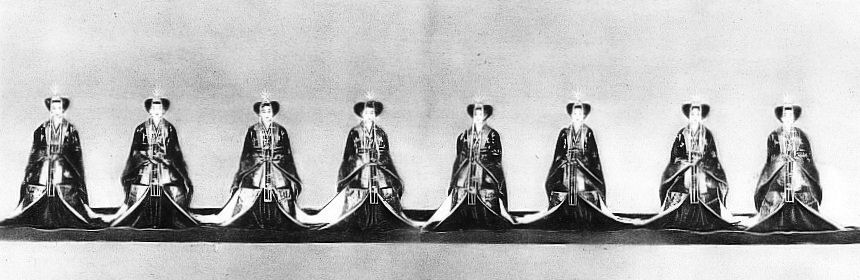
Dancers of the Gosechi dance performed in 1928, for the ascension of the Showa Emperor. See page for author, Public domain, via Wikimedia Commons

But I digress, Henjo was so mesmerized by their dance, he compared them with heavenly maidens, and hoped that the breeze would keep them on the earth a bit longer. As Professor Mostow notes, the Gosechi dance had a legendary origin involving Emperor Temmu who beheld heavenly maidens in the sky one night, so Bishop Henjo isn’t just making this up.

However, his playful simile has lasted through the ages.

1 This is still observed today in the form of Labor Day in Japan.

Winter Isolation: Poem Number 28

Winter’s always a quiet, lonely time (just ask Sei Shonagon):

JapaneseRomanizationTranslation
山里はYamazato waIn the mountain village,
冬ぞさびしさFuyu zo sabishisait is in winter that my loneliness
まさりけるMasari-keruincreases most,
人めも草もHitome mo kusa mowhen I think how both have dried up,
かれぬと思Karenu to omoebathe grasses and people’s visits.
Translation by Dr Joshua Mostow

According to Mostow, this poem was composed in answer to the question of whether Fall or Winter was the lonelier season. Obviously the author, Minamoto no Muneyuki Ason (源宗于朝臣, ? – 939), “Sir Minamoto no Muneyuki”, favored winter. Minamoto no Muneyuki was the grandson of Emperor Kōkō (poem 15) and had a large portfolio of poems published in official anthologies, and earned himself a place among the Thirty Six Immortals of Poetry as well.

To me at least, the poem reminds me also of nobleman from the Heian Court who were required to do at least one tour of duty in remote provinces as a provincial governor for 4 years. The more remote the province, the more menial and degrading the task. Very well-to-do men could usually get themselves out of this obligation but most middle and lower ranking officials could not. Being cut off from the Heian Court was often a lonely affair as evinced in the writings of men like Sugawara no Michizane and others so imagine the author was also conveying this familiar sense of the time of loneliness officials stuck in a remote mountain village away from the Court in winter and from friends.

A Cold Winter’s Night: Poem Number 6

This poem has over the years stuck with me every July as the Japanese festival of Tanabata approaches, but also in the deep of winter too.

JapaneseRomanizationTranslation
かささぎのKasasagi noWhen I see the whiteness
わたせる橋にWataseru hashi niof the frost that lies
置く霜のOku shimo noon the bridge the
magpies spread,
白きを見ればShiroki wo mirebathen do I know, indeed,
夜ぞふけにけるYo zo fuke ni keruthat the night has deepened.
Translation by Dr Joshua Mostow

This poem was composed by Chūnagon Yakamochi (中納言家持, 718 – 785), or “Middle Councillor Yakamochi”. He is also known as Ōtomo no Yakamochi (大伴家持). Yakamochi was from a prestigious but declining family at the time, and is credited with compiling the Manyoshu, the earliest extant poetry anthology we have today. Yakamochi also contributed many of his own poems to the Manyoshu (compiler’s privilege?), and is considered one of the Thirty Six Immortals of Poetry.

Unfortunately, Yakamochi later got caught up in a series political intrigues, and after achieving the rank of Middle Counselor, he was first sidelined to a remote post, and later after drowning in a river. Worse, just after his death in 785, a powerful noble named Fujiwara no Tanetsugu was assassinated, and Yakamochi was implicated as part of the plot, despite being dead. Thus the Otomo family name was disgraced until 806 when Yakamochi was posthumously pardoned and his rank restored.

Anyhow, this poem’s reference to the Magpie’s Bridge comes from two places: the Imperial Palace at the time had a set of stairs called the Magpie’s Bridge, but also in later generations, this also referred to the famous legend of Tanabata. On the night when Orihime and Hikoboshi would meet every year, they could cross a bridge made of magpies whose wings were extended end to end.

In both ways, the poem expresses a lonely, long, and cold winter’s night.